Head-to-head test
Goal Zero Yeti 500 vs Goal Zero Yeti 700
These are the same power station at two sizes, and the $200 step up buys 178 watt-hours at $1.12 each, which is more than either unit charges for the capacity it already carries.
Full profiles: Goal Zero Yeti 500 → · Goal Zero Yeti 700 →

Written by Wenny ZhengUpdated
Portable Power Tester, Station Arena Test Desk
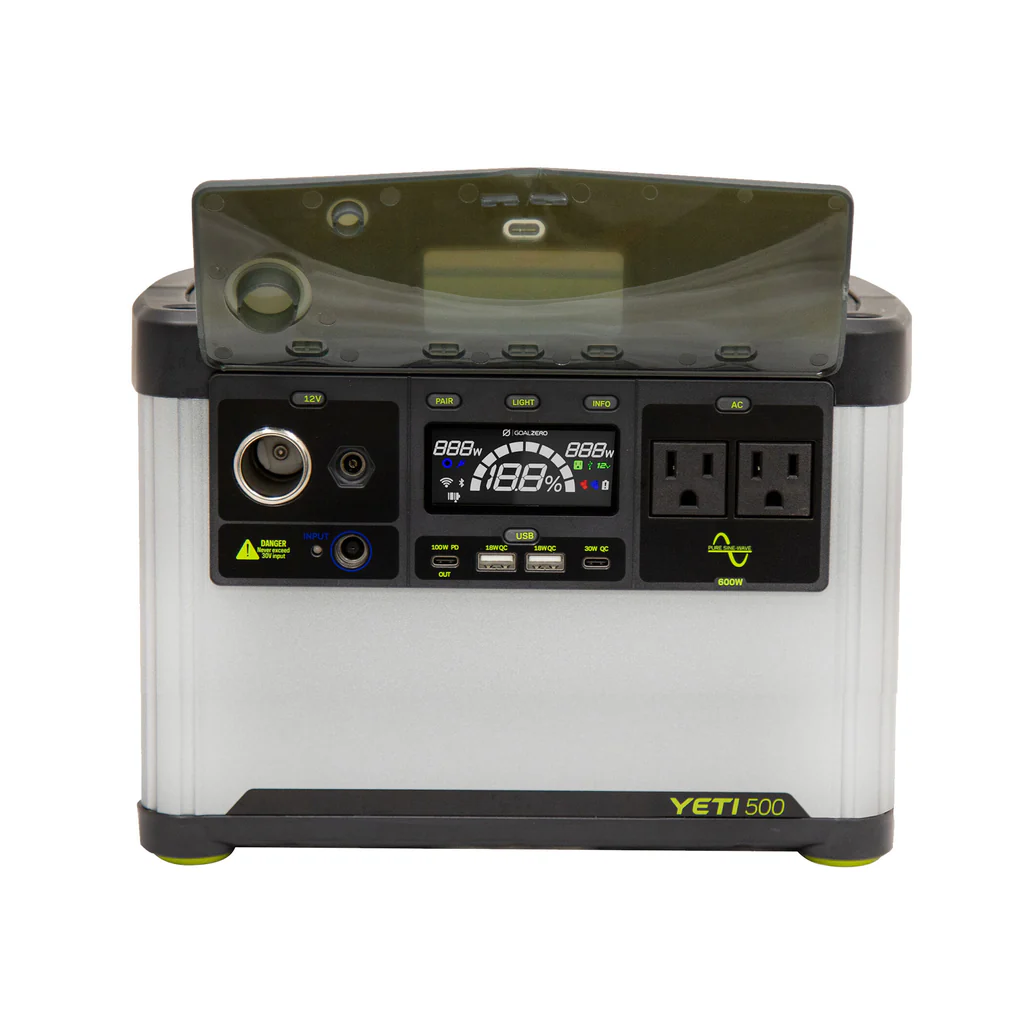
$499.95 · direct from Goal Zero
Last checked 1 day ago. Prices move — check before you buy.
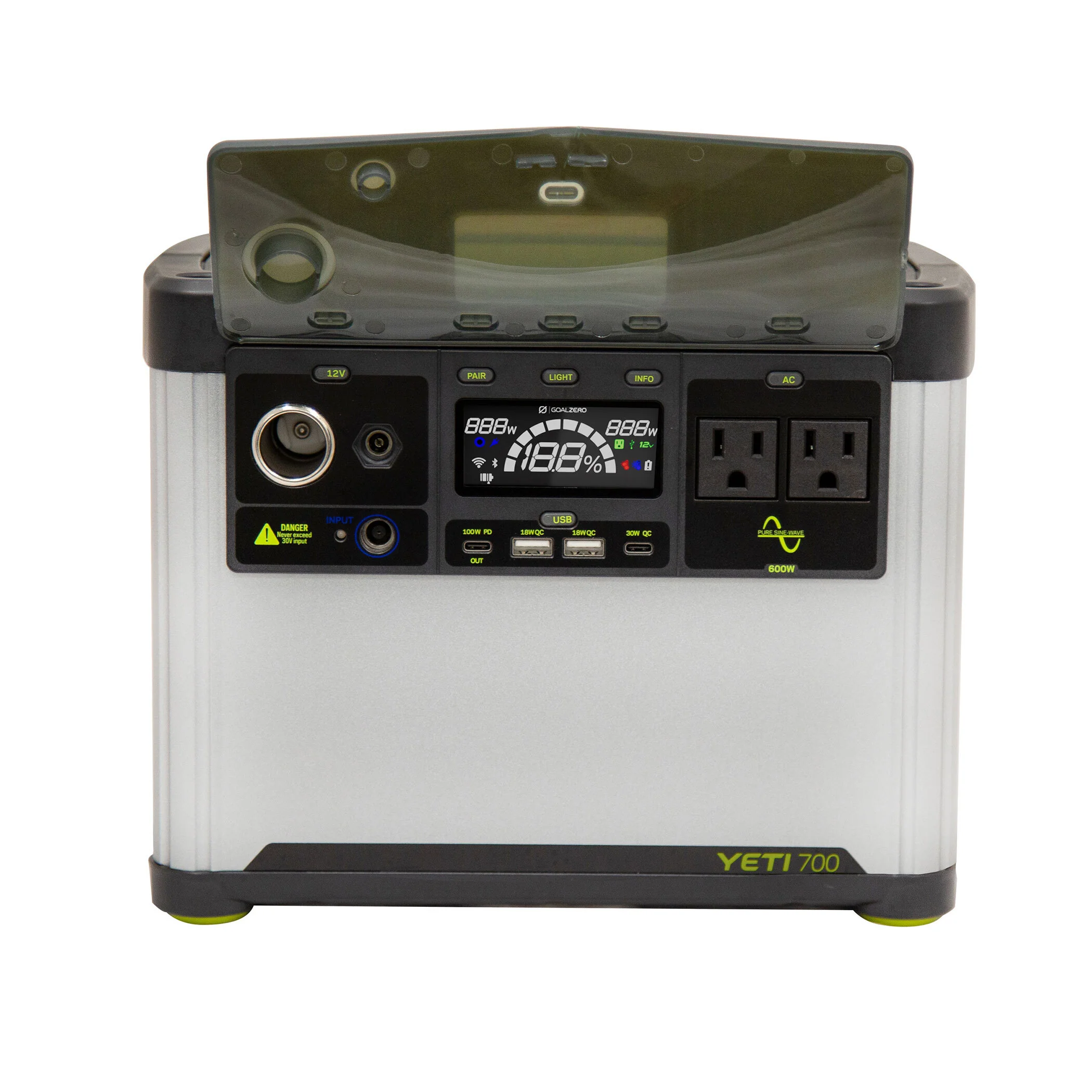
$699.95 · direct from Goal Zero
Last checked 1 day ago. Prices move — check before you buy.
Spec deltas
Buy the Yeti 500. It's $500 against $700, and what the extra money buys is 178 watt-hours and 100W of continuous output. What it costs you past the cash is 4.2 lb. Everything else on the two spec sheets is the same number printed twice: 4,000 cycles, five years of warranty, 200W of solar input, 100W USB-C, a 1,000W surge ceiling, a 20ms cutover to battery.
Run the arithmetic on that trade and it gets worse. $200 for 178Wh is $1.12 per added watt-hour, on a unit whose first 499 watt-hours cost a dollar each. You're paying a premium for the marginal capacity, from the same brand, in the same generation, off the same shelf.
The 178Wh doesn't move a decision either. Six load profiles run against this pair, and the CPAP night is the only one either unit finishes. Both finish it with room. Every other profile outruns the 500 and then keeps right on going past the 700. The one place the bigger unit genuinely wins is narrow and real: a continuous draw between 500W and 600W runs on its inverter and stalls the 500's. Work out whether that's your load before you decide anything else.
What the Numbers Reveal
Each conclusion stated first — the numbers behind it on one line, the full analysis below.
Capacity
Neither unit expands, so if you ever outgrow what you bought, the only move is a second box. A second Yeti 500 adds 499Wh for $500, a dollar a watt-hour. The growth path you'd be forced into anyway prices capacity better than the growth Goal Zero sells you at checkout.
Yeti 500: $500 for 499Wh, or $1.00 per watt-hourYeti 700: $700 for 677Wh, or $1.03 per watt-hourThe step between them is 178Wh for $200
Why it mattersIf you're reaching for the 700 as insurance against needing more later, you're buying the worst-priced watt-hours on the page to hedge a risk the smaller unit handles more cheaply.
continuous output
Goal Zero's own backup claim is made about the smaller unit: plug a full-size refrigerator straight into the Yeti 500 and expect up to six hoursA2. Check the arithmetic and that's 424Wh of usable energy (499Wh times 0.85) spread over six hours, roughly 70W average, which is a duty-cycled fridge rather than a continuous one. The 700 doesn't start that fridge any better. It holds 151Wh more usable energy, so at the same 70W average it runs about two hours longer.
Yeti 500: 500W continuous, 1,000W surgeYeti 700: 600W continuous, the same 1,000W surgeFridge and AC compressors pull two to three times their rated draw at startup
Why it mattersIf your question is whether it'll cover the fridge, both units answer it the same way, so decide on price and weight instead of on the inverter.
Typical price
That's why they land a penny apart on lifetime energy cost, $0.25 per kWh against $0.26. The bigger pool is spread across a bigger price and the advantage cancels. The 712 kWh is real energy you will not collect, and the $200 leaves your account the day you order.
Both units are rated for 4,000 cycles on LiFePO4A1B1At weekend cadence that works out to 38.5 years for either oneLifetime energy: 1,996 kWh for the Yeti 500, 2,708 kWh for the Yeti 700
Why it mattersDon't let the larger lifetime-energy figure pull you upward. It's a number you'll never spend.
Off-grid, that compounds daily. Every day you spend the 700's extra 151Wh of usable energy (677Wh times 0.85 against 499Wh times 0.85), you owe an extra stretch of daylight to replace it, and there's no larger input to buy your way out of. Capacity you paid $200 for is capacity you re-earn with sunshine every morning.
Both units cap solar input at 200WYeti 500 holds 499Wh; Yeti 700 holds 677WhThe 200W input ceiling is fixed on both, and neither unit expands
Why it mattersIf you camp on solar, the $200 does more toward actually reaching the 200W ceiling both units share than toward watt-hours you then have to refill through it.
The specific dimensions that decide these two units — everything else is a tie.
Lifetime Value
Selected because: The whole decision is $200 for 178Wh, and this is where that trade gets priced: $1.12 per added watt-hour against the $1.00 the Yeti 500 charges for the capacity it already carries.
cost / lifetime kWh
A penny separates these two across their entire rated lives, $0.25 per kWh against $0.26. Cycle either one 4,000 times and you've bought your energy at the same price. The lifetime column doesn't pick a winner here; it quietly confirms the 700 isn't a bargain hiding behind a bigger sticker.
Which hands the decision back to the purchase price, where the ratio runs the wrong way. $200 is 40% on top of the Yeti 500 for 36% more capacity. Stepping up inside a single product family should get cheaper per watt-hour, not dearer.
Your Life, Your Pick
Selected because: Six load profiles, and the extra 178Wh flips none of them. Both units finish the CPAP night; neither finishes anything else.
The CPAP night is the only profile either unit finishes, and both finish it with margin: 320Wh takes 75% of the 500's usable energy and 56% of the 700's. That's the extra capacity's entire practical contribution, more left over on a night you were always going to complete.
The near-miss is the one worth staring at. The tailgate profile wants 670Wh, which is 116% of what the bigger unit can actually deliver. It gets close enough to feel like it should have made it, and it doesn't. That's what the $200 buys in this matchup: a shorter shortfall.
Portability & Form Factor
Selected because: 4.2 lb separates a 16.1 lb unit from a 20.3 lb one, and that is the difference most likely to show up on the walk back from the car.
weight
16.1 lb is a one-hand grab on the way out the door. 20.3 lb is a one-hand grab you regret by the second trip. The 4.2 lb between them reads as trivial on a spec sheet and stops reading that way on the third lap back to the car with a cooler in the other hand.
Credit where it's owed, though: the 700 carries its energy better. 677Wh across 20.3 lb is 33 watt-hours per pound against the 500's 31 (499Wh over 16.1 lb). If you're optimizing energy per pound, the bigger unit is the more efficient object. If you're optimizing the lift, the smaller one is 26% lighter, and that's the figure your shoulder is voting on.
What the Specs Don't Tell You
Selected because: Both units stop at 1,000W of surge, so the 700's extra 100W of continuous output buys no extra starting power.
Both units stop at 1,000W of surge, which means they start the same appliances and refuse the same ones. The 500 reaches that ceiling by doubling its 500W continuous rating; the 700 stretches its 600W by two-thirds. Motor loads care about the ceiling and not the ratio, so the ceiling being identical is the whole story.
Cutover is the same on both as well: 20ms to battery, one figure, two spec sheets. Whatever you're keeping alive through a flicker gets the same treatment from either unit, so switchover isn't a way to tell these apart.
Growth Path
Selected because: Neither unit expands, so the size you buy is the size you keep. That's the one honest argument for spending up.
Neither expands, and that's no mark against either one. They're complete units at fixed sizes. All it changes is when you have to decide: you buy your ceiling on day one, or you buy a second box later.
That's the strongest case for the 700, so give it its due. If your real load sits between the 500's 424Wh of usable energy and the 700's 575Wh, no add-on closes that gap afterward, and $200 now beats $500 later for a second unit. The catch is that 178Wh is a thin hedge. It covers you against being slightly wrong about your needs, not against being wrong.
Strengths & trade-offs
Goal Zero Yeti 500
Strengths
- +Costs $200 less
- +Lighter by 4.2 lb
Trade-offs
- –No major technical downsides compared to rival.
Goal Zero Yeti 700
Strengths
- +Larger battery capacity
- +Higher AC output
Trade-offs
- –Substantially more expensive (+$200) than the Yeti 500.
Will It Power Your Gear?
Scenario math and per-appliance runtimes, modeled from the spec record.
Scenario verdicts
We ran the math on six real-world scenarios. Here's which unit survives your actual life.
SCN-01 · 2 nights · needs 2,100Wh
Weekend Camping
Two nights off-grid with essential comfort
Neither unit
Neither one covers a weekend. The profile calls for 2,100Wh and the larger of these two is still multiples short of it, so the extra capacity changes nothing about the outcome. Pair either unit with the 200W of solar input both accept and camp within your means, or move up a class of battery entirely.
Battery budget usedlower = more headroom
LOAD Phone Charger 15W×6h · LED Lights 40W×8h · Box Fan 75W×14h · CPAP Machine 40W×16h
SCN-02 · 8 hours · needs 1,645Wh
8-Hour Blackout
Keep the essentials running through a night without power
Neither unit
Neither of these is a whole-house blackout plan. The profile wants 1,645Wh and these are 499Wh and 677Wh boxes. What they will do is keep phones, a router and a CPAP running through the night, which is the job most people actually need at 2 a.m. Just don't buy the bigger one expecting it to change the verdict, because it doesn't.
Battery budget usedlower = more headroom
LOAD Fridge 150W×8h · Router + Modem 20W×8h · LED Lights (4 bulbs) 40W×6h · Phone Charger 15W×3h
SCN-03 · 8 hours · needs 320Wh
CPAP Overnight
Sleep therapy without interruption — the #1 medical use case
Either unit
Both finish the night, and both finish it with room: a 320Wh night takes 75% of the Yeti 500's usable energy and 56% of the Yeti 700's. That's the extra capacity's whole contribution in this matchup, more margin on a night you were always going to complete. If your machine runs a humidifier and pushes past the modeled draw, the deeper reserve is the one place the bigger unit does honest work.
Battery budget usedlower = more headroom
LOAD CPAP Machine 40W×8h
SCN-04 · 8 hours · needs 910Wh
Remote Workday
Full work day off-grid without power anxiety
Neither unit
Neither unit covers this scenario's 910Wh: the Yeti 500 comes up 486Wh short (about 47% covered), the Yeti 700 335Wh (63%). Treat this as partial cover — enough for the essentials in it, not the whole list.
Battery budget usedlower = more headroom
LOAD Laptop 60W×8h · External Monitor 30W×8h · Router + Modem 20W×8h · Phone Charger 15W×2h
SCN-05 · 4 hours · needs 670Wh
Tailgate Party
Game day power for the crew
Neither unit
Here's the argument against the upgrade in a single number: the profile wants 670Wh, which is 116% of what the Yeti 700 can actually deliver. It gets close enough to feel like it should have made it, and still doesn't. Neither unit finishes, so plan on a second battery or a shorter party.
Battery budget usedlower = more headroom
LOAD Blender 400W×0.5h · LED TV (55") 80W×4h · Bluetooth Speaker 15W×4h · Phone Charger (×3) 45W×2h
SCN-06 · 24 hours · needs 4,685Wh
Van Life Daily
A full day of mobile living — the ultimate endurance test
Neither unit
Neither unit covers this scenario's 4,685Wh: the Yeti 500 comes up 4,261Wh short (about 9% covered), the Yeti 700 4,110Wh (12%). This is well outside what either unit is for; the right answer here is a larger station, not a choice between these two.
Battery budget usedlower = more headroom
LOAD Mini-Fridge 150W×24h · Laptop 60W×4h · Phone Charger 15W×3h · LED Lights 40W×5h · Fan 75W×8h
The Load Test
RUNTIME = (Wh × 0.85) ÷ LOAD
None of the scenarios above exactly yours? Build it. Toggle what you'd plug in; both units are tested against the combined draw.
Essentials
Comfort & Convenience
High-Draw Appliances
Test duration
8h
Continuous draw
205W
Projected runtime
For this load: Yeti 700 runs 2.8h vs 2.1h.
$699.95 list · direct from Goal Zero
Modeled from the spec record — same math as the tables below. Methodology
Runtime by appliance
Real-world runtime estimates for common appliances, modeled at 85% inverter efficiency.¹
Essentials
The basics you need runningscale 0–38.4hComfort & Convenience
Makes off-grid life actually enjoyablescale 0–7.7hHigh-Draw Appliances
These reveal the real limits¹ Runtime = (capacity × 0.85) ÷ appliance watts. Within each group, all bars share one time scale (the group's longest runtime), so lengths are comparable across appliances; identical runtimes collapse into a single blue/orange bar. Actual runtime varies with battery age, temperature, and simultaneous loads — see methodology.
Conclusion
August 4, 2026
Verdict: the Goal Zero Yeti 500
Buy the Yeti 500 and keep the $200. The two share their chemistry, their 4,000-cycle rating, their five-year warranty, their 200W solar ceiling, their 100W USB-C and their 1,000W surge limit, so the entire decision comes down to 178Wh, 100W of continuous output and 4.2 lb. Divide the $200 by the capacity it adds and you're paying $1.12 per watt-hour to a company selling you the first 499 at a dollar. That capacity also doesn't change what either unit can do: of the six load profiles here, both cover the CPAP night and neither covers anything else. The one case that flips this is a continuous draw between 500W and 600W, which the Yeti 700's inverter runs and the 500's won't. If that's not your load, the 500 is the same machine for $200 less and 4.2 lb lighter.
Editor-assigned confidence, based on cited owner research and spec analysis.
List prices as of August 4, 2026. The links below open Goal Zero's current price.
$499.95 · direct from Goal Zero
Last checked 1 day ago. Prices move — check before you buy.
or check the Yeti 700 price$699.95 list
Written by Wenny Zheng, Portable Power Tester · Station Arena Test Desk · Updated August 4, 2026
Measured Data
Benchmark scores and the full spec record, side by side.
Benchmark scores
Full specifications
ᵈ Derived: price ÷ rated capacity. See the data behind our comparisons →
Comparison ToolAdd more power stations, side by sideOpen Tool →How these numbers are produced
Numeric verification
Every figure on this page traces to our spec database or arithmetic on it — no estimated numbers.
Owner claims
Statements about owner experience are cited to published reviews — see Sources & Research Notes below.
Runtime model
Runtime = (rated capacity × 0.85 inverter efficiency) ÷ device wattage. Solar recharge estimates assume panels deliver 70% of rated output. Cold weather, battery age, and stacked loads reduce real-world results.
Power Score
Computed from 14 published spec dimensions, weighted per use-case bench. Higher is better; a unit must meet a bench's minimum threshold to be rated.
See the full weight table and data sourcing on our methodology page →Class ranking (the star rating)
Each unit's star score is a category ranking, not customer reviews — no buyer opinions feed it. We score every station on size-independent quality (value, output, portability, endurance, ports, warranty, and more), then percentile-rank it against the other units in its capacity class, so a class-leading compact unit and a class-leading whole-home unit can both earn 5★. Here, Yeti 500 rates 4.5/5 (71st percentile of 22 Personal-class units), and Yeti 700 rates 3.6/5 (16th percentile of 20 Compact-class units).
How the class ranking is computed →Test Notes & Caveats
Hidden gotchas and advantages we spotted that you won't find on the product page.
Same ceiling, different headroom
Both units stop at 1,000W of surge, so they start the same appliances and refuse the same ones. The Yeti 500 reaches that ceiling by doubling its 500W continuous rating; the Yeti 700 stretches its 600W by two-thirds. Motors care about the ceiling rather than the ratio, which is why the bigger unit's extra 100W of continuous output buys nothing at the moment a compressor kicks in.
Five years each, at two prices
The coverage is identical and the price of it isn't. Five years works out to $100 per covered year on the Yeti 500 and $140 on the Yeti 700, because the warranty doesn't get longer when the box gets bigger. It's the same promise sold twice.
Full record above — the Test Desk pick is the Yeti 500.
Check Yeti 500 price →or check the Yeti 700 priceOwnership Analysis
What happens after you buy — true cost of ownership, brand trust, and growth potential.
Lifetime value
Service lifeyears at one full cycle per day
Lifetime energy delivered
Cost per delivered kWh
│ warranty ends · Reaching the cycle rating means ~80% capacity remains — degraded, not dead.
Analyst note
Both units have similar long-term ownership costs ($0.25/kWh vs $0.26/kWh). The price difference is what you see on the sticker — neither is a hidden bargain or rip-off. One thing to know reading the table: both carry the same 4,000-cycle rating, so the lifetime rows are sticker price and capacity in disguise — the wear horizon is identical and decides nothing here.
Growth path
Yeti 500
FIXED CAPACITYFixed at 499Wh, with no expansion — so size it for your needs up front rather than planning to add capacity later.
Accepts up to 200W of solar. Limited to a single portable panel.
Adequate ports for most setups, but heavy users may want a power strip.
Yeti 700
FIXED CAPACITYFixed at 677Wh, with no expansion — so size it for your needs up front rather than planning to add capacity later.
Accepts up to 200W of solar. Limited to a single portable panel.
Adequate ports for most setups, but heavy users may want a power strip.
Realistic full solar rechargeat 70% of rated panel output — see methodology
Analyst note
Neither expands, and that's no knock on either — each is a complete unit at a fixed size. Buy the capacity that covers your needs now (the Yeti 700 gives you the larger ceiling); you can't add to either later.
What Owners Report
Patterns from published owner reports and long-term reviews — every claim cited to its source below.
Goal Zero Yeti 500
The field record on the Yeti 500 is thin, and most of what exists traces to Goal Zero's own material rather than to long-term ownersA1A2A3. The one properly independent read is a 2026 long-term review that logged 180-plus charge and discharge cycles with minimal observed degradationA4. That's encouraging against a 4,000-cycle rating, and it is also under 5% of the way through it.
Watch which Yeti 500 you're looking at. This is the LiFePO4 unit that replaced the older NMC-based Yeti 500XA3, and the 4,000-cycle figure belongs to the LFP version; listings still mix the two together. The outage framing is Goal Zero's own, not a tested result: plug a full-size fridge in directly and expect up to six hoursA2. Take it as a manufacturer number until someone with a clamp meter says otherwise.
“The Yeti 500's LiFePO4 battery is rated for 4,000+ cycles, meaning daily use for over 10 years (to 80% capacity at 75F).”
Sources
goalzero.com · rei.com · propaneva.com · portablepowernerd.com
Goal Zero Yeti 700
The Yeti 700's record is thinner still, and the bulk of it is product-page copyB1B2B4. OutdoorGearLab's read is the useful independent one, and it's honest about what this is: light, simple, good for quick trips and device charging, not the most capable box on the shelfB3. The spec sheet agrees with that assessment.
The listing also carries an IPX4 water-resistance rating and a wide operating-temperature claimB2, which is a specification rather than a tested result, and the 500's material doesn't say either wayA1A3. If splash resistance is load-bearing for how you camp, that's the one documented asymmetry between them, and it's documented by the brand.
“A 6th-generation 677Wh compact power station on upgraded LiFePO4 chemistry rated for 4,000+ cycles — daily use for over 10 years.”
Sources
goalzero.com · amazon.com · campingsolar.us · outdoorgearlab.com
Sources & Research Notes
Every owner claim in this report is traceable to a published source. The bracketed references above resolve here.
Recurring owner themes
- High 4,000+ cycle LFP rating and outage-backup capability (including running a fridge for hours) are the standout points. [Yeti 500 · 2 entries]
- Modern LFP (4,000+ cycles), IPX4 ruggedness, and light, simple portability are the highlights; modest power and capacity. [Yeti 700 · 3 entries]
- A1
“The Yeti 500's LiFePO4 battery is rated for 4,000+ cycles, meaning daily use for over 10 years (to 80% capacity at 75F).”
goalzero.com / rei.com — Yeti 500 LFP · 2026 · [positive]
- A2
“Acts as a backup power supply when the grid drops — you can plug a full-size refrigerator directly in for up to six hours of runtime to prevent food waste.”
goalzero.com — Yeti 500 backup · 2026 · [positive]
- A3
“Weighs about 16 lbs, upgraded to LiFePO4 battery technology from the older NMC-based Yeti 500X.”
goalzero.com / propaneva.com — Yeti 500 review · 2026 · [mixed]
- A4
“One 2026 reviewer completed 180+ charge/discharge cycles with minimal observed degradation.”
portablepowernerd.com — Yeti 500 long-term review · 2026 · [positive]
- B1
“A 6th-generation 677Wh compact power station on upgraded LiFePO4 chemistry rated for 4,000+ cycles — daily use for over 10 years.”
goalzero.com / amazon.com — Yeti 700 · 2026 · [positive]
- B2
“Carries an IPX4 water-resistance rating and can handle extreme temperatures — a rugged, outdoor-ready design.”
goalzero.com / campingsolar.us — Yeti 700 review · 2026 · [positive]
- B3
“Ideal for quick camping trips and device charging — not the most powerful or capable, but lightweight and simple, appealing to portability-focused users.”
outdoorgearlab.com — Yeti 700 review · 2026 · [mixed]
- B4
“Part of Goal Zero's 6th-gen LiFePO4 Yeti family — a modern LFP replacement for the older NMC X-series.”
goalzero.com — Yeti 6th-gen family · 2026 · [positive]
Research compiled August 4, 2026.
Who Should Buy Which
Buy the Yeti 500 if you…
- →You carry it more often than you drain it. 16.1 lb is the difference between grabbing the unit on your way out the door and scheduling a trip to the car for it.
- →Your loads are phones, a laptop, lights, a router and a CPAP. The 320Wh CPAP night takes 75% of this unit's usable energy, which is margin rather than a squeeze.
- →You want short-outage fridge cover. Goal Zero rates the 500 to run a full-size refrigerator directly for up to six hoursA2, and the bigger unit starts the same appliances off the same 1,000W ceiling.
- →You'd rather put the $200 toward actually reaching the 200W of solar input both units accept than toward capacity you then have to refill through it.
Buy the Yeti 700 if you…
- →You have a continuous load parked between 500W and 600W. That's the one hard line between these two: the 700's inverter runs it and the 500's refuses it.
- →You already know you're pressed against 424Wh of usable energy (499Wh times 0.85) on the nights that count. Neither unit expands, so today is the only day you get to buy the bigger one.
- →You want the deepest reserve that still travels in one hand. 677Wh at 20.3 lb is 33 watt-hours per pound, the better of the two on that measure.
If neither fits
If the job is a full camping weekend at 2,100Wh, an eight-hour blackout at 1,645Wh or a van-life day at 4,685Wh, close both tabs. These are 499Wh and 677Wh boxes, and the gap you're trying to close is measured in thousands of watt-hours. Shop the 1,000 to 2,000Wh class instead, where 178 extra watt-hours isn't the question anyone is asking.
The Bottom Line
Take the Yeti 500. Same chemistry, same 4,000 cycles, same five-year warranty, same 1,000W surge, same 200W solar ceiling, same 20ms cutover, $200 cheaper and 4.2 lb easier to carry. The extra 178 watt-hours in the 700 cost $1.12 each, and they don't move a single one of the six load profiles here from can't to can.
The honest exception stands. If you have a continuous draw between 500W and 600W, or you're already pressed against the smaller unit's usable energy on the nights that matter, buy the 700 now, because neither of these grows later. Everyone else should buy the 500, put the $200 toward panels, and stop thinking about it.
Frequently Asked Questions
Answers drawn from the spec record and cited owner research.
Is the Yeti 700 worth $200 more than the Yeti 500?
Only if you have a continuous load between 500W and 600W, or you already know you need more than 424Wh of usable energy on a given night. The $200 buys 178 watt-hours, which works out to $1.12 per watt-hour against the $1.00 the Yeti 500 charges for the capacity it already carries. Everything else on the two spec sheets matches, down to the surge ceiling and the warranty.
Will the Yeti 500 run a refrigerator?
Goal Zero rates it for up to six hours with a full-size fridge plugged in directly. Both units share the same 1,000W surge ceiling, so if a compressor's startup draw trips one it trips the other, and the 700 doesn't start anything the 500 can't. What the bigger unit buys on a fridge is more runtime, not more starting power.
What's the difference between the Yeti 500 and the older Yeti 500X?
Different battery chemistry. The Yeti 500 here is the LiFePO4 unit that replaced the NMC-based Yeti 500X, and the 4,000-cycle rating belongs to the LFP version. Listings still conflate the two, so check the chemistry before you buy on the strength of a cycle number.
Can either one keep a computer alive when the power cuts?
Both do, and identically. Each switches to battery in 20ms, the same figure on both spec sheets, so cutover speed is not a way to separate these two. Choose on capacity, weight and price instead.
How long does each take to recharge from solar?
Both accept a maximum of 200W of solar input. At the full 200W that's roughly two and a half hours to fill the 500's 499Wh from empty and about three and a half for the 700's 677Wh, and real panels rarely hold rated output all day. The larger battery has the same size funnel, so it's the slower one to put back.
Where to buy
Goal Zero Yeti 500Pick
$499.95
$499.95 · direct from Goal Zero
Last checked 1 day ago. Prices move — check before you buy.
Goal Zero Yeti 700
$699.95
$699.95 · direct from Goal Zero
Last checked 1 day ago. Prices move — check before you buy.
Prices may vary by retailer and are subject to change.