Head-to-head test
BLUETTI AC50B vs BLUETTI EB3A
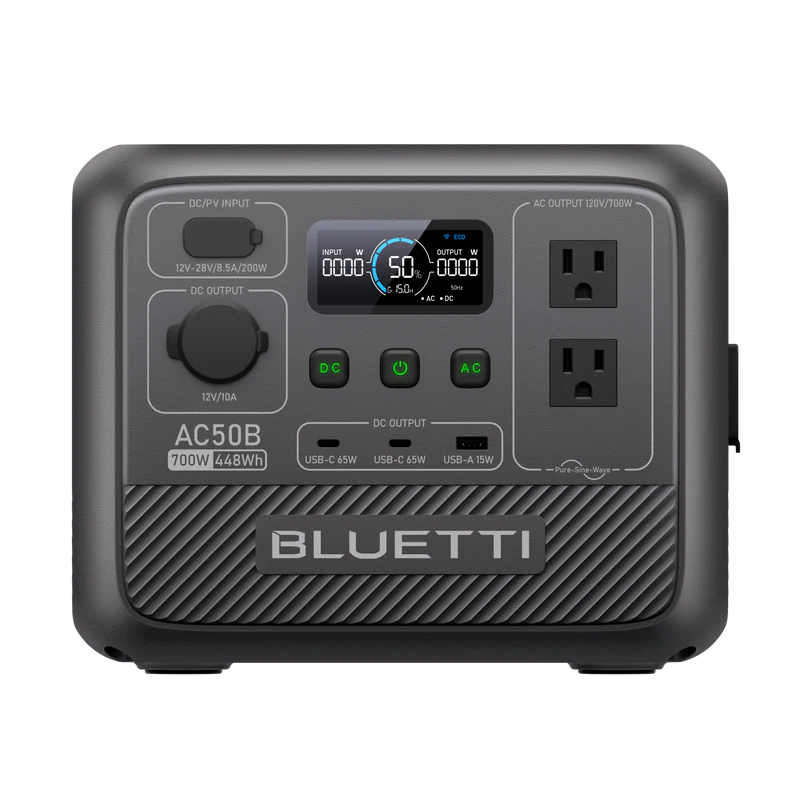
Both are closed 12-volt-outlet-sized BLUETTI boxes with no expansion port, so the $180 gap between them buys 180 more Wh, three more years of warranty, and — going by the EB3A's own owner forum — an inverter that doesn't mistake a sleeping CPAP for an overload.
Full profiles: BLUETTI AC50B → · BLUETTI EB3A →

Written by Wenny ZhengUpdated
Portable Power Tester, Station Arena Test Desk
$399.00 · direct from BLUETTI
Last checked 1 day ago. Prices move — check before you buy.

$219.00 · direct from BLUETTI
Last checked 1 day ago. Prices move — check before you buy.
Spec deltas
The BLUETTI AC50B costs $399 and holds 448Wh; the EB3A costs $219 and holds 268Wh. That 180Wh, $180 gap is the entire comparison — neither unit expands, so whatever capacity, warranty, and quiet you buy today is what you own for the life of the unit.
On paper the EB3A undercuts the AC50B everywhere that matters to a backpack: 10.1 lbs against 14.8, a 1,200W surge against 1,000W, and $180 back in your pocket. What the spec sheet doesn't show is the EB3A's own owner forum, which has spent three years (2022-2024) documenting the same failure — the unit throwing a false 'overload' error and cutting power at loads as light as 40-60WB5B7B8.
That pattern lands directly on the one scenario where these two units actually split: CPAP Overnight. The AC50B clears it with room in the tank; the EB3A doesn't, on capacity alone, before the UPS complaints even enter the picture.
What the Numbers Reveal
Each conclusion stated first — the numbers behind it on one line, the full analysis below.
Capacity
Owners report the EB3A doesn't wait for the tank to run dry to fail the same job: multiple forum threads describe it throwing an 'overload' error and cutting power at 40-60W loads, the exact range a CPAP draws, even on units freshly updated with the latest firmwareB5B6B7B8. One reported this happening on two separate units in the same wayB8. A CPAP night on the EB3A can fail two independent ways before the sun comes up.
CPAP Overnight needs 320Wh; the AC50B covers it at 84% of its 448Wh capacityThe EB3A needs 140% of its 268Wh capacity for the same job, past what it holds
Why it mattersAnyone powering a CPAP or another light medical load overnight should read the EB3A's capacity shortfall and its UPS complaints as compounding risks, not alternatives, and buy the AC50B.
That extra $180 also buys 500 more cycles (3,000 against 2,500) and 180 more Wh. None of it reads as a premium tax; it reads as the AC50B being priced for people who plan to still own it in year four, and the EB3A for people who don't expect to need it that long.
The AC50B carries a 5-year warranty at a computed $60 per warranty-yearThe EB3A carries a 2-year warranty at a computed $180 per warranty-year
Why it mattersA buyer shopping by sticker price alone is picking the option that costs more per year they actually own it.
continuous output
That number would matter for starting a compressor or a power tool, except the EB3A's own ledger shows owners hitting false shutdowns at 40-60W in UPS mode — a unit that claims it can double its output on paper struggling to stay on at a fraction of it in practiceB5B7. A surge rating is only as good as the inverter's confidence at the other end of the load range.
The EB3A's surge rating is 1,200W against a 600W continuous output — a 2.0x ratioThe AC50B's surge rating is 1,000W against 700W continuous — a 1.43x ratio
Why it mattersDon't let the EB3A's better surge number decide this alone — check it against the same unit's light-load complaints before trusting it with anything that has to stay running.
The specific dimensions that decide these two units — everything else is a tie.
Your Life, Your Pick
Selected because: CPAP Overnight is the one scenario that actually splits these two, and it's the one where the EB3A's ledger problems are most relevant.
Weekend Camping, the 8-Hour Blackout, Remote Workday, Tailgate Party, and Van Life Daily all defeat both units by wide margins — these are sub-500Wh boxes being asked to do a multi-kWh job, and neither is the right class of product for any of them. The gap between the two barely matters when both are already past 170% of what the scenario needs; buying either one for these jobs is the wrong move, not the wrong unit.
CPAP Overnight is the exception and the whole reason to pick between them. The AC50B finishes the night at 84% of its tank, with headroom to spare; the EB3A needs more Wh than it holds. Add the EB3A's own documented overload pattern at light loads and this scenario isn't close.
Lifetime Value
Selected because: Cost-per-warranty-year flips the sticker-price story in the AC50B's favor.
cost / lifetime kWh
Run the sticker price against the warranty term and the AC50B is the cheaper unit to own: $60 per warranty-year against the EB3A's $180, a $40 gap that runs the opposite direction of the $180 upfront gap. Cost-per-lifetime-kWh tells the same story — $0.22 for the AC50B against $0.30 for the EB3A.
The EB3A still wins on the number that matters most if $219 is genuinely the ceiling: it's the cheaper unit to buy today, full stop. Just don't mistake that for cheaper to own — over the warranty term it isn't.
What the Specs Don't Tell You
Selected because: Noise, surge ratio, UPS speed, and warranty all fire and are the concrete, spec-true tiebreakers.
rated cycles
The AC50B runs 5dB quieter under load (45dB against 50dB) and switches over to battery in 20ms against the EB3A's 30ms — both small numbers on a spec sheet, both the difference between a UPS event you notice and one you don't. The EB3A's surge ratio is the one spec where it leads outright: 2.0x its continuous rating against the AC50B's 1.43x, real headroom for starting harder loads.
Warranty is the widest gap on the page: 5 years against 2, which is where the AC50B's entire cost-per-year advantage comes from. None of these are marketing numbers — they're the four places the two units are actually built differently.
Growth Path
Selected because: Neither expands — clears up the AC50B's B80 pairing, which recharges rather than truly expands it.
Neither unit accepts a true expansion battery — what ships in the box is the ceiling for both, for the life of ownership. Some retailers list a B80 pairing for the AC50BA4, but that's a power-bank recharge path, not added onboard capacity; the AC50B's own spec sheet doesn't mark it expandable, and neither does the EB3A's.
That makes today's capacity call permanent either way. If 268Wh or 448Wh is close to your real ceiling, pick the one that actually clears it — there's no B80 or B230 waiting to rescue either model later.
Strengths & trade-offs
BLUETTI AC50B
Strengths
- +Larger battery capacity
- +Higher AC output
- +Longer warranty
Trade-offs
- –Substantially more expensive (+$180) than the EB3A.
BLUETTI EB3A
Strengths
- +Costs $180 less
- +Lighter by 4.7 lb
Trade-offs
- –No major technical downsides compared to rival.
Will It Power Your Gear?
Scenario math and per-appliance runtimes, modeled from the spec record.
Scenario verdicts
We ran the math on seven real-world scenarios. Here's which unit survives your actual life.
SCN-01 · 2 nights · needs 2,100Wh
Weekend Camping
Two nights off-grid with essential comfort
Neither unit
Neither unit covers this scenario's 2,100Wh: the AC50B comes up 1,719Wh short (about 18% covered), the EB3A 1,872Wh (11%). This is well outside what either unit is for; the right answer here is a larger station, not a choice between these two.
Battery budget usedlower = more headroom
LOAD Phone Charger 15W×6h · LED Lights 40W×8h · Box Fan 75W×14h · CPAP Machine 40W×16h
SCN-02 · 8 hours · needs 1,645Wh
8-Hour Blackout
Keep the essentials running through a night without power
Neither unit
Neither unit covers this scenario's 1,645Wh: the AC50B comes up 1,264Wh short (about 23% covered), the EB3A 1,417Wh (14%). This is well outside what either unit is for; the right answer here is a larger station, not a choice between these two.
Battery budget usedlower = more headroom
LOAD Fridge 150W×8h · Router + Modem 20W×8h · LED Lights (4 bulbs) 40W×6h · Phone Charger 15W×3h
SCN-03 · 8 hours · needs 320Wh
CPAP Overnight
Sleep therapy without interruption — the #1 medical use case
AC50B
The AC50B finishes the night at 84% of its 448Wh tank. The EB3A needs more Wh than it has to make it through — this is the one scenario these two units actually split on, and it splits hard.
Battery budget usedlower = more headroom
LOAD CPAP Machine 40W×8h
SCN-04 · 8 hours · needs 910Wh
Remote Workday
Full work day off-grid without power anxiety
Neither unit
Neither unit covers this scenario's 910Wh: the AC50B comes up 529Wh short (about 42% covered), the EB3A 682Wh (25%). Treat this as partial cover — enough for the essentials in it, not the whole list.
Battery budget usedlower = more headroom
LOAD Laptop 60W×8h · External Monitor 30W×8h · Router + Modem 20W×8h · Phone Charger 15W×2h
SCN-05 · 4 hours · needs 670Wh
Tailgate Party
Game day power for the crew
Neither unit
Neither unit covers this scenario's 670Wh: the AC50B comes up 289Wh short (about 57% covered), the EB3A 442Wh (34%). Treat this as partial cover — enough for the essentials in it, not the whole list.
Battery budget usedlower = more headroom
LOAD Blender 400W×0.5h · LED TV (55") 80W×4h · Bluetooth Speaker 15W×4h · Phone Charger (×3) 45W×2h
SCN-06 · 24 hours · needs 4,685Wh
Van Life Daily
A full day of mobile living — the ultimate endurance test
Neither unit
Both units miss this by more than an order of magnitude — the AC50B at 1,230% of what's needed, the EB3A at 2,057%. Neither belongs in this conversation; this comparison is between two units that both aren't the right product for a van-life day.
Battery budget usedlower = more headroom
LOAD Mini-Fridge 150W×24h · Laptop 60W×4h · Phone Charger 15W×3h · LED Lights 40W×5h · Fan 75W×8h
SCN-07 · an afternoon · needs 100Wh
Afternoon Off-Grid
Phones and a speaker at the park, beach, or campsite — the small-unit job description
Either unit
This is the job small stations are actually for, and both do it: the AC50B finishes at 26% used, the EB3A at 44%. At this size the decider is what rides in the bag — 10.1 lbs for the EB3A against 14.8 for the AC50B — and price, not the leftover watt-hours.
Battery budget usedlower = more headroom
LOAD Phone Charger (×2) 30W×2h · Bluetooth Speaker 10W×4h
The Load Test
RUNTIME = (Wh × 0.85) ÷ LOAD
None of the scenarios above exactly yours? Build it. Toggle what you'd plug in; both units are tested against the combined draw.
Essentials
Comfort & Convenience
High-Draw Appliances
Test duration
8h
Continuous draw
205W
Projected runtime
For this load: AC50B runs 1.9h vs 1.1h.
$399 list · direct from BLUETTI
Modeled from the spec record — same math as the tables below. Methodology
Runtime by appliance
Real-world runtime estimates for common appliances, modeled at 85% inverter efficiency.¹
Essentials
The basics you need runningscale 0–25.4hComfort & Convenience
Makes off-grid life actually enjoyablescale 0–5.1hHigh-Draw Appliances
These reveal the real limits¹ Runtime = (capacity × 0.85) ÷ appliance watts. Within each group, all bars share one time scale (the group's longest runtime), so lengths are comparable across appliances; identical runtimes collapse into a single blue/orange bar. Actual runtime varies with battery age, temperature, and simultaneous loads — see methodology.
Conclusion
July 15, 2026
Verdict: the AC50B, on Power Score margin
The AC50B costs $180 more but works out to $60 per warranty-year against the EB3A's $180, carries 500 more cycles, and is the only one of the two that clears the CPAP Overnight scenario outright. The EB3A wins on price and on the scale — 10.1 lbs against 14.8 — and that's a real reason to buy it if the unit is riding in a daypack. But for anything approaching a light 24/7 load, the EB3A's own community forum documents a multi-year pattern of false 'overload' shutdowns at exactly the wattage a CPAP draws, and that's not a risk the AC50B carries.
Editor-assigned confidence, based on cited owner research and spec analysis.
List prices as of July 15, 2026. The links below open BLUETTI's current price.
$399.00 · direct from BLUETTI
Last checked 1 day ago. Prices move — check before you buy.
or check the EB3A price$219.00 list
Written by Wenny Zheng, Portable Power Tester · Station Arena Test Desk · Updated July 15, 2026
Measured Data
Benchmark scores and the full spec record, side by side.
Benchmark scores
Not rated for both units (minimum threshold unmet): UPS, Tailgating.
Full specifications
ᵈ Derived: price ÷ rated capacity. See the data behind our comparisons →
Comparison ToolAdd more power stations, side by sideOpen Tool →How these numbers are produced
Numeric verification
Every figure on this page traces to our spec database or arithmetic on it — no estimated numbers.
Owner claims
Statements about owner experience are cited to published reviews — see Sources & Research Notes below.
Runtime model
Runtime = (rated capacity × 0.85 inverter efficiency) ÷ device wattage. Solar recharge estimates assume panels deliver 70% of rated output. Cold weather, battery age, and stacked loads reduce real-world results.
Power Score
Computed from 14 published spec dimensions, weighted per use-case bench. Higher is better; a unit must meet a bench's minimum threshold to be rated.
See the full weight table and data sourcing on our methodology page →Class ranking (the star rating)
Each unit's star score is a category ranking, not customer reviews — no buyer opinions feed it. We score every station on size-independent quality (value, output, portability, endurance, ports, warranty, and more), then percentile-rank it against the other units in its capacity class, so a class-leading compact unit and a class-leading whole-home unit can both earn 5★. Here, AC50B rates 4.6/5 (76th percentile of 22 Personal-class units), and EB3A rates 3.8/5 (29th percentile of 22 Personal-class units).
How the class ranking is computed →Test Notes & Caveats
Hidden gotchas and advantages we spotted that you won't find on the product page.
5 Decibels, One Direction
The AC50B runs 45dB under load against the EB3A's 50dB. Neither is loud at idle, but the gap becomes the difference between background hum and something you notice across a room during charging.
The Smaller Unit Has the Bigger Punch
The EB3A's 1,200W surge against its 600W continuous rating works out to a 2.0x ratio; the AC50B's 1,000W surge against 700W continuous is 1.43x. If starting a hard inrush load matters more than total capacity, the EB3A's inverter has the wider margin on paper.
20ms vs 30ms Switchover
The AC50B switches to battery power in 20ms against the EB3A's 30ms. Both are fast enough that most electronics won't notice, but the AC50B's margin is the wider one.
5 Years Against 2
The AC50B's warranty runs 5 years against the EB3A's 2 — the single widest spec gap between these two units, and the one that flips the cost-per-year math in the pricier unit's favor.
Ownership Analysis
What happens after you buy — true cost of ownership, brand trust, and growth potential.
Lifetime value
Service lifeyears at one full cycle per day
Lifetime energy delivered
Cost per delivered kWh
│ warranty ends · Reaching the cycle rating means ~80% capacity remains — degraded, not dead.
Analyst note
The EB3A is cheaper to buy, but the AC50B is cheaper to own. At $0.3/kWh over its lifetime vs $0.33/kWh, the AC50B's higher cycle life and capacity make each dollar go further over the years.
Growth path
AC50B
FIXED CAPACITYFixed at 448Wh, with no expansion — so size it for your needs up front rather than planning to add capacity later.
Accepts up to 200W of solar. Limited to a single portable panel.
Limited ports. You'll likely need a power strip or splitter.
EB3A
FIXED CAPACITYFixed at 268Wh, with no expansion — so size it for your needs up front rather than planning to add capacity later.
Accepts up to 200W of solar. Limited to a single portable panel.
Limited ports. You'll likely need a power strip or splitter.
Realistic full solar rechargeat 70% of rated panel output — see methodology
Analyst note
Neither expands, and that's no knock on either — each is a complete unit at a fixed size. Buy the capacity that covers your needs now (the AC50B gives you the larger ceiling); you can't add to either later.
What Owners Report
Patterns from published owner reports and long-term reviews — every claim cited to its source below.
BLUETTI AC50B
Coverage on the AC50B is thin but consistently positive: reviewers describe a 448Wh LiFePO4 battery rated for 2,500+ cycles as years of reliable daily useA1, and call it meaningfully lighter than BLUETTI's own AC70 at 14.8 lbs, a genuinely portable unit with 700W output at an easy-to-justify priceA2.
Charging draws praise too — about 3 hours standard, dropping to 1.25 hours with the optional 480W Turbo charger, or 0-80% in 45 minutesA3. Some listings mention a B80 pairing as an add-onA4, but that's a recharge accessory, not a true capacity expansion — the unit's spec sheet agrees it's a closed system.
“A 448Wh LiFePO4 battery with 700W output (1,000W Power Lifting), rated for 2,500+ cycles to 80% — years of reliable use.”
Sources
amazon.com · backuppowerhub.com · the-gadgeteer.com · t3.com · bluettipower.com
BLUETTI EB3A
The EB3A's ledger is the more interesting read, and not because it's flattering. The dominant, multi-year pattern (2022-2024) is owners hitting false 'overload' shutdowns running the unit as a UPS under light loads — 40-60W, the range a CPAP or a router drawsB5B7. One owner tried a firmware update at BLUETTI's suggestion and reported it made the blinking worse, not better, and got no further help after thatB9. Another reported the exact same failure on two separate unitsB8.
Fan noise complaints run alongside it across the same years — owners describe a wobble-driven whine even in silent modeB1, a strange 25-second electrical sequence when the fan kicks onB2, and noise loud enough to notice in a bedroom overnight even at idleB3. None of that erases the positive side: a 60-day field test covering two camping trips, an 18-hour outage, and five days of van life reported the reviewer would buy it again without hesitationB16, and a CPAP-specific test clocked about six hours of runtime and a four-hour rechargeB17. It's a genuinely capable unit for the jobs the failures don't touch.
“Bluetti advertises the EB3A as "tiny but mighty," and I have to agree. They crammed a lot of ports and functionality into a very portable package... it seems to be a very well-polished product.”
Sources
toolguyd.com · diysolarforum.com · backuppowerhub.com · wanderwoman.ca
Sources & Research Notes
Every owner claim in this report is traceable to a published source. The bracketed references above resolve here.
Recurring owner themes
- Affordable, genuinely portable LFP unit with 700W output, 2,500+ cycles, fast Turbo charging, and B80 expandability. [AC50B · 3 entries]
- Multiple owners across forums (2022-2024) report the EB3A randomly shutting off or throwing false 'overload' errors under light loads (40-60W) when used in UPS mode for CPAPs, computers, or routers — a persistent, unresolved issue even after firmware updates. [EB3A · 6 entries]
- Recurring complaints about fan noise and odd fan behavior (ramping, buzzing, wobble) span from 2022 through 2024, spanning silent mode, idle, and charging states, suggesting an ongoing hardware/firmware characteristic rather than a one-time defect. [EB3A · 5 entries]
- Owners report poor or unresponsive Bluetti customer support when troubleshooting UPS failures, including unhelpful firmware fixes and unanswered app support tickets. [EB3A · 2 entries]
- Despite reliability complaints in UPS use, several long-term/extended testers (60+ days, CPAP overnight use) report satisfaction with portability, build quality, and real-world runtime for camping/outage scenarios. [EB3A · 3 entries]
- A1
“A 448Wh LiFePO4 battery with 700W output (1,000W Power Lifting), rated for 2,500+ cycles to 80% — years of reliable use.”
amazon.com / backuppowerhub.com — AC50B review · 2026 · [positive]
- A2
“At 14.8 lbs it's meaningfully lighter than the AC70 (21.4 lbs) — a genuinely portable sub-15-lb unit with a long-cycle battery and 700W output at an easy-to-justify price.”
backuppowerhub.com / the-gadgeteer.com — AC50B review · 2026 · [positive]
- A3
“Standard AC charging is about 3 hours, dropping to 1.25 hours with the optional 480W Turbo charger; 0-80% in 45 minutes.”
amazon.com / t3.com — AC50B review · 2026 · [positive]
- A4
“The B80 can add 806Wh, but BLUETTI scopes this to "capacity expansion with B80 battery in Power Bank Mode" over an Aviation-to-XT60 cable — the pack recharges the unit rather than extending it as one system, so this is not expandability in the sense this site uses. At $279 it is BLUETTI's most affordable LiFePO4 station.”
bluettipower.com AC50B FAQ (primary) · 2026 · [positive]
- B1
“I got tired of hearing the fan on the EB3a coming and going off and on, even in the silent mode. The wobbly noise is because of being unbalanced.”
BLUETTI Community forum — 'EB3A fans noise - how is fix it!' · 2022-08 · [negative]
- B2
“Whenever the fan kicks on my EB3A makes a really strange 25 second sequence of electrical noises coming from near the intake fan on the left side of the unit.”
BLUETTI Community forum — 'EB3A Weird fan ramp up noise' · 2022-06 · [negative]
- B3
“Even in slow charging mode and even when fully charged already, the eb3a fan noise is too high to be in a bedroom (if AC input plugged in) The fan runs every 20 min or so”
BLUETTI Community forum — 'EB3A idle noise suggestion' · 2023-09 · [negative]
- B5
“There is a known issue when running it in UPS mode with a light load (40~60 watts). The unit does not keep itself cool and overheats. (The display shows overload.)”
toolguyd.com — 'Bluetti EB3A Portable Power Station Review' comments · 2023-04 (purchased Aug 2023) · [negative]
- B6
“Firmware was updated and did not help. There are various setting some people said helped, but none did for me. The issue has been around for as long as the product”
toolguyd.com — 'Bluetti EB3A Portable Power Station Review' comments · 2023-08 · [negative]
- B7
“About 2-3 hours into my night's sleep it shut down, showing an "overload" indication despite the fact that my CPAP only draws at most 40 watts.”
diysolarforum.com — 'EB3A "Overload" When Used as Uninterruptible Power Supply' · 2022-09 · [negative]
- B8
“He said that both had failed recently in exactly the same way under light loads... Of the units I personally know of that're being used in this way that's a 100% failure rate”
diysolarforum.com — 'EB3A "Overload" When Used as Uninterruptible Power Supply' · 2022-09 · [negative]
- B9
“I contacted bluetti support and they told me to upgrade the firmware. I did so, and that actually increased the frequency of the "blinks". Support eventually just shrugged and had no further help”
diysolarforum.com — 'Is Bluetti EB3A any good as a UPS?' · 2022-12 · [negative]
- B16
“After 60 days of testing—two camping trips, an 18-hour power outage, and five days of van life—would I buy the Bluetti EB3A again? Yes, without hesitation.”
backuppowerhub.com — 'Bluetti EB3A Review: Ultra-Compact Emergency Power Station' · 2026-05 · [positive]
- B17
“On a full charge, the BLUETTI EB3A powered my CPAP machine for approximately six hours... Charging the BLUETTI EB3A from a household outlet took just over four hours.”
wanderwoman.ca — 'CPAP Battery Backup for Camping and Power Outages' · 2026-06 · [positive]
Research compiled July 15, 2026.
Who Should Buy Which
Buy the AC50B if you…
- →You're running a CPAP, router, or other light load overnight and need the unit to actually stay on — the AC50B clears that scenario on capacity alone, no UPS caveats attached.
- →You want the lower cost per year owned: 5 years of warranty at $60/yr against the EB3A's 2 years at $180/yr.
Buy the EB3A if you…
- →Weight is the deciding constraint — 10.1 lbs against 14.8 is a real difference in a daypack or a bike pannier, and $219 against $399 matters if that's the hard ceiling.
- →The load is intermittent and non-critical: charging phones, running lights, topping off a camera battery — nothing where a false shutdown costs you sleep or a monitored medical device.
If neither fits
If the real job is a two-night camping trip (about 2,100Wh) or an 8-hour multi-appliance blackout (about 1,645Wh), both of these fail it outright — even the AC50B lands north of 400% of what's needed. Look at BLUETTI's larger AC-series units instead of choosing between these two.
The Bottom Line
Both are sealed, sub-15-pound BLUETTI boxes with no real expansion path, so the $180 between them is buying 180Wh, three extra years of warranty, and — per the EB3A's own owner forum — an inverter that doesn't flag a CPAP as an overload. That last point decides it for anyone running a light load overnight.
If weight and price are the only constraints and the load is casual, the EB3A's 10.1 lbs and $219 are a legitimate pick. For anything closer to a 24/7 job, take the AC50B — it's the cheaper one per year owned anyway.
Frequently Asked Questions
Answers drawn from the spec record and cited owner research.
What's the real difference between the BLUETTI AC50B and EB3A?
Capacity, price, and warranty. The AC50B holds 448Wh for $399 with a 5-year warranty; the EB3A holds 268Wh for $219 with a 2-year warranty. Both are closed systems with no true expansion path, and the AC50B runs 5dB quieter and switches to battery power 10ms faster.
Is the EB3A safe to use for CPAP backup?
Be cautious. It falls short of the CPAP Overnight scenario on raw capacity alone, needing more Wh than it holds, and multiple owners across 2022-2024 forum threads report the unit throwing false 'overload' errors and cutting power at the 40-60W range a CPAP draws. The AC50B clears the same scenario with capacity to spare and doesn't carry that complaint pattern.
Does either unit support battery expansion?
No. Some listings mention a B80 pairing for the AC50B, but that recharges the unit rather than adding true onboard capacity, and neither model's spec sheet marks it expandable. Whatever capacity you buy — 268Wh or 448Wh — is the ceiling for the life of the unit.
Is the AC50B worth $180 more than the EB3A?
By the numbers, yes, if you'll own it more than a year or two: the AC50B computes to $60 per warranty-year against the EB3A's $180, plus 500 more cycles and 180 more Wh. If the unit is strictly for light, non-critical backup and weight is the priority, the EB3A's $219 and 10.1 lbs are the better fit.
Which one is quieter and faster to switch over on outage?
The AC50B, on both counts — 45dB against the EB3A's 50dB under load, and a 20ms switchover against 30ms. Neither gap is dramatic, but they both point the same direction.
Where to buy
BLUETTI AC50BPick
$399.00
$399.00 · direct from BLUETTI
Last checked 1 day ago. Prices move — check before you buy.
BLUETTI EB3A
$219.00
$219.00 · direct from BLUETTI
Last checked 1 day ago. Prices move — check before you buy.
Prices may vary by retailer and are subject to change.