Head-to-head test
Goal Zero Yeti 300 vs Goal Zero Yeti 500
Goal Zero Yeti 300 vs Goal Zero Yeti 500: Buy the Yeti 500. Same cells, same 4,000 cycles, same five-year warranty, so it comes down to a single night: the Yeti 500 finishes an overnight CPAP run and the Yeti 300 quits about four-fifths of the way to morning.
Full profiles: Goal Zero Yeti 300 → · Goal Zero Yeti 500 →

Written by Wenny ZhengUpdated
Portable Power Tester, Station Arena Test Desk
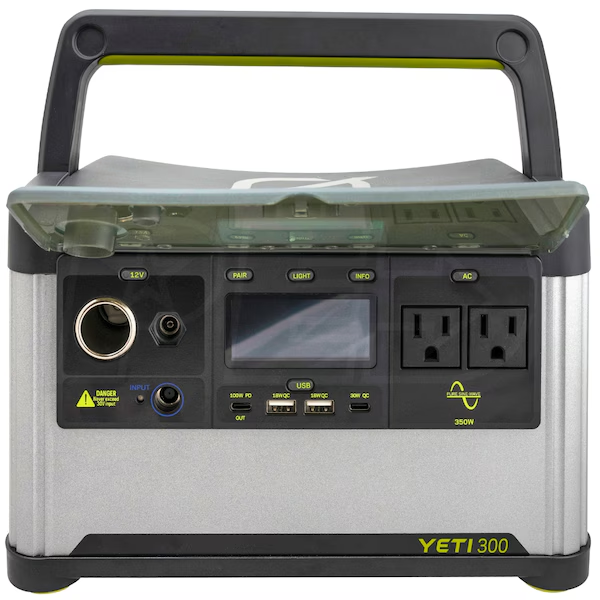
$349.95 · direct from Goal Zero
Last checked 1 day ago. Prices move — check before you buy.
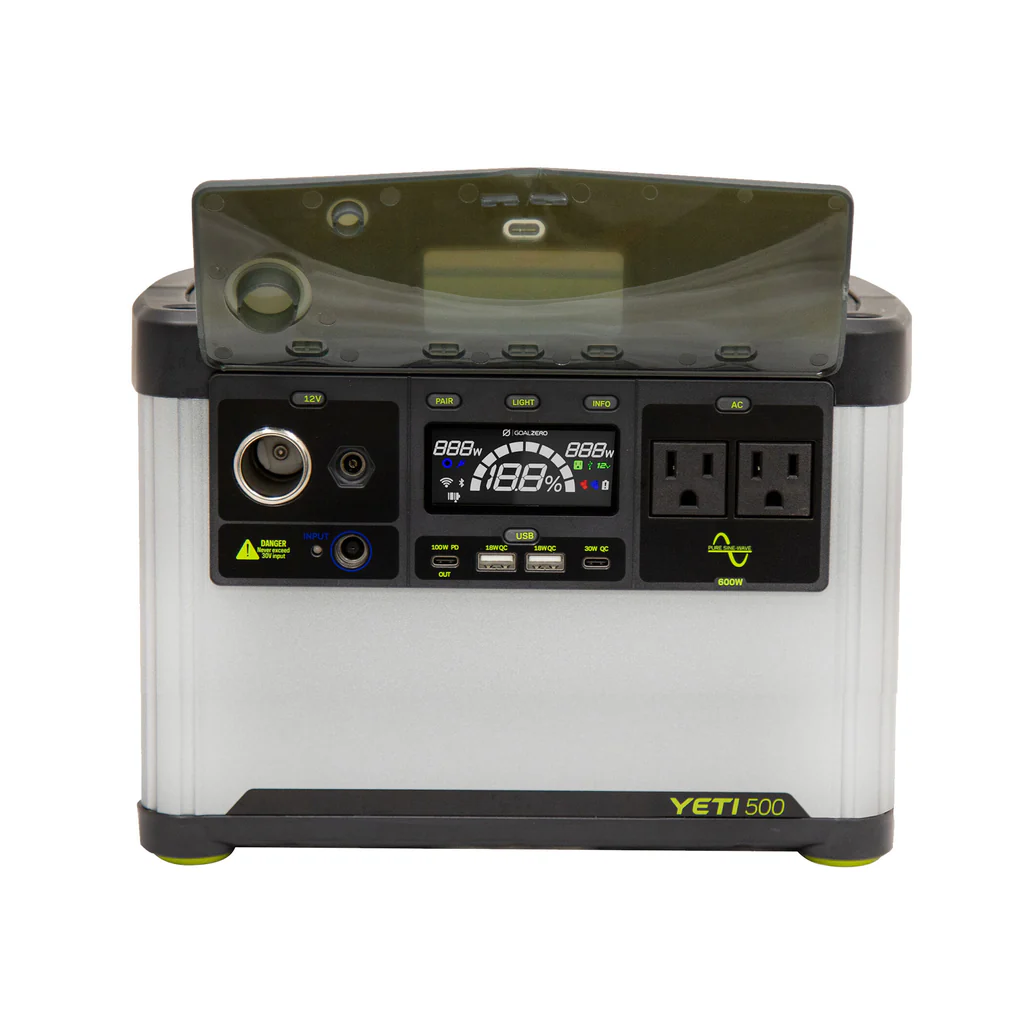
$499.95 · direct from Goal Zero
Last checked 1 day ago. Prices move — check before you buy.
Spec deltas
Take the Yeti 500. It's $500 against the Yeti 300's $350, and what that $150 buys is 202Wh more capacity and a 500W inverter in place of a 350W one. That's 68% more energy for 43% more money, which is the rare upsell that gets cheaper as it gets bigger.
Almost nothing else separates them. Both run LiFePO4 rated for 4,000 cycles, both carry a five-year warranty, both cap at 200W of solar input, both push 100W over USB-C, and both hand off to battery in 20 milliseconds. Goal Zero built one unit in two sizes and priced the larger one better per watt-hour.
So the decision is capacity and inverter, and both break the same way. On the overnight CPAP load scored here, the 300 runs out with about a fifth of the night still to go. That isn't a spec-sheet distinction. That's an alarm you didn't set.
What the Numbers Reveal
Each conclusion stated first — the numbers behind it on one line, the full analysis below.
Capacity
A capacity difference normally changes how comfortable a unit is to live with. This one changes whether the machine is still running at 5 a.m. And the leftover quarter on the 500 isn't slack, it's what absorbs a heated humidifier, a cold bedroom, or the plain fact that nobody starts the night at 100%.
Yeti 300: 297Wh rated capacityYeti 500: 499Wh rated capacityUsable energy runs about 85% of rated after inverter losses: roughly 252Wh and 424WhThe CPAP Overnight load draws 320Wh
Why it mattersIf a CPAP is anywhere on your list, even as a maybe, the 300 is off the table at any price.
continuous output
That gap is why the Tailgate load is the one scenario where a unit fails outright rather than merely running dry: the 300 can't power the peak draw at all, while the 500 can. Goal Zero markets the 500 as fridge backup, claiming up to six hours on a full-size refrigeratorB2, and while that's the manufacturer's figure rather than a measured one, the surge rating behind it is real and the 300 doesn't have it.
Yeti 300: 350W continuous, 600W surgeYeti 500: 500W continuous, 1,000W surgeCompressor and heating-element loads spike well above their running draw at startupOne review had the 300 shut down after two minutes with a coffee maker running near its rated outputA3
Why it mattersAnything with a compressor or a heating element belongs on the 500. On the 300 it may refuse at the moment of startup, with a full battery.
Cost / Wh
And because neither one accepts an expansion battery, the size you buy is the size you own for all 4,000 cycles. The $150 you save on the 300 is money you can never spend later to fix the ceiling, because the only upgrade path is a second power station, which costs more than picking right the first time.
Yeti 300: $350 for 297Wh, or $1.18 per watt-hourYeti 500: $500 for 499Wh, or $1.00 per watt-hourNeither unit expands: 297Wh and 499Wh are permanent ceilingsBoth rated 4,000 cycles
Why it mattersAnyone who isn't sure how much capacity they need should stop calculating and take the 500. Uncertainty is exactly what a fixed ceiling punishes.
weight
Weight is the argument people reach for when the real objection is price, and here it evaporates. What's left of the 300's case is $150 and one honest advantage: with both units capped at the same 200W of solar, the smaller tank fills faster, about 1.5 hours against 2.5 at full input.
Yeti 300: 13.7 lbYeti 500: 16.1 lbThe difference between them is 2.4 lbBoth cap at 200W of solar input
Why it mattersIf you're choosing the 300 to save your back, you're saving 2.4 lb. Choose it for the money or don't choose it.
The specific dimensions that decide these two units — everything else is a tie.
Runtime: Will It Power Your Gear?
Selected because: Take 85% off the rated capacity for inverter losses and these two land on opposite sides of a single overnight load.
continuous output
Nobody drains a battery to zero and no inverter is free, so take 85% off both before you plan anything. The 300 has about 252Wh to hand out; the 500, about 424Wh. On phone-and-laptop duty that difference is invisible. One review put the 300 at four to six hours of laptop work or 20 to 30 phone chargesA3, and the 500 simply does more of the same.
The gap only becomes real when one appliance has to run continuously to a fixed finish line. For small intermittent draws these two are interchangeable and you should buy on price. For the mask, the fridge, the modem, something that has to be alive at a specific hour, the 300's ceiling arrives before the hour does.
Your Life, Your Pick
Selected because: Only one of the six test loads produces a winner, and understanding why the other five don't is most of this decision.
Five of the six loads scored here defeat both units, and that's the most useful thing on this page. Weekend Camping alone asks for 2,100Wh, roughly five times what the 500 can actually deliver. Van Life, the eight-hour blackout, a full remote workday: those are wrong-aisle problems, not Yeti 300 versus Yeti 500 problems.
The two loads that do discriminate are small and specific. The overnight CPAP run is the only one with a declared winner and the 500 takes it. The tailgate is the other, and it splits a different way: neither unit lasts the whole party, but only the 500 can start the scenario's peak draw. The 300's 350W inverter won't pass it, so its state of charge never even gets to be the problem.
Growth Path
Selected because: Neither unit accepts an expansion battery, so the number on the box is the ceiling for all 4,000 cycles.
Neither of these accepts an expansion battery, and that's no mark against either one. Both are complete sealed units at a fixed size, and a sealed 297Wh box isn't worse than a sealed 499Wh box for being sealed. What it means is that the number printed on the side is the number you own until you sell it.
Which makes buying slightly more than you think you need the only sane rule here. Underestimate with an expandable unit and you buy a battery. Underestimate with these and you buy a second power station, which costs a good deal more than the $150 you were trying to save.
Lifetime Value
Selected because: Sizing up normally costs a premium; here the larger unit is the cheaper one per watt-hour, at the register and across its life.
cost / lifetime kWh
At 4,000 cycles both units are rated for roughly 11 years of daily cycling, which is longer than most people keep a power station and identical between the two. Cycle life doesn't decide this matchup. What it does is make the per-energy math meaningful: spread each price across everything the unit will ever deliver and the 500 comes to $0.25 per kilowatt-hour against the 300's $0.29.
Four cents doesn't buy anybody dinner, and it isn't the reason to take the 500. It's the reason not to feel clever about taking the 300. The smaller unit is the cheaper pick, not the thrifty one, and the distance between those two words is the entire $150.
Portability & Form Factor
Selected because: The last argument for the smaller unit is weight, and the whole gap is 2.4 lb.
weight
Both of these are one-hand carries with a fixed handle, and the difference between them is a full water bottle. That isn't a category of lift. You're not planning your day around it, not recruiting a second person, not skipping a trail because of it.
That matters because weight is the argument people reach for when the real reason is money. Say the real reason. If $150 is a genuine constraint, the 300 is a good little unit and you should buy it without apologizing for it. If it isn't, nothing on this page argues for carrying less energy.
Strengths & trade-offs
Goal Zero Yeti 300
Strengths
- +Costs $150 less
- +Lighter by 2.4 lb
Trade-offs
- –No major technical downsides compared to rival.
Goal Zero Yeti 500
Strengths
- +Larger battery capacity
- +Higher AC output
Trade-offs
- –Substantially more expensive (+$150) than the Yeti 300.
Will It Power Your Gear?
Scenario math and per-appliance runtimes, modeled from the spec record.
Scenario verdicts
We ran the math on seven real-world scenarios. Here's which unit survives your actual life.
SCN-01 · 2 nights · needs 2,100Wh
Weekend Camping
Two nights off-grid with essential comfort
Neither unit
Neither unit covers this scenario's 2,100Wh: the Yeti 300 comes up 1,848Wh short (about 12% covered), the Yeti 500 1,676Wh (20%). This is well outside what either unit is for; the right answer here is a larger station, not a choice between these two.
Battery budget usedlower = more headroom
LOAD Phone Charger 15W×6h · LED Lights 40W×8h · Box Fan 75W×14h · CPAP Machine 40W×16h
SCN-02 · 8 hours · needs 1,645Wh
8-Hour Blackout
Keep the essentials running through a night without power
Neither unit
Neither unit is house backup, and it isn't close: the load asks for 1,645Wh and even the 500 covers about a quarter of that. What both do well is hold one appliance up, the fridge or the modem or the mask, and both hand off to battery in 20 milliseconds, so whatever you leave plugged in doesn't reboot when the grid drops. Pick your one appliance first, then pick the unit that can start it.
Battery budget usedlower = more headroom
LOAD Fridge 150W×8h · Router + Modem 20W×8h · LED Lights (4 bulbs) 40W×6h · Phone Charger 15W×3h
SCN-03 · 8 hours · needs 320Wh
CPAP Overnight
Sleep therapy without interruption — the #1 medical use case
Yeti 500
One of these finishes the night. The load comes to 320Wh, and the 300 has about 252Wh to give once you allow for inverter losses, so it gets roughly four-fifths of the way and stops. The 500 ends the night with about a quarter of its usable energy untouched, which is the margin that covers a heated humidifier or a cold bedroom. This is the clearest result on the page, and it isn't close.
Battery budget usedlower = more headroom
LOAD CPAP Machine 40W×8h
SCN-04 · 8 hours · needs 910Wh
Remote Workday
Full work day off-grid without power anxiety
Neither unit
Neither unit covers this scenario's 910Wh: the Yeti 300 comes up 658Wh short (about 28% covered), the Yeti 500 486Wh (47%). Treat this as partial cover — enough for the essentials in it, not the whole list.
Battery budget usedlower = more headroom
LOAD Laptop 60W×8h · External Monitor 30W×8h · Router + Modem 20W×8h · Phone Charger 15W×2h
SCN-05 · 4 hours · needs 670Wh
Tailgate Party
Game day power for the crew
Neither unit
Neither unit lasts the whole party, but only one of them starts it. The peak draw here is more than the 300's 350W inverter and 600W surge will pass, so it won't run the biggest thing on the table at any state of charge, while the 500's 500W and 1,000W surge will. Then both run dry: the 500 covers about two-thirds of the load, the 300 about two-fifths. Nobody wins this scenario outright. If you're choosing anyway, choose the one that can turn the load on.
Battery budget usedlower = more headroom
LOAD Blender 400W×0.5h · LED TV (55") 80W×4h · Bluetooth Speaker 15W×4h · Phone Charger (×3) 45W×2h
SCN-06 · 24 hours · needs 4,685Wh
Van Life Daily
A full day of mobile living — the ultimate endurance test
Neither unit
Neither unit covers this scenario's 4,685Wh: the Yeti 300 comes up 4,433Wh short (about 5% covered), the Yeti 500 4,261Wh (9%). This is well outside what either unit is for; the right answer here is a larger station, not a choice between these two.
Battery budget usedlower = more headroom
LOAD Mini-Fridge 150W×24h · Laptop 60W×4h · Phone Charger 15W×3h · LED Lights 40W×5h · Fan 75W×8h
SCN-07 · an afternoon · needs 100Wh
Afternoon Off-Grid
Phones and a speaker at the park, beach, or campsite — the small-unit job description
Either unit
This is the job small stations are actually for, and both do it: the Yeti 300 finishes at 40% used, the Yeti 500 at 24%. At this size the decider is what rides in the bag — 13.7 lbs for the Yeti 300 against 16.1 for the Yeti 500 — and price, not the leftover watt-hours.
Battery budget usedlower = more headroom
LOAD Phone Charger (×2) 30W×2h · Bluetooth Speaker 10W×4h
The Load Test
RUNTIME = (Wh × 0.85) ÷ LOAD
None of the scenarios above exactly yours? Build it. Toggle what you'd plug in; both units are tested against the combined draw.
Essentials
Comfort & Convenience
High-Draw Appliances
Test duration
8h
Continuous draw
205W
Projected runtime
For this load: Yeti 500 runs 2.1h vs 1.2h.
$499.95 list · direct from Goal Zero
Modeled from the spec record — same math as the tables below. Methodology
Runtime by appliance
Real-world runtime estimates for common appliances, modeled at 85% inverter efficiency.¹
Essentials
The basics you need runningscale 0–28.3hComfort & Convenience
Makes off-grid life actually enjoyablescale 0–5.7hHigh-Draw Appliances
These reveal the real limits¹ Runtime = (capacity × 0.85) ÷ appliance watts. Within each group, all bars share one time scale (the group's longest runtime), so lengths are comparable across appliances; identical runtimes collapse into a single blue/orange bar. Actual runtime varies with battery age, temperature, and simultaneous loads — see methodology.
Conclusion
August 4, 2026
Verdict: the Yeti 500, on Power Score margin
Buy the Yeti 500. The extra $150 buys 202Wh more capacity and a 500W inverter with 1,000W of surge in place of 350W and 600W, and those two things decide every load on this page: the 500 is the only one of the pair that finishes an overnight CPAP run, and the only one that can start the biggest draw on a tailgate table. It's also the cheaper unit per watt-hour, at $1.00 against $1.18, so sizing up isn't a premium here. The Yeti 300 is still the right call if your load list is phones, a laptop and lights and you're confident it stays that way, because it gives up nothing on chemistry, cycle life, warranty or build. Anything with a compressor, a heating element, or a mask on your face, take the 500.
Editor-assigned confidence, based on cited owner research and spec analysis.
List prices as of August 4, 2026. The links below open Goal Zero's current price.
$499.95 · direct from Goal Zero
Last checked 1 day ago. Prices move — check before you buy.
or check the Yeti 300 price$349.95 list
Written by Wenny Zheng, Portable Power Tester · Station Arena Test Desk · Updated August 4, 2026
Measured Data
Benchmark scores and the full spec record, side by side.
Benchmark scores
Full specifications
ᵈ Derived: price ÷ rated capacity. See the data behind our comparisons →
Comparison ToolAdd more power stations, side by sideOpen Tool →How these numbers are produced
Numeric verification
Every figure on this page traces to our spec database or arithmetic on it — no estimated numbers.
Owner claims
Statements about owner experience are cited to published reviews — see Sources & Research Notes below.
Runtime model
Runtime = (rated capacity × 0.85 inverter efficiency) ÷ device wattage. Solar recharge estimates assume panels deliver 70% of rated output. Cold weather, battery age, and stacked loads reduce real-world results.
Power Score
Computed from 14 published spec dimensions, weighted per use-case bench. Higher is better; a unit must meet a bench's minimum threshold to be rated.
See the full weight table and data sourcing on our methodology page →Class ranking (the star rating)
Each unit's star score is a category ranking, not customer reviews — no buyer opinions feed it. We score every station on size-independent quality (value, output, portability, endurance, ports, warranty, and more), then percentile-rank it against the other units in its capacity class, so a class-leading compact unit and a class-leading whole-home unit can both earn 5★. Here, Yeti 300 rates 3.7/5 (24th percentile of 22 Personal-class units), and Yeti 500 rates 4.5/5 (71st percentile of 22 Personal-class units).
How the class ranking is computed →Test Notes & Caveats
Hidden gotchas and advantages we spotted that you won't find on the product page.
Same five years, different bill
The warranty is identical on both units, so it isn't a tiebreak. It's another way of pricing them. Spread each price across those five years and the 300 runs $70 a year against the 500's $100. Thirty dollars a year is the entire financial argument for the smaller unit, which is worth knowing before you let it decide anything.
Full record above — the Test Desk pick is the Yeti 500.
Check Yeti 500 price →or check the Yeti 300 priceOwnership Analysis
What happens after you buy — true cost of ownership, brand trust, and growth potential.
Lifetime value
Service lifeyears at one full cycle per day
Lifetime energy delivered
Cost per delivered kWh
│ warranty ends · Reaching the cycle rating means ~80% capacity remains — degraded, not dead.
Analyst note
The Yeti 300 is cheaper to buy, but the Yeti 500 is cheaper to own. At $0.25/kWh over its lifetime vs $0.29/kWh, the Yeti 500's higher cycle life and capacity make each dollar go further over the years. One thing to know reading the table: both carry the same 4,000-cycle rating, so the lifetime rows are sticker price and capacity in disguise — the wear horizon is identical and decides nothing here.
Growth path
Yeti 300
FIXED CAPACITYFixed at 297Wh, with no expansion — so size it for your needs up front rather than planning to add capacity later.
Accepts up to 200W of solar. Limited to a single portable panel.
Adequate ports for most setups, but heavy users may want a power strip.
Yeti 500
FIXED CAPACITYFixed at 499Wh, with no expansion — so size it for your needs up front rather than planning to add capacity later.
Accepts up to 200W of solar. Limited to a single portable panel.
Adequate ports for most setups, but heavy users may want a power strip.
Realistic full solar rechargeat 70% of rated panel output — see methodology
Analyst note
Neither expands, and that's no knock on either — each is a complete unit at a fixed size. Buy the capacity that covers your needs now (the Yeti 500 gives you the larger ceiling); you can't add to either later.
What Owners Report
Patterns from published owner reports and long-term reviews — every claim cited to its source below.
Goal Zero Yeti 300
The field record on the 300 is short and consistent. Reviewers describe a genuinely well-built small unit, IP54 sealed against dust and water, with rubberized corners and a handle that feels engineered rather than added, and clock a full 0-100% recharge in 50 minutesA2. The 297Wh LiFePO4 pack behind a 350W pure sine inverter is rated 4,000 cycles, which is Goal Zero optimizing for service life rather than raw outputA1.
The limits show up exactly where you'd expect them to. One review put its realistic duty at four to six hours of laptop work or 20 to 30 phone charges, and had it shut down after two minutes with a coffee maker running near its rated outputA3. Another called the price steep for the capacity you getA4, which is a fair complaint the 500 partly answers by charging less per watt-hour.
“A 297Wh LiFePO4 pack behind a 350W pure sine inverter (600W surge), rated 4,000 cycles — Goal Zero backs it with a long service life rather than raw output.”
Sources
goalzero.com · batteryskills.com · campingsolar.us · trailandkale.com · the-gadgeteer.com
Goal Zero Yeti 500
Long-term evidence on the 500 is thinner but points the right way: one 2026 reviewer logged more than 180 charge and discharge cycles with minimal observed degradationB4, which is early days against a 4,000-cycle ratingB1 but early days going in the right direction.
One thing to verify before you click buy. The LiFePO4 Yeti 500 is not the older NMC Yeti 500XB3, and listings still blend the two, so the 4,000-cycle rating belongs only to the LFP versionB1. If the cycle life you're reading sits in the hundreds, you're looking at the wrong unit. Goal Zero also pitches the 500 as a fridge bridge during an outage, claiming up to six hours on a full-size refrigeratorB2; that's a manufacturer figure, so take it as the shape of the capability rather than a measured runtime.
“The Yeti 500's LiFePO4 battery is rated for 4,000+ cycles, meaning daily use for over 10 years (to 80% capacity at 75F).”
Sources
goalzero.com · rei.com · propaneva.com · portablepowernerd.com
Sources & Research Notes
Every owner claim in this report is traceable to a published source. The bracketed references above resolve here.
Recurring owner themes
- Modern LFP (4,000+ cycles), IP54 ruggedness, and fast charging are the praise; small capacity and high price are the caveats. [Yeti 300 · 3 entries]
- High 4,000+ cycle LFP rating and outage-backup capability (including running a fridge for hours) are the standout points. [Yeti 500 · 2 entries]
- A1
“A 297Wh LiFePO4 pack behind a 350W pure sine inverter (600W surge), rated 4,000 cycles — Goal Zero backs it with a long service life rather than raw output.”
goalzero.com / batteryskills.com — Yeti 300 review · 2026 · [positive]
- A2
“At 13.7 lbs, meets IP54 for dust and water resistance, with top-tier build quality — rubberized corners and a sturdy handle; recharges 0-100% in 50 minutes.”
campingsolar.us / trailandkale.com — Yeti 300 review · 2026 · [positive]
- A3
“The 297Wh capacity limits it to lighter-duty use — 4-6 hours on a laptop or 20-30 phone charges — and it struggled near its 300W limit, shutting down after 2 minutes with a coffee maker.”
batteryskills.com — Yeti 300 review · 2026 · [mixed]
- A4
“A modern LFP (not NMC) rugged compact unit, though at $349.95 the price stings for the capacity.”
the-gadgeteer.com — Yeti 300 review · 2026 · [mixed]
- B1
“The Yeti 500's LiFePO4 battery is rated for 4,000+ cycles, meaning daily use for over 10 years (to 80% capacity at 75F).”
goalzero.com / rei.com — Yeti 500 LFP · 2026 · [positive]
- B2
“Acts as a backup power supply when the grid drops — you can plug a full-size refrigerator directly in for up to six hours of runtime to prevent food waste.”
goalzero.com — Yeti 500 backup · 2026 · [positive]
- B3
“Weighs about 16 lbs, upgraded to LiFePO4 battery technology from the older NMC-based Yeti 500X.”
goalzero.com / propaneva.com — Yeti 500 review · 2026 · [mixed]
- B4
“One 2026 reviewer completed 180+ charge/discharge cycles with minimal observed degradation.”
portablepowernerd.com — Yeti 500 long-term review · 2026 · [positive]
Research compiled August 4, 2026.
Who Should Buy Which
Buy the Yeti 300 if you…
- →Your load list is phones, a tablet, a laptop, a camera battery and a string of lights, and it always will be. That's four to six hours of laptop work or 20 to 30 phone chargesA3, and the 500 would be a bigger box doing the same job.
- →You want the lighter of the two for a trip where it lives between the tent and the picnic table, and you'll be refilling it from a panel most days. Same 200W input, smaller tank, back to full sooner.
- →$350 is the number you have. The 300 gives up nothing on chemistry, cycle life, warranty or build quality. It's a compromise on size only, and that's a clean compromise to make knowingly.
Buy the Yeti 500 if you…
- →A CPAP is anywhere in the picture. The overnight run is the one load here with a winner, and the 500 takes it with about a quarter of its usable energy left over for a humidifier or a cold room.
- →You want to keep the fridge alive through a normal outage. Not the house, the fridge, plus your phone, with a 1,000W surge ceiling that will actually let a compressor start.
- →You honestly don't know yet what you'll plug into it. Neither unit expands, so the only hedge available is buying the larger ceiling, and it happens to be the one that costs less per watt-hour.
If neither fits
If your plan is a weekend of camping, a full remote workday off-grid, or an eight-hour blackout with more than one appliance on it, close this tab. The camping load alone asks for 2,100Wh, about five times what the 500 can deliver, and the outage scenario is worse. Neither of these is a small version of the unit you want; they're a different category. Shop the class that starts where the 500 stops, and come back to the 300 later as the light one you actually carry.
The Bottom Line
Take the Yeti 500. Same chemistry, same 4,000 cycles, same five-year warranty, same 200W solar ceiling as the 300, and then it finishes the overnight run the 300 quits partway through, starts the loads the 300 refuses, and costs less per watt-hour doing it. Neither one expands, so whichever you buy is your ceiling for the next decade of daily cycling.
The honest case for the 300 is $150 and a full water bottle of weight. If $150 is real for you, it's a good unit and you should buy it without a second thought. If it isn't, you're economizing on the exact spec you'll wish you hadn't.
Frequently Asked Questions
Answers drawn from the spec record and cited owner research.
Is the Goal Zero Yeti 500 worth $150 more than the Yeti 300?
Yes, for most buyers. The $150 buys 202Wh more capacity and a 500W inverter with 1,000W of surge instead of 350W and 600W, and it works out cheaper per watt-hour, at $1.00 against $1.18. Take the 300 only if your entire load list is USB devices and a laptop and you're confident it stays that way.
Will a Goal Zero Yeti 300 run a CPAP all night?
Not on the overnight load scored here. That run comes to 320Wh and the 300 has roughly 252Wh usable after inverter losses, so it stops short of morning. The Yeti 500 covers the same night and ends with about a quarter of its usable energy left. Neither unit publishes a noise rating, so if fan noise at the bedside is a concern, that's one thing this comparison can't settle for you.
Can either Yeti run a refrigerator?
The 500 can start one; the 300 may not. A fridge compressor spikes well above its running draw at startup, and the 500's 1,000W surge has room for that where the 300's 600W is thin. Goal Zero claims up to six hours on a full-size fridge for the 500. Treat that as the manufacturer's number, and treat the unit as a bridge through an outage rather than house backup.
How long do these take to recharge from solar?
Both cap at 200W of solar input, so the smaller unit is the faster one to fill: about 1.5 hours for the 300's 297Wh and about 2.5 hours for the 500's 499Wh at the full 200W. Real panels rarely hold rated output for long, so plan on longer in anything but flat midday sun. From the wall, the 300 goes 0-100% in 50 minutes.
Is the Yeti 500 the same as the Yeti 500X?
No, and it's the one thing worth double-checking before you buy. The current Yeti 500 uses a LiFePO4 pack rated for 4,000 cycles; the older Yeti 500X was NMC with a far shorter rated life. Some listings still mix the two together. If the cycle life quoted on a listing is in the hundreds, you're looking at the older unit.
Where to buy
Goal Zero Yeti 300
$349.95
$349.95 · direct from Goal Zero
Last checked 1 day ago. Prices move — check before you buy.
Goal Zero Yeti 500Pick
$499.95
$499.95 · direct from Goal Zero
Last checked 1 day ago. Prices move — check before you buy.
Prices may vary by retailer and are subject to change.