Head-to-head test
Anker SOLIX C800 vs Goal Zero Yeti 700
Half the continuous output for $101 more: the Yeti 700 only makes sense if the box lives outdoors, where its rain rating is the one advantage the C800 can't match.
Full profiles: Anker SOLIX C800 → · Goal Zero Yeti 700 →

Written by Ian SchneiderUpdated
Solar & Off-Grid Tester, Station Arena Test Desk
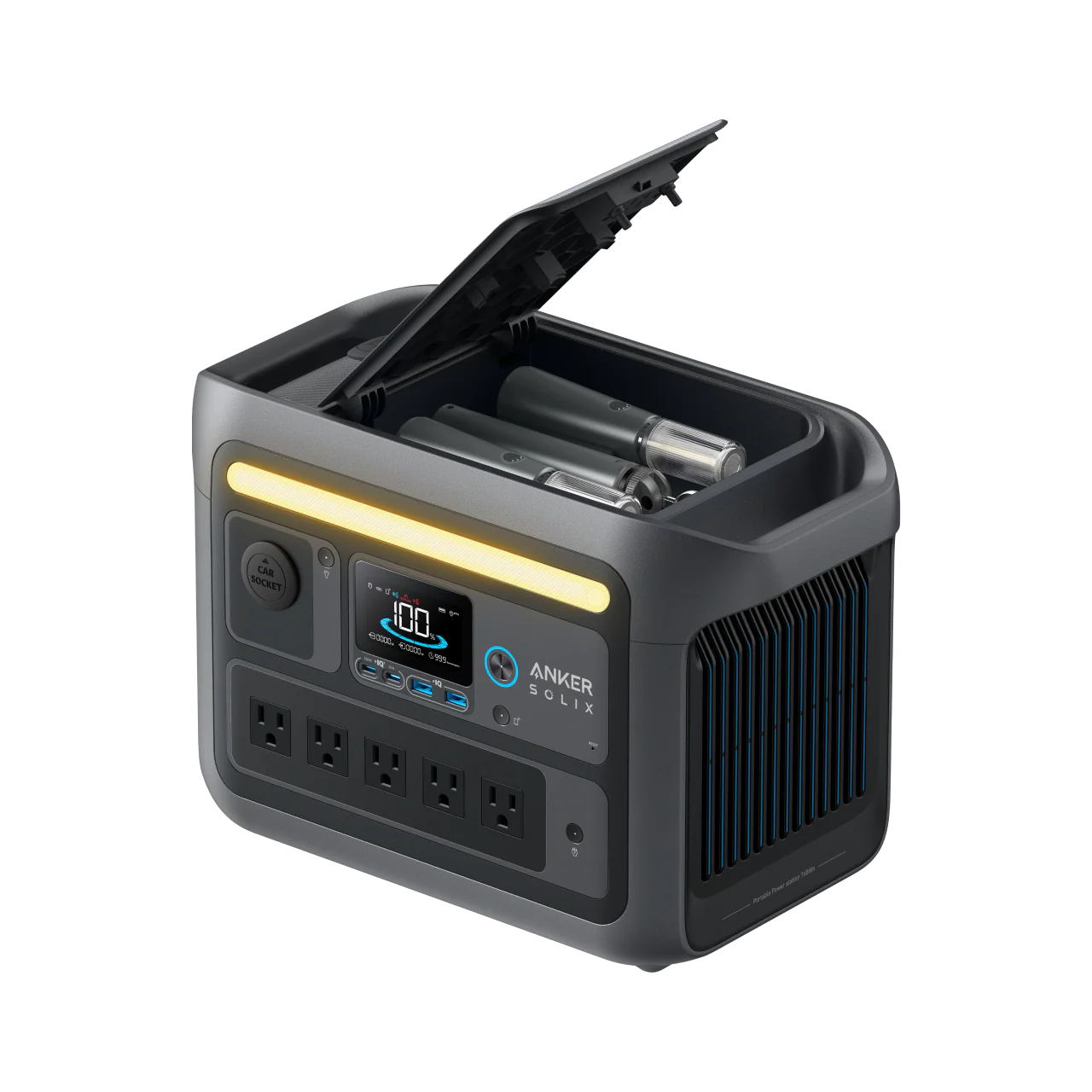
No longer sold
Anker has replaced the C800 line with the C800X — at $449.99 it currently ships with a 100W solar panel included, so the newer unit costs less than the C800 did.
SOLIX C800X · $449.99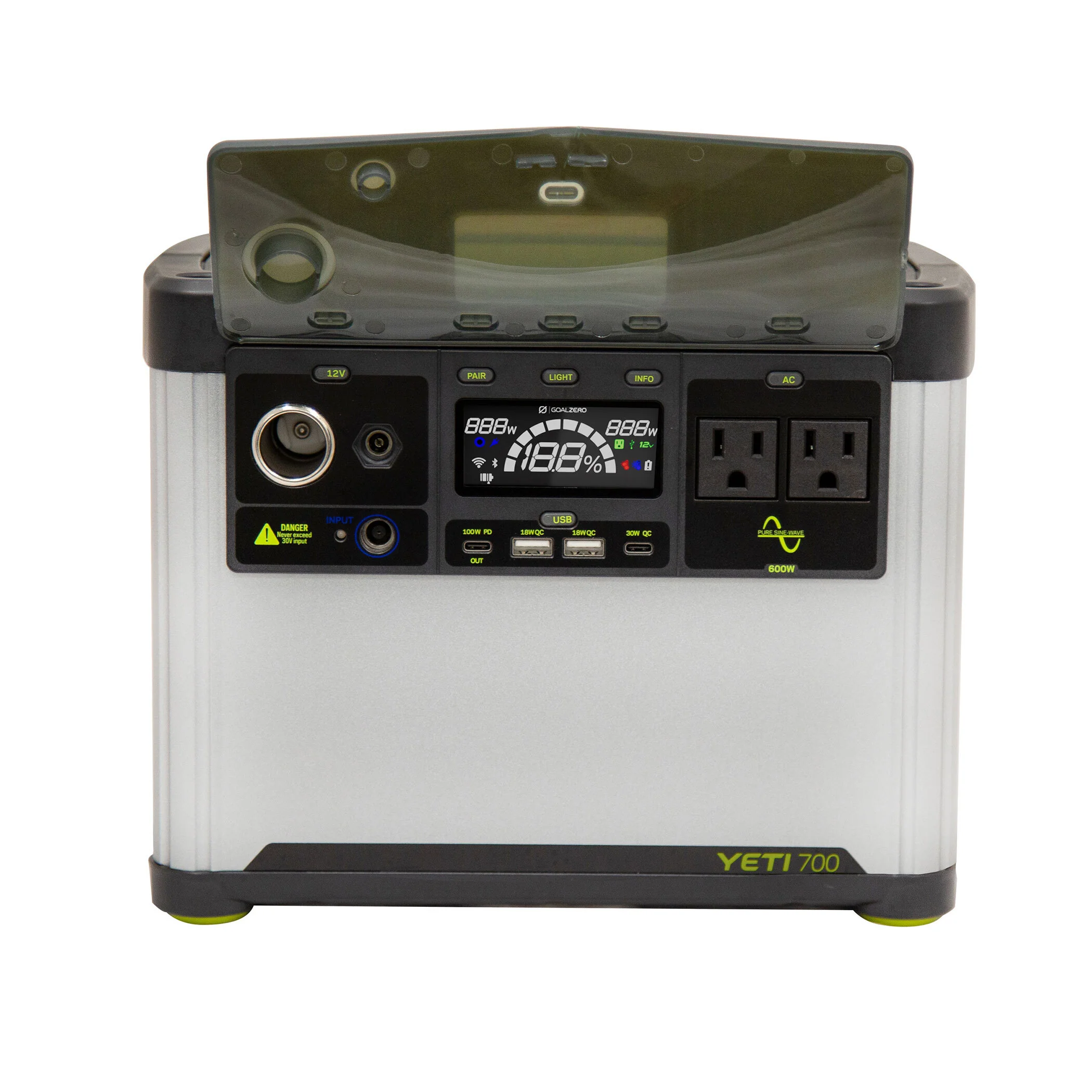
$699.95 · direct from Goal Zero
Last checked 1 day ago. Prices move — check before you buy.
Spec deltas
The Yeti 700 asks $101 more than the SOLIX C800 and hands back half the continuous output for it: 600W against 1,200W. It also holds 91Wh less and accepts 100W less solar. That's a lot of ground to make up on a $700 box.
It doesn't make the ground up on lifetime cost either. Both units land on 26 cents per lifetime kilowatt-hour, because the Yeti's 4,000-cycle rating and the C800's 3,000 are separated by roughly the same $101 you hand over at checkout to get them. The extra cycles aren't a bonus. They're the invoice.
What the Yeti genuinely has is an IPX4 ratingB2 and 4.5 fewer pounds to carry, against a C800 with no IP rating at allA2. If this thing is going to sit in an open truck bed or on a boat deck, that single line is worth the money. If it's going to live in a garage and come out on weekends, the Anker wins on nearly every axis that will touch your evening.
What the Numbers Reveal
Each conclusion stated first — the numbers behind it on one line, the full analysis below.
continuous output
The honest version of the C800's advantage is that it runs a heating appliance once per charge. The Yeti's 600W ceiling doesn't run one at all, because a 1,000W load is above its rated line before you plug in anything else. At this price the choice isn't more coffee versus less. It's coffee versus none.
SOLIX C800: 1,200W continuous, 1,600W surge, 768WhYeti 700: 600W continuous, 1,000W surgea tester ran a 1,000W coffee maker on the C800 for 42 minutes straightA3
Why it mattersIf anything on your list has a heating element in it, the C800 is the only one of these two that's even a candidate, and you should still budget one use per charge.
rated cycles
At one full cycle a day the C800 reaches 8.2 years and the Yeti 11, so both run long past the 5-year warranty they share. The $101 premium buys years nine through eleven of a 677Wh battery, at a point when 677Wh will read like a phone charger, and it charges you for those years during years one through eight, when you're the one living with a 600W ceiling.
C800: $599, 3,000 cycles at 768Wh, 2,304 kWh over its lifeYeti 700: $700, 4,000 cycles at 677Wh, 2,708 kWh over its lifeboth land at $0.26 per lifetime kilowatt-houridentical 5-year warranties
Why it mattersUnless you truly plan to cycle this to empty every day for the better part of a decade, stop reading the cycle rating as a reason to pay more.
solar input
An outage doesn't schedule itself around your solar window, and a campsite doesn't either. Between the 300W ceiling and a 58-minute wall recharge, the C800 turns whatever window you get into a full battery, so you can drain it over dinner and leave with it full in the morningA9A15. The Yeti needs a longer, better window to accomplish less.
C800: 300W solar input into 768WhYeti 700: 200W solar input into 677Whthe C800 reached a full charge in 58 minutes on a 600W wall adapterA9
Why it mattersAnyone buying this for blackouts should weigh intake ahead of capacity, because the gap in refill speed is far wider than the 91Wh gap in what they hold.
The Yeti's advantage isn't the scale, it's the seal. IPX4B2 means it can sit out through a squall or ride in an open bed, while the C800 wants a cover the moment weather threatensA2. No amount of the Anker's extra output compensates for that, because you can't spec your way out of water.
Yeti 700: 19.3 lbs, IPX4 ratedB2SOLIX C800: 23.8 lbs, no IP weather ratingA2at its weight the C800 was called too heavy to carry any distance on footA12
Why it mattersIf the unit will regularly be outdoors and unattended, buy the Yeti. If it's a garage-to-campsite tool, the pounds are a rounding error and the seal never gets tested.
The specific dimensions that decide these two units — everything else is a tie.
Runtime: Will It Power Your Gear?
Selected because: 1,200W against 600W decides more here than 768Wh against 677Wh, because one of these takes an appliance and the other doesn't.
continuous output
A full-size fridge pulls 700 to 800W just to startA11. That fits inside the Yeti's 1,000W surge and sits well above its 600W continuous rating, so whether it works comes down to how briefly the spike lasts. The C800 has 1,600W of surge with 1,200W of continuous underneath it. There's no coin flip to run.
The capacity gap is the least interesting number on this page. 91Wh separates them, about 13% more energy in the Anker. The output gap is 100%. When two batteries sit within a tenth of a kilowatt-hour of each other, what you can plug in matters more than how long you can leave it plugged in.
Lifetime Value
Selected because: Both land at 26 cents per lifetime kilowatt-hour, so the Yeti's extra 1,000 cycles are something you buy, not something you get.
These two cost the same to own, to the cent. 3,000 cycles at 768Wh is 2,304 kilowatt-hours across the C800's life; 4,000 cycles at 677Wh is 2,708 across the Yeti's. Divide each by its price and both come out at 26 cents per lifetime kilowatt-hour. Goal Zero's longevity edge is real, and it's already in the sticker.
Per warranty year the same thing happens from the other direction: $120 a year of coverage on the Anker against $140 on the Goal Zero, for terms that are identical at 5 years. Longevity you have to pay list price for isn't an advantage. It's a purchase, and the fair question is what else that money could have bought you.
Portability & Form Factor
Selected because: 4.5 pounds and a rain rating are the Yeti's entire physical case, and this is where you decide what they're worth.
weight
Nineteen pounds and twenty-four pounds are the same lift. Both are two hands and a straight back, out of the trunk and onto the table, and the C800 was already flagged as too heavy to carry any real distance on footA12, a verdict that would hold just as well 4.5 pounds lighter. If you were hoping the Yeti was the one you could hike with, it isn't.
The seal is the actual difference. IPX4B2 means the Yeti shrugs off rain and spray, where the C800 has no IP rating and needs covering when the weather turnsA2. That's the whole physical case for Goal Zero here, and it's a strong one for exactly the people it applies to: open truck beds, boat decks, job sites, anything left out overnight.
What the Specs Don't Tell You
Selected because: Anker publishes 45dB under load and Goal Zero publishes nothing, which matters more than it sounds if this ends up beside a bed.
rated cycles
Anker says the C800 runs at 45dB under load. Goal Zero says nothing at all about the Yeti 700. That asymmetry is worth more than the number itself. 45dB is modest, roughly a fridge humming across the room, and knowing it lets you decide in advance whether this belongs beside a tent wall. With the Yeti you find out after the card clears.
Credit where it's due on the inverter: the Yeti reserves 1,000W of surge over a 600W rating, which is 1.7x headroom, where the C800's 1,600W over 1,200W is 1.3x. More reserve usually signals an inverter that takes motor starts without complaint. It's still reserve over a smaller number, and the ceiling is the part you hit. Warranty is a genuine tie at 5 years each, so it settles nothing.
Brand Trust
Selected because: Goal Zero prices at a premium built on heritage and support, and only one of those two is still intact.
Goal Zero's premium has always rested on two things: being the oldest name in this category, and support that answered. The first is intact. The second has slipped badly, with long waits and tickets sitting unaddressed for weeks, and the official community forums have been shut down, which is a strange move for a brand whose loyalists are its best asset.
Anker isn't clean here either. SOLIX support quality is trending down from the no-hassle replacements that built the name, and firmware updates have pulled features without warning. Neither support column is a reason to pay more, which is precisely the problem for the unit that costs more. What Goal Zero still genuinely owns is the Yeti-Ready ecosystem of coolers, lights and vehicle kits built around the battery. If you're already in it, that's worth something no spec table shows.
Strengths & trade-offs
Anker SOLIX C800
Strengths
- +Costs $101 less
- +Larger battery capacity
- +Higher AC output
- +Faster solar charging
Trade-offs
- –Shorter-lived battery — rated for 3,000 charge cycles vs the Yeti 700's 4,000, so it wears out sooner.
Goal Zero Yeti 700
Strengths
- +Lighter by 3.5 lb
- +Rated for 4,000 charge cycles — much longer battery lifespan
Trade-offs
- –Weaker inverter (-600W) limits appliance compatibility.
Will It Power Your Gear?
Scenario math and per-appliance runtimes, modeled from the spec record.
Scenario verdicts
We ran the math on six real-world scenarios. Here's which unit survives your actual life.
SCN-01 · 2 nights · needs 2,100Wh
Weekend Camping
Two nights off-grid with essential comfort
Neither unit
Neither unit covers this scenario's 2,100Wh: the SOLIX C800 comes up 1,447Wh short (about 31% covered), the Yeti 700 1,525Wh (27%). Treat this as partial cover — enough for the essentials in it, not the whole list.
Battery budget usedlower = more headroom
LOAD Phone Charger 15W×6h · LED Lights 40W×8h · Box Fan 75W×14h · CPAP Machine 40W×16h
SCN-02 · 8 hours · needs 1,645Wh
8-Hour Blackout
Keep the essentials running through a night without power
Neither unit
Eight hours of outage loads adds up to 1,645Wh, roughly two and a half times what the C800 holds usable and nearly three times the Yeti's. Neither one carries the night by itself. What separates them is what you can plug in during the hours they do cover: 1,200W takes an appliance, 600W takes electronics.
Battery budget usedlower = more headroom
LOAD Fridge 150W×8h · Router + Modem 20W×8h · LED Lights (4 bulbs) 40W×6h · Phone Charger 15W×3h
SCN-03 · 8 hours · needs 320Wh
CPAP Overnight
Sleep therapy without interruption — the #1 medical use case
Either unit
A CPAP night runs 320Wh and both units cover it with room to spare, at 49% of the C800's usable capacity and 56% of the Yeti's. So it comes down to the thing sitting eighteen inches from your head at 3 a.m. Anker publishes 45dB under load for the C800; Goal Zero publishes nothing for the Yeti 700. Neither will be straining at this draw, but only one of them told you what it sounds like when it does.
Battery budget usedlower = more headroom
LOAD CPAP Machine 40W×8h
SCN-04 · 8 hours · needs 910Wh
Remote Workday
Full work day off-grid without power anxiety
Neither unit
Neither unit covers this scenario's 910Wh: the SOLIX C800 comes up 257Wh short (about 72% covered), the Yeti 700 335Wh (63%). Either gets you most of the way, so this is a scenario you plan around rather than one you should rule them out for.
Battery budget usedlower = more headroom
LOAD Laptop 60W×8h · External Monitor 30W×8h · Router + Modem 20W×8h · Phone Charger 15W×2h
SCN-05 · 4 hours · needs 670Wh
Tailgate Party
Game day power for the crew
Neither unit
670Wh of tailgate is a near miss for the C800 at 103% of its usable capacity and a clearer miss for the Yeti at 116%. Nobody's making it to the fourth quarter on either one. The Anker gets closer, and its 1,200W inverter will still take an appliance at the point where the Yeti's 600W has already said no. Plan a recharge either way.
Battery budget usedlower = more headroom
LOAD Blender 400W×0.5h · LED TV (55") 80W×4h · Bluetooth Speaker 15W×4h · Phone Charger (×3) 45W×2h
SCN-06 · 24 hours · needs 4,685Wh
Van Life Daily
A full day of mobile living — the ultimate endurance test
Neither unit
Neither unit covers this scenario's 4,685Wh: the SOLIX C800 comes up 4,032Wh short (about 14% covered), the Yeti 700 4,110Wh (12%). This is well outside what either unit is for; the right answer here is a larger station, not a choice between these two.
Battery budget usedlower = more headroom
LOAD Mini-Fridge 150W×24h · Laptop 60W×4h · Phone Charger 15W×3h · LED Lights 40W×5h · Fan 75W×8h
The Load Test
RUNTIME = (Wh × 0.85) ÷ LOAD
None of the scenarios above exactly yours? Build it. Toggle what you'd plug in; both units are tested against the combined draw.
Essentials
Comfort & Convenience
High-Draw Appliances
Test duration
8h
Continuous draw
205W
Projected runtime
For this load: SOLIX C800 runs 3.2h vs 2.8h.
Modeled from the spec record — same math as the tables below. Methodology
Runtime by appliance
Real-world runtime estimates for common appliances, modeled at 85% inverter efficiency.¹
Essentials
The basics you need runningscale 0–43.5hComfort & Convenience
Makes off-grid life actually enjoyablescale 0–8.7hHigh-Draw Appliances
These reveal the real limitsscale 0–0.7h¹ Runtime = (capacity × 0.85) ÷ appliance watts. Within each group, all bars share one time scale (the group's longest runtime), so lengths are comparable across appliances; identical runtimes collapse into a single blue/orange bar. Actual runtime varies with battery age, temperature, and simultaneous loads — see methodology.
Conclusion
August 2, 2026
Verdict: the SOLIX C800
Take the SOLIX C800. It's $101 cheaper, holds 91Wh more, doubles the continuous output to 1,200W, and takes in 300W of solar against 200W. The Yeti's best arithmetic answer gets erased by its own price tag: 4,000 cycles against 3,000 still leaves both units at 26 cents per lifetime kilowatt-hour. There is exactly one situation where the Yeti 700 is the right buy, and it's a real one. It carries an IPX4 ratingB2 where the C800 has noneA2, so if this unit is going to get rained on, weather sealing beats every number above it. Short of that, the decision isn't close.
Editor-assigned confidence, based on cited owner research and spec analysis.
List prices as of August 2, 2026. The links below open Anker's and Goal Zero's current prices.
$599.00 · direct from Anker
Last checked 1 day ago. Prices move — check before you buy.
or check the Yeti 700 price$699.95 list
Written by Ian Schneider, Solar & Off-Grid Tester · Station Arena Test Desk · Updated August 2, 2026
Measured Data
Benchmark scores and the full spec record, side by side.
Benchmark scores
Full specifications
ᵈ Derived: price ÷ rated capacity. See the data behind our comparisons →
Comparison ToolAdd more power stations, side by sideOpen Tool →How these numbers are produced
Numeric verification
Every figure on this page traces to our spec database or arithmetic on it — no estimated numbers.
Owner claims
Statements about owner experience are cited to published reviews — see Sources & Research Notes below.
Runtime model
Runtime = (rated capacity × 0.85 inverter efficiency) ÷ device wattage. Solar recharge estimates assume panels deliver 70% of rated output. Cold weather, battery age, and stacked loads reduce real-world results.
Power Score
Computed from 14 published spec dimensions, weighted per use-case bench. Higher is better; a unit must meet a bench's minimum threshold to be rated.
See the full weight table and data sourcing on our methodology page →Class ranking (the star rating)
Each unit's star score is a category ranking, not customer reviews — no buyer opinions feed it. We score every station on size-independent quality (value, output, portability, endurance, ports, warranty, and more), then percentile-rank it against the other units in its capacity class, so a class-leading compact unit and a class-leading whole-home unit can both earn 5★. Here, SOLIX C800 rates 4.1/5 (47th percentile of 20 Compact-class units), and Yeti 700 rates 3.6/5 (16th percentile of 20 Compact-class units).
How the class ranking is computed →Test Notes & Caveats
Hidden gotchas and advantages we spotted that you won't find on the product page.
45dB, and Anker Says So
45dB is a quiet room with a fridge humming across it, and that's the C800 working rather than idling. It's a modest number. More to the point, it's a number, so you can decide before buying whether you want it beside a tent wall or a bed.
The Yeti's Inverter Keeps More in Reserve
1,000W of surge over a 600W rating is 1.7x headroom, where the C800's 1,600W over 1,200W is 1.3x. The bigger reserve is a genuine mark in Goal Zero's favor, since inverters that hold more back tend to take motor starts without complaint. Just note where it tops out: 1,000W is the Yeti's absolute ceiling, and it's a load the C800 handles with 600W of surge still unspent.
Warranty: No Difference
Both units carry the same 5-year warranty, so coverage isn't a tiebreaker here.
Battery Lifespan in Real Years
The Yeti 700 is rated for 4,000 cycles vs 3,000. In real life: at daily use, that's 11 vs 8.2 years. At weekend use (twice a week), it's 38 vs 29 years. After hitting the cycle limit, the battery doesn't die — it drops to ~80% of original capacity, which is still very usable.
Goal Zero Doesn't Publish a Noise Figure
There's no dB rating for the Yeti 700. That isn't evidence it's loud, since plenty of quiet units skip the spec. It does mean the one question you can't settle before buying is the one you'll be asking at 2 a.m. with the fan running.
Full record above — the Test Desk pick is the SOLIX C800.
Check SOLIX C800 price →or check the Yeti 700 priceOwnership Analysis
What happens after you buy — true cost of ownership, brand trust, and growth potential.
Lifetime value
Service lifeyears at one full cycle per day
Lifetime energy delivered
Cost per delivered kWh
│ warranty ends · Reaching the cycle rating means ~80% capacity remains — degraded, not dead.
Analyst note
Both units cost the same to own over their rated lives — $0.26/kWh each. Lifetime cost can't separate them, so decide on the sticker price and everything else.
Brand trust
Anker
Ecosystem
7-8 SOLIX portable power stations across C-series (compact) and F-series (flagship), plus the X1 home energy system
Support
Anker's name was built on no-argument replacements, and that's still why a lot of people buy it. The SOLIX line is where the reputation is thinning: more scripted first-line responses, and return logistics on a battery this size are a project of their own.
Community
Moderate — active Reddit (r/Anker, r/AnkerSOLIXCommunity) and growing. Benefits from Anker's massive consumer electronics brand awareness.
App experience
Rated 4.5/5 iOS (~1,100 ratings) · 4.3/5 Android
Unique strength
Parent brand trust from Anker's consumer electronics dominance. InfiniPower technology for long cycle life. Strong $/Wh value in the mid-size and larger units — the S2000, F2600 and C1000 are among the better buys per watt-hour in the catalog.
Worth knowing
Firmware updates have removed features without warning. It isn't constant, but it has happened, and there's no version of the software you get to refuse.
Goal Zero
Ecosystem
Focused — a compact current line (6th-gen Yeti and Yeti Pro series), the previous-gen X series now out of stock across every model on Goal Zero's own store (checked 2026-09-13: 200X, 500X, 1000X, 1500X, 3000X, 6000X, some listed only as open-box), so buying one new means finding retailer stock, Sherpa power banks for the under-100Wh tier, plus Alta coolers, Nomad/Ranger solar panels, and vehicle integration kits
Support
Goal Zero is a Salt Lake City company and the oldest name in the category, which is most of what the premium has always bought. The support that once justified it has slipped, with long waits and unanswered email, and the official community forums are gone.
Community
Small but loyal — strong following in overlanding and preparedness communities. Official community forums were recently shuttered, frustrating long-time users.
App experience
Rated 4.4/5 iOS (~1,200 ratings) but recent reviews skew negative — recurring connectivity issues, crashes, and stability problems.
Unique strength
Pioneer of the portable power market — strongest brand heritage. US-based company with ruggedized, weather-resistant designs (IP ratings vary by model). Integrated "Yeti-Ready" ecosystem with coolers, lights, and vehicle kits.
Worth knowing
The Yeti-Ready ecosystem is the real asset: coolers, lights and vehicle integration kits designed around the battery. If you're already inside it, that's worth something the spec sheet can't show you.
Analyst note
Neither brand's support column is a reason to pay more right now, which is a particular problem for the unit that costs more. What's left of the Goal Zero premium is heritage and ruggedized design. Buy it for the ecosystem around it if you want that ecosystem. Don't buy it expecting a better help desk.
Growth path
SOLIX C800
FIXED CAPACITYFixed at 768Wh, with no expansion — so size it for your needs up front rather than planning to add capacity later.
Accepts up to 300W of solar. Limited to a single portable panel.
Adequate ports for most setups, but heavy users may want a power strip.
Yeti 700
FIXED CAPACITYFixed at 677Wh, with no expansion — so size it for your needs up front rather than planning to add capacity later.
Accepts up to 200W of solar. Limited to a single portable panel.
Adequate ports for most setups, but heavy users may want a power strip.
Realistic full solar rechargeat 70% of rated panel output — see methodology
Analyst note
Neither expands, and that's no knock on either — each is a complete unit at a fixed size. Buy the capacity that covers your needs now (the SOLIX C800 gives you the larger ceiling); you can't add to either later.
What Owners Report
Patterns from published owner reports and long-term reviews — every claim cited to its source below.
Anker SOLIX C800
The C800's field record comes from hands-on review sites rather than owners who have lived with one for a year, so read all of it as tester experienceA1A9A13. What the testers found is consistent. A 1,000W coffee maker ran 42 minutes straightA3. A 1,500W space heater held for 25 minutes past the 1,200W rating before the unit throttled itA8. A 30-inch drop from a tailgate onto gravel left scuffing and nothing elseA1. The 58-minute recharge on a 600W adapter drew the most comment, against rivals in the class that take over two hoursA9A15.
The complaints are just as specific. There's no IP weather rating, so it needs covering outdoorsA2. It's heavier than several similarly sized rivalsA4 and too heavy to carry any distance on footA12. 300W is a middling solar ceiling for a unit this sizeA5. The 4.7-star retailer rating across 692 reviews is the closest thing to crowd data hereA10, and what's missing is anything long-term: no six-month account, no cold-weather report, nothing either way on firmwareA10A13.
“We dropped it from a tailgate (30 inches) onto gravel—only minor scuffing, no damage.”
Sources
backuppowerhub.com · portablepowergeek.co.uk · batteryskills.com · batteryessence.com · toolsandtoys.net · bikmantech.com
Goal Zero Yeti 700
The Yeti 700's record is thinner still, and most of it traces back to Goal Zero's own materials rather than to people who own oneB1B4. The substance of it: sixth-generation LiFePO4 rated past 4,000 cycles, framed as daily use for more than ten yearsB1, an IPX4 rating with tolerance for temperature extremesB2, and a place in the modern LFP family that replaced the older NMC X-seriesB4.
The one clearly independent read lands it as light and simple rather than powerful, aimed at buyers who care most about portabilityB3. That's a fair description and it matches the spec sheet, which is reassuring as far as it goes. But there's no published noise figure, no cold-weather account and no long-term reliability report on this model, so the ruggedness claim is still the manufacturer's to proveB2B3.
“A 6th-generation 677Wh compact power station on upgraded LiFePO4 chemistry rated for 4,000+ cycles — daily use for over 10 years.”
Sources
goalzero.com · amazon.com · campingsolar.us · outdoorgearlab.com
Sources & Research Notes
Every owner claim in this report is traceable to a published source. The bracketed references above resolve here.
Recurring owner themes
- Build quality/chassis is repeatedly called solid and drop-resistant, but reviewers flag the lack of an IP weather rating as a real-world caveat for outdoor use. [SOLIX C800 · 3 entries]
- The 58-minute AC fast-recharge is the single most-mentioned standout feature, praised as faster than rivals like the Jackery 700. [SOLIX C800 · 2 entries]
- Reviewers note the unit can briefly exceed its 1200W rating for heavy appliances, but caution it can't sustain full-size continuous loads like a full-size fridge. [SOLIX C800 · 2 entries]
- Long 5-year warranty and strong retailer star ratings are cited as reassurance/value signals. [SOLIX C800 · 2 entries]
- Weight (~23-24 lbs) is repeatedly flagged as a downside relative to lighter rivals despite the compact footprint. [SOLIX C800 · 2 entries]
- Modern LFP (4,000+ cycles), IPX4 ruggedness, and light, simple portability are the highlights; modest power and capacity. [Yeti 700 · 3 entries]
- A1
“We dropped it from a tailgate (30 inches) onto gravel—only minor scuffing, no damage.”
backuppowerhub.com — Anker SOLIX C800 Review: Best Budget Power Station? · 2025-12 · [positive]
- A2
“However, the C800 lacks IP weather rating. Keep it covered when camping.”
backuppowerhub.com — Anker SOLIX C800 Review: Best Budget Power Station? · 2025-12 · [negative]
- A3
“A 1,000W coffee maker ran 42 minutes straight.”
backuppowerhub.com — Anker SOLIX C800 Review: Best Budget Power Station? · 2025-12 · [positive]
- A4
“The Solix C800 is nearly 3kg heavier than the River 2 Pro, and 2.5kg heavier than the Grecel T1000.”
portablepowergeek.co.uk — Anker Solix C800 Review · 2024-11 · [negative]
- A5
“Only allows a middling amount of solar charge at 300W max solar panels, when compared to its equivalently-sized models.”
portablepowergeek.co.uk — Anker Solix C800 Review · 2024-11 · [mixed]
- A7
“Zero fan noise under 500W loads, unlike louder competitors (e.g., Bluetti EB55). Only a mild hum at max load.”
batteryskills.com — Anker SOLIX C800 Portable Power Station Review · 2025-10 · [positive]
- A8
“Powered a 1500W space heater (surpassing its 1200W rating) for 25 minutes before throttling—unexpectedly robust for its size.”
batteryskills.com — Anker SOLIX C800 Portable Power Station Review · 2025-10 · [positive]
- A9
“Achieved a full charge in 58 minutes using a 600W AC adapter (matching Anker's claim), while competitors like the Jackery 700 take 2+ hours.”
batteryskills.com — Anker SOLIX C800 Portable Power Station Review · 2025-10 · [positive]
- A10
“Holds a 4.7-star rating from 692 Amazon reviews and ranks #81 in Outdoor Generators.”
batteryessence.com — Anker SOLIX C800 Portable Power Station 768Wh Review (retailer review summary) · 2026-03 · [positive]
- A11
“The 1200W output won't run a full-size refrigerator (700-800W startup) plus other essentials for long.”
batteryessence.com — Anker SOLIX C800 Portable Power Station 768Wh Review · 2026-03 · [negative]
- A12
“At 23.15 lbs (10.5 kg), this is too heavy for carrying far on foot. For hiking, a smaller, lighter power bank under 5 lbs is a better fit.”
batteryessence.com — Anker SOLIX C800 Portable Power Station 768Wh Review · 2026-03 · [negative]
- A13
“The top of the C800 is simply an empty storage area for keeping your smaller gear safe and organized.”
toolsandtoys.net — Anker SOLIX 'C800' and 'C800 Plus' Portable Power Stations · 2024 (CES 2024 launch coverage) · [neutral]
- A15
“The 58-minute fast charge means you can drain it all evening and have it ready by morning. No more planning days ahead for recharging.”
backuppowerhub.com — Anker SOLIX C800 Review: Best Budget Power Station? · 2025-12 · [positive]
- B1
“A 6th-generation 677Wh compact power station on upgraded LiFePO4 chemistry rated for 4,000+ cycles — daily use for over 10 years.”
goalzero.com / amazon.com — Yeti 700 · 2026 · [positive]
- B2
“Carries an IPX4 water-resistance rating and can handle extreme temperatures — a rugged, outdoor-ready design.”
goalzero.com / campingsolar.us — Yeti 700 review · 2026 · [positive]
- B3
“Ideal for quick camping trips and device charging — not the most powerful or capable, but lightweight and simple, appealing to portability-focused users.”
outdoorgearlab.com — Yeti 700 review · 2026 · [mixed]
- B4
“Part of Goal Zero's 6th-gen LiFePO4 Yeti family — a modern LFP replacement for the older NMC X-series.”
goalzero.com — Yeti 6th-gen family · 2026 · [positive]
Research compiled August 2, 2026.
Who Should Buy Which
Buy the SOLIX C800 if you…
- →You want a coffee maker or a kettle to actually work at the campsite. 1,200W of continuous output covers a 1,000W appliance with room left overA3; 600W covers none of it.
- →You're buying for outages and you top up in whatever window the sun or the grid gives you. 300W of solar intake and a 58-minute wall rechargeA9 make short windows count.
- →You want the watt-hours. 768Wh at $599 works out to 78 cents per watt-hour against the Yeti's $1.03, and the Anker is the larger battery of the two.
- →It lives in a garage or a trunk and comes out on weekends. The extra 4.5 pounds never leave the vehicle, and the missing rain rating never gets tested.
This is you — check the SOLIX C800 price
Buy the Yeti 700 if you…
- →It rides in an open truck bed, on a boat, or on a roof rack, and it will get wet. IPX4B2 is the one advantage on this page that $101 can't buy you on the Anker.
- →Your loads are genuinely small: phones, a laptop, lights, a CPAP. 677Wh and 600W cover that night after night, and it's the lighter box to carry to the tent.
- →You already own the Yeti-Ready coolers and vehicle kits and would rather keep one brand's accessories talking to each other.
- →You'll cycle it to empty every single day for a decade. 4,000 cycles is 11 years at that pace against the C800's 8.2, and you're one of the few buyers who will ever reach the difference.
If neither fits
If the plan is running a full-size refrigerator through a multi-day outage, close this tab. A fridge starts at 700 to 800WA11 and cycles all day and night, and eight hours of ordinary outage loads already comes to about two and a half times what the C800 holds usable. You want a unit several times this size with an inverter to match. Worth knowing before you shop: neither of these expands, so buying small now and adding capacity later isn't an option on either one.
The Bottom Line
Buy the SOLIX C800. You pay $101 less and get the bigger battery, double the continuous output and half again the solar intake, and the one number pointing the other way is cancelled by the price attached to it, since 4,000 cycles and 3,000 cycles both land these units at 26 cents per lifetime kilowatt-hour. That isn't a close decision dressed up as one.
The exception is real and it's narrow. If the unit is going to live outdoors, the Yeti's IPX4 shellB2 is the one advantage here the C800 can't answerA2, and no amount of extra watts helps a box that got rained on. Everyone else: take the Anker, and take the coffee maker with you.
Frequently Asked Questions
Answers drawn from the spec record and cited owner research.
Can the Goal Zero Yeti 700 run a coffee maker?
Not a 1,000W one. The Yeti's inverter stops at 600W continuous with a 1,000W surge, so a 1,000W appliance is above its rated line before you plug anything else in. The C800 handles that class of load, with a tester getting 42 minutes out of a 1,000W coffee maker. If small appliances are the reason you're buying, only one of these two is a candidate.
Why does the Yeti 700 cost more when it holds less?
You're paying for 4,000 cycles instead of 3,000, an IPX4 weather rating, and 4.5 fewer pounds. Two of those three are worth something. The cycle advantage isn't, in cost terms: both units come out at 26 cents per lifetime kilowatt-hour, so the longer life is precisely what the extra $101 buys rather than a bonus riding on top of it.
Which one is quieter for a CPAP?
Anker publishes 45dB under load for the C800, and one reviewer reported no fan noise at all below 500W. Goal Zero publishes no figure for the Yeti 700. A CPAP night runs about 320Wh, which is 49% of the C800's usable capacity and 56% of the Yeti's, so neither unit is working hard enough to reach its noisiest. The difference is that with the Anker you know in advance what you're getting.
Can I add more battery to either one later?
No. Both are fixed: 768Wh in the C800 and 677Wh in the Yeti 700, with no expansion battery available for either. That isn't a flaw in either design, it's simply what they are, so buy the capacity you need on day one. The C800 gives you the higher ceiling of the two by 91Wh.
How fast does each one recharge?
From the wall, the C800 reached full in 58 minutes on a 600W adapter. From solar, its 300W input cap against 768Wh works out to roughly two and a half hours of ideal sun, where the Yeti's 200W cap against 677Wh is closer to three and a half. Panels rarely hit their rating in real conditions, so treat both solar figures as best cases and plan for longer on a cloudy day.
Check SOLIX C800 price →
Where to buy
Anker SOLIX C800Pick
$599.00
$599.00 · direct from Anker
Last checked 1 day ago. Prices move — check before you buy.
Goal Zero Yeti 700
$699.95
$699.95 · direct from Goal Zero
Last checked 1 day ago. Prices move — check before you buy.
Prices may vary by retailer and are subject to change.