Head-to-head test
Goal Zero Yeti 500X vs Goal Zero Yeti 700
Both units charge you about a dollar per watt-hour, so the Yeti 700's eight-times-longer cycle rating is effectively free, and the 500X's entire case is $200 less cash and 7.4 fewer pounds to carry.
Full profiles: Goal Zero Yeti 500X → · Goal Zero Yeti 700 →

Written by Wenny ZhengUpdated
Portable Power Tester, Station Arena Test Desk
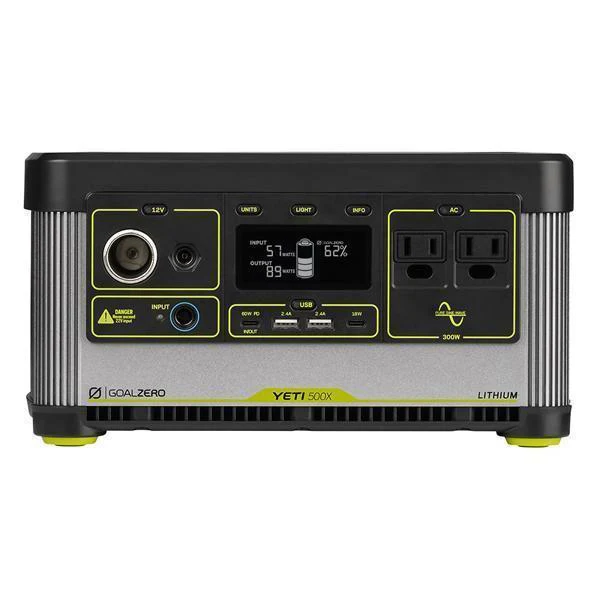
$499.95 · direct from Goal Zero
Last checked 1 day ago. Prices move — check before you buy.
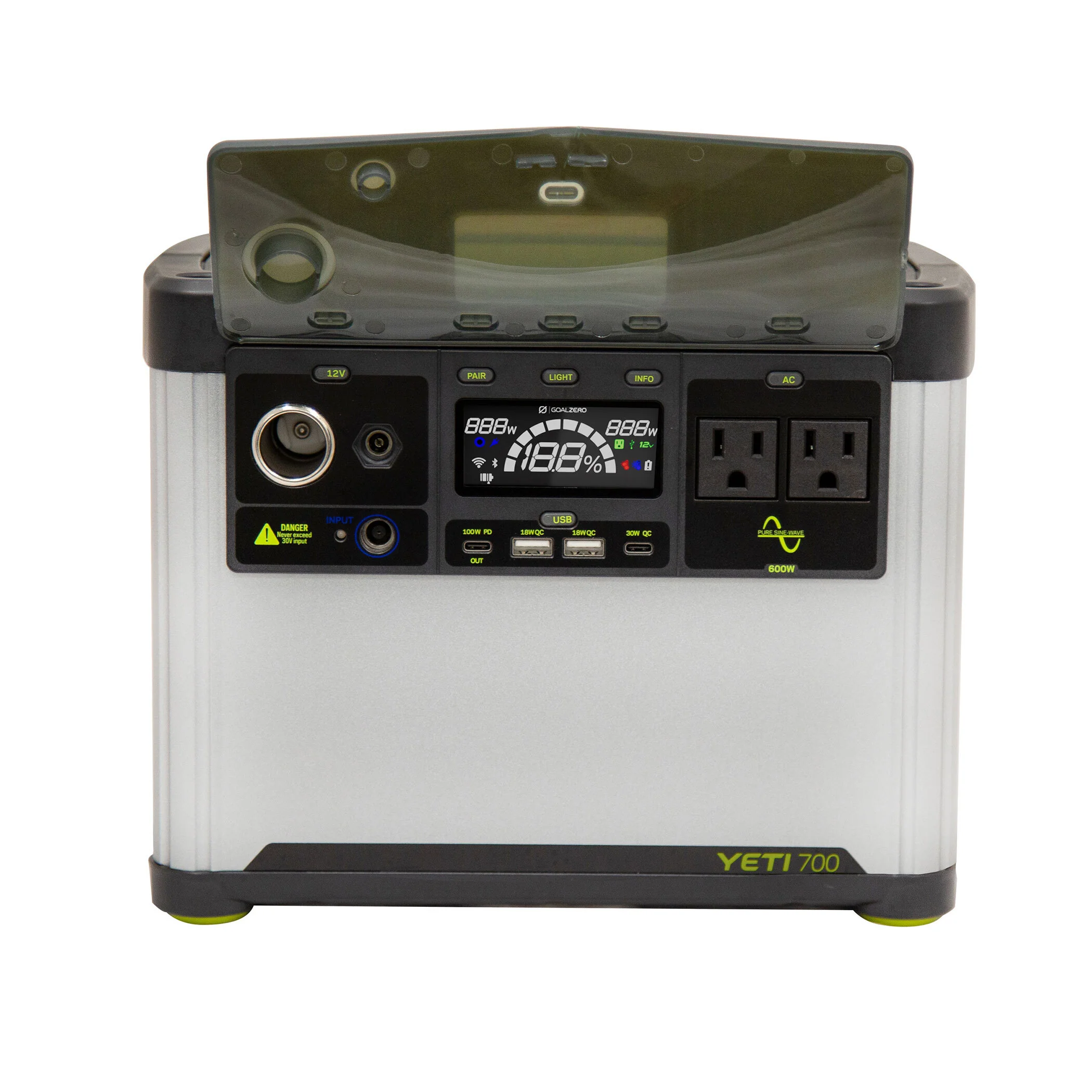
$699.95 · direct from Goal Zero
Last checked 1 day ago. Prices move — check before you buy.
Spec deltas
The Yeti 700 costs $200 more and holds 180Wh more, which reads like the standard bigger-battery upcharge until you divide it out. $500 across 497Wh is $1.01 a watt-hour. $700 across 677Wh is $1.03. You're buying the same energy at the same price, just more of it.
That makes everything else on the 700's side of the sheet free, and there's a lot of it: 4,000 rated cycles against 500, a 600W inverter against 300W, five years of warranty against two, and a 20ms switch to battery the 500X can't do at any speed. Rated out over their cycle lives, the 500X delivers 249 kWh of energy and the 700 delivers 2,708 kWh. Call it $2.01 per lifetime kilowatt-hour against 26 cents. Read that once and the rest of this page is footnotes.
The 500X's case is real but narrow. It's 12.9 pounds against 20.3, it's genuinely compact and well built for its capacityA2, and if you cycle it on weekends rather than daily the 500-cycle rating buys years rather than months. Buy it if $500 is a hard ceiling and nothing you own draws more than 300W. Otherwise the 700 is the unit.
What the Numbers Reveal
Each conclusion stated first — the numbers behind it on one line, the full analysis below.
rated cycles
Which means the eight-fold cycle gap costs nothing to acquire. Across their rated lives the 500X delivers 249 kWh and the 700 delivers 2,708 kWh, or $2.01 per lifetime kilowatt-hour against 26 cents, and you paid no premium per watt-hour to get the better end of that.
Yeti 500X: $500 for 497WhYeti 700: $700 for 677Wh500 rated cycles against 4,000 rated cycles
Why it mattersAnyone framing this as spending $200 more for 180Wh more has the trade backwards. The extra capacity is the least of what the $200 buys.
continuous output
The 400W draw in the tailgate list sits above the 500X's 300W continuous rating, so it never gets to spend a single one of its 497 watt-hours. The 700 holds that load on 600W continuous with room over it. Surge covers the startup spike. It does not raise the ceiling you live under all day.
Yeti 500X: 300W continuous, 600W surgeYeti 700: 600W continuous, 1,000W surgeThe tailgate scenario draws a 400W peak
Why it mattersIf anything you plan to plug in runs above 300W, the 500X is out on the inverter alone and every other line on this page is academic.
solar input
Neither unit covers a full outage day on one charge, so what decides a multi-day event isn't capacity, it's turnaround, and the 700 is ahead on both halves of it. Off a panel its usable energy per day runs further ahead of the 500X than the 180Wh difference on the spec sheet suggests.
Yeti 500X: 120W maximum solar input, 497Wh capacityYeti 700: 200W maximum solar input, 677Wh capacityThe 8-hour blackout list needs 1,645Wh against 422Wh and 575Wh usable
Why it mattersIf you plan to run either of these off the sun rather than a wall socket, the 700's lead is wider than the capacity line makes it look.
The specific dimensions that decide these two units — everything else is a tie.
Lifetime Value
Selected because: The two units price energy two cents apart per watt-hour, so the 500-cycle versus 4,000-cycle gap is the only thing left to decide it.
cost / lifetime kWh
A cycle rating only bills you if you spend it. At one cycle a week the 500X's 500 cycles still cover 9.6 years, which is longer than most people keep a power station, and at that pace the 700's 76.9-year figure is a number with no meaning attached to it. The enormous gap on paper turns into real money only if you cycle these things hard.
The warranty column doesn't come with that caveat. It's $250 per covered year on the 500X against $140 on the 700, and that holds whether you use it nightly or twice a summer. Goal Zero backs the LFP unit for five years and the older NMC one for twoA1B1, and a warranty length is a manufacturer betting its own money on how long its cells hold up. It's the cheapest honest read you get on a spec nobody can test in a store.
Runtime: Will It Power Your Gear?
Selected because: The 500X's 300W continuous inverter, not its 497Wh, is what rules loads in or out.
continuous output
What rules loads in or out here isn't watt-hours, it's watts. The 500X stops at 300W continuous and the 700 runs 600W. On a 300W ceiling you're in laptop, phone, lights and CPAP territory and you stay there, however much charge is sitting in the pack.
Capacity is the smaller story. 497Wh and 677Wh become 422Wh and 575Wh once you take the standard 15% off for inverter losses, so the 700's real headroom is 153Wh. That shows up as one more device-day, not one more appliance. Its USB-C port also delivers 100W against the 500X's 60W, which on units this size is a bigger share of what you'll actually plug in than the AC sockets are.
What the Specs Don't Tell You
Selected because: A 20ms UPS switchover on one unit and none on the other, plus five years of warranty against two, are the differences that cost real money.
rated cycles
Two of the flagged differences move money and one moves nothing. The UPS gap is the serious one: the 700 hands off to battery in 20 milliseconds, the 500X publishes no switchover figure at all, so only one of these belongs behind a desktop. The warranty gap is the other, and it's five years against two.
The app-control flag is noise. The 500X has no app, which on a unit this size means walking over and reading the screen. It's a convenience, it's worth something on a cold morning, and it should be the last thing to tip a $200 decision.
Portability & Form Factor
Selected because: 12.9 lbs against 20.3 lbs is the 500X's one outright win, and for the right buyer it's the whole argument.
weight
12.9 pounds is a grocery-bag lift. One hand, one trip, no planning. 20.3 pounds is still a one-person carry and nothing like the wheeled units, but you feel it on the walk from the car to the site, and you'll set it down once on the way.
That 7.4-pound difference is the only line the 500X wins outright, and for one buyer it's decisive: if the unit gets carried further than it gets cycled, lighter beats longer-lived. If it lives in a closet or a truck bed and only comes out at the destination, weight is the wrong thing to be optimising.
Your Life, Your Pick
Selected because: Five of the six scenarios come back 'neither', which is the most useful thing this page can tell you about either unit.
Five of the six scenarios come back 'neither', and that's the table doing its job. The weekend camping list wants 2,100Wh and these two hold 422Wh and 575Wh usable. This isn't a close-run fight between two blackout units. It's two device chargers being asked to do a generator's work.
The one both units clear is the CPAP night at 320Wh, and they clear it with room over. If that's the job, capacity has stopped being a variable and you're choosing on weight, price, warranty and whether you need the thing to survive the wall going dark.
Strengths & trade-offs
Goal Zero Yeti 500X
Strengths
- +Costs $200 less
- +Lighter by 7.4 lb
Trade-offs
- –Lacks smartphone app control for remote monitoring.
- –Shorter-lived battery — rated for 500 charge cycles vs the Yeti 700's 4,000, so it wears out sooner.
Goal Zero Yeti 700
Strengths
- +Larger battery capacity
- +Higher AC output
- +Longer warranty
- +Faster solar charging
- +Rated for 4,000 charge cycles — much longer battery lifespan
Trade-offs
- –Substantially more expensive (+$200) than the Yeti 500X.
Will It Power Your Gear?
Scenario math and per-appliance runtimes, modeled from the spec record.
Scenario verdicts
We ran the math on six real-world scenarios. Here's which unit survives your actual life.
SCN-01 · 2 nights · needs 2,100Wh
Weekend Camping
Two nights off-grid with essential comfort
Neither unit
2,100Wh is a fridge-and-coffee weekend, and these are laptop-and-lantern units at 422Wh and 575Wh usable. Neither is close. The honest answer is a bigger station, not the bigger of these two.
Battery budget usedlower = more headroom
LOAD Phone Charger 15W×6h · LED Lights 40W×8h · Box Fan 75W×14h · CPAP Machine 40W×16h
SCN-02 · 8 hours · needs 1,645Wh
8-Hour Blackout
Keep the essentials running through a night without power
Neither unit
Eight hours of household essentials comes to 1,645Wh. The 700 holds 575Wh of usable energy, the 500X holds 422Wh, and both are partial cover. Pick the two or three things that genuinely need to stay on and plan around that number, or buy a class larger.
Battery budget usedlower = more headroom
LOAD Fridge 150W×8h · Router + Modem 20W×8h · LED Lights (4 bulbs) 40W×6h · Phone Charger 15W×3h
SCN-03 · 8 hours · needs 320Wh
CPAP Overnight
Sleep therapy without interruption — the #1 medical use case
Either unit
A CPAP pulls about 40W, so eight hours is 320Wh and both units finish the night with charge to spare: 102Wh left on the 500X, 255Wh on the 700. Neither publishes a noise figure, so the fan at 2 a.m. is an unknown on both sides and can't break the tie. What can break it is the wall. Two nights without a recharge needs 640Wh and neither has it, so whichever you buy you're charging daily, and only the 700 switches to battery fast enough (20ms) to keep the machine running when the grid drops mid-night.
Battery budget usedlower = more headroom
LOAD CPAP Machine 40W×8h
SCN-04 · 8 hours · needs 910Wh
Remote Workday
Full work day off-grid without power anxiety
Neither unit
910Wh of laptop, monitor and desk gear is more than either unit holds. The 500X covers about 47% of it and the 700 about 63%, so both are half-day machines unless there's a wall socket or a panel in the picture.
Battery budget usedlower = more headroom
LOAD Laptop 60W×8h · External Monitor 30W×8h · Router + Modem 20W×8h · Phone Charger 15W×2h
SCN-05 · 4 hours · needs 670Wh
Tailgate Party
Game day power for the crew
Neither unit
The 500X is out before capacity gets a say: this list peaks at 400W and its inverter runs 300W continuous. The 700 holds that draw on 600W but carries 575Wh of usable energy against a 670Wh list, so it comes up short too. Wrong size of unit rather than a close call.
Battery budget usedlower = more headroom
LOAD Blender 400W×0.5h · LED TV (55") 80W×4h · Bluetooth Speaker 15W×4h · Phone Charger (×3) 45W×2h
SCN-06 · 24 hours · needs 4,685Wh
Van Life Daily
A full day of mobile living — the ultimate endurance test
Neither unit
4,685Wh a day against 422Wh and 575Wh of usable capacity. That's a roof-solar and house-battery problem, and neither of these is a candidate for it.
Battery budget usedlower = more headroom
LOAD Mini-Fridge 150W×24h · Laptop 60W×4h · Phone Charger 15W×3h · LED Lights 40W×5h · Fan 75W×8h
The Load Test
RUNTIME = (Wh × 0.85) ÷ LOAD
None of the scenarios above exactly yours? Build it. Toggle what you'd plug in; both units are tested against the combined draw.
Essentials
Comfort & Convenience
High-Draw Appliances
Test duration
8h
Continuous draw
205W
Projected runtime
For this load: Yeti 700 runs 2.8h vs 2.1h.
$699.95 list · direct from Goal Zero
Modeled from the spec record — same math as the tables below. Methodology
Runtime by appliance
Real-world runtime estimates for common appliances, modeled at 85% inverter efficiency.¹
Essentials
The basics you need runningscale 0–38.4hComfort & Convenience
Makes off-grid life actually enjoyablescale 0–7.7hHigh-Draw Appliances
These reveal the real limits¹ Runtime = (capacity × 0.85) ÷ appliance watts. Within each group, all bars share one time scale (the group's longest runtime), so lengths are comparable across appliances; identical runtimes collapse into a single blue/orange bar. Actual runtime varies with battery age, temperature, and simultaneous loads — see methodology.
Conclusion
August 9, 2026
Verdict: the Yeti 700, on Power Score margin
Take the Yeti 700. The $200 premium buys energy at the same rate the 500X sells it ($700 across 677Wh is $1.03 a watt-hour, $500 across 497Wh is $1.01), which means the rest of the 700's column arrives without a per-watt-hour premium: 4,000 rated cycles instead of 500, a 600W inverter instead of 300W, five years of warranty instead of two, and a 20ms handoff to battery the 500X doesn't offer at all. Rated across their cycle lives that lands as 26 cents per kilowatt-hour against $2.01. The 500X is the right call in one situation, and it's a narrow one: $500 is a hard ceiling, nothing you plug in draws more than 300W, and the 7.4 pounds you save is weight you'd actually be carrying.
Editor-assigned confidence, based on cited owner research and spec analysis.
List prices as of August 9, 2026. The links below open Goal Zero's current price.
$699.95 · direct from Goal Zero
Last checked 1 day ago. Prices move — check before you buy.
or check the Yeti 500X price$499.95 list
Written by Wenny Zheng, Portable Power Tester · Station Arena Test Desk · Updated August 9, 2026
Measured Data
Benchmark scores and the full spec record, side by side.
Benchmark scores
Not rated for both units (minimum threshold unmet): UPS, CPAP, Solar Generator, Tailgating.
Full specifications
ᵈ Derived: price ÷ rated capacity. See the data behind our comparisons →
Comparison ToolAdd more power stations, side by sideOpen Tool →How these numbers are produced
Numeric verification
Every figure on this page traces to our spec database or arithmetic on it — no estimated numbers.
Owner claims
Statements about owner experience are cited to published reviews — see Sources & Research Notes below.
Runtime model
Runtime = (rated capacity × 0.85 inverter efficiency) ÷ device wattage. Solar recharge estimates assume panels deliver 70% of rated output. Cold weather, battery age, and stacked loads reduce real-world results.
Power Score
Computed from 14 published spec dimensions, weighted per use-case bench. Higher is better; a unit must meet a bench's minimum threshold to be rated.
See the full weight table and data sourcing on our methodology page →Class ranking (the star rating)
Each unit's star score is a category ranking, not customer reviews — no buyer opinions feed it. We score every station on size-independent quality (value, output, portability, endurance, ports, warranty, and more), then percentile-rank it against the other units in its capacity class, so a class-leading compact unit and a class-leading whole-home unit can both earn 5★. Here, Yeti 500X rates 3.5/5 (14th percentile of 22 Personal-class units), and Yeti 700 rates 3.6/5 (16th percentile of 20 Compact-class units).
How the class ranking is computed →Test Notes & Caveats
Hidden gotchas and advantages we spotted that you won't find on the product page.
No App on the 500X, and It Barely Matters
The 500X has no app control, which on a unit this size means walking over and reading the front screen. That's a convenience gap, not a capability gap. The 700 earns its $200 on cycles, inverter headroom and warranty, and this card shouldn't move your decision by a dollar.
The 500X Wins the Ratio and Loses the Point
600W of surge over 300W continuous is 2.0x of headroom. The 700's 1,000W over 600W is 1.67x. The 500X has the better multiplier and the lower ceiling, which is what doubling a small number gets you. Buy on the ceiling, because that's the figure a motor either clears or doesn't.
The 700 Is a UPS. The 500X Is a Battery.
The Yeti 700 hands off to battery in 20 milliseconds when wall power drops. The 500X has no UPS mode and no switchover figure to publish, so anything plugged into it goes down with the grid. If you're shopping because a desktop, a NAS or a router can't be allowed to reboot, this line settles the comparison and nothing else on the page matters.
Two Years Against Five
These are not the same terms, and the split follows the cycle ratings rather than the marketing: Goal Zero backs the 700 for five years and the 500X for two, the same direction as their 4,000-versus-500 cycle figures. A warranty length is a manufacturer betting its own money on how long its cells hold up, which makes it the most honest spec on the sheet.
500 Cycles Against 4,000, Converted Into Years
At a cycle a day the 500X's rating is spent in 1.4 years and the 700's in 11. Most people don't cycle daily, and that's the fair caveat: on weekend use the 500X still covers 4.8 years and the 700's 38.5 becomes a number with nothing behind it. The gap is enormous on paper and only charges you if you use the thing hard.
Full record above — the Test Desk pick is the Yeti 700.
Check Yeti 700 price →or check the Yeti 500X priceOwnership Analysis
What happens after you buy — true cost of ownership, brand trust, and growth potential.
Lifetime value
Service lifeyears at one full cycle per day
Lifetime energy delivered
Cost per delivered kWh
│ warranty ends · Reaching the cycle rating means ~80% capacity remains — degraded, not dead.
Analyst note
The Yeti 500X is cheaper to buy, but the Yeti 700 is cheaper to own. At $0.26/kWh over its lifetime vs $2.01/kWh, the Yeti 700's higher cycle life and capacity make each dollar go further over the years.
Delivers each lifetime kWh for $1.75 less — check the Yeti 700 price →
Growth path
Yeti 500X
FIXED CAPACITYFixed at 497Wh, with no expansion — so size it for your needs up front rather than planning to add capacity later.
Accepts up to 120W of solar. Limited to a single portable panel.
Limited ports. You'll likely need a power strip or splitter.
Yeti 700
FIXED CAPACITYFixed at 677Wh, with no expansion — so size it for your needs up front rather than planning to add capacity later.
Accepts up to 200W of solar. Limited to a single portable panel.
Adequate ports for most setups, but heavy users may want a power strip.
Realistic full solar rechargeat 70% of rated panel output — see methodology
Analyst note
Neither expands, and that's no knock on either — each is a complete unit at a fixed size. Buy the capacity that covers your needs now (the Yeti 700 gives you the larger ceiling); you can't add to either later.
What Owners Report
Patterns from published owner reports and long-term reviews — every claim cited to its source below.
Goal Zero Yeti 500X
Field notes on the 500X are consistent and unexciting, which for a power station is a compliment. Owner reviews describe it charging two laptops, a Nintendo Switch, an iPad and a stack of phones without dramaA3, and reviewers single out how compact and well built it is for its capacityA2. Nobody is complaining about the hardware.
The complaint is the calendar. Reviewers place it as an older Li-NMC design rated to 500 cycles to 80% of original capacityA1, and note that an LFP Yeti 500 with a far higher cycle rating has since replaced it in the lineupA4. That doesn't make the unit in front of you worse than it was. It does mean you'd be buying the outgoing chemistry at a current price.
“Weighs 12.9 lbs and is one of the most compact 505Wh power stations, with praised portability and build quality.”
Sources
nomadwatts.com · bestbuy.com · yuenx.com · survival-kompass.de · portablepowernerd.com
Goal Zero Yeti 700
The 700's evidence base is thinner and newer, and what exists comes from reviewers and Goal Zero's own material rather than owners who have lived with one for yearsB1B3B4. Read it accordingly.
What's there is consistent. One review frames it as light, simple, and deliberately not the most capable unit at its priceB3, which matches the spec sheet exactly: this is a portable, not a house battery. It carries an IPX4 rating and a tolerance for temperature extremesB2, which matters if it's going to live in a truck bed rather than a hall cupboard. Goal Zero rates the LiFePO4 pack at 4,000-plus cyclesB1.
“A 6th-generation 677Wh compact power station on upgraded LiFePO4 chemistry rated for 4,000+ cycles — daily use for over 10 years.”
Sources
goalzero.com · amazon.com · campingsolar.us · outdoorgearlab.com
Sources & Research Notes
Every owner claim in this report is traceable to a published source. The bracketed references above resolve here.
Recurring owner themes
- Compact, well-built, and reliable for small devices, but held back by 500-cycle NMC chemistry vs newer LFP. [Yeti 500X · 3 entries]
- Modern LFP (4,000+ cycles), IPX4 ruggedness, and light, simple portability are the highlights; modest power and capacity. [Yeti 700 · 3 entries]
- A1
“A 505Wh Li-ion NMC battery rated for 500 charge cycles to 80% capacity, with a 300W continuous inverter (350W surge, 2,000W peak).”
nomadwatts.com / bestbuy.com — Yeti 500X review · 2026 · [negative]
- A2
“Weighs 12.9 lbs and is one of the most compact 505Wh power stations, with praised portability and build quality.”
yuenx.com / survival-kompass.de — Yeti 500X review · 2026 · [positive]
- A3
“Owners report reliably charging multiple devices — two laptops, a Nintendo Switch, an iPad, and multiple phones — without problems.”
bestbuy.com owner reviews — Yeti 500X · 2026 · [positive]
- A4
“An older NMC design; a newer LFP Yeti 500 has since replaced it with a far higher cycle rating.”
portablepowernerd.com — Yeti 500X/500 review · 2026 · [mixed]
- B1
“A 6th-generation 677Wh compact power station on upgraded LiFePO4 chemistry rated for 4,000+ cycles — daily use for over 10 years.”
goalzero.com / amazon.com — Yeti 700 · 2026 · [positive]
- B2
“Carries an IPX4 water-resistance rating and can handle extreme temperatures — a rugged, outdoor-ready design.”
goalzero.com / campingsolar.us — Yeti 700 review · 2026 · [positive]
- B3
“Ideal for quick camping trips and device charging — not the most powerful or capable, but lightweight and simple, appealing to portability-focused users.”
outdoorgearlab.com — Yeti 700 review · 2026 · [mixed]
- B4
“Part of Goal Zero's 6th-gen LiFePO4 Yeti family — a modern LFP replacement for the older NMC X-series.”
goalzero.com — Yeti 6th-gen family · 2026 · [positive]
Research compiled August 9, 2026.
Who Should Buy Which
Buy the Yeti 500X if you…
- →Your budget stops at $500 and nothing you own draws more than 300W: a laptop, a pile of phones, a string of lights, a CPAP.
- →You carry it more than you cycle it. 12.9 pounds is a one-hand, one-trip lift, and the 700 is 7.4 pounds heavier every time you pick it up.
- →You'll use it a handful of times a year, which is the one usage pattern where the 500-cycle rating never becomes your problem.
Buy the Yeti 700 if you…
- →You expect to cycle it often. At a cycle a day the 500X's rating is spent in 1.4 years and the 700's in 11.
- →Something you plug in might clear 300W. The 700 runs 600W continuous and surges to 1,000W, which is double and change on both counts.
- →You want it to cover a power cut without a reboot, and you want it to survive weather: 20ms switchover, five years of warranty, and an IPX4 rating if it lives outdoorsB2.
If neither fits
Anyone shopping for outage backup, a fridge, or van life should close this tab. The 8-hour blackout list alone asks for 1,645Wh against 422Wh and 575Wh of usable capacity, and the van life figure is 4,685Wh a day. The fix isn't picking the better of these two, it's buying a class larger. And if you specifically want the small, light, inexpensive end of Goal Zero, reviewers note the LFP Yeti 500 has replaced the 500X in the lineupA4, which makes the 500X the outgoing design rather than the budget pick.
The Bottom Line
Take the Yeti 700. Both units sell energy at essentially the same price per watt-hour, so the 4,000-cycle pack, the 600W inverter, the five-year warranty and the 20ms switchover all arrive with no premium attached. The $200 buys the whole column, not just the extra 180Wh.
The 500X keeps one honest advantage and it weighs 7.4 pounds. If the unit gets carried further than it gets cycled, and nothing you plug in clears 300W, that's a real reason to save the money and nobody should talk you out of it. Everyone else should pay the extra $200 once and stop thinking about it.
Frequently Asked Questions
Answers drawn from the spec record and cited owner research.
Is the Yeti 700 worth $200 more than the Yeti 500X?
Yes, and the reason isn't capacity. The two are within two cents of each other per watt-hour, so the extra money buys the 700's 4,000-cycle LiFePO4 pack, its 600W inverter and its five-year warranty without any premium on the energy itself. The only good reason to save the $200 is that $500 is your ceiling.
What can the Yeti 500X's 300W inverter actually run?
Anything drawing under 300W continuously: laptops, phones, lights, and a CPAP at roughly 40W. Above that it's out. The tailgate scenario on this page peaks at 400W and the 500X can't hold it, even though its 600W surge rating looks like it should help. Surge covers the startup spike, not the load you run for an hour.
Can you use a Goal Zero Yeti as a UPS for a computer?
The Yeti 700 can. It hands off to battery in 20 milliseconds when wall power drops. The Yeti 500X publishes no switchover figure at all and isn't sold as a UPS, so if the point is keeping a desktop or a NAS from rebooting, only one of these two is in that conversation.
How many charge cycles does the Yeti 500X have?
500, rated to 80% of original capacity, against 4,000 for the Yeti 700. That's a chemistry difference: the 500X uses older NMC cells and the 700 uses LiFePO4. Treat 500 cycles as a fade point rather than a failure date. How long it takes to reach depends entirely on how often you cycle it.
Which Goal Zero is better for camping, the 500X or the 700?
The 700, unless weight decides it for you. Neither covers this page's 2,100Wh weekend list, since usable capacity after inverter losses is 422Wh and 575Wh, so both are device-and-lantern units rather than fridge-and-coffee units. The 700 also refills faster from a panel, taking 200W of solar input against the 500X's 120W.
Where to buy
Goal Zero Yeti 500X
$499.95
$499.95 · direct from Goal Zero
Last checked 1 day ago. Prices move — check before you buy.
Goal Zero Yeti 700Pick
$699.95
$699.95 · direct from Goal Zero
Last checked 1 day ago. Prices move — check before you buy.
Prices may vary by retailer and are subject to change.