Head-to-head test
Anker SOLIX C300 DC vs DJI Power 2000
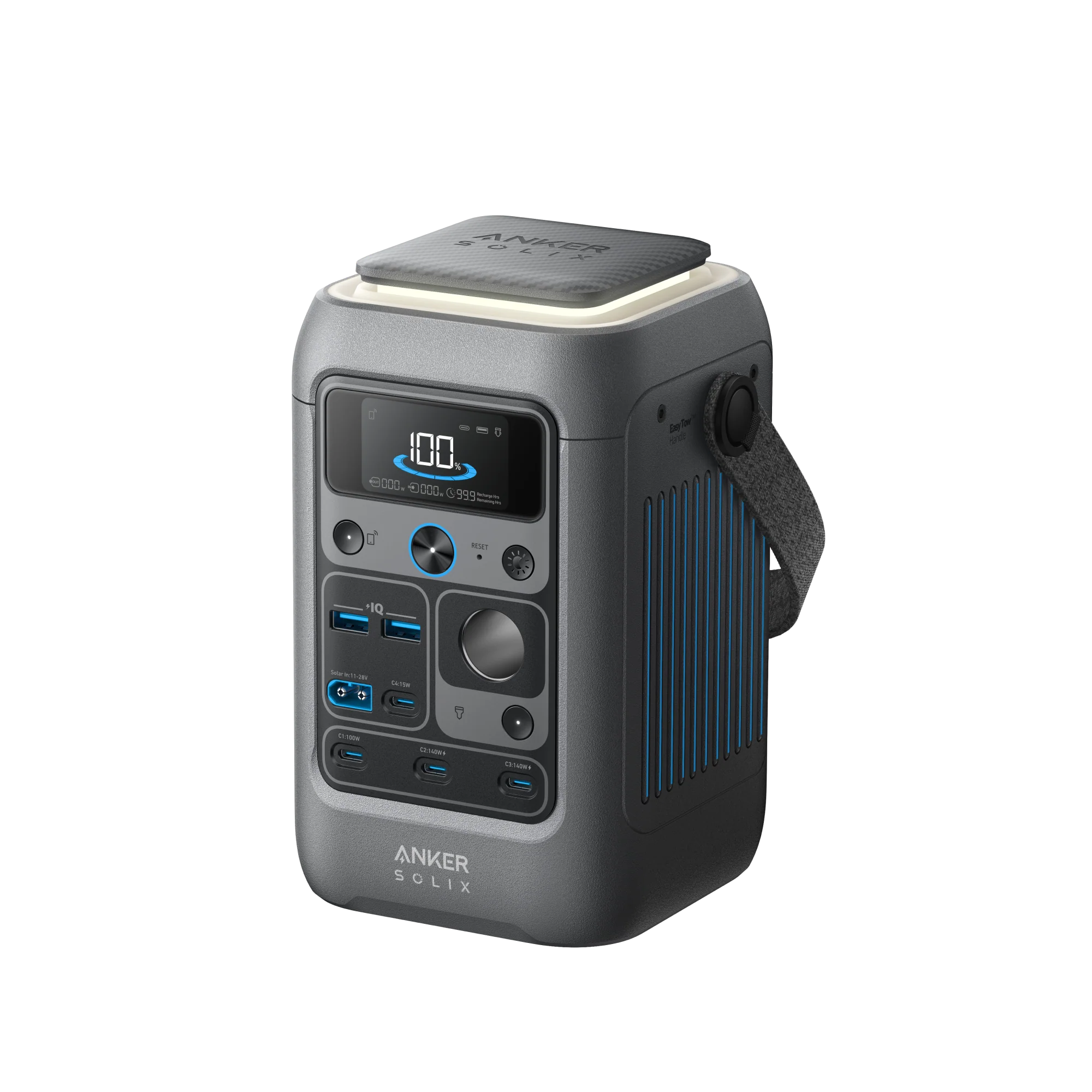
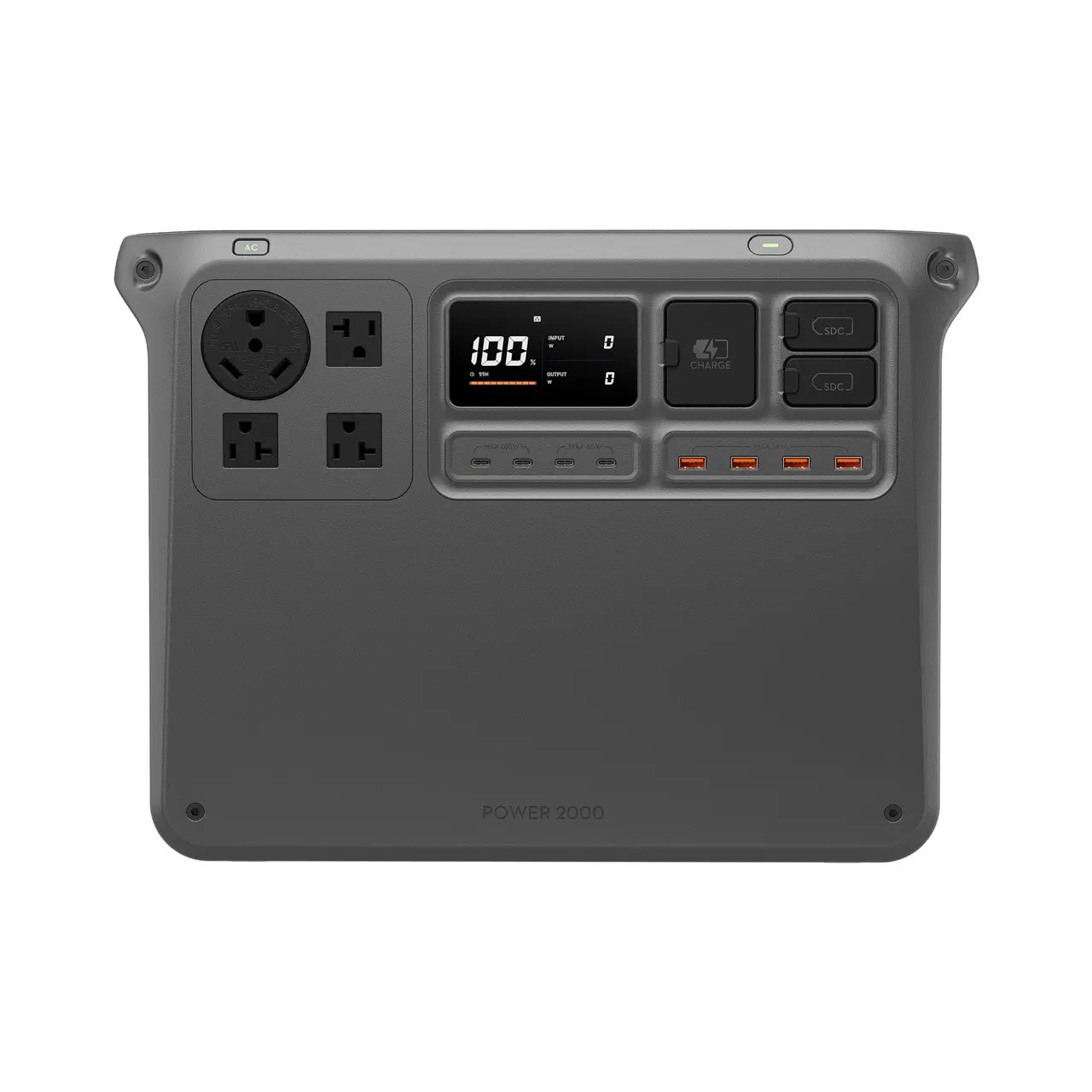
One of these is a phone-and-laptop charger that happens to sit on a power-station shelf; the other is the actual power station. Know which job you have before you compare a single spec.
Full profiles: Anker SOLIX C300 DC → · DJI Power 2000 →

Written by Ian SchneiderUpdated
Solar & Off-Grid Tester, Station Arena Test Desk
$199.99 · direct from Anker
Last checked 1 day ago. Prices move — check before you buy.
$1,299.00 · direct from DJI
Last checked 1 day ago. Prices move — check before you buy.
Spec deltas
The DJI Power 2000 holds 2,048Wh and puts out up to 3,000W of AC power. The SOLIX C300 DC holds 288Wh and has no AC inverter at all — its 300W ceiling is DC and USB only. That's not a smaller model in the same lineup. It's a different tool, and most people landing on this page are actually shopping for one of the two jobs, not choosing between them.
At $200 and 6.17 lbs, the C300 DC is built to keep phones, laptops, and small gear charged from a backpack: two USB-A ports, four USB-C, a 12V socket. At $1,299 and 48.5 lbs, the Power 2000 is built to run things with a cord. It covers an 8-Hour Blackout's 1,645Wh load using 94% of its capacity, and switches to backup power in about 10 milliseconds if the grid drops mid-task.
Run it against six real scenarios and the split holds. The Power 2000 wins four of six outright, the SOLIX C300 DC wins none, and the two 'neither' results — Weekend Camping and Van Life Daily — are cases where even the bigger unit falls short, not places the smaller one sneaks a win. Need an actual power station, and the Power 2000 is the one on this page. Don't, and the C300 DC is $1,099 cheaper and a lot lighter to carry.
What the Numbers Reveal
Each conclusion stated first — the numbers behind it on one line, the full analysis below.
Typical price
What that weight and money actually buy is the 3,000W AC inverter and 2,048Wh reservoir behind those ports — capability the C300 DC doesn't have at any USB-C speed, because it has no AC inverter at all.
SOLIX C300 DC: 140W max USB-C charging, 6.17 lbs, $200DJI Power 2000: 140W max USB-C charging (identical), 48.5 lbs, $1,299
Why it mattersIf the whole job is fast-charging a phone and laptop from a backpack, the C300 DC hits the identical USB-C ceiling for about 85% less money and roughly an eighth of the weight. The Power 2000 buys nothing extra for that specific job.
cost / lifetime kWh
Warranty coverage tells the same story a different way: the C300 DC runs $67 a year across its 3-year warranty, the Power 2000 $260 a year across its 5-year warranty — not even 4 times the annual cost for a unit holding more than 7 times the battery (2,048Wh vs 288Wh).
SOLIX C300 DC: $200, 3,000 cycles, 288Wh capacity → 864 total lifetime kWh, $0.23 cost per lifetime kWhDJI Power 2000: $1,299, 4,000 cycles, 2,048Wh capacity → 8,192 total lifetime kWh, $0.16 cost per lifetime kWh
Why it mattersPrice this as cost-to-own instead of cash-on-day-one, and the box that looks expensive at checkout is the budget option, and the one that looks cheap is the premium tax.
The Power 2000 pairs its much larger capacity with an automatic switchover to backup power in about 10 milliseconds. The C300 DC has no such spec, because it has no AC circuit to switch in the first place.
8-Hour Blackout needs 1,645Wh; SOLIX C300 DC's entire rated capacity is 288WhCPAP Overnight needs 320Wh — already more than the C300 DC's 288Wh ratingSOLIX C300 DC has no AC inverter (rated output is 300W of DC/USB power only)
Why it mattersAnyone shopping this pair for overnight medical equipment or blackout backup should skip the price comparison entirely and go straight to the Power 2000. The C300 DC isn't a cheaper option for that job — it isn't an option at all.
That's not a call this page should make either way. It's a genuine open question worth confirming with DJI directly before buying for van life or multi-day camping specifically because you're planning to expand later.
Weekend Camping needs 2,100Wh — the Power 2000 (2,048Wh) needs to supply about 21% more than it can holdVan Life Daily needs 4,685Wh — the Power 2000 needs to supply roughly 2.7 times what it can holdDJI Power 2000 spec sheet lists it as expansion-battery compatible; DJI's brand profile separately notes there's no established expansion ecosystem for this power-station line yet
Why it mattersIf your real load is a 4,685Wh/day van setup or a 2,100Wh weekend, don't buy either unit today assuming you can expand your way there. Verify the Power 2000's expansion battery is actually purchasable first, and size a dedicated house-battery-and-solar setup if it isn't.
The specific dimensions that decide these two units — everything else is a tie.
Your Life, Your Pick
Selected because: Establishes which unit, if either, actually fits the reader's real use case before any other spec matters.
Two of six scenarios end in 'neither,' and that's the most useful result on this page: Weekend Camping (2,100Wh) and Van Life Daily (4,685Wh) both exceed what even the Power 2000 can supply alone — the camping load needs about 21% more than it can hold, and the daily van-life load needs roughly 2.7 times what it can hold. Neither of these units is a house-battery replacement, and treating either one like it is how a trip goes dark on night two.
The other four scenarios break the same way every time: the SOLIX C300 DC can't cover an 8-Hour Blackout, a CPAP Overnight, a Remote Workday, or a Tailgate Party — it has no AC inverter, so any load beyond direct USB or DC charging is off the table regardless of price. The Power 2000 clears all four, using as little as 18% of its capacity for the CPAP night. That's not a close comparison. It's a different weight class.
Lifetime Value
Selected because: Cost per lifetime kWh flips the sticker-price story — worth surfacing early since the cheaper-looking unit isn't the cheaper one to own.
cost / lifetime kWh
The Power 2000 is the pricier box and the cheaper one to own — not a contradiction, just two different measurements. Sticker price says $1,299 against $200; cost per kWh actually delivered over each unit's working life says the opposite, because the Power 2000 holds more energy and survives more charge cycles before it's done.
That distinction holds no matter how often you'd use either one, daily, weekly, or only on weekends, because it comes from how much energy and how many cycles each battery has behind it, not from your usage pattern. The exact multi-year math for each cadence is broken out in the Test Notes below.
What the Specs Don't Tell You
Selected because: Surfaces UPS, warranty, cycle life, noise disclosure, and the expansion-battery ambiguity in one place.
rated cycles
The clearest asymmetry here is protection, not price: the Power 2000 auto-switches to backup power in about 10 milliseconds if the grid drops, and the C300 DC has no such spec because it has no AC circuit to protect in the first place. The noise gap follows the same logic — DJI publishes a 30dB rating for the Power 2000, and Anker doesn't publish one for the C300 DC at all.
The one gotcha worth pausing on is expansion. The Power 2000's spec sheet lists it as expansion-battery compatible, but DJI's own brand notes say there's no established expansion ecosystem for this power-station line yet. That's worth confirming directly before you buy expecting to add capacity later, not something to take on faith. The C300 DC's fixed 288Wh isn't really a gotcha by comparison: it was never sold as a unit you'd grow, so there's nothing here to outgrow.
Portability & Form Factor
Selected because: Weight and the identical USB-C ceiling show exactly where the price gap buys nothing (device charging) and where it buys everything (AC output).
weight
6.17 lbs is a one-hand, single-finger-loop carry, closer to a large water bottle than a power station. 48.5 lbs is a two-hand, bend-your-knees lift, worth confirming you have somewhere to set it down before you pick it up.
That gap is the whole reason the two coexist: the C300 DC is light because it isn't running an inverter, and the Power 2000 is heavy because it is. If you've already decided you need AC output, the weight isn't a debate. It's the cost of admission.
Brand Trust
Selected because: Support-quality trend for Anker and DJI's newness to power stations both matter given how young this cross-brand pairing is.
Anker is the established brand showing some strain: historically excellent support is reportedly giving way to more AI-driven responses and heavier return logistics on large units, even as its scale and cycle-life tech keep SOLIX competitive on value. DJI is the opposite shape — about two years of power-station history, backed by drone-grade engineering and a global repair network built for a different product line.
Community support reflects the same asymmetry: Anker has active, dedicated forums; DJI's power-station discussion still mostly lives inside general drone communities. That matters if you like troubleshooting with other owners of the exact unit you bought — Anker currently has more of them to ask.
Strengths & trade-offs
Anker SOLIX C300 DC
Strengths
- +Costs $1,099 less
- +Lighter by 42.3 lb
Trade-offs
- –Weaker inverter (-2,700W) limits appliance compatibility.
- –Sealed capacity — the Power 2000 can add batteries to grow past 288Wh; this one can't.
- –Shorter-lived battery — rated for 3,000 charge cycles vs the Power 2000's 4,000, so it wears out sooner.
DJI Power 2000
Strengths
- +Larger battery capacity
- +Higher AC output
- +Longer warranty
- +Faster solar charging
- +Rated for 4,000 charge cycles — much longer battery lifespan
Trade-offs
- –Substantially more expensive (+$1,099) than the SOLIX C300 DC.
- –Significantly heavier (+42.3 lbs), making it harder to move.
Will It Power Your Gear?
Scenario math and per-appliance runtimes, modeled from the spec record.
Scenario verdicts
We ran the math on seven real-world scenarios. Here's which unit survives your actual life.
SCN-01 · 2 nights · needs 2,100Wh
Weekend Camping
Two nights off-grid with essential comfort
Neither unit
A typical weekend's camping power draw (2,100Wh) needs about 21% more than even the Power 2000 can supply, and the SOLIX C300 DC isn't close at all. Neither wins this one outright — the Power 2000 gets you nearest, but plan on topping up with solar or trimming the load rather than expecting either box to cover the whole weekend alone.
Battery budget usedlower = more headroom
LOAD Phone Charger 15W×6h · LED Lights 40W×8h · Box Fan 75W×14h · CPAP Machine 40W×16h
SCN-02 · 8 hours · needs 1,645Wh
8-Hour Blackout
Keep the essentials running through a night without power
Power 2000
An 8-hour outage pulling 1,645Wh is roughly 6.7 times more than the SOLIX C300 DC can deliver. It's not in this fight. The Power 2000 uses 94% of its capacity to cover it, tighter than ideal, but it gets you through the outage.
Battery budget usedlower = more headroom
LOAD Fridge 150W×8h · Router + Modem 20W×8h · LED Lights (4 bulbs) 40W×6h · Phone Charger 15W×3h
SCN-03 · 8 hours · needs 320Wh
CPAP Overnight
Sleep therapy without interruption — the #1 medical use case
Power 2000
A CPAP running all night needs 320Wh, which alone is already more than the SOLIX C300 DC's entire 288Wh rating, before losing anything to inverter overhead it doesn't even have. The Power 2000 spends just 18% of its capacity on the same night. This one isn't close.
Battery budget usedlower = more headroom
LOAD CPAP Machine 40W×8h
SCN-04 · 8 hours · needs 910Wh
Remote Workday
Full work day off-grid without power anxiety
Power 2000
A remote workday's 910Wh draw is about 3.7 times more than the SOLIX C300 DC can supply. This is a laptop-charging tool, not a workday power source. The Power 2000 covers it on about half its capacity, with plenty left over.
Battery budget usedlower = more headroom
LOAD Laptop 60W×8h · External Monitor 30W×8h · Router + Modem 20W×8h · Phone Charger 15W×2h
SCN-05 · 4 hours · needs 670Wh
Tailgate Party
Game day power for the crew
Power 2000
A tailgate blender alone draws 400W at peak, more than the SOLIX C300 DC's entire 300W output rating, so it can't even attempt this one regardless of total energy. The Power 2000 handles the full 670Wh scenario using about 38% of its capacity, with 1,071Wh to spare.
Battery budget usedlower = more headroom
LOAD Blender 400W×0.5h · LED TV (55") 80W×4h · Bluetooth Speaker 15W×4h · Phone Charger (×3) 45W×2h
SCN-06 · 24 hours · needs 4,685Wh
Van Life Daily
A full day of mobile living — the ultimate endurance test
Neither unit
A full van-life day at 4,685Wh is roughly 19 times more than the SOLIX C300 DC can supply, and still about 2.7 times more than the Power 2000 can supply alone. This is a house-battery-and-solar job, not a single power station's — neither unit here is sized for daily van life by itself.
Battery budget usedlower = more headroom
LOAD Mini-Fridge 150W×24h · Laptop 60W×4h · Phone Charger 15W×3h · LED Lights 40W×5h · Fan 75W×8h
SCN-07 · an afternoon · needs 100Wh
Afternoon Off-Grid
Phones and a speaker at the park, beach, or campsite — the small-unit job description
Either unit
This row is here for the SOLIX C300 DC's class of job: phones and a speaker, 100Wh across an afternoon. Both cover it — the SOLIX C300 DC finishes at 41% used, and the Power 2000 barely notices it. For this job the Power 2000's extra capacity is dead weight, not headroom; take the SOLIX C300 DC at 6.2 lbs and leave the rest at home.
Battery budget usedlower = more headroom
LOAD Phone Charger (×2) 30W×2h · Bluetooth Speaker 10W×4h
The Load Test
RUNTIME = (Wh × 0.85) ÷ LOAD
None of the scenarios above exactly yours? Build it. Toggle what you'd plug in; both units are tested against the combined draw.
Essentials
Comfort & Convenience
High-Draw Appliances
Test duration
8h
Continuous draw
205W
Projected runtime
Only the Power 2000 can run this load — the SOLIX C300 DC has no AC outlets for the wall-plug gear in it.
$1,299 list · direct from DJI
Modeled from the spec record — same math as the tables below. Methodology
Runtime by appliance
Real-world runtime estimates for common appliances, modeled at 85% inverter efficiency.¹
Essentials
The basics you need runningscale 0–116.1hComfort & Convenience
Makes off-grid life actually enjoyablescale 0–23.2hHigh-Draw Appliances
These reveal the real limitsscale 0–1.7h¹ Runtime = (capacity × 0.85) ÷ appliance watts. Within each group, all bars share one time scale (the group's longest runtime), so lengths are comparable across appliances; identical runtimes collapse into a single blue/orange bar. Actual runtime varies with battery age, temperature, and simultaneous loads — see methodology.
Conclusion
July 26, 2026
Verdict: the Power 2000, on Power Score margin
If your job is running anything with a cord for hours — a CPAP overnight, a fridge through a blackout, a laptop and monitor through a remote workday off-grid — the Power 2000 is the only one of these two that can do it, and it's also the cheaper of the two to own once you count total energy delivered over its life, not just the sticker price. The SOLIX C300 DC isn't a downgraded version of it. It's a 288Wh, AC-less device charger that wins only when the entire job is topping up phones and laptops on the move, where its 140W USB-C ceiling matches the Power 2000's exactly for a fraction of the weight and price.
Editor-assigned confidence, based on cited owner research and spec analysis.
List prices as of July 26, 2026. The links below open Anker's and DJI's current prices.
$1,299.00 · direct from DJI
Last checked 1 day ago. Prices move — check before you buy.
or check the SOLIX C300 DC price$199.99 list
Written by Ian Schneider, Solar & Off-Grid Tester · Station Arena Test Desk · Updated July 26, 2026
Measured Data
Benchmark scores and the full spec record, side by side.
Benchmark scores
Not rated for both units (minimum threshold unmet): UPS, RV Living, Home Backup, CPAP, Solar Generator, Tailgating, Food Truck.
Full specifications
ᵈ Derived: price ÷ rated capacity. See the data behind our comparisons →
Comparison ToolAdd more power stations, side by sideOpen Tool →How these numbers are produced
Numeric verification
Every figure on this page traces to our spec database or arithmetic on it — no estimated numbers.
Owner claims
Statements about owner experience are cited to published reviews — see Sources & Research Notes below.
Runtime model
Runtime = (rated capacity × 0.85 inverter efficiency) ÷ device wattage. Solar recharge estimates assume panels deliver 70% of rated output. Cold weather, battery age, and stacked loads reduce real-world results.
Power Score
Computed from 14 published spec dimensions, weighted per use-case bench. Higher is better; a unit must meet a bench's minimum threshold to be rated.
See the full weight table and data sourcing on our methodology page →Class ranking (the star rating)
Each unit's star score is a category ranking, not customer reviews — no buyer opinions feed it. We score every station on size-independent quality (value, output, portability, endurance, ports, warranty, and more), then percentile-rank it against the other units in its capacity class, so a class-leading compact unit and a class-leading whole-home unit can both earn 5★. Here, SOLIX C300 DC rates 4.4/5 (62nd percentile of 22 Personal-class units), and Power 2000 rates 4.3/5 (56th percentile of 26 Large-class units).
How the class ranking is computed →Test Notes & Caveats
Hidden gotchas and advantages we spotted that you won't find on the product page.
SOLIX C300 DC: No AC Outlets At All
The SOLIX C300 DC's 300W is a DC port total — USB and 12V — not an inverter rating. Anything with a wall plug (a fridge, a TV, a coffee maker, most fans and lamps) never plugs in, at any wattage. That's the design, not a defect: it buys weight, silence, and efficiency for phone, laptop, camera, and 12V-CPAP loads. The Power 2000 carries a real inverter behind 4 AC outlets, so it plays in both worlds. Decide which side of that line your gear lives on before weighing anything else on this page.
Fixed Capacity Is The Point, Not A Flaw
The SOLIX C300 DC ships sealed at 288Wh with no expansion path, but it was never meant to grow. It's a device-charging brick, not a home-backup base unit, so size it for what you'll actually carry rather than for room to add on later. The Power 2000 is listed as expansion-battery compatible, but DJI doesn't yet have an established expansion ecosystem for this line. Treat that as a spec sheet claim to verify at purchase time, not a guarantee to plan around today.
10 Milliseconds, Or No Spec At All
The Power 2000 switches to backup power in about 10 milliseconds if the grid drops, fast enough that most connected electronics never notice the gap. The SOLIX C300 DC has no switchover spec at all, because it has no AC circuit to switch. It was never built to sit between your gear and a wall outlet.
Longer Warranty, Bigger Battery Behind It
The Power 2000 carries a 5-year warranty against the C300 DC's 3 years — two more years of coverage, but also coverage on a unit that runs $260 a year within its warranty term versus $67 a year for the C300 DC. Neither figure is really about which is the better deal; they're about what each is insuring — a 288Wh charger versus a 2,048Wh power plant.
How Long Each One Actually Lasts You
Used only on weekends, the SOLIX C300 DC is rated for about 28.8 years and the Power 2000 for about 38.5. Both outlast the point of asking. Used daily, that drops to 8.2 years for the C300 DC and 11 for the Power 2000, the more realistic number for whichever one becomes someone's everyday charger.
One Spec Sheet Has A Noise Rating, One Doesn't
DJI publishes a noise spec for the Power 2000, about 30dB, quiet enough to sit near a bed. Anker doesn't publish one for the C300 DC at all, which isn't necessarily bad news, but it's not something you can compare on paper if fan noise matters to your setup.
Full record above — the Test Desk pick is the Power 2000.
Check Power 2000 price →or check the SOLIX C300 DC priceOwnership Analysis
What happens after you buy — true cost of ownership, brand trust, and growth potential.
Lifetime value
Service lifeyears at one full cycle per day
Lifetime energy delivered
Cost per delivered kWh
│ warranty ends · Reaching the cycle rating means ~80% capacity remains — degraded, not dead.
Analyst note
The SOLIX C300 DC is cheaper to buy, but the Power 2000 is cheaper to own. At $0.16/kWh over its lifetime vs $0.23/kWh, the Power 2000's higher cycle life and capacity make each dollar go further over the years.
Brand trust
Anker
Ecosystem
Anker's SOLIX line spans 7-8 portable power stations across the compact C-series and flagship F-series, plus the X1 home energy system for anyone who eventually outgrows portable units entirely.
Support
Historically excellent, no-hassle replacements built Anker's reputation, but recent reports describe more AI-driven support responses and heavier return logistics for larger units. Worth knowing before a warranty claim, though it's less of an issue for a unit as light as the C300 DC.
Community
Active Reddit communities (r/Anker, r/AnkerSOLIXCommunity) benefit from Anker's broader consumer-electronics name recognition.
App experience
Rated 4.5/5 iOS (~1,100 ratings) · 4.3/5 Android
Unique strength
InfiniPower cell technology built for long cycle life, plus Gen 2 pricing that's genuinely competitive on dollars per watt-hour.
Worth knowing
Firmware updates have reportedly removed features on some SOLIX units without warning, and Anker's expansion ecosystem is smaller than some rivals'. Neither matters for a sealed, non-expandable unit like the C300 DC, but it's context on the brand overall.
DJI
Ecosystem
DJI entered power stations in 2024 and has four models so far: Power 500, Power 1000 V2, Power 1000 Mini, and Power 2000. A young lineup built on battery engineering from the drone business.
Support
DJI leans on its existing global drone repair and support network, which carries a solid reputation, though there's limited track record specific to power stations yet.
Community
No dedicated power-station community yet. Most discussion happens inside general drone forums rather than power-specific ones.
App experience
Rated 3.5/5 iOS and Android (DJI Home app ratings reflect entire DJI ecosystem including drones/cameras, not power-station-specific). Users report the on-device screen is more reliable than the app.
Unique strength
Measured as one of the quietest stations in its category, with fast wall-charging and 700+ battery patents inherited from drone R&D, plus SDC ports for fast-charging DJI drones directly if you're already in that ecosystem.
Worth knowing
There's no built-in solar charge controller. Solar input needs a separate proprietary adapter, and the expansion-battery ecosystem for this line is unproven despite being listed as compatible on the spec sheet. Both matter more the further out you're planning.
Analyst note
Anker is the established name managing some support growing pains; DJI is the accomplished outsider with about two years of power-station history backed by a much longer record building batteries for something else. Neither caveat should decide this purchase on its own. The capacity gap between these two units already does that.
Growth path
SOLIX C300 DC
FIXED CAPACITYFixed at 288Wh, with no expansion — so size it for your needs up front rather than planning to add capacity later.
Accepts up to 100W of solar. Limited to a single portable panel.
Adequate ports for most setups, but heavy users may want a power strip.
Power 2000
EXPANDABLESupports DJI expansion batteries, so you can add capacity later without replacing the base unit — useful if your needs may climb past 2,048Wh.
Accepts up to 1,800W of solar. Enough for a serious multi-panel array.
Generous port selection supports complex multi-device setups.
Expansion batteries are DJI-specific. You're investing in the DJI ecosystem.
Realistic full solar rechargeat 70% of rated panel output — see methodology
Analyst note
The SOLIX C300 DC is sealed at 288Wh, which is fine if that covers you. The Power 2000 starts at 2,048Wh and can grow beyond it with DJI expansion batteries — real headroom the SOLIX C300 DC doesn't have if your needs climb toward partial-home backup.
What Owners Report
Patterns from published owner reports and long-term reviews — every claim cited to its source below.
Anker SOLIX C300 DC
Reviewers and owners consistently describe the C300 DC as light and purpose-built for what it does — about 6.2 lbs, no AC inverter, made to keep phones, laptops, and small gear charged rather than to run anythingA1A3. The port selection draws praise too: two USB-A, four USB-C, and a 12V socket, with two-way USB-C fast charging getting it to 80% in about an hourA2.
The one recurring caveat is about fit, not quality: this is explicitly a device-charging tool, and coverage is clear it's the wrong pick for anyone expecting to run AC appliances off itA4.
“A 288Wh unit that ditches the heavy AC inverter to focus on DC power, keeping it very light at about 6.2 lbs.”
Sources
the-gadgeteer.com · forbes.com · androidpolice.com · batteryessence.com · bestbuy.com · campingsolar.us
DJI Power 2000
Reviewers are unusually consistent on three things: charging speed, quiet operation, and build quality. A full wall charge lands around 90 minutes, with some tests clocking it faster, and 1,800W solar input can fill it from empty in about 75 minutesB1. It's also among the quietest units tested, staying near-silent even under heavy loadB2.
Its eightfold protection system — flame-retardant materials, a nano-coated BMS, dozens of temperature sensors and fuses, and structural reinforcement rated for a one-ton static load — reads like DJI brought its drone-grade engineering standards to a power stationB3. What's missing is time: this coverage comes from reviewers and early testers rather than long-term owners, since both the Power 2000 and DJI's power-station line are still newB4.
“Among the fastest-charging tested — a full wall charge in about 90 minutes (reviewers measured even faster, roughly an hour), and up to 1,800W of solar input for a full solar charge in about 75 minutes.”
Sources
bobvila.com · t3.com · thesolarlab.com · campingsolar.us · protoolreviews.com · greenerideal.com · dronexl.co
Sources & Research Notes
Every owner claim in this report is traceable to a published source. The bracketed references above resolve here.
Recurring owner themes
- Light DC-only design (no AC inverter), fast USB-C charging, and good port selection for device charging are the highlights. [SOLIX C300 DC · 3 entries]
- Standout fast charging (wall and 1800W solar), near-silent operation, and an unusually robust safety-focused build are the consistent praise. [Power 2000 · 3 entries]
- A1
“A 288Wh unit that ditches the heavy AC inverter to focus on DC power, keeping it very light at about 6.2 lbs.”
the-gadgeteer.com / forbes.com — SOLIX C300 DC review · 2026 · [positive]
- A2
“Offers 2 USB-A and 4 USB-C ports plus a 12V car socket; two-way USB-C with PD 3.1 recharges the unit to 80% in about 1 hour.”
androidpolice.com / batteryessence.com — SOLIX C300 DC review · 2026 · [positive]
- A3
“Owners praise its portability and capacity — enough to charge a phone and laptop several times, run a fan for hours, or power a small light setup.”
bestbuy.com owner reviews — SOLIX C300 DC / C300X · 2026 · [positive]
- A4
“A DC-focused design with app integration and solar support — best for modern travelers charging devices, not running AC appliances.”
androidpolice.com / campingsolar.us — SOLIX C300 DC review · 2026 · [mixed]
- B1
“Among the fastest-charging tested — a full wall charge in about 90 minutes (reviewers measured even faster, roughly an hour), and up to 1,800W of solar input for a full solar charge in about 75 minutes.”
bobvila.com / t3.com — DJI Power 2000 review · 2025-2026 · [positive]
- B2
“One of the quietest power stations tested — only about 29 dB at 5 feet when the fan kicked in, virtually silent, and it stayed among the quietest units even under the heaviest loads.”
bobvila.com / thesolarlab.com — DJI Power 2000 review · 2025-2026 · [positive]
- B3
“Built with an eightfold protection system — flame-retardant materials, a nano-coated BMS, 26 temperature sensors, 21 fuses, and structural reinforcement rated to support a one-ton static load — positioning it as one of the safest, most robust units on the market.”
campingsolar.us / protoolreviews.com — DJI Power 2000 review · 2025-2026 · [positive]
- B4
“Ran everything reviewers threw at it, handled surges consistently, and recharged incredibly fast, especially from solar; deep integration for DJI drone users is a unique advantage.”
greenerideal.com / dronexl.co — DJI Power 2000 review · 2025-2026 · [positive]
Research compiled July 26, 2026.
What Owners Actually Report
Drawn from 98 comments on independent review channels — not from retailer reviews, which skew to the first week of ownership. Each line is our summary of one commenter's claim, linked to the original. We record what they said, including where it contradicts the spec sheet.
Anker SOLIX C300 DC
12 claims from 8 comments · 10 from owners · 5 with figures
- Solar input
- 4 · 100% negative
- Runtime
- 2 · 0% negative
- Charging
- 2 · 39% negative
- Other
- 1 · 0% negative
- Size & weight
- 1 · 0% negative
What owners complain about
28V input ceiling blocks a 25.6V LiFePO4 bank, which can reach 29.2V fully charged.
Solar inputmeasuredowner4 agreedsource →
Says the C300 DC has no pass-through charging and just cycles between 98% and 100%.
Charging7 agreedsource →
DC5521 plugs with poor tolerances have heated up at 5A; wishes it used XT60 throughout.
Build qualityownersource →
What owners praise
BiPAP with heated hose and humidifier at 80% used 47% of the 288Wh pack over 5 hours of sleep.
Runtimemeasuredowner5 agreedsource →
Can be charged over USB-C at up to 140W, which he thinks is fantastic.
Chargingmeasuredownersource →
His favorite unit: small, transportable, very efficient on 12V and charges well off solar.
Otherownersource →
DJI Power 2000
143 claims from 90 comments · 58 from owners · 5 with figures
- App & firmware
- 24 · 42% negative
- Other
- 21 · 36% negative
- Build quality
- 25 · 72% negative
- Durability
- 11 · 100% negative
- Warranty & support
- 8 · 34% negative
What owners complain about
With the expansion battery he only gets 2800Wh on DC.
Runtimemeasuredownersource →
DJI told him all Power 2000 units have an EMI issue with no fix; his Mac Mini coil-whined.
Build qualityowner5 agreedsource →
3600W surge is not bad but lower than some comparable units.
Inverter & surgemeasuredownersource →
What owners praise
Claims are weighted by how specific they are, whether the commenter owns the unit, and how many readers agreed. Comments that mention a product under a rival's review count for more, because the commenter had no reason to be there. This is what buyers report, not our test results — for measurements we ran ourselves, see the methodology.
Who Should Buy Which
Buy the SOLIX C300 DC if you…
- →The digital nomad who needs a phone and laptop topped up between coffee shops and rideshares and hasn't plugged into an AC outlet in a week. The C300 DC's 140W USB-C ceiling matches the Power 2000's, at 6.17 lbs and $200.
- →Anyone who wants a spare battery in a backpack or glovebox for phones, tablets, and small USB-C gear, not a power source for anything with a plug.
Buy the Power 2000 if you…
- →Anyone running a CPAP overnight, a mini-fridge through a blackout, or a full remote workday off-grid — loads the C300 DC can't attempt at all since it has no AC inverter.
- →Buyers who want automatic backup power: the Power 2000's roughly 10-millisecond switchover keeps connected gear running if the grid drops mid-task, something the C300 DC has no spec for.
If neither fits
Van lifers running a full daily household load, or anyone provisioning multi-day camping past 2,100Wh: both units fall short here — Van Life Daily needs roughly 2.7 times more than even the Power 2000 holds — so the honest answer is a dedicated house-battery-and-solar setup, not either box on this page.
The Bottom Line
These two were never really competing. The SOLIX C300 DC is a 288Wh, AC-less USB charger that happens to share a shelf with power stations; the Power 2000 is an actual 2,048Wh station that wins four of the six real-world loads tested here, and even at $1,099 more upfront it comes out to $0.16 per lifetime kWh delivered against the C300 DC's $0.23. The pricier box is the cheaper one to own.
So buy on the job, not the price tag. If it's charging a phone and a laptop on the move, get the C300 DC and keep the $1,099 — you'll hit the same 140W USB-C ceiling either way. If it's running anything with a cord through a blackout, a CPAP night, or an off-grid workday, get the Power 2000; nothing about the C300 DC's price turns it into capacity it doesn't have.
Frequently Asked Questions
Answers drawn from the spec record and cited owner research.
Can the Anker SOLIX C300 DC run a fridge or a CPAP machine?
No. It has no AC inverter, just 300W of DC and USB output from a 288Wh battery. A CPAP Overnight alone needs 320Wh, already more than the C300 DC's entire rated capacity, and an 8-Hour Blackout needs 1,645Wh. It's built for charging phones, laptops, and small DC gear, not running anything with a plug.
Is the DJI Power 2000 worth paying so much more than the SOLIX C300 DC?
Only if you need what the extra money buys: a 3,000W AC inverter, 2,048Wh of capacity, and an automatic 10-millisecond switchover to backup power. For pure USB-C device charging, both units cap out at the identical 140W, so the price gap buys nothing extra in that one specific use case.
Does the DJI Power 2000 support expansion batteries?
DJI's spec sheet lists the Power 2000 as expansion-compatible, but DJI doesn't yet have an established expansion-battery ecosystem for this power-station line. Don't buy it today assuming you can add capacity next year. Confirm current availability with DJI directly before counting on that path.
Which one is quieter, the SOLIX C300 DC or the Power 2000?
DJI publishes a noise rating for the Power 2000, about 30dB, while Anker hasn't published one for the C300 DC at all. That's worth knowing on its own if fan noise matters to your setup, independent of which unit is objectively quieter.
Which power station is cheaper to own long-term?
The Power 2000, even though it costs $1,099 more upfront. Measured per kWh actually delivered over each unit's working life, it comes out to $0.16 for the Power 2000 against $0.23 for the C300 DC. The pricier unit is the cheaper one by that measure, because it also holds far more energy and survives more charge cycles before it's done.
Brand matchup
Anker SOLIX vs DJI: measured across every matchup →Where to buy
Anker SOLIX C300 DC
$199.99
$199.99 · direct from Anker
Last checked 1 day ago. Prices move — check before you buy.
DJI Power 2000Pick
$1,299.00
$1,299.00 · direct from DJI
Last checked 1 day ago. Prices move — check before you buy.
Prices may vary by retailer and are subject to change.