Head-to-head test
Anker SOLIX C200 DC vs BLUETTI EP900 + 4×B500
This isn't a matchup, it's a category error: a 4.2-lb DC brick with no AC outlets against a 589-lb battery an electrician wires into your breaker panel, and the only real decision is which of two unrelated jobs is yours.
Full profiles: Anker SOLIX C200 DC → · BLUETTI EP900 + 4×B500 →

Written by Gunner GustafsonUpdated
Whole-Home Backup Tester, Station Arena Test Desk
Spec deltas
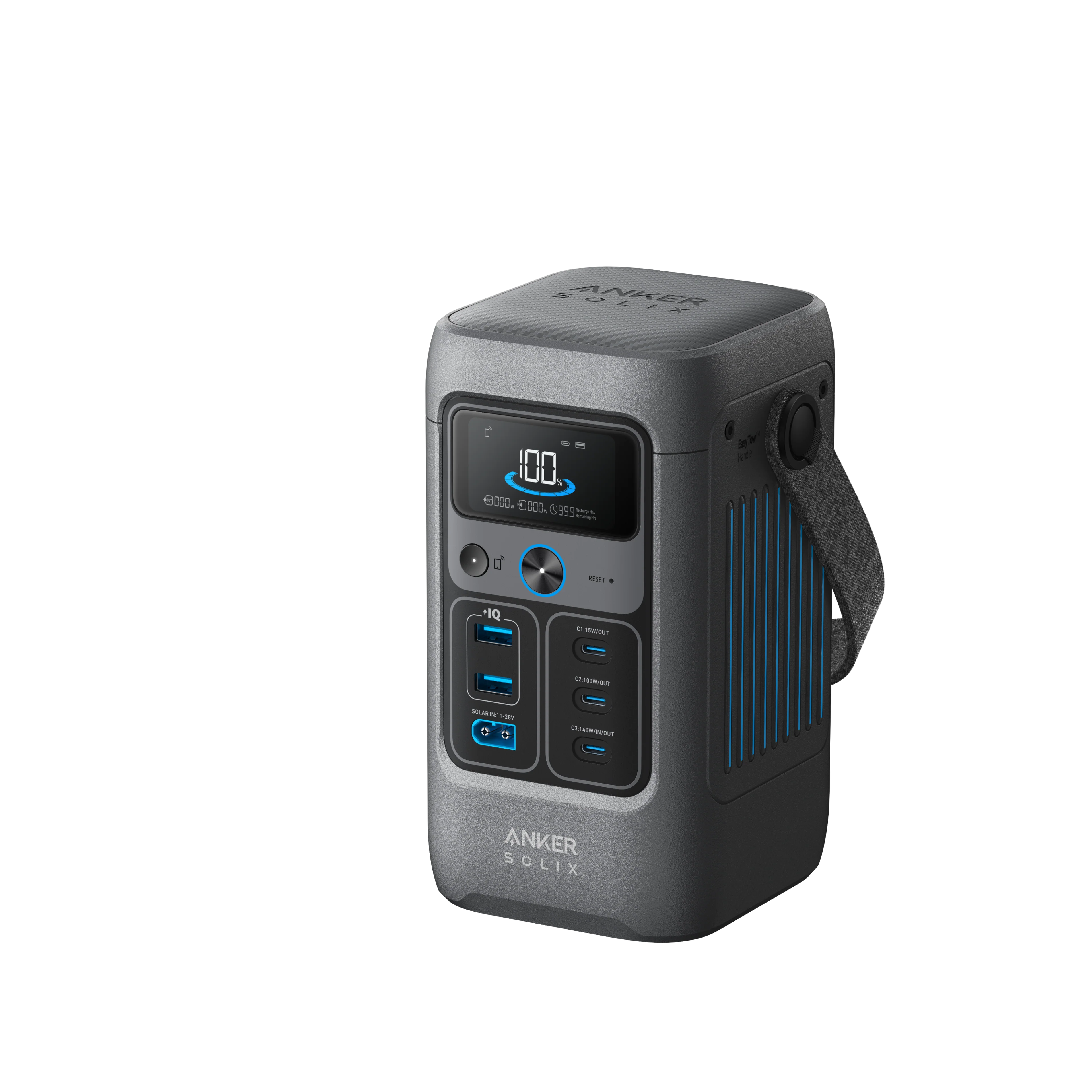
Put a $140 power bank and a $17,298 home-battery install on the same page and the comparison breaks before it starts. The Anker SOLIX C200 DC weighs 4.2 pounds and has no AC outlets at all. The BLUETTI EP900 stack weighs 589 pounds and gets hardwired into your electrical panel by an electrician. These aren't two sizes of the same product; they're answers to two questions that never share a shopper.
The number that ends most of this is the one Anker's spec sheet buries: the C200 DC's 200W is a DC port total, USB-C and 12V, not an inverter rating. Nothing with a wall plug runs on it, at any wattage. A fridge, a coffee maker, a standard-plug CPAP: none of them connect. The EP900 has the opposite problem. It's a 9,000W system with power throughout the building and not one socket on the box you could walk over and plug into.
So we'll do the useful thing instead of forcing a winner. Below is which unit answers which job, why the per-kilowatt-hour math that seems to favor the big BLUETTI is a trap for most buyers, and, the part most people here actually need, why the thing you probably pictured, a box you carry outside and plug a real appliance into, is neither of these.
What the Numbers Reveal
Each conclusion stated first — the numbers behind it on one line, the full analysis below.
The one thing people buy a power station for, carry a box to where you are and plug something in, sits in the exact gap between them. That's why three of the six scenarios come back 'neither': the Anker can't finish, the BLUETTI can't go.
Anker C200 DC: 0 AC outlets, and its 200W is a DC port total (USB-C/12V), not an inverter ratingBLUETTI EP900 stack: hardwired, 589 lbs, feeds a subpanel with no sockets on the boxEngine returns 'neither' for Weekend Camping, Tailgate Party, and Van Life Daily
Why it mattersIf you pictured plugging a cooler or a coffee maker into a box on the campsite table, both of these are the wrong purchase, and it's cheaper to learn that now than after checkout.
cost / lifetime kWh
Cost per lifetime kilowatt-hour only counts if you'll cycle the energy. The Anker's whole job is 100Wh-an-afternoon top-ups, where the engine calls the BLUETTI's 119,040 kWh of lifetime capacity dead weight, not headroom. Buy the big stack to trickle a phone and you've bought a power plant to run a nightlight.
Anker C200 DC: $140, 576 kWh total lifetime energyBLUETTI EP900 stack: $17,298, 119,040 kWh total lifetime energyLifetime cost per kWh: $0.24 Anker vs $0.15 BLUETTI
Why it mattersThe per-kWh number favors the BLUETTI and means nothing unless you have a house full of loads to feed it.
Owners reached for it independently of Anker's marketing to keep a satellite dish alive on a boat and at a remote siteA4A5, which is a different universe from a 589-lb stack bolted to a breaker panel. One rides in a backpack pocket; the other arrives on a pallet.
Anker C200 DC: 192Wh, 4.2 lbs, 140W USB-C, no inverterOwners bought it specifically to run a Starlink Mini off-grid, reporting 5-6 hours with 40% leftA4A5Amazon's owner-review summary flags Starlink Mini as a lead use caseA15
Why it mattersIf your sentence is 'keep my Starlink Mini and phone running off-grid,' the Anker is the answer and the BLUETTI never enters it.
The specific dimensions that decide these two units — everything else is a tie.
Your Life, Your Pick
Selected because: Across six real jobs, one or both units fail, and three come back 'neither', which is the fastest proof these two don't cross-shop.
The scenario table reads like a broken scoreboard, and that's the point. Weekend Camping, Tailgate, Van Life: 'neither.' The BLUETTI has the energy, 16,864 usable watt-hours, but it's wired to a building and can't come. The Anker can come but has no AC outlet for the lights, blender, or TV those days need. The one row where the Anker shines is the quiet one: Afternoon Off-Grid, 100Wh of phones and a speaker, which it finishes at 61% used while the BLUETTI barely notices the load. That row is the C200's entire reason to exist, and the BLUETTI's inability to travel is the EP900's defining trait.
What the Specs Don't Tell You
Selected because: The two facts that decide everything live here: the Anker's total lack of AC outlets and the BLUETTI's 589-lb installed reality.
rated cycles
Two cards do all the work. The first: the Anker has no AC outlets, so its 200W is a DC port budget for USB and 12V, and anything with a wall plug is simply out. That's a design choice, not a defect, it's what buys the 4.2-lb weight and the silence, but it's the line that sorts buyers before anything else on this page matters. The second: the BLUETTI's 589 lbs is an install weight, lifted once by the electrician who mounts it at your panel.
The BLUETTI also lists a UPS mode rated no worse than 10ms, so a desktop or router rides through a grid drop; the Anker lists none, so whatever's plugged in rides an outage only as far as your reaction time. Both facts point the same direction: these are built for opposite rooms of your life.
Portability & Form Factor
Selected because: 4.2 lbs against 589 lbs is the widest gap on the page, and it sorts which unit can even show up to your job.
weight
This is the only section with a real blowout, and it's almost comic: 4.2 pounds against 589. You lift the Anker with two fingers. You do not lift the BLUETTI at all, a crew and an electrician set it in place and it never moves again. Portability is the whole case for the C200 and a non-starter for the EP900, which the engine flatly disqualifies from anything you carry. If 'pick it up and take it somewhere' is anywhere in your plan, the comparison is already over.
Lifetime Value
Selected because: The BLUETTI wins cost per lifetime kWh ($0.15 vs $0.24); this is where you see why that's the wrong number to buy on unless your loads are whole-home.
cost / lifetime kWh
On paper the big stack is the better deal: $0.15 per lifetime kilowatt-hour against the Anker's $0.24, helped by 6,000 rated cycles to the C200's 3,000. Read that and stop, and you'd talk yourself into a $17,298 purchase to save nine cents a kilowatt-hour. The catch is you only bank that by actually pushing energy through it, 119,040 kWh of it, over a 16.4-year daily-use life. The C200's owner runs 100Wh afternoons; at that duty the EP900's cheaper energy stays theoretical forever.
Up front, the Anker is the cheaper box per watt-hour anyway, $0.73 against $0.87. Value follows the load, and these two loads don't overlap.
Strengths & trade-offs
Anker SOLIX C200 DC
Strengths
- +Costs $17,158 less
- +Lighter by 584.8 lb
Trade-offs
- –Weaker inverter (-8,800W) limits appliance compatibility.
- –Sealed capacity — the EP900 + 4×B500 can add batteries to grow past 192Wh; this one can't.
- –Shorter-lived battery — rated for 3,000 charge cycles vs the EP900 + 4×B500's 6,000, so it wears out sooner.
BLUETTI EP900 + 4×B500
Strengths
- +Larger battery capacity
- +Higher AC output
- +Longer warranty
- +Faster solar charging
- +Rated for 6,000 charge cycles — much longer battery lifespan
Trade-offs
- –Substantially more expensive (+$17,158) than the SOLIX C200 DC.
- –Significantly heavier (+584.8 lbs), making it harder to move.
- –Very heavy unit that may be difficult for one person to lift.
Will It Power Your Gear?
Scenario math and per-appliance runtimes, modeled from the spec record.
Scenario verdicts
We ran the math on seven real-world scenarios. Here's which unit survives your actual life.
SCN-01 · 2 nights · needs 2,100Wh
Weekend Camping
Two nights off-grid with essential comfort
Neither unit
Neither gives you a powered weekend: the EP900 + 4×B500 has the energy but is wired to the building, and the SOLIX C200 DC has no AC outlets, so the led lights and box fan in this scenario never plug in — it's a DC station for USB and 12V gear, and no wattage figure changes that. One can't go; the other can't finish.
Battery budget usedlower = more headroom
LOAD Phone Charger 15W×6h · LED Lights 40W×8h · Box Fan 75W×14h · CPAP Machine 40W×16h
SCN-02 · 8 hours · needs 1,645Wh
8-Hour Blackout
Keep the essentials running through a night without power
EP900 + 4×B500
The SOLIX C200 DC has no AC outlets, so the fridge, router + modem and the rest in this scenario never plug in — it's a DC station for USB and 12V gear, and no wattage figure changes that. The EP900 + 4×B500 handles this scenario with 15,219Wh to spare.
Battery budget usedlower = more headroom
LOAD Fridge 150W×8h · Router + Modem 20W×8h · LED Lights (4 bulbs) 40W×6h · Phone Charger 15W×3h
SCN-03 · 8 hours · needs 320Wh
CPAP Overnight
Sleep therapy without interruption — the #1 medical use case
EP900 + 4×B500
The row says the Anker loses on capacity, but the sharper catch is that only a 12V or USB-powered CPAP can even connect to it, a standard wall-plug CPAP finds no outlet at all. Give it a DC CPAP and 163 usable watt-hours still tap out about halfway through a 320Wh night, so it's a top-up-and-solar setup, not set-and-forget. The BLUETTI runs any CPAP, plug or 12V, and its 16,864 usable watt-hours don't register the load.
Battery budget usedlower = more headroom
LOAD CPAP Machine 40W×8h
SCN-04 · 8 hours · needs 910Wh
Remote Workday
Full work day off-grid without power anxiety
EP900 + 4×B500
The SOLIX C200 DC has no AC outlets, so the external monitor and router + modem in this scenario never plug in — it's a DC station for USB and 12V gear, and no wattage figure changes that. The EP900 + 4×B500 handles this scenario with 15,954Wh to spare.
Battery budget usedlower = more headroom
LOAD Laptop 60W×8h · External Monitor 30W×8h · Router + Modem 20W×8h · Phone Charger 15W×2h
SCN-05 · 4 hours · needs 670Wh
Tailgate Party
Game day power for the crew
Neither unit
Neither gives you a powered game day: the EP900 + 4×B500 has the energy but is wired to the building, and the SOLIX C200 DC has no AC outlets, so the blender and led tv in this scenario never plug in — it's a DC station for USB and 12V gear, and no wattage figure changes that. One can't go; the other can't finish.
Battery budget usedlower = more headroom
LOAD Blender 400W×0.5h · LED TV (55") 80W×4h · Bluetooth Speaker 15W×4h · Phone Charger (×3) 45W×2h
SCN-06 · 24 hours · needs 4,685Wh
Van Life Daily
A full day of mobile living — the ultimate endurance test
Neither unit
Neither gives you a powered van: the EP900 + 4×B500 has the energy but is wired to the building, and the SOLIX C200 DC has no AC outlets, so the mini-fridge, led lights and the rest in this scenario never plug in — it's a DC station for USB and 12V gear, and no wattage figure changes that. One can't go; the other can't finish.
Battery budget usedlower = more headroom
LOAD Mini-Fridge 150W×24h · Laptop 60W×4h · Phone Charger 15W×3h · LED Lights 40W×5h · Fan 75W×8h
SCN-07 · an afternoon · needs 100Wh
Afternoon Off-Grid
Phones and a speaker at the park, beach, or campsite — the small-unit job description
Either unit
This row is here for the SOLIX C200 DC's class of job: phones and a speaker, 100Wh across an afternoon. Both cover it — the SOLIX C200 DC finishes at 61% used, and the EP900 + 4×B500 barely notices it. For this job the EP900 + 4×B500's extra capacity is dead weight, not headroom; at 4.2 lbs the SOLIX C200 DC is the one you'll be glad you brought.
Battery budget usedlower = more headroom
LOAD Phone Charger (×2) 30W×2h · Bluetooth Speaker 10W×4h
The Load Test
RUNTIME = (Wh × 0.85) ÷ LOAD
None of the scenarios above exactly yours? Build it. Toggle what you'd plug in; both units are tested against the combined draw.
Essentials
Comfort & Convenience
High-Draw Appliances
Test duration
8h
Continuous draw
205W
Projected runtime
Only the EP900 + 4×B500 can run this load — the SOLIX C200 DC has no AC outlets for the wall-plug gear in it.
$17,298 list · direct from BLUETTI
Planning for more than this? Describe your whole setup and get it sized →
Modeled from the spec record — same math as the tables below. Methodology
Runtime by appliance
Real-world runtime estimates for common appliances, modeled at 85% inverter efficiency.¹
Essentials
The basics you need runningscale 0–1124.3hComfort & Convenience
Makes off-grid life actually enjoyablescale 0–224.9hHigh-Draw Appliances
These reveal the real limitsscale 0–16.9h¹ Runtime = (capacity × 0.85) ÷ appliance watts. Within each group, all bars share one time scale (the group's longest runtime), so lengths are comparable across appliances; identical runtimes collapse into a single blue/orange bar. Actual runtime varies with battery age, temperature, and simultaneous loads — see methodology.
Conclusion
August 30, 2026
Verdict: the EP900 + 4×B500, on Power Score margin
Call it a tie only because these two never belong on the same shortlist. The Anker C200 DC is a 4.2-lb, 192Wh DC brick with no AC outlets: it tops up phones, laptops, a Starlink Mini, and 12V gear, and that's the whole list. The BLUETTI EP900 stack is a 589-lb, 19,840Wh system an electrician wires into your subpanel to back up a house, with no sockets on the box, and it never leaves the wall. In three of the six scenarios the engine returns 'neither,' which is the honest verdict for the page: one can't run AC, the other can't move. Buy the Anker if your job is off-grid top-ups; buy the BLUETTI if your job is whole-home backup; buy neither if you wanted the ordinary thing both skip, a portable you carry that also runs a wall plug.
Editor-assigned confidence, based on cited owner research and spec analysis.
Written by Gunner Gustafson, Whole-Home Backup Tester · Station Arena Test Desk · Updated August 30, 2026
Black Friday · 38 days out
Price to beat:EP900 + 4×B500 $17,298
We have never seen it discounted, so any real cut would be a first.
Measured Data
Benchmark scores and the full spec record, side by side.
Benchmark scores
Not rated for both units (minimum threshold unmet): Home Backup, Food Truck, Apartment Balcony.
Full specifications
ᵈ Derived: price ÷ rated capacity. See the data behind our comparisons →
Comparison ToolAdd more power stations, side by sideOpen Tool →How these numbers are produced
Numeric verification
Every figure on this page traces to our spec database or arithmetic on it — no estimated numbers.
Owner claims
Statements about owner experience are cited to published reviews — see Sources & Research Notes below.
Runtime model
Runtime = (rated capacity × 0.85 inverter efficiency) ÷ device wattage. Solar recharge estimates assume panels deliver 70% of rated output. Cold weather, battery age, and stacked loads reduce real-world results.
Power Score
Computed from 14 published spec dimensions, weighted per use-case bench. Higher is better; a unit must meet a bench's minimum threshold to be rated.
See the full weight table and data sourcing on our methodology page →Class ranking (the star rating)
Each unit's star score is a category ranking, not customer reviews — no buyer opinions feed it. We score every station on size-independent quality (value, output, portability, endurance, ports, warranty, and more), then percentile-rank it against the other units in its capacity class, so a class-leading compact unit and a class-leading whole-home unit can both earn 5★. Here, SOLIX C200 DC rates 4.0/5 (43rd percentile of 24 Personal-class units), and EP900 + 4×B500 rates 4.3/5 (57th percentile of 29 Whole-Home / Off-Grid-class units).
How the class ranking is computed →Test Notes & Caveats
Hidden gotchas and advantages we spotted that you won't find on the product page.
EP900 + 4×B500: 589 lbs Is a Commitment
At 589 lbs, this is an installed system: an electrician mounts it at the electrical panel and its weight matters exactly once. It backs up the building — it was never going to be carried anywhere.
EP900 + 4×B500: 50dB Published
50dB is about as loud as moderate rainfall. It is BLUETTI's own rating rather than a reading on a shared bench — makers differ on whether they quote a best case or a figure under load, so treat it as a starting point rather than what you would hear at a bedside. For most people, fan noise around 45dB and up is where sleep starts to suffer.
SOLIX C200 DC: No AC Outlets At All
The SOLIX C200 DC's 200W is a DC port total — USB and 12V — not an inverter rating. Anything with a wall plug (a fridge, a TV, a coffee maker, most fans and lamps) never plugs in, at any wattage. That's the design, not a defect: it buys weight, silence, and efficiency for phone, laptop, camera, and 12V-CPAP loads. The EP900 + 4×B500 carries a real inverter, so it plays in both worlds. Decide which side of that line your gear lives on before weighing anything else on this page.
SOLIX C200 DC: Fixed Capacity
The SOLIX C200 DC is sealed at 192Wh — fine if that covers you, but it's the ceiling. By contrast the EP900 + 4×B500 can add expansion batteries, though the first thing it has over the SOLIX C200 DC is its own 19,840Wh base — expansion is the step after that, for the buyer who would outgrow 19,840Wh as well.
Only the EP900 + 4×B500 Lists a UPS Mode
The EP900 + 4×B500 can sit between the wall and your gear and hand it to battery when the grid drops — rated ≤10ms — quick enough on paper that desktop PCs and routers should ride through, treating that as the rating it is. Worth it for a router, a desktop PC, or a CPAP. The SOLIX C200 DC's spec sheet lists no UPS mode, so anything plugged into it rides an outage only as far as your reaction time.
Warranty: 10 Years vs 3
The EP900 + 4×B500 is covered for 10 years against the SOLIX C200 DC's 3 years. The cheaper SOLIX C200 DC does buy more warranty per dollar (21.4 years per $1,000 against 0.6), but that is a statement about price, not about coverage — if a fault appears in year 4, only one of these is still covered. An underrated factor if you're keeping this unit for years.
Battery Lifespan in Real Years
The EP900 + 4×B500 is rated for 6,000 cycles vs 3,000. In real life: at daily use, that's 16.4 vs 8.2 years. At weekend use (twice a week), it's 58 vs 29 years. One caution reading years across different sizes: a cycle is 19,840Wh on the EP900 + 4×B500 and 192Wh on the SOLIX C200 DC, so count lifetime energy — roughly 119,040 kWh against 576 kWh over the rated life. After hitting the cycle limit, the battery doesn't die — it drops to ~80% of original capacity, which is still very usable.
SOLIX C200 DC: Noise Level Not Disclosed
The EP900 + 4×B500 publishes its noise level (50dB); the SOLIX C200 DC doesn't publish one. That isn't evidence the SOLIX C200 DC is louder — it means there's no figure to hold it to, and no way to compare the two on this without hearing them. If you're buying for a bedroom, a CPAP, or an apartment, treat the EP900 + 4×B500's 50dB as the only published number on the table — a spec-sheet figure, not a measurement — and look for hands-on reports of the SOLIX C200 DC before deciding.
Ownership Analysis
What happens after you buy — true cost of ownership, brand trust, and growth potential.
Lifetime value
Service lifeyears at one full cycle per day
Lifetime energy delivered
Cost per delivered kWh
│ warranty ends · Reaching the cycle rating means ~80% capacity remains — degraded, not dead.
Analyst note
The SOLIX C200 DC is cheaper to buy, but the EP900 + 4×B500 is cheaper to own. At $0.15/kWh over its lifetime vs $0.24/kWh, the EP900 + 4×B500's higher cycle life and capacity make each dollar go further over the years.
Brand trust
Anker
Ecosystem
7-8 SOLIX portable power stations across C-series (compact) and F-series (flagship), plus the X1 home energy system
Support
US-based support. Historically known for incredible no-hassle replacements, but recent reports describe AI-driven support agents giving generic responses and complex return logistics for heavy units (hazmat shipping). The Anker brand reputation is still strong, but SOLIX-specific support quality is trending down.
Community
Moderate — active Reddit (r/Anker, r/AnkerSOLIXCommunity) and growing. Benefits from Anker's massive consumer electronics brand awareness.
App experience
Rated 4.5/5 iOS (~1,100 ratings) · 4.3/5 Android
Unique strength
Parent brand trust from Anker's consumer electronics dominance. InfiniPower technology for long cycle life. Strong $/Wh value in the mid-size and larger units — the S2000, F2600 and C1000 are among the better buys per watt-hour in the catalog.
Worth knowing
Anker's SOLIX support used to be the category's easy button, no-hassle replacements, fast. Recent reports point the other way, toward AI-driven first-line agents and hazmat return logistics on heavier units. On a $140 brick that barely matters; you'd just buy another. It only starts to sting as the unit gets bigger and pricier, which the C200 isn't.
BLUETTI
Ecosystem
One of the broadest lineups — 15-20+ models from budget (AC2A) to flagship portable (Apex 300, 2764.8Wh). Includes specialized products: vehicle solar hubs, sodium-ion cold-weather units, and balcony storage systems.
Support
The most inconsistent support in the space. Heavily email-based with China timezone delays. Some users get smooth, efficient service; others report weeks of troubleshooting runarounds, being offered discounts on new units instead of repairs, and confusing third-party purchase claim processes. Buying direct from Bluetti's website tends to produce better support outcomes.
Community
Active and growing — Reddit r/bluetti has a dedicated community. Second-largest after EcoFlow in engagement.
App experience
Rated 4.5/5 iOS and Android — tied for best app experience in the category. V3.0 UI redesign was well-received.
Unique strength
Among the best capacity-to-price ratios available — several Elite and Apex units are the lowest $/Wh in the catalog. Widest product diversity including industry-firsts like sodium-ion cold-weather units and dual solar+alternator vehicle hubs. LFP across the rest of the range, though rated cycle life spans 2,500 (EB3A) to 6,000, and it varies WITHIN the Elite range rather than tracking it — the Elite 300 and Elite 200 V2 are rated 6,000 while the Elite 30 V2, Elite 10 Mini, Elite 320 and Elite 400 are rated 3,000+ and the Elite 100 V2 4,000+, so check the specific model. Dual-voltage (120V/240V) in flagships.
Worth knowing
BLUETTI's support is the most inconsistent in the space, email-based and timezone-lagged, smooth for some buyers and a weeks-long runaround for others. On a $140 unit that's an annoyance. On a $17,298 hardwired install you can't easily unplug and ship back, it's the single biggest risk you're taking, and buying direct rather than through a reseller tends to produce better outcomes.
Analyst note
The support-quality gap barely matters on the Anker and matters enormously on the BLUETTI, because the stakes scale with the box. Nobody agonizes over warranty service on a $140 power bank. Everybody should think hard about it before wiring a $17,298 battery system into their house on a ten-year bet.
Growth path
SOLIX C200 DC
FIXED CAPACITYFixed at 192Wh, with no expansion — so size it for your needs up front rather than planning to add capacity later.
Accepts up to 100W of solar. Limited to a single portable panel.
Limited ports. You'll likely need a power strip or splitter.
EP900 + 4×B500
EXPANDABLESupports BLUETTI expansion batteries, so you can add capacity later without replacing the base unit — useful if your needs may climb past 19,840Wh.
Accepts up to 9,000W of solar. Enough for a serious multi-panel array.
Limited ports. You'll likely need a power strip or splitter.
Expansion batteries are BLUETTI-specific. You're investing in the BLUETTI ecosystem.
Realistic full solar rechargeat 70% of rated panel output — see methodology
Analyst note
The SOLIX C200 DC is sealed at 192Wh, which is fine if that covers you. The EP900 + 4×B500 starts at 19,840Wh and can grow beyond it with BLUETTI expansion batteries — real headroom the SOLIX C200 DC doesn't have if your needs climb toward partial-home backup.
What Owners Report
Patterns from published owner reports and long-term reviews — every claim cited to its source below.
Anker SOLIX C200 DC
Field data on the C200 DC is real and mostly positive, drawn from Amazon verified buyers, Anker's own review widget, and a YouTube teardown's commentsA0. The through-line owners didn't expect is that it outlasts their guesses under continuous duty: a full 8-hour delivery shift with a phone plugged in the whole time never dropping below 75%, always-on passthrough to a Linux mini-PC, a 2.5-day iPad sessionA3A6A14. The most-repeated real-world job is Starlink Mini off-grid, 5-6 hours on a boat with 40% left and flawless pass-through power, no inverter neededA4A5. Two honest gripes recur: no wall charger is in the box, and you need a high-wattage USB-C charger to refill it quickly, which cost one buyer a return when he had nothing compatible on handA2A7A10. One uncorroborated red flag is worth noting but not weighting: a single commenter reported going through three units with USB-C port failuresA12.
“But in the specs it says the usb ports will shut off in 2 hours and that time can't be changed... I'm deciding between it and the Jackery 240D which keeps the ports on for 12 hours. But the Anker is lighter, cheaper and has a better warranty.”
Sources
diysolarforum.com · amazon.com · ankersolix.com · judge.me
BLUETTI EP900 + 4×B500
There's almost no long-term owner data on the EP900 stack, and that itself is the findingB0. It's a newer, niche whole-home system, so most of what exists is pre-purchase forum Q&A rather than months-later ownership. The recurring note before buying is nervousness about BLUETTI support if something goes wrong, 'on paper it's a dream but who knows with Bluetti tech support'B1B2. What owner-adjacent praise there is lands on the hardware: a heavy-duty DC disconnect and clean internal cable routing that reviewers call a real step up from BLUETTI's older unitsB6B7. Forum veterans are also openly skeptical of the outdoor-rated marketing and unclear standby draw, warning against trusting it in real cold if it's installed outsideB4B5. Nobody surfaced with hands-on reports on fan noise, UPS switchover, or 6-plus-month reliability, so on those, treat the spec sheet as a promise, not a resultB0.
“on paper it's a dream but who knows with Bluetti tech support?”
Sources
diysolarforum.com · lifenhancer.com
Sources & Research Notes
Every owner claim in this report is traceable to a published source. The bracketed references above resolve here.
Recurring owner themes
- No wall charger is included, and getting decent charge speed means sourcing a high-wattage (18W+, ideally 140W PD3.1) USB-C charger yourself — a recurring source of either mild annoyance or, for one reviewer who lacked a compatible charger on hand, a full return-to-sender experience. [SOLIX C200 DC · 3 entries]
- Independently of Anker's own marketing, multiple owners specifically bought and use the C200 DC to run a Starlink Mini off-grid (boat, remote site), reporting flawless pass-through power and multi-hour runtime without an inverter. [SOLIX C200 DC · 3 entries]
- Sustained, continuous-duty use (an 8-hour delivery shift, always-on passthrough to a Linux SBC, a multi-day iPad session) holds up better than owners expected, with battery percentage staying higher than they anticipated. [SOLIX C200 DC · 3 entries]
- Despite Anker's "39% smaller than peers" marketing claim, real-world size/weight impressions are split — some owners find it genuinely pocketable, others notice real heft once it's actually loaded in a bag. [SOLIX C200 DC · 2 entries]
- Prospective buyers repeatedly express hesitation about Bluetti customer service/support quality before purchasing, based on secondhand reports rather than direct long-term ownership. [EP900 + 4×B500 · 2 entries]
- Forum commenters are skeptical of Bluetti's outdoor-rated marketing claims, especially regarding real-world heat/cold performance and unclear standby power consumption. [EP900 + 4×B500 · 2 entries]
- Physical build details (cable routing, DC disconnect switch) draw specific praise as improvements over older Bluetti portable units. [EP900 + 4×B500 · 3 entries]
- A2
“It's lightweight, easy to carry, and has enough power for phones, lights, a fan, and smaller devices... I like how quiet it is compared to larger units. My only complaint is I wish it included the wall charger instead of having to buy one separately.”
amazon.com customer review (Verified Purchase, Style: Anker SOLIX C200 DC) — "Handy Little Power Station" · 2026-05 · [positive]
- A3
“I have used this unit every day as a delivery driver to keep my phone and tablet running and so far I've never gotten below 75%... over an eight hour shift with the phone plugged in constantly.”
amazon.com customer review (Verified Purchase, Style: Anker SOLIX C200 DC) — "Perfect for top ups and small emergencies" · 2025-12 · [positive]
- A4
“I bought this to power my starlink mini on my fishing boat, I used it the other day for 5 or 6 hours and it still had 40% power left, great product and works great for a mini with no need for inverter.”
amazon.com customer review (Verified Purchase, Style: Anker SOLIX C200 DC) — "Works great for starlink mini!" · 2026-06 · [positive]
- A5
“The Starlink Mini worked flawlessly utilizing the Starlink cable connected to the adapter plugged into the USB-C 100w output outlet on the Anker... the pass through charging worked with no issues. Should power the Starlink mini for 6-8 hrs without charging.”
amazon.com customer review (Verified Purchase, Style: Anker SOLIX C200 DC) — "Powers Starlink Mini" · 2026-04 · [positive]
- A6
“It has continuous pd to a linux sbc when i plug in to charge and unplug to go remote the computer never loses power. That's a big deal for performance that other batteries can't match. The WiFi battery health monitoring is also amazing.”
amazon.com customer review (Verified Purchase, Style: Anker SOLIX C200 DC) — "Best battery for continuous PD" · 2026-06 · [positive]
- A7
“Can't get this battery to charge. Just discovered I have to now spend a small fortune for a 140W adapter, which it did not come with, in order to get it to charge... The User Guide has 4 pages of warnings per language but no operational instructions.”
amazon.com customer review (Verified Purchase, Style: Anker SOLIX C200 DC) — "140W adapter needed to charge, not included." · 2025-12 · [negative]
- A10
“Holds true to its capacity. Charging to full is quick if you have correct charge block. The price was okay but you do get Anker Solix backing.”
ankersolix.com product reviews (Judge.me widget on /products/c200-dc) · 2026-03 · [positive]
- A12
“Gone through 3 of these now. All 3 developed issues with the USB-C ports.”
YouTube — "Review: Anker SOLIX C200 DC Power Bank Station (60,000mAh), 192Wh Portable Power Station" (The Breakdown With Luke) — comment · 2025 · [negative]
- A14
“If I keep the screen brightness at 50% the iPad draws 4-5 watts... at 90% brightness 14-15 watts... with screen off just sound 0-1 watt... I'm getting 2.5 days direct connected to IPad.”
YouTube — "Review: Anker SOLIX C200 DC Power Bank Station (60,000mAh), 192Wh Portable Power Station" (The Breakdown With Luke) — comment · 2025 · [positive]
- A15
“Customers find the power bank reliable, with one mentioning it works well with Starlink Mini... appreciate its fast 140W recharging capability, providing up to 10-12 hours of use... The compact size receives mixed feedback, with some finding it sufficiently large while others consider it too big.”
amazon.com "Customers say" AI-generated review summary (943 ratings, ASIN B0D62P85ZR) · unknown · [mixed]
- B1
“on paper it's a dream but who knows with Bluetti tech support?”
diysolarforum.com — 'Bluetti EP900' thread · 2023-04 · [mixed]
- B2
“The cost seems really competitive, but I'm concerned about some very negative customer service reviews.”
diysolarforum.com — 'Bluetti EP900' thread · 2023-04 · [negative]
- B4
“It may have temperature protections, or even internal heat, but if you need to use it in real heat, or real cold for a string of near solar-less winter days I wouldn't count on it if it's installed outside.”
diysolarforum.com — 'Bluetti EP900 to Power your House' thread · 2023-04 · [negative]
- B5
“Imho, Bluetti marketing is quite unrealistic. I wonder what the units consume themselves.”
diysolarforum.com — 'Bluetti EP900 to Power your House' thread · 2023-04 · [negative]
- B6
“Nice that Bluetti finally came up with a battery cable system between it's batteries that isn't a giant bulky obtrusive cable sticking a foot out. Well done.”
diysolarforum.com — 'Bluetti EP900 to Power your House' thread · 2023-04 · [positive]
- B7
“I really like that there's a heavy-duty DC disconnect on these units rather than a button or switch. This will be much more reliable long term.”
lifenhancer.com — 'Bluetti EP900 Review' · 2025-03 · [positive]
Research compiled August 30, 2026.
Who Should Buy Which
Buy the SOLIX C200 DC if you…
- →The off-grid top-up buyer: you keep a phone, laptop, camera, or Starlink Mini alive away from the wall, and everything you'd plug in is USB-C or 12VA4A5. At 4.2 lbs it's the biggest battery you'd still toss in a daypack.
- →The 12V CPAP user who wants a light carry for a weekend, not a week: 192Wh covers roughly half a 320Wh night, so pair it with solar or plan to top up.
- →Anyone who kept reaching for a giant phone power bank and wished it were bigger. This is that, with a screen and 140W USB-C, not a scaled-down home unit.
Buy the EP900 + 4×B500 if you…
- →The homeowner committing to permanent backup: you have (or are adding) solar, you want 19,840Wh feeding a subpanel, and you'll have an electrician install it. The 589 lbs matters exactly once.
- →The buyer who needs a seamless grid drop: the EP900 lists a UPS mode rated no worse than 10ms, so a desktop, router, or medical device rides through an outage the instant it happens.
- →Anyone whose loads are the whole house, a fridge, well pump, and HVAC through a multi-day blackout, where the C200's DC-only ports were never in the running.
If neither fits
Here's the tab-closer, and it's most of you: if you want an ordinary portable power station, a box you carry to a campsite, a tailgate, or a blackout and plug a real AC appliance into, buy neither of these. The Anker can't run the appliance; the BLUETTI can't come to the campsite. You want a mid-size unit with a genuine inverter and a carry handle, the thing both of these bracket without either one being it: an Anker C1000 or F-series, a Jackery Explorer, or a mid-size BLUETTI AC model. Start there and you'll spend a fraction of the BLUETTI while getting everything the Anker can't do.
The Bottom Line
The honest verdict is that there's no verdict to give: these two never belonged on the same shortlist. One is a 4.2-lb DC brick with no AC outlets; the other is a 589-lb battery an electrician bolts to your breaker panel. Each is missing the opposite half of a normal power station, which is why three of six scenarios come back 'neither', the Anker can't finish, the BLUETTI can't go. Match the box to the job: the Anker for off-grid top-ups and a Starlink Mini, the BLUETTI for permanent whole-home backup.
And if you're here because you wanted the sensible middle, one box, carry it anywhere, plug in a real appliance, take that as the most useful thing this page can tell you: it's neither of these. Spend a fraction of the BLUETTI on a mid-size AC unit with a handle, and you'll get everything the Anker can't do without wiring a battery into your wall to get it.
Frequently Asked Questions
Answers drawn from the spec record and cited owner research.
Can the Anker SOLIX C200 DC run a refrigerator or any household appliance?
No. The C200 DC has no AC outlets, and its 200W rating is a DC port total for USB-C and 12V, so anything with a standard wall plug never connects, regardless of how little power it draws. It's built for phones, laptops, cameras, a Starlink Mini, and 12V gear. If you need to run AC appliances, this is the wrong unit at any price.
Why does the BLUETTI EP900 cost over 100 times more than the Anker?
Because it isn't the same kind of product. The EP900 with four B500 batteries is a 19,840Wh whole-home energy system that an electrician hardwires into your electrical panel, with 9,000W output and a UPS mode. The Anker is a 192Wh DC power bank you carry in one hand. The $17,298 versus $140 gap is a category gap, not a markup.
Can I take the BLUETTI EP900 camping or move it between rooms?
No. At 589 pounds and hardwired into your subpanel, the EP900 stack is a fixed installation with no outlets on the unit itself, it powers the building's wiring, not a plug you carry. It's disqualified from anything portable. If you want BLUETTI capacity you can move, you're looking at their portable AC line, not this.
Is the Anker C200 DC good enough for CPAP?
Only for a 12V or USB-powered CPAP, and only for part of a night. A standard wall-plug CPAP can't connect at all, since there's no AC outlet. Even a DC CPAP draws its 163 usable watt-hours down to roughly half of a 320Wh night, so plan on solar top-ups or treat it as backup rather than every-night power.
Which one is the better value?
By cost per lifetime kilowatt-hour the BLUETTI wins, about $0.15 against the Anker's $0.24, thanks to twice the charge cycles. But that only pays off if you actually cycle whole-home loads through it. For phone-and-laptop top-ups, the Anker is far cheaper up front and the BLUETTI's capacity sits unused. Value here follows your load, and these two serve loads that don't overlap.
Where to buy
Anker SOLIX C200 DC
Sold on Amazon · today’s price is on the listing

BLUETTI EP900 + 4×B500
$17,298.00
$17,298.00 · direct from BLUETTI
Last checked 16 days ago. Prices move — check before you buy.
Prices may vary by retailer and are subject to change.