Head-to-head test
EcoFlow RIVER 3 vs Anker SOLIX C300
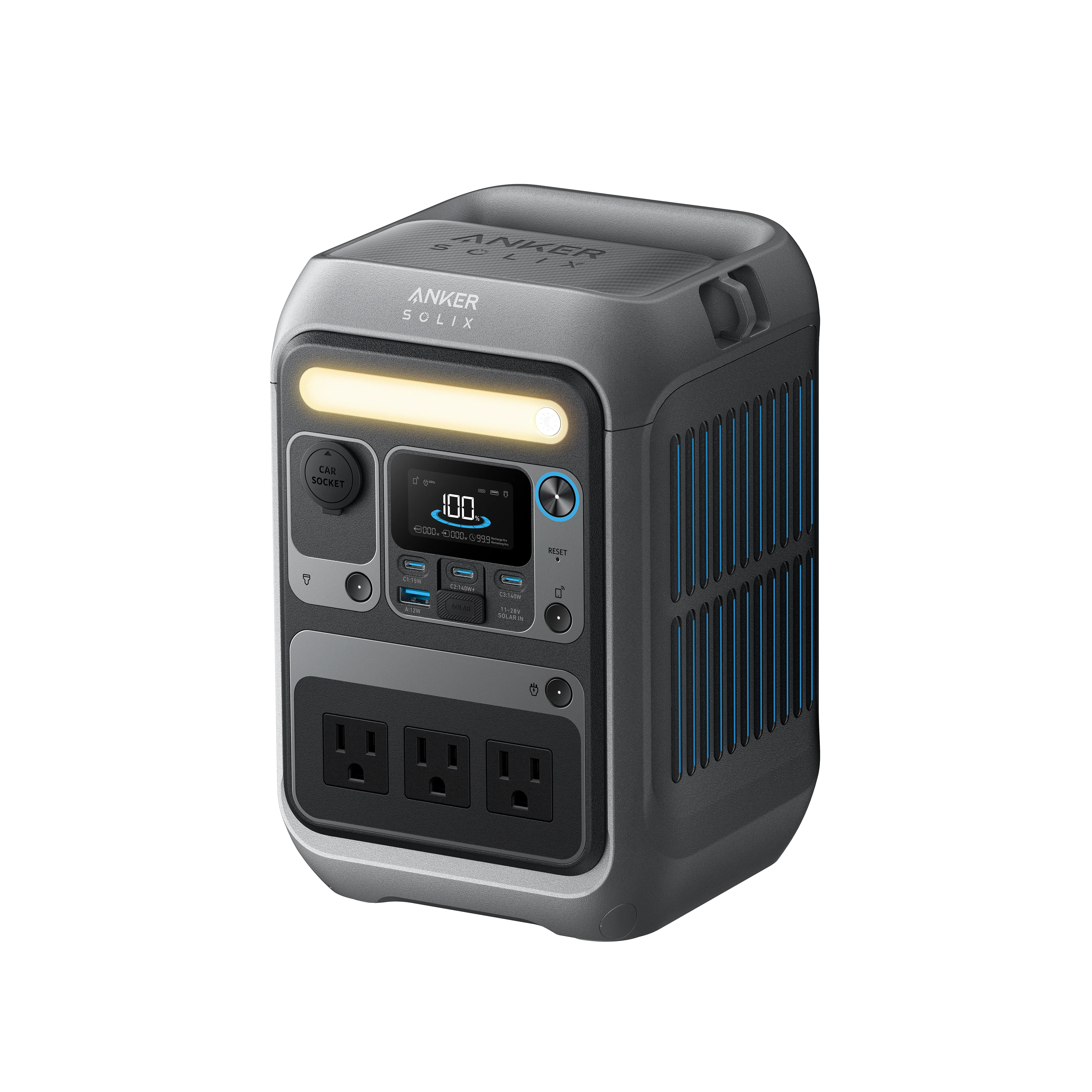
The Anker SOLIX C300 holds more (288Wh vs 245), charges devices faster (dual 140W USB-C to one 100W port), and switches over quicker — while the RIVER 3 answers with $131 off, a pound less, and an IP54 rugged shell.
Full profiles: EcoFlow RIVER 3 → · Anker SOLIX C300 →

Written by Wenny ZhengUpdated
Portable Power Tester, Station Arena Test Desk

$239.00 · direct from EcoFlow
Last checked 14 days ago. Prices move — check before you buy.
$329.99 · direct from Anker
Last checked 1 day ago. Prices move — check before you buy.
Spec deltas
Two compact ~300Wh units built to keep devices charged, $131 apart. The EcoFlow RIVER 3 is $199; the Anker SOLIX C300 is $330 — and the pricier Anker packs more where it counts for this class.
The C300 holds more (288Wh vs 245), and its dual 140W USB-C ports charge a laptop far faster than the RIVER 3's single 100W portB1. It also switches to battery in 10ms to the RIVER 3's 20ms and runs quieter at 25dB — while costing the same $0.28 per lifetime kWh to own.
The RIVER 3's case is price and ruggedness: $131 cheaper, a pound-plus lighter (7.8 lb vs 9.1), an IP54 water- and dust-resistant shell the C300 doesn't matchA2, and slightly more solar input. For a unit that lives outdoors, those add up.
What the Numbers Reveal
Each conclusion stated first — the numbers behind it on one line, the full analysis below.
A ~300Wh unit's main job is charging phones, cameras, and laptops, and the C300 does it faster: two 140W USB-C ports to the RIVER 3's single 100W, enough to fast-charge a laptop and a phone at onceB1, plus a 10ms UPS reviewers call unique at this sizeB3. That's capability aimed squarely at the use case.
the C300 has dual 140W USB-C ports vs the RIVER 3's single 100WB1these are device-charging units firstthe C300's 10ms UPS is unusually fast for the sizeB3
Why it mattersIf you're buying this to keep gear charged fast, the C300's ports are the deciding advantage.
weight
The C300's extra 43Wh of capacity comes with $131 more and 1.3 lb more to carry — and cost-to-own lands identical at $0.28 per lifetime kWh, so neither is the value winner. It's a straight trade: more capacity and ports for a higher price and a heavier bag.
the C300 holds 288Wh vs the RIVER 3's 245the C300 is $330 vs the RIVER 3's $199the C300 weighs 9.1 lb vs the RIVER 3's 7.8
Why it mattersWeight- and budget-focused buyers lean RIVER 3; capacity- and charging-focused buyers lean C300.
The RIVER 3's IP54 shell shrugs off splashes and dustA2, where the C300 carries no weatherproof rating — so for a rainy campsite or a dusty trail, the RIVER 3 is the safer unit, and it's lighter to carry there with slightly more solar input to refill.
the RIVER 3 carries an IP54 water- and dust-resistance ratingA2the C300 has no comparable weatherproof ratingthe RIVER 3 is also lighter and takes a bit more solar
Why it mattersOutdoor and rough-use buyers should take the rugged, lighter RIVER 3; indoor and desk users won't miss the rating.
The specific dimensions that decide these two units — everything else is a tie.
What the Specs Don't Tell You
Selected because: USB-C speed, UPS, and noise are where the C300 earns its premium.
The gotchas that fire both favor the C300, and they matter for a device unit. Its 10ms UPS switchover beats the RIVER 3's 20ms — reviewers single it out as unusually fast for this size and priceB3 — and it runs quieter at 25dB to 30dB. Small numbers, but exactly the ones that count for a unit on your desk.
The bigger everyday difference is USB-C: the C300's dual 140W ports fast-charge a laptop and a phone at once, where the RIVER 3 has a single 100W portB1. For keeping modern gear topped up quickly, that's the C300's clearest edge — and the reason it reads as the more modern charger of the two.
Portability & Form Factor
Selected because: The RIVER 3's lighter, IP54-rugged build is its clearest counter.
weight
Here the RIVER 3 pulls ahead. It's lighter — 7.8 lb to the C300's 9.1 — and, more importantly, IP54 water- and dust-resistantA2, where the C300 carries no weatherproof rating. For a unit you sling into a bag for camping or toss in a truck bed, lighter-and-rugged is a real advantage.
The C300 spends its extra weight on more battery, which is a fair trade if the unit mostly lives on a desk or in a car. But for the outdoors — rain, dust, a bumpy trail — the RIVER 3 is the one built to take it, and the easier one to carry there.
Lifetime Value
Selected because: Cost-to-own is tied; it's a capability-vs-price call, not a value one.
cost / lifetime kWh
On pure value the two land even: both cost $0.28 per lifetime kWh to own, so neither is the cheaper unit to run over its life. The RIVER 3 wins the upfront number by $131 ($199 vs $330); the C300 gives you 43Wh more capacity and the faster ports for it.
So this isn't a value decision — it's a capability-versus-price one. If the $131 and the extra 1.3 lb don't bother you, the C300's bigger battery and better charging are worth having; if they do, the RIVER 3 does the core job for less.
Brand Trust
Selected because: EcoFlow's ecosystem vs Anker's compact-build reputation, at low stakes.
Both are strong consumer-electronics brands with good apps. EcoFlow brings the deepest ecosystem and a top-rated app, though its support draws polarized reports and it had an October 2025 DELTA Max 2000 recall worth noting. Anker brings parent-brand trust and a well-liked app, with SOLIX-specific support reportedly slipping from its old no-hassle standard, but a strong reputation for compact, well-built gearB2.
At this small size, trust matters less than fit: neither brand's quirks will haunt a $200-240 device unit the way they might a $3,000 home system. Buy on the hardware — capacity and ports versus price and ruggedness — and either brand will stand behind it reasonably well.
Strengths & trade-offs
EcoFlow RIVER 3
Strengths
- +Costs $131 less
- +Lighter by 1.3 lb
- +Faster solar charging
Trade-offs
- –No major technical downsides compared to rival.
Anker SOLIX C300
Strengths
- +Larger battery capacity
Trade-offs
- –Substantially more expensive (+$131) than the RIVER 3.
Will It Power Your Gear?
Scenario math and per-appliance runtimes, modeled from the spec record.
Scenario verdicts
We ran the math on seven real-world scenarios. Here's which unit survives your actual life.
SCN-01 · 2 nights · needs 2,100Wh
Weekend Camping
Two nights off-grid with essential comfort
Neither unit
Neither unit covers this scenario's 2,100Wh: the RIVER 3 comes up 1,892Wh short (about 10% covered), the SOLIX C300 1,855Wh (12%). This is well outside what either unit is for; the right answer here is a larger station, not a choice between these two.
Battery budget usedlower = more headroom
LOAD Phone Charger 15W×6h · LED Lights 40W×8h · Box Fan 75W×14h · CPAP Machine 40W×16h
SCN-02 · 8 hours · needs 1,645Wh
8-Hour Blackout
Keep the essentials running through a night without power
Neither unit
Neither unit covers this scenario's 1,645Wh: the RIVER 3 comes up 1,437Wh short (about 13% covered), the SOLIX C300 1,400Wh (15%). This is well outside what either unit is for; the right answer here is a larger station, not a choice between these two.
Battery budget usedlower = more headroom
LOAD Fridge 150W×8h · Router + Modem 20W×8h · LED Lights (4 bulbs) 40W×6h · Phone Charger 15W×3h
SCN-03 · 8 hours · needs 320Wh
CPAP Overnight
Sleep therapy without interruption — the #1 medical use case
Neither unit
Neither unit covers a CPAP's roughly 320Wh overnight draw — the C300's 288Wh gets closer than the RIVER 3's 245, but both fall short of a full night once you account for usable capacity. For overnight CPAP, both are undersized; the 43Wh gap between them doesn't change that. Look at a 500Wh-plus unit instead.
Battery budget usedlower = more headroom
LOAD CPAP Machine 40W×8h
SCN-04 · 8 hours · needs 910Wh
Remote Workday
Full work day off-grid without power anxiety
Neither unit
Neither runs a full laptop-and-monitor workday, but both shine at what they're actually for — topping up a laptop fast. Here the C300's dual 140W USB-C ports are the edge: they refill a USB-C laptop far quicker than the RIVER 3's single 100W port, so you spend less time tethered even if neither lasts the whole day unplugged.
Battery budget usedlower = more headroom
LOAD Laptop 60W×8h · External Monitor 30W×8h · Router + Modem 20W×8h · Phone Charger 15W×2h
SCN-05 · 4 hours · needs 670Wh
Tailgate Party
Game day power for the crew
Neither unit
A tailgate's cooler-and-speakers draw outruns both units well before the event ends — these are device chargers, not party power. The C300's extra 43Wh buys a little more runtime, but if a tailgate is the real use, both are too small; size up to a 500Wh-plus unit.
Battery budget usedlower = more headroom
LOAD Blender 400W×0.5h · LED TV (55") 80W×4h · Bluetooth Speaker 15W×4h · Phone Charger (×3) 45W×2h
SCN-06 · 24 hours · needs 4,685Wh
Van Life Daily
A full day of mobile living — the ultimate endurance test
Neither unit
Neither unit covers this scenario's 4,685Wh: the RIVER 3 comes up 4,477Wh short (about 4% covered), the SOLIX C300 4,440Wh (5%). This is well outside what either unit is for; the right answer here is a larger station, not a choice between these two.
Battery budget usedlower = more headroom
LOAD Mini-Fridge 150W×24h · Laptop 60W×4h · Phone Charger 15W×3h · LED Lights 40W×5h · Fan 75W×8h
SCN-07 · an afternoon · needs 100Wh
Afternoon Off-Grid
Phones and a speaker at the park, beach, or campsite — the small-unit job description
Either unit
This is the job small stations are actually for, and both do it: the RIVER 3 finishes at 48% used, the SOLIX C300 at 41%. At this size the decider is what rides in the bag — 7.8 lbs for the RIVER 3 against 9.1 for the SOLIX C300 — and price, not the leftover watt-hours.
Battery budget usedlower = more headroom
LOAD Phone Charger (×2) 30W×2h · Bluetooth Speaker 10W×4h
The Load Test
RUNTIME = (Wh × 0.85) ÷ LOAD
None of the scenarios above exactly yours? Build it. Toggle what you'd plug in; both units are tested against the combined draw.
Essentials
Comfort & Convenience
High-Draw Appliances
Test duration
8h
Continuous draw
205W
Projected runtime
For this load: SOLIX C300 runs 1.2h vs 1h.
$329.99 list · direct from Anker
Modeled from the spec record — same math as the tables below. Methodology
Runtime by appliance
Real-world runtime estimates for common appliances, modeled at 85% inverter efficiency.¹
Essentials
The basics you need runningscale 0–16.3hComfort & Convenience
Makes off-grid life actually enjoyablescale 0–3.3hHigh-Draw Appliances
These reveal the real limits¹ Runtime = (capacity × 0.85) ÷ appliance watts. Within each group, all bars share one time scale (the group's longest runtime), so lengths are comparable across appliances; identical runtimes collapse into a single blue/orange bar. Actual runtime varies with battery age, temperature, and simultaneous loads — see methodology.
Conclusion
July 13, 2026
Verdict: the Anker SOLIX C300
Two ~300Wh device-charging units, $131 apart, and the pricier Anker SOLIX C300 is the more capable one at $330 to the EcoFlow RIVER 3's $199. It holds more (288Wh vs 245), charges devices far faster through dual 140W USB-C ports against the RIVER 3's single 100W, switches to battery in 10ms to 20ms, and runs quieter at 25dB to 30dB — with the same $0.28 per lifetime kWh cost-to-own. The RIVER 3 counters with a lower price, a lighter body (7.8 lb vs 9.1), an IP54 water-resistant shell the C300 lacks, and a hair more solar input (110W vs 100W). Take the C300 for capacity and fast device charging; take the RIVER 3 for the lower price, lighter weight, and outdoor ruggedness.
Editor-assigned confidence, based on cited owner research and spec analysis.
List prices as of July 13, 2026. The links below open EcoFlow's and Anker's current prices.
$329.99 · direct from Anker
Last checked 1 day ago. Prices move — check before you buy.
or check the RIVER 3 price$239.00 list
Written by Wenny Zheng, Portable Power Tester · Station Arena Test Desk · Updated July 13, 2026
Measured Data
Benchmark scores and the full spec record, side by side.
Benchmark scores
Full specifications
ᵈ Derived: price ÷ rated capacity. See the data behind our comparisons →
Comparison ToolAdd more power stations, side by sideOpen Tool →How these numbers are produced
Numeric verification
Every figure on this page traces to our spec database or arithmetic on it — no estimated numbers.
Owner claims
Statements about owner experience are cited to published reviews — see Sources & Research Notes below.
Runtime model
Runtime = (rated capacity × 0.85 inverter efficiency) ÷ device wattage. Solar recharge estimates assume panels deliver 70% of rated output. Cold weather, battery age, and stacked loads reduce real-world results.
Power Score
Computed from 14 published spec dimensions, weighted per use-case bench. Higher is better; a unit must meet a bench's minimum threshold to be rated.
See the full weight table and data sourcing on our methodology page →Class ranking (the star rating)
Each unit's star score is a category ranking, not customer reviews — no buyer opinions feed it. We score every station on size-independent quality (value, output, portability, endurance, ports, warranty, and more), then percentile-rank it against the other units in its capacity class, so a class-leading compact unit and a class-leading whole-home unit can both earn 5★. Here, RIVER 3 rates 4.4/5 (67th percentile of 22 Personal-class units), and SOLIX C300 rates 4.2/5 (52nd percentile of 22 Personal-class units).
How the class ranking is computed →Test Notes & Caveats
Hidden gotchas and advantages we spotted that you won't find on the product page.
UPS Switchover: ≤10ms vs ≤20ms
The C300's 10ms UPS switchover beats the RIVER 3's 20ms — and reviewers flag it as unusually fast for a unit this small and cheap. For a desk unit protecting a sensitive device from grid blips, the C300's quicker cutover is the safer bet; for casual device charging, both are fine, but the C300 holds the edge.
Warranty: No Difference
Both carry a 5-year warranty, so coverage is a wash — neither brand out-protects the other here. At this size and price, that parity means the decision comes down to the hardware — capacity, ports, ruggedness — not the paperwork.
Full record above — the Test Desk pick is the SOLIX C300.
Check SOLIX C300 price →or check the RIVER 3 priceOwnership Analysis
What happens after you buy — true cost of ownership, brand trust, and growth potential.
Lifetime value
Service lifeyears at one full cycle per day
Lifetime energy delivered
Cost per delivered kWh
│ warranty ends · Reaching the cycle rating means ~80% capacity remains — degraded, not dead.
Analyst note
The RIVER 3 wins on both sticker price and long-term value. At $0.27/kWh over its lifetime, it's meaningfully cheaper to own. Clear value winner. One thing to know reading the table: both carry the same 3,000-cycle rating, so the lifetime rows are sticker price and capacity in disguise — the wear horizon is identical and decides nothing here.
Brand trust
EcoFlow
Ecosystem
Largest in portable power — 12-15 models across DELTA Pro, DELTA 3, and RIVER 3 series, plus solar panels and smart home panels
Support
US-based phone/email/chat support (1-800-368-8604). Experiences are polarized — many report hassle-free prepaid-label replacements, but others report long waits and refurbished units sent for new claims. Pro tip: buying from Costco or Amazon gives you a stronger return safety net.
Community
Largest community in the space — Reddit r/Ecoflow_community (~31K members), multiple Facebook groups, and an official community forum
App experience
Rated 4.6/5 iOS (~8,400 ratings) · 4.2/5 Android (~17,000 ratings)
Unique strength
Fastest-charging technology (X-Stream), deepest product ecosystem, and most active innovation cadence. At the very top of the range, the DELTA Pro Ultra platform stacks batteries and inverters into whole-home backup — a flagship path, not a line-wide feature.
Worth knowing
Tested subscription paywalls for advanced app features in early 2025 before community backlash paused the plan. No parts or service offered out of warranty.
Anker
Ecosystem
7-8 SOLIX portable power stations across C-series (compact) and F-series (flagship), plus the X1 home energy system
Support
US-based support. Historically known for incredible no-hassle replacements, but recent reports describe AI-driven support agents giving generic responses and complex return logistics for heavy units (hazmat shipping). The Anker brand reputation is still strong, but SOLIX-specific support quality is trending down.
Community
Moderate — active Reddit (r/Anker, r/AnkerSOLIXCommunity) and growing. Benefits from Anker's massive consumer electronics brand awareness.
App experience
Rated 4.5/5 iOS (~1,100 ratings) · 4.3/5 Android
Unique strength
Parent brand trust from Anker's consumer electronics dominance. InfiniPower technology for long cycle life. Strong $/Wh value in the mid-size and larger units — the S2000, F2600 and C1000 are among the better buys per watt-hour in the catalog.
Worth knowing
Support quality appears to be declining from its historically excellent level. Firmware updates have removed features without warning. Expansion ecosystem is smaller than EcoFlow's.
Analyst note
EcoFlow brings the deepest ecosystem and a top-rated app, with an October 2025 DELTA Max 2000 recall worth noting on its record; its RIVER 3 here adds IP54 ruggedness and a light build. Anker brings parent-brand trust from its consumer-electronics dominance and a reputation for compact, well-built gear, though SOLIX-specific support is reportedly slipping; its C300 leans on capacity and standout dual-140W USB-C charging. At this small, inexpensive tier neither brand's support quirks will define the experience — both stand behind their gear reasonably. Decide on the hardware: the C300's capacity and fast charging, or the RIVER 3's rugged, lighter, cheaper build.
Growth path
RIVER 3
FIXED CAPACITYFixed at 245Wh, with no expansion — so size it for your needs up front rather than planning to add capacity later.
Accepts up to 110W of solar. Limited to a single portable panel.
Limited ports. You'll likely need a power strip or splitter.
SOLIX C300
FIXED CAPACITYFixed at 288Wh, with no expansion — so size it for your needs up front rather than planning to add capacity later.
Accepts up to 100W of solar. Limited to a single portable panel.
Adequate ports for most setups, but heavy users may want a power strip.
Realistic full solar rechargeat 70% of rated panel output — see methodology
Analyst note
Neither expands, and that's no knock on either — each is a complete unit at a fixed size. Buy the capacity that covers your needs now (the SOLIX C300 gives you the larger ceiling); you can't add to either later.
What Owners Report
Patterns from published owner reports and long-term reviews — every claim cited to its source below.
EcoFlow RIVER 3
The RIVER 3 earns consistent praise as a rare strict upgrade over the RIVER 2 — quieter at sub-30dB, IP54-rugged, faster-switching, more compact, and cheaper all at onceA1A2A4 — and reviewers recommend it as the better small-unit buy for 2026 across camping, van life, and home UPS useA3. Its IP54 shell and light weight make it the outdoor-friendly pick here.
Field data is directional rather than long-term, but the platform's improvements are well-documentedA2.
“The RIVER 3 operates under 30 dB — EcoFlow calls it 'whisper quiet,' quieter than a library — one of the most significant upgrades over the louder RIVER 2.”
Sources
backuppowerhub.com · ecoflow.com · rv.com · versus.com
Anker SOLIX C300
The SOLIX C300's highlights are its charging and switchover: 288Wh with dual 140W USB-C ports for fast device chargingB1, and a 10ms UPS reviewers call legitimately unique at this size and priceB3. Anker markets it as 30% smaller than competing stations, and reviewers call it compact and well-built for the capacityB2.
It's aimed at users who value reliability, smart features, and a compact designB4 — a device-charging unit first, with capacity and port speed as its selling points.
“288Wh capacity with 300W output (600W with SurgePad) and dual 140W USB-C ports for fast device charging.”
Sources
ankersolix.com · trustedreviews.com · im.com.au · solarwaypoint.com · backuppowerhub.com · powerstationlab.com
Sources & Research Notes
Every owner claim in this report is traceable to a published source. The bracketed references above resolve here.
Recurring owner themes
- The RIVER 3 improves on the RIVER 2 across the board — quieter (sub-30 dB), IP54-rugged, faster UPS, more capacity, lighter, and cheaper — a rare strict upgrade. [RIVER 3 · 3 entries]
- Compact, light design; dual 140W USB-C fast charging; and a standout 10ms UPS rare at this size are the highlights. [SOLIX C300 · 3 entries]
- A1
“The RIVER 3 operates under 30 dB — EcoFlow calls it 'whisper quiet,' quieter than a library — one of the most significant upgrades over the louder RIVER 2.”
backuppowerhub.com / ecoflow.com — RIVER 2 vs RIVER 3 · 2026 · [positive]
- A2
“Over the RIVER 2, the RIVER 3 adds IP54 waterproofing, a faster UPS switchover, a 2x runtime mode, and a more compact, lighter form factor.”
backuppowerhub.com — RIVER 2 vs RIVER 3 · 2026 · [positive]
- A3
“Recommended as the better buy for most in 2026 — for camping, van life, or home UPS backup, where durability and noise matter, the data consistently favors the RIVER 3.”
backuppowerhub.com / rv.com — RIVER 3 review · 2026 · [positive]
- A4
“Holds more capacity and weighs less than the RIVER 2 while costing less, making it effectively a strict upgrade on the same platform.”
ecoflow.com / versus.com — RIVER 2 vs RIVER 3 · 2026 · [positive]
- B1
“288Wh capacity with 300W output (600W with SurgePad) and dual 140W USB-C ports for fast device charging.”
ankersolix.com / trustedreviews.com — SOLIX C300 review · 2026 · [positive]
- B2
“Anker claims the C300 is 30% smaller than competing power stations; reviewers call it impressively light and compact for the capacity, aimed at keeping phones and gadgets charged on hikes and camping trips.”
im.com.au / solarwaypoint.com — SOLIX C300 review · 2026 · [positive]
- B3
“Its 10ms UPS switchover is legitimately unique in this size and price class.”
backuppowerhub.com / powerstationlab.com — SOLIX C300 review · 2026 · [positive]
- B4
“Targets users who value reliability, smart features, and compact design.”
backuppowerhub.com — SOLIX C300 review · 2026 · [positive]
Research compiled July 13, 2026.
What Owners Actually Report
Drawn from 32 comments on independent review channels — not from retailer reviews, which skew to the first week of ownership. Each line is our summary of one commenter's claim, linked to the original. We record what they said, including where it contradicts the spec sheet.
EcoFlow RIVER 3
35 claims from 21 comments · 30 from owners · 9 with figures
- UPS switchover
- 5 · 47% negative
- Price & value
- 6 · 17% negative
- Runtime
- 2 · 0% negative
- Warranty & support
- 6 · 73% negative
- Other
- 2 · 100% negative
What owners complain about
Accepts 80V-170V before switching over, which he calls poor for a home-office UPS.
UPS switchovermeasuredowner34 agreedsource →
Surge protection is only 150J, so he keeps it behind an older UPS's surge-only port.
Othermeasuredowner34 agreedsource →
Screen showed jumbled alphanumeric symbols, and the returned unit came back with Wi-Fi disabled.
Durabilityowner6 agreedsource →
What owners praise
Kept router and switch alive about 4 hours per charge during the 5 day post-Milton outage.
Runtimemeasuredowner38 agreedsource →
Happy sticking with their RIVER 3 units at $169 each.
Price & valuemeasuredowner45 agreedsource →
Works awesome as a UPS for Starlink router, switch and camera through rural spikes and outages.
UPS switchoverowner38 agreedsource →
Anker SOLIX C300
14 claims from 11 comments · 9 from owners · 2 with figures
- Build quality
- 2 · 55% negative
- Other
- 3 · 0% negative
- Size & weight
- 2 · 21% negative
- Solar input
- 3 · 14% negative
- Durability
- 1 · 0% negative
What owners complain about
Returned it: temps hit 52C and above when recharging at 300-330W, with a terrible burning plastic smell.
Build qualitymeasuredowner5 agreedsource →
A 300W inverter cannot start a fridge or drive a drill, where a 600W unit can.
Inverter & surgesource →
Calls the tall tower form factor nonsense in a car camper where a flat, stable unit is needed.
Size & weightsource →
What owners praise
Prefers the Ankers for portable use in the car or beside a chair.
Size & weightowner34 agreedsource →
Better AC outlet spacing, more USB-C ports and a light; bought two after the EcoFlow issue.
Build qualityowner4 agreedsource →
Uses two Anker 300W stations to power video lights on film shoots instead of costly V-mount batteries.
Otherowner1 agreedsource →
Claims are weighted by how specific they are, whether the commenter owns the unit, and how many readers agreed. Comments that mention a product under a rival's review count for more, because the commenter had no reason to be there. This is what buyers report, not our test results — for measurements we ran ourselves, see the methodology.
Who Should Buy Which
Buy the RIVER 3 if you…
- →You want the lower price ($199) and the lighter body (7.8 lb).
- →The unit goes outdoors — IP54 water- and dust-resistance handles rain and trail dustA2.
- →You want a bit more solar input (110W) to refill off-grid.
If neither fits
Both are roughly 250-290Wh units — sized for phones, cameras, and laptop top-ups, not for running appliances, a CPAP overnight, or a blackout. If you need to power real loads or last a night, step up to a 500Wh-plus unit; these are trip-and-desk chargers, not backup.
The Bottom Line
Buy the Anker SOLIX C300 if this unit's job is charging devices well. It holds more (288Wh), charges far faster through dual 140W USB-C ports, switches over quicker, and runs quieter — the more capable modern charger for $131 more, at the same cost-to-ownB1B3. For desk and travel device duty, it's the stronger pick.
Buy the EcoFlow RIVER 3 for price, weight, and the outdoors. It's $131 cheaper, a pound-plus lighter, and IP54 water- and dust-resistant where the C300 isn'tA2 — the better companion for camping and rough use. Between two good small units, let fast charging versus rugged value make the call.
Frequently Asked Questions
Answers drawn from the spec record and cited owner research.
EcoFlow RIVER 3 vs Anker SOLIX C300 — which should I buy?
The SOLIX C300 if fast device charging and capacity matter: it holds more (288Wh vs 245), has dual 140W USB-C ports to the RIVER 3's single 100W, switches over faster (10ms vs 20ms), and runs quieter, for $131 more. Choose the RIVER 3 for the lower price, the lighter weight (7.8 lb vs 9.1), and its IP54 water- and dust-resistance, which the C300 lacks.
Which charges a laptop faster?
The Anker SOLIX C300 — it has two 140W USB-C ports, so it can fast-charge a laptop (and a phone alongside it) well beyond what the RIVER 3's single 100W USB-C port delivers. For anyone keeping USB-C laptops and devices topped up quickly, that dual-140W setup is the C300's standout advantage.
Which is better for camping?
The EcoFlow RIVER 3, mainly for its IP54 water- and dust-resistance and lighter 7.8-lb weight — it's the one built to handle rain, dust, and a bumpy trail, and easier to carry there. The C300 holds a bit more and charges faster, but with no weatherproof rating, it's better suited to a car, desk, or tent than exposed outdoor use.
Which holds more power?
The Anker SOLIX C300, at 288Wh to the RIVER 3's 245 — about 43Wh, or roughly 18%, more capacity. Both cost the same $0.28 per lifetime kWh to own, so the C300's extra capacity comes at a fair price; it just costs $131 more up front and weighs 1.3 lb more.
Where to buy
EcoFlow RIVER 3
$239.00
$239.00 · direct from EcoFlow
Last checked 14 days ago. Prices move — check before you buy.
Anker SOLIX C300Pick
$329.99
$329.99 · direct from Anker
Last checked 1 day ago. Prices move — check before you buy.
Prices may vary by retailer and are subject to change.