Head-to-head test
Anker SOLIX C300 vs BLUETTI Apex 300 + 2×B500K
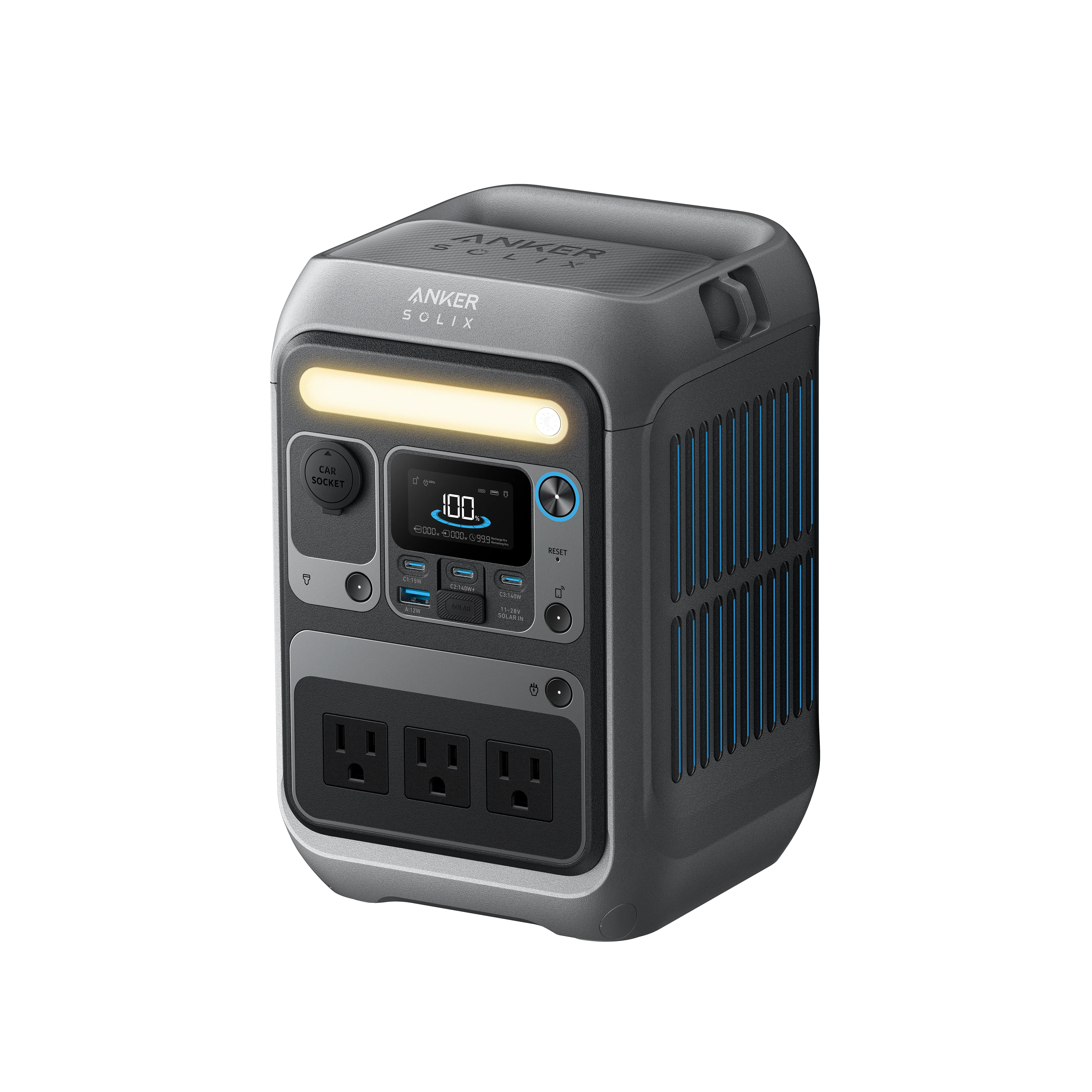
These aren't two power stations to choose between. One is a 9.1-lb topper you throw in a daypack and the other is a 282.2-lb system you install and leave, so the only question that decides anything is whether you're shopping to carry or to install.
Full profiles: Anker SOLIX C300 → · BLUETTI Apex 300 + 2×B500K →

Written by Gunner GustafsonUpdated
Whole-Home Backup Tester, Station Arena Test Desk
$329.99 · direct from Anker
Last checked 1 day ago. Prices move — check before you buy.

$5,399.00 · direct from BLUETTI
Last checked 1 day ago. Prices move — check before you buy.
Spec deltas
One of these you throw in a daypack; the other you install and leave. The Anker SOLIX C300 is a 9.1-lb, 288Wh unit that costs $330 and lives in a backpack pocket. The BLUETTI Apex 300 with two B500K batteries is a 282.2-lb, 13,005Wh system that costs $5,399 and, once you set it down, stays there. They both store electricity. That is roughly where the resemblance ends.
So there is no winner in the usual sense, and inventing one would waste the time you came here to save. The question isn't which is better. It's which one answers the problem you actually have. Need to carry power to a campsite and keep phones, a speaker, and a laptop alive? That's the C300, and the Apex physically can't do it. Need to keep a fridge and a few circuits running through a multi-day outage? That's the Apex, and the C300 covers about 15% of one eight-hour blackout before it's finished.
Answer a single question and you've chosen: do you pick this up and take it, or does it live in one place? If you can't answer that, you're not ready to buy either one, and if you're honestly torn between a $330 carry and a $5,399 install, your real need is a mid-size unit sitting between them. Everything below is here to make that call quickly.
What the Numbers Reveal
Each conclusion stated first — the numbers behind it on one line, the full analysis below.
weight
Add the price and the picture resolves. At about 18 times the cost ($5,399 against $330), this was never a choice between more or less capacity. It's a choice between carrying a little for $330 and installing a lot for $5,399, which are two different purchases that happen to share a spec sheet.
SOLIX C300 holds 288Wh and weighs 9.1 lbsApex 300 + 2 B500K holds 13,005Wh and weighs 282.2 lbs (stationary)C300 is $330; the Apex bundle is $5,399
Why it mattersDecide which of those two purchases you're making before you compare anything else; that call decides this page.
That $0.12 is only real if you actually deliver the 45,517 kWh it assumes. Run a phone charge through 13,005Wh of capacity and you've spent $5,399 to use a sliver of the battery, and your true cost per kilowatt-hour balloons far past the C300's.
Apex: $0.12 per lifetime kWhC300: $0.35 per lifetime kWhApex lifetime energy is 45,517 kWh across 3,500 cycles
Why it mattersTreat cost-per-kWh as a metric for house-scale loads. If your loads are phone-scale, it's quietly arguing you into hardware you'll never use.
The single scenario both pass is a 100Wh afternoon of phones and a speaker, and even there the engine's advice is to grab the C300 and leave the Apex home. So the whole region where these two overlap is one easy afternoon, and inside it the big battery's capacity is dead weight rather than an edge.
C300 covers about 15% of a 1,645Wh eight-hour blackout on 245Wh usableApex is stationary at 282.2 lbs and doesn't travelAfternoon Off-Grid (100Wh) is the only scenario both units pass
Why it mattersIf your real need sits anywhere outside that one afternoon, only one of these was ever a candidate. Buy for the job, not the spec gap.
At the roughly 40W draw of a CPAP, which is the one load where these quiet-mode dB floors are close to honest, you're choosing between a battery that dies before your alarm and a refrigerator-loud box running by your head all night. Neither is what someone shopping for a CPAP power source actually wants.
C300 is rated as low as 25dB; Apex runs around 45dB under loadC300's 245Wh usable falls 75Wh short of a 320Wh CPAP nightApex finishes the CPAP night with 10,734Wh to spare
Why it mattersIf CPAP is the reason you're here, skip both and look at a quiet mid-size portable sized for a full night.
The specific dimensions that decide these two units — everything else is a tie.
Portability & Form Factor
Selected because: 9.1 lbs you carry versus 282.2 lbs you install: this one fact sorts you into a product before any other spec matters.
weight
Start with the only spec that actually sorts you into a product: you pick up the C300, and you install the Apex. 9.1 lbs is a one-hand grab off a shelf and into a daypack. The Apex is a two-person, bent-knees lift you make once, into the spot it will keep. A tester of the lighter base Apex 300 could barely carry it a few feet and never got it onto a tableB4, and reviewers say it ships without wheels, so plan on a cartB11.
That one gap decides more than a weight figure should. A unit you can't move can't come camping, can't ride to the tailgate, and can't follow you from the office to the bedside. A 288Wh unit you can move anywhere still can't hold up a house. Portability and capacity trade off completely here, and no unit in this matchup gives you both. Which side of that trade you need is the entire decision.
Your Life, Your Pick
Selected because: Each unit fails the other's core jobs outright, so seeing the loads side by side is how you find which column is even yours.
Seven scenarios, and the pattern across them is almost comically symmetric: each unit fails the exact jobs the other exists for. The C300 covers roughly 27% of a 910Wh remote workday and about 5% of a 4,685Wh van-life day, and less on anything bigger. It runs out early on every home-scale load. The Apex clears them all on energy, with thousands of watt-hours to spare, then loses the only two that require leaving the house, because it doesn't travel to the campsite or the tailgate.
Exactly one row is a pass for both. Afternoon Off-Grid asks for 100Wh of phones and a speaker, and the engine's read is blunt: take the C300 at 9.1 lbs and leave the Apex home, because here the extra capacity is dead weight, not headroom. So the whole territory where these two compete is a single relaxed afternoon, and even there the answer is the cheaper, lighter unit. Everywhere else, only one of them was ever on the table.
Lifetime Value
Selected because: The Apex costs less per lifetime kWh ($0.12 against $0.35) yet about 18 times more up front, worth untangling before the per-kWh figure talks you into it.
cost / lifetime kWh
The counterintuitive line on the spec strip is that the Apex is the cheaper unit. It comes to $0.12 per lifetime kilowatt-hour against the C300's $0.35, because dividing a price by a very large lifetime energy total makes the price look small. Read only that number and you'd call the $5,399 system the value buy.
It's the value buy only if you use it like one. The $0.12 assumes you cycle about 45,517 kWh through the Apex over its life. Buy 13,005Wh to keep a phone topped up and you've spent $5,399 to touch a rounding error of that, and your real cost per kilowatt-hour stops being cheap in a hurry. The C300's $0.35, by contrast, works out to roughly $0.03 to run a weekend. Both are honestly cheap to own for the job each was built for, and neither one's per-kWh figure survives being handed to the other's buyer.
Growth Path
Selected because: One is sealed at 288Wh; the other scales past 13,005Wh toward partial-home backup, the clearest sign these answer different questions.
solar input
The C300 is sealed at 288Wh, and that isn't the knock it can look like. It's the finished form of a device-topper. You size it up front, and if 288Wh covers your phones and a laptop, you never think about capacity again. Calling a complete unit not-expandable only counts against it if you needed it to expand, and someone charging a headlamp doesn't.
The Apex is the opposite on purpose. It opens at 13,005Wh as an Apex 300 with two B500K batteries and keeps climbing with more BLUETTI batteries, which is exactly what turns a big battery into partial-home backup. That headroom is real, and it's the clearest sign these two answer different questions. It also carries a cost the C300 sidesteps: reviewers of the Apex ecosystem flag pricey add-ons, roughly $330 for the Hub D1 that supplies the USB and DC ports the face lacks, and about $699 to parallel two units, with the full accessory menu reading as overwhelming for buyers and their walletsB2B6B7B12. Those notes come from sibling B300K configurations rather than this exact bundleB0, but the ecosystem they describe is the one you'd buy into.
Strengths & trade-offs
Anker SOLIX C300
Strengths
- +Costs $5,069 less
- +Lighter by 273.1 lb
Trade-offs
- –Weaker inverter (-3,540W) limits appliance compatibility.
- –Sealed capacity — the Apex 300 + 2×B500K can add batteries to grow past 288Wh; this one can't.
- –Shorter-lived battery — rated for 3,000 charge cycles vs the Apex 300 + 2×B500K's 6,000, so it wears out sooner.
BLUETTI Apex 300 + 2×B500K
Strengths
- +Larger battery capacity
- +Higher AC output
- +Faster solar charging
- +Rated for 6,000 charge cycles — much longer battery lifespan
Trade-offs
- –Substantially more expensive (+$5,069) than the SOLIX C300.
- –Significantly heavier (+273.1 lbs), making it harder to move.
- –Very heavy unit that may be difficult for one person to lift.
Will It Power Your Gear?
Scenario math and per-appliance runtimes, modeled from the spec record.
Scenario verdicts
We ran the math on seven real-world scenarios. Here's which unit survives your actual life.
SCN-01 · 2 nights · needs 2,100Wh
Weekend Camping
Two nights off-grid with essential comfort
Neither unit
The weekend is the mismatch in miniature. The Apex stores the 2,100Wh many times over but at 282.2 lbs stays home, while the C300 travels easily and covers about 12% of the load. One can't go, the other can't finish. What actually powers your Saturday is a mid-size portable, which is neither of these.
Battery budget usedlower = more headroom
LOAD Phone Charger 15W×6h · LED Lights 40W×8h · Box Fan 75W×14h · CPAP Machine 40W×16h
SCN-02 · 8 hours · needs 1,645Wh
8-Hour Blackout
Keep the essentials running through a night without power
Apex 300 + 2×B500K
The SOLIX C300 doesn't finish — 245Wh usable against the 1,645Wh this needs leaves it 1,400Wh short, about 15% of the scenario covered. The Apex 300 + 2×B500K covers it with 9,409Wh to spare.
Battery budget usedlower = more headroom
LOAD Fridge 150W×8h · Router + Modem 20W×8h · LED Lights (4 bulbs) 40W×6h · Phone Charger 15W×3h
SCN-03 · 8 hours · needs 320Wh
CPAP Overnight
Sleep therapy without interruption — the #1 medical use case
Apex 300 + 2×B500K
The Apex is the only one that gets you to morning here, finishing the 320Wh night with 10,734Wh still in reserve. But it does it at around 45dB, the sound of a running refrigerator next to the bed, while the quiet C300 rated as low as 25dB stops about 75Wh short of the full night. If CPAP is the entire reason you're shopping, weigh that tradeoff before the capacity number decides for you.
Battery budget usedlower = more headroom
LOAD CPAP Machine 40W×8h
SCN-04 · 8 hours · needs 910Wh
Remote Workday
Full work day off-grid without power anxiety
Apex 300 + 2×B500K
The SOLIX C300 doesn't finish — 245Wh usable against the 910Wh this needs leaves it 665Wh short, about 27% of the scenario covered. The Apex 300 + 2×B500K covers it with 10,144Wh to spare.
Battery budget usedlower = more headroom
LOAD Laptop 60W×8h · External Monitor 30W×8h · Router + Modem 20W×8h · Phone Charger 15W×2h
SCN-05 · 4 hours · needs 670Wh
Tailgate Party
Game day power for the crew
Neither unit
Neither wins the parking lot. The C300 fires the 400W peak on its 600W surge, then its 300W continuous rating takes the load back and the party stops. The Apex wouldn't notice 400W, but at 282.2 lbs it isn't the thing you carry to a tailgate. Bring a mid-size portable that can both travel and hold the load.
Battery budget usedlower = more headroom
LOAD Blender 400W×0.5h · LED TV (55") 80W×4h · Bluetooth Speaker 15W×4h · Phone Charger (×3) 45W×2h
SCN-06 · 24 hours · needs 4,685Wh
Van Life Daily
A full day of mobile living — the ultimate endurance test
Apex 300 + 2×B500K
A 4,685Wh day is squarely the Apex's job. It covers it and still holds 6,369Wh, while the C300's 245Wh usable is about 5% of the day. Just be honest about the label: 282.2 lbs bolted into a build is fixed-install territory, a big rig or a fifth-wheel, not a nimble stealth van you move gear around in.
Battery budget usedlower = more headroom
LOAD Mini-Fridge 150W×24h · Laptop 60W×4h · Phone Charger 15W×3h · LED Lights 40W×5h · Fan 75W×8h
SCN-07 · an afternoon · needs 100Wh
Afternoon Off-Grid
Phones and a speaker at the park, beach, or campsite — the small-unit job description
Either unit
This row is here for the SOLIX C300's class of job: phones and a speaker, 100Wh across an afternoon. Both cover it — the SOLIX C300 finishes at 41% used, and the Apex 300 + 2×B500K barely notices it. For this job the Apex 300 + 2×B500K's extra capacity is dead weight, not headroom; take the SOLIX C300 at 9.1 lbs and leave the rest at home.
Battery budget usedlower = more headroom
LOAD Phone Charger (×2) 30W×2h · Bluetooth Speaker 10W×4h
The Load Test
RUNTIME = (Wh × 0.85) ÷ LOAD
None of the scenarios above exactly yours? Build it. Toggle what you'd plug in; both units are tested against the combined draw.
Essentials
Comfort & Convenience
High-Draw Appliances
Test duration
8h
Continuous draw
205W
Projected runtime
For this load: Apex 300 + 2×B500K runs 53.9h vs 1.2h.
$5,399 list · direct from BLUETTI
Modeled from the spec record — same math as the tables below. Methodology
Runtime by appliance
Real-world runtime estimates for common appliances, modeled at 85% inverter efficiency.¹
Essentials
The basics you need runningscale 0–736.9hComfort & Convenience
Makes off-grid life actually enjoyablescale 0–147.4hHigh-Draw Appliances
These reveal the real limitsscale 0–11.1h¹ Runtime = (capacity × 0.85) ÷ appliance watts. Within each group, all bars share one time scale (the group's longest runtime), so lengths are comparable across appliances; identical runtimes collapse into a single blue/orange bar. Actual runtime varies with battery age, temperature, and simultaneous loads — see methodology.
Conclusion
August 30, 2026
Verdict: the Apex 300 + 2×B500K, on Power Score margin
Call it a tie, but not the coin-flip kind: these two don't compete, so the honest move is to route you to the right one instead of crowning a winner. If you have to carry it, the C300 is the only candidate, because the Apex weighs 282.2 lbs and stays where you set it. If you have to back up a home, the Apex is the only candidate, because the C300 covers about 15% of a single eight-hour blackout before it quits. Decide whether you're carrying or installing and you've decided this. If you can't decide that, you're not ready to buy either, and what you actually want is a mid-size unit that sits between them.
Editor-assigned confidence, based on cited owner research and spec analysis.
Written by Gunner Gustafson, Whole-Home Backup Tester · Station Arena Test Desk · Updated August 30, 2026
Measured Data
Benchmark scores and the full spec record, side by side.
Benchmark scores
Not rated for both units (minimum threshold unmet): UPS, Home Backup, CPAP, Tailgating, Food Truck, Apartment Balcony, Camping.
Full specifications
ᵈ Derived: price ÷ rated capacity. See the data behind our comparisons →
Comparison ToolAdd more power stations, side by sideOpen Tool →How these numbers are produced
Numeric verification
Every figure on this page traces to our spec database or arithmetic on it — no estimated numbers.
Owner claims
Statements about owner experience are cited to published reviews — see Sources & Research Notes below.
Runtime model
Runtime = (rated capacity × 0.85 inverter efficiency) ÷ device wattage. Solar recharge estimates assume panels deliver 70% of rated output. Cold weather, battery age, and stacked loads reduce real-world results.
Power Score
Computed from 14 published spec dimensions, weighted per use-case bench. Higher is better; a unit must meet a bench's minimum threshold to be rated.
See the full weight table and data sourcing on our methodology page →Class ranking (the star rating)
Each unit's star score is a category ranking, not customer reviews — no buyer opinions feed it. We score every station on size-independent quality (value, output, portability, endurance, ports, warranty, and more), then percentile-rank it against the other units in its capacity class, so a class-leading compact unit and a class-leading whole-home unit can both earn 5★. Here, SOLIX C300 rates 4.2/5 (52nd percentile of 22 Personal-class units), and Apex 300 + 2×B500K rates 3.5/5 (14th percentile of 29 Whole-Home / Off-Grid-class units).
How the class ranking is computed →Test Notes & Caveats
Hidden gotchas and advantages we spotted that you won't find on the product page.
282.2 lbs, and It Means It
This is a two-person, bent-knees lift you perform once, into the spot the unit will keep. Once it's placed it's a semi-permanent appliance, so choose the spot before you choose the unit. The C300 you pick up with one hand at 9.1 lbs. If it has to travel at all, that gap has already decided this.
Only One of These Sleeps Next to You
The C300 is rated as low as 25dB; the Apex runs around 45dB under load, about the sound of a running refrigerator. For a TV in the next room that's nothing. For a CPAP or a bedside during an outage, that 20dB gap is the comparison, and it points one way.
A Sealed Box vs. the First Rung of a Ladder
The C300 is fixed at 288Wh. That's the ceiling, but it's an honest ceiling for a device-topper, not a missing feature, so size it up front. The Apex is built to grow, climbing past 13,005Wh with more BLUETTI batteries on a path that genuinely reaches partial-home backup. If your needs might rise toward the house, that's the one column with somewhere to go, and it's the only reason on this page to pay the Apex's freight.
Same Five Years, Very Different Per-Dollar
Both carry a 5-year warranty, so coverage is not a tiebreaker. The per-dollar math looks lopsided, about 16.7 years of cover per $1,000 on the C300 against 0.9 on the Apex, but that spread is just the price gap wearing a warranty costume. Read it as what each unit costs, not as one being better protected.
Battery Lifespan in Real Years
The Apex 300 + 2×B500K is rated for 6,000 cycles vs 3,000. In real life: at daily use, that's 16.4 vs 8.2 years. At weekend use (twice a week), it's 58 vs 29 years. One caution reading years across different sizes: a cycle is 13,005Wh on the Apex 300 + 2×B500K and 288Wh on the SOLIX C300, so count lifetime energy — roughly 78,029 kWh against 864 kWh over the rated life. After hitting the cycle limit, the battery doesn't die — it drops to ~80% of original capacity, which is still very usable.
Ownership Analysis
What happens after you buy — true cost of ownership, brand trust, and growth potential.
Lifetime value
Service lifeyears at one full cycle per day
Lifetime energy delivered
Cost per delivered kWh
│ warranty ends · Reaching the cycle rating means ~80% capacity remains — degraded, not dead.
Analyst note
The SOLIX C300 is cheaper to buy, but the Apex 300 + 2×B500K is cheaper to own. At $0.07/kWh over its lifetime vs $0.38/kWh, the Apex 300 + 2×B500K's higher cycle life and capacity make each dollar go further over the years.
Brand trust
Anker
Ecosystem
Seven or eight SOLIX stations span compact C-series to flagship F-series, with the X1 home system on top. For a device-topper like the C300 you're buying into a lineup that scales well above it if you ever want more.
Support
US-based, and historically famous for no-hassle replacements. Recent reports are cloudier: AI-driven agents giving generic answers, and hazmat return logistics on heavy units. SOLIX-specific support quality looks like it's trending down from an excellent baseline.
Community
Moderate but active, with r/Anker and a growing SOLIX subreddit, riding Anker's broad consumer-electronics recognition.
App experience
Rated 4.5/5 iOS (~1,100 ratings) · 4.3/5 Android
Unique strength
Parent-brand trust from Anker's electronics business, InfiniPower cells rated for long cycle life, and strong dollar-per-watt-hour in the mid and large units.
Worth knowing
Firmware updates have removed features without warning, and the expansion ecosystem is smaller than EcoFlow's. For a sealed C300 the expansion point is moot, but the firmware one isn't.
BLUETTI
Ecosystem
One of the broadest lineups in the category, 15 to 20-plus models from budget to flagship, including sodium-ion cold-weather units and vehicle solar hubs. The Apex sits at the top as a modular system you extend rather than replace.
Support
The most inconsistent in the space, mostly email with China-timezone delays. Some buyers get smooth service, others get weeks of runaround and offers of discounts instead of repairs. Buying direct tends to produce the better outcomes.
Community
Active and growing, with a dedicated r/bluetti, second only to EcoFlow in engagement.
App experience
Rated 4.5/5 iOS and Android — tied for best app experience in the category. V3.0 UI redesign was well-received.
Unique strength
Among the best capacity-to-price ratios anywhere, one of the widest product ranges in the category, full LFP chemistry, and dual-voltage output in the flagships.
Worth knowing
Support inconsistency is the number-one risk, and some older or discontinued units have become unrepairable for lack of a spare-parts policy. On a system this expensive, that risk is worth pricing in.
Analyst note
The brand contrast lines up with the product contrast. Anker sells a consumer-electronics-grade compact with strong parent-brand trust and support that used to be a selling point and lately isn't. BLUETTI sells the biggest-capacity, cheapest-per-watt-hour system here, wrapped in support that's a genuine coin flip. The kicker: support matters far more on a $5,399 install you'll lean on in an outage than on a $330 topper you can replace off a shelf, so if you go BLUETTI, buy direct and factor the risk in.
Growth path
SOLIX C300
FIXED CAPACITYFixed at 288Wh, with no expansion — so size it for your needs up front rather than planning to add capacity later.
Accepts up to 100W of solar. Limited to a single portable panel.
Adequate ports for most setups, but heavy users may want a power strip.
Apex 300 + 2×B500K
EXPANDABLESupports BLUETTI expansion batteries, so you can add capacity later without replacing the base unit — useful if your needs may climb past 13,005Wh.
Accepts up to 2,400W of solar. Enough for a serious multi-panel array.
Generous port selection supports complex multi-device setups.
Expansion batteries are BLUETTI-specific. You're investing in the BLUETTI ecosystem.
Realistic full solar rechargeat 70% of rated panel output — see methodology
Analyst note
The SOLIX C300 is sealed at 288Wh, which is fine if that covers you. The Apex 300 + 2×B500K starts at 13,005Wh and can grow beyond it with BLUETTI expansion batteries — real headroom the SOLIX C300 doesn't have if your needs climb toward partial-home backup.
What Owners Report
Patterns from published owner reports and long-term reviews — every claim cited to its source below.
Anker SOLIX C300
The field record for the C300 is review-desk, not long-haul ownership, so read it as first impressions rather than a durability verdictA0. Those impressions are consistent: reviewers call it impressively light and compact for 288Wh and squarely aimed at keeping phones and gadgets charged on hikes and camping tripsA2, single out the dual 140W USB-C for genuinely fast device chargingA1, and flag the sub-10ms UPS switchover as unusual at this size and priceA3. The buyer they picture is someone who wants reliability and smart features in something they can actually carryA4.
“288Wh capacity with 300W output (600W with SurgePad) and dual 140W USB-C ports for fast device charging.”
Sources
ankersolix.com · trustedreviews.com · im.com.au · solarwaypoint.com · backuppowerhub.com · powerstationlab.com
BLUETTI Apex 300 + 2×B500K
Here's the honest caveat first: genuine long-term field data for this exact Apex 300 plus two B500K batteries barely exists yet, since it's a recent, niche configurationB0. Most published testing is of the Apex 300 with the older B300K battery, so treat those notes as character, not specB0. Only one verified owner post names the B500K pairing, and it tells you who really buys this: someone running a 50A fifth-wheel RV off itB10.
What the reviews agree on is the weight. One tester of the base Apex 300 could barely carry it a few feet and couldn't lift it onto a tableB4, and reviewers note it ships without wheels, so budget for a cartB11. The other recurring theme is accessory cost: the face has no built-in USB or DC, so you add the roughly $330 Hub D1 to get themB2B6, paralleling two units runs about $699 for the Hub A1B7, and the whole modular menu reads as overwhelming for buyers and their walletsB12. Those last notes come from sibling B300K tests, not this bundleB0, and nobody has reported multi-month longevity, cold-weather behavior, or firmware history for this exact config yetB0.
“Some units sound like small jet engines under load, but the Apex 300's fans are relatively tame.”
Sources
techspective.net · thesolarlab.com · t3.com · trustedreviews.com · notebookcheck.net
Sources & Research Notes
Every owner claim in this report is traceable to a published source. The bracketed references above resolve here.
Recurring owner themes
- Compact, light design; dual 140W USB-C fast charging; and a standout 10ms UPS rare at this size are the highlights. [SOLIX C300 · 3 entries]
- Reviewers consistently note the lack of built-in USB/DC ports, requiring a separate $300 Hub D1 accessory, as a notable and costly design compromise. [Apex 300 + 2×B500K · 3 entries]
- The unit's extreme weight (~85 lbs base, more with expansion batteries) makes it effectively immobile once placed, despite being marketed as 'portable.' [Apex 300 + 2×B500K · 3 entries]
- The modular ecosystem (Hub A1, Hub D1, expansion batteries) is praised for flexibility but criticized for high add-on costs relative to competitors. [Apex 300 + 2×B500K · 3 entries]
- A1
“288Wh capacity with 300W output (600W with SurgePad) and dual 140W USB-C ports for fast device charging.”
ankersolix.com / trustedreviews.com — SOLIX C300 review · 2026 · [positive]
- A2
“Anker claims the C300 is 30% smaller than competing power stations; reviewers call it impressively light and compact for the capacity, aimed at keeping phones and gadgets charged on hikes and camping trips.”
im.com.au / solarwaypoint.com — SOLIX C300 review · 2026 · [positive]
- A3
“Its 10ms UPS switchover is legitimately unique in this size and price class.”
backuppowerhub.com / powerstationlab.com — SOLIX C300 review · 2026 · [positive]
- A4
“Targets users who value reliability, smart features, and compact design.”
backuppowerhub.com — SOLIX C300 review · 2026 · [positive]
- B2
“Not having DC or USB ports on the face is a tradeoff. The Hub D1 solves the problem—but it's an additional $300 accessory that you then have to bolt on after the fact.”
techspective.net — Bluetti Apex 300 with B300K Review · 2025-09 · [negative]
- B4
“In fact, it's so heavy I can hardly carry it more than a few feet at a time and have been unable to lift it onto a table”
t3.com — Bluetti Apex 300 review · 2025-11 · [negative]
- B6
“That Bluetti D1 Power Hub that gives you your DC and USB ports costs about $300, which is a steep price for what you're getting.”
thesolarlab.com — Bluetti Apex 300 Review · unknown · [negative]
- B7
“Say you want to connect multiple Apex 300 power stations together, you'll need to buy the Bluetti Hub A1 Parallel Box, which retails for around $699!”
thesolarlab.com — Bluetti Apex 300 Review · unknown · [negative]
- B10
“I recently purchased a Bluetti Apex 300 with a B500K expansion battery to help power our 50A Brinkley 5th wheel.”
BLUETTI Community forum — 'Apex 300 operating mode and settings?' · 2026-02 · [positive]
- B11
“No wheels though, so if you plan on moving it regularly, invest in a cart.”
thesolarlab.com — Bluetti Apex 300 Review · unknown · [negative]
- B12
“This can [be] overwhelming both for buyers and their wallets... these optional accessories also provide a high degree of flexibility.”
notebookcheck.net — Bluetti APEX 300 power storage system review · 2025-08 · [mixed]
Research compiled August 30, 2026.
Who Should Buy Which
Buy the SOLIX C300 if you…
- →The camper or hiker who has to carry what they bring and mostly needs phones, headlamps, a speaker, and a tablet kept alive across a weekend.
- →The desk worker who wants a silent 288Wh buffer for a laptop and monitor through short outages, small enough to live in a bag or a drawer.
- →The person who wants a quiet always-on backup for one small device like a router or a mini-PC, and values the C300's sub-10ms UPS switchover that reviewers call unusual at this sizeA3.
Buy the Apex 300 + 2×B500K if you…
- →The homeowner who wants 13,005Wh of partial-home backup, enough to hold a fridge, wifi, and a few circuits through a multi-day outage, installed once in a chosen spot.
- →The big-rig owner: the only verified owner in our field notes bought this exact pairing to power a 50A fifth-wheel RVB10.
- →The off-grid cabin or worksite that needs 3,840W of continuous output and can soak up 2,400W of solar to refill, and never needs the unit to move.
If neither fits
Skip both if you're buying for a CPAP: the quiet C300 quits about 75Wh short of a 320Wh night, and the Apex finishes but runs around 45dB right by your head, so a quiet mid-size portable serves you better. Skip both if you want a genuinely powered weekend away, too, since the C300 covers only about 12% of a 2,100Wh weekend and the Apex won't travel at 282.2 lbs. And if you're simply cross-shopping a $330 carry against a $5,399 install, that's the tell your need isn't scoped yet: decide whether you carry or install first, and you'll usually land on a mid-size unit that is neither of these.
The Bottom Line
There's no crowning one of these, because they aren't in the same race. The C300 is a 9.1-lb topper you carry; the Apex 300 with two B500K batteries is a 282.2-lb backup system you install and forget. The lone afternoon of phone-charging where both qualify is the entire overlap between them, and even there the smarter pick is the one you can lift.
So don't weigh them against each other. Weigh the question they answer. Do you pick it up and take it, or does it live in one spot? That answer buys you the right box. And if you're still standing there with a $330 carry in one hand and a $5,399 install in the other, set both down. What you need is somewhere in the middle, and it isn't on this page.
Frequently Asked Questions
Answers drawn from the spec record and cited owner research.
Is the Anker SOLIX C300 or the BLUETTI Apex 300 the better buy?
Neither, because they're not the same kind of product. The C300 is a 9.1-lb, 288Wh unit you carry to top up phones, a laptop, and a speaker; the Apex 300 with two B500K batteries is a 282.2-lb, 13,005Wh system you install for home or big-RV backup, at about 18 times the price. Choose by whether you need to carry it or install it, and the winner is obvious.
Can the Anker SOLIX C300 back up my house in a blackout?
No, not in any real sense. Its 245Wh of usable energy covers about 15% of a typical 1,645Wh eight-hour blackout, which is enough for phones, a router, and some lights, but nowhere near a fridge overnight. Whole-home or partial-home backup is the Apex's job, or another system in the thousands-of-watt-hours range.
Does the BLUETTI Apex 300 have USB ports built in?
Not on the unit's face. Reviewers of the Apex 300 note there are no built-in USB or DC outputs, so you add the Hub D1 accessory, about $330, to get them. The little C300, by contrast, puts dual 140W USB-C right on the box, so don't assume the pricier system out-ports the cheaper one. Those Apex reviews tested sibling configurations, not this exact bundle.
Why does the BLUETTI cost less per kilowatt-hour if it's so much more expensive?
Because cost-per-lifetime-kWh spreads the purchase price over every watt-hour the battery will ever deliver. The Apex lands at $0.12 across an estimated 45,517 kWh of lifetime energy, versus $0.35 for the C300, but that only pays off if you actually run house-scale loads through it. Use 13,005Wh to charge a phone and you've paid $5,399 to touch a sliver of it, which makes your real per-kWh cost anything but cheap.
Which one is better for a CPAP machine?
Honestly, probably neither. The C300 is quiet, rated as low as 25dB, but its 245Wh of usable energy stops about 75Wh short of a full 320Wh CPAP night; the Apex clears the night easily but runs around 45dB, about as loud as a refrigerator next to the bed. For CPAP specifically, a quiet mid-size portable serves you better than either of these.
Where to buy
Anker SOLIX C300
$329.99
$329.99 · direct from Anker
Last checked 1 day ago. Prices move — check before you buy.
BLUETTI Apex 300 + 2×B500K
$5,399.00
$5,399.00 · direct from BLUETTI
Last checked 1 day ago. Prices move — check before you buy.
Prices may vary by retailer and are subject to change.