Head-to-head test
EcoFlow RIVER 3 MAX PLUS vs DJI Power 2000
An 8-Hour Blackout draws about 1,645Wh; the RIVER 3 Max Plus holds 858 and the Power 2000 holds 2,048 — no per-watt-hour discount fixes a battery that's the wrong size for the job.
Full profiles: EcoFlow RIVER 3 MAX PLUS → · DJI Power 2000 →
Looking for a different matchup? EcoFlow DELTA 3 Max Plus vs DJI Power 2000

Written by Ian SchneiderUpdated
Solar & Off-Grid Tester, Station Arena Test Desk
Spec deltas
$940 (on last listed prices) separates these two, and it isn't buying a nicer version of the same battery. The Power 2000 holds 2,048Wh to the RIVER 3 Max Plus's 858Wh, more than double the capacity, in a case that's more than double the weight too. Both carry an identical 5-year warranty. Only one of them is actually built to run a house through an outage on its own.
Run the ownership math and the RIVER 3 Max Plus wins it: $0.14 per lifetime kWh against $0.16 for the Power 2000, plus a much smaller check up front. Run six real usage scenarios instead of a spreadsheet, and the Power 2000 takes four of them outright, including the 8-hour blackout that an 858Wh battery can't finish alone.
That's the actual question this page answers: do you need 2,048Wh badly enough to carry an extra 27.7 lbs and write the bigger check, or would 858Wh plus $940 (on last listed prices) back in your pocket cover your real nights. Answer that honestly and the rest of this page just confirms it.
What the Numbers Reveal
Each conclusion stated first — the numbers behind it on one line, the full analysis below.
solar input
The gap holds even after the power comes back on in the form of sunlight: at 1,800W of solar input against 200W, the Power 2000 refills its much bigger battery faster than the RIVER 3 Max Plus tops off its smaller one, a 9x difference in intake speed.
An 8-Hour Blackout scenario needs about 1,645WhThe RIVER 3 Max Plus holds 858Wh totalThe Power 2000 accepts up to 1,800W of solar input against the RIVER 3 Max Plus's 200W
Why it mattersAnyone planning around a multi-day outage, not just an overnight one, should treat the RIVER 3 Max Plus's price tag as irrelevant. It isn't sized or equipped for that job.
That efficiency edge only shows up in scenarios small enough for 858Wh to cover, and that's 2 of the 6 tested here, both with the Power 2000 still holding far more spare capacity in reserve. For the other 4, the RIVER 3 Max Plus's better rate is a rate on capacity it doesn't have.
RIVER 3 Max Plus costs $0.14 per lifetime kWh, the Power 2000 costs $0.16The RIVER 3 Max Plus can physically run 2 of the 6 tested scenarios (CPAP Overnight, Tailgate Party) without draining dry, the Power 2000 runs 4 outright
Why it mattersIf your use case is genuinely small and fixed, the cheaper rate is real and worth taking. If it's bigger or unpredictable, the rate on paper doesn't matter because the RIVER 3 Max Plus can't finish the job to collect it.
weight
That weight only earns its keep in scenarios that actually need 2,048Wh. For anything the RIVER 3 Max Plus already covers on its own, like a CPAP or a tailgate afternoon, you're carrying 27.7 extra lbs for capacity that sits unused.
RIVER 3 Max Plus weighs 20.8 lbsPower 2000 weighs 48.5 lbsPower 2000 holds 2,048Wh versus the RIVER 3 Max Plus's 858Wh
Why it mattersWeigh the real use case, literally. If the load never tops 858Wh, the RIVER 3 Max Plus does the job at less than half the weight, for a fraction of the money.
rated cycles
That 2.8-year gap compounds if you're actually cycling this daily, like van life or a standing home-backup routine, rather than the occasional weekend. It's the difference between replacing the unit mid-decade or well past it.
Both units carry a 5-year warrantyRIVER 3 Max Plus is rated for 3,000 cycles, the Power 2000 for 4,000At daily use that's 8.2 years for the RIVER 3 Max Plus versus 11 for the Power 2000
Why it mattersIf daily use is genuinely your pattern, the Power 2000's extra cycle life is worth factoring in alongside its extra capacity. If you cycle it a few times a month, both units will outlast your interest in them either way.
The specific dimensions that decide these two units — everything else is a tie.
Your Life, Your Pick
Selected because: p2 wins all four non-neither scenarios outright; on the two neither-scenarios, p1 still falls further short. The clearest functional signal on the page.
Six scenarios, and the Power 2000 wins four of them outright: an 8-hour blackout, a CPAP overnight, a remote workday, and a tailgate party. The RIVER 3 Max Plus can technically run two of those without draining dry, but with a lot less room to spare in each case.
The two scenarios neither unit finishes alone are the tell. Weekend Camping and Van Life Daily both call for more capacity than even the Power 2000 carries solo, but the RIVER 3 Max Plus falls further short of both, needing roughly two and a half times its own capacity for a weekend and more than five times for van life. If your real use case lives in that territory, you're not really choosing between these two. You're shopping for a bigger system, or a way to recharge mid-use, no matter which of these you start with.
Lifetime Value
Selected because: cheaperToOwn is p1, but by only 2 cents/kWh. The real story is whether that thin edge matters against a 2.4x capacity gap.
The RIVER 3 Max Plus is the better deal by the numbers the spreadsheet cares about: $0.14 per lifetime kWh against $0.16 for the Power 2000. That's a real win, but it's a close one. Two cents a kWh, not an order of magnitude.
Widen the lens and the Power 2000 is still moving the bigger number: 8,192 kWh over its rated life against 2,574 for the RIVER 3 Max Plus, because a bigger battery times more rated cycles beats a slightly better per-unit rate. Buy the RIVER 3 Max Plus for the better rate. Buy the Power 2000 if you actually need that much total energy moved over the unit's life, like daily van use or a standing backup system, not the occasional weekend.
Portability & Form Factor
Selected because: 20.8 lbs vs 48.5 lbs is the physical cost of the capacity gap, reinforcing the core do-you-need-that-much-unit question.
weight
20.8 lbs is a one-hand carry: off a shelf, into a trunk, up a flight of stairs without thinking about it. 48.5 lbs is a different kind of object. Still technically one person, but a bent-knees lift you plan for, not one you do one-handed while holding a flashlight. That's the price of 2,048Wh in a portable box.
Neither unit is swappable, so whichever one you buy, you're committing to carrying its full weight every time it moves. If this is living in a closet and coming out for outages, 48.5 lbs barely matters. If it's going in and out of a vehicle every weekend, the RIVER 3 Max Plus's 20.8 lbs is the one you'll actually be happy to keep lifting.
What the Specs Don't Tell You
Selected because: warranty and cycleLife both fire: identical 5-year term, very different cycle count and dollar-per-year value underneath it.
rated cycles
Both of these carry a 5-year warranty, so the term isn't what separates them. What's underneath it is: the RIVER 3 Max Plus is rated for 3,000 cycles, the Power 2000 for 4,000, and at a realistic daily-use pace that's the difference between roughly 8 and 11 years before the pack fades toward 80% of its original capacity.
The warranty card below breaks down what that identical term is actually worth on each unit once you factor in what you paid for it. They're not backing the same size bet.
Brand Trust
Selected because: cross-brand pair (sameBrand=false): EcoFlow's mature ecosystem and community against DJI's ~2-year track record and drone-grade engineering pedigree.
This is a cross-brand matchup, and the two companies are at different points in their story. EcoFlow has spent close to a decade building out RIVER, DELTA, and solar hardware around this unit, plus the largest owner community in the category to ask questions in. DJI entered power stations only in 2024, four models deep, leaning on support infrastructure and battery engineering built for drones, not off-grid backup.
Neither fact should be the deciding one on its own. A newer catalog doesn't make the Power 2000's hardware worse, and a bigger community doesn't make the RIVER 3 Max Plus's warranty claims easier if EcoFlow's support queue is having a bad week. Weigh it as a tiebreaker, not a headline.
Strengths & trade-offs
EcoFlow RIVER 3 MAX PLUS
Strengths
- +Lighter by 27.7 lb
Trade-offs
- –Weaker inverter (-2,400W) limits appliance compatibility.
- –Shorter-lived battery — rated for 3,000 charge cycles vs the Power 2000's 4,000, so it wears out sooner.
DJI Power 2000
Strengths
- +Larger battery capacity
- +Higher AC output
- +Faster solar charging
- +Rated for 4,000 charge cycles — much longer battery lifespan
Trade-offs
- –Significantly heavier (+27.7 lbs), making it harder to move.
Will It Power Your Gear?
Scenario math and per-appliance runtimes, modeled from the spec record.
Scenario verdicts
We ran the math on six real-world scenarios. Here's which unit survives your actual life.
SCN-01 · 2 nights · needs 2,100Wh
Weekend Camping
Two nights off-grid with essential comfort
Neither unit
A weekend of camping draws around 2,100Wh. The Power 2000's 2,048Wh looks close on a spec sheet, but between typical inverter losses and the fact that nobody runs a battery to empty, it still comes up short. The RIVER 3 Max Plus's 858Wh isn't close at all. Neither wins this one outright, so bring a way to top off from the car or a panel, or trim the load, whichever of these you pack.
Battery budget usedlower = more headroom
LOAD Phone Charger 15W×6h · LED Lights 40W×8h · Box Fan 75W×14h · CPAP Machine 40W×16h
SCN-02 · 8 hours · needs 1,645Wh
8-Hour Blackout
Keep the essentials running through a night without power
Power 2000
An 8-hour blackout draws about 1,645Wh. The RIVER 3 Max Plus's 858Wh doesn't reach that on its own, so you'd be rationing power by hour four. The Power 2000's 2,048Wh clears it with real margin left over for a phone, a router, and a fridge cycling on and off through the night.
Battery budget usedlower = more headroom
LOAD Fridge 150W×8h · Router + Modem 20W×8h · LED Lights (4 bulbs) 40W×6h · Phone Charger 15W×3h
SCN-03 · 8 hours · needs 320Wh
CPAP Overnight
Sleep therapy without interruption — the #1 medical use case
Either unit
A CPAP overnight draws roughly 320Wh, and both units handle it without drama. The difference is headroom: the RIVER 3 Max Plus uses a meaningful chunk of its 858Wh doing it, while the Power 2000 barely dents its 2,048Wh, leaving room to also run a fan, a phone charger, and a nightstand light without a second thought.
Battery budget usedlower = more headroom
LOAD CPAP Machine 40W×8h
SCN-04 · 8 hours · needs 910Wh
Remote Workday
Full work day off-grid without power anxiety
Power 2000
A remote workday of laptop, monitor, phone, router, and a coffee maker pulls about 910Wh. That's more than the RIVER 3 Max Plus's 858Wh holds outright, before any inverter loss even applies. Close, but no. The Power 2000's 2,048Wh comes nowhere near its limit doing the same job.
Battery budget usedlower = more headroom
LOAD Laptop 60W×8h · External Monitor 30W×8h · Router + Modem 20W×8h · Phone Charger 15W×2h
SCN-05 · 4 hours · needs 670Wh
Tailgate Party
Game day power for the crew
Power 2000
A tailgate party, speaker, string lights, a small fan, and phone charging for the group, runs around 670Wh. The RIVER 3 Max Plus can just about cover it, but it's working close to its limit. The Power 2000 covers the same party with plenty of capacity left to spare, if you'd rather not watch the percentage gauge while the game's on.
Battery budget usedlower = more headroom
LOAD Blender 400W×0.5h · LED TV (55") 80W×4h · Bluetooth Speaker 15W×4h · Phone Charger (×3) 45W×2h
SCN-06 · 24 hours · needs 4,685Wh
Van Life Daily
A full day of mobile living — the ultimate endurance test
Neither unit
Van life daily power, fridge, water pump, lighting, laptop, and an induction cooktop some nights, adds up to around 4,685Wh a day. That's more than five times the RIVER 3 Max Plus's 858Wh and still well beyond the Power 2000's 2,048Wh. Neither unit is sized to run a daily van-life load solo. That's a job for a built-in DC system or multiple units, not a single portable station from either brand.
Battery budget usedlower = more headroom
LOAD Mini-Fridge 150W×24h · Laptop 60W×4h · Phone Charger 15W×3h · LED Lights 40W×5h · Fan 75W×8h
The Load Test
RUNTIME = (Wh × 0.85) ÷ LOAD
None of the scenarios above exactly yours? Build it. Toggle what you'd plug in; both units are tested against the combined draw.
Essentials
Comfort & Convenience
High-Draw Appliances
Test duration
8h
Continuous draw
205W
Projected runtime
For this load: Power 2000 runs 8.5h vs 3.6h.
$1,299 list · direct from DJI
Planning for more than this? Describe your whole setup and get it sized →
Modeled from the spec record — same math as the tables below. Methodology
Runtime by appliance
Real-world runtime estimates for common appliances, modeled at 85% inverter efficiency.¹
Essentials
The basics you need runningscale 0–116.1hComfort & Convenience
Makes off-grid life actually enjoyablescale 0–23.2hHigh-Draw Appliances
These reveal the real limitsscale 0–1.7h¹ Runtime = (capacity × 0.85) ÷ appliance watts. Within each group, all bars share one time scale (the group's longest runtime), so lengths are comparable across appliances; identical runtimes collapse into a single blue/orange bar. Actual runtime varies with battery age, temperature, and simultaneous loads — see methodology.
Conclusion
July 28, 2026
Verdict: the Power 2000, on Power Score margin
DJI's Power 2000 wins this matchup on capability: it clears four of the six real-world scenarios tested outright, and comes closer than the RIVER 3 Max Plus on the two scenarios neither unit fully covers. That capability is backed by 5 times the continuous output, 9 times the solar input ceiling, and a PowerScore of 4,208 against 2,822. The RIVER 3 Max Plus is still the better deal per watt-hour and the cheaper, lighter unit to own outright — that math doesn't flip, and for genuinely small, predictable loads it's still the smarter buy. But value-per-Wh only pays off if you're buying enough Wh, and 858 isn't enough for four of the six jobs tested here. Buy the Power 2000 if your loads run past a laptop and a CPAP. Buy the RIVER 3 Max Plus and bank the difference if they don't.
Editor-assigned confidence, based on cited owner research and spec analysis.
List prices as of July 28, 2026. The links below open DJI's current price.
$1,299.00 · direct from DJI
Last checked 16 days ago. Prices move — check before you buy.
Written by Ian Schneider, Solar & Off-Grid Tester · Station Arena Test Desk · Updated July 28, 2026
Black Friday · 38 days out
Price to beat:Power 2000 $1,299
We have never seen it discounted, so any real cut would be a first.
Measured Data
Benchmark scores and the full spec record, side by side.
Benchmark scores
Not rated for both units (minimum threshold unmet): RV Living, Home Backup, Food Truck.
Full specifications
ᵈ Derived: price ÷ rated capacity. See the data behind our comparisons →
Comparison ToolAdd more power stations, side by sideOpen Tool →How these numbers are produced
Numeric verification
Every figure on this page traces to our spec database or arithmetic on it — no estimated numbers.
Owner claims
Statements about owner experience are cited to published reviews — see Sources & Research Notes below.
Runtime model
Runtime = (rated capacity × 0.85 inverter efficiency) ÷ device wattage. Solar recharge estimates assume panels deliver 70% of rated output. Cold weather, battery age, and stacked loads reduce real-world results.
Power Score
Computed from 14 published spec dimensions, weighted per use-case bench. Higher is better; a unit must meet a bench's minimum threshold to be rated.
See the full weight table and data sourcing on our methodology page →Class ranking (the star rating)
Each unit's star score is a category ranking, not customer reviews — no buyer opinions feed it. We score every station on size-independent quality (value, output, portability, endurance, ports, warranty, and more), then percentile-rank it against the other units in its capacity class, so a class-leading compact unit and a class-leading whole-home unit can both earn 5★. Here, RIVER 3 MAX PLUS rates 4.9/5 (95th percentile of 20 Compact-class units), and Power 2000 rates 4.3/5 (60th percentile of 26 Large-class units).
How the class ranking is computed →Test Notes & Caveats
Hidden gotchas and advantages we spotted that you won't find on the product page.
Same Term, Different Bet
Both units carry a 5-year warranty. The RIVER 3 Max Plus costs $359 (last listed price), working out to about $72 of coverage per warranty year. The Power 2000 costs $1,299, or about $260 per warranty year. Identical term, a very different amount of money riding on it if something goes wrong in year four.
3,000 Cycles vs 4,000, in Actual Years
At daily use, that gap works out to about 8.2 years for the RIVER 3 Max Plus versus 11 for the Power 2000. At twice-a-week weekend use, it's roughly 28.8 years versus 38.5. Neither battery dies at the cycle limit. It settles to roughly 80% of its original capacity, still usable, just fading.
Full record above — the Test Desk pick is the Power 2000.
Check Power 2000 price →Ownership Analysis
What happens after you buy — true cost of ownership, brand trust, and growth potential.
Lifetime value
Service lifeyears at one full cycle per day
Lifetime energy delivered
Cost per delivered kWh
│ warranty ends · Reaching the cycle rating means ~80% capacity remains — degraded, not dead.
Analyst note
The RIVER 3 MAX PLUS is no longer sold, so there is no price to work its cost per kWh from, and this comparison doesn't quote one. On what you can actually buy today, the Power 2000 works out at $0.16/kWh over its rated life. If you already own the RIVER 3 MAX PLUS, the hardware comparison still holds: over its rated life the RIVER 3 MAX PLUS delivers about 2,574 kWh and the Power 2000 about 8,192 kWh.
Brand trust
EcoFlow
Ecosystem
The deepest catalog in the category: RIVER 3, DELTA 3, and DELTA Pro lines, plus solar panels and smart home panels, so the RIVER 3 Max Plus slots into a much bigger system later if you want to build one.
Support
US-based phone, email, and chat support. Warranty claims run the gamut from a fast prepaid-label replacement to a longer wait for a refurbished unit, so buying through a retailer with its own return policy is a useful safety net if EcoFlow's queue is having a slow week.
Community
The biggest community in portable power: an official forum plus a Reddit community around 31K members, so a RIVER-specific question almost always already has an answer somewhere.
App experience
Rated 4.6/5 iOS (~8,400 ratings) · 4.2/5 Android (~17,000 ratings)
Unique strength
Fast-charging tech (X-Stream) and the widest expansion lineup in the category, from this unit's own add-on battery up through EcoFlow's whole-home systems.
Worth knowing
EcoFlow's catalog isn't spotless: a different model, the DELTA Max 2000, was recalled in October 2025 over an overheating risk. That's a separate product line, not this one, but it's part of the same company's track record. EcoFlow also doesn't offer parts or service once a unit is out of warranty.
DJI
Ecosystem
Brand new to power stations as of 2024, with just four models: Power 500, Power 1000 V2, Power 1000 Mini, and this Power 2000. No multi-generation lineup to grow into yet, just this unit and its own expansion batteries.
Support
DJI is routing power-station support through the same global network built for its drones, established infrastructure, but with only a couple of years of power-station-specific claims behind it.
Community
No dedicated power-station community yet. Power 2000 owners mostly post inside the much larger drone-focused r/dji, not a space built around backup power.
App experience
Rated 3.5/5 iOS and Android (DJI Home app ratings reflect entire DJI ecosystem including drones/cameras, not power-station-specific). Users report the on-device screen is more reliable than the app.
Unique strength
Drone-derived battery engineering shows up as a heavily layered protection system, flame-retardant housing, a nano-coated battery-management chip, dozens of temperature sensors, and a case rated to hold serious static weight, plus SDC ports that fast-charge DJI drone batteries directly. A real perk if you're already in the DJI ecosystem, irrelevant if you're not.
Worth knowing
DJI's track record in power stations is only about two years old, and this unit doesn't come with a built-in solar charge controller. Hitting the full 1,800W solar figure means buying DJI's separate proprietary adapter, not just any panel.
Analyst note
EcoFlow wins on tenure here: more models, a bigger community, more warranty claims processed one way or another. DJI's case rests on pedigree borrowed from somewhere else, drone-grade battery safety and charging speed, from a company still building its power-station-specific track record. Neither history is a reason to walk away from either unit, but if brand trust is the tiebreaker for you, EcoFlow has the longer one.
Growth path
RIVER 3 MAX PLUS
EXPANDABLESupports EcoFlow expansion batteries, so you can add capacity later without replacing the base unit — useful if your needs may climb past 858Wh.
Accepts up to 200W of solar. Limited to a single portable panel.
Adequate ports for most setups, but heavy users may want a power strip.
Expansion batteries are EcoFlow-specific. You're investing in the EcoFlow ecosystem.
Power 2000
EXPANDABLESupports DJI expansion batteries, so you can add capacity later without replacing the base unit — useful if your needs may climb past 2,048Wh.
Accepts up to 1,800W of solar. Enough for a serious multi-panel array.
Generous port selection supports complex multi-device setups.
Expansion batteries are DJI-specific. You're investing in the DJI ecosystem.
Realistic full solar rechargeat 70% of rated panel output — see methodology
Analyst note
Growth only counts if you can still buy in, and the RIVER 3 MAX PLUS is no longer sold (EcoFlow points owners to the RIVER 2 Pro). That leaves the Power 2000: it starts at 2,048Wh and takes DJI expansion batteries, so the ceiling moves if your needs do. The RIVER 3 MAX PLUS's expandability still matters if you already own one, but it isn't a reason to pick it over the Power 2000.
What Owners Report
Patterns from published owner reports and long-term reviews — every claim cited to its source below.
EcoFlow RIVER 3 MAX PLUS
Direct field reports on the RIVER 3 Max Plus specifically are thin. Most hands-on reviews cover the smaller RIVER 3 or RIVER 3 Plus, with the Max Plus mentioned mainly as the Plus bundled with EcoFlow's larger EB600 expansion battery for a combined 858WhA2A9. What's there is positive: reviewers clocked a quick recharge from the wall for this capacityA1, praised the sub-10ms UPS switchover that's held up across the RIVER 3 familyA3, and called it a strong middle ground for a weekend off-grid or wild-camping tripA5.
The caveats track the RIVER 3 Max Plus's size rather than anything specific to it: it won't run a hair dryer or microwave, though reviewers note that's true of most portable stations short of the big DELTA-class unitsA4, and the extended X-Boost output is meant for resistive loads like heaters, not sensitive electronics such as a desktop PCA7. No multi-month reliability reports, fan-noise complaints, or firmware issues turned up in the available field reports for this exact model, so treat the enthusiasm here as early and short-term rather than years of accumulated ownership.
“The RIVER 3 Max Plus (Wireless) can go from empty to full from mains in around 2.3 hours, which is very quick given its capacity.”
Sources
wandering-bird.com · root-nation.com · phonearena.com
DJI Power 2000
Coverage of the Power 2000 is more current and more consistent than the RIVER 3 Max Plus's, drawn from recent hands-on reviews rather than older or adjacent-model coverage. Recharge speed draws consistent praise: reviewers clocked it among the fastest units tested, both from a wall outlet and from solar input, with multiple sources independently landing on similar resultsB1. Fan noise is the other repeated theme. Testers found it among the quietest stations in the category, staying hushed even under heavy loadB2.
The safety engineering gets specific attention too. Reviewers describe a heavily layered protection system spanning flame-retardant materials, redundant fuses, extensive temperature monitoring, and a reinforced structural build, positioning it as one of the more robust units they've testedB3. Between the charging speed, the quiet running, and the drone-derived engineering, reviewers consistently came away impressed, including specific praise for how useful the DJI integration is if you already own DJI dronesB4. As with any product this new to the category, there isn't yet a base of multi-year ownership reports. What exists is strong, recent, and short-term.
“Among the fastest-charging tested — a full wall charge in about 90 minutes (reviewers measured even faster, roughly an hour), and up to 1,800W of solar input for a full solar charge in about 75 minutes.”
Sources
bobvila.com · t3.com · thesolarlab.com · campingsolar.us · protoolreviews.com · greenerideal.com · dronexl.co
Sources & Research Notes
Every owner claim in this report is traceable to a published source. The bracketed references above resolve here.
Recurring owner themes
- Owners/reviewers consistently note the Max Plus is a modular upgrade (base unit + EB600 battery) rather than a distinct unit, and reference its 858Wh combined capacity — this conflicts with the 1196Wh figure given in the task brief, suggesting a possible spec discrepancy or regional/bundle variant not covered by available sources. [RIVER 3 MAX PLUS · 3 entries]
- Reviewers agree the extended 1200W X-Boost output is best suited to resistive/heating loads, not sensitive electronics like PCs. [RIVER 3 MAX PLUS · 2 entries]
- Sub-10ms UPS switchover is repeatedly highlighted as a standout, real-world-tested feature across the River 3 Plus/Max/Max Plus family. [RIVER 3 MAX PLUS · 2 entries]
- Standout fast charging (wall and 1800W solar), near-silent operation, and an unusually robust safety-focused build are the consistent praise. [Power 2000 · 3 entries]
- A1
“The RIVER 3 Max Plus (Wireless) can go from empty to full from mains in around 2.3 hours, which is very quick given its capacity.”
wandering-bird.com — REVIEW: Ecoflow River 3 Max Plus- vanlife essential or not? · 2025-11 · [positive]
- A2
“The RIVER 3 Max Plus (Wireless) is created by taking the RIVER 3 Plus (Wireless) and attaching the larger EB600 extra battery, giving a total capacity of 858Wh.”
wandering-bird.com — REVIEW: Ecoflow River 3 Max Plus- vanlife essential or not? · 2025-11 · [positive]
- A3
“UPS (Uninterruptible Power Supply) switching on the RIVER 3 Plus/Max models is under 10 milliseconds”
wandering-bird.com — REVIEW: Ecoflow River 3 Max Plus- vanlife essential or not? · 2025-11 · [positive]
- A4
“It won't run a high-power hairdryer or microwave, but that's true for most portable power stations unless you go for one of the big Delta units.”
wandering-bird.com — REVIEW: Ecoflow River 3 Max Plus- vanlife essential or not? · 2025-11 · [mixed]
- A5
“For typical wild parking or a weekend off-grid, the Max Plus version is a brilliant middle ground.”
wandering-bird.com — REVIEW: Ecoflow River 3 Max Plus- vanlife essential or not? · 2025-11 · [positive]
- A7
“the extended output is designed for resistive loads – things like hair dryers, heaters, or compact air conditioners. It's not meant for sensitive electronics like desktop PCs.”
root-nation.com — EcoFlow River 3 Max Review (discusses River 3 Max Plus family) · 2025-05 · [mixed]
- A9
“With the EB300, you transform the station into the River 3 Max model, while the larger expansion battery gives you the EcoFlow River 3 Max Plus.”
phonearena.com — EcoFlow River 3 Plus Review · 2025-03 · [positive]
- B1
“Among the fastest-charging tested — a full wall charge in about 90 minutes (reviewers measured even faster, roughly an hour), and up to 1,800W of solar input for a full solar charge in about 75 minutes.”
bobvila.com / t3.com — DJI Power 2000 review · 2025-2026 · [positive]
- B2
“One of the quietest power stations tested — only about 29 dB at 5 feet when the fan kicked in, virtually silent, and it stayed among the quietest units even under the heaviest loads.”
bobvila.com / thesolarlab.com — DJI Power 2000 review · 2025-2026 · [positive]
- B3
“Built with an eightfold protection system — flame-retardant materials, a nano-coated BMS, 26 temperature sensors, 21 fuses, and structural reinforcement rated to support a one-ton static load — positioning it as one of the safest, most robust units on the market.”
campingsolar.us / protoolreviews.com — DJI Power 2000 review · 2025-2026 · [positive]
- B4
“Ran everything reviewers threw at it, handled surges consistently, and recharged incredibly fast, especially from solar; deep integration for DJI drone users is a unique advantage.”
greenerideal.com / dronexl.co — DJI Power 2000 review · 2025-2026 · [positive]
Research compiled July 28, 2026.
Who Should Buy Which
Buy the RIVER 3 MAX PLUS if you…
- →Buy the RIVER 3 Max Plus if your real draw is small and you know it: a CPAP through the night, a weekend of phone and cooler charging, a tailgate afternoon. It covers those jobs today, weighs 20.8 lbs you'll barely notice moving, and costs $940 less (on last listed prices) than the Power 2000 for capacity you're not going to use anyway.
- →It's also the safer entry point if you're new to backup power and don't want to overbuy: light enough to build the habit of using it, charging devices, running it through a short outage, without committing to a 48.5-lb appliance you have to find a permanent spot for.
Buy the Power 2000 if you…
- →Buy the Power 2000 if your outage or trip actually needs more than 858Wh: an 8-hour blackout, a full remote workday, or anything running more than one device for hours at a stretch. It's the only one of these two built to finish that job without a mid-afternoon recharge.
- →It's also worth knowing that reviewers came away impressed with how quietly the Power 2000 runs under loadB2 and with the drone-charging integration if you're already inside the DJI ecosystemB4, even though both spec sheets list the same 30dB rating on paper. Budget for the weight either way: 48.5 lbs is a two-handed lift, and the price is real money, not a rounding error next to the RIVER 3 Max Plus.
If neither fits
Skip both if your regular draw is closer to the Van Life Daily or Weekend Camping scenarios tested here, 2,100Wh to 4,685Wh a day. That's beyond even the Power 2000's 2,048Wh alone, and no amount of picking between these two solves it. Look at the next tier up from either brand, a model built for expansion batteries stacked from day one, or a proper DC-coupled van system instead of a single portable station.
The Bottom Line
This comes down to whether you need 2,048Wh or 858Wh is already plenty, not which brand builds a better box. The Power 2000 is the one that actually finishes an 8-hour blackout, a remote workday, and most of the other real scenarios tested here. The RIVER 3 Max Plus is the one that costs $940 less (on last listed prices) and runs cheaper per kWh for loads that fit inside it.
Buy the size you'll actually draw, not the size that feels safest on the shelf. If that's a CPAP and a phone, take the RIVER 3 Max Plus and enjoy the extra $940 (on last listed prices) in your pocket. If it's a full workday or a real outage, the Power 2000 is the one that doesn't leave you rationing power at hour four.
Frequently Asked Questions
Answers drawn from the spec record and cited owner research.
Is the DJI Power 2000 worth more than 3 times the price of the EcoFlow RIVER 3 Max Plus?
If your loads regularly exceed 858Wh, largely yes: it clears four of the six real-world scenarios tested here that the RIVER 3 Max Plus can't finish alone, and it delivers far more total lifetime energy over its life, 8,192 kWh against 2,574 kWh. If your loads are smaller and predictable, the RIVER 3 Max Plus is the better dollar-for-dollar buy. It's actually cheaper per lifetime kWh, $0.14 versus $0.16.
Can the EcoFlow RIVER 3 Max Plus run a full house during a blackout?
Not on its own for anything beyond a few hours. An 8-hour blackout draws around 1,645Wh, and the RIVER 3 Max Plus holds 858Wh total, so it runs out before the outage does. The Power 2000's 2,048Wh is sized to get through that same 8-hour stretch with margin left over.
Are the EcoFlow RIVER 3 Max Plus and DJI Power 2000 both expandable?
Yes, both support add-on expansion batteries rather than being sealed at their base capacity. The RIVER 3 Max Plus starts at 858Wh and the Power 2000 at 2,048Wh before either is expanded, and both carry the same 5-year warranty regardless of which you start from. The Power 2000's much higher 1,800W solar input, versus 200W on the RIVER 3 Max Plus, means it can also refill a bigger expanded bank faster once you've grown it.
Which one is quieter, the RIVER 3 Max Plus or the Power 2000?
On paper, neither. Both are rated at the same 30dB. In practice, reviewers who tested the Power 2000 came away calling it among the quietest units in the category, even under heavy load. There isn't comparable noise-specific field commentary for the RIVER 3 Max Plus to weigh against that, so treat it as a reviewer-observed edge for the Power 2000 rather than a spec advantage.
Is the DJI Power 2000 too heavy to be portable?
At 48.5 lbs, it's a two-handed lift, not a grab-and-go unit, more than double the RIVER 3 Max Plus's 20.8 lbs. It's still designed to be moved rather than permanently installed, but plan on setting it somewhere and leaving it there instead of repacking it every trip. If frequent repacking is your pattern, the RIVER 3 Max Plus's weight is the more livable number.
Brand matchup
EcoFlow vs DJI: measured across every matchup →Where to buy

EcoFlow RIVER 3 MAX PLUS
No longer sold
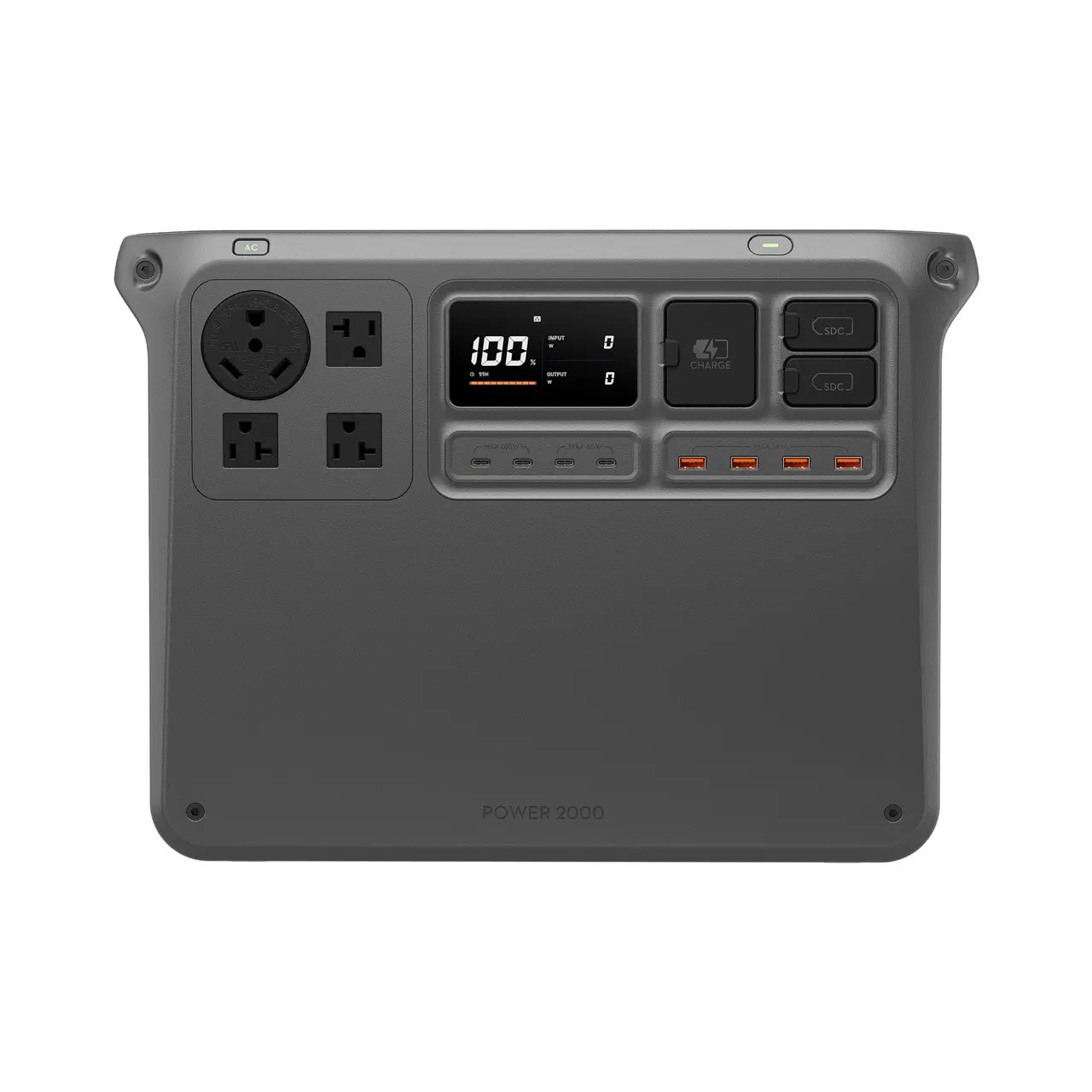
DJI Power 2000Pick
$1,299.00
$1,299.00 · direct from DJI
Last checked 16 days ago. Prices move — check before you buy.
Prices may vary by retailer and are subject to change.