Head-to-head test
EcoFlow RIVER 2 Pro vs Anker SOLIX C800X
Two identical 768Wh packs in two different boxes, so the only question that matters is whether you ever need to hold more than 800W, and on a pack this small that's a half-hour privilege you carry nearly seven extra pounds to own.
Full profiles: EcoFlow RIVER 2 Pro → · Anker SOLIX C800X →

Written by Ian SchneiderUpdated
Solar & Off-Grid Tester, Station Arena Test Desk
Spec deltas
Two 768Wh packs, both rated for at least 3,000 cycles, both peaking at the same 1,600W, both covered for five years, both charging a laptop over USB-C at 100W. After the flat 85% derate this site applies to every unit, each one gives you 653Wh of usable energy, identical to the watt-hour. Capacity is off the table before the comparison starts.
What's left is 400W of continuous output, 6.8 pounds, and about a hundred dollars, except the hundred dollars is not what it looks like. The price on Anker's record covers the C800X packaged with a 100W solar panel rather than the bare station, so every value figure on this page compares a station-plus-panel against a station. Buyers have run into the same fog on Anker's own storefront, where the C800X's panel bundles are genuinely hard to locate and tell apartB4.
The RIVER 2 Pro is the pick for the loads a 768Wh pack actually serves, and it's the one you carry with one arm. The C800X earns the extra money in exactly two situations: a load that sits between 800W and 1,200W, or a desktop PC wired through the UPS. Both are real buyers. Neither is the usual one.
What the Numbers Reveal
Each conclusion stated first — the numbers behind it on one line, the full analysis below.
continuous output
Because both units peak at the same 1,600W, the C800X isn't better at starting loads. Its 400W of extra continuous rating buys permission to hold a kettle or a 1,000W microwave, for roughly as long as it takes to heat something and not a minute longer. The surge ratio the spec sheet flatters the RIVER 2 Pro with is the same ceiling divided by a smaller number, not extra muscle.
SOLIX C800X: 1,200W continuous output; RIVER 2 Pro: 800WBoth units: 768Wh capacity, 653Wh usable after the flat 85% derateBoth units surge to the same 1,600W
Why it mattersIf a 1,000W appliance is why you're shopping, the C800X is the only one of these two that will hold it. If your list is a laptop, a CPAP, lights and phones, you will never see 800W, and you're carrying capability you can't reach.
solar input
The panel that actually comes in the C800X bundle is a 100W, which needs roughly 7.5 hours on the same pack, a whole solar day for one refill. The 300W ceiling only becomes an advantage after you've bought more panel than the box contains, which is the identical purchase a RIVER 2 Pro owner makes, minus 80W of headroom at the top.
SOLIX C800X: 300W solar input; RIVER 2 Pro: 220WBoth packs: 768WhThe C800X's listed price covers the station together with a 100W solar panel
Why it mattersDon't let the higher input ceiling decide this. Anyone who wants a genuinely fast solar refill is buying panels separately on either unit, so budget for that and compare the stations on what the stations do.
Neither figure is a stopwatch result, so treat them as classes rather than measurements. One owner does describe PCs and a router riding through an outage on his unit with no interruption at allB6, though our research could not confirm which SOLIX model that comment is aboutB0, so it's character rather than proof. The honest version is that only one of these two is rated into the class a desktop needs, and even that is a spec-sheet promise.
SOLIX C800X: UPS transfer rated no worse than 20msRIVER 2 Pro: rated no worse than 30msBoth figures are published ceilings, not measured results
Why it mattersIf the thing on the other end of the cable is a desktop with unsaved work, buy the C800X and stop reading. If it's a router, a modem or a NAS, either one holds the line and you should spend the money on weight instead.
The only dB claim in circulation for the C800X comes from a single affiliate review reporting fan noise below 30dB at a 290W load, on an in-house test nobody outside that site can verifyB16B0. What is on the record for the RIVER 2 Pro is that EcoFlow footnotes the 62dB itselfA2 and at least one owner cut away internal plastic to fit a quieter fanA1. So there is no like-for-like noise comparison available here, only one inapplicable ceiling and one unverified claim.
CPAP Overnight needs about 40W for eight hours, 320Wh, and both units finish it with 333Wh of usable energy leftRIVER 2 Pro: EcoFlow publishes 62dB as the level the RIVER 2 series reaches when charging or discharging at high wattageSOLIX C800X: no manufacturer noise figure published at all
Why it mattersIf this unit is going to sleep two feet from your head, discount both spec sheets and plan to hear the thing before the return window closes. The RIVER 2 Pro at 40W is not the 62dB unit, and the C800X at 40W is simply unknown.
The specific dimensions that decide these two units — everything else is a tie.
What the Specs Don't Tell You
Selected because: Everything that separates these two boxes is in these cards: 400W of continuous output, the rated UPS transfer, and one published noise figure facing a blank.
The surge card is the one to read twice. Both units peak at 1,600W, so anything one can start, the other can start, and the RIVER 2 Pro's 2x surge ratio is arithmetic rather than ability: the same ceiling divided by 800W instead of 1,200W. What the C800X genuinely owns is the 400W of continuous output above 800W, and that's a question about which appliances are allowed, not about how long they last.
The noise pair is less flattering to our pick, so here's the honest version. EcoFlow publishes 62dB and footnotes that the RIVER 2 series reaches it when charging or discharging at high wattageA2, which is the opposite convention to most makers, who quote a best case in a capped quiet mode. Anker publishes nothing. The RIVER 2 Pro looks like the loud one on this page largely because it is the one that told you, and the defensible position is that neither fan is a known quantity at the loads you will actually run.
Lifetime Value
Selected because: The figures below read the C800X's price as a bare station when it is quoted for the station plus a 100W solar panel, so the per-watt-hour gap is not a like-for-like comparison.
cost / lifetime kWh
Divide either price by the energy each pack delivers over at least 3,000 cycles and you get numbers that look decisive: about fifteen cents a kilowatt-hour against twenty. That calculation is not comparing what it appears to be comparing. The Anker listing behind the higher price covers the C800X together with a 100W solar panel, so the per-watt-hour spread is charging a station-plus-panel against a bare station and calling the difference value.
Here is what each price actually buys. $349 gets you the RIVER 2 Pro and nothing else. $450 gets you a C800X and a panel, on a storefront buyers have found genuinely hard to navigate between the bundle variantsB4. Until Anker quotes a bare-unit price, the only honest thing to say is that the cost gap is narrower than this section's arithmetic implies, and if a starter panel was on your list anyway it may not be a gap at all.
Portability & Form Factor
Selected because: The same 768Wh in two boxes nearly seven pounds apart, which is the difference between a one-hand lift and a considered one.
weight
24 lbs against 17.2 is about 40% more unit to carry for exactly the same energy. The RIVER 2 Pro is a one-hand lift off a shelf and into a footwell without thinking about it; the C800X is the one you put down before you open the tailgate. Neither is a two-person job, and if the unit is going to live next to your router and never move, this section is the one you can skip.
Weight is also where the C800X's extra output shows up as a cost rather than a feature. You are carrying the heavier inverter whether or not you ever ask it for 1,200W, and a 768Wh pack empties fast enough at that rating that the question rarely comes up.
Your Life, Your Pick
Selected because: Both units hold 653Wh usable, so every row lands identically and the only interesting question is which rows they miss.
Every row lands identically, because the packs are the same size down to the watt-hour, which makes the misses the real content. The 8-hour blackout wants 1,645Wh and each unit covers about 40% of it. The weekend camping list wants 2,100Wh and they cover under a third. The tailgate is the cruel one: 670Wh of demand against 653Wh usable, a 17Wh miss, which is one string of lights.
The single row both units pass is the CPAP, and it isn't close. 320Wh out of 653 leaves 333Wh still in the pack at breakfast, so capacity decides nothing and the fan would decide everything, if either maker had published a figure you could use. That is the subject of the noise cards further up, and it is the one place on this page where the right answer is to go and listen.
Brand Trust
Selected because: With the hardware this close, support and ecosystem are what's left to break the tie, and both brands have a direction of travel worth reading.
Both companies are moving in directions worth knowing before you spend. Anker's after-sales reputation was earned by its consumer-electronics business rather than this product line, and the SOLIX-specific record is split: one owner describes an order Anker would not correct, another a USB-C failure collected on a provided label and returned repaired in three daysB8B10, though our research could not confirm either comment is about this exact SKUB0. EcoFlow's support record is polarized in the same shape, and the company tested subscription paywalls for advanced app features in early 2025 before backlash paused the plan.
One commercial signal does tilt this. An owner reported the C800X listed as Final Sale on Anker's Canadian siteB5, which is usually how a SKU begins its exit, and a station whose model is on the way out is a harder unit to get parts and answers for. The RIVER 2 Pro sits inside the widest lineup and the busiest community in portable power, which is the thing you actually use at 11 p.m. when a unit won't take a charge. Buy from a retailer with a real return window either way.
Strengths & trade-offs
EcoFlow RIVER 2 Pro
Strengths
- +Costs $101 less
- +Lighter by 6.8 lb
Trade-offs
- –Can receive complaints about fan noise under heavy load.
Anker SOLIX C800X
Strengths
- +Higher AC output
- +Faster solar charging
Trade-offs
- –No major technical downsides compared to rival.
Will It Power Your Gear?
Scenario math and per-appliance runtimes, modeled from the spec record.
Scenario verdicts
We ran the math on six real-world scenarios. Here's which unit survives your actual life.
SCN-01 · 2 nights · needs 2,100Wh
Weekend Camping
Two nights off-grid with essential comfort
Neither unit
Neither unit covers this scenario's 2,100Wh: the RIVER 2 Pro comes up 1,447Wh short (about 31% covered), the SOLIX C800X 1,447Wh (31%). Treat this as partial cover — enough for the essentials in it, not the whole list.
Battery budget usedlower = more headroom
LOAD Phone Charger 15W×6h · LED Lights 40W×8h · Box Fan 75W×14h · CPAP Machine 40W×16h
SCN-02 · 8 hours · needs 1,645Wh
8-Hour Blackout
Keep the essentials running through a night without power
Neither unit
Neither unit does this job. 1,645Wh of demand against 653Wh usable is about 40% of the night on either side, identical. What that 40% buys is still real, the phones and the router and the lights and a laptop through the evening, as long as you decide in advance what you are not plugging in. Neither of these is a whole-outage plan.
Battery budget usedlower = more headroom
LOAD Fridge 150W×8h · Router + Modem 20W×8h · LED Lights (4 bulbs) 40W×6h · Phone Charger 15W×3h
SCN-03 · 8 hours · needs 320Wh
CPAP Overnight
Sleep therapy without interruption — the #1 medical use case
Either unit
Both finish the night, and it isn't close: a 40W machine for eight hours is 320Wh, which leaves 333Wh of usable energy still in either pack at breakfast. Capacity decides nothing here, so the fan would decide everything, except one maker publishes a ceiling that describes heavy charging rather than a sleeping CPAP and the other publishes nothing. Pick on weight and price, and accept that you're buying a fan you haven't heard.
Battery budget usedlower = more headroom
LOAD CPAP Machine 40W×8h
SCN-04 · 8 hours · needs 910Wh
Remote Workday
Full work day off-grid without power anxiety
Neither unit
Both come up 257Wh short of a 910Wh day, the most annoying kind of miss: about 72% of the way there, and the same 72% on each unit. A laptop and a monitor will get you most of a working day. The thing that breaks it is the one high-draw habit you forgot to count. Plan a mid-afternoon top-up from a wall socket or a panel and either unit does the job.
Battery budget usedlower = more headroom
LOAD Laptop 60W×8h · External Monitor 30W×8h · Router + Modem 20W×8h · Phone Charger 15W×2h
SCN-05 · 4 hours · needs 670Wh
Tailgate Party
Game day power for the crew
Neither unit
Seventeen watt-hours. That is the entire margin by which both units miss this one, 670Wh of demand against 653Wh usable, identical on each side. Nobody's evening ends over 17Wh: leave one string of lights off, or let the speaker die in the last quarter. The 400W peak in this load starts fine on either unit, so this is a capacity near-miss and not a power problem.
Battery budget usedlower = more headroom
LOAD Blender 400W×0.5h · LED TV (55") 80W×4h · Bluetooth Speaker 15W×4h · Phone Charger (×3) 45W×2h
SCN-06 · 24 hours · needs 4,685Wh
Van Life Daily
A full day of mobile living — the ultimate endurance test
Neither unit
Neither unit covers this scenario's 4,685Wh: the RIVER 2 Pro comes up 4,032Wh short (about 14% covered), the SOLIX C800X 4,032Wh (14%). This is well outside what either unit is for; the right answer here is a larger station, not a choice between these two.
Battery budget usedlower = more headroom
LOAD Mini-Fridge 150W×24h · Laptop 60W×4h · Phone Charger 15W×3h · LED Lights 40W×5h · Fan 75W×8h
The Load Test
RUNTIME = (Wh × 0.85) ÷ LOAD
None of the scenarios above exactly yours? Build it. Toggle what you'd plug in; both units are tested against the combined draw.
Essentials
Comfort & Convenience
High-Draw Appliances
Test duration
8h
Continuous draw
205W
Projected runtime
Dead heat — both run this 205W load for roughly 3.2h. Pick on price, weight, or ports.
Planning for more than this? Describe your whole setup and get it sized →
Modeled from the spec record — same math as the tables below. Methodology
Runtime by appliance
Real-world runtime estimates for common appliances, modeled at 85% inverter efficiency.¹
Essentials
The basics you need runningscale 0–43.5hComfort & Convenience
Makes off-grid life actually enjoyablescale 0–8.7hHigh-Draw Appliances
These reveal the real limitsscale 0–0.7h¹ Runtime = (capacity × 0.85) ÷ appliance watts. Within each group, all bars share one time scale (the group's longest runtime), so lengths are comparable across appliances; identical runtimes collapse into a single blue/orange bar. Actual runtime varies with battery age, temperature, and simultaneous loads — see methodology.
Conclusion
September 13, 2026
Verdict: the RIVER 2 Pro
Take the RIVER 2 Pro. Both units hold 768Wh, come off the same 3,000-cycle minimum, surge to the same 1,600W and carry the same five years of coverage, so there is no battery argument to have here, and that leaves the RIVER 2 Pro nearly seven pounds lighter and cheaper as a bare station. Confidence is moderate rather than high for one specific reason: the C800X's price on record is quoted for the station packaged with a 100W solar panel, so every per-watt-hour figure on this page is charging a bundle against a bare unit and the real hardware gap is smaller than the arithmetic implies. Two things flip the call cleanly. A load you need to hold between 800W and 1,200W, which only the C800X will sustain, or a desktop PC on the UPS, where a rated 20ms transfer beats a rated 30ms one.
Editor-assigned confidence, based on cited owner research and spec analysis.
List prices as of September 13, 2026. The links below open EcoFlow's and Anker's current prices.
$349.00 · direct from EcoFlow
Last checked 16 days ago. Prices move — check before you buy.
or check the SOLIX C800X price$449.99 list
Written by Ian Schneider, Solar & Off-Grid Tester · Station Arena Test Desk · Updated September 13, 2026
Black Friday · 38 days out
Prices to beat:RIVER 2 Pro $349SOLIX C800X $450
We have never seen either discounted, so any real cut would be a first.
Measured Data
Benchmark scores and the full spec record, side by side.
Benchmark scores
Not rated for both units (minimum threshold unmet): UPS.
Full specifications
ᵈ Derived: price ÷ rated capacity. See the data behind our comparisons →
Comparison ToolAdd more power stations, side by sideOpen Tool →How these numbers are produced
Numeric verification
Every figure on this page traces to our spec database or arithmetic on it — no estimated numbers.
Owner claims
Statements about owner experience are cited to published reviews — see Sources & Research Notes below.
Runtime model
Runtime = (rated capacity × 0.85 inverter efficiency) ÷ device wattage. Solar recharge estimates assume panels deliver 70% of rated output. Cold weather, battery age, and stacked loads reduce real-world results.
Power Score
Computed from 14 published spec dimensions, weighted per use-case bench. Higher is better; a unit must meet a bench's minimum threshold to be rated.
See the full weight table and data sourcing on our methodology page →Class ranking (the star rating)
Each unit's star score is a category ranking, not customer reviews — no buyer opinions feed it. We score every station on size-independent quality (value, output, portability, endurance, ports, warranty, and more), then percentile-rank it against the other units in its capacity class, so a class-leading compact unit and a class-leading whole-home unit can both earn 5★. Here, RIVER 2 Pro rates 4.6/5 (79th percentile of 20 Compact-class units), and SOLIX C800X rates 4.3/5 (58th percentile of 20 Compact-class units).
How the class ranking is computed →Test Notes & Caveats
Hidden gotchas and advantages we spotted that you won't find on the product page.
The RIVER 2 Pro's 62dB Is a Ceiling, Not a Comparison
EcoFlow publishes this figure the unusual way round. Most makers quote a best case, often a capped quiet mode, so their unit only gets louder from there. EcoFlow quotes the level the RIVER 2 series reaches when charging and discharging at high wattage, so a light load sits well below it. Two consequences: 62dB is not the sound of your CPAP running, and it is not a like-for-like gap against a maker who publishes nothing. Judge this one by ear.
Same Ceiling, Flattering Ratio
Both units peak at 1,600W, so anything one can start, the other can start. The RIVER 2 Pro's 2x surge ratio looks better only because it divides that shared ceiling by a smaller continuous rating, 800W instead of 1,200W. The real difference arrives after the compressor has spun up: the C800X can hold 400W more, indefinitely. Read the ratio as a fact about continuous output, not about starting ability.
≤20ms vs ≤30ms: One of These Clears a Desktop
Both numbers are rated ceilings rather than stopwatch results, and both are invisible to a router, a modem or a TV. Desktop power supplies are where they split: 20ms clears most of them, while 30ms is long enough that many will drop out and reboot on you. If a PC with unsaved work is on the other end of the cable, this card is the reason to pay more. If it's a NAS or a network closet, it isn't.
Five Years Each, and the Per-Dollar Version Misleads
Coverage is identical, five years on both, so this is not a tiebreak. The per-dollar framing flatters the RIVER 2 Pro purely because it divides by a lower price, and the C800X's price on record is quoted for the station together with a 100W solar panel. That makes the years-per-$1,000 spread a comparison between a bundle and a bare unit. Same terms, different receipts.
Anker Publishes Nothing Here
A blank is not a quiet fan. Anker gives no noise level for the C800X, so there is no figure to hold it to and no way to set it beside the RIVER 2 Pro's published ceiling. The only dB number floating around for this unit comes from one affiliate site's unverified in-house test, which is worth exactly what that sentence suggests. If this is going in a bedroom or an apartment, hear it before the return window shuts.
Full record above — the Test Desk pick is the RIVER 2 Pro.
Check RIVER 2 Pro price →or check the SOLIX C800X priceOwnership Analysis
What happens after you buy — true cost of ownership, brand trust, and growth potential.
Lifetime value
Service lifeyears at one full cycle per day
Lifetime energy delivered
Cost per delivered kWh
│ warranty ends · Reaching the cycle rating means ~80% capacity remains — degraded, not dead.
Analyst note
The RIVER 2 Pro wins on both sticker price and long-term value. At $0.15/kWh over its lifetime, it's meaningfully cheaper to own. Clear value winner. One thing to know reading the table: both carry the same 3,000-cycle rating, so the lifetime rows are sticker price and capacity in disguise — the wear horizon is identical and decides nothing here.
Brand trust
EcoFlow
Ecosystem
The deepest lineup in portable power, 12 to 15 models across DELTA Pro, DELTA 3 and RIVER 3, plus panels and smart home panels. If your next purchase is a bigger station rather than a different brand, this is the easier place to already be standing.
Support
US phone, email and chat, with genuinely polarized outcomes: prepaid-label replacements handled without fuss for some, long waits and refurbished units against new claims for others. Buying through Costco or Amazon gives you a second safety net that doesn't depend on which experience you get.
Community
The largest community in the space, a subreddit of roughly 31K members plus several Facebook groups and an official forum. That is the resource you actually use at 11 p.m. when a unit won't take a charge.
App experience
Rated 4.6/5 iOS (~8,400 ratings) · 4.2/5 Android (~17,000 ratings)
Unique strength
X-Stream fast charging and the busiest innovation cadence in the category, with the DELTA Pro Ultra platform stacking batteries and inverters into whole-home backup at the very top of the range.
Worth knowing
EcoFlow tested subscription paywalls for advanced app features in early 2025 and paused the plan after backlash. There are no parts and no service once the warranty is up.
Anker
Ecosystem
Seven or eight SOLIX stations across the compact C-series and the flagship F-series, plus the X1 home energy system. Narrower than EcoFlow's, and this unit's own siblings are part of the problem: Anker's materials never clearly separate the C800, the C800X and the C800 Plus.
Support
US-based, and living largely off a reputation earned by Anker's consumer-electronics business rather than by this product line. The recent record includes AI-driven first-line responses and awkward return logistics for heavy units that ship as hazmat.
Community
Moderate and growing. r/Anker and r/AnkerSOLIXCommunity are both active, and Anker's brand awareness keeps pulling new people in.
App experience
Rated 4.5/5 iOS (~1,100 ratings) · 4.3/5 Android
Unique strength
InfiniPower cycle life, and strong dollars-per-watt-hour once you move up the range, where the S2000, F2600 and C1000 are among the better buys per watt-hour in the catalog.
Worth knowing
Firmware updates have removed features without warning, SOLIX-specific support quality appears to be sliding from its historic level, and the expansion ecosystem is smaller than EcoFlow's.
Analyst note
EcoFlow is the bigger, busier ecosystem and Anker is the better-known name, and on this particular pair neither fact decides anything: the hardware is too close, and both companies' support stories have the same polarized shape. Where the brand column earns its place is your second purchase. If you expect to add a bigger station or more panels later, EcoFlow's range is wider and its community is where the answers already live.
Growth path
RIVER 2 Pro
FIXED CAPACITYFixed at 768Wh, with no expansion — so size it for your needs up front rather than planning to add capacity later.
Accepts up to 220W of solar. Limited to a single portable panel.
Adequate ports for most setups, but heavy users may want a power strip.
SOLIX C800X
FIXED CAPACITYFixed at 768Wh, with no expansion — so size it for your needs up front rather than planning to add capacity later.
Accepts up to 300W of solar. Limited to a single portable panel.
Adequate ports for most setups, but heavy users may want a power strip.
Realistic full solar rechargeat 70% of rated panel output — see methodology
Analyst note
Neither expands, and that's no knock on either — each is a complete unit at a fixed size. They hold the same 768Wh, so capacity can't break the tie: decide on price, weight, and the rest, and know that whichever you pick is the ceiling.
What Owners Report
Patterns from published owner reports and long-term reviews — every claim cited to its source below.
EcoFlow RIVER 2 Pro
Field data specific to the RIVER 2 Pro is thin, and the reason is worth stating: most RIVER 2 discussion online doesn't make clear which of the three models it is about, so our research could verify only four entriesA0. What survives is almost entirely about the fan. EcoFlow's own documentation concedes the RIVER 2 Max and RIVER 2 Pro can reach 62dB when charging and discharging at high wattageA2, and one owner went as far as fitting a quieter fan, cutting away internal plastic to make it fitA1.
Two smaller signals round it out. A CPAP user in a RIVER 2 Pro thread describes an AirSense 11 running overnight without trouble on a ResMed DC-DC cable from his own bank, which is the low-loss way to do it rather than a test of this inverterA4. And an EcoFlow group thread is titled with the question of whether running the unit as a UPS shortens battery lifeA3, which is the right question to ask of anything you plan to leave permanently plugged in, and one no published owner report here answers.
“Will using River 2 Pro as a UPS affect battery life ...”
Sources
ctrl-alt-rees.com
Anker SOLIX C800X
The C800X's field record is thinner still and comes from almost one place: the comment threads under a single YouTube review, whose top comment is a viewer pointing out that the video contained no tests at allB15B0. Owners who kept the unit are content with it. One runs PCs and a router through it as a UPS with no interruption when the mains dropB6, another has had it about a year running a heater on low, a toaster and phone charging with no reliability complaintB14, though our research could not confirm which SOLIX model either comment describesB0. The faults on record are all 2024 stock: a unit whose temperature reading fell from room temperature to near freezing indoors and cut the AC inverter offB7, and a reported reverse-polarity AC outlet on early unitsB9.
The clearest pattern isn't about the hardware at all. Buyers can't tell the C800X apart from the C800 and the C800 Plus, and the only difference anyone can name is a telescoping light pole in the top compartment, which the X and the Plus are said to carry and the base unit isn'tB1B2. One buyer skipped the lights on purpose to keep that compartment for his own chargers and cablesB11. Meanwhile every measured number in circulation for this unit traces back to one affiliate review claiming a 45-day in-house test that nobody can checkB16B17B18. Buy it somewhere with a return window, because you are going to be the one testing it.
“I am confused the Anker C800x isn't supposed to have the lights in the top compartment? Those are supposed to be in the Anker solix C800 plus.”
Sources
battenhomesecurity.com
Sources & Research Notes
Every owner claim in this report is traceable to a published source. The bracketed references above resolve here.
Recurring owner themes
- Fan noise at high wattage charging/discharging is a consistent owner and manufacturer-acknowledged complaint, severe enough that some owners physically mod the unit with quieter fans. [RIVER 2 Pro · 2 entries]
- Buyers cannot tell the C800X apart from the C800 and C800 Plus; the top-compartment light pole is the only difference anyone can name, and owners say Anker's own materials never spell the lineup out. [SOLIX C800X · 4 entries]
- Anker's after-sales handling is polarised: one owner describes an order/RMA that Anker would not correct, another a no-quibble USB-C warranty repair returned within three days. [SOLIX C800X · 2 entries]
- Owners work around the absence of an expansion battery by feeding an external LiFePO4 pack into the 11-60V XT-60 solar input; experienced users counter that it costs MPPT conversion losses and occupies the only charge input. [SOLIX C800X · 2 entries]
- The hardware faults on record are all from 2024 units - a false low-temperature reading that shut the inverter off despite current firmware, and a reported reverse-polarity AC outlet on early stock - so they may not describe current production. [SOLIX C800X · 2 entries]
- Owners who kept the unit report it doing exactly the job they bought it for - UPS for a router and PCs, a heater on low, a toaster - with no reliability complaint after roughly a year. [SOLIX C800X · 2 entries]
- Every measured figure in circulation for this unit traces back to one affiliate site's unverified test; the highest-traffic C800X video review contains no measurements at all and viewers called it out. [SOLIX C800X · 4 entries]
- A1
“I've since performed the same mod on my RIVER 2 PRO and it works great for that unit, too - although it did involve cutting away some of the internal plastic.”
ctrl-alt-rees.com blog — 'EcoFlow RIVER 2 Noisy Fan Fix!' · 2022-11-17 · [negative]
- A2
“When charging and discharging at high wattage, RIVER 2 Max and RIVER 2 Pro may make a noise up to 62db.”
EcoFlow official product page — RIVER 2 Series specs/FAQ footnotes · unknown · [negative]
- A3
“Will using River 2 Pro as a UPS affect battery life ...”
Facebook — EcoFlow Club group post title · unknown · [mixed]
- A4
“I'm very new to CPAP (1 week) and I live in a van. I have solar and a decent battery bank and I've got the ResMed DC-DC cable which powers my AirSense 11 AutoSet overnight no problem.”
Apnea Board forum — '[Equipment] EcoFlow River 2 Pro' thread · 2025-07 · [mixed]
- B1
“I am confused the Anker C800x isn't supposed to have the lights in the top compartment? Those are supposed to be in the Anker solix C800 plus.”
youtube The Solar Lab — comment on "Anker C800X - Finally, a REAL Power Station for $499?" · 2025-11 · [mixed]
- B2
“I have same question re: the 800, 800X and 800 Plus. So far, only thing I know fir sure is that the X & + versions have flashlights & telescoping rod in top compartment, while the 800 does not... Anker doesn't spell it out anywhere I can find.”
youtube The Solar Lab — comment reply on "Anker C800X - Finally, a REAL Power Station for $499?" · 2024-10 · [negative]
- B4
“I just bought the c800x with the 200 watt panels..was very hard to locate on the Anker website..cost was $629…could of bought the unit with the 100 watt panels..for $429...very strange way to locate the c800 units.”
youtube The Solar Lab — comment on "What Power Station Do You Actually Need? - Anker SOLIX Edition" · 2026-07 · [mixed]
- B5
“The C800X is showing as "Final Sale" on the Canadian site, so it sounds like it may be phased out soon.”
youtube The Solar Lab — comment on "What Power Station Do You Actually Need? - Anker SOLIX Edition" · 2026-07 · [mixed]
- B6
“Yes I've actually purchased both this and the CX1000, and I have no interruption of service on the PCs or router when unplugged or power outage.”
youtube The Solar Lab — reply to a question about using it as a home-office UPS, on "Anker C800X - Finally, a REAL Power Station for $499?" · 2026-08 · [positive]
- B7
“I have the latest firmware on the C800, the temp drops suddenly from room temp (19C 66 F) to 4C 39 F and sometimes below freezing 0 C 32 F shutting off the AC inverter....this is when its inside my living room the entire time.”
youtube The Solar Lab — comment on "Anker C800X - Finally, a REAL Power Station for $499?" · 2024-12 · [negative]
- B8
“A pretty good product, but pray you never need customer support. They made several mistakes with my order... It was their complete lack of willingness to try and correct them. Unless you can roll the dice for $500, I would avoid it.”
youtube The Solar Lab — comment on "Anker C800X - Finally, a REAL Power Station for $499?" · 2024-09 · [negative]
- B9
“The first units they sent out were defective, ( reverse polarity ) on the 110 ac outlet! Ruined my window ac !”
youtube The Solar Lab — comment reply on "Anker C800X - Finally, a REAL Power Station for $499?" · 2024-09 · [negative]
- B10
“I had to do a warranty claim on mine due to the usb c stopped working. So far it's been easy, sent then a video about the issue. sent it in via FedEx label provided by Anker. After 3 days, they just emailed me it's been repaired.”
youtube The Solar Lab — comment reply on "Anker C800X - Finally, a REAL Power Station for $499?" · 2024-11 · [mixed]
- B11
“I already have flashlights and lanterns that take 18650 and 21700 lithium batteries, so I opted for the C800 without the lights for $429. I would rather have the extra storage space on top for my own lights, chargers and cables.”
youtube The Solar Lab — comment on "Anker C800X - Finally, a REAL Power Station for $499?" · 2024-07 · [mixed]
- B12
“Can't expand? Get a 5k to 15k rack mount battery. A cable to attach it to the solar input, done. Expanded... The rack mount battery is 52.1 volts and the solar input on the Anker can handle 60.”
youtube The Solar Lab — comment on "Anker C800X - Finally, a REAL Power Station for $499?" · 2024-08 · [positive]
- B13
“Yes its expandable××there losses going into the solar charge controller and then extra wear on the batteries as you're charging the internal batteries first then discharging them. Plus you're limited to the capacity of the mppt and you can no longer use it to charge the unit.”
youtube The Solar Lab — reply rebutting the XT-60 expansion workaround, on "Anker C800X - Finally, a REAL Power Station for $499?" · 2025-07 · [mixed]
- B14
“mine has 4 outlets to use for small things...I can run a portable heater (on low) or fan. Also, small appliances (toaster). It also has USB ports for charging things... I've had it about a year and I love it.”
youtube The Solar Lab — comment reply on "Anker C800X - Finally, a REAL Power Station for $499?" · 2025-11 · [positive]
- B15
“You are called 'The Solar Lab' but this video didn't have any tests or performance info? Maybe you should be called the 'Unsponsored Unboxers'.”
youtube The Solar Lab — top comment on "Anker C800X - Finally, a REAL Power Station for $499?" (129k views, the highest-traffic C800X review) · 2024-03 · [negative]
- B16
“Fan noise stayed below 30dB, allowing comfortable indoor use. Multi-device testing at a 290W combined load showed stable long-duration performance.”
battenhomesecurity.com — "Anker SOLIX C800X Review: Serious Emergency Power Station", byline Fabian Raemy; affiliate site claiming a 45-day in-house test (test claim unverified) · 2025-12 · [positive]
- B17
“95°F testing caused no throttling, while 28°F cold testing reduced capacity by only 8%.”
battenhomesecurity.com — "Anker SOLIX C800X Review: Serious Emergency Power Station", byline Fabian Raemy; affiliate site claiming a 45-day in-house test (test claim unverified) · 2025-12 · [positive]
- B18
“Simulated 48-hour winter outage... refrigerator runtime of 24-30 hours. SurgePad supported brief surges, including a 1400W air conditioner startup.”
battenhomesecurity.com — "Anker SOLIX C800X Review: Serious Emergency Power Station", byline Fabian Raemy; affiliate site claiming a 45-day in-house test (test claim unverified) · 2025-12 · [positive]
Research compiled September 13, 2026.
Who Should Buy Which
Buy the RIVER 2 Pro if you…
- →You're running a laptop, a phone, a few lights and maybe a CPAP, and the unit gets carried into a tent, a footwell or a hotel room. 17.2 lbs is the whole argument, and nothing on that list comes close to 800W.
- →You want the cheapest honest route to 768Wh because you already own panels, or because you have no intention of charging from the sun at all.
- →You expect to buy into a lineup rather than a single box. EcoFlow runs the widest range in portable power and the most active community in the space, which is what you lean on when something misbehaves.
Buy the SOLIX C800X if you…
- →Something on your list draws between 800W and 1,200W: a kettle, a 1,000W microwave, a heat gun. The C800X is the only one of these two that will hold it, and it'll hold it for about half an hour, which for a kettle is plenty.
- →A desktop with unsaved work is the thing you're protecting. A rated 20ms transfer is the one on this page that most PC power supplies should ride through, where 30ms is where they start rebooting.
- →You want a panel in the box and you're content to read the listed price as a starter kit rather than as the price of a station.
If neither fits
Anyone shopping for a fridge through a real outage, or a van that runs off the pack, should close both tabs cheerfully. 653Wh of usable energy covers about 40% of an eight-hour blackout list and roughly a seventh of a day's van-life draw, and no amount of inverter fixes a pack that size. Go one class up, where the extra money buys watt-hours instead of watts.
The Bottom Line
Same pack, same surge ceiling, same warranty, same USB-C. The one thing the C800X does that the RIVER 2 Pro can't is hold a load above 800W, and on 768Wh that is a half-hour privilege: worth about a hundred dollars if a kettle or a microwave is the reason you're shopping, worth nothing at all if your list tops out at a laptop and a CPAP.
So take the RIVER 2 Pro, carry it with one hand, and put the difference toward panels. If a desktop with unsaved work is what you're protecting, or a 1,000W appliance is genuinely on the list, buy the C800X instead and understand you're buying a panel along with it. And if what you actually need is a fridge through a two-day outage, neither box is the answer. That's a watt-hour problem, and no inverter has ever fixed one.
Frequently Asked Questions
Answers drawn from the spec record and cited owner research.
Why is the Anker SOLIX C800X more expensive if both hold 768Wh?
Partly because it isn't priced as a bare station. The listing that price comes from covers the C800X together with a 100W solar panel, so some of the gap is a panel you may or may not want. On the hardware side the extra money buys 400W more continuous output, a UPS transfer rated no worse than 20ms instead of 30ms, and 80W more solar input ceiling. It also buys 6.8 more pounds to carry.
Which one is quieter, the RIVER 2 Pro or the SOLIX C800X?
Nobody can honestly tell you, and be suspicious of anyone who does. EcoFlow publishes 62dB for the RIVER 2 series and says plainly that it's the level reached when charging and discharging at high wattage, so it's a ceiling rather than the sound of a light load. Anker publishes no figure at all for the C800X; the only dB number in circulation comes from one affiliate review reporting below 30dB at a 290W load, on a test nobody has verified. If quiet matters to you, plan to hear the unit yourself.
Can either of these run a 1,000W microwave?
The SOLIX C800X can, at 1,200W continuous. The RIVER 2 Pro can't hold it at 800W. Both surge to the same 1,600W, so the difference isn't about getting the appliance started, it's about sustaining it. Keep the pack size in view: 653Wh of usable energy at 1,000W is about half an hour of total runtime, so a microwave is a minutes-at-a-time proposition on either unit.
Can I use either one as a UPS for my computer?
Both list a UPS mode, at different rated speeds: the C800X no worse than 20ms, the RIVER 2 Pro no worse than 30ms. For a router, modem or NAS either is fine. For a desktop, 30ms is long enough that many power supplies will drop out and reboot, which makes the C800X the safer of the two. Neither figure is a measurement, so test it with something you can afford to lose before you trust it with work.
Do the RIVER 2 Pro or the C800X expand?
Neither. Both are fixed at 768Wh, and that isn't a mark against either one, since each is a complete unit at a set size and they're the same size, so capacity can't break the tie. Some C800X owners feed an external battery into the XT-60 solar input as a workaround, and more experienced owners push back that it costs conversion losses in the charge controller and occupies the only charge input you have. Size it correctly the first time.
Where to buy
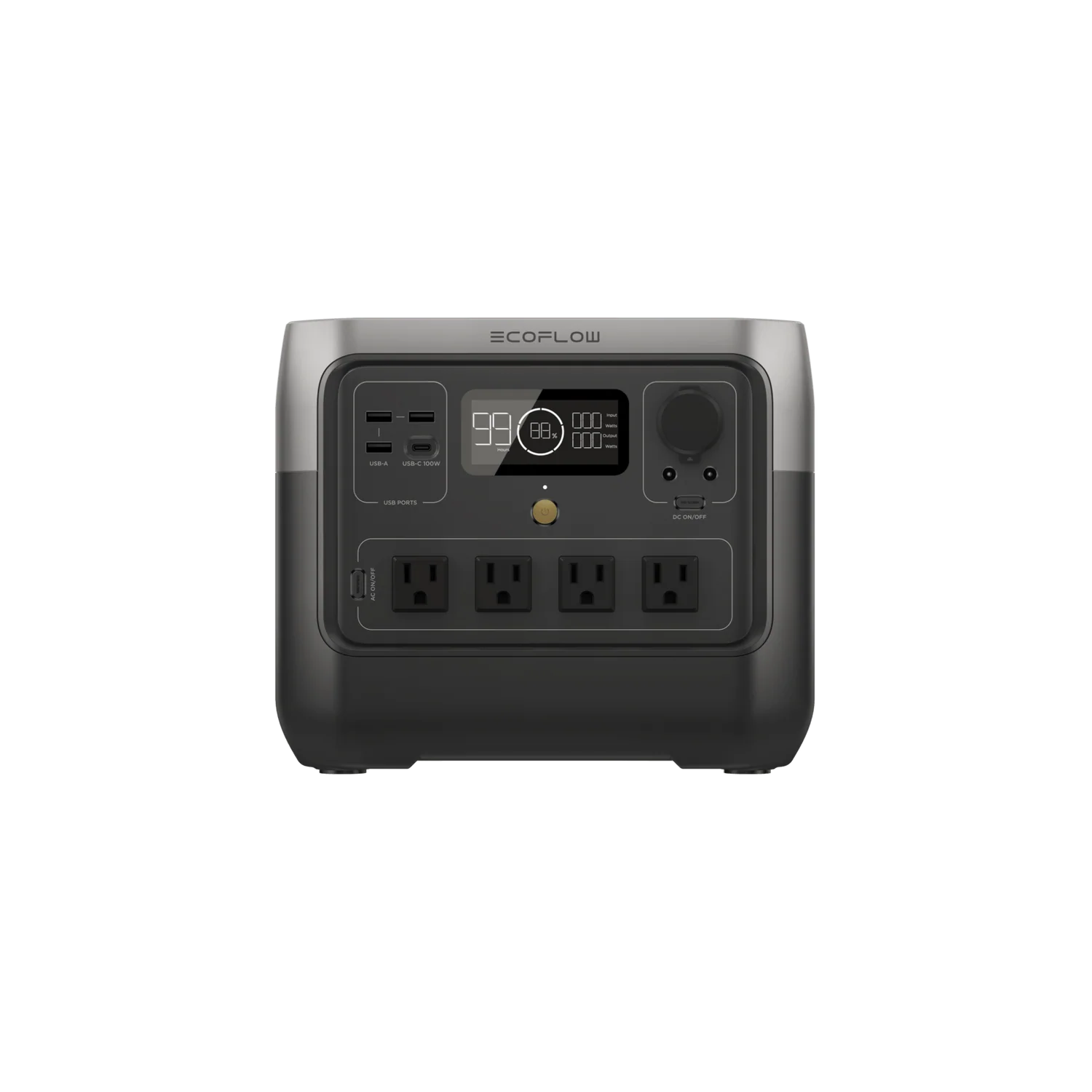
EcoFlow RIVER 2 ProPick
$349.00
$349.00 · direct from EcoFlow
Last checked 16 days ago. Prices move — check before you buy.

Anker SOLIX C800X
$449.99
$449.99 · direct from Anker
Last checked 16 days ago. Prices move — check before you buy.
Prices may vary by retailer and are subject to change.