Head-to-head test
EcoFlow RIVER 2 Max vs EcoFlow RIVER 3 230
This is a size decision wearing the costume of a generation decision: the RIVER 3 230 is the newer, better-built EcoFlow, and it still cannot reach morning on a CPAP night, which is the only thing that separates these two on any load we run.
Full profiles: EcoFlow RIVER 2 Max → · EcoFlow RIVER 3 230 →

Written by Wenny ZhengUpdated
Portable Power Tester, Station Arena Test Desk
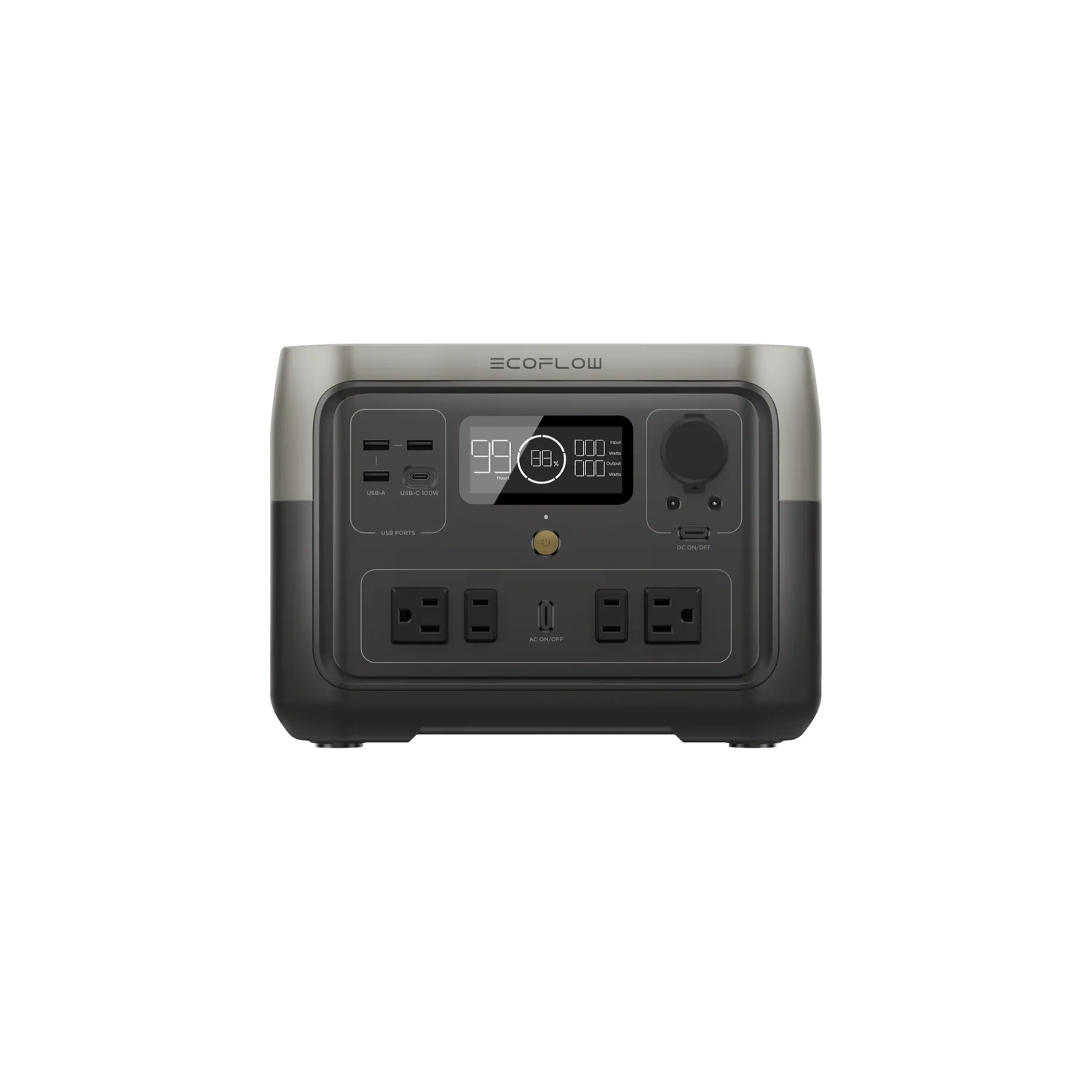
$289.00 · direct from EcoFlow
Last checked 1 day ago. Prices move — check before you buy.

$189.00 · direct from EcoFlow
Last checked 56 days ago. Prices move — check before you buy.
Spec deltas
Five of the seven load profiles we run return the same answer for both of these units: buy something bigger. A weekend of camping wants 2,100Wh, an eight-hour blackout 1,645Wh, van life 4,685Wh, and the RIVER 2 Max has 435Wh of usable energy to offer after the flat 85% derate we apply to every unit. That is not a failure of either box. It is their honest size. These are the stations that live in a hall closet and the back of a car, not the ones that carry a house.
Where they do overlap, the answer is the RIVER 2 Max. It costs $289 against $189 and holds 512Wh against 230Wh, which works out to cheaper watt-hours in both directions, and it is the only one of the pair that finishes a 320Wh CPAP night. Exactly one of the seven scenarios splits them, and that is the one.
The case for the RIVER 3 230 is real and it is short: 7.8 lbs against 13.4, and a UPS transfer rated in a class a desktop is likelier to ride through. If those two sentences describe your purchase, stop reading and buy the cheaper unit. If they do not, pay the difference and take the bigger pack.
What the Numbers Reveal
Each conclusion stated first — the numbers behind it on one line, the full analysis below.
Capacity
Neither unit accepts an expansion battery, so a shortfall like that has no later fix. Three missing hours on the RIVER 3 230 are permanent at 3 a.m., and the only remedies are the other unit or a second one of these.
RIVER 3 230: 230Wh nameplate, 196Wh usable after the flat 85% derateRIVER 2 Max: 512Wh nameplate, 435Wh usable on the same derateThe CPAP profile is a 40W draw wanting 320Wh overnight, which is eight hours at that draw
Why it mattersIf a CPAP or anything else that has to run until morning is on your list, the extra $100 ($289 against $189) is not a preference. It is the price of the machine working.
solar input
The usual reason to buy down a size is that a larger pack takes longer to fill and you spend the trip babysitting it. That reason does not exist here. The RIVER 2 Max refills inside the same part of an afternoon from a panel and inside an hour from the wallA2, so its extra 282Wh (512 against 230) costs nothing in patience.
RIVER 2 Max: 220W of solar input against 512WhRIVER 3 230: 110W of solar input against 230WhReviewers time a full RIVER 2 Max wall charge at about 60 minutes on X-StreamA2
Why it mattersAnyone who talked themselves into the smaller unit on recharge speed should go back and decide on capacity instead, because recharge speed is not a difference between these two.
continuous output
Both units keep the same two-to-one ratio of surge to continuous, so scale is the only thing that differs and the line that matters is 300W. Anything above it is out on the RIVER 3 230 however briefly it started. The RIVER 2 Max holds 400W all afternoon and then loses the same scenario on energy instead, 435Wh usable against 670Wh needed.
RIVER 3 230: 300W continuous, 600W surgeRIVER 2 Max: 500W continuous, 1,000W surgeThe tailgate profile asks for a 400W peak inside a 670Wh afternoon
Why it mattersWrite down the largest continuous draw you own. If it is over 300W, the RIVER 3 230 is eliminated before capacity gets a vote.
Typical price
Across the rated life that compounds to 19 cents a lifetime kilowatt-hour against 27. So the $100 you keep by buying the RIVER 3 230 buys precisely two things: $100, and 5.6 lbs off your shoulder (7.8 lbs against 13.4). Both are real. Neither is value.
RIVER 2 Max: $289 for 512Wh, which is $0.56 per WhRIVER 3 230: $189 for 230Wh, which is $0.82 per WhBoth packs carry the same 3,000-cycle minimum and the same 5-year warranty term
Why it mattersIf the budget truly stops at $189, buy the RIVER 3 230 without guilt. If it does not, the RIVER 2 Max is the cheaper unit in every sense except the sticker.
The specific dimensions that decide these two units — everything else is a tie.
Your Life, Your Pick
Selected because: Five of the seven load profiles return neither for both units, and the two that do not are where this decision actually lives.
Five rows reading neither is not a broken test. It is the correct read on a 230Wh box and a 512Wh one. Van life asks 4,685Wh and the RIVER 2 Max comes up 4,250Wh short of it, which is less a near miss than a category error, and the RIVER 3 230 is further back still.
The two rows that count sit at the bottom of the load scale. Afternoon Off-Grid, 100Wh of phones and lights, is a comfortable pass for both and comes down to what rides in the bag. CPAP Overnight, 320Wh, is the single row where one unit reaches morning and the other does not. If you want the evidence for this page, that is the evidence.
Lifetime Value
Selected because: $289 for 512Wh against $189 for 230Wh: the cheaper unit is the more expensive energy, and both carry the same 3,000-cycle minimum.
cost / lifetime kWh
The smaller price tag here is attached to the more expensive energy. Same 3,000-cycle minimum, same five-year term, more dollars per watt-hour, so nothing in the RIVER 2 Max's premium is buying longevity. It is buying capacity, at a better rate than the cheap box charges for less of it.
One figure in this section will mislead you if you let it. Cost per warranty year favors the RIVER 3 230 at $38 against $58, which looks like an advantage in the terms and is not one. The terms are identical on both units, so that spread is the price gap wearing a different hat. Price is doing less work in this decision than the sticker suggests. Capacity is doing all of it.
Portability & Form Factor
Selected because: 7.8 lbs against 13.4 is the RIVER 3 230's entire case for itself, so it is worth weighing properly.
weight
The RIVER 3 230's case is 5.6 lbs of absence (7.8 lbs against 13.4), and it is a better case than it sounds. Neither of these is a bent-knees lift, so the question is not whether you can carry it. It is whether the thing goes into a daypack alongside a camera and a lunch, or becomes the reason you take the car. At 7.8 lbs you forget it is in there. At 13.4 you plan around it.
That is the whole of the argument, though. Neither needs a cart or a second pair of hands, and once either one is sitting on the picnic table its weight stops existing. If the walk from the car is short, this section should not move you.
What the Specs Don't Tell You
Selected because: One card here runs against our pick: the RIVER 2 Max's UPS transfer is rated no worse than 30ms, against no worse than 20ms on the RIVER 3 230.
One card here points away from our pick, and it is the one to read twice. The RIVER 2 Max's UPS transfer is rated no worse than 30ms, long enough that many desktops will drop rather than ride through, against a rating of no worse than 20ms on the RIVER 3 230. Both are ceilings the maker publishes, not stopwatch results from us. If the job is holding a PC up through a flicker, that single row outweighs everything capacity has to say.
The noise numbers are the opposite kind of card: they look decisive and are not. EcoFlow publishes the RIVER series figure as a maximum the unit reaches at high wattage, so the RIVER 2 Max's 62dB describes the hour it spends swallowing a fast charge, not the night it spends trickling 40W into a CPAP. Read it as a ceiling you can schedule around rather than a 32dB gap between 62 and 30.
Growth Path
Selected because: Neither unit can be expanded, so the 512Wh or 230Wh you choose here is permanent.
solar input
Neither unit takes an expansion battery, which at this size is ordinary rather than a demerit. What it means practically is that the number on the box is the number forever, so the question stops being which unit is better and becomes which ceiling you want to live with, 512Wh or 230Wh. An undersized buy has exactly one fix here, and the fix is a second unit sitting next to the first.
So put it as a test rather than a preference. If you cannot say with confidence that 230Wh covers your worst night, you have already chosen the RIVER 2 Max.
Strengths & trade-offs
EcoFlow RIVER 2 Max
Strengths
- +Larger battery capacity
- +Higher AC output
- +Faster solar charging
Trade-offs
- –Substantially more expensive (+$100) than the RIVER 3 230.
- –Can receive complaints about fan noise under heavy load.
EcoFlow RIVER 3 230
Strengths
- +Costs $100 less
- +Lighter by 5.6 lb
Trade-offs
- –No major technical downsides compared to rival.
Will It Power Your Gear?
Scenario math and per-appliance runtimes, modeled from the spec record.
Scenario verdicts
We ran the math on seven real-world scenarios. Here's which unit survives your actual life.
SCN-01 · 2 nights · needs 2,100Wh
Weekend Camping
Two nights off-grid with essential comfort
Neither unit
Neither unit covers this scenario's 2,100Wh: the RIVER 2 Max comes up 1,665Wh short (about 21% covered), the RIVER 3 230 1,905Wh (9%). This is well outside what either unit is for; the right answer here is a larger station, not a choice between these two.
Battery budget usedlower = more headroom
LOAD Phone Charger 15W×6h · LED Lights 40W×8h · Box Fan 75W×14h · CPAP Machine 40W×16h
SCN-02 · 8 hours · needs 1,645Wh
8-Hour Blackout
Keep the essentials running through a night without power
Neither unit
1,645Wh is close to four times the RIVER 2 Max's 435Wh of usable energy and more than eight times the RIVER 3 230's 196Wh. Neither of these is a blackout station. They are the thing you keep charged so the phones and the router stay up while a blackout station does the actual work. If keeping a house running overnight is why you are shopping, the gap between these two prices is the wrong argument to be having.
Battery budget usedlower = more headroom
LOAD Fridge 150W×8h · Router + Modem 20W×8h · LED Lights (4 bulbs) 40W×6h · Phone Charger 15W×3h
SCN-03 · 8 hours · needs 320Wh
CPAP Overnight
Sleep therapy without interruption — the #1 medical use case
RIVER 2 Max
Eight hours at 40W is 320Wh, and this is where the two part company. The RIVER 2 Max ends the night with 115Wh spare. The RIVER 3 230 has 196Wh usable, about five hours at that draw, so it quits with three hours still to go, and at 3 a.m. the fix is not a setting in the app. It is a bigger battery.
Battery budget usedlower = more headroom
LOAD CPAP Machine 40W×8h
SCN-04 · 8 hours · needs 910Wh
Remote Workday
Full work day off-grid without power anxiety
Neither unit
Neither unit covers this scenario's 910Wh: the RIVER 2 Max comes up 475Wh short (about 48% covered), the RIVER 3 230 715Wh (22%). This is well outside what either unit is for; the right answer here is a larger station, not a choice between these two.
Battery budget usedlower = more headroom
LOAD Laptop 60W×8h · External Monitor 30W×8h · Router + Modem 20W×8h · Phone Charger 15W×2h
SCN-05 · 4 hours · needs 670Wh
Tailgate Party
Game day power for the crew
Neither unit
The RIVER 3 230 will start a 400W load on its 600W surge and then hand it straight back to a 300W continuous rating, so capacity never gets a vote. The RIVER 2 Max holds the 400W without complaint and runs out of energy instead, 435Wh usable against the 670Wh the afternoon wants, 235Wh short. Both answers are no. The RIVER 2 Max's is simply the closer no.
Battery budget usedlower = more headroom
LOAD Blender 400W×0.5h · LED TV (55") 80W×4h · Bluetooth Speaker 15W×4h · Phone Charger (×3) 45W×2h
SCN-06 · 24 hours · needs 4,685Wh
Van Life Daily
A full day of mobile living — the ultimate endurance test
Neither unit
Neither unit covers this scenario's 4,685Wh: the RIVER 2 Max comes up 4,250Wh short (about 9% covered), the RIVER 3 230 4,490Wh (4%). This is well outside what either unit is for; the right answer here is a larger station, not a choice between these two.
Battery budget usedlower = more headroom
LOAD Mini-Fridge 150W×24h · Laptop 60W×4h · Phone Charger 15W×3h · LED Lights 40W×5h · Fan 75W×8h
SCN-07 · an afternoon · needs 100Wh
Afternoon Off-Grid
Phones and a speaker at the park, beach, or campsite — the small-unit job description
Either unit
This is the row these two were built for, and both walk it: 100Wh of phones and lights against 435Wh usable on the RIVER 2 Max and 196Wh on the RIVER 3 230. Nothing here is strained, so the decision moves to what you are carrying, 7.8 lbs against 13.4, and what you paid. If an afternoon like this one is your honest use case, the RIVER 3 230 is the honest answer.
Battery budget usedlower = more headroom
LOAD Phone Charger (×2) 30W×2h · Bluetooth Speaker 10W×4h
The Load Test
RUNTIME = (Wh × 0.85) ÷ LOAD
None of the scenarios above exactly yours? Build it. Toggle what you'd plug in; both units are tested against the combined draw.
Essentials
Comfort & Convenience
High-Draw Appliances
Test duration
8h
Continuous draw
205W
Projected runtime
For this load: RIVER 2 Max runs 2.1h vs 1h.
$289 list · direct from EcoFlow
Modeled from the spec record — same math as the tables below. Methodology
Runtime by appliance
Real-world runtime estimates for common appliances, modeled at 85% inverter efficiency.¹
Essentials
The basics you need runningscale 0–29hComfort & Convenience
Makes off-grid life actually enjoyablescale 0–5.8hHigh-Draw Appliances
These reveal the real limits¹ Runtime = (capacity × 0.85) ÷ appliance watts. Within each group, all bars share one time scale (the group's longest runtime), so lengths are comparable across appliances; identical runtimes collapse into a single blue/orange bar. Actual runtime varies with battery age, temperature, and simultaneous loads — see methodology.
Conclusion
September 13, 2026
Verdict: the RIVER 2 Max, on Power Score margin
Take the RIVER 2 Max. $289 buys 512Wh where the RIVER 3 230 asks $189 for 230Wh, which makes the bigger unit the cheaper energy per watt-hour on the shelf and cheaper again across the 3,000 cycles both packs are rated for, and it is the difference between finishing a 320Wh CPAP night with 115Wh spare and stopping about three hours short of the alarm. Neither unit expands, so whichever ceiling you buy is the one you keep. Two honest things keep this short of a lock. The RIVER 3 230 is the newer generation, rated quieter with IP54 water resistanceB2, and its UPS transfer is rated in the faster class, which is the safer side of the line if what you are protecting is a desktop with unsaved work. And if your whole load list is phones, a laptop and lights on an afternoon out, the lighter, cheaper unit is genuinely the right call.
Editor-assigned confidence, based on cited owner research and spec analysis.
List prices as of September 13, 2026. The links below open EcoFlow's current price.
$289.00 · direct from EcoFlow
Last checked 1 day ago. Prices move — check before you buy.
or check the RIVER 3 230 price$189.00 list
Written by Wenny Zheng, Portable Power Tester · Station Arena Test Desk · Updated September 13, 2026
Measured Data
Benchmark scores and the full spec record, side by side.
Benchmark scores
Not rated for both units (minimum threshold unmet): UPS, Solar Generator.
Full specifications
ᵈ Derived: price ÷ rated capacity. See the data behind our comparisons →
Comparison ToolAdd more power stations, side by sideOpen Tool →How these numbers are produced
Numeric verification
Every figure on this page traces to our spec database or arithmetic on it — no estimated numbers.
Owner claims
Statements about owner experience are cited to published reviews — see Sources & Research Notes below.
Runtime model
Runtime = (rated capacity × 0.85 inverter efficiency) ÷ device wattage. Solar recharge estimates assume panels deliver 70% of rated output. Cold weather, battery age, and stacked loads reduce real-world results.
Power Score
Computed from 14 published spec dimensions, weighted per use-case bench. Higher is better; a unit must meet a bench's minimum threshold to be rated.
See the full weight table and data sourcing on our methodology page →Class ranking (the star rating)
Each unit's star score is a category ranking, not customer reviews — no buyer opinions feed it. We score every station on size-independent quality (value, output, portability, endurance, ports, warranty, and more), then percentile-rank it against the other units in its capacity class, so a class-leading compact unit and a class-leading whole-home unit can both earn 5★. Here, RIVER 2 Max rates 3.7/5 (26th percentile of 20 Compact-class units), and RIVER 3 230 rates 4.3/5 (57th percentile of 22 Personal-class units).
How the class ranking is computed →Test Notes & Caveats
Hidden gotchas and advantages we spotted that you won't find on the product page.
62dB is a ceiling, not a bedside reading
EcoFlow publishes this figure as the maximum the RIVER 2 Max reaches when it is moving high wattage, which describes the hour it spends taking a fast charge rather than the night it spends trickling 40W into a CPAP. The RIVER 3 230 is rated 30dB, which is lower on paper. What it is not is 32dB of measured difference: two ratings from one maker need not describe the same operating regime, and this one is a maximum rather than a quiet-mode floor. If noise is why you are here, plan around when the unit charges rather than which number is smaller.
The one spec that favors the smaller unit
Both list a UPS mode and both figures are rated ceilings rather than measurements. The RIVER 3 230's rating of no worse than 20ms is fine for routers and most electronics, with the fussiest PC power supplies sitting right on that line. The RIVER 2 Max is rated no worse than 30ms, a transfer long enough that many desktops will not ride through it, so plan on the occasional reboot for sensitive gear. This is the single row where the cheaper, smaller unit is the better buy on a spec instead of on price. If a computer with unsaved work is the thing being protected, it may be the row that decides the page.
Same five years, so it is not the tiebreak
The terms are identical on both units, which is worth saying only because the per-dollar version of them flatters the smaller one. That spread measures the price difference, not the terms. Nothing in the warranty separates these two, so spend the attention on capacity.
Full record above — the Test Desk pick is the RIVER 2 Max.
Check RIVER 2 Max price →or check the RIVER 3 230 priceOwnership Analysis
What happens after you buy — true cost of ownership, brand trust, and growth potential.
Lifetime value
Service lifeyears at one full cycle per day
Lifetime energy delivered
Cost per delivered kWh
│ warranty ends · Reaching the cycle rating means ~80% capacity remains — degraded, not dead.
Analyst note
The RIVER 3 230 is cheaper to buy, but the RIVER 2 Max is cheaper to own. At $0.19/kWh over its lifetime vs $0.27/kWh, the RIVER 2 Max's higher cycle life and capacity make each dollar go further over the years. One thing to know reading the table: both carry the same 3,000-cycle rating, so the lifetime rows are sticker price and capacity in disguise — the wear horizon is identical and decides nothing here.
Growth path
RIVER 2 Max
FIXED CAPACITYFixed at 512Wh, with no expansion — so size it for your needs up front rather than planning to add capacity later.
Accepts up to 220W of solar. Limited to a single portable panel.
Adequate ports for most setups, but heavy users may want a power strip.
RIVER 3 230
FIXED CAPACITYFixed at 230Wh, with no expansion — so size it for your needs up front rather than planning to add capacity later.
Accepts up to 110W of solar. Limited to a single portable panel.
Limited ports. You'll likely need a power strip or splitter.
Realistic full solar rechargeat 70% of rated panel output — see methodology
Analyst note
Neither expands, and that's no knock on either — each is a complete unit at a fixed size. Buy the capacity that covers your needs now (the RIVER 2 Max gives you the larger ceiling); you can't add to either later.
What Owners Report
Patterns from published owner reports and long-term reviews — every claim cited to its source below.
EcoFlow RIVER 2 Max
Coverage of the RIVER 2 Max converges on the same three thingsA0. It puts 512Wh in 13.4 lbs, lighter than Li-Ion rivals of similar sizeA1. It refills fully in about an hour on X-Stream charging, with several charging routes availableA2. And the app does real work over Wi-Fi and Bluetooth, including capping charge speed from a phoneA3. In field use one reviewer ran a telescope, a 65-inch LED TV, two laptops and phones through a four-hour event and finished with power to spare on the same 3,000-cycle LFP packA4. Our own read is that this unit has both press and owner reviews behind it rather than press aloneA0.
“512Wh in a light package of about 13 lbs, lighter than some of its closest competitors that use Li-Ion chemistry.”
Sources
storagereview.com · backuppowerhub.com · gagadget.com · ecoflow.com · thecampingnerd.com · thetechnologyman.com · bestbuy.com
EcoFlow RIVER 3 230
Field data on this exact variant is thin, and the reason is worth stating plainly: most RIVER 3 coverage is of the standard RIVER 3, not the 230Wh version in front of youB0. What it does establish is line-levelB0. Sub-30dB running, which EcoFlow calls whisper quietB1, plus IP54 water resistance, a faster UPS switchover, a 2x runtime mode and a more compact body than the RIVER 2 generationB2. Reviewers land on the RIVER 3 as the better buy for most people in 2026B3.
Take that recommendation for what it is, a verdict on a generation rather than on a sizeB0B3. The upgrades are real and they would apply to any RIVER 3. None of them puts another 282Wh into a 230Wh pack (512 against 230), and that is the only difference on this page that changes an answer.
“The RIVER 3 operates under 30 dB — EcoFlow calls it 'whisper quiet,' quieter than a library — one of the most significant upgrades over the louder RIVER 2.”
Sources
backuppowerhub.com · ecoflow.com · rv.com
Sources & Research Notes
Every owner claim in this report is traceable to a published source. The bracketed references above resolve here.
Recurring owner themes
- Light weight, fast roughly-one-hour charging, and a simple capable app are the standout praise for this 512Wh unit. [RIVER 2 Max · 3 entries]
- The RIVER 3 line's upgrades — sub-30 dB noise, IP54 waterproofing, faster UPS, more compact build — make it the recommended pick over the RIVER 2 for most uses. [RIVER 3 230 · 3 entries]
- A1
“512Wh in a light package of about 13 lbs, lighter than some of its closest competitors that use Li-Ion chemistry.”
storagereview.com / backuppowerhub.com — RIVER 2 Max review · 2026 · [positive]
- A2
“Fully charges in about 60 minutes via X-Stream charging — far faster than most portable power stations — with multiple charging options.”
gagadget.com / ecoflow.com — RIVER 2 Max review · 2026 · [positive]
- A3
“The EcoFlow app offers simple remote control and monitoring over WiFi and Bluetooth — view charge levels, customize settings, and adjust charging speed from a phone.”
thecampingnerd.com / ecoflow.com — RIVER 2 Max review · 2026 · [positive]
- A4
“Upgraded LFP chemistry rated for about 3,000 cycles, roughly a decade of everyday use; in field testing it powered a telescope, a 65-inch LED TV, two laptops, and phones through a 4-hour event with power to spare.”
thetechnologyman.com / bestbuy.com owner reviews — RIVER 2 Max · 2026 · [positive]
- B1
“The RIVER 3 operates under 30 dB — EcoFlow calls it 'whisper quiet,' quieter than a library — one of the most significant upgrades over the louder RIVER 2.”
backuppowerhub.com / ecoflow.com — RIVER 3 review · 2026 · [positive]
- B2
“Over the RIVER 2, the RIVER 3 adds IP54 waterproofing, a faster UPS switchover, a 2x runtime mode, quieter operation, and a more compact form factor.”
backuppowerhub.com — RIVER 2 vs RIVER 3 · 2026 · [positive]
- B3
“Recommended as the better buy for most in 2026 — for camping, van life, or home UPS backup, where durability and noise matter, the data consistently favors the RIVER 3.”
backuppowerhub.com / rv.com — RIVER 3 review · 2026 · [positive]
Research compiled September 13, 2026.
Who Should Buy Which
Buy the RIVER 2 Max if you…
- →You are running a CPAP and want one box that reaches morning. 435Wh usable against a 320Wh night leaves 115Wh in hand, which is margin for a heated humidifier rather than a coin flip.
- →Something on your list draws between 300W and 500W continuously. The RIVER 2 Max holds it; the RIVER 3 230 will start it and then quit on you.
- →You own a 220W panel, or want to, and expect an afternoon of sun to actually fill the pack it is plugged into.
- →You want the higher ceiling because neither unit can be extended later, and $289 against $189 is a small premium for more than double the 230Wh.
Buy the RIVER 3 230 if you…
- →Everything you will ever plug in is a phone, a laptop, a camera battery or lights, and none of it crosses 300W.
- →It is going in a daypack. 7.8 lbs is the difference between bringing it on the hike and leaving it in the trunk.
- →What you are protecting is a desktop through a flicker. The faster rated transfer class is the safer side of that line, and it is the one spec where the smaller unit wins outright.
- →You already own a large station for real outages and want a quiet, cheap second box to keep the router and the phones alive.
If neither fits
If your shopping list is a weekend of camping (2,100Wh), an eight-hour blackout (1,645Wh), a remote workday (910Wh) or van life (4,685Wh), close this tab cheerfully. The RIVER 2 Max is 1,210Wh short of the blackout on its own, and choosing between these two does nothing about that. What you want is a station several times this size, bought once, a class up. The one caveat in the other direction: if your real need is charging phones and a laptop on an afternoon out, both of these are more unit than you need and a large USB power bank does it for less.
The Bottom Line
The RIVER 2 Max is the buy at $289. It is the only one of the two that reaches morning on a CPAP night, it holds 500W where the other holds 300W, and its watt-hours are cheaper both on the shelf and across the 3,000 cycles they share. The RIVER 3 230 answers a narrower question well: 7.8 lbs, $189, and a transfer rating that is friendlier to a desktop.
What the newer generation cannot do is put more energy into a 230Wh pack, and energy is the only thing that separated these two on any load we ran. Buy the RIVER 2 Max, size it to the worst night you actually expect, and treat the extra 5.6 lbs (13.4 against 7.8) as the fee for not running out at 3 a.m.
Frequently Asked Questions
Answers drawn from the spec record and cited owner research.
Is the RIVER 3 230 better than the RIVER 2 Max?
On build and generation, in places yes: the RIVER 3 line is newer, rated quieter, IP54 rated, and rated for a faster UPS transfer. On the thing most people are actually deciding, no. 230Wh at $189 against 512Wh at $289 means the RIVER 2 Max is both the larger pack and the cheaper energy per watt-hour. Choose the RIVER 3 230 because it is light or because of the transfer rating, not because it is the newer box.
Will the RIVER 3 230 run a CPAP all night?
Not a full night. Against a 40W machine over an eight-hour, 320Wh night it has 196Wh usable, which is about five hours, so it stops roughly three hours short. The RIVER 2 Max finishes the same night with 115Wh in reserve. Add a heated humidifier and the draw climbs, which eats into the RIVER 2 Max's margin and puts the RIVER 3 230 further behind.
How long does the RIVER 2 Max take to charge?
About an hour from a wall outlet on X-Stream charging. From solar, its 220W input against 512Wh works out to a bit over two hours of strong sun from empty. The RIVER 3 230's 110W input against 230Wh lands in the same neighborhood, so refill time is not a reason to pick one over the other.
What is the biggest thing either one can run?
The RIVER 2 Max holds 500W continuous with 1,000W of surge; the RIVER 3 230 holds 300W with 600W of surge. Both keep the same two-to-one surge ratio, so the difference is purely scale. The trap is the surge number: the RIVER 3 230 can start a 400W load and then fail to hold it, because the 300W rating takes over the moment it is running.
Can I add a second battery to either one later?
No, neither one expands. Both are fixed packs, 512Wh and 230Wh, which is normal at this size and not a mark against either. It does mean the ceiling you buy is the ceiling you keep, so if there is any chance your needs grow, the RIVER 2 Max starts more than twice as high.
Where to buy
EcoFlow RIVER 2 MaxPick
$289.00
$289.00 · direct from EcoFlow
Last checked 1 day ago. Prices move — check before you buy.
EcoFlow RIVER 3 230
$189.00
$189.00 · direct from EcoFlow
Last checked 56 days ago. Prices move — check before you buy.
Prices may vary by retailer and are subject to change.