Head-to-head test
EcoFlow DELTA Pro 3 vs Anker SOLIX E10
These two store energy at the same cost per lifetime kilowatt-hour, so the only question left is sockets or circuits: the SOLIX E10 has no outlets on the box and backs up the building, not the appliance.
Full profiles: EcoFlow DELTA Pro 3 → · Anker SOLIX E10 →
Looking for a different matchup? EcoFlow DELTA Pro Ultra vs Anker SOLIX E10

Written by Gunner GustafsonUpdated
Whole-Home Backup Tester, Station Arena Test Desk
Spec deltas
Buy the DELTA Pro 3 at $2,799 unless you're paying an electrician. The SOLIX E10 holds more energy, 6,144Wh against 4,096Wh, and costs $4,299, but both work out to 17 cents per lifetime kilowatt-hour. The energy inside them is priced the same, which means the extra money is buying something other than power.
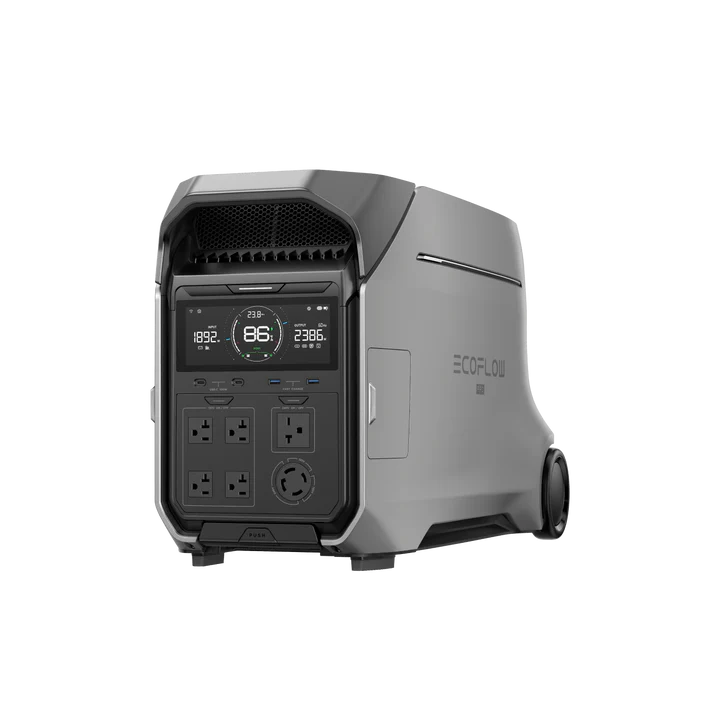
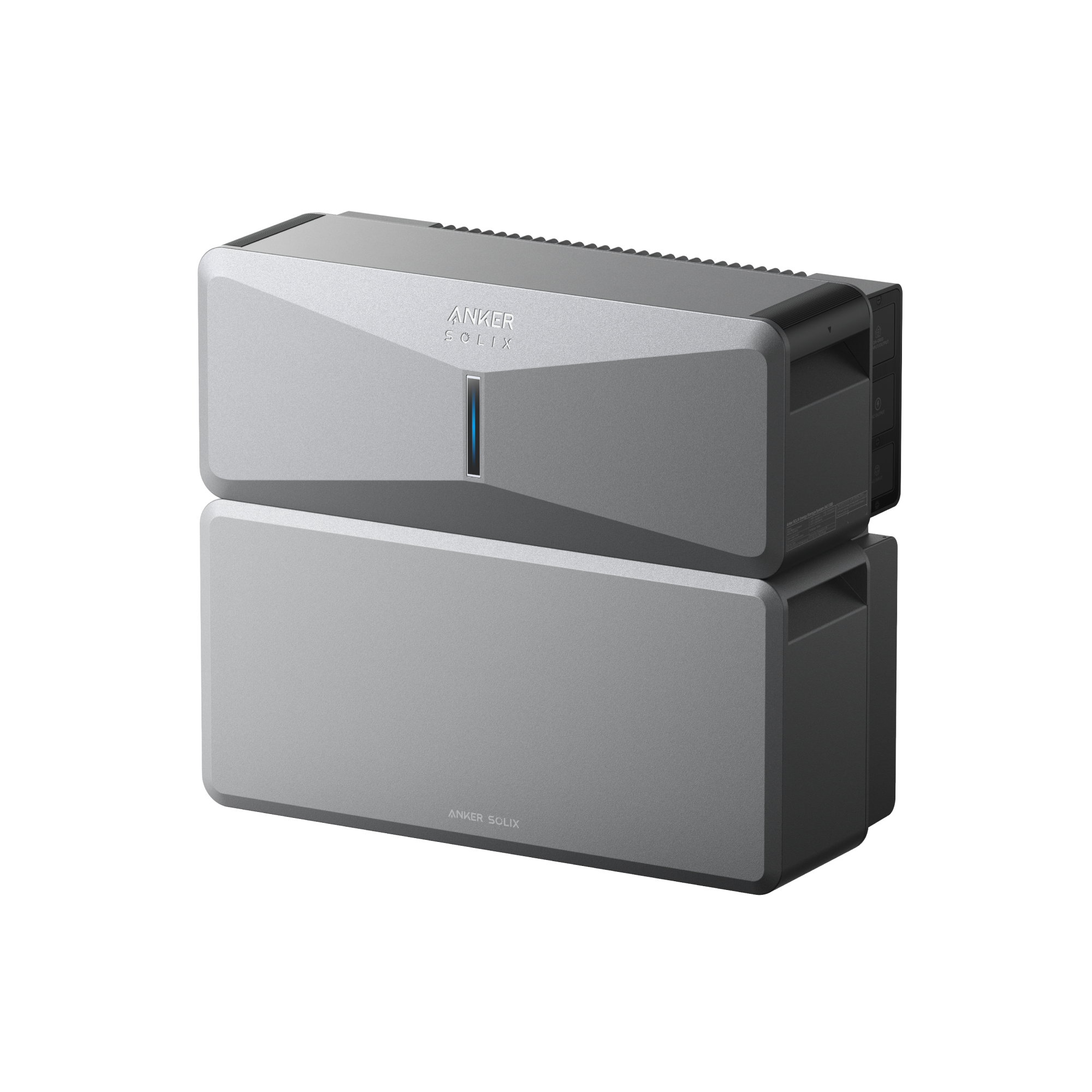
What it's buying is a wiring job. The SOLIX E10 has no outlets. It's an installed system that feeds a subpanel, so the electricity comes out of your walls and there is nothing on the unit itself to plug a kettle into. The DELTA Pro 3 is the other kind of object: sockets on the box, 4,000W continuous with a published 6,000W peak for 2,000W of headroom when something kicks on, and backup that works the afternoon it lands.
Neither of these travels, so portability can't break the tie. The DELTA Pro 3 is a 112.4 lb two-person lift that's meant to stay put; the E10 is a 190.6 lb wall installation that doesn't leave the building. The real question is sockets or circuits, and if it's circuits, the E10 is genuinely good at it. Reviewers ran it through real storms in two different climates and couldn't tell when the grid droppedB4B5.
What the Numbers Reveal
Each conclusion stated first — the numbers behind it on one line, the full analysis below.
Grid-tied, that's a line on your power bill and easy to ignore. Islanded, it comes out of the pack, and the E10's 2,048Wh capacity lead over the DELTA Pro 3 amounts to a little over two days of its own standby draw. That's still a lead. It's just a narrower one than 6,144Wh against 4,096Wh suggests, and the reviewer who measured the 40W said plainly it belongs in any lifespan math on a system this sizeB10.
SOLIX E10 measured idle consumption came in around 40 wattsB10SOLIX E10 delivers 5,222Wh after the flat 85% derate, from 6,144Wh nameplatethe CPAP scenario's entire overnight load is 320Wh at about 40W
Why it mattersIf you're sizing for multi-day outages rather than single evenings, subtract a day of standby from the headline capacity before you compare the two.
The eight-hour outage on this page averages about 206W, which is 1,645Wh spread over eight hours: a fridge, a router, some lights, a phone. That's the load these two are honestly sized for, and there the E10 finishes with 3,577Wh in reserve against the DELTA Pro 3's 1,837Wh. Add central air and the E10's extra 2,048Wh over the DELTA Pro 3's 4,096Wh buys about 80 more minutes at 1,536W, not another night. Neither of these keeps a house cool through an outage.
SOLIX E10 holds 6,144Wh, 5,222Wh usable after the 85% deratea hands-on review drained a two-battery E10 install running central AC in about four hours on a hot April dayB8the eight-hour blackout scenario is a 1,645Wh load with a 150W peak
Why it mattersIf keeping the AC running is why you're buying, stop comparing these two and price expansion batteries, because choosing between them won't fix it.
Capacity
The DELTA Pro 3's 2,000W covers its own 4,096Wh in about two hours of full rated sun, which is all one box needs. Both units take expansion batteries, and the DELTA Pro 3's documented ceiling is 48kWhA1, so this isn't one unit that grows against one that doesn't. The difference is that the E10's growth path runs through a permanent array, which is the same commitment you made the moment you decided to install it.
SOLIX E10 accepts up to 9,000W of solar inputDELTA Pro 3 accepts up to 2,000W of solar inputcapacities are 6,144Wh and 4,096Wh respectively
Why it mattersIf there's no rooftop array in your plan, the 9,000W input is the most expensive spec on this page that you will never touch.
The place it costs money is time-of-use scheduling. Someone buying this to shift load onto cheap overnight rates can set what looks like the right off-peak schedule and never pull from the grid at all, because only one of the three settings does that and nothing on screen explains itB2. Add the setup-day firmware update that fails with no recovery path, forcing you to unplug the E10 from the combiner box and pair to it directly to finishB11, and the pattern is clear: the E10's rough edges are all software. The hardware is reported as excellent, passively cooled with no fans at allB9.
the SOLIX E10 is hardwired with no outlets on the box, so the app is the only control surfacefour independent reviews and an install thread all flag the Solix app as the system's weakest partB1B2B3B12only the Super Off-Peak setting actually charges the batteries from the grid; the other two off-peak options use solar alone, and the app doesn't say soB2
Why it mattersIf you're buying for rate arbitrage rather than outages, confirm in week one that the schedule is genuinely charging from the grid, before you trust the savings math.
The specific dimensions that decide these two units — everything else is a tie.
Your Life, Your Pick
Selected because: Three of the six scenarios come back 'neither,' which is the fastest way to see that these two aren't the same kind of machine.
Three of the six come back 'neither,' and not one of them is a capacity failure. Camping, the tailgate and van life all die on the same fact: the DELTA Pro 3 is a 112.4 lb unit built to sit still, and the E10 is bolted to a building's electrical panel. The 670Wh a tailgate asks for is trivial for either one. It's the going that doesn't happen.
Where they separate is the outage, and even there it's a margin story rather than pass or fail. Both clear the eight-hour night comfortably, 47% used against 31%. What's left behind is the whole argument: about one more night at that draw in the DELTA Pro 3, a little over two in the E10. If your outages reliably end by breakfast, that headroom is insurance you're buying and won't cash.
Lifetime Value
Selected because: Both land at 17 cents per lifetime kilowatt-hour, so the gap between $2,799 and $4,299 isn't buying cheaper energy.
Cycle life decides nothing here, and neither does the price of stored energy. Both packs are rated for at least 4,000 cycles, both carry five years, and cycled every weekend each would run about 38.5 years, close to eight times that warranty. Two units built to outlast their own paperwork by the same margin can't be told apart on durability.
What the money buys is a chassis, not a discount. Per year of warranty cover the DELTA Pro 3 works out at $560 and the E10 at $860, which is just the price gap restated in smaller type. The useful way to read the tie is this: if you've decided you want circuits instead of sockets, you aren't paying an efficiency penalty for the privilege, and if you haven't decided, there's no bargain waiting on the cheaper unit either. The energy is the same energy. Pick the shape you can actually install.
What the Specs Don't Tell You
Selected because: Four cards fire here, and the two that decide anything are the lift and the fact that only one of these units publishes a noise figure at all.
Only one of these publishes a noise figure, and it belongs to the unit I'm recommending, so it's worth being careful with. The DELTA Pro 3's 30dB is a manufacturer best-case floor, the quiet end of a quiet mode, not a reading of the unit working. Anker publishes nothing at all for the E10, so there's no paper comparison to be made. Field reporting beats the spec sheet here: the E10 is described as a high-voltage design with large heat-dissipation fins and no cooling fans whatsoeverB9. If silence is the requirement, that sentence is more useful than any number on this page.
'Portable power station' is the wrong label for the DELTA Pro 3, and the weight card is where that shows. 112.4 lbs is a two-person, bent-knees lift with no good answer for basement stairs, and you own that lift again every time you decide the unit should live somewhere else. The E10's 190.6 lbs is heavier and matters less, because it goes on a wall once and then the number is history. On switchover, both figures are ratings rather than stopwatch results, no worse than 10ms against no worse than 20ms, and the gap between those two ratings is smaller than the gap between any rating and a measurement.
Growth Path
Selected because: Both take expansion batteries, so the real difference is what feeds them: 9,000W of solar input against 2,000W.
solar input
The E10 has the better growth story, and it costs more than the battery does. Both units take expansion batteries, so the real difference is the intake: 9,000W of solar against 2,000W, four and a half times the array. That only pays off if panels are actually going on a roof, at which point you're standing in front of an electrician again.
The DELTA Pro 3 isn't the sealed unit in this pairing, which is worth saying because the cheaper unit usually is. Its documented expansion ceiling is 48kWhA1, so capacity growth is available on both sides. What it can't do is drink from a big roof, because 2,000W is the solar input it publishes. Buy the E10 if the array is the plan. Buy the DELTA Pro 3 if the plan is more battery, plugged into a wall.
Brand Trust
Selected because: Both warranties run five years, so the brand risk here is about service and software, not coverage.
Both warranties run five years, so the brand question isn't coverage. It's who you'll be dealing with in year three, and the answer is uncomfortable on both sides. EcoFlow's support draws reports in opposite directions, offers nothing at all once the term is up, and the company tested paywalling advanced app features in early 2025 before backing off under pressure. Anker arrives with enormous consumer-electronics goodwill, but SOLIX-specific support is trending down, firmware has removed features without warning, and sending a heavy unit back runs through hazmat shipping.
One more piece of context on that five-year term: in the hardwired home-battery class it reads thin. Reviewers weighing the E10's five years and 60% capacity-retention guarantee against a Tesla Powerwall's ten years and 70% found the comparison unflatteringB6. That isn't a knock on the E10 against the DELTA Pro 3, which carries exactly the same five years. It's a reminder that crossing from appliance to installed infrastructure changes what counts as generous. EcoFlow's scale is the practical edge in this column: 12 to 15 models and the largest community in the category means someone has already hit whatever you're about to hit.
Strengths & trade-offs
EcoFlow DELTA Pro 3
Strengths
- +Costs $1,500 less
- +Lighter by 77.1 lb
Trade-offs
- –Weaker inverter (-3,680W) limits appliance compatibility.
- –Very heavy unit that may be difficult for one person to lift.
Anker SOLIX E10
Strengths
- +Larger battery capacity
- +Higher AC output
- +Faster solar charging
Trade-offs
- –Substantially more expensive (+$1,500) than the DELTA Pro 3.
- –Significantly heavier (+77.1 lbs), making it harder to move.
- –Very heavy unit that may be difficult for one person to lift.
Will It Power Your Gear?
Scenario math and per-appliance runtimes, modeled from the spec record.
Scenario verdicts
We ran the math on six real-world scenarios. Here's which unit survives your actual life.
SCN-01 · 2 nights · needs 2,100Wh
Weekend Camping
Two nights off-grid with essential comfort
Neither unit
Scoring these two at a campsite is a category error: the DELTA Pro 3 at 113.5 lbs is not a take-along — it rolls off a truck bed if it travels at all, and the SOLIX E10 is installed at the electrical panel — it backs up the building and doesn't leave it. The 2,100Wh here is trivial for either — it's the going that doesn't happen. If you need power away from the building, you're shopping the wrong class.
Battery budget usedlower = more headroom
LOAD Phone Charger 15W×6h · LED Lights 40W×8h · Box Fan 75W×14h · CPAP Machine 40W×16h
SCN-02 · 8 hours · needs 1,645Wh
8-Hour Blackout
Keep the essentials running through a night without power
SOLIX E10
Both get through the night, so read the leftovers rather than the pass. The E10 ends at 31% used with 3,577Wh in reserve, the DELTA Pro 3 at 47% with 1,837Wh, which is roughly one more night against a little over two. Worth knowing what this night actually is: 1,645Wh spread across eight hours averages about 206W, so it's a fridge, a router and some lights, not cooling. If your outages end by breakfast, the extra reserve is insurance you'll never cash.
Battery budget usedlower = more headroom
LOAD Fridge 150W×8h · Router + Modem 20W×8h · LED Lights (4 bulbs) 40W×6h · Phone Charger 15W×3h
SCN-03 · 8 hours · needs 320Wh
CPAP Overnight
Sleep therapy without interruption — the #1 medical use case
Either unit
A CPAP asks for 320Wh across the night, 9% of the DELTA Pro 3 and 6% of the E10, so capacity settles nothing and both pass. What the scorecard can't show is that you can't do this with the SOLIX E10 the way you're picturing it. It has no outlets. It powers your bedroom through the wall after an install, so there's nothing to set on the nightstand and plug into. Noise is the other unknown: the DELTA Pro 3's published figure is a best-case floor and Anker publishes none, so nobody can promise you a quiet 3 a.m.
Battery budget usedlower = more headroom
LOAD CPAP Machine 40W×8h
SCN-04 · 8 hours · needs 910Wh
Remote Workday
Full work day off-grid without power anxiety
Either unit
910Wh for a full workday is 26% of the DELTA Pro 3 and 17% of the E10, so both carry the day without effort and neither wins on energy. The split is the plug. The DELTA Pro 3 lists 100W of USB-C, enough to run a laptop straight off the unit with no brick in the loop, while the E10 publishes no USB-C figure and has no sockets at all, so a remote workday on it means working inside the building it's wired into. If the desk moves, only one of these follows, and it's the 112.4 lb one.
Battery budget usedlower = more headroom
LOAD Laptop 60W×8h · External Monitor 30W×8h · Router + Modem 20W×8h · Phone Charger 15W×2h
SCN-05 · 4 hours · needs 670Wh
Tailgate Party
Game day power for the crew
Neither unit
Scoring these two at a tailgate is a category error: the DELTA Pro 3 at 113.5 lbs is not a take-along — it rolls off a truck bed if it travels at all, and the SOLIX E10 is installed at the electrical panel — it backs up the building and doesn't leave it. The 670Wh here is trivial for either — it's the going that doesn't happen. If you need power away from the building, you're shopping the wrong class.
Battery budget usedlower = more headroom
LOAD Blender 400W×0.5h · LED TV (55") 80W×4h · Bluetooth Speaker 15W×4h · Phone Charger (×3) 45W×2h
SCN-06 · 24 hours · needs 4,685Wh
Van Life Daily
A full day of mobile living — the ultimate endurance test
Neither unit
Neither gives you a powered van, for opposite reasons. The DELTA Pro 3 covers about 74% of a 4,685Wh day and comes up 1,203Wh short, so it's not the morning you want. The E10 has the energy but finishes at 90% used with 537Wh left, and it's wired to a building anyway, so it isn't coming. Even if it could, 537Wh is not margin: one cloudy day and you're rationing. Van builds get solved with a 12V house bank and a proper alternator charger, not with either of these.
Battery budget usedlower = more headroom
LOAD Mini-Fridge 150W×24h · Laptop 60W×4h · Phone Charger 15W×3h · LED Lights 40W×5h · Fan 75W×8h
The Load Test
RUNTIME = (Wh × 0.85) ÷ LOAD
None of the scenarios above exactly yours? Build it. Toggle what you'd plug in; both units are tested against the combined draw.
Essentials
Comfort & Convenience
High-Draw Appliances
Test duration
8h
Continuous draw
205W
Projected runtime
For this load: SOLIX E10 runs 25.5h vs 17h.
$4,299 list · direct from Anker
Planning for more than this? Describe your whole setup and get it sized →
Modeled from the spec record — same math as the tables below. Methodology
Runtime by appliance
Real-world runtime estimates for common appliances, modeled at 85% inverter efficiency.¹
Essentials
The basics you need runningscale 0–348.2hComfort & Convenience
Makes off-grid life actually enjoyablescale 0–69.6hHigh-Draw Appliances
These reveal the real limitsscale 0–5.2h¹ Runtime = (capacity × 0.85) ÷ appliance watts. Within each group, all bars share one time scale (the group's longest runtime), so lengths are comparable across appliances; identical runtimes collapse into a single blue/orange bar. Actual runtime varies with battery age, temperature, and simultaneous loads — see methodology.
Conclusion
September 13, 2026
Verdict: the EcoFlow DELTA Pro 3
The DELTA Pro 3 wins on the ground most buyers of this pair are actually standing on: it works the day it arrives, it's $2,799 against the SOLIX E10's $4,299, and the energy it stores costs the same per lifetime kilowatt-hour. Against the loads people really do back up, it finishes an eight-hour outage at 47% used with 1,837Wh still in the pack. The SOLIX E10 is the stronger machine and the higher-scoring one on our instrument, but every advantage it holds (6,144Wh, 7,680W of continuous output, 9,000W of solar input) sits behind an install at your electrical panel and the subpanel it feeds. If that install is happening, buy the E10 and don't look back. If it isn't, the E10 is a $4,299 system with nowhere to plug anything in.
Editor-assigned confidence, based on cited owner research and spec analysis.
List prices as of September 13, 2026. The links below open EcoFlow's and Anker's current prices.
$2,799.00 · direct from EcoFlow
Last checked 16 days ago. Prices move — check before you buy.
or check the SOLIX E10 price$4,299.00 list
Written by Gunner Gustafson, Whole-Home Backup Tester · Station Arena Test Desk · Updated September 13, 2026
Black Friday · 38 days out
Prices to beat:DELTA Pro 3 $2,399SOLIX E10 $4,299
The lowest we have recorded for each. We have never seen the SOLIX E10 discounted, so any real cut on it would be a first.
Measured Data
Benchmark scores and the full spec record, side by side.
Benchmark scores
Not rated for both units (minimum threshold unmet): RV Living, Solar Generator.
Full specifications
ᵈ Derived: price ÷ rated capacity. See the data behind our comparisons →
Comparison ToolAdd more power stations, side by sideOpen Tool →How these numbers are produced
Numeric verification
Every figure on this page traces to our spec database or arithmetic on it — no estimated numbers.
Owner claims
Statements about owner experience are cited to published reviews — see Sources & Research Notes below.
Runtime model
Runtime = (rated capacity × 0.85 inverter efficiency) ÷ device wattage. Solar recharge estimates assume panels deliver 70% of rated output. Cold weather, battery age, and stacked loads reduce real-world results.
Power Score
Computed from 14 published spec dimensions, weighted per use-case bench. Higher is better; a unit must meet a bench's minimum threshold to be rated.
See the full weight table and data sourcing on our methodology page →Class ranking (the star rating)
Each unit's star score is a category ranking, not customer reviews — no buyer opinions feed it. We score every station on size-independent quality (value, output, portability, endurance, ports, warranty, and more), then percentile-rank it against the other units in its capacity class, so a class-leading compact unit and a class-leading whole-home unit can both earn 5★. Here, DELTA Pro 3 rates 3.9/5 (37th percentile of 20 Home Backup-class units), and SOLIX E10 rates 5.0/5 (99th percentile of 20 Home Backup-class units).
How the class ranking is computed →Test Notes & Caveats
Hidden gotchas and advantages we spotted that you won't find on the product page.
Weight: One of These Is a Lift You Repeat
190.6 lbs sounds worse than 112.4 and costs you less. The SOLIX E10 goes on a wall once, and after that afternoon its weight is the installer's memory. The DELTA Pro 3's 112.4 lbs is a two-person, bent-knees lift with no good answer for basement stairs, and you own that lift again every time you decide the unit should live somewhere else. Neither of these is grab-and-go. The difference is that only one of them has to be moved once.
UPS Switchover: ≤10ms vs ≤20ms
Both list a UPS mode, at different rated speeds. The DELTA Pro 3 is rated ≤10ms — quick enough on paper that desktop PCs and routers should ride through, treating that as the rating it is. The SOLIX E10 is rated ≤20ms — fine on paper for routers and most electronics; the fussiest PC power supplies sit right at this line. If a computer with unsaved work is the thing being protected, the stated class is worth the attention; nothing here is a lab result.
Warranty: No Difference
Both units carry the same 5-year warranty, so coverage isn't a tiebreaker here. Worth saying because the per-dollar framing can suggest otherwise: the DELTA Pro 3 works out at 1.8 years of cover per $1,000 spent against the SOLIX E10's 1.2, but that spread is the price gap, not the terms.
Only One of These Publishes a Noise Figure
The DELTA Pro 3's 30dB is the only number on the table, and it's worth knowing what kind of number it is: a manufacturer best-case floor, the quiet end of a quiet mode, not a reading of the unit under load. Anker publishes nothing for the SOLIX E10, which is not evidence it's louder. It means there's no figure to hold it to and no paper comparison to make. If you're buying for a bedroom, a CPAP or an apartment wall, the spec sheet is the wrong place to settle this. Go find hands-on reports of the E10 actually running, and treat the 30dB as a floor rather than a promise.
Full record above — the Test Desk pick is the DELTA Pro 3.
Check DELTA Pro 3 price →or check the SOLIX E10 priceOwnership Analysis
What happens after you buy — true cost of ownership, brand trust, and growth potential.
Lifetime value
Service lifeyears at one full cycle per day
Lifetime energy delivered
Cost per delivered kWh
│ warranty ends · Reaching the cycle rating means ~80% capacity remains — degraded, not dead.
Analyst note
Both units cost the same to own over their rated lives — $0.17/kWh each. Lifetime cost can't separate them, so decide on the sticker price and everything else. One thing to know reading the table: both carry the same 4,000-cycle rating, so the lifetime rows are sticker price and capacity in disguise — the wear horizon is identical and decides nothing here.
Brand trust
EcoFlow
Ecosystem
Largest in portable power — 12-15 models across DELTA Pro, DELTA 3, and RIVER 3 series, plus solar panels and smart home panels
Support
US-based phone, email and chat, and the reports split hard: plenty of hassle-free prepaid-label replacements, plenty of long waits and refurbished units sent against new claims. The practical move is to buy somewhere with its own returns backstop, Costco or Amazon, and treat EcoFlow's queue as the second line rather than the first.
Community
Largest community in the space — Reddit r/Ecoflow_community (~31K members), multiple Facebook groups, and an official community forum
App experience
Rated 4.6/5 iOS (~8,400 ratings) · 4.2/5 Android (~17,000 ratings)
Unique strength
Fastest-charging technology (X-Stream), deepest product ecosystem, and most active innovation cadence. At the top of the range sit two whole-home paths: the TITAN line, one 5 kWh unit that grows to 30 kWh, and the DELTA Pro Ultra platform, which stacks batteries and inverters further — flagship paths, not line-wide features.
Worth knowing
There's no parts or service path once the five years are up, so year six is a replacement rather than a repair. EcoFlow also tested paywalling advanced app features in early 2025 and pulled back after community pushback, which tells you the app's feature set is a business decision as much as an engineering one.
Anker
Ecosystem
7-8 SOLIX portable power stations across C-series (compact) and F-series (flagship), plus the X1 home energy system
Support
Anker's reputation was built on no-hassle consumer-electronics replacements, but SOLIX-specific reports are trending the other way: AI-driven agents returning generic answers, and return logistics for heavy units that run through hazmat shipping. On a wall-mounted system that second part is worse than it sounds, because sending the unit back starts with getting it off your wall.
Community
Moderate — active Reddit (r/Anker, r/AnkerSOLIXCommunity) and growing. Benefits from Anker's massive consumer electronics brand awareness.
App experience
Rated 4.5/5 iOS (~1,100 ratings) · 4.3/5 Android
Unique strength
Parent brand trust from Anker's consumer electronics dominance. InfiniPower technology for long cycle life. Strong $/Wh value in the mid-size and larger units — the S2000, F2600 and C1000 are among the better buys per watt-hour in the catalog.
Worth knowing
Firmware updates have removed features without warning, which lands harder here than on a portable unit, because the app is the only way to control a system with no sockets on it. The expansion ecosystem is smaller than EcoFlow's too, so there are fewer parts to grow into later.
Analyst note
Both warranties run five years, so this column isn't about coverage. It's about who you're stuck with, and neither answer is clean: EcoFlow has the larger ecosystem, the biggest community in the category and a support record people describe in opposite terms, while Anker brings stronger parent-brand goodwill and a SOLIX support operation that appears to be sliding. The asymmetry that matters is structural. A weak app on a box with sockets is an annoyance you plug around. A weak app on a hardwired system is the only control surface you have.
Growth path
DELTA Pro 3
EXPANDABLESupports EcoFlow expansion batteries, so you can add capacity later without replacing the base unit — useful if your needs may climb past 4,096Wh.
Accepts up to 2,600W of solar. Enough for a serious multi-panel array.
Generous port selection supports complex multi-device setups.
Expansion batteries are EcoFlow-specific. You're investing in the EcoFlow ecosystem.
SOLIX E10
EXPANDABLESupports Anker expansion batteries, so you can add capacity later without replacing the base unit — useful if your needs may climb past 6,144Wh.
Accepts up to 9,000W of solar. Enough for a serious multi-panel array.
Limited ports. You'll likely need a power strip or splitter.
Expansion batteries are Anker-specific. You're investing in the Anker ecosystem.
Realistic full solar rechargeat 70% of rated panel output — see methodology
Analyst note
Both expand, but the SOLIX E10's higher solar ceiling (9,000W vs 2,600W) gives it the stronger off-grid growth path — more panels can feed a bigger bank as it grows.
What Owners Report
Patterns from published owner reports and long-term reviews — every claim cited to its source below.
EcoFlow DELTA Pro 3
The file on the DELTA Pro 3 is thin, and what's in it comes from review sites and retailer pages rather than owners two years deepA0A4. Treat it as confirmation, not experience. What it does confirm is the charging, which is the unit's real trick: multi-charge reaching 0 to 80% in about 50 minutes on up to 7,000W of combined input, with a full pack in roughly 90 minutesA3. In a rolling outage where the grid comes back for an hour at a time, that's the difference between catching the window and missing it.
The rest is spec confirmation: 4,096Wh of LFP with dual-voltage 120V/240V output and expansion to 48kWhA1, cells rated past 4,000 cycles to 80% with an IP65 battery ratingA2, and a weight that reviewers name as the single real complaint on a unit they otherwise call a gold-standard whole-home backupA4. No long-term owner report appears anywhere in what we haveA0.
“4,096Wh LFP battery with 4,000W continuous AC output (6,000W with X-Boost) and dual-voltage 120V/240V, expandable to 48kWh.”
Sources
ecoflow.com · amazon.com · homedepot.com · thepowerpick.com · outboundpower.com · techradar.com · thesolarlab.com
Anker SOLIX E10
The E10's field record is unusually good for a product this new, and it splits cleanly down the middle: the hardware impresses and the software doesn'tB0. On the hardware side, reviewers in two different climates report the switchover is simply undetectableB4B5. One only discovered outages had happened by checking the app's history afterwardB4; another, in rural Ohio with frequent storms, reports brownouts gone, lights that no longer flicker, and smart-home devices that stopped rebooting on brief dipsB5. It's also described as a high-voltage passively cooled design with no cooling fans at all, which is about the quietest thing anyone can say about a batteryB9.
The software is the consistent complaint, across four independent sourcesB1B2B3B12. The app is called clean but shallow next to a Powerwall's or EcoFlow's own smart panelB1, confusing on time-of-use scheduling where only one of three off-peak settings actually charges from the gridB2, and blunt that it isn't good enough for a system this expensive that can only be controlled through itB3. Two build-and-setup catches round it out: one reviewer broke a plastic battery-module handle during normal use and called the riveted hardware under-built for the weight it carriesB7, and an installer hit a firmware update that fails with no recovery path, forcing them to unplug the E10 from the combiner box and pair to it directly to finishB11. Nothing in this file is six months old, because the unit isn'tB0.
“The Solix app is cleanly laid out and has most of what I need, but it isn't as robust as some of the others out there — Tesla Powerwall and EcoFlow's Smart Home Panel offer richer data, graphs, and integrations.”
Sources
appleinsider.com · gizmodo.com · thesolarlab.com · diysolarforum.com
Sources & Research Notes
Every owner claim in this report is traceable to a published source. The bracketed references above resolve here.
Recurring owner themes
- Huge 4,096Wh LFP capacity, 4,000W dual-voltage output, very fast charging, and big expandability are the standout praise; it's heavy at ~113 lbs. [DELTA Pro 3 · 2 entries]
- Reviewers across multiple independent outlets and a live install thread consistently flag the Solix app as the E10's weakest link — serviceable for basic setups but short on the depth, clarity, and configurability of rivals like Tesla Powerwall. [SOLIX E10 · 4 entries]
- UPS switchover is repeatedly praised as imperceptible, holding up across multiple reviewers and real storm events in different climates. [SOLIX E10 · 2 entries]
- Build-quality and setup nitpicks — a broken plastic handle on a 130lb battery module and a firmware-update bug with no recovery path during install — surfaced despite otherwise smooth day-to-day operation. [SOLIX E10 · 2 entries]
- A1
“4,096Wh LFP battery with 4,000W continuous AC output (6,000W with X-Boost) and dual-voltage 120V/240V, expandable to 48kWh.”
ecoflow.com / amazon.com — DELTA Pro 3 · 2026 · [positive]
- A2
“LiFePO4 rated for 4,000+ cycles to 80% (10+ years), with an IP65 battery rating.”
homedepot.com / thepowerpick.com — DELTA Pro 3 review · 2026 · [positive]
- A3
“Multi-charge technology reaches 0-80% in about 50 minutes using up to 7,000W input, with a full charge in roughly 90 minutes; up to 2,600W solar.”
outboundpower.com / techradar.com — DELTA Pro 3 review · 2026 · [positive]
- A4
“Weighs about 113.5 lbs; reviewers call it a gold-standard whole-home backup unit for 2026.”
techradar.com / thesolarlab.com — DELTA Pro 3 review · 2026 · [positive]
- B1
“The Solix app is cleanly laid out and has most of what I need, but it isn't as robust as some of the others out there — Tesla Powerwall and EcoFlow's Smart Home Panel offer richer data, graphs, and integrations.”
appleinsider.com — "Anker Solix E10 review: Whole home battery backups finally come within reach" · 2026-07 · [mixed]
- B2
“Anker's Solix app home screen looks a lot like the Tesla Powerwall app's, but the Time-of-Use scheduling section is confusing — only the Super Off-Peak setting actually charges the batteries from the grid; the other two off-peak options only use solar, and the app doesn't explain that upfront.”
gizmodo.com — "Anker Solix E10 review: No Power? No Problem" · 2026 · [mixed]
- B3
“The app experience isn't great — it's really basic and just not where it needs to be for a system this expensive that requires the app for control.”
thesolarlab.com — "Anker SOLIX E10 Review: Best Whole-Home Battery Backup?" · 2026 · [negative]
- B4
“I didn't see any evidence — no lights flickering, no fans slowing down, nothing — when the system moved to battery-only power and back to the grid; I only found out outages had happened by checking the app's history.”
gizmodo.com — "Anker Solix E10 review: No Power? No Problem" · 2026 · [positive]
- B5
“In rural Ohio with frequent outages, the system reliably kicked in during every storm — my brownouts are completely gone, the lights no longer flicker, and smart home devices stopped rebooting from brief power dips.”
appleinsider.com — "Anker Solix E10 review: Whole home battery backups finally come within reach" · 2026-07 · [positive]
- B6
“Anker's five-year warranty with a 60% capacity-retention guarantee is 'not encouraging' next to Tesla Powerwall's 10-year warranty promising 70% retention.”
gizmodo.com — "Anker Solix E10 review: No Power? No Problem" · 2026 · [negative]
- B7
“We actually broke one of the battery handles during normal use — they're plastic with cheap riveted hardware, which feels under-built for a 130lb battery module.”
thesolarlab.com — "Anker SOLIX E10 Review: Best Whole-Home Battery Backup?" · 2026 · [negative]
- B8
“On a hot April day, central AC only lasted about four hours before draining the two-battery setup, exposing the limits of a smaller install under heavy cooling load.”
gizmodo.com — "Anker Solix E10 review: No Power? No Problem" · 2026-04 · [negative]
- B9
“This is a high-voltage system with passive cooling — it runs completely silent. Large heat-dissipation fins eliminate the need for cooling fans entirely.”
thesolarlab.com — "Anker SOLIX E10 Review: Best Whole-Home Battery Backup?" · 2026 · [positive]
- B10
“Measured idle consumption came in around 40 watts, which is worth factoring into any battery-lifespan math on a system this size.”
thesolarlab.com — "Anker SOLIX E10 Review: Best Whole-Home Battery Backup?" · 2026 · [negative]
- B11
“There's a known bug where the firmware update required to complete setup can fail on the E10 while the Power Dock's update completes — the setup flow has no way to recover, so you have to unplug the E10 from the combiner box, pair to it directly, finish its firmware update, then reconnect it to the dock.”
diysolarforum.com — "Anker Solix E10 - Install" · 2026 · [negative]
- B12
“Anker needs more in-depth installation and configuration support documentation — the app works great for 'conventional' settings but lacks configurability for more specialized setups.”
diysolarforum.com — "Anker Solix E10 - Install" · 2026 · [mixed]
Research compiled September 13, 2026.
What Owners Actually Report
Drawn from 70 comments on independent review channels — not from retailer reviews, which skew to the first week of ownership. Each line is our summary of one commenter's claim, linked to the original. We record what they said, including where it contradicts the spec sheet.
EcoFlow DELTA Pro 3
74 claims from 50 comments · 50 from owners · 22 with figures
- Charging
- 8 · 30% negative
- Runtime
- 7 · 0% negative
- Price & value
- 11 · 3% negative
- Expandability
- 7 · 97% negative
- Warranty & support
- 8 · 69% negative
What owners complain about
His DP3 can only charge from an external 120V source while outputting 240V.
Chargingowner7 agreedsource →
At almost 120 lb he would not call the DP3 portable.
Size & weightmeasuredowner3 agreedsource →
Regrets buying the DP3 over the F3800 because it lacks 240V passthrough.
Expandabilityowner4 agreedsource →
What owners praise
Recharges in about 70 minutes at 3400W from a 240V generator inlet.
Chargingmeasuredowner57 agreedsource →
Ran lights, fans, modem, fridge and a 1300W air conditioner through a 5-day hurricane outage.
Runtimemeasuredowner30 agreedsource →
Costco sells a DELTA Pro 3 twin pack at $4,999, dropping to $4,499 on sale.
Price & valuemeasuredowner6 agreedsource →
Anker SOLIX E10
37 claims from 20 comments · 16 from owners · 4 with figures
- Price & value
- 12 · 8% negative
- Warranty & support
- 4 · 50% negative
- App & firmware
- 3 · 96% negative
- Other
- 5 · 6% negative
- Runtime
- 2 · 0% negative
What owners complain about
Support took over 2 days to reply; he solved the setup bug himself first.
Warranty & supportmeasuredowner43 agreedsource →
Firmware update failed on the combined E10 + Power Dock setup; had to separate units to update.
App & firmwareowner43 agreedsource →
Inverter slowly discharged on standby load while setup was stuck.
Idle drainowner43 agreedsource →
What owners praise
12kWh/10kW E10 setup cost about $7,300 versus over $10k for equivalent DPUX.
Price & valuemeasuredowner9 agreedsource →
Supports his 20-panel roof array, unlike the DPU's 5kW solar limit.
Solar inputmeasuredowner5 agreedsource →
Has run their house for the last month and it is amazing despite lower specs than the Ultra.
Runtimeownerafter 1 months23 agreedsource →
Claims are weighted by how specific they are, whether the commenter owns the unit, and how many readers agreed. Comments that mention a product under a rival's review count for more, because the commenter had no reason to be there. This is what buyers report, not our test results — for measurements we ran ourselves, see the methodology.
Who Should Buy Which
Buy the DELTA Pro 3 if you…
- →You want working backup this week and the only tool involved is the plug on the wall. $2,799, sockets on the box, no permit, no subpanel, nobody to schedule.
- →You're covering a fridge, a router, some lights and a CPAP through an overnight outage. The DELTA Pro 3 ends the eight-hour night at 47% used with 1,837Wh still in the pack, which is another night at the same draw.
- →You need 240V for a well pump or a compressor and you'd rather run a cord to it than rewire a panel. The DELTA Pro 3 is dual-voltage 120V/240VA1.
- →You care more about refilling between grid flickers than about headroom. 0 to 80% in about 50 minutes on up to 7,000W of combined inputA3 is worth more in a rolling outage than reserve capacity you never reach.
Buy the SOLIX E10 if you…
- →An electrician is already coming, and what you want protected is circuits: the well pump, the furnace fan, the whole upstairs, not three appliances huddled around a box.
- →Your outages run past one evening. 3,577Wh left after the eight-hour load is two more nights at the same draw, and that is the entire argument for spending $4,299.
- →You want the house to ride through a storm without anyone inside noticing, which is exactly what reviewers describe in real weatherB4B5.
- →There's a real array in the plan, now or soon. 9,000W of solar input is the one spec on this page that needs a roof, and nothing else here rewards one.
- →You need continuous wattage rather than stored energy. 7,680W with a published 10,000W peak starts and holds loads the DELTA Pro 3's 4,000W won't.
If neither fits
If the picture in your head has a campsite, a tailgate or a van in it, close this tab. A 112.4 lb unit built to stay put and a 190.6 lb system wired to a building are both answers to a question you aren't asking; you want the 1 to 2kWh class that one person carries in one hand. And if the goal is keeping central air running through an outage, neither of these does it: a two-battery E10 install drained in about four hours under real cooling loadB8, so the honest options are a far bigger bank or a generator, not a choice between these two.
The Bottom Line
Same energy, different shape. Both of these store a lifetime kilowatt-hour for the same money, both are rated past 4,000 cycles, both carry five years. What separates them is that one has sockets and the other has circuits, and circuits arrive with an electrician, a subpanel and a permit attached. Take the DELTA Pro 3 at $2,799 and have backup running the afternoon it lands.
If the install is genuinely happening, the recommendation flips and the E10 is the better machine: whole-house coverage, a switchover nobody in the house noticesB4B5, and solar headroom that only makes sense with a roof behind it. Just be clear which purchase you're making. The E10 is the first stage of an electrical system. The DELTA Pro 3 is a very large appliance you can use tonight.
Frequently Asked Questions
Answers drawn from the spec record and cited owner research.
Can the Anker SOLIX E10 be used as a portable power station?
No. It's a hardwired system with no outlets on the box, installed at your electrical panel to feed a subpanel, and it weighs 190.6 lbs. The power comes out of your wall sockets, not out of the unit. If you want something you plug into directly, that's the DELTA Pro 3 or a much smaller station.
Is the SOLIX E10 worth $1,500 more than the DELTA Pro 3?
Only if you're wiring it in. The two store energy at the same cost per lifetime kilowatt-hour, so $4,299 against $2,799 isn't buying cheaper power. It's buying 2,048Wh more capacity, 9,000W of solar input, and whole-house circuits instead of sockets. If the install isn't happening, none of those three ever reach you.
Will either one run central air conditioning during a blackout?
Not for long. A two-battery E10 install running central AC drained in about four hours on a hot April day, which works out to roughly 1,536W of continuous draw from 6,144Wh. The eight-hour outage both units clear easily averages about 206W, which is a fridge-and-router night. Backing up cooling means a much larger bank, whichever brand you pick.
Which one is quieter for a bedroom or a CPAP?
You can't settle it from the spec sheets. The DELTA Pro 3 publishes 30dB, which is a manufacturer best-case floor rather than a reading under load, and Anker publishes no figure for the E10 at all. The one useful data point is field reporting that the E10 is passively cooled with large heat fins and no cooling fans. At a CPAP's 40W draw both units sit under 10% used overnight, so this is a noise decision, not a capacity one.
Do I need an electrician for the EcoFlow DELTA Pro 3?
Not to use it. You plug appliances into the sockets on the unit and you're done, which is the whole reason it wins this comparison unless an install is already in the budget. If you want it feeding your house circuits instead of extension cords, that's a separate purchase and a separate install, and it's the job the SOLIX E10 is built for out of the box.
Where to buy
EcoFlow DELTA Pro 3Pick
$2,799.00
$2,799.00 · direct from EcoFlow
Last checked 16 days ago. Prices move — check before you buy.
Anker SOLIX E10
$4,299.00
$4,299.00 · direct from Anker
Last checked 16 days ago. Prices move — check before you buy.
Prices may vary by retailer and are subject to change.