Head-to-head test
EcoFlow DELTA 3 Ultra vs Goal Zero Yeti 3000X
The Yeti 3000X asks $1,601 more than the DELTA 3 Ultra for a battery rated to give out eight times sooner.
Full profiles: EcoFlow DELTA 3 Ultra → · Goal Zero Yeti 3000X →

Written by Gunner GustafsonUpdated
Whole-Home Backup Tester, Station Arena Test Desk

$1,399.00 · direct from EcoFlow
Last checked 1 day ago. Prices move — check before you buy.
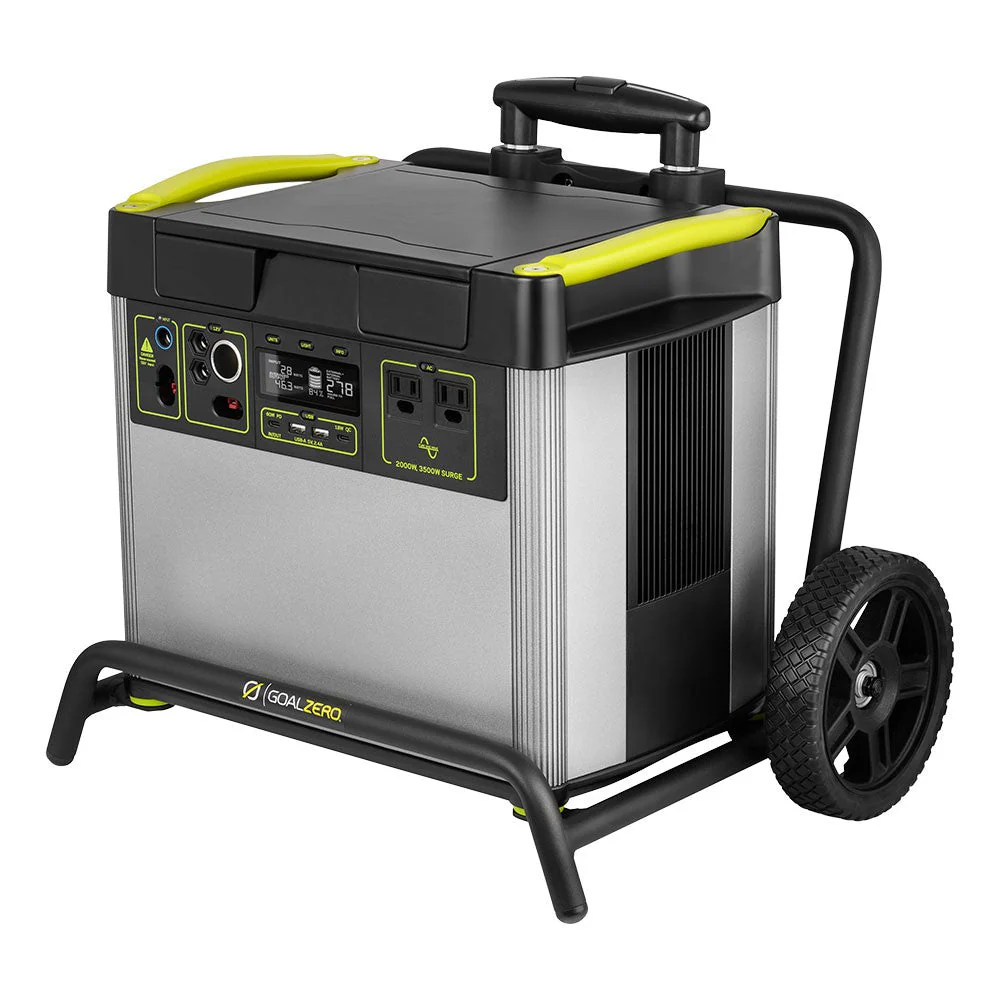
$2,999.95 · direct from Goal Zero
Last checked 1 day ago. Prices move — check before you buy.
Spec deltas
Two batteries 40Wh apart in size, $1,601 apart in price. The DELTA 3 Ultra holds 3,072Wh and asks $1,399; the Yeti 3000X holds 3,032Wh and asks $3,000. Nothing further down the spec sheet argues for the expensive one.
The price gap isn't even the damaging part. Goal Zero built the 3000X on a Li-ion NMC pack rated for 500 cycles to 80% capacity, against a class standard that has moved past 3,000B1. The DELTA is rated for 4,000. Charge both every Saturday and the Yeti reaches the end of its rated life in under five years. The DELTA is rated to keep going for thirty-eight.
What the Yeti genuinely has: a US company behind it, IPX4 weather resistance, an expansion port, 2.3 lb less to lift, and a roll cart in the box, which is more than a footnote at this weightB2. On the six loads we model the two units are a dead heat. Both cover five of them, neither covers the sixth. That's the fair version, and the DELTA still wins by $1,601.
What the Numbers Reveal
Each conclusion stated first — the numbers behind it on one line, the full analysis below.
rated cycles
Divide price by lifetime energy and the DELTA lands at $0.11 per delivered kilowatt-hour against the Yeti's $1.98. The warranty says the same thing from the other end: five years of coverage on $1,399 works out to $260 a covered year, while two years on $3,000 is $1,500. You are not paying a premium for a premium product here. You are paying a premium for less product.
DELTA 3 Ultra: $1,399, 3,072Wh, rated 4,000 cyclesYeti 3000X: $3,000, 3,032Wh, rated 500 cyclesTotal lifetime energy: 12,288 kWh vs 1,516 kWh
Why it mattersIf you assumed the Goal Zero costs more because it's built to last longer, check the cycle rating before you check anything else.
continuous output
That headroom costs nothing, because the unit that has it is the cheaper one. And across the six loads we model it never once comes up: both units start every peak. So read it for what it is, insurance against the appliance you haven't bought yet, the well pump or the shop compressor or the second window unit, thrown in free.
DELTA 3 Ultra: 3,600W continuous, 7,200W surgeYeti 3000X: 2,000W continuous, 3,500W surgeAll six modeled scenarios show both units starting and holding peak draw
Why it mattersIf your load list is stable and modest, ignore this line entirely. If it's likely to grow upward rather than just longer, only one of these two has anywhere to grow into.
The DELTA publishes 30 dBA, and reviewers pushing its inverter toward maximum described fans that never became distracting or annoyingA1A2. A CPAP is nowhere near that load. Goal Zero publishes nothing, which isn't proof of a loud machine, but a decibel rating is the kind of number a company prints when the number flatters it.
CPAP overnight draws 320Wh, which is 12% of usable capacity on either unitDELTA 3 Ultra rated at 30 dBAGoal Zero publishes no noise figure for the Yeti 3000X
Why it mattersAnyone buying this to run a medical device should stop comparing watt-hours and start asking about fans.
Capacity
Now look at the one job neither unit can do alone, the full van-life day at 4,685Wh. That is precisely where you'd need the growth path to be trustworthy, and it isn't. You'd be bolting on lead-acid at half usable capacity while halving the good battery underneath it, on a base unit whose cells are rated for 500 cyclesB1.
Yeti 3000X starts at 3,032Wh, which is 40Wh below the DELTA's fixed 3,072WhGoal Zero's Tank batteries are lead-acid, deliver roughly 50% of nameplate as usable capacity, and halve the onboard lithium when connectedB4Van Life Daily needs 4,685Wh, which is 179% of the DELTA's usable capacity and 182% of the Yeti's
Why it mattersIf expandability is the specific reason you're leaning Goal Zero, that's the one argument on this page that doesn't survive contact with the details.
The specific dimensions that decide these two units — everything else is a tie.
Lifetime Value
Selected because: Nearly the same battery, $1,601 apart at checkout and eight times apart in rated cycles. This is where the matchup ends.
cost / lifetime kWh
Two things can justify a $3,000 power station: it does more, or it lasts longer. The Yeti 3000X does neither, and the cycle rating is why. Its pack is named in reviews as the unit's biggest single drawback, measured explicitly against LiFePO4 rivals rated past 3,000 chargesB1. A sticker price is really a down payment on a number of cycles, and this one buys 500 of them.
Charged every Saturday, the Yeti hits the end of its rated life inside five years. The DELTA is rated for thirty-eight. Whatever you make of the two brands, you'll be replacing the expensive one first.
PowerScore Breakdown
Selected because: 5,072 against 3,257, and most of that gap is inverter: 3,600W continuous versus 2,000W.
overall power score
5,072 against 3,257, and almost all the daylight between them is inverter. The Yeti stops at 2,000W continuous with a 3,500W surge; the DELTA holds 3,600W and spikes to 7,200W. To be fair to the Yeti, it isn't short for anything on this page. It starts and holds every peak in all six modeled loads. The gap only shows up past them, which is exactly where an unplanned appliance lives.
There's a solar half to this too. 800W of input against 600W means a hard-sun refill takes the DELTA about four hours and the Yeti about five (3,072Wh at 800W; 3,032Wh at 600W). One hour sounds like nothing until it's October, the panels go flat at four in the afternoon, and you're deciding whether tomorrow starts full.
What the Specs Don't Tell You
Selected because: Six flags fire on this pair, and exactly one of them lands against the cheaper unit.
rated cycles
Six flags fire here and only one lands against the DELTA: it's a sealed box, and 3,072Wh is where it stays. Take that seriously if your draw is trending upward. Everything else on the card sorts the same direction, with the longer warranty, the longer cycle life and the published noise figure all on the same side.
The flag that changes what you're allowed to plug in is UPS, and it's one-sided. Testers who pulled the DELTA's wall plug mid-session saw no dips and no shutdownsA5A6. The Yeti 3000X has no UPS mode, which is fine at a campsite and disqualifying in a home office.
Growth Path
Selected because: The Yeti's expansion port is its only structural advantage, and it starts 40Wh behind the DELTA's fixed 3,072Wh.
solar input
Expandability is the Yeti's one structural card, and Goal Zero deals it face down. The base unit starts 40Wh below where the DELTA already sits, so a first expansion battery spends most of its value catching up. Then there's what you're expanding into: Tank batteries run on lead-acid, give back roughly half their nameplate as usable capacity, and cut the Yeti's own lithium in half the moment one is attachedB4. You bolt on a battery and the system gets vaguer about how much it holds.
Set that against the DELTA's real weakness, because it is real: what you buy is the ceiling. If you're confident you'll outgrow 3,072Wh, that's a genuine reason to shop a larger system. It is not a reason to shop the Yeti, whose growth path is worse than its starting point.
Your Life, Your Pick
Selected because: Both units clear five of the six loads we model and neither clears the sixth, which is why price ends up doing the deciding.
Five of the six loads we model end in a tie, and not a narrow one. They're the same answer twice. Weekend camping takes 80% of the DELTA's usable capacity and 81% of the Yeti's. A CPAP night takes 12% of each. Both start every peak. If capability were the whole question you'd flip a coin, buy the cheaper one, and be right.
The sixth is the one worth reading. Full van life wants 4,685Wh a day, which comes to 179% of what the DELTA can usably deliver and 182% of the Yeti. Neither is close, and no amount of solar closes a gap that size in a single day. If that's the plan, this is the wrong comparison to be reading.
Strengths & trade-offs
EcoFlow DELTA 3 Ultra
Strengths
- +Costs $1,600.9 less
- +Larger battery capacity
- +Higher AC output
- +Longer warranty
- +Faster solar charging
- +Rated for 4,000 charge cycles — much longer battery lifespan
Trade-offs
- –No major technical downsides compared to rival.
Goal Zero Yeti 3000X
Strengths
- +Lighter by 2.3 lb
Trade-offs
- –Substantially more expensive (+$1,600.9) than the DELTA 3 Ultra.
- –Weaker inverter (-1,600W) limits appliance compatibility.
- –Shorter-lived battery — rated for 500 charge cycles vs the DELTA 3 Ultra's 4,000, so it wears out sooner.
Will It Power Your Gear?
Scenario math and per-appliance runtimes, modeled from the spec record.
Scenario verdicts
We ran the math on six real-world scenarios. Here's which unit survives your actual life.
SCN-01 · 2 nights · needs 2,100Wh
Weekend Camping
Two nights off-grid with essential comfort
Either unit
Both handle the weekend, and by the same margin, roughly four-fifths of usable capacity either way. So decide it on Sunday morning instead. The DELTA takes 800W of solar to the Yeti's 600W, which is the difference between packing up full and packing up nearly full.
Battery budget usedlower = more headroom
LOAD Phone Charger 15W×6h · LED Lights 40W×8h · Box Fan 75W×14h · CPAP Machine 40W×16h
SCN-02 · 8 hours · needs 1,645Wh
8-Hour Blackout
Keep the essentials running through a night without power
Either unit
Both ride out the eight hours on about two-thirds of usable capacity, so capacity isn't the tiebreak. The switchover is. The DELTA carries a UPS mode and hands off before your equipment notices; the Yeti 3000X doesn't have one. If there's a desktop, a modem or a sump controller on the other end, that's the whole decision.
Battery budget usedlower = more headroom
LOAD Fridge 150W×8h · Router + Modem 20W×8h · LED Lights (4 bulbs) 40W×6h · Phone Charger 15W×3h
SCN-03 · 8 hours · needs 320Wh
CPAP Overnight
Sleep therapy without interruption — the #1 medical use case
Either unit
A dead heat, 12% of either battery, which is eight nights of therapy before either one runs dry. Capacity has nothing left to say here. What decides a CPAP night is the fan eighteen inches from your ear, and only one of these two publishes a decibel rating. That's the DELTA.
Battery budget usedlower = more headroom
LOAD CPAP Machine 40W×8h
SCN-04 · 8 hours · needs 910Wh
Remote Workday
Full work day off-grid without power anxiety
Either unit
Both power your workstation all day without strain. At these utilization levels the real difference is USB-C for direct laptop charging — 140W on the DELTA 3 Ultra against 60W — which beats the inverter for convenience and wastes less energy.
Battery budget usedlower = more headroom
LOAD Laptop 60W×8h · External Monitor 30W×8h · Router + Modem 20W×8h · Phone Charger 15W×2h
SCN-05 · 4 hours · needs 670Wh
Tailgate Party
Game day power for the crew
Either unit
Both handle game day easily. Since capacity isn't the deciding factor, weight is: at 69.8 lbs the Yeti 3000X is the one you'll be glad you brought. Fan noise under load is worth a listen too — it's audible in the lulls between songs.
Battery budget usedlower = more headroom
LOAD Blender 400W×0.5h · LED TV (55") 80W×4h · Bluetooth Speaker 15W×4h · Phone Charger (×3) 45W×2h
SCN-06 · 24 hours · needs 4,685Wh
Van Life Daily
A full day of mobile living — the ultimate endurance test
Neither unit
Neither one covers this. Full-time van living wants 4,685Wh a day; the DELTA comes in at 179% of its usable capacity and the Yeti at 182%. That isn't a near miss you can solar your way out of, it's most of a second battery. If van life is the plan, buy a properly sized house bank instead of either of these.
Battery budget usedlower = more headroom
LOAD Mini-Fridge 150W×24h · Laptop 60W×4h · Phone Charger 15W×3h · LED Lights 40W×5h · Fan 75W×8h
The Load Test
RUNTIME = (Wh × 0.85) ÷ LOAD
None of the scenarios above exactly yours? Build it. Toggle what you'd plug in; both units are tested against the combined draw.
Essentials
Comfort & Convenience
High-Draw Appliances
Test duration
8h
Continuous draw
205W
Projected runtime
Dead heat — both run this 205W load for roughly 12.7h. Pick on price, weight, or ports.
Modeled from the spec record — same math as the tables below. Methodology
Runtime by appliance
Real-world runtime estimates for common appliances, modeled at 85% inverter efficiency.¹
Essentials
The basics you need runningscale 0–174.1hComfort & Convenience
Makes off-grid life actually enjoyablescale 0–34.8hHigh-Draw Appliances
These reveal the real limitsscale 0–2.6h¹ Runtime = (capacity × 0.85) ÷ appliance watts. Within each group, all bars share one time scale (the group's longest runtime), so lengths are comparable across appliances; identical runtimes collapse into a single blue/orange bar. Actual runtime varies with battery age, temperature, and simultaneous loads — see methodology.
Conclusion
August 4, 2026
Verdict: the DELTA 3 Ultra
Buy the DELTA 3 Ultra. The two packs are 40Wh apart in size (3,072Wh against 3,032Wh), but the DELTA carries nearly twice the inverter, eight times the rated cycles, five years of warranty against two, and 800W of solar input against 600W. It costs $1,399 where the Yeti costs $3,000. The Yeti's counterarguments come down to a 2.3 lb weight advantage nobody feels on a seventy-pound box and an expansion port that expands into lead-acidB4. Put the $1,601 you save into panels, or don't spend it at all.
Editor-assigned confidence, based on cited owner research and spec analysis.
List prices as of August 4, 2026. The links below open EcoFlow's and Goal Zero's current prices.
$1,399.00 · direct from EcoFlow
Last checked 1 day ago. Prices move — check before you buy.
or check the Yeti 3000X price$2,999.95 list
Written by Gunner Gustafson, Whole-Home Backup Tester · Station Arena Test Desk · Updated August 4, 2026
Measured Data
Benchmark scores and the full spec record, side by side.
Benchmark scores
Not rated for both units (minimum threshold unmet): UPS, Apartment Balcony.
Full specifications
ᵈ Derived: price ÷ rated capacity. See the data behind our comparisons →
Comparison ToolAdd more power stations, side by sideOpen Tool →How these numbers are produced
Numeric verification
Every figure on this page traces to our spec database or arithmetic on it — no estimated numbers.
Owner claims
Statements about owner experience are cited to published reviews — see Sources & Research Notes below.
Runtime model
Runtime = (rated capacity × 0.85 inverter efficiency) ÷ device wattage. Solar recharge estimates assume panels deliver 70% of rated output. Cold weather, battery age, and stacked loads reduce real-world results.
Power Score
Computed from 14 published spec dimensions, weighted per use-case bench. Higher is better; a unit must meet a bench's minimum threshold to be rated.
See the full weight table and data sourcing on our methodology page →Class ranking (the star rating)
Each unit's star score is a category ranking, not customer reviews — no buyer opinions feed it. We score every station on size-independent quality (value, output, portability, endurance, ports, warranty, and more), then percentile-rank it against the other units in its capacity class, so a class-leading compact unit and a class-leading whole-home unit can both earn 5★. Here, DELTA 3 Ultra rates 4.7/5 (80th percentile of 26 Large-class units), and Yeti 3000X rates 3.3/5 (1st percentile of 26 Large-class units).
How the class ranking is computed →Test Notes & Caveats
Hidden gotchas and advantages we spotted that you won't find on the product page.
Both of These Are Two-Person Objects
72.1 lb for the DELTA against 69.8 for the Yeti, a difference you will never once feel. Seventy pounds is a bent-knees lift, a not-on-the-stairs lift, and a good reason to decide now where in the house it's going to live. The Yeti at least comes with a roll cart. Neither of these goes in a backpack, and if the plan involves carrying one any real distance, you're shopping in the wrong weight class.
The DELTA's Ceiling Is the Box You Buy
This is the DELTA 3 Ultra's one genuine loss on this page. There's no expansion port, so 3,072Wh isn't a starting figure, it's the number, permanently. If you already know your draw is climbing, price a larger system now rather than buying twice. If your load list is settled, a sealed unit is one fewer cable, one fewer connector and one fewer thing to fail.
Only One of These Is a UPS
The DELTA 3 Ultra switches to battery in 10 milliseconds, fast enough that a desktop, a router or a NAS never registers that the grid went away. The Yeti 3000X has no UPS mode, so anything on it that can't survive a gap in power will take the gap. If you're shopping to protect equipment rather than to power a campsite, that single line is most of the comparison.
Warranty: 5 Years vs 2
The DELTA 3 Ultra is covered for 5 years against the Yeti 3000X's 2 years. An underrated factor if you're keeping this unit for years.
Battery Lifespan in Real Years
The DELTA 3 Ultra is rated for 4,000 cycles vs 500. In real life: at daily use, that's 11 vs 1.4 years. At weekend use (twice a week), it's 38 vs 5 years. After hitting the cycle limit, the battery doesn't die — it drops to ~80% of original capacity, which is still very usable.
Goal Zero Doesn't Say How Loud It Gets
EcoFlow publishes a decibel rating for the DELTA 3 Ultra. Goal Zero publishes nothing for the Yeti 3000X. That's not evidence of a loud machine, but a noise spec is the kind of number a company prints when the number flatters it. If this is going in a bedroom, beside a CPAP, or in a van where you sleep four feet from it, you're buying the Yeti without knowing what it sounds like.
Full record above — the Test Desk pick is the DELTA 3 Ultra.
Check DELTA 3 Ultra price →or check the Yeti 3000X priceOwnership Analysis
What happens after you buy — true cost of ownership, brand trust, and growth potential.
Lifetime value
Service lifeyears at one full cycle per day
Lifetime energy delivered
Cost per delivered kWh
│ warranty ends · Reaching the cycle rating means ~80% capacity remains — degraded, not dead.
Analyst note
The DELTA 3 Ultra wins on both sticker price and long-term value. At $0.11/kWh over its lifetime, it's meaningfully cheaper to own. Clear value winner.
Delivers each lifetime kWh for $1.87 less — check the DELTA 3 Ultra price →
Brand trust
EcoFlow
Ecosystem
Largest in portable power — 12-15 models across DELTA Pro, DELTA 3, and RIVER 3 series, plus solar panels and smart home panels
Support
US-based phone/email/chat support (1-800-368-8604). Experiences are polarized — many report hassle-free prepaid-label replacements, but others report long waits and refurbished units sent for new claims. Pro tip: buying from Costco or Amazon gives you a stronger return safety net.
Community
Largest community in the space — Reddit r/Ecoflow_community (~31K members), multiple Facebook groups, and an official community forum
App experience
Rated 4.6/5 iOS (~8,400 ratings) · 4.2/5 Android (~17,000 ratings)
Unique strength
Fastest-charging technology (X-Stream), deepest product ecosystem, and most active innovation cadence. At the very top of the range, the DELTA Pro Ultra platform stacks batteries and inverters into whole-home backup — a flagship path, not a line-wide feature.
Worth knowing
Tested subscription paywalls for advanced app features in early 2025 before community backlash paused the plan. No parts or service offered out of warranty.
Goal Zero
Ecosystem
Focused — a compact current line (6th-gen Yeti and Yeti Pro series), the previous-gen X series now out of stock across every model on Goal Zero's own store (checked 2026-09-13: 200X, 500X, 1000X, 1500X, 3000X, 6000X, some listed only as open-box), so buying one new means finding retailer stock, Sherpa power banks for the under-100Wh tier, plus Alta coolers, Nomad/Ranger solar panels, and vehicle integration kits
Support
US-based company (Salt Lake City, owned by NRG Energy). Historically considered premium support, but 2025-2026 reports describe long wait times, unresponsive email communication, and tickets going unaddressed for weeks. The "premium support justifies premium pricing" argument is weakening.
Community
Small but loyal — strong following in overlanding and preparedness communities. Official community forums were recently shuttered, frustrating long-time users.
App experience
Rated 4.4/5 iOS (~1,200 ratings) but recent reviews skew negative — recurring connectivity issues, crashes, and stability problems.
Unique strength
Pioneer of the portable power market — strongest brand heritage. US-based company with ruggedized, weather-resistant designs (IP ratings vary by model). Integrated "Yeti-Ready" ecosystem with coolers, lights, and vehicle kits.
Worth knowing
Typically the priciest brand per watt-hour — though individual pairings vary, and on some pages the Yeti is the cheaper energy. Support quality has declined from its "premium" standard. Perceived as competitively stagnant vs. faster-innovating Chinese competitors. Reliability reports on newer models are concerning.
Analyst note
Don't let the brand column carry much weight here. EcoFlow has the deeper catalog, the faster charging tech and by far the larger owner community, but its support stories run hot and cold and it has a 2025 recall on a different model to answer for. Goal Zero has the heritage, the US address and the ruggedized designs, but support has slipped well below the standard that used to justify the price, and it shut down its own community forums. Two imperfect companies. On this page the spec sheet and the price tag are doing the deciding, not the badge.
Growth path
DELTA 3 Ultra
FIXED CAPACITYFixed at 3,072Wh — a sealed, complete system rather than a starting point. There's no expansion port, so that figure is the ceiling: check it against your longest unplugged stretch before you buy.
Accepts up to 800W of solar. Suitable for a 1-2 panel setup.
Generous port selection supports complex multi-device setups.
Yeti 3000X
EXPANDABLESupports Goal Zero expansion batteries, so you can add capacity later without replacing the base unit — useful if your needs may climb past 3,032Wh.
Accepts up to 600W of solar. Suitable for a 1-2 panel setup.
Adequate ports for most setups, but heavy users may want a power strip.
Expansion batteries are Goal Zero-specific. You're investing in the Goal Zero ecosystem.
Realistic full solar rechargeat 70% of rated panel output — see methodology
Analyst note
Don't read the Yeti 3000X's expandability as a straight win here: it starts at 3,032Wh, below the DELTA 3 Ultra's 3,072Wh, so a first expansion battery largely buys back capacity the DELTA 3 Ultra already includes. It only pulls ahead if you'd grow past 3,072Wh — short of that, the DELTA 3 Ultra's larger fixed capacity is the simpler value.
What Owners Report
Patterns from published owner reports and long-term reviews — every claim cited to its source below.
EcoFlow DELTA 3 Ultra
The field record on the DELTA 3 Ultra comes from review-desk testing rather than years of ownership, so treat it as early evidence rather than a long-term verdict. What's there is consistent. Fans that stay unobtrusive even with the inverter pushed hardA1A2. A shell, cable and sliding port covers that read as engineered rather than assembledA9A15. Clean behaviour on grid loss, with no dips and no shutdowns when the wall plug came out mid-sessionA5A6. One tester held 300 to 600W of GPU load for a little over four and a half hoursA7; another got through an eight-hour remote workday on a laptop, a desktop workstation and monitors with 40% still in the tankA8.
Two honest catches from the same testing. Overload the unit and the 30A port is the first thing it drops, which caught at least one tester off guardA3. And the display washes out in direct sun badly enough to need a cupped hand over itA11, a small thing right up until you're squinting at your state of charge in a parking lot.
“Even when you're pushing it hard, the DELTA 3 Ultra Plus runs much quieter than older EcoFlow models, like the DELTA 2 Max.”
Sources
thesolarlab.com · postperspective.com · appleinsider.com · digitaltrends.com · popsci.com
Goal Zero Yeti 3000X
The Yeti's field record is thin, four substantive entries, and it's dominated by one complaint. The cycle rating is called out as the unit's biggest drawback, set directly against LiFePO4 competitors rated past 3,000 chargesB1. Weight comes second: roughly 70 pounds, with the roll cart described not as a bonus accessory but as the thing that makes the unit movable at allB2.
The expansion story gets the same treatment. The Tank system runs on lead-acid, returns about half its nameplate as usable capacity, and halves the Yeti's own lithium when it's connectedB4. That's the entire growth path, described by the people who tested it.
“A roughly 70-pound unit that comes with a roll cart, essential to move it around.”
Sources
poweredportablesolar.com · bestgeneratorsolar.com · shopsolarkits.com · rei.com · goalzero.com · protoolreviews.com
Sources & Research Notes
Every owner claim in this report is traceable to a published source. The bracketed references above resolve here.
Recurring owner themes
- Reviewers consistently praise the quiet fan operation of the Ultra-tier unit compared to older EcoFlow models, though this is described in professional test conditions rather than long-term ownership. [DELTA 3 Ultra · 2 entries]
- UPS/switchover performance is repeatedly called seamless with no observed dips or shutdowns during power interruption tests. [DELTA 3 Ultra · 3 entries]
- The unit's substantial 74 lb weight is flagged across multiple reviews as a portability drawback, mitigated somewhat by wheels and handle design. [DELTA 3 Ultra · 2 entries]
- Build quality/durability (casing, cable, port covers) is repeatedly highlighted as premium and well-engineered. [DELTA 3 Ultra · 2 entries]
- Large NMC capacity but a crippling 500-cycle rating, heavy weight (roll cart needed), and a limited lead-acid expansion path are the recurring points. [Yeti 3000X · 3 entries]
- A1
“Even when you're pushing it hard, the DELTA 3 Ultra Plus runs much quieter than older EcoFlow models, like the DELTA 2 Max.”
thesolarlab.com — EcoFlow DELTA 3 Ultra Plus Review: The Ultimate DELTA? · 2025-09/10 (approx) · [positive]
- A2
“Even when you're pushing the inverter to its maximum output, the fans never become annoying or distracting.”
thesolarlab.com — EcoFlow DELTA 3 Ultra Plus Review: The Ultimate DELTA? · 2025-09/10 (approx) · [positive]
- A3
“One weird thing we noticed was the fact that the unit always seems to shut down the 30A port first when you overload the unit.”
thesolarlab.com — EcoFlow DELTA 3 Ultra Plus Review: The Ultimate DELTA? · 2025-09/10 (approx) · [mixed]
- A5
“Over my career I have become accustomed to APC batteries immediately switching on when there is a power hit or power shut-off, and the EcoFlow Delta 3 Ultra Plus works in the exact same way.”
postperspective.com — Review: EcoFlow Delta 3 Ultra Plus Portable Power Station · 2026-04 · [positive]
- A6
“I didn't experience any shut-offs or dips when I unplugged the EcoFlow from the wall.”
postperspective.com — Review: EcoFlow Delta 3 Ultra Plus Portable Power Station · 2026-04 · [positive]
- A7
“Using Maxon's Cinebench 2026 GPU benchmark, I was pulling between 300W and 600W on one of the AC outputs... the EcoFlow Delta 3 Ultra Plus would last a little over 4.5 hours.”
postperspective.com — Review: EcoFlow Delta 3 Ultra Plus Portable Power Station · 2026-04 · [positive]
- A8
“I was able to work remotely for an eight-hour day with 40% power left, which included running my laptop, desktop workstation and monitors.”
postperspective.com — Review: EcoFlow Delta 3 Ultra Plus Portable Power Station · 2026-04 · [positive]
- A9
“It does not feel cheap or fragile. Everything from the outer shell case to the plastic buttons and the AC cable feels substantial and durable enough to withstand day-to-day wear and tear.”
appleinsider.com — EcoFlow Delta 3 Ultra Plus review: Premium, but solid power · 2025-11-16 · [positive]
- A11
“But, while facing the sun, I had to employ the classic "cup hands cover" maneuver to get a clear look at the screen status.”
appleinsider.com — EcoFlow Delta 3 Ultra Plus review: Premium, but solid power · 2025-11-16 · [negative]
- A15
“I really love how the rear panel doors for the input ports slide into protective slots when in use.”
popsci.com — EcoFlow DELTA 3 portable power station series first impressions · 2025-09-29 · [positive]
- B1
“Its biggest drawback is the Li-ion NMC battery rated for only 500 cycles to 80% capacity, where LiFePO4 power stations last 3,000+ cycles.”
poweredportablesolar.com / bestgeneratorsolar.com — Yeti 3000X review · 2026 · [negative]
- B2
“A roughly 70-pound unit that comes with a roll cart, essential to move it around.”
shopsolarkits.com / rei.com — Yeti 3000X review · 2026 · [mixed]
- B4
“Expandable via the Goal Zero Tank system, but the Tank uses lead-acid batteries that allow only ~50% usable capacity and halve the onboard lithium capacity when connected — a limited expansion path.”
poweredportablesolar.com — Yeti 3000X / Tank review · 2026 · [negative]
Research compiled August 4, 2026.
Who Should Buy Which
Buy the DELTA 3 Ultra if you…
- →You're wiring a home office to ride out grid blips. A desktop, a monitor and a modem on the DELTA's UPS switchover turns an outage into something you read about later instead of something that eats your unsaved work.
- →You buy once and keep things. At a full cycle a day this is rated for eleven years, which makes it a unit you hand down rather than one you schedule a replacement for.
- →You need actual inverter headroom, a well pump or a shop compressor or two heavy things at once, and you'd rather not discover the ceiling by tripping it.
- →You charge a full-size laptop off USB-C. 100W against 60W is the difference between charging while you work and charging instead of working.
- →You're the one sleeping next to it. Only one of these two publishes a noise figure, and you're the person who finds out whether it was accurate.
Buy the Yeti 3000X if you…
- →You already own Goal Zero panels, Tank batteries and Yeti-Ready gear, and switching ecosystems means rebuying hardware that currently works fine.
- →You want a US-based company, IPX4 weather resistance and a decade of overlanding heritage behind the box, and you've found the 3000X discounted steeply enough that the cycle rating stops being the story. At $3,000 it's very hard to argue for. At a real markdown the conversation changes.
If neither fits
You're living in a van full time. The daily load for that life is close to double what either unit can usably deliver, so both of these have you rationing power by Wednesday and cycling the battery hard enough to age it fast. Buy a properly sized LFP house bank with a real charger and an alternator tie-in, or plan on two units from the start. A single portable box is the wrong shape for that job, and paying $3,000 for the shorter-lived version of the wrong shape is worse.
The Bottom Line
Take the DELTA 3 Ultra. It's the larger battery, the stronger inverter, the faster solar refill, the longer warranty, and the only one of the two with a UPS switchover, and it's the one that costs $1,399 instead of $3,000. The cycle rating is what turns a clear win into a lopsided one: eight times the rated charges means eight times the energy out of a unit you paid less than half as much for.
The Yeti's honest case is a roll cart, two spare pounds and a Salt Lake City addressB2. Those are real. They are not $1,601 real, and they don't survive a pack that, charged every weekend, reaches the end of its rated life before the DELTA's five-year warranty has even run out.
Frequently Asked Questions
Answers drawn from the spec record and cited owner research.
Is the Goal Zero Yeti 3000X still worth buying in 2026?
Not at $3,000, and not against this particular rival. The DELTA 3 Ultra matches its capacity to within 40Wh and beats it on inverter output, solar input, warranty, USB-C and cycle life while costing $1,601 less. The Yeti makes sense in two situations: you're already invested in Goal Zero panels and Tank batteries, or you've found it discounted far enough that the 500-cycle rating stops mattering to your math.
Which one can run bigger appliances?
The DELTA 3 Ultra, comfortably. It holds 3,600W continuously and surges to 7,200W, where the Yeti tops out at 2,000W continuous and 3,500W surge. That means the DELTA runs all day above the level the Yeti can only manage for an instant. Worth knowing: across the six load profiles we model, both units start every peak, so this gap only bites if your appliance list grows.
Can I expand the Yeti 3000X past the DELTA 3 Ultra's capacity?
Technically yes, practically it's a poor trade. The Yeti starts 40Wh below the DELTA, so your first expansion battery mostly buys back ground you'd have had for free. And Goal Zero's Tank batteries are lead-acid: roughly half the nameplate is usable, and attaching one halves the Yeti's own lithium capacity. The DELTA can't expand at all, but 3,072Wh sealed beats 3,032Wh that shrinks when you try to grow it.
Does the Yeti 3000X work as a UPS for a computer?
No. The Yeti 3000X has no UPS mode, so it isn't the unit for equipment that can't tolerate a gap in power. The DELTA 3 Ultra switches over in 10 milliseconds, and testers who pulled its wall plug mid-session saw no dips and no shutdowns. If protecting a desktop, a NAS or a network rack is why you're shopping, that's a one-sided answer.
Which is quieter for running a CPAP overnight?
The DELTA 3 Ultra is the only one of the two you can answer that question about. It's rated at 30 dBA, and reviewers running its inverter near maximum described fans that never became distracting, while a CPAP is a small fraction of that load. Goal Zero publishes no noise figure for the Yeti 3000X at all. Capacity is a non-issue either way, since a modeled CPAP night draws 12% of either unit.
Where to buy
EcoFlow DELTA 3 UltraPick
$1,399.00
$1,399.00 · direct from EcoFlow
Last checked 1 day ago. Prices move — check before you buy.
Goal Zero Yeti 3000X
$2,999.95
$2,999.95 · direct from Goal Zero
Last checked 1 day ago. Prices move — check before you buy.
Prices may vary by retailer and are subject to change.