Head-to-head test
Goal Zero Yeti 1500 (6th Gen) vs Goal Zero Yeti 3000X
Goal Zero Yeti 1500 (6th Gen) vs Goal Zero Yeti 3000X: Buy the Yeti 1500 (6th Gen). Cycled daily, the 3000X runs through its rated 500 cycles in under a year and a half; the Yeti 1500 (6th Gen) costs half as much and is eleven years into the same job on its original battery.
Full profiles: Goal Zero Yeti 1500 (6th Gen) → · Goal Zero Yeti 3000X →

Written by Gunner GustafsonUpdated
Whole-Home Backup Tester, Station Arena Test Desk
Spec deltas
The Yeti 1500 (6th Gen) wins this on the battery inside it. Goal Zero rates it for 4,000 cycles. The 3000X gets 500. Same brand, same shelf, same 2,000W inverter, and two completely different propositions about how long you own the thing.
That doesn't make the 3000X a bad box. It holds 3,032Wh to the 1500's 1,505Wh, it takes five of the six load profiles on this page, and it wins our PowerScore 3,317 to 2,930. If your only question is which unit gets you through Saturday night without thinking about it, the answer is the 3000X and we're not going to pretend otherwise.
Then you price it. Twice the money, a 2-year warranty against 5, 600W of solar input against 900, 60W of USB-C against 140, and 69.78 lbs against 52.75. The 3000X wins the weekend. The 1500 wins the decade.
What the Numbers Reveal
Each conclusion stated first — the numbers behind it on one line, the full analysis below.
rated cycles
Put the price back in and the two gaps compound. Twice the money for a quarter of the energy is nearly eight times the cost per kilowatt-hour delivered, 25 cents against $1.98. That figure already swallows every advantage the 3000X has, because the capacity, the expansion port and the higher PowerScore are all priced into the $3,000 (last listed price) and none of them add a cycle to the pack.
Yeti 3000X: 3,032Wh, rated 500 cycles, $3,000 (last listed price)Yeti 1500 (6th Gen): 1,505Wh, rated 4,000 cycles, $1,500Rated lifetime throughput: 1,516kWh for the 3000X, 6,021kWh for the 1500
Why it mattersIf you'll actually use this thing on a schedule, weekly camping or every outage or a jobsite, buy the 1500. The 3000X only pencils out for someone who cycles it a handful of times a year and shelves it in between.
solar input
The pair also brings 1,800W of solar input instead of 600W, 8,000 rated cycles instead of 500, and two 52.75-lb boxes instead of one 69.78-lb one. Here's the honest catch: two units are two islands. You can't pool them into a single 3,000Wh reservoir behind one outlet, and you have two things to keep charged. But both units invert 2,000W, so nothing gets more powerful by living in one enclosure. Only duration on a single circuit does.
Yeti 1500 (6th Gen): $1,500, 1,505Wh, 900W solar input, 4,000 cycles, 52.75 lbsYeti 3000X: $3,000 (last listed price), 3,032Wh, 600W solar input, 500 cycles, 69.78 lbsBoth units invert 2,000W continuous
Why it mattersAnyone about to buy the 3000X for capacity should price two 1500s first. The one-box argument has to be worth $1,500 and 7,500 rated cycles all by itself.
That flips which unit you want in a long outage. A big one-time reserve is worth real money on night one. By night three what matters is how fast the box comes back, and the 1500 comes back from empty in a little over an hour on any wall outlet or generatorA2. Field testing also put the 1500's solar recharge at six to eight hours in ordinary cloud and imperfect angles against a claimed 4.5A3. Apply that same haircut to the 3000X's five hours and its refill stops fitting inside one good day.
Yeti 1500 (6th Gen): 1,505Wh capacity, 900W max solar inputYeti 3000X: 3,032Wh capacity, 600W max solar inputHands-on testing measured a full 0 to 100% wall recharge on the 1500 in just over an hourA2
Why it mattersBuying for outages rather than for one big trip? Recharge rate is the survival spec, and it belongs to the 1500 by 300W of solar input.
Only two of the profiles are real capability wins, the camping weekend and the blackout, where the 1500 runs past its usable capacity and the 3000X doesn't. And the sixth defeats both of them: the van-life day puts the 3000X at 182% of usable and the 1500 at 366%, so the unit costing $1,500 more still can't do the hardest thing on the list. That premium buys exactly two scenarios.
The 3000X is the computed winner in five of the six scenario profilesRemote Workday, 910Wh: the 1500 finishes at 71% of usable capacity, the 3000X at 35%CPAP Overnight: 25% against 12%Van Life Daily is a loss for both, at 366% against 182%
Why it mattersTotal your real draw before you shop. If it lands near the 910Wh workday, the scenario column is scoring headroom, and headroom is the most expensive thing on this page.
The specific dimensions that decide these two units — everything else is a tie.
Lifetime Value
Selected because: Twice the price buys a quarter of the lifetime energy, and everything else on this page is downstream of that.
Amortized across a weekend-use life, the 1500 costs 11 cents a day to own. The 3000X costs $1.71. Same brand, same inverter rating, and one of them is roughly fifteen times more expensive for every day it sits in your garage.
The gap isn't really the sticker; it's the chemistry under it. A 500-cycle pack has to be re-bought on a schedule and a 4,000-cycle one mostly doesn't, and the warranty terms point the same direction: $300 of purchase price per covered year against $1,500. Goal Zero is telling you how long it expects each unit to last, and you can read it straight off the paperwork.
Your Life, Your Pick
Selected because: The bigger battery sweeps the load profiles, so it's worth separating the wins that are capability from the wins that are only margin.
Five wins out of six looks decisive right up until you check what got won. The CPAP night asks for 320Wh and the 3000X ends it at 12% used against the 1500's 25%, a distinction with no consequence in the middle of the night, because neither unit was ever going to run dry.
The two that count are the camping weekend and the 8-hour blackout. Both outrun the 1500's tank and neither outruns the 3000X's. If that's genuinely your use, a full weekend with nowhere to plug in or a whole outage without a sunny window in it, then the 3000X is doing something the 1500 can't, and you should weigh it against the cycle life you're buying to get it. If it isn't your use, you're funding a reserve you'll never reach.
Growth Path
Selected because: Only the 3000X expands, and what it expands into is the detail that decides whether expandability counts here.
solar input
The 3000X's growth path runs through Goal Zero's Tank batteries, which are lead-acid: only about half of what you bolt on is usable, and connecting one halves the onboard lithium capacity you already paid forB4. You add a battery and the system hands back part of what you already owned. Expandability only counts if the thing you expand into is worth having.
The 1500's weakness is the mirror image and we'll say it first: it's sealed at 1,505Wh, and it won't accept the older Yeti Tank batteries eitherA9. What you buy is the ceiling, so size it for the load you have rather than the one you're forecasting. But a ceiling you can see beats a growth path that charges you to shrink, and if you do outgrow it, a second sealed unit adds watt-hours without subtracting any.
Portability & Form Factor
Selected because: Seventeen pounds separates these two, which is roughly the line between a one-person lift and a scheduled one.
weight
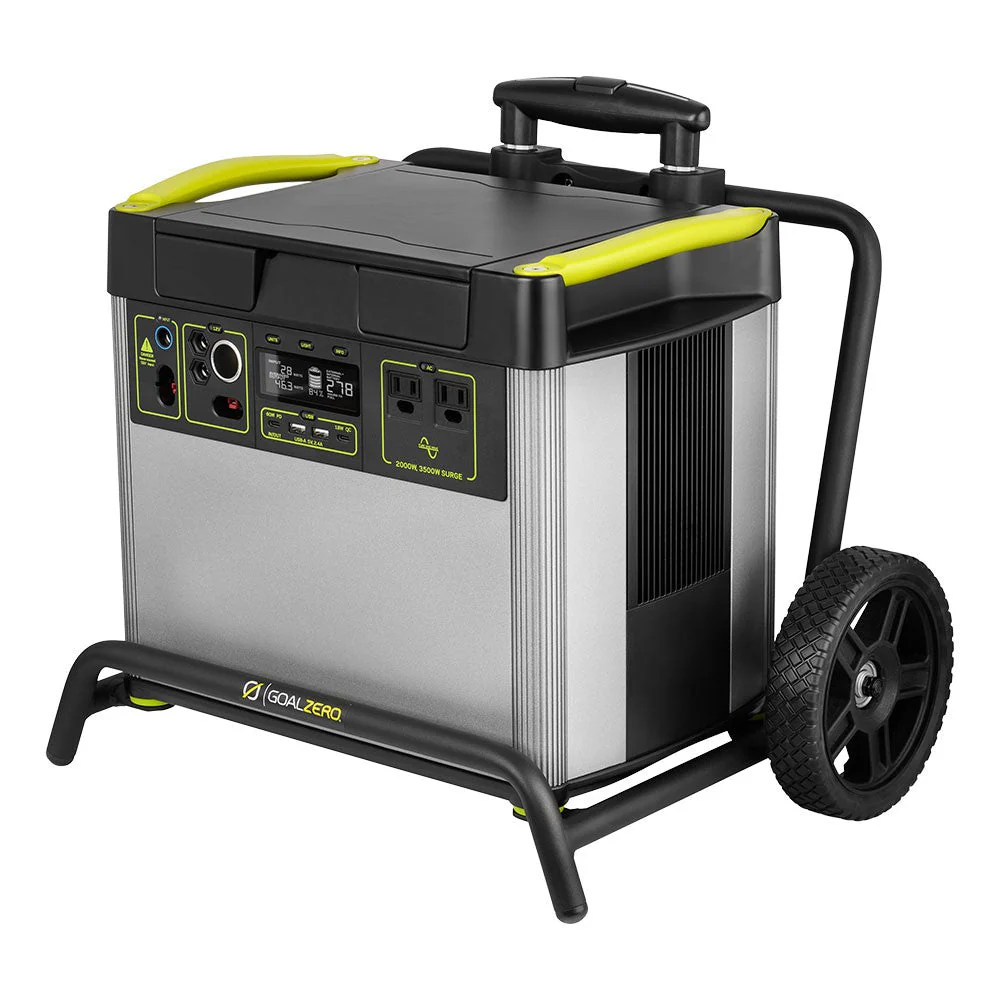
Seventeen pounds sounds like a rounding error until there's a staircase involved. 52.75 lbs is a bent-knees lift into a truck bed that most adults manage alone. 69.78 lbs is where you start recruiting a second person, and the roll cart that ships with the 3000X isn't a courtesy accessory, it's how the unit movesB2.
Where the 1500 earns its keep is the part that isn't on the scale: the aluminum enclosure came through rocky roads and a long run of speed bumps without complaint in hands-on testingA6. If the unit lives in a truck bed, that matters more than the pound count. If it lives in a basement and comes out twice a year, skip this section entirely and go back to the cycle ratings.
Strengths & trade-offs
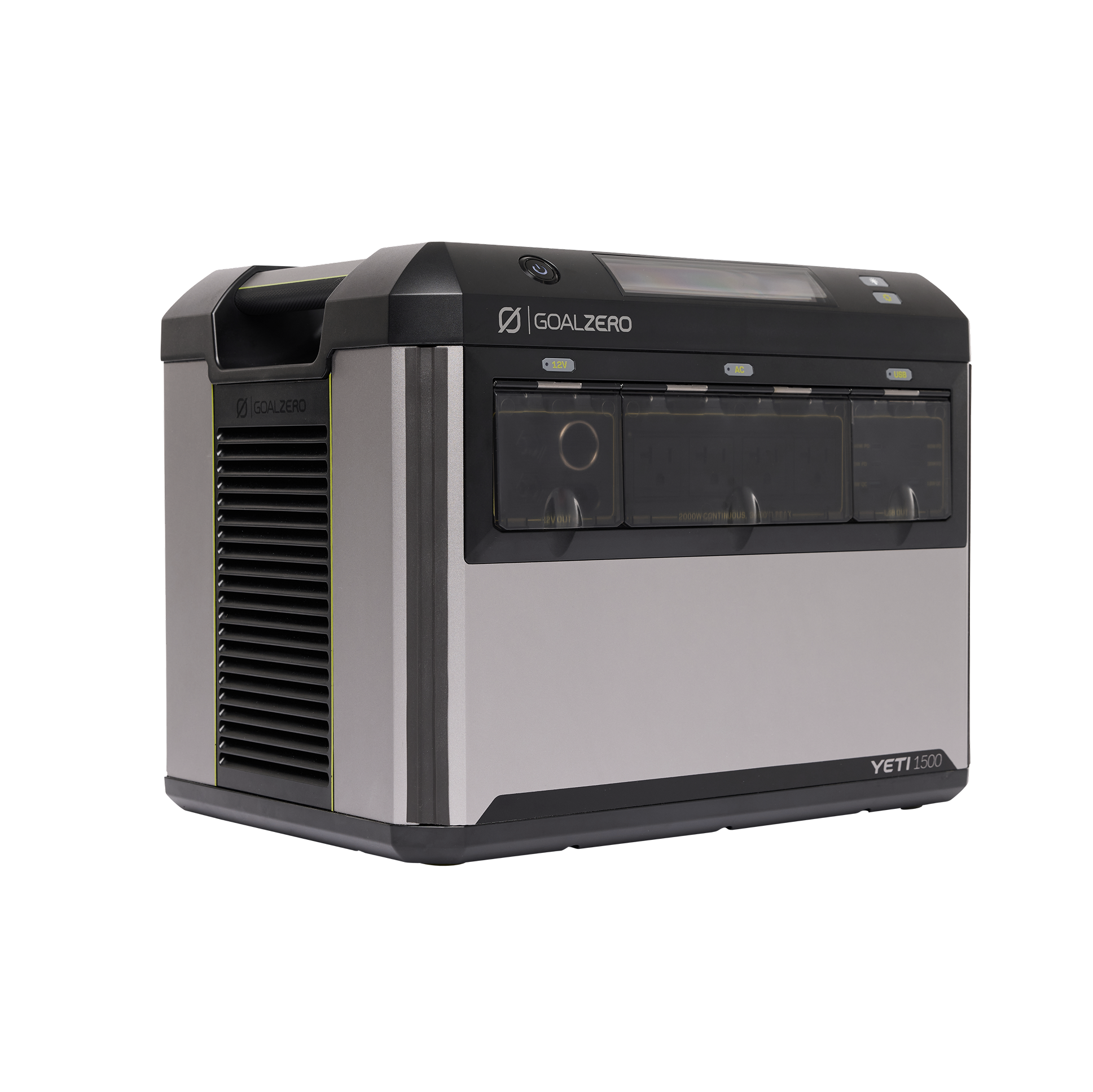
Goal Zero Yeti 1500 (6th Gen)
Strengths
- +Lighter by 17 lb
- +Longer warranty
- +Faster solar charging
- +Rated for 4,000 charge cycles — much longer battery lifespan
Trade-offs
- –Sealed capacity — the Yeti 3000X can add batteries to grow past 1,505.3Wh; this one can't.
Goal Zero Yeti 3000X
Strengths
- +Larger battery capacity
Trade-offs
- –Significantly heavier (+17 lbs), making it harder to move.
- –Shorter-lived battery — rated for 500 charge cycles vs the Yeti 1500 (6th Gen)'s 4,000, so it wears out sooner.
Will It Power Your Gear?
Scenario math and per-appliance runtimes, modeled from the spec record.
Scenario verdicts
We ran the math on six real-world scenarios. Here's which unit survives your actual life.
SCN-01 · 2 nights · needs 2,100Wh
Weekend Camping
Two nights off-grid with essential comfort
Yeti 3000X
Two nights at 2,100Wh is the load that finds the 1500's ceiling. It lands at 164% of usable capacity and doesn't finish, while the 3000X coasts through at 81%. This is the scenario the 3000X exists for. It's also the one where a sunny afternoon changes the answer, since the 1500 takes 900W of solar to the 3000X's 600W.
Battery budget usedlower = more headroom
LOAD Phone Charger 15W×6h · LED Lights 40W×8h · Box Fan 75W×14h · CPAP Machine 40W×16h
SCN-02 · 8 hours · needs 1,645Wh
8-Hour Blackout
Keep the essentials running through a night without power
Yeti 3000X
The 3000X takes this on tank size, ending at 64% of usable capacity against a 1500 that runs past its own at 129%. Night one belongs to the bigger battery. Night three belongs to whichever unit refills fastest, and that's the 1500 at 900W of solar input against 600W.
Battery budget usedlower = more headroom
LOAD Fridge 150W×8h · Router + Modem 20W×8h · LED Lights (4 bulbs) 40W×6h · Phone Charger 15W×3h
SCN-03 · 8 hours · needs 320Wh
CPAP Overnight
Sleep therapy without interruption — the #1 medical use case
Either unit
The 3000X wins by using 12% of itself instead of 25%, which is the least consequential victory on this page. A 320Wh night doesn't threaten either unit. What matters at the bedside is fan behavior at low load, and a draw that small is a fraction of what either 2,000W inverter is built to push. Decide this one on price.
Battery budget usedlower = more headroom
LOAD CPAP Machine 40W×8h
SCN-04 · 8 hours · needs 910Wh
Remote Workday
Full work day off-grid without power anxiety
Yeti 3000X
The Yeti 3000X clears the workday at 35% used, banking 1,667Wh — late work, extra calls, or a second laptop charge without arithmetic. The Yeti 1500 (6th Gen) at 71% also finishes, with 369Wh of slack for the unplanned.
Battery budget usedlower = more headroom
LOAD Laptop 60W×8h · External Monitor 30W×8h · Router + Modem 20W×8h · Phone Charger 15W×2h
SCN-05 · 4 hours · needs 670Wh
Tailgate Party
Game day power for the crew
Yeti 3000X
The 3000X has the headroom, finishing at 26% used against 52%. Neither unit is troubled by a 670Wh afternoon. What separates them is that you carried 69.78 lbs across the parking lot to get that margin instead of 52.75, and the margin buys you nothing you'll use before the game ends.
Battery budget usedlower = more headroom
LOAD Blender 400W×0.5h · LED TV (55") 80W×4h · Bluetooth Speaker 15W×4h · Phone Charger (×3) 45W×2h
SCN-06 · 24 hours · needs 4,685Wh
Van Life Daily
A full day of mobile living — the ultimate endurance test
Neither unit
Neither unit covers this. A day this size runs the 3000X to 182% of its usable capacity and the 1500 to 366%, which means the honest answer is that you're shopping in the wrong category. A draw like that wants a wired house bank with alternator charging, not a portable box you have to babysit. If your real day is smaller than the profile, the workday and camping numbers are the ones to read.
Battery budget usedlower = more headroom
LOAD Mini-Fridge 150W×24h · Laptop 60W×4h · Phone Charger 15W×3h · LED Lights 40W×5h · Fan 75W×8h
The Load Test
RUNTIME = (Wh × 0.85) ÷ LOAD
None of the scenarios above exactly yours? Build it. Toggle what you'd plug in; both units are tested against the combined draw.
Essentials
Comfort & Convenience
High-Draw Appliances
Test duration
8h
Continuous draw
205W
Projected runtime
For this load: Yeti 3000X runs 12.6h vs 6.2h.
Planning for more than this? Describe your whole setup and get it sized →
Modeled from the spec record — same math as the tables below. Methodology
Runtime by appliance
Real-world runtime estimates for common appliances, modeled at 85% inverter efficiency.¹
Essentials
The basics you need runningscale 0–171.8hComfort & Convenience
Makes off-grid life actually enjoyablescale 0–34.4hHigh-Draw Appliances
These reveal the real limitsscale 0–2.6h¹ Runtime = (capacity × 0.85) ÷ appliance watts. Within each group, all bars share one time scale (the group's longest runtime), so lengths are comparable across appliances; identical runtimes collapse into a single blue/orange bar. Actual runtime varies with battery age, temperature, and simultaneous loads — see methodology.
Conclusion
August 1, 2026
Verdict: the Yeti 1500 (6th Gen)
Buy the Yeti 1500 (6th Gen). It costs $1,500 against $3,000 (last listed price), inverts the same 2,000W, starts marginally bigger loads (3,600W surge against 3,500W), takes 900W of solar against 600W, carries a 5-year warranty against 2, and is rated for 4,000 cycles against 500. The 3000X's genuine advantage is a single-charge tank of 3,032Wh, which is why it wins five of the six load profiles below and takes the PowerScore 3,317 to 2,930. That advantage is worth $1,500 only if you truly need more than the 1500's 1,505Wh out of one box in one sitting and you won't cycle it often, because at 500 cycles you're re-buying the battery on a schedule. And if capacity is the whole reason you're here, two Yeti 1500s cost the same $3,000 (last listed price) as one 3000X.
Editor-assigned confidence, based on cited owner research and spec analysis.
List prices as of August 1, 2026. The links below open Goal Zero's current price.
Sold on Amazon · today’s price is on the listing
Written by Gunner Gustafson, Whole-Home Backup Tester · Station Arena Test Desk · Updated August 1, 2026
Measured Data
Benchmark scores and the full spec record, side by side.
Benchmark scores
Not rated for both units (minimum threshold unmet): UPS, CPAP.
Full specifications
ᵈ Derived: price ÷ rated capacity. See the data behind our comparisons →
Comparison ToolAdd more power stations, side by sideOpen Tool →How these numbers are produced
Numeric verification
Every figure on this page traces to our spec database or arithmetic on it — no estimated numbers.
Owner claims
Statements about owner experience are cited to published reviews — see Sources & Research Notes below.
Runtime model
Runtime = (rated capacity × 0.85 inverter efficiency) ÷ device wattage. Solar recharge estimates assume panels deliver 70% of rated output. Cold weather, battery age, and stacked loads reduce real-world results.
Power Score
Computed from 14 published spec dimensions, weighted per use-case bench. Higher is better; a unit must meet a bench's minimum threshold to be rated.
See the full weight table and data sourcing on our methodology page →Class ranking (the star rating)
Each unit's star score is a category ranking, not customer reviews — no buyer opinions feed it. We score every station on size-independent quality (value, output, portability, endurance, ports, warranty, and more), then percentile-rank it against the other units in its capacity class, so a class-leading compact unit and a class-leading whole-home unit can both earn 5★. Here, Yeti 1500 (6th Gen) rates 3.4/5 (4th percentile of 27 Everyday-class units), and Yeti 3000X rates 3.3/5 (1st percentile of 26 Large-class units).
How the class ranking is computed →Test Notes & Caveats
Hidden gotchas and advantages we spotted that you won't find on the product page.
69.78 lbs, and Where It Has To Go
Seventeen pounds separates these two, and that line falls almost exactly where one person stops being enough. 52.75 lbs is a bent-knees lift into a truck bed. 69.78 lbs is where basement stairs become a two-person conversation and wheels stop being optional. Neither is a backpacking unit. Only one is a carry-it-out-to-the-driveway unit.
The Yeti 1500's Ceiling Is the Box You Buy
Fixed at 1,505Wh, no expansion port, and no compatibility with Goal Zero's older Tank batteries either. That's a real limitation and it belongs right here next to our pick: buy this unit for the load you have, because nothing gets added later. The counterweight is what the alternative expands into. The Tank batteries are lead-acid, they give back only part of what you bolt on, and connecting one cuts the onboard lithium in half. A ceiling you can see beats a growth path that charges you to shrink.
Only the Yeti 1500 (6th Gen) Lists a UPS Mode
The Yeti 1500 (6th Gen) can sit between the wall and your gear and hand it to battery when the grid drops — rated ≤15ms — fine on paper for routers and most electronics; the fussiest PC power supplies sit right at this line. Worth it for a router, a desktop PC, or a CPAP. The Yeti 3000X's spec sheet lists no UPS mode, so anything plugged into it rides an outage only as far as your reaction time.
What a Covered Year Actually Costs
Five years against two, on units priced $1,500 and $3,000 (last listed price), works out to $300 of purchase price per covered year against $1,500. The warranties don't track the cycle ratings exactly, but they point the same way, and they're the closest thing you get to each manufacturer's own estimate of how long its battery lasts. Read them as a forecast, not a favour.
Rated Cycles, Converted to Calendar
Run each unit on a weekend cadence and the ratings convert to 38.5 years for the 1500 and 4.8 for the 3000X. Nobody keeps a power station for 38 years, and that's the point: one of these gets replaced because you wanted something newer, the other because it stopped holding a useful charge. Daily use compresses the same gap to 11 years against 1.4.
Full record above — the Test Desk pick is the Yeti 1500 (6th Gen).
Check Yeti 1500 (6th Gen) price →Ownership Analysis
What happens after you buy — true cost of ownership, brand trust, and growth potential.
Lifetime value
Service lifeyears at one full cycle per day
Lifetime energy delivered
Cost per delivered kWh
│ warranty ends · Reaching the cycle rating means ~80% capacity remains — degraded, not dead.
Analyst note
The Yeti 3000X is no longer sold, so there is no price to work its cost per kWh from, and this comparison doesn't quote one. On what you can actually buy today, the Yeti 1500 (6th Gen) works out at $0.25/kWh over its rated life. If you already own the Yeti 3000X, the hardware comparison still holds: over its rated life the Yeti 1500 (6th Gen) delivers about 6,021 kWh and the Yeti 3000X about 1,516 kWh.
Growth path
Yeti 1500 (6th Gen)
FIXED CAPACITYFixed at 1,505Wh, with no expansion — so size it for your needs up front rather than planning to add capacity later.
Accepts up to 900W of solar. Suitable for a 1-2 panel setup.
Generous port selection supports complex multi-device setups.
Yeti 3000X
EXPANDABLESupports Goal Zero expansion batteries, so you can add capacity later without replacing the base unit — useful if your needs may climb past 3,032Wh.
Accepts up to 600W of solar. Suitable for a 1-2 panel setup.
Adequate ports for most setups, but heavy users may want a power strip.
Expansion batteries are Goal Zero-specific. You're investing in the Goal Zero ecosystem.
Realistic full solar rechargeat 70% of rated panel output — see methodology
Analyst note
Growth only counts if you can still buy in, and the Yeti 3000X is no longer sold (Goal Zero points owners to the Yeti PRO 4000). That leaves the Yeti 1500 (6th Gen): it is sealed at 1,505Wh, so buy the size that covers you now. The Yeti 3000X's expandability still matters if you already own one, but it isn't a reason to pick it over the Yeti 1500 (6th Gen).
What Owners Report
Patterns from published owner reports and long-term reviews — every claim cited to its source below.
Goal Zero Yeti 1500 (6th Gen)
The field record on this generation is short, and what exists is professional hands-on review work rather than long-term ownershipA2A6. It's good, though. A full 0 to 100% wall recharge in just over an hourA2, a CPAP run overnight that ended the morning with more than 60% still in the tankA4, and a clean handoff from mains to battery that kept a modem and router alive through a winter stormA5. The aluminum shell survived rocky roads and an endless run of speed bumps without issueA6.
The complaints are real but narrow. The fans become audible, not loud, when the inverter is working near its 2,000W ceilingA1. Solar recharge lands nearer six to eight hours in ordinary conditions than the 4.5 Goal Zero claimsA3. The 6mm port ecosystem is proprietary enough to limit accessories, and it won't take the older Yeti Tank batteriesA9. A minority of REI reviewers report harder failures: one unit that stopped accepting charge on 120VAC, solar and 12V alike, with unsatisfying support afterwardA10, and connectivity and charging trouble following a firmware updateA11. Those are two voices against an otherwise positive professional consensus, and a firmware fault may already be patched. Worth knowing. Not worth deciding on.
“When pushing the inverter near its 2,000W limit, the internal cooling fans become audible — not loud, but noticeable in a quiet room.”
Sources
exploreandrenovate.com · wattsourcer.com
Goal Zero Yeti 3000X
Field material on the 3000X is thin and points one direction. The defining note is the Li-ion NMC pack, rated for 500 cycles to 80% capacity where LiFePO4 designs run past 3,000B1. The rest is physical: roughly 70 pounds with a roll cart described as essential rather than optionalB2, and a Tank expansion system whose lead-acid batteries surrender about half their capacity and halve the onboard lithium when connectedB4. What exists is review-desk assessment rather than long-term owner reporting, and it's consistentB1B2B4.
“A roughly 70-pound unit that comes with a roll cart, essential to move it around.”
Sources
poweredportablesolar.com · bestgeneratorsolar.com · shopsolarkits.com · rei.com · goalzero.com · protoolreviews.com
Sources & Research Notes
Every owner claim in this report is traceable to a published source. The bracketed references above resolve here.
Recurring owner themes
- Real-world charging speed, CPAP endurance, and UPS backup performance consistently match or beat Goal Zero's marketing claims in hands-on tests, though solar recharge time runs slower than advertised once conditions aren't ideal. [Yeti 1500 (6th Gen) · 4 entries]
- Reviewers flag the unit's price and near-60-lb weight as barriers, and its proprietary 6mm port ecosystem plus incompatibility with older Yeti Tank batteries as an ecosystem lock-in concern. [Yeti 1500 (6th Gen) · 2 entries]
- A minority of REI buyers report serious reliability failures (total charging failure across all input types) paired with unsatisfying customer service, plus firmware-update-triggered connectivity problems — a contrast to the otherwise positive professional-review consensus. [Yeti 1500 (6th Gen) · 2 entries]
- Large NMC capacity but a crippling 500-cycle rating, heavy weight (roll cart needed), and a limited lead-acid expansion path are the recurring points. [Yeti 3000X · 3 entries]
- A1
“When pushing the inverter near its 2,000W limit, the internal cooling fans become audible — not loud, but noticeable in a quiet room.”
exploreandrenovate.com — "Goal Zero Yeti 1500 Worth Buying? Honest Pros & Cons Analysis" · 2026 · [mixed]
- A2
“A full charge from 0 to 100% completes in just over an hour via wall power.”
Popular Science — "Goal Zero Yeti 1500 6G review: A rugged portable power station that isn't afraid to get dirty" · 2026 · [positive]
- A3
“Goal Zero claims a 4.5-hour full recharge from solar, but in more typical conditions with some cloud movement and sub-optimal angles, 6-8 hours is a more realistic expectation.”
exploreandrenovate.com — "Goal Zero Yeti 1500 Worth Buying? Honest Pros & Cons Analysis" · 2026 · [mixed]
- A4
“I ran a CPAP machine overnight, which left me with more than 60% capacity in the morning.”
Popular Science — "Goal Zero Yeti 1500 6G review: A rugged portable power station that isn't afraid to get dirty" · 2026 · [positive]
- A5
“The transition from mains to power bank worked seamlessly as you'd hope — it kept the modem and router running through a winter storm.”
Popular Science — "Goal Zero Yeti 1500 6G review: A rugged portable power station that isn't afraid to get dirty" · 2026 · [positive]
- A6
“The aluminum enclosure gives a premium, tool-like feel, and the unit survived rocky roads and over the seemingly endless number of speed bumps without issue.”
Popular Science — "Goal Zero Yeti 1500 6G review: A rugged portable power station that isn't afraid to get dirty" · 2026 · [positive]
- A9
“The 6mm port ecosystem is proprietary, limiting accessory options, and the unit is not compatible with older Yeti Tank expansion batteries.”
wattsourcer.com — "Goal Zero Yeti 1500 Review (2026)" · 2026 · [negative]
- A10
“The unit stopped accepting charges via 120VAC, solar, and 12V inputs, resulting in complete system failure, and the owner reported less than satisfactory customer service from Goal Zero.”
REI customer reviews — Goal Zero Yeti 1500 Portable Power Station product page (review aggregate) · unknown · [negative]
- A11
“Experienced connectivity and charging issues after a firmware update.”
REI customer reviews — Goal Zero Yeti 1500 Portable Power Station product page (review aggregate) · unknown · [negative]
- B1
“Its biggest drawback is the Li-ion NMC battery rated for only 500 cycles to 80% capacity, where LiFePO4 power stations last 3,000+ cycles.”
poweredportablesolar.com / bestgeneratorsolar.com — Yeti 3000X review · 2026 · [negative]
- B2
“A roughly 70-pound unit that comes with a roll cart, essential to move it around.”
shopsolarkits.com / rei.com — Yeti 3000X review · 2026 · [mixed]
- B4
“Expandable via the Goal Zero Tank system, but the Tank uses lead-acid batteries that allow only ~50% usable capacity and halve the onboard lithium capacity when connected — a limited expansion path.”
poweredportablesolar.com — Yeti 3000X / Tank review · 2026 · [negative]
Research compiled August 1, 2026.
Who Should Buy Which
Buy the Yeti 1500 (6th Gen) if you…
- →You'll put real cycles on it. Weekly camping, every outage, a jobsite trailer, a van you actually sleep in. That's where the cycle rating stops being a spec and starts being the reason you aren't shopping for one of these again.
- →You're backing up the essentials rather than the house. Modem, router, phones, a CPAP, a couple of lamps. A 320Wh night uses a quarter of this unit, and the handoff is 25ms on either box, fast enough that the router never notices the grid left.
- →You carry it yourself. 52.75 lbs is the difference between one person loading a truck and two people agreeing on a time to do it together.
- →You want solar to do actual work. 900W of input refills the entire tank in under two hours of full sun (1,505 divided by 900), which is a morning, not a project.
Buy the Yeti 3000X if you…
- →You need more than 1,505Wh from a single box in a single sitting, in one place: a camping weekend at the 2,100Wh profile, or an outage you'll ride out with no sunny window in it. That's the one thing the 1500 cannot do and the 3000X can.
- →You'll cycle it rarely. Cycle ratings only bite when you spend cycles, and at a weekend cadence the 3000X's rated life works out to 4.8 years against the 1500's 38.5. Still lopsided. But 4.8 years might be all you were planning for.
- →You already own Goal Zero Tank batteries or 6mm-ecosystem gear and want to keep using it. The 6th-gen 1500 won't take the old TanksA9. The 3000X will.
If neither fits
If your day looks like the 4,685Wh van-life profile, close this tab cheerfully. That load runs the 3000X to 182% of its usable capacity and the 1500 to 366%, so neither one is a van's daily driver; you want a wired house bank with alternator charging, not a box with a handle. And at the other end, if the biggest thing you'll ever run is the 320Wh CPAP night, you're shopping two tiers too high. You'd be spending $1,500 to use 25% of the smaller unit on your heaviest evening. Buy a compact LFP station instead and put the difference toward panels.
The Bottom Line
Take the Yeti 1500 (6th Gen). You're paying half as much for a pack rated to deliver roughly four times the total energy, and the per-kilowatt-hour gap that comes out of those two facts is the number that ends the argument. No feature closes it. The 3000X's larger tank is a genuine advantage on the one night you need it, and the 1500 is genuinely sealed at 1,505Wh with no way to add later, but the money you save covers a second 1500 outright.
If you're the exception, one big trip a year, a fixed location, a Tank battery already in the garage, buy the 3000X with your eyes open about what 500 cycles means in calendar time. Everyone else: the cheaper Goal Zero is also the better Goal Zero, and that doesn't happen often enough to ignore when it does.
Frequently Asked Questions
Answers drawn from the spec record and cited owner research.
Is the Yeti 1500 (6th Gen) the same thing as the Yeti 1500X?
No, and Goal Zero's naming makes that easy to get wrong. The unit on this page is the 6th-generation Yeti 1500: $1,500, 1,505Wh, rated 4,000 cycles, 900W solar input, 5-year warranty. The older Yeti 1500X is a different product and none of the numbers here describe it. Check that the listing says 6th Gen before you pay, and note the 3000X on this page is likewise an older-series unit built on Li-ion NMC rather than LFP.
Is the Yeti 3000X worth twice the price for twice the battery?
Only if you need the whole 3,032Wh at once and won't cycle it often. You're paying $3,000 (last listed price) against $1,500 for a pack rated at 500 cycles against 4,000, which is why the cost per lifetime kilowatt-hour lands at $1.98 against 25 cents. Twice the battery today, roughly a quarter of the energy across the life of the unit.
Can the Yeti 1500 (6th Gen) get me through a whole blackout?
Most of one. The 8-hour blackout profile wants 1,645Wh, which puts the 1500 at 129% of its usable capacity, so it comes up short where the 3000X finishes at 64%. What rescues it is the refill: a full 0 to 100% wall recharge took just over an hour in hands-on testing, and it accepts 900W of solar, so a generator hour or a sunny morning resets the whole tank. It also starts anything the 3000X starts, with 3,600W of surge against 3,500W.
Does the Yeti 3000X's expansion actually add usable capacity?
Less than the word suggests. The Tank expansion batteries are lead-acid, so only about half of what you bolt on is usable, and connecting one also halves the onboard lithium capacity. The port is real; the expansion is mostly theatre. If you want more energy behind a Goal Zero badge, a second sealed lithium unit adds watt-hours without subtracting any.
Do I actually need 3,000Wh, or is 1,500Wh enough?
Add up your loads before you spend the extra $1,500. The remote-workday and tailgate profiles on this page both finish comfortably inside the 1500. The camping weekend and the full 8-hour blackout do not, and those are the only two loads that need the bigger tank. The real dividing line is whether you'll burn more than one full charge before you can reach an outlet or unfold panels.
Where to buy
Goal Zero Yeti 1500 (6th Gen)Pick
Sold on Amazon · today’s price is on the listing
Goal Zero Yeti 3000X
No longer sold
Prices may vary by retailer and are subject to change.