Head-to-head test
EcoFlow DELTA 3 Ultra vs Anker SOLIX C2000 Gen 2
One of these gets you through a second night on the same charge and the other doesn't, and everything else on this page is downstream of that.
Full profiles: EcoFlow DELTA 3 Ultra → · Anker SOLIX C2000 Gen 2 →

Written by Gunner GustafsonUpdated
Whole-Home Backup Tester, Station Arena Test Desk

$1,399.00 · direct from EcoFlow
Last checked 1 day ago. Prices move — check before you buy.
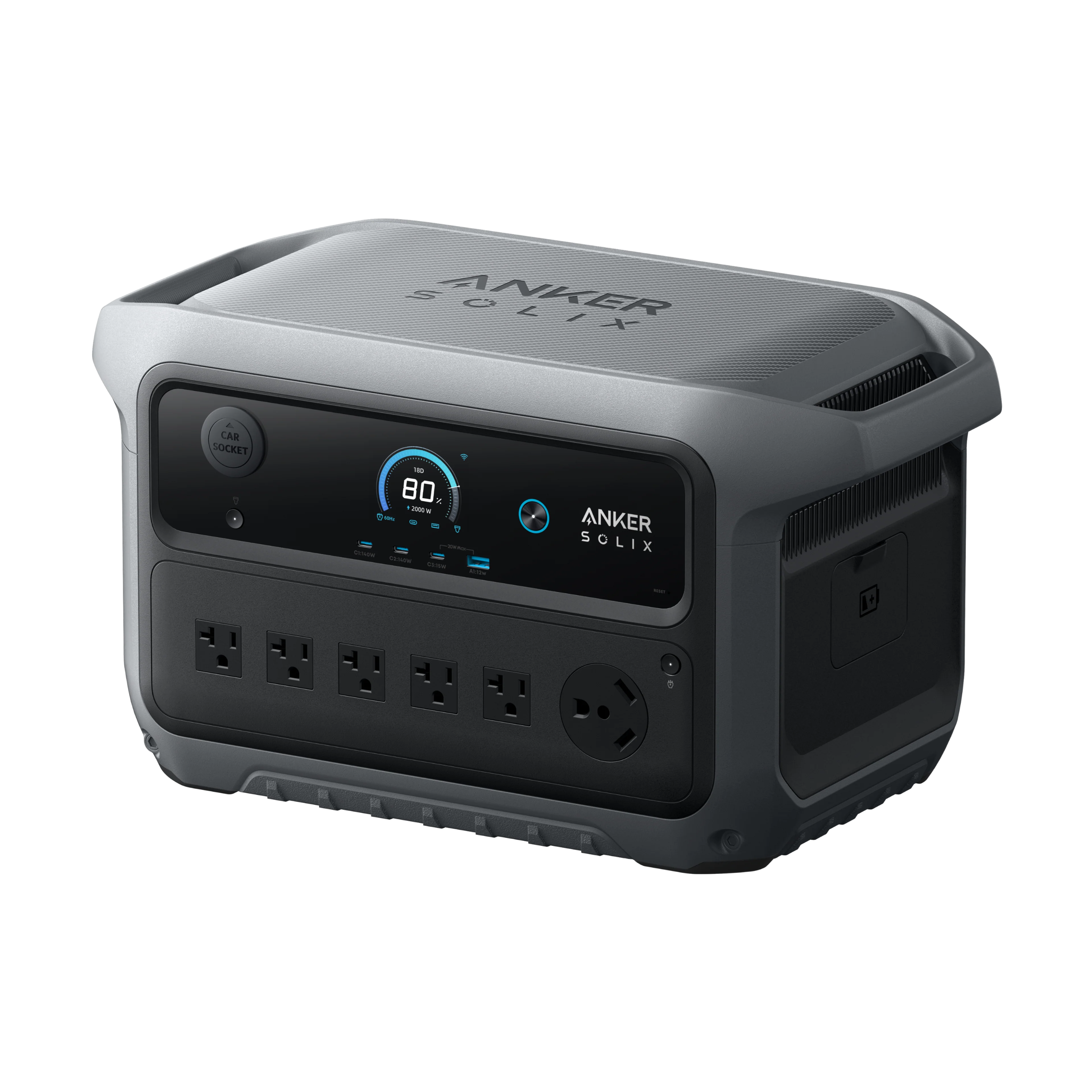
$999.99 · direct from Anker
Last checked 1 day ago. Prices move — check before you buy.
Spec deltas
The $399 between these two is the best-priced energy on the page. It buys 1,024Wh, which works out to $0.29 a watt-hour, and both units charge more than that for the capacity already inside them: $0.42 on the $1,399 EcoFlow, $0.49 on the $1,000 Anker. The cheaper box on the shelf is the expensive one per watt-hour.
That extra battery earns its keep exactly once, on the second night. Rated capacity is optimistic on both, because the inverter takes a cut and nobody runs a pack to zero. Call it 85% and the Ultra has about 2,611Wh to hand out while the C2000 Gen 2 has about 1,741Wh. An eight-hour blackout draws 1,645Wh. One of these ends it with a second evening still in the pack, and the other ends it empty.
The counter-argument weighs 30.4 lb. 41.7 lb is a lift you do without thinking about it first. 72.1 lb is two hands, bent knees, and a moment of planning. Solar input is 800W on both, so the bigger pack doesn't refill any faster. It just holds more between refills.
What the Numbers Reveal
Each conclusion stated first — the numbers behind it on one line, the full analysis below.
Capacity
Run the real loads through those figures and the Anker's shape shows up. It spends 94% of what it has getting through an eight-hour outage, and it doesn't finish a two-night camping trip at all. That's a single-event unit: one night, one outage, one trip, then it wants a wall. The Ultra ends the same outage having spent 63%, with a second evening still sitting in the pack.
DELTA 3 Ultra: 3,072Wh rated capacitySOLIX C2000 Gen 2: 2,048Wh rated capacity8-Hour Blackout profile draws 1,645Wh: Ultra at 63% of usable, C2000 Gen 2 at 94%Weekend Camping profile draws 2,100Wh: Ultra at 80%, C2000 Gen 2 at 121%
Why it mattersIf there's a recharge between events, the Anker's 1,741Wh is plenty. If the second night has to come out of the same charge, it isn't.
Typical price
Same 4,000-cycle rating and same 5-year warranty on both, so lifetime energy comes down to capacity alone: 12,288 kWh through the Ultra against 8,192 kWh through the Anker. Divide by what you paid and it's $0.11 per lifetime kWh against $0.12. The unit with the bigger sticker delivers the cheaper kilowatt-hour, and it keeps delivering it for 4,000 cycles.
DELTA 3 Ultra: $1,399SOLIX C2000 Gen 2: $1,000Capacity 3,072Wh against 2,048WhCost per watt-hour: $0.42 against $0.49
Why it mattersBuying on sticker price here means accepting a higher rate per watt-hour for the privilege of spending less today. Worth it when cash is the constraint. Worth knowing when it isn't.
Neither unit covers a full off-grid day on one charge anyway. A 4,685Wh day runs the Ultra to 179% of what it has and the Anker to 269%. So the number governing off-grid life isn't capacity, it's how much you can put back each day, and that's identical on both. The bigger pack buys you cloudy Tuesdays, not faster ones.
Both units cap solar input at 800WCapacity 3,072Wh against 2,048WhVan Life Daily profile needs 4,685Wh: Ultra at 179% of usable, C2000 Gen 2 at 269%, neither covers it
Why it mattersAnyone living off the panels daily should size the array first and treat the capacity difference as insurance against the days the array underperforms, not as a charging advantage.
continuous output
The inverter gap only cashes out above 2,400W continuous. Under that line you're hauling 30.4 lb of headroom the job never asks for, and headroom is free while weight gets charged to you on every trip.
DELTA 3 Ultra: 3,600W continuous, 7,200W surgeSOLIX C2000 Gen 2: 2,400W continuous, 4,000W surgeWeights: 72.1 lb against 41.7 lb
Why it mattersIf nothing you own pulls more than 2,400W continuously, the Anker's inverter is the right size and the weight you save costs you nothing.
The specific dimensions that decide these two units — everything else is a tie.
Runtime: Will It Power Your Gear?
Selected because: What the price gap actually buys is 1,024Wh, and that's the number every other question on this page reports to.
continuous output
The gap that decides this page isn't the one on the spec sheet. It's the 870Wh between 2,611Wh and 1,741Wh of genuinely available energy, and that's roughly half of everything the Anker holds. Inverter losses take their cut from both, and nobody drains a pack to zero, so the shortfall doesn't shrink. It just stops being abstract the moment you're two nights out with no wall.
The measured record backs the arithmetic rather than the marketing. A reviewer holding a steady 300W to 600W draw logged a little over 4.5 hoursA7. Another ran a full workday off it, laptop and desktop workstation and monitors, and shut everything down with 40% still showingA8. Both land where 2,611Wh of usable energy says they should, which is more than you can say for most runtime figures printed on a box.
Your Life, Your Pick
Selected because: Across six load profiles the Anker fails one outright and clears another at 94% of what it has. That's the capacity gap in the only form that matters.
Read the margins, not the win column. The Ultra takes four of the six profiles, CPAP Overnight goes to both, and Van Life Daily goes to neither. Tailgate Party and Remote Workday sit at 26% and 35% for the Ultra against 38% and 52% for the Anker, which is two comfortable units and one of them carrying a battery it never touches. Weekend Camping at 2,100Wh is where that stops. The Anker doesn't finish it.
The eight-hour blackout is the one worth staring at, because it looks like a pass. The Anker clears it having spent 94% of what it has. That's a pass in the table and a rough night in the house, because an outage that overruns its forecast, or a second one the next evening, has nothing to draw on. The Ultra ends the same eight hours at 63%. Both switch over in 10ms, so neither drops a desktop or a modem on the way in. The entire difference is what's left on the way out.
Portability & Form Factor
Selected because: One of these you pick up and the other you position. 30.4 lb is the strongest card the Anker holds.
weight
One of these is luggage and the other is furniture. 41.7 lb comes out of a trunk, over a tailgate, down to a dock, without anyone making a plan about it. 72.1 lb is two hands and bent knees, or two people, or a spot on the garage floor that it gets introduced to once and never leaves.
So the question isn't which is lighter. It's how often the thing moves. A utility-closet install for outage backup notices 72.1 lb on installation day and never again. A unit that rides to a campsite most weekends notices the difference in both directions, every trip, usually while you're carrying something else too. Reviewers found the C2000 Gen 2 markedly easier to handle for its capacity than the unit it replacesB5.
Lifetime Value
Selected because: $1,399 against $1,000 inverts the moment you divide by capacity: $0.11 a lifetime kWh against $0.12.
cost / lifetime kWh
Spending more to pay less is counterintuitive on a shelf and obvious on a spreadsheet. Both packs are rated 4,000 cycles under 5-year warranties, so the only variable in lifetime energy is capacity: 12,288 kWh through the Ultra, 8,192 kWh through the Anker. Divide each by its price and you get $0.11 a lifetime kWh against $0.12.
Here's the version that favours the Anker, and it's a fair one. Cost per warranty year runs $260 for the Ultra against $200 for the C2000 Gen 2, because you're financing more battery across the same five years of coverage. Run the cells toward 4,000 cycles and the lifetime figure governs. Replace the station in a few years because the category moved or your needs changed, and the warranty-year figure is the honest one. Be honest with yourself about which of those buyers you are.
Growth Path
Selected because: The Anker takes expansion batteries and the Ultra doesn't, which sounds decisive until you count what the first battery spends catching up.
The Ultra is sealed. What you buy is what it holds, and next to that the Anker's expansion port reads like a trump card until you count where it starts. It's 1,024Wh down out of the box, so the first battery you bolt on is largely spent reaching a number the Ultra shipped with. You only get ahead past 3,072Wh, and if that's where you're headed, neither of these is the right place to begin.
There's a second bill that never shows on a spec sheet. The expanded Anker isn't a 41.7 lb unit one person picks up any more, and that was the whole reason to prefer it. The configuration that finally beats the Ultra on capacity surrenders the thing the Anker was winning, and surrenders it before it's even caught up. Fixed capacity is a limitation when the fixed number is small. At 3,072Wh it's just a finished product.
Strengths & trade-offs
EcoFlow DELTA 3 Ultra
Strengths
- +Larger battery capacity
- +Higher AC output
Trade-offs
- –Substantially more expensive (+$399) than the SOLIX C2000 Gen 2.
- –Significantly heavier (+30.4 lbs), making it harder to move.
Anker SOLIX C2000 Gen 2
Strengths
- +Costs $399 less
- +Lighter by 30.4 lb
Trade-offs
- –Weaker inverter (-1,200W) limits appliance compatibility.
Will It Power Your Gear?
Scenario math and per-appliance runtimes, modeled from the spec record.
Scenario verdicts
We ran the math on six real-world scenarios. Here's which unit survives your actual life.
SCN-01 · 2 nights · needs 2,100Wh
Weekend Camping
Two nights off-grid with essential comfort
DELTA 3 Ultra
Two nights at 2,100Wh is where these two separate. The Ultra covers it having spent 80% of what it has, with a morning still in reserve. The C2000 Gen 2's 2,048Wh works out to roughly 1,741Wh you can actually use, which puts the same trip at 121%. It doesn't finish, and no amount of load discipline argues with that. Bring a panel and recharge on day two and the Anker is fine. Without one, this weekend belongs to the Ultra outright.
Battery budget usedlower = more headroom
LOAD Phone Charger 15W×6h · LED Lights 40W×8h · Box Fan 75W×14h · CPAP Machine 40W×16h
SCN-02 · 8 hours · needs 1,645Wh
8-Hour Blackout
Keep the essentials running through a night without power
DELTA 3 Ultra
Both units get through it. What separates them is what's left afterwards. Drawing 1,645Wh, the Ultra spends 63% of its usable energy and the C2000 Gen 2 spends 94%, which means nothing in hand if the outage overruns its forecast or repeats the next evening. Switchover is 10ms on both, so neither will drop a desktop or a modem when the lights go. Judge this one on reserve, not on pass or fail.
Battery budget usedlower = more headroom
LOAD Fridge 150W×8h · Router + Modem 20W×8h · LED Lights (4 bulbs) 40W×6h · Phone Charger 15W×3h
SCN-03 · 8 hours · needs 320Wh
CPAP Overnight
Sleep therapy without interruption — the #1 medical use case
Either unit
Both handle this one and neither breaks a sweat: 320Wh a night is 12% of the Ultra's usable energy and 18% of the C2000 Gen 2's, both are rated 30 dBA, and both switch over in 10ms. Those last two are the specs that count when the unit is sitting a couple of feet from your head at 3 a.m. So break the dead heat on the things that aren't tied. At 320Wh a night, that's roughly eight nights out of the Ultra's ~2,611Wh against about five out of the Anker's ~1,741Wh, and 41.7 lb you can move to a bedside yourself against 72.1 lb you can't.
Battery budget usedlower = more headroom
LOAD CPAP Machine 40W×8h
SCN-04 · 8 hours · needs 910Wh
Remote Workday
Full work day off-grid without power anxiety
DELTA 3 Ultra
The DELTA 3 Ultra clears the workday at 35% used, banking 1,701Wh — late work, extra calls, or a second laptop charge without arithmetic. The SOLIX C2000 Gen 2 at 52% also finishes, with 831Wh of slack for the unplanned.
Battery budget usedlower = more headroom
LOAD Laptop 60W×8h · External Monitor 30W×8h · Router + Modem 20W×8h · Phone Charger 15W×2h
SCN-05 · 4 hours · needs 670Wh
Tailgate Party
Game day power for the crew
DELTA 3 Ultra
Both handle game day; the DELTA 3 Ultra keeps more in reserve (26% used vs 38%). Tailgating is a light load, though, so the number you'll feel is weight: 41.7 lbs for the SOLIX C2000 Gen 2 against 72.1 lbs for the DELTA 3 Ultra, from the trunk to the setup spot.
Battery budget usedlower = more headroom
LOAD Blender 400W×0.5h · LED TV (55") 80W×4h · Bluetooth Speaker 15W×4h · Phone Charger (×3) 45W×2h
SCN-06 · 24 hours · needs 4,685Wh
Van Life Daily
A full day of mobile living — the ultimate endurance test
Neither unit
Neither unit covers this one, and it isn't close. A 4,685Wh day runs the Ultra to 179% of its usable energy and the C2000 Gen 2 to 269%. These are overnight packs being asked to do a small house's daily work. Both cap solar at 800W, so you can't charge your way out of the deficit either. Full-time van power wants a system sized to the daily load and installed once, not a portable station pressed into a job it was never shaped for.
Battery budget usedlower = more headroom
LOAD Mini-Fridge 150W×24h · Laptop 60W×4h · Phone Charger 15W×3h · LED Lights 40W×5h · Fan 75W×8h
The Load Test
RUNTIME = (Wh × 0.85) ÷ LOAD
None of the scenarios above exactly yours? Build it. Toggle what you'd plug in; both units are tested against the combined draw.
Essentials
Comfort & Convenience
High-Draw Appliances
Test duration
8h
Continuous draw
205W
Projected runtime
For this load: DELTA 3 Ultra runs 12.7h vs 8.5h.
$1,399 list · direct from EcoFlow
Modeled from the spec record — same math as the tables below. Methodology
Runtime by appliance
Real-world runtime estimates for common appliances, modeled at 85% inverter efficiency.¹
Essentials
The basics you need runningscale 0–174.1hComfort & Convenience
Makes off-grid life actually enjoyablescale 0–34.8hHigh-Draw Appliances
These reveal the real limitsscale 0–2.6h¹ Runtime = (capacity × 0.85) ÷ appliance watts. Within each group, all bars share one time scale (the group's longest runtime), so lengths are comparable across appliances; identical runtimes collapse into a single blue/orange bar. Actual runtime varies with battery age, temperature, and simultaneous loads — see methodology.
Conclusion
August 2, 2026
Verdict: the DELTA 3 Ultra, on Power Score margin
Pay $399 more and you get 1,024Wh more battery, which is cheaper per watt-hour than the capacity already sitting inside either unit. That's what buys the difference between ending an eight-hour outage with a second evening still in the pack and ending it empty, and between finishing a two-night camping weekend and not finishing it. Both run 4,000-cycle cells under 5-year warranties, so the bigger box also delivers the cheaper kilowatt-hour over its life, $0.11 against $0.12. The Anker's answer is 41.7 lb against 72.1 lb, and it's a real answer rather than a consolation prize: if the unit moves more than a few times a year, the weight gap decides this and capacity is a footnote. Buy the Ultra if it's going to live in one place and cover more than one night. Buy the C2000 Gen 2 if you're the one lifting it.
Editor-assigned confidence, based on cited owner research and spec analysis.
List prices as of August 2, 2026. The links below open EcoFlow's and Anker's current prices.
$1,399.00 · direct from EcoFlow
Last checked 1 day ago. Prices move — check before you buy.
or check the SOLIX C2000 Gen 2 price$999.99 list
Written by Gunner Gustafson, Whole-Home Backup Tester · Station Arena Test Desk · Updated August 2, 2026
Measured Data
Benchmark scores and the full spec record, side by side.
Benchmark scores
Not rated for both units (minimum threshold unmet): CPAP, Apartment Balcony, Camping.
Full specifications
ᵈ Derived: price ÷ rated capacity. See the data behind our comparisons →
Comparison ToolAdd more power stations, side by sideOpen Tool →How these numbers are produced
Numeric verification
Every figure on this page traces to our spec database or arithmetic on it — no estimated numbers.
Owner claims
Statements about owner experience are cited to published reviews — see Sources & Research Notes below.
Runtime model
Runtime = (rated capacity × 0.85 inverter efficiency) ÷ device wattage. Solar recharge estimates assume panels deliver 70% of rated output. Cold weather, battery age, and stacked loads reduce real-world results.
Power Score
Computed from 14 published spec dimensions, weighted per use-case bench. Higher is better; a unit must meet a bench's minimum threshold to be rated.
See the full weight table and data sourcing on our methodology page →Class ranking (the star rating)
Each unit's star score is a category ranking, not customer reviews — no buyer opinions feed it. We score every station on size-independent quality (value, output, portability, endurance, ports, warranty, and more), then percentile-rank it against the other units in its capacity class, so a class-leading compact unit and a class-leading whole-home unit can both earn 5★. Here, DELTA 3 Ultra rates 4.7/5 (80th percentile of 26 Large-class units), and SOLIX C2000 Gen 2 rates 4.1/5 (48th percentile of 26 Large-class units).
How the class ranking is computed →Test Notes & Caveats
Hidden gotchas and advantages we spotted that you won't find on the product page.
72.1 lb Is a Siting Decision, Not a Carrying One
The Ultra weighs 72.1 lb. The C2000 Gen 2 weighs 41.7 lb. That's the difference between a unit one adult moves on impulse and a unit that gets a considered spot on the garage floor and keeps it. Neither figure disqualifies anything on its own; together they tell you which of these you're actually shopping for. Work out how often the thing has to move before you decide how much capacity you want.
Fixed at 3,072Wh, and Why That Isn't the Con It Looks Like
The Ultra has no expansion port. What it holds is what it will always hold, and that's a genuine weakness next to a C2000 Gen 2 that takes add-on batteries. Then count where the Anker starts. It's 1,024Wh down out of the box, so the first battery you bolt on is largely spent reaching a number the Ultra shipped with, and the unit that comes out the other side is no longer the 41.7 lb one you could pick up. Growing capacity here only pays past 3,072Wh, and at that point neither of these is the right starting point.
Twice Its Own Rating, Against 1.67x
The Ultra's 7,200W surge is exactly double its 3,600W continuous rating. The C2000 Gen 2's 4,000W over 2,400W works out to about 1.67 times. A high ratio is a reasonable proxy for inverter quality and this one favours the Ultra, but be honest about when it cashes out: across all six load profiles here, both units start the peak. This is insurance against the well pump or compressor you buy next year, not something you'll notice next weekend.
Same 5 Years, Same 4,000 Cycles, Different Price Per Year
Warranty terms are identical, five years and 4,000 rated cycles on both, so the only thing that differs is what you paid for the coverage: $260 per warranty year on the Ultra against $200 on the C2000 Gen 2. You're financing more battery across the same span. Spread over the cells' rated life the Ultra still delivers the cheaper kilowatt-hour, $0.11 against $0.12. The warranty-year figure only wins the argument if you plan to be done with the station well before 4,000 cycles.
Full record above — the Test Desk pick is the DELTA 3 Ultra.
Check DELTA 3 Ultra price →or check the SOLIX C2000 Gen 2 priceOwnership Analysis
What happens after you buy — true cost of ownership, brand trust, and growth potential.
Lifetime value
Service lifeyears at one full cycle per day
Lifetime energy delivered
Cost per delivered kWh
│ warranty ends · Reaching the cycle rating means ~80% capacity remains — degraded, not dead.
Analyst note
The SOLIX C2000 Gen 2 is cheaper to buy, but the DELTA 3 Ultra is cheaper to own. At $0.11/kWh over its lifetime vs $0.12/kWh, the DELTA 3 Ultra's higher cycle life and capacity make each dollar go further over the years. One thing to know reading the table: both carry the same 4,000-cycle rating, so the lifetime rows are sticker price and capacity in disguise — the wear horizon is identical and decides nothing here.
Brand trust
EcoFlow
Ecosystem
Largest in portable power — 12-15 models across DELTA Pro, DELTA 3, and RIVER 3 series, plus solar panels and smart home panels
Support
US-based phone, email, and chat, with a record that's genuinely split rather than good or bad. Prepaid-label replacements handled without argument on one side; long waits and refurbished units sent against claims on new hardware on the other. There's no parts supply or paid service once the warranty's out, either. Buying through a retailer with its own returns desk, Costco or Amazon, puts a second net under the manufacturer's, which is worth the extra minute at checkout on a box this size.
Community
Largest community in the space — Reddit r/Ecoflow_community (~31K members), multiple Facebook groups, and an official community forum
App experience
Rated 4.6/5 iOS (~8,400 ratings) · 4.2/5 Android (~17,000 ratings)
Unique strength
Fastest-charging technology (X-Stream), deepest product ecosystem, and most active innovation cadence. At the very top of the range, the DELTA Pro Ultra platform stacks batteries and inverters into whole-home backup — a flagship path, not a line-wide feature.
Worth knowing
Tested subscription paywalls for advanced app features in early 2025 before community backlash paused the plan. No parts or service offered out of warranty.
Anker
Ecosystem
7-8 SOLIX portable power stations across C-series (compact) and F-series (flagship), plus the X1 home energy system
Support
Anker built its name on no-hassle replacements, and the SOLIX line is spending that credit rather than adding to it. First-line support leans on AI agents returning generic answers, and sending a station this heavy back means hazmat shipping rather than a padded envelope. Still a safer bet than most of the category. The trend line just points the wrong way, and it's better to know that now than during a claim.
Community
Moderate — active Reddit (r/Anker, r/AnkerSOLIXCommunity) and growing. Benefits from Anker's massive consumer electronics brand awareness.
App experience
Rated 4.5/5 iOS (~1,100 ratings) · 4.3/5 Android
Unique strength
Parent brand trust from Anker's consumer electronics dominance. InfiniPower technology for long cycle life. Strong $/Wh value in the mid-size and larger units — the S2000, F2600 and C1000 are among the better buys per watt-hour in the catalog.
Worth knowing
Support quality appears to be declining from its historically excellent level. Firmware updates have removed features without warning. Expansion ecosystem is smaller than EcoFlow's.
Analyst note
Two support stories heading in opposite directions from their reputations. EcoFlow's is inconsistent but sits behind the deepest ecosystem and the largest owner community in portable power, which means the answer is often findable without opening a ticket at all. Anker's is coasting on a consumer-electronics track record its power-station division isn't clearly earning, with a smaller expansion ecosystem behind it. Neither should change your pick between these two. The hedge is the same either way: buy from a retailer with its own returns policy, because these are heavy boxes and you don't want a warranty claim to depend on you arranging freight.
Growth path
DELTA 3 Ultra
FIXED CAPACITYFixed at 3,072Wh — a sealed, complete system rather than a starting point. There's no expansion port, so that figure is the ceiling: check it against your longest unplugged stretch before you buy.
Accepts up to 800W of solar. Suitable for a 1-2 panel setup.
Generous port selection supports complex multi-device setups.
SOLIX C2000 Gen 2
EXPANDABLESupports Anker expansion batteries, so you can add capacity later without replacing the base unit — useful if your needs may climb past 2,048Wh.
Accepts up to 800W of solar. Suitable for a 1-2 panel setup.
Generous port selection supports complex multi-device setups.
Expansion batteries are Anker-specific. You're investing in the Anker ecosystem.
Realistic full solar rechargeat 70% of rated panel output — see methodology
Analyst note
Don't read the SOLIX C2000 Gen 2's expandability as a straight win here: it starts at 2,048Wh, below the DELTA 3 Ultra's 3,072Wh, so a first expansion battery largely buys back capacity the DELTA 3 Ultra already includes. It only pulls ahead if you'd grow past 3,072Wh — short of that, the DELTA 3 Ultra's larger fixed capacity is the simpler value.
What Owners Report
Patterns from published owner reports and long-term reviews — every claim cited to its source below.
EcoFlow DELTA 3 Ultra
The field record here is bench work, not long service. What exists comes from reviewers running structured tests rather than owners three winters inA1A7A9, so weigh it accordingly. Inside that limit it's consistent. Fans stay unobtrusive even with the inverter pushed hardA1A2, and the build reads as substantial rather than cost-engineered, down to the rear port doors that slide into their own protective slotsA9A15.
UPS behaviour is the strongest thread in the set. Reviewers describe the changeover behaving like a dedicated APC-style backup, with no dip and no shutdown when wall power is pulledA5A6, and note that the unit doesn't clamp its output down to whatever it happens to be drawing on input, which plenty of stations doA4. Two smaller flags before you buy. The 30A port looks like the first output dropped when the unit is overloadedA3, and the screen washes out in direct sun badly enough that you'll cup a hand over it to read anythingA11.
“Even when you're pushing it hard, the DELTA 3 Ultra Plus runs much quieter than older EcoFlow models, like the DELTA 2 Max.”
Sources
thesolarlab.com · postperspective.com · appleinsider.com · digitaltrends.com · popsci.com
Anker SOLIX C2000 Gen 2
Coverage of the C2000 Gen 2 is broad and unusually consistent, and it's all hands-on review work rather than multi-season ownership, with no long-term reports surfaced yetB1B2B4. On noise, reviewers rate it quieter at full power than any other high-output Anker station they'd tested, with fans reaching only around 35 dB at a metre under heavy loadB1. Worth holding that against the 30 dBA both units print on their spec sheets.
The other repeated note is that it's boring, in the best available sense. No firmware ritual, no odd voltage behaviour, turn it on and plug inB2. The Solix app gets treated as a useful way to watch the unit over Bluetooth or Wi-Fi rather than a step you're required to completeB3. One reviewer's summary, few points of criticism and among the more attractive 2 kWh stations on the market, is representative of the whole set rather than an outlierB4.
“Even at full power it's far quieter than any other powerful Anker station tested — the fans never rise above a subdued, easily-backgrounded whirr, working largely silently and only occasionally reaching a pleasantly quiet ~35 dB at 1 m under high load.”
Sources
notebookcheck.net · thesolarlab.com · trustedreviews.com · androidguys.com
Sources & Research Notes
Every owner claim in this report is traceable to a published source. The bracketed references above resolve here.
Recurring owner themes
- Reviewers consistently praise the quiet fan operation of the Ultra-tier unit compared to older EcoFlow models, though this is described in professional test conditions rather than long-term ownership. [DELTA 3 Ultra · 2 entries]
- UPS/switchover performance is repeatedly called seamless with no observed dips or shutdowns during power interruption tests. [DELTA 3 Ultra · 3 entries]
- The unit's substantial 74 lb weight is flagged across multiple reviews as a portability drawback, mitigated somewhat by wheels and handle design. [DELTA 3 Ultra · 2 entries]
- Build quality/durability (casing, cable, port covers) is repeatedly highlighted as premium and well-engineered. [DELTA 3 Ultra · 2 entries]
- Reviewers consistently praise quiet operation, fast charging, premium build, and no-fuss plug-and-play simplicity. [SOLIX C2000 Gen 2 · 3 entries]
- A1
“Even when you're pushing it hard, the DELTA 3 Ultra Plus runs much quieter than older EcoFlow models, like the DELTA 2 Max.”
thesolarlab.com — EcoFlow DELTA 3 Ultra Plus Review: The Ultimate DELTA? · 2025-09/10 (approx) · [positive]
- A2
“Even when you're pushing the inverter to its maximum output, the fans never become annoying or distracting.”
thesolarlab.com — EcoFlow DELTA 3 Ultra Plus Review: The Ultimate DELTA? · 2025-09/10 (approx) · [positive]
- A3
“One weird thing we noticed was the fact that the unit always seems to shut down the 30A port first when you overload the unit.”
thesolarlab.com — EcoFlow DELTA 3 Ultra Plus Review: The Ultimate DELTA? · 2025-09/10 (approx) · [mixed]
- A4
“Many power stations limit you to the input wattage when outputting power, but this EcoFlow power station does not.”
thesolarlab.com — EcoFlow DELTA 3 Ultra Plus Review: The Ultimate DELTA? · 2025-09/10 (approx) · [positive]
- A5
“Over my career I have become accustomed to APC batteries immediately switching on when there is a power hit or power shut-off, and the EcoFlow Delta 3 Ultra Plus works in the exact same way.”
postperspective.com — Review: EcoFlow Delta 3 Ultra Plus Portable Power Station · 2026-04 · [positive]
- A6
“I didn't experience any shut-offs or dips when I unplugged the EcoFlow from the wall.”
postperspective.com — Review: EcoFlow Delta 3 Ultra Plus Portable Power Station · 2026-04 · [positive]
- A7
“Using Maxon's Cinebench 2026 GPU benchmark, I was pulling between 300W and 600W on one of the AC outputs... the EcoFlow Delta 3 Ultra Plus would last a little over 4.5 hours.”
postperspective.com — Review: EcoFlow Delta 3 Ultra Plus Portable Power Station · 2026-04 · [positive]
- A8
“I was able to work remotely for an eight-hour day with 40% power left, which included running my laptop, desktop workstation and monitors.”
postperspective.com — Review: EcoFlow Delta 3 Ultra Plus Portable Power Station · 2026-04 · [positive]
- A9
“It does not feel cheap or fragile. Everything from the outer shell case to the plastic buttons and the AC cable feels substantial and durable enough to withstand day-to-day wear and tear.”
appleinsider.com — EcoFlow Delta 3 Ultra Plus review: Premium, but solid power · 2025-11-16 · [positive]
- A11
“But, while facing the sun, I had to employ the classic "cup hands cover" maneuver to get a clear look at the screen status.”
appleinsider.com — EcoFlow Delta 3 Ultra Plus review: Premium, but solid power · 2025-11-16 · [negative]
- A15
“I really love how the rear panel doors for the input ports slide into protective slots when in use.”
popsci.com — EcoFlow DELTA 3 portable power station series first impressions · 2025-09-29 · [positive]
- B1
“Even at full power it's far quieter than any other powerful Anker station tested — the fans never rise above a subdued, easily-backgrounded whirr, working largely silently and only occasionally reaching a pleasantly quiet ~35 dB at 1 m under high load.”
notebookcheck.net / thesolarlab.com — Anker SOLIX C2000 Gen 2 review · 2026 · [positive]
- B2
“Really simple to use — no need to download firmware or deal with weird voltage drops; you just turn it on, plug in, and go. Rapid charging and premium build.”
trustedreviews.com / thesolarlab.com — Anker SOLIX C2000 Gen 2 review · 2026 · [positive]
- B3
“The Anker Solix app is a good way to monitor the station during charging and use over Bluetooth or Wi-Fi; reviewers appreciated the monitoring functionality.”
androidguys.com — Anker SOLIX C2000 Gen 2 review · 2026 · [positive]
- B4
“Delivers a convincing performance with few points of criticism — undoubtedly one of the most attractive 2 kWh power stations on the market.”
notebookcheck.net — Anker SOLIX C2000 Gen 2 review · 2026 · [positive]
- B5
“Substantially lighter than its predecessor — the Gen 2 shed a large amount of weight versus the original C2000, making it notably easier to carry for its capacity.”
notebookcheck.net — '11.6 kg lighter than its predecessor' review · 2026 · [positive]
Research compiled August 2, 2026.
Who Should Buy Which
Buy the DELTA 3 Ultra if you…
- →Two nights and 2,100Wh with no wall in between. The Ultra finishes that weekend. The Anker doesn't.
- →It's going in the garage, the utility closet, or the RV bay, and the job is outage backup. Weight is a one-time tax when nothing ever moves it, and what you're paying for is the part of the outage that runs long.
- →Something in your house pulls more than 2,400W continuously. The Ultra's 3,600W rating with 7,200W behind it is the only inverter here that covers it.
- →You keep things until they die. Across 4,000 cycles on identical warranty terms, the Ultra delivers the cheaper kilowatt-hour.
Buy the SOLIX C2000 Gen 2 if you…
- →You're the one carrying it, more than a few times a year. That's the whole argument, and it's a good one.
- →Your pattern is one night, one outage, one trip, then a recharge. 1,741Wh covers a single event cleanly, and 800W of solar puts it back in about 2.5 hours of full-rate sun.
- →You charge devices more than you run appliances. 140W over USB-C beats the Ultra's 100W, and a desk full of laptops and phones never comes near the inverter ceiling.
- →The $399 matters more this month than 1,024Wh does. That's a cash-flow argument and a legitimate one. It just isn't a value-per-watt-hour argument.
If neither fits
If your day looks like the Van Life Daily profile at 4,685Wh, close this tab cheerfully and shop a category up. That load runs the Ultra to 179% of what it has and the Anker to 269%, and no amount of load discipline closes a hole that size. You can't charge your way out of it either, because 800W is the ceiling on both. What you want is at least about 5,500Wh of usable energy (4,685 divided by 0.85), or a properly installed house battery with its own array and charge controller, rather than a portable station doing a fixed installation's job.
The Bottom Line
The Ultra wins this, for a narrower reason than the spec sheet suggests. It isn't the inverter, because both units start every peak load we model. It isn't solar, which is 800W on both and therefore a wash. It's that the price gap buys the cheapest watt-hours anywhere in this comparison, and those watt-hours turn an eight-hour outage from a finish on empty into a finish with a second evening in hand, and a two-night camping weekend from a shortfall into a comfortable pass. Over 4,000 cycles that same capacity makes the more expensive box the cheaper kilowatt-hour.
The Anker's case is that you can pick it up, and it's strong enough to flip this for a whole category of buyer. If the unit rides to a campsite most weekends, you're paying that weight difference on every trip for capacity you only occasionally need, and 1,741Wh covers a single night without complaining. If it's going to sit in a garage waiting for the grid to fail, the weight stops mattering the moment it's in place, and the Ultra is the bigger unit, the cheaper one to own, and the one still holding something when the lights stay off past dinner. Most people reading this are the second buyer. Go get the Ultra.
Frequently Asked Questions
Answers drawn from the spec record and cited owner research.
Is the EcoFlow DELTA 3 Ultra worth $399 more than the Anker SOLIX C2000 Gen 2?
On capacity, yes. That $399 buys 1,024Wh, which is $0.29 a watt-hour, cheaper than the rate either unit charges for the capacity already inside it. The reason to say no isn't the money, it's the 30.4 lb attached to it. Work out how often the thing has to move and the price question answers itself.
Can the Anker SOLIX C2000 Gen 2 handle a full weekend of camping?
Not two nights, no. That profile draws 2,100Wh and the Anker has about 1,741Wh to give once you account for the roughly 85% of a pack that's genuinely usable, which puts the trip at 121% of what's there. The Ultra covers the same weekend at 80%. One night, or a weekend with a solar recharge in the middle, is a different question entirely, and the Anker handles that comfortably.
Which one is better for a power outage?
The Ultra, and the margin shows up in the back half of the outage rather than the front. Both switch over in 10ms, so neither will drop a desktop, a router, or a sump pump controller. But an eight-hour outage drawing 1,645Wh leaves the Ultra having spent 63% and the Anker 94%. One of those has a second evening in it and the other doesn't. If outages where you live routinely run past eight hours or arrive in pairs, that reserve is the whole decision.
Does the SOLIX C2000 Gen 2's expandability make it the better long-term buy?
Only if you'd genuinely climb past 3,072Wh. The Anker starts 1,024Wh below the Ultra, so its first add-on battery mostly buys back capacity the Ultra already includes, and it costs the Anker the one-person 41.7 lb lift that was its best feature. The Ultra is fixed at 3,072Wh, and at this size that's a stopping point most buyers were going to reach anyway rather than a wall they run into.
How fast does each one recharge from solar?
Both cap solar input at 800W, so refill time just tracks capacity: about 4 hours at full rate for the Ultra, about 2.5 hours for the Anker. Full-rate hours aren't daylight hours, though. Panel angle, temperature, and cloud all eat into that, so treat both as floors rather than schedules. Because the ceiling is identical, the bigger pack isn't slower to live with day to day. It just carries you further between refills.
Where to buy
EcoFlow DELTA 3 UltraPick
$1,399.00
$1,399.00 · direct from EcoFlow
Last checked 1 day ago. Prices move — check before you buy.
Anker SOLIX C2000 Gen 2
$999.99
$999.99 · direct from Anker
Last checked 1 day ago. Prices move — check before you buy.
Prices may vary by retailer and are subject to change.