Head-to-head test
EcoFlow DELTA 3 Plus vs Jackery Explorer 2000 Plus
If the box never has to leave the room it lives in, the Explorer 2000 Plus is both the bigger battery and the cheaper one to own; the DELTA 3 Plus's entire case is that you can pick it up with one hand.
Full profiles: EcoFlow DELTA 3 Plus → · Jackery Explorer 2000 Plus →

Written by Ian SchneiderUpdated
Solar & Off-Grid Tester, Station Arena Test Desk

$719.00 · direct from EcoFlow
Last checked 1 day ago. Prices move — check before you buy.
No longer sold
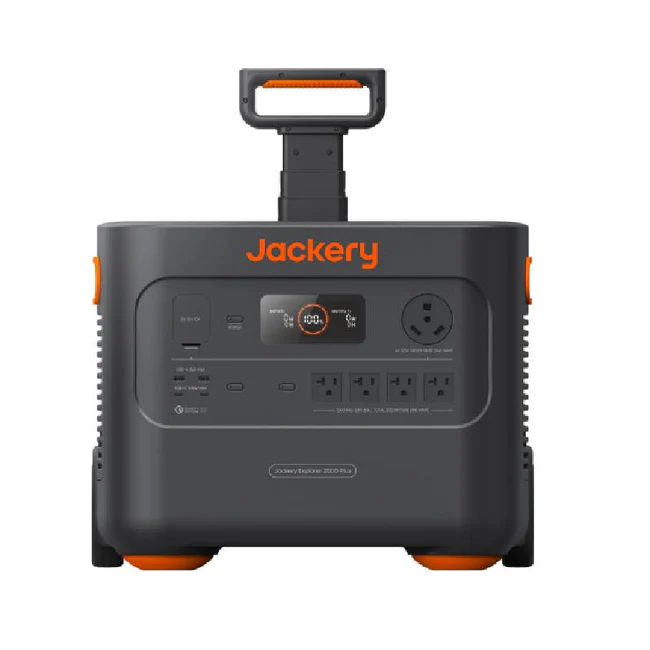
Jackery no longer sells the Explorer 2000 Plus as a standalone unit — the listing now carries only kits, the add-on battery and a refurbished unit. Its successor in the line is the HomePower 2000 Plus v2: the same 2 kWh class with a 2,400W inverter in the newer design.
HomePower 2000 Plus v2 · $1,199.00Spec deltas
Two hundred and ten dollars buys a second battery here. The Explorer 2000 Plus lists at $899 against the DELTA 3 Plus's $719, and for that gap you get 2,043Wh instead of 1,024Wh, a 3,000W inverter instead of 1,800W, and a 6,000W surge ceiling instead of 3,600W. On energy, this isn't a close comparison.
The bill arrives when you lift it. 61.5 lbs against 27 lbs isn't 'heavier,' it's a different category of object: one gets wheeled, the other gets carried, and reviewers who have moved the Jackery say stairs want a second pair of handsB3. Everything the Explorer wins, it wins from wherever you set it down.
So the real question is whether your unit has an address. Basement, hall closet, home office, a cabin that stays put: buy the Jackery and stop reading. Trunk, jobsite, third-floor walkup, anything you'll pick up more than a few times a season: the DELTA 3 Plus's 27 lbs is worth a thousand watt-hours to you, and that's a legitimate trade rather than a consolation prize.
What the Numbers Reveal
Each conclusion stated first — the numbers behind it on one line, the full analysis below.
The Explorer's 2,043Wh derates to about 1,736Wh, so it closes the same day with just under half its usable pack still there and could run tomorrow without seeing a wall socket. Forty watt-hours sounds like a rounding error. It's the last stretch of the afternoon, and it arrives at exactly the hour you can't stop working.
DELTA 3 Plus: 1,024Wh rated capacityExplorer 2000 Plus: 2,043Wh rated capacityThe remote workday scenario draws 910WhUsable energy runs about 85% of rated after inverter losses
Why it mattersIf you're buying a battery to run a full work setup off one charge, don't buy the 1,024Wh unit on the strength of its label.
The DELTA 3 Plus's clearest advantage over the Explorer is the one its documented flaw sits directly on top ofA1A2, and the repair reviewers expect is a firmware update that hasn't shippedA4. Meanwhile the Explorer's slower 20ms transfer is still fast enough for laptops, routers, TVs and CPAPs. The only gear that notices the difference between the two is a desktop or NAS with a marginal power supply.
DELTA 3 Plus switches over in 10ms; Explorer 2000 Plus in 20msBoth units are rated 30 dBAReviewers report the DELTA 3 Plus's fans run at low load and cycle on and off erratically, against near-silent marketingA1Reviewers say the erratic cycling also raises overheating risk under heavy load, and expect EcoFlow can fix it in firmwareA2A4
Why it mattersIf you want the DELTA 3 Plus specifically as a silent always-on desk UPS, buy it somewhere with a real return window and listen to the fans in week one.
continuous output
The Explorer doesn't only start those loads, it finishes the night with them, and barely: the blackout model leaves it at 5% of usable capacity. That's a win with nothing behind it. The DELTA 3 Plus needs 189% of its usable pack for the same eight hours, so an outage becomes a recharge problem for it well before it becomes a comfort problem.
Explorer 2000 Plus: 3,000W continuous, 6,000W surgeDELTA 3 Plus: 1,800W continuous, 3,600W surgeThe 8-hour blackout model needs 1,645Wh, which the Explorer covers using 95% of its usable capacity
Why it mattersOutage list with a well pump, a microwave or a space heater on it: the 1,800W unit is the wrong tool at any price. Outage list with a fridge, a router and phones on it: both finish, and price decides.
weight
Weight only decides between units that can both do the job. In the days these units actually win, the blackout and the workday, the box doesn't move at all, so the heavier one carries no penalty and the lighter one earns no credit. The weight argument is loudest exactly where the honest answer is buy panels or buy bigger.
Weekend Camping needs 2,100Wh and the model calls it for neither unitVan Life Daily needs 4,685Wh and the model calls it for neither unitExplorer 2000 Plus weighs 61.5 lbs; DELTA 3 Plus weighs 27 lbs
Why it mattersIf you're weighing 27 lbs against 61.5 lbs for a camping trip, you're solving the wrong problem: neither pack finishes that weekend alone, and solar is the fix, not the lighter box.
The specific dimensions that decide these two units — everything else is a tie.
Portability & Form Factor
Selected because: 27 lbs against 61.5 is the one spec here that can overrule everything else on the page.
weight
Thirty-four and a half pounds is the difference between a unit you sling into a trunk and one you plan a route for. The DELTA 3 Plus at 27 lbs is a one-hand, no-thought carry. The Explorer 2000 Plus at 61.5 lbs is a bent-knee, two-hand lift, and reviewers who have moved it say stairs want a second personB3. Jackery fitted wheels and a telescoping handle for a reason, and wheels solve flat ground and only flat ground.
The useful question isn't how heavy it is, it's how often you'll find out. A unit that lives in a hall closet and gets rolled to the kitchen during an outage weighs nothing in practice. A unit that goes in and out of a hatchback every other Friday weighs 61.5 lbs sixty times a year. Work out which of those two people you are, because the rest of this page assumes the first one.
Runtime: Will It Power Your Gear?
Selected because: 1,024Wh against 2,043Wh decides the two modeled days where only one of these units finishes.
continuous output
Rated capacity is the number on the box; usable capacity is the number your Friday night actually runs on. Apply the standard 85% derate for inverter losses and the DELTA 3 Plus's 1,024Wh becomes about 870Wh, while the Explorer's 2,043Wh becomes about 1,736Wh. That's the gap that matters, and it's almost exactly two to one.
Two to one is also the gap between a unit that finishes an ordinary day and one that doesn't. Nothing about the DELTA 3 Plus is slow or weak on its own terms. It's a 1,000Wh-class box being asked to do 2,000Wh-class work in half the situations people buy these for, and it loses those days by small, infuriating margins rather than large ones.
Lifetime Value
Selected because: Identical 4,000-cycle ratings mean the bigger pack delivers twice the lifetime energy for 30% more money.
cost / lifetime kWh
Both cells are rated for 4,000 cycles, which reduces lifetime cost to one line of arithmetic: price divided by cycles times capacity. The Explorer delivers about 8,171 kWh across its rated life for $899. The DELTA 3 Plus delivers about 4,096 kWh for $719. Eleven cents a kilowatt-hour against seventeen, and after you've read that once you don't need it again.
The only ownership metric the DELTA 3 Plus wins is cost per warranty year, $138 against $180, and it wins that by owning half as much battery. Judging these two on the sticker means reading the wrong number: per unit of energy delivered over its rated life, the $899 unit is the discount.
Your Life, Your Pick
Selected because: Four of the six modeled days go to the Explorer 2000 Plus and two go to neither unit, which is its own kind of answer.
The scoreboard reads four to nothing with two abstentions, and the abstentions are the interesting part. A 2,100Wh camping weekend and a 4,685Wh van-life day beat both units, which means the two situations where 61.5 lbs hurts most are the two where the lighter unit isn't a solution either. Weight only decides between units that can both do the job.
Where the Explorer's wins actually bite is indoors. It clears the 8-hour blackout model and a 910Wh remote workday, and the DELTA 3 Plus clears neither. Its other two wins, the CPAP night and the tailgate, are wins on headroom rather than on finishing, since both units get through those days with room left. Sort the four wins into those two piles and you can see what you're really buying: not a better afternoon, a longer night.
Brand Trust
Selected because: You're trading EcoFlow's much better app for Jackery's much wider return counter, and neither support desk is a selling point.
Neither support desk is a reason to buy. EcoFlow's outcomes are polarized, with prepaid replacement labels for some buyers and long waits and refurbished units for others. Jackery's are more consistently criticized: scripted replies, strict receipt requirements, refurbished replacements for units that failed new. The practical move with either brand is to buy from Costco or Amazon so the retailer's return window, and not the warranty department, is your first line of defense.
Where they genuinely differ is software and shelf space. EcoFlow's app rates 4.6 on iOS and 4.2 on Android; Jackery's sits between 2.3 and 3.3, split across two confusing apps and demanding a login even when you're standing next to the unit. Against that, Jackery is on the floor at Costco, Home Depot, Best Buy and Amazon, which is worth more during a warranty dispute than any number of stars. If you'll live in the app daily, that's a real point for the DELTA 3 Plus. It is not a point worth half the battery.
Strengths & trade-offs
EcoFlow DELTA 3 Plus
Strengths
- +Costs $180 less
- +Lighter by 34.5 lb
Trade-offs
- –Weaker inverter (-1,200W) limits appliance compatibility.
Jackery Explorer 2000 Plus
Strengths
- +Larger battery capacity
- +Higher AC output
- +Faster solar charging
Trade-offs
- –Significantly heavier (+34.5 lbs), making it harder to move.
Will It Power Your Gear?
Scenario math and per-appliance runtimes, modeled from the spec record.
Scenario verdicts
We ran the math on six real-world scenarios. Here's which unit survives your actual life.
SCN-01 · 2 nights · needs 2,100Wh
Weekend Camping
Two nights off-grid with essential comfort
Neither unit
Neither one finishes this weekend, and knowing that now beats discovering it on Saturday night. 2,100Wh is 121% of the Explorer 2000 Plus's usable capacity and 241% of the DELTA 3 Plus's, so the bigger unit gets closer without getting there. Bring panels or plan on a partial weekend, whichever box you pick.
Battery budget usedlower = more headroom
LOAD Phone Charger 15W×6h · LED Lights 40W×8h · Box Fan 75W×14h · CPAP Machine 40W×16h
SCN-02 · 8 hours · needs 1,645Wh
8-Hour Blackout
Keep the essentials running through a night without power
Explorer 2000 Plus
The Explorer 2000 Plus finishes the eight hours with about 5% of its usable capacity left, which is a win and a warning in the same breath. The DELTA 3 Plus needs 189% of its usable pack for the same night, so it would need recharging partway through the outage that caused the problem.
Battery budget usedlower = more headroom
LOAD Fridge 150W×8h · Router + Modem 20W×8h · LED Lights (4 bulbs) 40W×6h · Phone Charger 15W×3h
SCN-03 · 8 hours · needs 320Wh
CPAP Overnight
Sleep therapy without interruption — the #1 medical use case
Either unit
A 320Wh night takes 18% of the Explorer 2000 Plus's usable capacity and 37% of the DELTA 3 Plus's, which works out to five nights of runway against under three. Twenty milliseconds versus ten is a difference no CPAP will ever notice. Nights of runway in a multi-day outage is a difference you would.
Battery budget usedlower = more headroom
LOAD CPAP Machine 40W×8h
SCN-04 · 8 hours · needs 910Wh
Remote Workday
Full work day off-grid without power anxiety
Explorer 2000 Plus
This is the cruelest kind of miss. A 910Wh workday consumes 105% of the DELTA 3 Plus's usable capacity, a shortfall of five percent that arrives at the worst end of the day. The Explorer 2000 Plus closes the same day having spent 52% of its usable pack, with enough left to do tomorrow as well.
Battery budget usedlower = more headroom
LOAD Laptop 60W×8h · External Monitor 30W×8h · Router + Modem 20W×8h · Phone Charger 15W×2h
SCN-05 · 4 hours · needs 670Wh
Tailgate Party
Game day power for the crew
Explorer 2000 Plus
Both units run the tailgate comfortably, so this one goes to the Explorer 2000 Plus purely on headroom: 39% of its usable capacity against 77% of the DELTA 3 Plus's. The asterisk the scoreboard doesn't charge is the walk from the parking lot, where 61.5 lbs across gravel is its own kind of cost.
Battery budget usedlower = more headroom
LOAD Blender 400W×0.5h · LED TV (55") 80W×4h · Bluetooth Speaker 15W×4h · Phone Charger (×3) 45W×2h
SCN-06 · 24 hours · needs 4,685Wh
Van Life Daily
A full day of mobile living — the ultimate endurance test
Neither unit
Neither unit covers this scenario's 4,685Wh: the DELTA 3 Plus comes up 3,815Wh short (about 19% covered), the Explorer 2000 Plus 2,949Wh (37%). This is well outside what either unit is for; the right answer here is a larger station, not a choice between these two.
Battery budget usedlower = more headroom
LOAD Mini-Fridge 150W×24h · Laptop 60W×4h · Phone Charger 15W×3h · LED Lights 40W×5h · Fan 75W×8h
The Load Test
RUNTIME = (Wh × 0.85) ÷ LOAD
None of the scenarios above exactly yours? Build it. Toggle what you'd plug in; both units are tested against the combined draw.
Essentials
Comfort & Convenience
High-Draw Appliances
Test duration
8h
Continuous draw
205W
Projected runtime
For this load: Explorer 2000 Plus runs 8.5h vs 4.2h.
Modeled from the spec record — same math as the tables below. Methodology
Runtime by appliance
Real-world runtime estimates for common appliances, modeled at 85% inverter efficiency.¹
Essentials
The basics you need runningscale 0–115.8hComfort & Convenience
Makes off-grid life actually enjoyablescale 0–23.2hHigh-Draw Appliances
These reveal the real limitsscale 0–1.7h¹ Runtime = (capacity × 0.85) ÷ appliance watts. Within each group, all bars share one time scale (the group's longest runtime), so lengths are comparable across appliances; identical runtimes collapse into a single blue/orange bar. Actual runtime varies with battery age, temperature, and simultaneous loads — see methodology.
Conclusion
August 1, 2026
Verdict: the Explorer 2000 Plus, on Power Score margin
Buy the Explorer 2000 Plus unless you'll be carrying it. $899 against $719 buys twice the battery, an inverter that goes from 1,800W to 3,000W with a 6,000W surge ceiling instead of 3,600W, and a lower cost per kilowatt-hour across a life both units are rated to reach at 4,000 cycles. It takes four of the six modeled days and the two it doesn't take go to neither unit. The DELTA 3 Plus is not a bad box: it switches over faster, it has the better app behind it, and at 27 lbs it's the only one of the two you can get up a flight of stairs alone. That last point is the only one strong enough to overturn the rest, and for most buyers it never comes up.
Editor-assigned confidence, based on cited owner research and spec analysis.
List prices as of August 1, 2026. The links below open EcoFlow's and Jackery's current prices.
$899.00 · direct from Jackery
Last checked 21 days ago. Prices move — check before you buy.
or check the DELTA 3 Plus price$719.00 list
Written by Ian Schneider, Solar & Off-Grid Tester · Station Arena Test Desk · Updated August 1, 2026
Measured Data
Benchmark scores and the full spec record, side by side.
Benchmark scores
Not rated for both units (minimum threshold unmet): CPAP, Camping.
Full specifications
ᵈ Derived: price ÷ rated capacity. See the data behind our comparisons →
Comparison ToolAdd more power stations, side by sideOpen Tool →How these numbers are produced
Numeric verification
Every figure on this page traces to our spec database or arithmetic on it — no estimated numbers.
Owner claims
Statements about owner experience are cited to published reviews — see Sources & Research Notes below.
Runtime model
Runtime = (rated capacity × 0.85 inverter efficiency) ÷ device wattage. Solar recharge estimates assume panels deliver 70% of rated output. Cold weather, battery age, and stacked loads reduce real-world results.
Power Score
Computed from 14 published spec dimensions, weighted per use-case bench. Higher is better; a unit must meet a bench's minimum threshold to be rated.
See the full weight table and data sourcing on our methodology page →Class ranking (the star rating)
Each unit's star score is a category ranking, not customer reviews — no buyer opinions feed it. We score every station on size-independent quality (value, output, portability, endurance, ports, warranty, and more), then percentile-rank it against the other units in its capacity class, so a class-leading compact unit and a class-leading whole-home unit can both earn 5★. Here, DELTA 3 Plus rates 4.2/5 (54th percentile of 27 Everyday-class units), and Explorer 2000 Plus rates 4.5/5 (68th percentile of 26 Large-class units).
How the class ranking is computed →Test Notes & Caveats
Hidden gotchas and advantages we spotted that you won't find on the product page.
61.5 lbs: The Number That Can Overrule the Others
Wheels and a telescoping handle solve flat ground and nothing else. Stairs are a bent-knee, two-hand, ideally two-person job, and this is the one line item capable of overturning every other conclusion on this page. If the unit has a permanent home and moves twice a year, stop weighting it at all. If it rides in a trunk every other weekend, 27 lbs against 61.5 is the entire comparison.
10ms vs 20ms: One Device Actually Cares
Both transfer fast enough that a laptop, a router, a TV or a CPAP never notices the handoff. The gap opens for exactly one class of gear: a desktop PC or a NAS with a tight power supply, which can drop out in the window between the two. Protecting one of those is the single best reason to take the DELTA 3 Plus's line-interactive transfer. Everything else in the house is indifferent.
Same Five Years, Different Bill
Both units carry 5 years, so on terms the warranty column is a tie. The money isn't: $138 per covered year for the DELTA 3 Plus against $180 for the Explorer 2000 Plus. That $42 a year is the rent on 1,019Wh of additional battery, which is about as cheap as extra capacity gets.
Full record above — the Test Desk pick is the Explorer 2000 Plus.
Check Explorer 2000 Plus price →or check the DELTA 3 Plus priceOwnership Analysis
What happens after you buy — true cost of ownership, brand trust, and growth potential.
Lifetime value
Service lifeyears at one full cycle per day
Lifetime energy delivered
Cost per delivered kWh
│ warranty ends · Reaching the cycle rating means ~80% capacity remains — degraded, not dead.
Analyst note
The DELTA 3 Plus is cheaper to buy, but the Explorer 2000 Plus is cheaper to own. At $0.11/kWh over its lifetime vs $0.18/kWh, the Explorer 2000 Plus's higher cycle life and capacity make each dollar go further over the years. One thing to know reading the table: both carry the same 4,000-cycle rating, so the lifetime rows are sticker price and capacity in disguise — the wear horizon is identical and decides nothing here.
Brand trust
EcoFlow
Ecosystem
The deepest catalog in portable power, spanning DELTA Pro, DELTA 3 and RIVER 3 alongside panels and smart home panels, so the DELTA 3 Plus is a doorway rather than a dead end.
Support
US-based phone, email and chat, with genuinely polarized outcomes: prepaid replacement labels and quick turnarounds for some buyers, long waits and refurbished units sent against new claims for others. Buying through Costco or Amazon hands you a return counter that doesn't argue.
Community
The largest user base in the category, roughly 31,000 on the subreddit plus Facebook groups and an official forum. The practical benefit is dull and real: someone has already posted your problem.
App experience
Rated 4.6/5 iOS (~8,400 ratings) · 4.2/5 Android (~17,000 ratings)
Unique strength
X-Stream fast charging and the widest expansion ceiling anyone offers, up to 180kWh with the DELTA Pro Ultra X.
Worth knowing
EcoFlow recalled the DELTA Max 2000 in October 2025 over overheating and fire risk across six incidents, and floated subscription paywalls for advanced app features in early 2025 before community backlash paused the plan. Out of warranty there is no parts or service path at all.
Jackery
Ecosystem
Explorer portables and HomePower backup units plus the SolarSaga panel line, with the occasional genuinely odd form factor like the Solar Gazebo.
Support
US-based and the most criticized part of ownership: slow or dismissive replies, scripted AI agents, strict receipt requirements on warranty claims, and refurbished replacements for units that failed new. Buy it from Costco or Amazon and the retailer's return policy becomes your real warranty.
Community
The smallest forum presence of the major brands at roughly 2,000 on its subreddit, offset by heavy YouTube coverage that comes with the name recognition.
App experience
Rated 2.3-3.3/5 iOS and Android — the weakest app experience of the major brands. Multiple confusing apps (Jackery app vs Jackery Home) and mandatory login even offline.
Unique strength
Distribution. Costco, Home Depot, Best Buy and Amazon all stock it, which means you can put hands on one before buying and walk one back after.
Worth knowing
The app is the weakest of the majors at 2.3 to 3.3 stars, split across two confusing apps and demanding a login even offline. A few older Jackery models still ship NMC chemistry with a shorter rated life, so check the cycle rating on the exact unit you're buying; this one is rated 4,000 cycles.
Analyst note
EcoFlow gives you the better software and the deeper ecosystem. Jackery gives you a store you can drive to. Both support desks draw the same complaint, scripted replies and refurbished replacements, which is the argument for buying either one from a retailer with a no-questions return window rather than direct from the brand.
Growth path
DELTA 3 Plus
EXPANDABLESupports EcoFlow expansion batteries, so you can add capacity later without replacing the base unit — useful if your needs may climb past 1,024Wh.
Accepts up to 1,000W of solar. Enough for a serious multi-panel array.
Generous port selection supports complex multi-device setups.
Expansion batteries are EcoFlow-specific. You're investing in the EcoFlow ecosystem.
Explorer 2000 Plus
EXPANDABLESupports Jackery expansion batteries, so you can add capacity later without replacing the base unit — useful if your needs may climb past 2,043Wh.
Accepts up to 1,200W of solar. Enough for a serious multi-panel array.
Adequate ports for most setups, but heavy users may want a power strip.
Expansion batteries are Jackery-specific. You're investing in the Jackery ecosystem.
Realistic full solar rechargeat 70% of rated panel output — see methodology
Analyst note
Both expand, so neither locks you out of growth — decide on capacity, price, and the rest, not the expansion checkbox.
What Owners Report
Patterns from published owner reports and long-term reviews — every claim cited to its source below.
EcoFlow DELTA 3 Plus
Reviewer coverage of the DELTA 3 Plus keeps circling one thing: the fans. They come on under low load and cycle on and off erratically, which is a strange result for a unit marketed as near-silentA1, and at least one review argues that same erratic behavior means the fans aren't cooling properly when the load is heavyA2. Reviewers think EcoFlow can fix it in software, as it has done on other units after release, so this may be a dated complaint by the time you read itA4.
Everything else lands well. Reviewers describe very fast recharge times and a sub-10ms UPS switchover they call seamlessA3. The pattern here is narrow and specific rather than general: this is a well-built unit with one repeatedly-cited flaw sitting on the exact feature it markets hardest.
“Otherwise well-designed, with very fast recharge times and a seamless sub-10ms UPS switchover for uninterrupted power.”
Sources
thesolarlab.com
Jackery Explorer 2000 Plus
The Explorer 2000 Plus reads as the boring, dependable one. Reviewers call it easy to use and relatively quiet even under a 3,000W load, and note it will run anything from a CPAP machine to an electric grill without complaintB1. The build gets described as tank-like, with IP65 dust and water resistance on key ports and two MPPT solar inputsB5.
Two consistent caveats. The weight is real: wheels and a handle help on smooth ground, but reviewers say stairs still demand a two-person liftB3. And the app, while it exposes genuinely useful data like cycle counts and efficiency graphs, is described as lacking the polish of rivalsB4. On the upside of the ledger, reviewers put single-unit expansion at up to 12kWh, and two paired units at 6,000W output and up to 24kWhB2, so this is a floor rather than a ceiling.
“Reviewers describe it as dependable, easy to use, and relatively quiet even under a 3000W load, with universal compatibility for powering everything from CPAP machines to electric grills.”
Sources
outdoorgearlab.com · thesolarpit.com · jackery.com · voltagebasics.com · storagereview.com · thesolarlab.com · tipselite3s.com
Sources & Research Notes
Every owner claim in this report is traceable to a published source. The bracketed references above resolve here.
Recurring owner themes
- The DELTA 3 Plus's headline weakness is fan behavior — fans run even at low load and cycle erratically, undercutting its quiet-UPS marketing. [DELTA 3 Plus · 3 entries]
- Standout expandability (up to 24kWh dual), a rugged IP65 build with wheels, and dependable quiet operation are the praise; the heavy weight and an app that needs polish are the caveats. [Explorer 2000 Plus · 3 entries]
- A1
“Marketed as near-silent, but real-world fan performance is a significant flaw: the fans activate even under low loads and cycle on and off erratically, which limits its effectiveness as a quiet UPS.”
T3 — EcoFlow DELTA 3 Plus review: Lightning-fast charging with a noisy flaw; thesolarlab.com — DELTA 3 Plus Review · 2026 · [negative]
- A2
“Part of why it stays quiet is that the internal fans aren't always doing their job properly — the erratic cycling raises the risk of the unit overheating when running heavy loads.”
thesolarlab.com — EcoFlow DELTA 3 Plus Review: Amazing, but One Big Quirk? · 2026 · [negative]
- A3
“Otherwise well-designed, with very fast recharge times and a seamless sub-10ms UPS switchover for uninterrupted power.”
T3 / thesolarlab.com — DELTA 3 Plus reviews · 2026 · [positive]
- A4
“Reviewers note EcoFlow should be able to resolve the fan behavior with a software update, as it has done for other power stations after release.”
thesolarlab.com — DELTA 3 Plus Review · 2026 (dated claim — may be partially addressed by firmware) · [mixed]
- B1
“Reviewers describe it as dependable, easy to use, and relatively quiet even under a 3000W load, with universal compatibility for powering everything from CPAP machines to electric grills.”
outdoorgearlab.com / thesolarpit.com — Jackery Explorer 2000 Plus review · 2026 · [positive]
- B2
“Massive expandability — each unit's battery expands up to 12kWh, and pairing two units gives 6000W output and up to 24kWh total, ideal for RVs, home backup, or serious off-grid setups.”
jackery.com / thesolarpit.com — Explorer 2000 Plus review · 2026 · [positive]
- B3
“Not light at around 61-62 lbs — included wheels and a handle help on smooth surfaces, but it still demands a two-person lift for stairs.”
outdoorgearlab.com / voltagebasics.com — Explorer 2000 Plus review · 2026 · [mixed]
- B4
“The app nails the essentials with pro-level insights like cycle counts and efficiency graphs, but it lacks some of the bells and whistles of rivals and still needs polishing.”
storagereview.com / thesolarlab.com — Explorer 2000 Plus review · 2026 · [mixed]
- B5
“Strong solar with two MPPT inputs (up to ~1,200-1,400W), plus a tank-like build with IP65 dust and water resistance on key ports.”
storagereview.com / tipselite3s.com — Explorer 2000 Plus review · 2026 · [positive]
Research compiled August 1, 2026.
What Owners Actually Report
Drawn from 54 comments on independent review channels — not from retailer reviews, which skew to the first week of ownership. Each line is our summary of one commenter's claim, linked to the original. We record what they said, including where it contradicts the spec sheet.
EcoFlow DELTA 3 Plus
70 claims from 44 comments · 58 from owners · 26 with figures
- Solar input
- 10 · 26% negative
- Price & value
- 8 · 19% negative
- Runtime
- 6 · 12% negative
- Durability
- 8 · 69% negative
- App & firmware
- 8 · 50% negative
What owners complain about
The 60V and 15A per-port limits stop him putting three 195W panels on each solar input.
Solar inputmeasuredowner14 agreedsource →
Draws about 30W just to convert, so a 70W load actually pulls closer to 100W.
Idle drainmeasuredowner7 agreedsource →
Unit, extra battery, panels, stands and cables came to about $2,000 total.
Price & valuemeasuredowner7 agreedsource →
What owners praise
Swapped a DELTA Pro for four DELTA 3 Plus at 27 lb each for portability and redundancy.
Size & weightmeasuredowner34 agreedsource →
Each DELTA 3 Plus has two 500W solar inputs.
Solar inputmeasuredowner34 agreedsource →
Bought four at $649 each and runs a fridge, 8000 BTU AC, dehumidifier and office.
Price & valuemeasuredowner34 agreedsource →
Jackery Explorer 2000 Plus
15 claims from 10 comments · 11 from owners · 2 with figures
- Expandability
- 3 · 48% negative
- Solar input
- 2 · 0% negative
- Warranty & support
- 3 · 100% negative
- Price & value
- 2 · 88% negative
- Charging
- 1 · 100% negative
What owners complain about
The pairing connector box is way overpriced at $200.
Price & valuemeasuredownersource →
Has contacted Jackery too many times across four units and calls their support bad.
Warranty & supportownersource →
The 2000 Plus parallel kit did not do what he needed despite the spec talk.
Expandabilityownersource →
What owners praise
Feeds 4800W into the system across 8 DC ports; any input backfeeds and charges everything.
Solar inputmeasuredowner100 agreedsource →
Each expansion battery has its own controller, giving MPPT redundancy in a grid-down scenario.
Expandabilityowner100 agreedsource →
Switching his decision to Jackery on the reviewer's A grade over the AC300's A- and Delta's B-.
Other17 agreedsource →
Claims are weighted by how specific they are, whether the commenter owns the unit, and how many readers agreed. Comments that mention a product under a rival's review count for more, because the commenter had no reason to be there. This is what buyers report, not our test results — for measurements we ran ourselves, see the methodology.
Who Should Buy Which
Buy the DELTA 3 Plus if you…
- →You carry it. Trunk to campsite, third-floor walkup, jobsite, back down the basement stairs at the end of the season. 27 lbs is a one-hand grab and 61.5 is a plan.
- →You're protecting a desktop or a NAS through flickers and brownouts, and want the 10ms transfer. Test the fan behavior inside the return window before you commit to keeping it in the room where you workA1.
- →Your loads are laptops, phones, a router, a CPAP and a small fridge, and $719 is the budget. Same 4,000-cycle rating, same 5-year warranty, same 100W USB-C, just less of it.
Buy the Explorer 2000 Plus if you…
- →It has a home. Basement, garage, hall closet, the corner of the home office. A unit that gets rolled six feet twice a year doesn't care what it weighs.
- →Your outage list includes something with a compressor or a heating element in it. 3,000W continuous and a 6,000W surge ceiling start loads that a 3,600W ceiling can refuse.
- →You want room to grow into it rather than out of it: two MPPT solar inputs taking up to 1,200W, and per-unit expansion reviewers put at up to 12kWhB2B5.
This is you — check the Explorer 2000 Plus price
If neither fits
If you're outfitting a van or planning a genuinely off-grid week, close both tabs. The models here put a full van-life day at 4,685Wh and a camping weekend at 2,100Wh, and neither of these units covers either one on its own charge. You want the next class up, a large base unit with expansion batteries and a real solar array, or a wired-in house bank, rather than a portable box with a handle on it.
The Bottom Line
Take the Explorer 2000 Plus. The extra $180 buys twice the pack, an inverter that starts loads the other one refuses, and the lower cost per kilowatt-hour across a life both units are rated to reach. Four of the six modeled days go to it, and the two that don't go to nobody, which tells you something about where the ceiling really is.
The one thing that overturns all of it is a staircase. If this unit is going up and down stairs, in and out of a trunk, or onto your back more than a few times a season, buy the DELTA 3 Plus and accept that you're buying a 1,000Wh-class box with a fan question attached. Everyone else: it's the heavy one, and it should live wherever you put it down.
Frequently Asked Questions
Answers drawn from the spec record and cited owner research.
Is the Jackery Explorer 2000 Plus worth $180 more than the EcoFlow DELTA 3 Plus?
If the unit stays in one place, yes, comfortably. $899 against $719 buys 2,043Wh instead of 1,024Wh, a 3,000W inverter instead of 1,800W, and a lower cost per kilowatt-hour over the rated life despite the higher sticker. The one thing the extra money doesn't buy back is 34.5 lbs of weight.
Can the EcoFlow DELTA 3 Plus run a full work-from-home day?
Not on one charge, at least not in the model used here. A remote workday draws 910Wh, and 1,024Wh rated becomes roughly 870Wh once you apply the usual 85% inverter derate, so it comes up about 40Wh short at the end of the day rather than the start. Plug it into a panel or a wall outlet over lunch and it's fine. The Explorer 2000 Plus closes the same day having used 52% of its usable pack.
Which one is better for a power outage?
The Explorer 2000 Plus, and not narrowly. The 8-hour blackout model needs 1,645Wh, which it covers using about 95% of its usable capacity, while the DELTA 3 Plus would need roughly 189% of its own and run dry partway through. Its 6,000W surge ceiling also starts compressor and heating loads that a 3,600W ceiling can turn down.
Which is quieter for running a CPAP overnight?
Both are rated 30 dBA, but the rating and the reports don't agree. Reviewers repeatedly describe the DELTA 3 Plus's fans switching on at low load and cycling erratically, which is exactly the behavior that wakes someone sleeping two feet away. The Explorer 2000 Plus is described as relatively quiet even under a 3,000W draw. A 320Wh night is trivial for either pack, so noise is the only question that actually matters here.
How hard is the Explorer 2000 Plus to move at 61.5 lbs?
Flat ground is fine, since it has wheels and a telescoping handle. Stairs are the problem, and reviewers who have carried it say it wants two people. Plan on it living in one spot and being rolled rather than lifted. If that doesn't describe how you'd use it, the 27 lb DELTA 3 Plus is the honest answer even though it's the smaller battery.
Check Explorer 2000 Plus price →
Brand matchup
EcoFlow vs Jackery: measured across every matchup →Where to buy
EcoFlow DELTA 3 Plus
$719.00
$719.00 · direct from EcoFlow
Last checked 1 day ago. Prices move — check before you buy.
Jackery Explorer 2000 PlusPick
$899.00
$899.00 · direct from Jackery
Last checked 21 days ago. Prices move — check before you buy.
Prices may vary by retailer and are subject to change.