Head-to-head test
BLUETTI AC200L vs Jackery Explorer 2000 Plus
Both units cost the same to own, dollar for dollar over their lifetimes, which flips the usual math: the Jackery's $300-higher price isn't a premium but an even trade for quieter operation, twice the surge headroom, and wheels the BLUETTI can't match.
Full profiles: BLUETTI AC200L → · Jackery Explorer 2000 Plus →

Written by Gunner GustafsonUpdated
Whole-Home Backup Tester, Station Arena Test Desk

$899.00 · direct from BLUETTI
Last checked 1 day ago. Prices move — check before you buy.
No longer sold
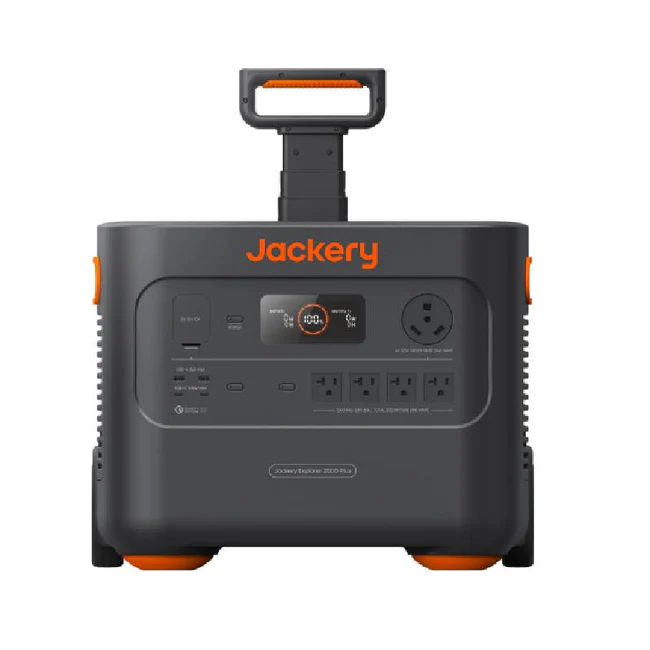
Jackery no longer sells the Explorer 2000 Plus as a standalone unit — the listing now carries only kits, the add-on battery and a refurbished unit. Its successor in the line is the HomePower 2000 Plus v2: the same 2 kWh class with a 2,400W inverter in the newer design.
HomePower 2000 Plus v2 · $1,199.00Spec deltas
The BLUETTI AC200L costs $899 and the Jackery Explorer 2000 Plus costs $1,199, and the reflex here is to grab the cheaper twin and pocket the $300. This time the reflex is wrong. Both units carry almost exactly the same battery — 2,048Wh against 2,043Wh — but the Jackery is rated for 4,000 charge cycles to the BLUETTI's 3,000, and that extra life makes the two cost the same to own over their full lifetimes.
Runtime can't break the tie, because runtime lives in the battery and the batteries match. Every scenario we model finishes in a dead heat: both hold a fridge through an eight-hour blackout with a single-digit cushion, both sip through a CPAP night on less than a fifth of their charge, and both come up about a fifth short of a no-recharge camping weekend. If capacity is all you weigh, flip a coin.
So the decision moves to what capacity can't see, and there the Jackery pulls ahead three ways: it runs far quieter, it surges to a ceiling the BLUETTI can't touch, and it rolls on wheels the BLUETTI never fitted despite weighing nearly the same. The BLUETTI answers with a lower sticker, a cheaper warranty year, and a field-tested habit of hitting every number it printsA9A16. If the box lives in the garage, that's enough. If it lives anywhere you'll hear it or lean on it, the Jackery is the buy.
What the Numbers Reveal
Each conclusion stated first — the numbers behind it on one line, the full analysis below.
rated cycles
That reframes the whole matchup. The $300 gap isn't a discount the BLUETTI hands you — it's the price of 2,027 more lifetime kilowatt-hours, sold at the identical rate. So the only way the lower sticker becomes real savings is if you never run the cycles you'd be skipping, and at daily use the AC200L still lasts 8.2 years — a runway few backup buyers ever exhaust.
BLUETTI AC200L: $899, 2,048Wh, rated 3,000 cyclesJackery Explorer 2000 Plus: $1,199, 2,043Wh, rated 4,000 cyclescomputed lifetime energy: 6,144 kWh for the AC200L against 8,171 kWh for the Explorer 2000 Plus
Why it mattersHard cyclers and off-grid daily users pay nothing extra for the Jackery's longer life; emergency-only buyers who'll never see year eight keep the $300.
The catch worth naming is that 50dB is the BLUETTI's worst case, not its bedside reality — an independent tester clocked its fans at 40 to 48dB, and at 18% load they barely spinA8. But the Jackery's floor is lower by design, and for anyone sleeping beside the unit, a quiet machine you can forget beats a louder one you're hoping stays calm.
Jackery rated 30dB, BLUETTI rated 50dB under loadthe CPAP scenario draws just 18% of either battery, with the unit an arm's length from your head for eight hoursa hands-on tester measured the AC200L's fans at 40 to 48dB at three feetA8
Why it mattersIf this runs a CPAP or lives in the bedroom, the Jackery's noise floor is worth the $300 by itself; if it lives in the garage, ignore this row entirely.
continuous output
Both units run the same fridge all night without noticing. The gap shows up at the instant a motor starts — a well pump or an RV air conditioner spiking to three times its running draw for a fraction of a second, which is exactly what trips an undersized inverter. The Jackery has far more room for that spike than the BLUETTI, so it starts a class of motor the AC200L simply has to refuse.
BLUETTI: 2,400W continuous, 3,600W surge — a 1.5x surge ratioJackery: 3,000W continuous, 6,000W surge — a 2.0x surge ratiocompressor and pump motors briefly pull two to three times their running draw at startup
Why it mattersAnyone sizing this to a well pump, an RV air conditioner, or a table saw should treat surge as the deciding spec — and it points at the Jackery.
The specific dimensions that decide these two units — everything else is a tie.
Lifetime Value
Selected because: The spine of the verdict: both land at the same cost per lifetime kWh, so the $300 gap is an even trade, not a premium.
cost / lifetime kWh
This table usually crowns a winner. Here it calls a draw: the AC200L is cheaper to buy and rated for fewer cycles, the Jackery pricier and rated for more, and when you spread each price across the energy its cells will ever deliver, the two meet at the same cost per kilowatt-hour. The Jackery costs more because it lasts longer, and the two effects erase each other almost to the penny.
That draw only pays out if you spend the cycles. Run either as occasional backup and neither sniffs its rated life — at a weekend a week the AC200L is good for 28.8 years and the Jackery for 38.5, and nobody keeps a 2kWh box past either mark. So the lower sticker is genuine savings for the light user and a rounding error for the heavy one. The honest counterweight sits one column over: the BLUETTI also costs less per warranty year, the cheaper coverage to fall back on.
What the Specs Don't Tell You
Selected because: Five cards fire; noise and surge both point at the Jackery, warranty points back at the BLUETTI — the whole matchup in five rows.
rated cycles
Five flags fire, and they don't all point the same way. Noise and surge are the Jackery's to claim: it runs quieter under load, and its surge ratio of 2.0x against the BLUETTI's 1.5x says its inverter keeps more in reserve for the moment a motor kicks. Those two cards are most of why this verdict leans the way it does.
The other three split or point back. Cycle life favors the Jackery on paper, but you've already paid for those cycles in the price, so it isn't a free win. Warranty favors the BLUETTI, cheaper per covered year. And weight is a near-tie the portability section untangles. Read the noise and surge rows twice; skim the rest.
Portability & Form Factor
Selected because: Near-identical weight (62.4 vs 61.5 lb) but the Jackery has wheels and the AC200L doesn't — a real fork for anyone with stairs or a truck bed.
weight
On the scale these two are the same box: 62.4 pounds for the BLUETTI, 61.5 for the Jackery, a difference you will never feel. What you will feel is that one of them brought wheels. The Jackery rolls on an integrated wheel-and-handle setupB3, while the AC200L is a bare two-handed lift with nothing but side handles and no integrated wheels at allA17.
That turns a spec tie into a real fork. On smooth ground — garage to driveway, campsite pull-through — the Jackery tows like luggage and its weight stops mattering. On stairs or into a truck bed both get carried, and there the wheels are dead weight while the BLUETTI's slightly lighter body is the marginally easier hoist. Most hauling happens on the flat, which is one more quiet point for the Jackery.
Brand Trust
Selected because: Cross-brand: BLUETTI's value-and-breadth with shaky support vs Jackery's retail ubiquity with a weak app; buy-direct advice moves outcomes.
BLUETTI's column is the category's value play: one of the broadest lineups in the market, the best capacity-per-dollar in it, and an app that rates near the top of the class. The asterisk is support — the most inconsistent record in the space, heavily email-based with timezone lag, and outcomes that improve noticeably when you buy direct from BLUETTI rather than through a reseller. If the AC200L wins your money, buy it from BLUETTI itself.
Jackery's column trades on reach: the widest retail shelf of any brand here — Costco, Home Depot, Best Buy — and the name recognition that rides with it. Its support draws much the same criticism BLUETTI's does, which is why the standing advice is to buy from Costco or Amazon for the return protection, and its app is the weakest of the majors. Neither brand column should flip your verdict; both argue for keeping the receipt and registering the warranty the day the box lands.
Your Life, Your Pick
Selected because: Every scenario ties at nearly identical percentages — the dead heat is itself the finding that capacity settles nothing here.
Read down the scenario table and the two columns are the same column. The eight-hour blackout takes 94% of usable capacity on the BLUETTI and 95% on the Jackery, a rounding error apart. The CPAP night takes 18% on both. The camping weekend overruns both by the same fifth. Identical capacity in, identical results out.
So the scenarios don't pick a winner; they prove the pick has to come from somewhere else. Both switch to battery in 20 milliseconds, fast enough that a desktop or router rides through the cutover without a blink. Both tap out on a full van-life day and a no-recharge camping weekend. Where they differ isn't in what they run — it's in how loudly they run it and what they can start, which is what the rest of this page is about.
Strengths & trade-offs
BLUETTI AC200L
Strengths
- +Larger battery capacity
Trade-offs
- –Weaker inverter (-600W) limits appliance compatibility.
- –Shorter-lived battery — rated for 3,000 charge cycles vs the Explorer 2000 Plus's 4,000, so it wears out sooner.
Jackery Explorer 2000 Plus
Strengths
- +Lighter by 0.9 lb
- +Higher AC output
- +Rated for 4,000 charge cycles — much longer battery lifespan
Trade-offs
- –No major technical downsides compared to rival.
Will It Power Your Gear?
Scenario math and per-appliance runtimes, modeled from the spec record.
Scenario verdicts
We ran the math on six real-world scenarios. Here's which unit survives your actual life.
SCN-01 · 2 nights · needs 2,100Wh
Weekend Camping
Two nights off-grid with essential comfort
Neither unit
Two nights of lights, a CPAP, and phone charging want about 2,100 watt-hours, and both batteries come up roughly a fifth short once inverter losses take their cut. This is a tie both units lose. The fix is identical for each — a solar panel and a sunny afternoon, or a shorter appliance list. Nobody wins this row, so settle it in the sections above.
Battery budget usedlower = more headroom
LOAD Phone Charger 15W×6h · LED Lights 40W×8h · Box Fan 75W×14h · CPAP Machine 40W×16h
SCN-02 · 8 hours · needs 1,645Wh
8-Hour Blackout
Keep the essentials running through a night without power
Either unit
Both clear the night with a single-digit cushion — 94% of usable capacity on the BLUETTI, 95% on the Jackery, close enough to call even. Both hand off to battery fast enough that a router or desktop never notices the grid left. Capacity settles nothing here; pick on noise, surge, and price.
Battery budget usedlower = more headroom
LOAD Fridge 150W×8h · Router + Modem 20W×8h · LED Lights (4 bulbs) 40W×6h · Phone Charger 15W×3h
SCN-03 · 8 hours · needs 320Wh
CPAP Overnight
Sleep therapy without interruption — the #1 medical use case
Explorer 2000 Plus
A CPAP barely sips — 18% of either battery, so both end the night more than four-fifths full. Capacity is beside the point. What matters is that the unit sits an arm's length from your head for eight hours, and that makes noise the real spec. Both do the job; the quieter one lets you forget it's there.
Battery budget usedlower = more headroom
LOAD CPAP Machine 40W×8h
SCN-04 · 8 hours · needs 910Wh
Remote Workday
Full work day off-grid without power anxiety
Either unit
A laptop, a monitor, and a phone through a workday draw about half of either battery, delivered over identical 100W USB-C. There's no daylight between them here — same runtime, same ports. Buy on the specs that aren't tied.
Battery budget usedlower = more headroom
LOAD Laptop 60W×8h · External Monitor 30W×8h · Router + Modem 20W×8h · Phone Charger 15W×2h
SCN-05 · 4 hours · needs 670Wh
Tailgate Party
Game day power for the crew
Either unit
A speaker, a blender, and a warming tray for an afternoon use barely over a third of either battery, so both cruise. If the cook setup escalates, the Jackery's bigger inverter has more room before it strains; on runtime alone this is a wash.
Battery budget usedlower = more headroom
LOAD Blender 400W×0.5h · LED TV (55") 80W×4h · Bluetooth Speaker 15W×4h · Phone Charger (×3) 45W×2h
SCN-06 · 24 hours · needs 4,685Wh
Van Life Daily
A full day of mobile living — the ultimate endurance test
Neither unit
A full van-life day asks for about 4,685 watt-hours — well over twice what either unit usably holds. Neither does this solo. Both take expansion batteries from their own lines, so either can grow toward the job, but if this is your daily reality, budget for that second battery on day one or shop a class up.
Battery budget usedlower = more headroom
LOAD Mini-Fridge 150W×24h · Laptop 60W×4h · Phone Charger 15W×3h · LED Lights 40W×5h · Fan 75W×8h
The Load Test
RUNTIME = (Wh × 0.85) ÷ LOAD
None of the scenarios above exactly yours? Build it. Toggle what you'd plug in; both units are tested against the combined draw.
Essentials
Comfort & Convenience
High-Draw Appliances
Test duration
8h
Continuous draw
205W
Projected runtime
Dead heat — both run this 205W load for roughly 8.5h. Pick on price, weight, or ports.
Modeled from the spec record — same math as the tables below. Methodology
Runtime by appliance
Real-world runtime estimates for common appliances, modeled at 85% inverter efficiency.¹
Essentials
The basics you need runningscale 0–116.1hComfort & Convenience
Makes off-grid life actually enjoyablescale 0–23.2hHigh-Draw Appliances
These reveal the real limitsscale 0–1.7h¹ Runtime = (capacity × 0.85) ÷ appliance watts. Within each group, all bars share one time scale (the group's longest runtime), so lengths are comparable across appliances; identical runtimes collapse into a single blue/orange bar. Actual runtime varies with battery age, temperature, and simultaneous loads — see methodology.
Conclusion
July 13, 2026
Verdict: the Explorer 2000 Plus
Buy the Jackery Explorer 2000 Plus if the unit will ever sit where you sleep or have to start a big motor. It costs $300 more up front, but both batteries deliver energy at the same fifteen cents per lifetime kilowatt-hour, so that gap buys real hardware instead of a markup: it runs 20dB quieter, surges far past what the BLUETTI can, and rolls on wheels despite weighing within a pound of its rival. The BLUETTI AC200L's case is narrower but honest — it's $300 cheaper today, it costs less per warranty year, and independent testing shows it hits its rated capacity and switches over faster than its own spec sheet promisesA9A7. For a fridge-and-router blackout box that lives in the garage and never approaches its cycle ceiling, that's the smarter money. But on nearly every axis a buyer can actually feel — noise, surge, portability — the Jackery is the better machine, and the lifetime math means you don't overpay to get it.
Editor-assigned confidence, based on cited owner research and spec analysis.
List prices as of July 13, 2026. The links below open BLUETTI's and Jackery's current prices.
$899.00 · direct from Jackery
Last checked 21 days ago. Prices move — check before you buy.
or check the AC200L price$899.00 list
Written by Gunner Gustafson, Whole-Home Backup Tester · Station Arena Test Desk · Updated July 13, 2026
Measured Data
Benchmark scores and the full spec record, side by side.
Benchmark scores
Full specifications
ᵈ Derived: price ÷ rated capacity. See the data behind our comparisons →
Comparison ToolAdd more power stations, side by sideOpen Tool →How these numbers are produced
Numeric verification
Every figure on this page traces to our spec database or arithmetic on it — no estimated numbers.
Owner claims
Statements about owner experience are cited to published reviews — see Sources & Research Notes below.
Runtime model
Runtime = (rated capacity × 0.85 inverter efficiency) ÷ device wattage. Solar recharge estimates assume panels deliver 70% of rated output. Cold weather, battery age, and stacked loads reduce real-world results.
Power Score
Computed from 14 published spec dimensions, weighted per use-case bench. Higher is better; a unit must meet a bench's minimum threshold to be rated.
See the full weight table and data sourcing on our methodology page →Class ranking (the star rating)
Each unit's star score is a category ranking, not customer reviews — no buyer opinions feed it. We score every station on size-independent quality (value, output, portability, endurance, ports, warranty, and more), then percentile-rank it against the other units in its capacity class, so a class-leading compact unit and a class-leading whole-home unit can both earn 5★. Here, AC200L rates 3.9/5 (36th percentile of 26 Large-class units), and Explorer 2000 Plus rates 4.5/5 (68th percentile of 26 Large-class units).
How the class ranking is computed →Test Notes & Caveats
Hidden gotchas and advantages we spotted that you won't find on the product page.
A Near-Tie on the Scale
Within a pound of each other — 62.4 pounds for the BLUETTI, 61.5 for the Jackery — so raw weight won't decide this. Both are two-handed lifts you won't want to carry upstairs. How they move on flat ground is the real difference, and the portability section takes that up.
Twenty Decibels Is a Lot
On paper the Jackery runs at 30dB and the BLUETTI at 50dB under load — about four times the perceived loudness, the gap between a library and a conversation. The honest nuance: 50dB is the BLUETTI's worst case under heavy draw, and at the low loads where quiet actually matters, like a CPAP or a few lights, its fans run much closer to the Jackery's. But if the unit is headed for a bedroom, the Jackery's lower floor is the safer bet.
Surge Ratio Is the Tell
The Jackery can throw 6,000W for a startup spike on a 3,000W continuous rating — a 2.0x cushion. The BLUETTI manages 3,600W over 2,400W, a 1.5x cushion. That ratio is a decent proxy for inverter quality, and it's the margin that decides whether a compressor or pump actually starts. Advantage Jackery, and it's the kind that matters exactly once per appliance: at the instant you switch it on.
Warranty: No Difference
Both units carry the same 5-year warranty, so coverage isn't a tiebreaker here. Both figures are maximums rather than guarantees: BLUETTI's depends on buying direct from BLUETTI or registering the unit, since reseller purchases carry a shorter term; Jackery's on registering the unit with Jackery, which is what extends the base term to the full period.
You Already Paid for These Cycles
The Jackery's 4,000-cycle rating beats the BLUETTI's 3,000, and at a full cycle a day that's the difference between roughly 8 years of service and 11. Normally that's a clean win. Here it isn't a free one — the Jackery's price already reflects those cycles, which is exactly why the two units cost the same per lifetime kilowatt-hour. This number is the reason the premium isn't a premium, not a bonus stacked on top of it.
Full record above — the Test Desk pick is the Explorer 2000 Plus.
Check Explorer 2000 Plus price →or check the AC200L priceOwnership Analysis
What happens after you buy — true cost of ownership, brand trust, and growth potential.
Lifetime value
Service lifeyears at one full cycle per day
Lifetime energy delivered
Cost per delivered kWh
│ warranty ends · Reaching the cycle rating means ~80% capacity remains — degraded, not dead.
Analyst note
The AC200L is cheaper to buy, but the Explorer 2000 Plus is cheaper to own. At $0.11/kWh over its lifetime vs $0.15/kWh, the Explorer 2000 Plus's higher cycle life and capacity make each dollar go further over the years.
Brand trust
BLUETTI
Ecosystem
One of the broadest lineups — 15-20+ models from budget (AC2A) to flagship portable (Apex 300, 2764.8Wh). Includes specialized products: vehicle solar hubs, sodium-ion cold-weather units, and balcony storage systems.
Support
The most inconsistent support record in the space, heavily email-based with timezone lag. Outcomes improve noticeably when you buy direct from BLUETTI rather than through a third-party seller.
Community
Active and growing — Reddit r/bluetti has a dedicated community. Second-largest after EcoFlow in engagement.
App experience
Rated 4.5/5 iOS and Android — tied for best app experience in the category. V3.0 UI redesign was well-received.
Unique strength
The best capacity-per-dollar in the category and one of its widest lineups — 15-plus models from budget units to dual-voltage flagships, all standardized on LFP cells.
Worth knowing
Support inconsistency is the brand's top risk factor, and some older units have gone unrepairable for lack of spare parts. Register the warranty and buy direct to hedge both.
Jackery
Ecosystem
12-15+ models across Explorer (portable) and HomePower (home backup) series, plus SolarSaga panel ecosystem and innovative form factors
Support
US-based but widely criticized for slow, scripted responses and strict receipt requirements on warranty claims. The standing workaround is to buy from Costco or Amazon for their return protection.
Community
Smallest community of the major brands — Reddit r/Jackery has ~2,000 members. YouTube presence is solid due to brand recognition.
App experience
Rated 2.3-3.3/5 iOS and Android — the weakest app experience of the major brands. Multiple confusing apps (Jackery app vs Jackery Home) and mandatory login even offline.
Unique strength
The widest retail footprint of any brand here — Costco, Home Depot, Best Buy, Amazon — plus the strongest name recognition. The dependable, everywhere-available option.
Worth knowing
The app is the weakest of the major brands, and Jackery has been among the slower brands to move its full lineup to LFP — though this expandable flagship is one of the LFP models.
Analyst note
Two different bets. BLUETTI is the value pick with the broadest catalog and the category's best capacity-per-dollar, undercut by the least consistent support record in the space — which is why buying direct matters. Jackery is the recognizable, on-every-shelf name with retail return protection as its safety net, undercut by a weak app and criticized support of its own. Neither is a reason to flip the verdict; both are a reason to keep the receipt and register the warranty the day the box lands.
Growth path
AC200L
EXPANDABLESupports BLUETTI expansion batteries, so you can add capacity later without replacing the base unit — useful if your needs may climb past 2,048Wh.
Accepts up to 1,200W of solar. Enough for a serious multi-panel array.
Adequate ports for most setups, but heavy users may want a power strip.
Expansion batteries are BLUETTI-specific. You're investing in the BLUETTI ecosystem.
Explorer 2000 Plus
EXPANDABLESupports Jackery expansion batteries, so you can add capacity later without replacing the base unit — useful if your needs may climb past 2,043Wh.
Accepts up to 1,200W of solar. Enough for a serious multi-panel array.
Adequate ports for most setups, but heavy users may want a power strip.
Expansion batteries are Jackery-specific. You're investing in the Jackery ecosystem.
Realistic full solar rechargeat 70% of rated panel output — see methodology
Analyst note
Both expand, so neither locks you out of growth — decide on capacity, price, and the rest, not the expansion checkbox.
What Owners Report
Patterns from published owner reports and long-term reviews — every claim cited to its source below.
BLUETTI AC200L
The AC200L's loudest owner theme is connectivity, and it's a genuine pattern: owners report failed WiFi pairing, an app that drops its cloud connection away from home, and no non-Bluetooth way to check the unit remotelyA2A3A5A14. One owner was told to ship the battery back to fix what was plainly an app problemA3. If you plan to monitor this during an outage from another room, that Bluetooth-only leash is a real limitA14.
The hardware itself tests well. An independent reviewer measured the switchover at 13.1 milliseconds against a 20ms spec, ran a full-size fridge for 32 hours on a single charge, and found 97% of rated capacity left after 183 cyclesA7A9A16. The fans that a couple of owners flag for cycling on and off at idleA1 measured a quiet 40 to 48dB under load in that same hands-on testingA8. The recurring physical gripe is the one the spec sheet hides: at nearly 60 pounds with no wheels, repositioning it is a two-handed choreA17.
“The BLUETTI app works well to give one all of the relevant info on a BLUETTI power system...after almost a year of use...the account for logging into the app is not the same as the BLUETTI web account.”
Sources
reviews.matanich.co · portablepowernerd.com · backuppowerhub.com
Jackery Explorer 2000 Plus
Straight talk: the field record on the Explorer 2000 Plus is thinner than the BLUETTI's — five solid review-based entries, not a deep owner forum. What's there is consistent. Reviewers call it dependable and easy, and notably quiet even under a full 3,000W load, with output universal enough to run everything from a CPAP to an electric grillB1.
The build and expansion draw the most praise: a rugged IP65-rated body on wheels, twin MPPT solar inputs, and a battery that expands toward 12kWh on its own or 24kWh paired with a second unitB5B2B3. The app is the weak spot reviewers keep flagging — it covers the essentials like cycle counts and efficiency graphs but still needs polishB4. Treat this as a promising, lightly tested record rather than a proven one.
“Reviewers describe it as dependable, easy to use, and relatively quiet even under a 3000W load, with universal compatibility for powering everything from CPAP machines to electric grills.”
Sources
outdoorgearlab.com · thesolarpit.com · jackery.com · voltagebasics.com · storagereview.com · thesolarlab.com · tipselite3s.com
Sources & Research Notes
Every owner claim in this report is traceable to a published source. The bracketed references above resolve here.
Recurring owner themes
- App/WiFi connectivity is a recurring pain point — owners report failed WiFi pairing, cloud disconnects, and no remote (non-Bluetooth) monitoring option. [AC200L · 4 entries]
- Fan/relay cycling behavior gets mixed reports: some owners flag frequent on/off cycling at idle/solar cutover, while a hands-on tester measured the fans as relatively quiet under load. [AC200L · 2 entries]
- UPS switchover is fast and reliable in practical tests, but reviewers note the 20ms spec (vs newer 10ms competitors) could risk flicker for very sensitive electronics. [AC200L · 2 entries]
- Independent runtime/capacity and cycle-health tests have generally matched or come close to the advertised 2048Wh rating and cycle-life claims. [AC200L · 3 entries]
- Weight and lack of wheels/accessory-integration quirks are recurring physical/practical gripes despite otherwise positive reception. [AC200L · 2 entries]
- Standout expandability (up to 24kWh dual), a rugged IP65 build with wheels, and dependable quiet operation are the praise; the heavy weight and an app that needs polish are the caveats. [Explorer 2000 Plus · 3 entries]
- A1
“I own a AC200L (US)...one is the common PV relay clicking at sunset/sunrise and the other is the fan turning on for 25 seconds every 60 seconds or so.”
BLUETTI Community forum — 'ac200L PV relay and fan turning on every minute' · 2024-05 · [negative]
- A2
“WIFI WIFI! I can't get my new AC200L to log into my WIFI network. Have reached out to company they keep telling me to do the same things I have already done.”
BLUETTI Community forum — 'AC200L trouble' · 2025-11 · [negative]
- A3
“The IOS app for my AC200L will disconnect from the cloud on a consistent basis when I'm away from my home network...wants me to return the 65lb battery for an app issue.”
BLUETTI Community forum — 'AC200L IOS app Cloud login not working' · 2025-03 · [negative]
- A5
“You are better off buying a Ecoflow or Anker! Bluetti app is not stable enough. It disconnects from my WiFi every month or two without warning.”
Apple App Store — BLUETTI App reviews · unknown · [negative]
- A7
“It's advertised to switch from wall power to battery power within 20 milliseconds, but I measured it at just 13.1 milliseconds! This is one of the fastest UPS modes I've seen.”
Lifenhancer — 'Bluetti AC200L Review' · 2024-03 · [positive]
- A8
“The AC200L's fans surprised me with their quietness. They have two variable speeds...At 3 feet away, I measured around 40dB at the lower speed and 48dB at the higher speed.”
Lifenhancer — 'Bluetti AC200L Review' · 2024-03 · [positive]
- A9
“I then tested how long the AC200L would run a full-size refrigerator. Starting at 100% charge, it powered the refrigerator for 32 hours and still had 7% of the capacity remaining.”
Lifenhancer — 'Bluetti AC200L Review' · 2024-03 · [positive]
- A14
“The lack of Wi-Fi is our biggest gripe...with the AC200L, you need to be within Bluetooth range (about 30 feet practically). For home backup use where you might be away when an outage hits, this is a real limitation.”
portablepowernerd.com — 'Bluetti AC200L Tested: 4-Month Honest Review' · 2026-02 · [negative]
- A16
“I checked the battery health in the Bluetti app six months later in September. After 183 full cycles the capacity read 97% of original.”
GridFree Guide — 'The Workhorse Standard: Bluetti AC200L Review' · 2026-04 · [positive]
- A17
“the unit's 62.4 lbs weight with no integrated wheels makes repositioning awkward. Users with mobility constraints or who need to move the unit frequently will want to factor that in.”
backuppowerhub.com — 'Bluetti AC200L Review: Expandable Power Station Worth It' · 2026 (approx, '3 weeks ago' at time of search) · [negative]
- B1
“Reviewers describe it as dependable, easy to use, and relatively quiet even under a 3000W load, with universal compatibility for powering everything from CPAP machines to electric grills.”
outdoorgearlab.com / thesolarpit.com — Jackery Explorer 2000 Plus review · 2026 · [positive]
- B2
“Massive expandability — each unit's battery expands up to 12kWh, and pairing two units gives 6000W output and up to 24kWh total, ideal for RVs, home backup, or serious off-grid setups.”
jackery.com / thesolarpit.com — Explorer 2000 Plus review · 2026 · [positive]
- B3
“Not light at around 61-62 lbs — included wheels and a handle help on smooth surfaces, but it still demands a two-person lift for stairs.”
outdoorgearlab.com / voltagebasics.com — Explorer 2000 Plus review · 2026 · [mixed]
- B4
“The app nails the essentials with pro-level insights like cycle counts and efficiency graphs, but it lacks some of the bells and whistles of rivals and still needs polishing.”
storagereview.com / thesolarlab.com — Explorer 2000 Plus review · 2026 · [mixed]
- B5
“Strong solar with two MPPT inputs (up to ~1,200-1,400W), plus a tank-like build with IP65 dust and water resistance on key ports.”
storagereview.com / tipselite3s.com — Explorer 2000 Plus review · 2026 · [positive]
Research compiled July 13, 2026.
What Owners Actually Report
Drawn from 37 comments on independent review channels — not from retailer reviews, which skew to the first week of ownership. Each line is our summary of one commenter's claim, linked to the original. We record what they said, including where it contradicts the spec sheet.
BLUETTI AC200L
41 claims from 27 comments · 30 from owners · 12 with figures
- Solar input
- 6 · 0% negative
- Price & value
- 6 · 0% negative
- Build quality
- 5 · 5% negative
- Charging
- 4 · 17% negative
- Runtime
- 2 · 43% negative
What owners complain about
His Nomadic X2 air conditioner would drain the 2048Wh AC200L in about an hour.
Runtimemeasuredownersource →
His crosscut saw plus dust collector keeps kicking off the 2400W inverter.
Inverter & surgeownersource →
So heavy it took two people to move; not something he would carry around.
Size & weightownersource →
What owners praise
Runs everything else on the AC200L, which uses very little idle consumption.
Idle drainowner11 agreedsource →
Recharges from 65% to full by 1pm on a portable 350W array, so he stopped tracking it.
Solar inputmeasuredownerafter 2 months4 agreedsource →
Just bought an AC200L for $1200 and calls it much better price-to-performance than solid state.
Price & valuemeasuredowner2 agreedsource →
Jackery Explorer 2000 Plus
15 claims from 10 comments · 11 from owners · 2 with figures
- Expandability
- 3 · 48% negative
- Solar input
- 2 · 0% negative
- Warranty & support
- 3 · 100% negative
- Price & value
- 2 · 88% negative
- Charging
- 1 · 100% negative
What owners complain about
The pairing connector box is way overpriced at $200.
Price & valuemeasuredownersource →
Has contacted Jackery too many times across four units and calls their support bad.
Warranty & supportownersource →
The 2000 Plus parallel kit did not do what he needed despite the spec talk.
Expandabilityownersource →
What owners praise
Feeds 4800W into the system across 8 DC ports; any input backfeeds and charges everything.
Solar inputmeasuredowner100 agreedsource →
Each expansion battery has its own controller, giving MPPT redundancy in a grid-down scenario.
Expandabilityowner100 agreedsource →
Switching his decision to Jackery on the reviewer's A grade over the AC300's A- and Delta's B-.
Other17 agreedsource →
Claims are weighted by how specific they are, whether the commenter owns the unit, and how many readers agreed. Comments that mention a product under a rival's review count for more, because the commenter had no reason to be there. This is what buyers report, not our test results — for measurements we ran ourselves, see the methodology.
Who Should Buy Which
Buy the AC200L if you…
- →The unit is blackout insurance that lives in the garage or a closet. It'll run a fridge, lights, and a router through an outage exactly as well as the Jackery, it'll never approach its cycle ceiling, and the noise you'd have paid to avoid is two rooms away and irrelevant. Pocket the $300.
- →Your budget is firm today. $300 is $300, both units cover every everyday scenario on this page, and the AC200L is the one that leaves money for a solar panel.
- →You buy on the warranty math. Same five years of coverage on both, but the BLUETTI costs less per covered year — the cheaper promise to fall back on.
- →You want the unit with a track record. Independent testing shows the AC200L hitting its rated capacity and beating its own switchover specA9A7, where the Jackery's field record is still thin.
Buy the Explorer 2000 Plus if you…
- →It's going where you'll hear it — a CPAP on the nightstand, a bedroom, a quiet cabin. The quieter unit is the one you don't lie awake listening to, and noise is the one thing capacity can't fix.
- →You start motors: a well pump, an RV air conditioner, a table saw. The Jackery's taller surge ceiling starts loads the AC200L's inverter has to turn away.
- →You'll cycle it hard — van weekends, an off-grid cabin, near-daily draws. Heavy rotation is where the longer cycle rating stops being spec-sheet trivia and becomes the reason the higher price isn't really one.
- →You want it to roll. It weighs what the BLUETTI weighs, but its wheels and tow handle do the hauling on any smooth surfaceB3.
This is you — check the Explorer 2000 Plus price
If neither fits
If your target is a no-recharge camping weekend (about 2,100Wh of draw) or a full van-life day (4,685Wh), both of these tap out — at 121% and 269% of usable capacity respectively — so shop a 3kWh-class unit or plan an expansion battery from day one. And if the real load is a phone, a laptop, and a lamp, a 1kWh station does that job for hundreds less than either of these.
The Bottom Line
The twins cost the same to own — that's the whole page. Because the Jackery's longer life pays back its higher price, the $300 gap stops being a premium and becomes an even trade, and the trade throws in quieter operation, a bigger surge ceiling, and wheels the BLUETTI can't match. When two units cost the same per kilowatt-hour to run, you take the one that's easier to live with, and that's the Jackery.
The exception is real and worth stating plainly: if this is a fridge-and-router backup box that lives in the garage, gets cycled a few dozen times a year, and never sits where you'll hear it, the BLUETTI AC200L does that identical job for $300 less and has the test record to prove it hits its numbersA9A16. Buy the BLUETTI to save money on a job that never uses the Jackery's advantages. Buy the Jackery for everything else, and rest easy that the extra cost isn't extra at all.
Frequently Asked Questions
Answers drawn from the spec record and cited owner research.
Is the Jackery Explorer 2000 Plus worth $300 more than the BLUETTI AC200L?
If the unit will sit anywhere you sleep or need to start a big motor, yes — and here's the part that surprises people: you're not really paying a premium. Both cost the same per lifetime kilowatt-hour, because the Jackery's higher price buys 1,000 extra charge cycles at the identical rate. So the $300 effectively hands you its quieter operation and bigger surge ceiling for free. If it's garage blackout insurance you'll rarely cycle, the BLUETTI does the identical job for $300 less.
Which is quieter, the AC200L or the Explorer 2000 Plus?
The Jackery, and by a wide margin — about 20dB quieter under load, which is roughly four times quieter to the ear. Worth knowing: an independent tester measured the AC200L's fans at 40 to 48dB, below its own spec, and at the low loads a CPAP or a few lights draw, they barely spin. But if silence beside your bed is the priority, the Jackery's lower floor is the safer pick.
Do the AC200L and Explorer 2000 Plus cost the same to run over their lifetimes?
Effectively yes, and it's the key to this whole matchup. Spread each unit's price across the energy its battery is rated to deliver over its life and both land at fifteen cents per kilowatt-hour. The BLUETTI is cheaper to buy; the Jackery lasts proportionally longer, so per unit of energy delivered they're a dead heat. The difference is entirely in what you'll do with the unit, not what it costs to feed it.
Can either one start a well pump or a large power tool?
The Jackery is the safer bet by a clear margin. Motor-driven gear like a well pump or an air conditioner briefly pulls two to three times its running watts at the instant it starts, and the Jackery's surge ceiling has far more room for that spike than the BLUETTI's. Both handle the same steady loads all day; the gap only appears in that startup instant, where the Jackery starts motors the AC200L has to refuse. Size to the surge, not the running watts.
Can either power a full weekend of camping without recharging?
No — a two-night camping load of about 2,100Wh overruns both, since only about 85% of a rated watt-hour survives the inverter and nobody drains to zero. Both accept up to 1,200W of solar, which is the real fix: a sunny afternoon refills either one. If you need multi-day autonomy without sun, you want a bigger unit or an expansion battery, not either of these.
Check Explorer 2000 Plus price →
Brand matchup
BLUETTI vs Jackery: measured across every matchup →Where to buy
BLUETTI AC200L
$899.00
$899.00 · direct from BLUETTI
Last checked 1 day ago. Prices move — check before you buy.
Jackery Explorer 2000 PlusPick
$899.00
$899.00 · direct from Jackery
Last checked 21 days ago. Prices move — check before you buy.
Prices may vary by retailer and are subject to change.