Head-to-head test
EcoFlow DELTA 3 Plus vs Goal Zero Yeti 1500X
The DELTA 3 Plus switches over in 10ms against the Yeti's 25ms, refills on solar in roughly an hour against the Yeti's two and a half, and costs $406 less with eight times the cycle life — the one thing to know before buying it is that multiple reviewers independently caught its fans cycling on even at low load, undercutting its own near-silent marketing.
Full profiles: EcoFlow DELTA 3 Plus → · Goal Zero Yeti 1500X →

Written by Ian SchneiderUpdated
Solar & Off-Grid Tester, Station Arena Test Desk

$719.00 · direct from EcoFlow
Last checked 1 day ago. Prices move — check before you buy.
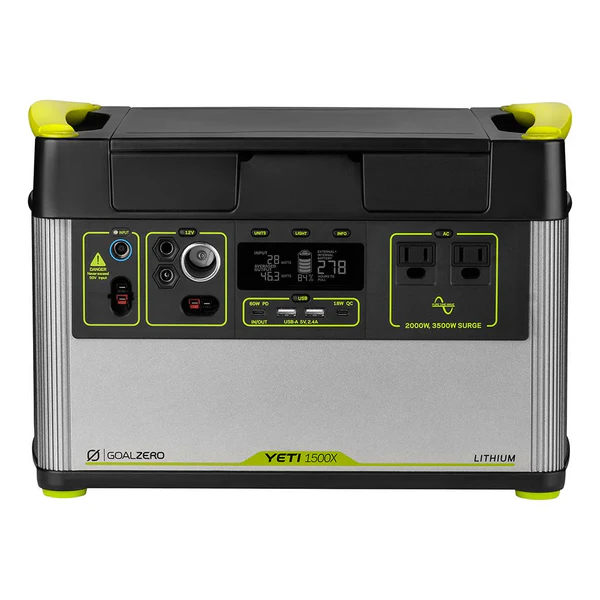
$1,124.89 · direct from Goal Zero
Last checked 1 day ago. Prices move — check before you buy.
Spec deltas
The EcoFlow DELTA 3 Plus switches over to battery power in under 10ms, true line-interactive UPS speed against the Yeti 1500X's 25ms basic standby — a gap independent testing confirms holds up in practice, calling the transition seamlessA3. It's also $406 cheaper at $719 against $1,125, and rated for 4,000 charge cycles against the Yeti's 500.
That cycle-life gap runs the same math seen elsewhere in this batch: $0.17 per lifetime kWh for the DELTA 3 Plus against the Yeti's $1.48, roughly 8.7 times cheaper to own. Both units take expansion batteries, so growth path isn't the differentiator it usually is — instead the DELTA 3 Plus's 1,000W solar ceiling against the Yeti's 600W means a full battery refills in roughly an hour of strong sun against roughly two and a half for the Yeti.
The honest catch, and it needs saying up front: multiple reviewers independently report the DELTA 3 Plus's fans kicking on even at low loads and cycling erratically, which cuts against its near-silent marketingA1A2. It may be fixable in firmware, as EcoFlow has done before, but as of today it's a real, verified behavior, not a rumor.
What the Numbers Reveal
Each conclusion stated first — the numbers behind it on one line, the full analysis below.
Bring in the Yeti's undisclosed noise rating as the third fact, and the pattern repeats: one unit publishes a number and gets it independently verified, the other one is a manufacturer's silence on a spec that matters at 3 a.m.
The DELTA 3 Plus switches over in under 10ms against the Yeti's 25msReviewers confirm the sub-10ms switchover is seamless in practice, delivering uninterrupted power to connected devicesA3
Why it mattersAnyone running sensitive electronics through one of these as a UPS should weigh the DELTA 3 Plus's tested 10ms switchover over the Yeti's slower, unverified 25ms.
solar input
In a multi-day outage that's the difference between one strong-sun afternoon fully recharging the unit and needing most of two, which matters more than either unit's base capacity once you're actually living off solar.
The DELTA 3 Plus accepts up to 1,000W of solar input against the Yeti's 600WThe DELTA 3 Plus's 1,024Wh capacity divided by 1,000W works out to roughly one hour for a full solar refill, against the Yeti's roughly 2.5 hours (1,516Wh over 600W)
Why it mattersBuyers planning to run these off-grid for more than a day should weight solar refill speed as heavily as starting capacity — the DELTA 3 Plus gets back in the game faster.
The honest complication is that reviewers also note this looks like a firmware issue rather than a hardware ceiling, since EcoFlow has resolved comparable fan behavior on other units after releaseA4 — so today's flaw isn't necessarily tomorrow's flaw.
The DELTA 3 Plus is marketed as near-silent with a 30dBA ratingTwo independent reviewers report the fans activate even under low loads and cycle on and off erraticallyA1A2
Why it mattersBuyers who need proven silence right now, not a future update, should test one in person or wait for a firmware note before assuming the spec sheet number is what they'll actually hear.
rated cycles
With that card off the table, the decision comes down to what's left: price, cycle life, UPS speed, and solar refill rate, and every one of those currently favors the DELTA 3 Plus.
Both the DELTA 3 Plus and the Yeti 1500X support expansion batteries from their own ecosystemsThe DELTA 3 Plus costs $406 less and is rated for 4,000 cycles against the Yeti's 500
Why it mattersBuyers shouldn't pay the Yeti's premium for future expansion room in this specific matchup — the DELTA 3 Plus expands too, for $406 less, and fills faster besides.
The specific dimensions that decide these two units — everything else is a tie.
Lifetime Value
Selected because: The 8x cycle-life gap and 8.7x cost-per-kWh gap are the core economic case for the DELTA 3 Plus.
cost / lifetime kWh
The DELTA 3 Plus is the cheaper purchase by $406 and the cheaper unit to own by a much wider margin — $0.17 per lifetime kWh against the Yeti's $1.48, on a 4,000-cycle rating against 500. Cost-per-warranty-year makes the same case from another angle: $140 a year for the DELTA 3 Plus, $562 for the Yeti.
The two units are close on continuous output (1,800W against 2,000W), so this isn't a case of the cheaper unit doing less. It's a case of paying the Yeti's premium for a bigger stock tank and an older battery chemistry.
Your Life, Your Pick
Selected because: CPAP Overnight, Remote Workday, and Tailgate Party all separate on margin from the Yeti's larger tank.
Weekend Camping, the 8-Hour Blackout, and Van Life Daily defeat both units outright, so those three don't move this decision. CPAP Overnight, Remote Workday, and Tailgate Party all go to the Yeti on margin — it completes each with more capacity to spare (25%, 71%, and 52% of its tank used) than the DELTA 3 Plus (37%, 105%, and 77%).
Remote Workday is the one worth flagging specifically: the DELTA 3 Plus needs 105% of its capacity to cover a modeled 910Wh workday, meaning it can't quite finish that load on its own tank the way the Yeti's larger capacity can. Anyone whose daily draw runs lighter than a full workday of laptop, monitor, and router should read the other two scenarios as comfortable, not disqualifying.
What the Specs Don't Tell You
Selected because: UPS switchover speed and noise disclosure are the sharpest spec-true differentiators outside of price and capacity.
rated cycles
The DELTA 3 Plus switches over in under 10ms — true line-interactive UPS speed, independently confirmed as seamless — against the Yeti's 25ms basic standbyA3. It also carries a 5-year warranty against the Yeti's 2, and both units decline to publish a fully verified quiet-operation record: the DELTA 3 Plus's 30dBA rating comes with a documented fan-cycling complaint, and the Yeti simply doesn't publish a number at all.
Neither unit has a clean win on noise. What separates them is that the DELTA 3 Plus at least gives buyers a number and a known issue to weigh, where the Yeti gives neither.
Growth Path
Selected because: Both units expand, making this the one pair in the batch where growth isn't a differentiator — worth explaining plainly, with solar ceiling as the real tiebreak.
solar input
Both units take expansion batteries from their own brand's ecosystem, so neither is a dead end if your needs grow — the usual argument for paying more for the expandable unit doesn't apply in this pairing. That makes this one of the few comparisons in this batch where growth path isn't the deciding factor.
What does differentiate them under the expansion umbrella is solar ceiling: 1,000W for the DELTA 3 Plus against 600W for the Yeti, which works out to roughly an hour for a full solar refill against roughly two and a half. If you're actually living off solar for more than a day, that's the growth-adjacent spec that matters more than either unit's expansion port.
Strengths & trade-offs
EcoFlow DELTA 3 Plus
Strengths
- +Costs $405.9 less
- +Lighter by 18.6 lb
- +Longer warranty
- +Faster solar charging
- +Rated for 4,000 charge cycles — much longer battery lifespan
Trade-offs
- –No major technical downsides compared to rival.
Goal Zero Yeti 1500X
Strengths
- +Larger battery capacity
- +Higher AC output
Trade-offs
- –Substantially more expensive (+$405.9) than the DELTA 3 Plus.
- –Significantly heavier (+18.6 lbs), making it harder to move.
- –Shorter-lived battery — rated for 500 charge cycles vs the DELTA 3 Plus's 4,000, so it wears out sooner.
Will It Power Your Gear?
Scenario math and per-appliance runtimes, modeled from the spec record.
Scenario verdicts
We ran the math on six real-world scenarios. Here's which unit survives your actual life.
SCN-01 · 2 nights · needs 2,100Wh
Weekend Camping
Two nights off-grid with essential comfort
Neither unit
Neither unit covers this scenario's 2,100Wh: the DELTA 3 Plus comes up 1,230Wh short (about 41% covered), the Yeti 1500X 811Wh (61%). Treat this as partial cover — enough for the essentials in it, not the whole list.
Battery budget usedlower = more headroom
LOAD Phone Charger 15W×6h · LED Lights 40W×8h · Box Fan 75W×14h · CPAP Machine 40W×16h
SCN-02 · 8 hours · needs 1,645Wh
8-Hour Blackout
Keep the essentials running through a night without power
Neither unit
Neither unit covers this scenario's 1,645Wh: the DELTA 3 Plus comes up 775Wh short (about 53% covered), the Yeti 1500X 356Wh (78%). Either gets you most of the way, so this is a scenario you plan around rather than one you should rule them out for.
Battery budget usedlower = more headroom
LOAD Fridge 150W×8h · Router + Modem 20W×8h · LED Lights (4 bulbs) 40W×6h · Phone Charger 15W×3h
SCN-03 · 8 hours · needs 320Wh
CPAP Overnight
Sleep therapy without interruption — the #1 medical use case
Either unit
Both units handle a CPAP overnight with room to spare, but the Yeti does it with more margin (25% used against 37%). If guaranteed quiet matters more than either number, the DELTA 3 Plus's documented low-load fan behavior is the bigger consideration here than raw capacity.
Battery budget usedlower = more headroom
LOAD CPAP Machine 40W×8h
SCN-04 · 8 hours · needs 910Wh
Remote Workday
Full work day off-grid without power anxiety
Yeti 1500X
The Yeti finishes a full remote workday with real capacity left (71% used); the DELTA 3 Plus needs slightly more than its own tank holds (105%). Anyone whose daily draw looks like a full workday should size to the Yeti or plan around the DELTA 3 Plus's ceiling.
Battery budget usedlower = more headroom
LOAD Laptop 60W×8h · External Monitor 30W×8h · Router + Modem 20W×8h · Phone Charger 15W×2h
SCN-05 · 4 hours · needs 670Wh
Tailgate Party
Game day power for the crew
Yeti 1500X
Both handle game day; the Yeti 1500X keeps more in reserve (52% used vs 77%). Tailgating is a light load, though, so the number you'll feel is weight: 27 lbs for the DELTA 3 Plus against 45.6 lbs for the Yeti 1500X, from the trunk to the setup spot.
Battery budget usedlower = more headroom
LOAD Blender 400W×0.5h · LED TV (55") 80W×4h · Bluetooth Speaker 15W×4h · Phone Charger (×3) 45W×2h
SCN-06 · 24 hours · needs 4,685Wh
Van Life Daily
A full day of mobile living — the ultimate endurance test
Neither unit
Neither unit covers this scenario's 4,685Wh: the DELTA 3 Plus comes up 3,815Wh short (about 19% covered), the Yeti 1500X 3,396Wh (27%). This is well outside what either unit is for; the right answer here is a larger station, not a choice between these two.
Battery budget usedlower = more headroom
LOAD Mini-Fridge 150W×24h · Laptop 60W×4h · Phone Charger 15W×3h · LED Lights 40W×5h · Fan 75W×8h
The Load Test
RUNTIME = (Wh × 0.85) ÷ LOAD
None of the scenarios above exactly yours? Build it. Toggle what you'd plug in; both units are tested against the combined draw.
Essentials
Comfort & Convenience
High-Draw Appliances
Test duration
8h
Continuous draw
205W
Projected runtime
For this load: Yeti 1500X runs 6.3h vs 4.2h.
$1,124.89 list · direct from Goal Zero
Modeled from the spec record — same math as the tables below. Methodology
Runtime by appliance
Real-world runtime estimates for common appliances, modeled at 85% inverter efficiency.¹
Essentials
The basics you need runningscale 0–85.9hComfort & Convenience
Makes off-grid life actually enjoyablescale 0–17.2hHigh-Draw Appliances
These reveal the real limitsscale 0–1.3h¹ Runtime = (capacity × 0.85) ÷ appliance watts. Within each group, all bars share one time scale (the group's longest runtime), so lengths are comparable across appliances; identical runtimes collapse into a single blue/orange bar. Actual runtime varies with battery age, temperature, and simultaneous loads — see methodology.
Conclusion
July 14, 2026
Verdict: the DELTA 3 Plus, on Power Score margin
The DELTA 3 Plus wins on nearly every ownership number: $406 cheaper, 18.64 lbs lighter, 4,000 rated cycles against 500, and $0.17 per lifetime kWh against $1.48. Its 10ms line-interactive UPS switchover beats the Yeti's 25ms outright, and both units are expandable, so the Yeti's usual growth-path argument doesn't apply here — instead the DELTA 3 Plus's 1,000W solar ceiling against the Yeti's 600W means it also refills faster once both are expanded. The genuine catch, and it should be said plainly, is fan behavior: reviewers report the fans activate even at low loads and cycle erratically, a real flaw against a unit marketed as near-silent, though EcoFlow has a track record of fixing this kind of issue with firmware updates. For most buyers the price, speed, and lifetime cost make this an easy call. Anyone who needs guaranteed silence tonight, not eventually, should weigh that fan report before buying.
Editor-assigned confidence, based on cited owner research and spec analysis.
List prices as of July 14, 2026. The links below open EcoFlow's and Goal Zero's current prices.
$719.00 · direct from EcoFlow
Last checked 1 day ago. Prices move — check before you buy.
or check the Yeti 1500X price$1,124.89 list
Written by Ian Schneider, Solar & Off-Grid Tester · Station Arena Test Desk · Updated July 14, 2026
Measured Data
Benchmark scores and the full spec record, side by side.
Benchmark scores
Not rated for both units (minimum threshold unmet): UPS, CPAP.
Full specifications
ᵈ Derived: price ÷ rated capacity. See the data behind our comparisons →
Comparison ToolAdd more power stations, side by sideOpen Tool →How these numbers are produced
Numeric verification
Every figure on this page traces to our spec database or arithmetic on it — no estimated numbers.
Owner claims
Statements about owner experience are cited to published reviews — see Sources & Research Notes below.
Runtime model
Runtime = (rated capacity × 0.85 inverter efficiency) ÷ device wattage. Solar recharge estimates assume panels deliver 70% of rated output. Cold weather, battery age, and stacked loads reduce real-world results.
Power Score
Computed from 14 published spec dimensions, weighted per use-case bench. Higher is better; a unit must meet a bench's minimum threshold to be rated.
See the full weight table and data sourcing on our methodology page →Class ranking (the star rating)
Each unit's star score is a category ranking, not customer reviews — no buyer opinions feed it. We score every station on size-independent quality (value, output, portability, endurance, ports, warranty, and more), then percentile-rank it against the other units in its capacity class, so a class-leading compact unit and a class-leading whole-home unit can both earn 5★. Here, DELTA 3 Plus rates 4.2/5 (54th percentile of 27 Everyday-class units), and Yeti 1500X rates 3.3/5 (1st percentile of 27 Everyday-class units).
How the class ranking is computed →Test Notes & Caveats
Hidden gotchas and advantages we spotted that you won't find on the product page.
Only the DELTA 3 Plus Lists a UPS Mode
The DELTA 3 Plus can sit between the wall and your gear and hand it to battery when the grid drops — rated ≤10ms — quick enough on paper that desktop PCs and routers should ride through, treating that as the rating it is. Worth it for a router, a desktop PC, or a CPAP. The Yeti 1500X's spec sheet lists no UPS mode, so anything plugged into it rides an outage only as far as your reaction time.
Warranty: 5 Years vs 2
The DELTA 3 Plus is covered for 5 years against the Yeti 1500X's 2 years. An underrated factor if you're keeping this unit for years.
Eight Times the Charge Cycles
4,000 rated cycles against 500 is the backbone of this page's economic case. It's why the cheaper unit up front also ends up the dramatically cheaper one to own over time.
Yeti 1500X: Noise Level Not Disclosed
The DELTA 3 Plus publishes its noise level (30dB); the Yeti 1500X doesn't publish one. That isn't evidence the Yeti 1500X is louder — it means there's no figure to hold it to, and no way to compare the two on this without hearing them. If you're buying for a bedroom, a CPAP, or an apartment, treat the DELTA 3 Plus's 30dB as the only published number on the table — a spec-sheet figure, not a measurement — and look for hands-on reports of the Yeti 1500X before deciding.
Full record above — the Test Desk pick is the DELTA 3 Plus.
Check DELTA 3 Plus price →or check the Yeti 1500X priceOwnership Analysis
What happens after you buy — true cost of ownership, brand trust, and growth potential.
Lifetime value
Service lifeyears at one full cycle per day
Lifetime energy delivered
Cost per delivered kWh
│ warranty ends · Reaching the cycle rating means ~80% capacity remains — degraded, not dead.
Analyst note
The DELTA 3 Plus wins on both sticker price and long-term value. At $0.18/kWh over its lifetime, it's meaningfully cheaper to own. Clear value winner.
Delivers each lifetime kWh for $1.30 less — check the DELTA 3 Plus price →
Brand trust
EcoFlow
Ecosystem
Largest in portable power — 12-15 models across DELTA Pro, DELTA 3, and RIVER 3 series, plus solar panels and smart home panels
Support
US-based phone/email/chat support (1-800-368-8604). Experiences are polarized — many report hassle-free prepaid-label replacements, but others report long waits and refurbished units sent for new claims. Pro tip: buying from Costco or Amazon gives you a stronger return safety net.
Community
Largest community in the space — Reddit r/Ecoflow_community (~31K members), multiple Facebook groups, and an official community forum
App experience
Rated 4.6/5 iOS (~8,400 ratings) · 4.2/5 Android (~17,000 ratings)
Unique strength
Fastest-charging technology (X-Stream), deepest product ecosystem, and most active innovation cadence. At the very top of the range, the DELTA Pro Ultra platform stacks batteries and inverters into whole-home backup — a flagship path, not a line-wide feature.
Worth knowing
Tested subscription paywalls for advanced app features in early 2025 before community backlash paused the plan. No parts or service offered out of warranty.
Goal Zero
Ecosystem
Focused — a compact current line (6th-gen Yeti and Yeti Pro series), the previous-gen X series now out of stock across every model on Goal Zero's own store (checked 2026-09-13: 200X, 500X, 1000X, 1500X, 3000X, 6000X, some listed only as open-box), so buying one new means finding retailer stock, Sherpa power banks for the under-100Wh tier, plus Alta coolers, Nomad/Ranger solar panels, and vehicle integration kits
Support
US-based company (Salt Lake City, owned by NRG Energy). Historically considered premium support, but 2025-2026 reports describe long wait times, unresponsive email communication, and tickets going unaddressed for weeks. The "premium support justifies premium pricing" argument is weakening.
Community
Small but loyal — strong following in overlanding and preparedness communities. Official community forums were recently shuttered, frustrating long-time users.
App experience
Rated 4.4/5 iOS (~1,200 ratings) but recent reviews skew negative — recurring connectivity issues, crashes, and stability problems.
Unique strength
Pioneer of the portable power market — strongest brand heritage. US-based company with ruggedized, weather-resistant designs (IP ratings vary by model). Integrated "Yeti-Ready" ecosystem with coolers, lights, and vehicle kits.
Worth knowing
Typically the priciest brand per watt-hour — though individual pairings vary, and on some pages the Yeti is the cheaper energy. Support quality has declined from its "premium" standard. Perceived as competitively stagnant vs. faster-innovating Chinese competitors. Reliability reports on newer models are concerning.
Analyst note
EcoFlow and Goal Zero are close competitors. Both have established support channels and growing ecosystems. Compare their specific warranty terms and community size for your peace of mind.
Growth path
DELTA 3 Plus
EXPANDABLESupports EcoFlow expansion batteries, so you can add capacity later without replacing the base unit — useful if your needs may climb past 1,024Wh.
Accepts up to 1,000W of solar. Enough for a serious multi-panel array.
Generous port selection supports complex multi-device setups.
Expansion batteries are EcoFlow-specific. You're investing in the EcoFlow ecosystem.
Yeti 1500X
EXPANDABLESupports Goal Zero expansion batteries, so you can add capacity later without replacing the base unit — useful if your needs may climb past 1,516Wh.
Accepts up to 600W of solar. Suitable for a 1-2 panel setup.
Adequate ports for most setups, but heavy users may want a power strip.
Expansion batteries are Goal Zero-specific. You're investing in the Goal Zero ecosystem.
Realistic full solar rechargeat 70% of rated panel output — see methodology
Analyst note
Both expand, but the DELTA 3 Plus's higher solar ceiling (1,000W vs 600W) gives it the stronger off-grid growth path — more panels can feed a bigger bank as it grows.
What Owners Report
Patterns from published owner reports and long-term reviews — every claim cited to its source below.
EcoFlow DELTA 3 Plus
The DELTA 3 Plus's headline weakness in reviews is fan behavior. It's marketed as near-silent, but multiple reviewers independently report the fans activating even under low loads and cycling on and off erratically, which undercuts that marketing and raises overheating risk under heavy sustained loadsA1A2. One reviewer noted EcoFlow has resolved comparable fan issues on other units through firmware updates before, so this may not be a permanent hardware ceilingA4.
Outside of that, reviewers are positive: very fast recharge times and a UPS switchover under 10ms that delivers genuinely uninterrupted power to connected devices in practiceA3. The fan complaint is the one thing worth knowing before buying, not a reason to write off the rest of the unit.
“Otherwise well-designed, with very fast recharge times and a seamless sub-10ms UPS switchover for uninterrupted power.”
Sources
thesolarlab.com
Goal Zero Yeti 1500X
Reviewers repeatedly flag the Yeti's charging speed and pricing as its weakest points — relatively slow AC charging paired with a price that stays premium regardless, a consistent knock in 2025-2026 coverageB4. That's compounded by the underlying battery chemistry: NMC cells rated for just 500 cycles, roughly 3-5 years of typical use before noticeable degradation, a structural disadvantage against the LiFePO4 cells standard on most current competitorsB1.
What reviewers credit is the build and the app: a dense, durable enclosure with port covers that have held up under sustained use in vehicle installs and off-grid structuresB2, and remote monitoring of solar input and battery status, though owner feedback on the app's reliability has been mixed over the yearsB3.
“A quiet, capacious power station with a dense, durable enclosure and durable port covers that has held up under sustained use in vehicle installs and off-grid structures.”
Sources
portablepowerauthority.com · bestgeneratorsolar.com · pcworld.com · offgridweb.com · makeuseof.com · batteryskills.com · digitalcameraworld.com
Sources & Research Notes
Every owner claim in this report is traceable to a published source. The bracketed references above resolve here.
Recurring owner themes
- The DELTA 3 Plus's headline weakness is fan behavior — fans run even at low load and cycle erratically, undercutting its quiet-UPS marketing. [DELTA 3 Plus · 3 entries]
- Praised for build quality, quiet operation, and a capable remote app; held back by 500-cycle NMC chemistry, slow AC charging, and premium pricing versus modern LFP units. [Yeti 1500X · 3 entries]
- A1
“Marketed as near-silent, but real-world fan performance is a significant flaw: the fans activate even under low loads and cycle on and off erratically, which limits its effectiveness as a quiet UPS.”
T3 — EcoFlow DELTA 3 Plus review: Lightning-fast charging with a noisy flaw; thesolarlab.com — DELTA 3 Plus Review · 2026 · [negative]
- A2
“Part of why it stays quiet is that the internal fans aren't always doing their job properly — the erratic cycling raises the risk of the unit overheating when running heavy loads.”
thesolarlab.com — EcoFlow DELTA 3 Plus Review: Amazing, but One Big Quirk? · 2026 · [negative]
- A3
“Otherwise well-designed, with very fast recharge times and a seamless sub-10ms UPS switchover for uninterrupted power.”
T3 / thesolarlab.com — DELTA 3 Plus reviews · 2026 · [positive]
- A4
“Reviewers note EcoFlow should be able to resolve the fan behavior with a software update, as it has done for other power stations after release.”
thesolarlab.com — DELTA 3 Plus Review · 2026 (dated claim — may be partially addressed by firmware) · [mixed]
- B1
“Uses lithium NMC chemistry rated for 500 cycles to 80% capacity — roughly 3-5 years before noticeable degradation with typical use — which puts it at a structural disadvantage against the current wave of LiFePO4 competitors.”
portablepowerauthority.com / bestgeneratorsolar.com — Yeti 1500X review · 2025-2026 · [negative]
- B2
“A quiet, capacious power station with a dense, durable enclosure and durable port covers that has held up under sustained use in vehicle installs and off-grid structures.”
pcworld.com / offgridweb.com — Yeti 1500X review · 2025-2026 · [positive]
- B3
“Bluetooth and WiFi app control via the Yeti app provides detailed real-time analytics and full remote control — turning AC outlets on/off, monitoring solar input, checking battery status from a distance — though owner feedback on app reliability has been mixed over the years.”
makeuseof.com / batteryskills.com — Yeti 1500X review · 2025-2026 · [mixed]
- B4
“Relatively slow AC charging and persistent premium pricing weigh against it in 2025-2026.”
bestgeneratorsolar.com / digitalcameraworld.com — Yeti 1500X review · 2025-2026 · [negative]
Research compiled July 14, 2026.
What Owners Actually Report
Drawn from 53 comments on independent review channels — not from retailer reviews, which skew to the first week of ownership. Each line is our summary of one commenter's claim, linked to the original. We record what they said, including where it contradicts the spec sheet.
EcoFlow DELTA 3 Plus
70 claims from 44 comments · 58 from owners · 26 with figures
- Solar input
- 10 · 26% negative
- Price & value
- 8 · 19% negative
- Runtime
- 6 · 12% negative
- Durability
- 8 · 69% negative
- App & firmware
- 8 · 50% negative
What owners complain about
The 60V and 15A per-port limits stop him putting three 195W panels on each solar input.
Solar inputmeasuredowner14 agreedsource →
Draws about 30W just to convert, so a 70W load actually pulls closer to 100W.
Idle drainmeasuredowner7 agreedsource →
Unit, extra battery, panels, stands and cables came to about $2,000 total.
Price & valuemeasuredowner7 agreedsource →
What owners praise
Swapped a DELTA Pro for four DELTA 3 Plus at 27 lb each for portability and redundancy.
Size & weightmeasuredowner34 agreedsource →
Each DELTA 3 Plus has two 500W solar inputs.
Solar inputmeasuredowner34 agreedsource →
Bought four at $649 each and runs a fridge, 8000 BTU AC, dehumidifier and office.
Price & valuemeasuredowner34 agreedsource →
Goal Zero Yeti 1500X
13 claims from 9 comments · 10 from owners · 2 with figures
- Solar input
- 2 · 100% negative
- Charging
- 2 · 0% negative
- Runtime
- 1 · 0% negative
- Price & value
- 3 · 18% negative
- Expandability
- 1 · 0% negative
What owners complain about
The 600W max MPPT input is his biggest pain; wants 2000W input.
Solar inputmeasuredowner6 agreedsource →
Goal Zero is available in Canada but is so expensive.
Price & valuesource →
What owners praise
Runs the fridge during outages and is valued for portability.
Runtimeowner6 agreedsource →
With the rapid charger it recharges quickly enough for his needs.
Chargingowner6 agreedsource →
Picked one up for $500 because the Anderson port was damaged, then repaired it himself.
Price & valuemeasuredowner1 agreedsource →
Claims are weighted by how specific they are, whether the commenter owns the unit, and how many readers agreed. Comments that mention a product under a rival's review count for more, because the commenter had no reason to be there. This is what buyers report, not our test results — for measurements we ran ourselves, see the methodology.
Who Should Buy Which
Buy the DELTA 3 Plus if you…
- →Buyers who need a fast, verified UPS switchover for sensitive electronics — 10ms against the Yeti's 25ms
- →Anyone optimizing total cost of ownership — $406 cheaper and $0.17 per lifetime kWh against the Yeti's $1.48
- →Off-grid buyers who rely on solar to refill, where the 1,000W ceiling cuts recharge time roughly in half against the Yeti's 600W
Buy the Yeti 1500X if you…
- →Buyers who need guaranteed quiet operation tonight and can't risk the DELTA 3 Plus's documented low-load fan cycling
- →Anyone who needs a full remote workday of laptop, monitor, and router power without running the tank close to empty
- →Existing Goal Zero owners already using Yeti-compatible coolers, lights, or vehicle kits
If neither fits
Anyone sizing for a real weekend camping trip, an 8-hour blackout, or full van-life daily power should look at a bigger-capacity class entirely — both units fail all three scenarios outright, with the DELTA 3 Plus needing up to 538% of its capacity and the Yeti up to 364%.
The Bottom Line
The DELTA 3 Plus wins the economics and the UPS speed decisively — $406 cheaper, eight times the rated cycle life, and a true 10ms line-interactive switchover against the Yeti's 25ms, with both units equally able to expand later.
The one thing to know before buying it is the fan report: reviewers independently caught it cycling at low load despite near-silent marketing. If guaranteed quiet tonight isn't the priority, the DELTA 3 Plus's price and speed make this an easy call.
Frequently Asked Questions
Answers drawn from the spec record and cited owner research.
Is the EcoFlow DELTA 3 Plus quieter than the Goal Zero Yeti 1500X?
On paper the DELTA 3 Plus publishes a 30dBA rating and the Yeti publishes nothing at all, but multiple reviewers report the DELTA 3 Plus's fans cycling on even at low loads, which undercuts its near-silent marketing. Neither unit has a clean, verified win on noise right now.
How much faster does the EcoFlow DELTA 3 Plus switch over as a UPS than the Yeti 1500X?
The DELTA 3 Plus switches over in under 10ms, true line-interactive speed independently confirmed as seamless in practice. The Yeti 1500X switches over in 25ms, more than twice as slow, which is basic standby UPS behavior rather than line-interactive.
Does the EcoFlow DELTA 3 Plus support expansion batteries?
Yes. Both the DELTA 3 Plus and the Yeti 1500X take expansion batteries from their own ecosystems, so neither locks a buyer out of growing capacity later — one of the few pairings in this comparison set where that isn't a differentiator.
Is the EcoFlow DELTA 3 Plus's fan noise a real problem?
Yes, based on current reviews. Multiple reviewers independently report the fans activating even under low loads and cycling erratically, which contradicts the unit's near-silent marketing. EcoFlow has fixed similar fan behavior on other units with firmware updates before, so it may improve, but as of today it's a verified complaint.
Is the EcoFlow DELTA 3 Plus cheaper to own than the Goal Zero Yeti 1500X?
Yes, by a wide margin. It costs $406 less upfront and is rated for 4,000 charge cycles against the Yeti's 500, pricing out to $0.17 per lifetime kWh against $1.48 — roughly 8.7 times cheaper to own over the life of the battery.
Where to buy
EcoFlow DELTA 3 PlusPick
$719.00
$719.00 · direct from EcoFlow
Last checked 1 day ago. Prices move — check before you buy.
Goal Zero Yeti 1500X
$1,124.89
$1,124.89 · direct from Goal Zero
Last checked 1 day ago. Prices move — check before you buy.
Prices may vary by retailer and are subject to change.