Head-to-head test
EcoFlow DELTA 3 Max Plus vs Goal Zero Yeti 3000X
Capacity is the only round the Yeti 3000X wins, and a bigger battery turns out to be the most expensive way to lose it once you count the $1,801 premium, the 500-cycle lifespan, and the UPS mode it doesn't have.
Full profiles: EcoFlow DELTA 3 Max Plus → · Goal Zero Yeti 3000X →

Written by Gunner GustafsonUpdated
Whole-Home Backup Tester, Station Arena Test Desk

$1,199.00 · direct from EcoFlow
Last checked 1 day ago. Prices move — check before you buy.
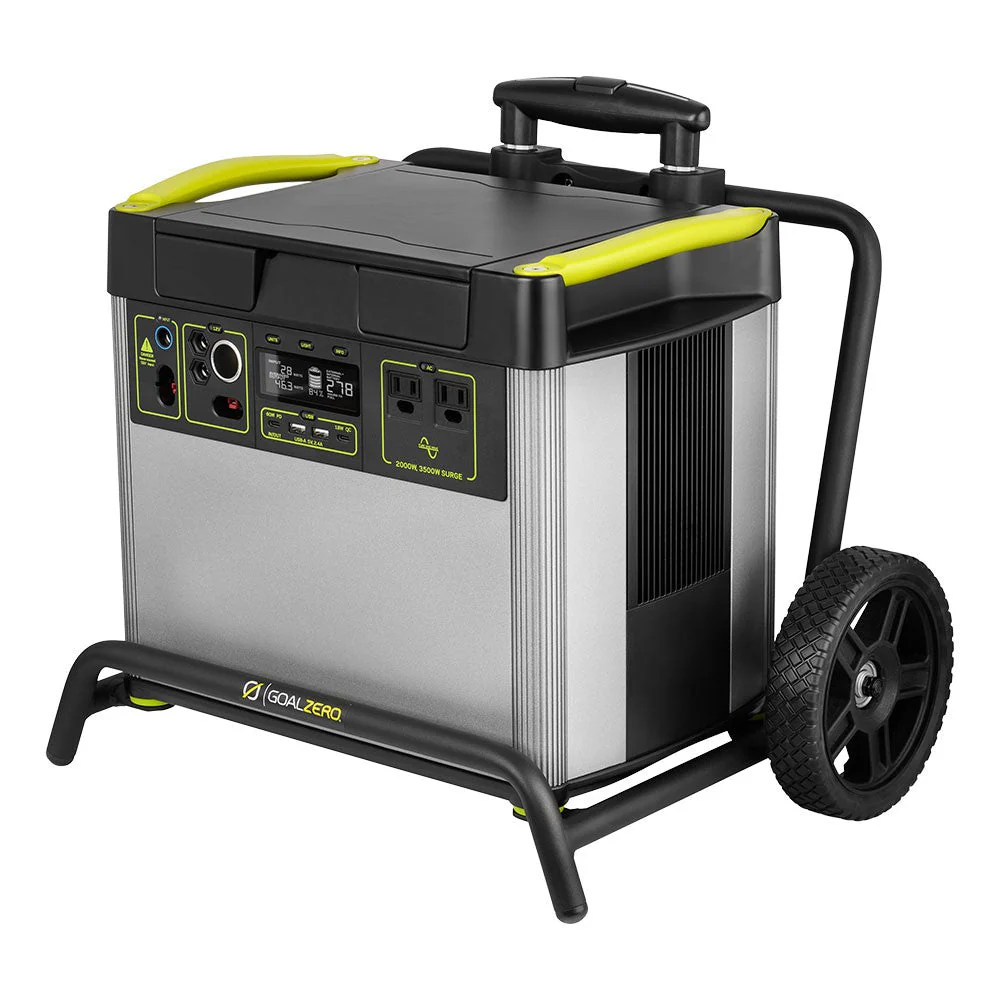
$2,999.95 · direct from Goal Zero
Last checked 1 day ago. Prices move — check before you buy.
Spec deltas
The DELTA 3 Max Plus wins this on the math that follows you home. It's $1,199 to the Yeti 3000X's $3,000, and it's rated for 4,000 charge cycles where the Yeti is rated for 500B1. So the cheaper box is also the one built to last eight times as long: you pay $1,801 less for roughly five times the lifetime energy. Most of this page is footnotes to that.
The Yeti's pushback is capacity, and it's real. It holds 3,032Wh to the DELTA's 2,048Wh, nearly a kilowatt-hour more, and on a single charge with no way to top up it does more work. It clears a 2,100Wh camping weekend the DELTA's base unit comes up 359Wh short of. If your use is one big off-grid pull and then home again, weigh that edge honestly.
Everywhere else the ledger runs one direction. The DELTA is lighter by 19 pounds, takes far more solar (1,000W against 600W), holds its output to 3,000W against 2,000W, carries a five-year warranty to the Yeti's two, and is the only one of the pair that can sit inline as a UPS. The Yeti answers with a bigger battery and a $1,801 bill. Bigger, here, is the expensive choice.
What the Numbers Reveal
Each conclusion stated first — the numbers behind it on one line, the full analysis below.
solar input
But that edge only exists while you can't refill. The DELTA's 2,048Wh takes on up to 1,000W of sun, a bit over two hours in strong light, where the Yeti's 3,032Wh crawls in at 600W, closer to five. The moment a panel or a wall is in reach, the smaller, faster box catches up in a morning, and the DELTA's ceiling climbs toward 10kWhA4 if you ever outgrow it.
Usable energy after the flat 85% derate: Yeti 3000X ~2,577Wh vs DELTA 3 Max Plus ~1,741WhWeekend Camping needs 2,100Wh: the DELTA falls 359Wh short while the Yeti covers it with 477Wh to spareDELTA takes up to 1,000W solar for 2,048Wh; Yeti takes 600W for 3,032Wh
Why it mattersThe only buyer the Yeti's capacity actually serves is the one draining close to 2,500Wh in a single off-grid session with no way to recharge before the next one.
Typical price
Put those together and each usable kilowatt-hour works out to about fifteen cents on the DELTA and a dollar ninety-eight on the Yeti, the same electricity billed roughly thirteen times higher, entirely because a 500-cycle NMC packB1 wears out where a 4,000-cycle one keeps going. At daily use that's 11 years of service against 1.4.
DELTA 3 Max Plus: $1,199, rated for about 8,192 kWh of lifetime energyYeti 3000X: $3,000, rated for about 1,516 kWh of lifetime energy, on a 500-cycle NMC packB1
Why it mattersIf you'll actually cycle this, daily backup or regular trips, the Yeti isn't the premium option. It's the one that costs more to buy and far more to run.
The Yeti lists no UPS mode, so anything plugged into it reboots the moment power fails and waits for you to switch it over. The DELTA's rated 10ms cutover is quick enough on paper that a desktop and a router never notice. The extra reserve is worth little if your PC already restarted, and the DELTA does the ride-through while lasting 4,000 cycles to the Yeti's 500B1 on standby.
8-Hour Blackout: the Yeti finishes at 64% used with 932Wh left; the DELTA at 94% with 96WhDELTA 3 Max Plus lists a switchover rated no worse than 10ms; Yeti 3000X lists no UPS modeYeti rated for 500 cycles on standbyB1
Why it mattersFor home backup behind a desk or a router, the Yeti is out on the UPS spec before price enters. For a cabin you top up by hand and drain slowly, its reserve matters more.
The specific dimensions that decide these two units — everything else is a tie.
Lifetime Value
Selected because: $1,199 against $3,000, 4,000 charge cycles against 500, roughly fifteen cents against a dollar ninety-eight per lifetime kilowatt-hour. The cost of ownership isn't close, and it outlives every other spec on the page.
cost / lifetime kWh
The Yeti 3000X asks $1,801 more up front and then keeps charging you for it. Spread each unit's price across the warranty it ships with and the DELTA works out to about $240 a year of coverage against the Yeti's $1,500. Stretch it across cycle life instead and the pattern holds: 11 years of daily service for the DELTA against about 1.4 for the Yeti before it settles to roughly 80% capacity. This is the thirteen-times gap from the top of the page wearing different clothes. However you slice the cost, the Yeti is the expensive way to store a watt-hour.
Runtime: Will It Power Your Gear?
Selected because: The Yeti 3000X's one genuine advantage: 3,032Wh holds about 836Wh more usable than the DELTA and clears single-charge loads the DELTA's base unit can't.
continuous output
Here's the Yeti's real case, stated as plainly as it deserves: it holds more. After the flat 85% derate both units get, the Yeti has about 2,577Wh usable to the DELTA's 1,741Wh, and that 836Wh is the difference between finishing a 2,100Wh camping weekend and stopping 359Wh short of it. Four of our six scenarios go to the Yeti for exactly this reason, and no cost-per-kWh argument changes the fact that on a single charge it does more work.
What shrinks the edge is how each one refills. The DELTA takes up to 1,000W of solar to the Yeti's 600W, and it has less to replace: 2,048Wh at 1,000W is a two-hour top-up in strong sun, where 3,032Wh at 600W is nearer five. So the Yeti's lead holds only in the narrow window where you drain it once and can't recharge before you need it again. Plug either into a panel or a wall by midday and the smaller box is full first.
What the Specs Don't Tell You
Selected because: Weight (69.8 vs 50.7 lbs), a UPS mode only the DELTA lists, and five-year against two-year warranties. The quiet specs that compound every month you own it.
rated cycles
Three of the smaller specs quietly decide who this is for. Weight: the Yeti is 69.8 lbs and ships with a roll cartB2 because 70 pounds is a two-person lift on anything but flat ground, while the DELTA is 50.7 lbs and you just pick it up. UPS: the DELTA can sit between the wall and your gear and cut over in no worse than 10ms, a rating rather than a stopwatch reading, so a desktop or router rides out the drop, while the Yeti lists no UPS mode at all. Warranty: five years against two. None of these is the headline, but they're the specs you feel every month you own the thing.
Growth Path
Selected because: Both expand, but the DELTA scales toward 10kWh on up to 1,000W of solar while the Yeti's Tank path runs on lead-acid and hands back much of what you add.
solar input
Both units expand, but only one expansion is worth having. The DELTA adds EcoFlow Smart Extra Batteries to climb from 2,048Wh toward 10kWhA4, fed by up to 1,000W of solar as the bank grows. The Yeti expands through Goal Zero's Tank, and the Tank is lead-acid: it hands you only about half the capacity you bolt on and pulls the onboard lithium down to roughly half when it's connectedB4. One path scales. The other adds weight and takes back much of what it gave. If you think you'll grow, that's not a close call.
Strengths & trade-offs
EcoFlow DELTA 3 Max Plus
Strengths
- +Costs $1,800.9 less
- +Lighter by 19.1 lb
- +Higher AC output
- +Longer warranty
- +Faster solar charging
- +Rated for 4,000 charge cycles — much longer battery lifespan
Trade-offs
- –No major technical downsides compared to rival.
Goal Zero Yeti 3000X
Strengths
- +Larger battery capacity
Trade-offs
- –Substantially more expensive (+$1,800.9) than the DELTA 3 Max Plus.
- –Significantly heavier (+19.1 lbs), making it harder to move.
- –Weaker inverter (-1,000W) limits appliance compatibility.
- –Shorter-lived battery — rated for 500 charge cycles vs the DELTA 3 Max Plus's 4,000, so it wears out sooner.
Will It Power Your Gear?
Scenario math and per-appliance runtimes, modeled from the spec record.
Scenario verdicts
We ran the math on six real-world scenarios. Here's which unit survives your actual life.
SCN-01 · 2 nights · needs 2,100Wh
Weekend Camping
Two nights off-grid with essential comfort
Yeti 3000X
This is the Yeti's scenario, and it earns it. A 2,100Wh weekend is more than the DELTA's base unit can finish, and the Yeti clears it with 477Wh still in reserve while the DELTA stops about 359Wh short, roughly a fifth of the way from the end. If your camping looks like one big draw with no midday recharge, the bigger battery is the honest pick here. If a panel comes along by lunch, the DELTA's faster refill erases the gap.
Battery budget usedlower = more headroom
LOAD Phone Charger 15W×6h · LED Lights 40W×8h · Box Fan 75W×14h · CPAP Machine 40W×16h
SCN-02 · 8 hours · needs 1,645Wh
8-Hour Blackout
Keep the essentials running through a night without power
Yeti 3000X
Both survive the night. The Yeti 3000X finishes at 64% used with 932Wh left — 57% of a second night. The DELTA 3 Max Plus finishes at 94% with 96Wh, 6% of a second night. If your outages tend to run past one evening, that difference is the whole argument between them.
Battery budget usedlower = more headroom
LOAD Fridge 150W×8h · Router + Modem 20W×8h · LED Lights (4 bulbs) 40W×6h · Phone Charger 15W×3h
SCN-03 · 8 hours · needs 320Wh
CPAP Overnight
Sleep therapy without interruption — the #1 medical use case
Either unit
Call this a tie and mean it. A CPAP pulls about 40W, so eight hours barely touches either pack: the DELTA ends the night around 18% used and the Yeti near 12%, and capacity decides nothing. Break it on the specs that reach your pillow instead. The DELTA publishes a 30dB floor and the Yeti publishes no noise figure at all, so it's the only one you can vet before it's humming 18 inches from your head. Add the DELTA's lower price and its UPS mode and the tie tips without capacity ever mattering.
Battery budget usedlower = more headroom
LOAD CPAP Machine 40W×8h
SCN-04 · 8 hours · needs 910Wh
Remote Workday
Full work day off-grid without power anxiety
Yeti 3000X
The Yeti 3000X clears the workday at 35% used, banking 1,667Wh — late work, extra calls, or a second laptop charge without arithmetic. The DELTA 3 Max Plus at 52% also finishes, with 831Wh of slack for the unplanned.
Battery budget usedlower = more headroom
LOAD Laptop 60W×8h · External Monitor 30W×8h · Router + Modem 20W×8h · Phone Charger 15W×2h
SCN-05 · 4 hours · needs 670Wh
Tailgate Party
Game day power for the crew
Yeti 3000X
Both handle game day; the Yeti 3000X keeps more in reserve (26% used vs 38%). Tailgating is a light load, though, so the number you'll feel is weight: 50.7 lbs for the DELTA 3 Max Plus against 69.8 lbs for the Yeti 3000X, from the trunk to the setup spot.
Battery budget usedlower = more headroom
LOAD Blender 400W×0.5h · LED TV (55") 80W×4h · Bluetooth Speaker 15W×4h · Phone Charger (×3) 45W×2h
SCN-06 · 24 hours · needs 4,685Wh
Van Life Daily
A full day of mobile living — the ultimate endurance test
Neither unit
Neither box is built for this. The full-time van load here runs 4,685Wh a day, and both come up well short: the DELTA by 2,944Wh, the Yeti by 2,108Wh, so even the bigger one covers only about 55% of the day. Treat either as an essentials-only bridge, not the whole rig, and if this is genuinely your daily draw, look at a stackable platform rather than a single unit.
Battery budget usedlower = more headroom
LOAD Mini-Fridge 150W×24h · Laptop 60W×4h · Phone Charger 15W×3h · LED Lights 40W×5h · Fan 75W×8h
The Load Test
RUNTIME = (Wh × 0.85) ÷ LOAD
None of the scenarios above exactly yours? Build it. Toggle what you'd plug in; both units are tested against the combined draw.
Essentials
Comfort & Convenience
High-Draw Appliances
Test duration
8h
Continuous draw
205W
Projected runtime
For this load: Yeti 3000X runs 12.6h vs 8.5h.
$2,999.95 list · direct from Goal Zero
Modeled from the spec record — same math as the tables below. Methodology
Runtime by appliance
Real-world runtime estimates for common appliances, modeled at 85% inverter efficiency.¹
Essentials
The basics you need runningscale 0–171.8hComfort & Convenience
Makes off-grid life actually enjoyablescale 0–34.4hHigh-Draw Appliances
These reveal the real limitsscale 0–2.6h¹ Runtime = (capacity × 0.85) ÷ appliance watts. Within each group, all bars share one time scale (the group's longest runtime), so lengths are comparable across appliances; identical runtimes collapse into a single blue/orange bar. Actual runtime varies with battery age, temperature, and simultaneous loads — see methodology.
Conclusion
August 30, 2026
Verdict: the DELTA 3 Max Plus
Buy the DELTA 3 Max Plus. The Yeti 3000X's larger 3,032Wh pack genuinely wins the single-charge scenarios, and it finishes a 2,100Wh camping weekend the DELTA's base unit can't. But that's the only column it takes. For $1,801 less up front the DELTA delivers 4,000 cycles against the Yeti's 500 (about 8,192 kWh of lifetime energy to 1,516), carries 19 fewer pounds, charges from up to 1,000W of solar against 600W, and lists a UPS mode rated no worse than 10ms that the Yeti doesn't have at all. Unless you specifically need close to 2,500Wh in a single off-grid pull you can't recharge, the capacity edge never pays for the rest.
Editor-assigned confidence, based on cited owner research and spec analysis.
List prices as of August 30, 2026. The links below open EcoFlow's and Goal Zero's current prices.
$1,199.00 · direct from EcoFlow
Last checked 1 day ago. Prices move — check before you buy.
or check the Yeti 3000X price$2,999.95 list
Written by Gunner Gustafson, Whole-Home Backup Tester · Station Arena Test Desk · Updated August 30, 2026
Measured Data
Benchmark scores and the full spec record, side by side.
Benchmark scores
Not rated for both units (minimum threshold unmet): UPS, CPAP.
Full specifications
ᵈ Derived: price ÷ rated capacity. See the data behind our comparisons →
Comparison ToolAdd more power stations, side by sideOpen Tool →How these numbers are produced
Numeric verification
Every figure on this page traces to our spec database or arithmetic on it — no estimated numbers.
Owner claims
Statements about owner experience are cited to published reviews — see Sources & Research Notes below.
Runtime model
Runtime = (rated capacity × 0.85 inverter efficiency) ÷ device wattage. Solar recharge estimates assume panels deliver 70% of rated output. Cold weather, battery age, and stacked loads reduce real-world results.
Power Score
Computed from 14 published spec dimensions, weighted per use-case bench. Higher is better; a unit must meet a bench's minimum threshold to be rated.
See the full weight table and data sourcing on our methodology page →Class ranking (the star rating)
Each unit's star score is a category ranking, not customer reviews — no buyer opinions feed it. We score every station on size-independent quality (value, output, portability, endurance, ports, warranty, and more), then percentile-rank it against the other units in its capacity class, so a class-leading compact unit and a class-leading whole-home unit can both earn 5★. Here, DELTA 3 Max Plus rates 4.2/5 (52nd percentile of 26 Large-class units), and Yeti 3000X rates 3.3/5 (1st percentile of 26 Large-class units).
How the class ranking is computed →Test Notes & Caveats
Hidden gotchas and advantages we spotted that you won't find on the product page.
Yeti 3000X: 69.8 lbs Is a Commitment
At 69.8 lbs, this is manageable but not fun to move. That's heavier than a large checked suitcase. How much it costs you depends on whether it rolls — wheels and a telescoping handle change the job completely at this weight, and our spec record doesn't track them, so look at the product photos before you plan on carrying it from the car.
Only one of these rides through the outage
The DELTA 3 Max Plus can sit inline between the wall and your gear and hand off to battery in no worse than 10ms when the grid drops, a rating rather than a stopwatch reading, but quick enough on paper that a desktop, router, or CPAP shouldn't notice. The Yeti 3000X lists no UPS mode, so whatever's plugged into it goes dark and reboots at the exact moment you wanted backup. For always-on protection, that single line is the difference between a backup unit and a big battery you have to run to.
Warranty: 5 Years vs 2
The DELTA 3 Max Plus is covered for 5 years against the Yeti 3000X's 2 years. An underrated factor if you're keeping this unit for years.
Same energy, an eighth of the lifespan
The DELTA 3 Max Plus is rated for 4,000 cycles and the Yeti 3000X for 500, the same task with eight times the runway. In daily-use terms that's about 11 years against 1.4, or in weekend terms 38 years against 5. Neither dies at the limit; both settle to roughly 80% capacity and keep going. But one gets there in a decade and the other in a year and a half, and they cost $1,199 and $3,000 to start. Every other spec is arguing over a decision this row already made.
One number on the table, one blank
The DELTA 3 Max Plus publishes a 30dB floor; the Yeti 3000X publishes nothing. That's not proof the Yeti is louder, it's the absence of any figure to hold it to, which is its own problem if the unit is going in a bedroom or next to a CPAP. Read the 30dB as a best-case spec-sheet number rather than a measurement, and go find hands-on impressions of the Yeti before you commit to sleeping beside it.
Full record above — the Test Desk pick is the DELTA 3 Max Plus.
Check DELTA 3 Max Plus price →or check the Yeti 3000X priceOwnership Analysis
What happens after you buy — true cost of ownership, brand trust, and growth potential.
Lifetime value
Service lifeyears at one full cycle per day
Lifetime energy delivered
Cost per delivered kWh
│ warranty ends · Reaching the cycle rating means ~80% capacity remains — degraded, not dead.
Analyst note
The DELTA 3 Max Plus wins on both sticker price and long-term value. At $0.15/kWh over its lifetime, it's meaningfully cheaper to own. Clear value winner.
Delivers each lifetime kWh for $1.83 less — check the DELTA 3 Max Plus price →
Brand trust
EcoFlow
Ecosystem
Largest in portable power — 12-15 models across DELTA Pro, DELTA 3, and RIVER 3 series, plus solar panels and smart home panels
Support
US-based phone, email, and chat. Experiences are genuinely mixed: plenty of painless prepaid-label swaps, but also reports of long waits and refurbished replacements on new claims. Buying through Costco or Amazon gives you a stronger return backstop.
Community
Largest community in the space — Reddit r/Ecoflow_community (~31K members), multiple Facebook groups, and an official community forum
App experience
Rated 4.6/5 iOS (~8,400 ratings) · 4.2/5 Android (~17,000 ratings)
Unique strength
The deepest lineup in portable power and the fastest charging in it, with X-Stream recharge, 12 to 15 models across the DELTA and RIVER series, plus panels and smart-home gear. If you want a platform to grow into, this is the widest one.
Worth knowing
EcoFlow floated a subscription paywall for some advanced app features in early 2025 and paused it after backlash, and it doesn't offer out-of-warranty repair. The app itself rates well, at 4.6 on iOS.
Goal Zero
Ecosystem
Focused — a compact current line (6th-gen Yeti and Yeti Pro series), the previous-gen X series now out of stock across every model on Goal Zero's own store (checked 2026-09-13: 200X, 500X, 1000X, 1500X, 3000X, 6000X, some listed only as open-box), so buying one new means finding retailer stock, Sherpa power banks for the under-100Wh tier, plus Alta coolers, Nomad/Ranger solar panels, and vehicle integration kits
Support
Historically the premium-support name, but 2025 and 2026 reports describe long waits, unanswered email, and tickets sitting for weeks, and the community forums were recently shut down. The pay-more-for-premium-care argument is weaker than it was.
Community
Small but loyal — strong following in overlanding and preparedness communities. Official community forums were recently shuttered, frustrating long-time users.
App experience
Rated 4.4/5 iOS (~1,200 ratings) but recent reviews skew negative — recurring connectivity issues, crashes, and stability problems.
Unique strength
The heritage brand. Goal Zero more or less started this category, and it's still a US company in Salt Lake City building rugged, weather-minded gear with a tight Yeti-ready ecosystem of coolers, lights, and vehicle kits. Overlanders and preppers stay loyal for good reasons.
Worth knowing
Typically the priciest brand per watt-hour, and here that holds. It's also seen as slower to innovate than its faster-moving competitors, and reliability reports on newer models have raised eyebrows. The heritage is real; make sure you're buying it for the ruggedness and not just the name.
Analyst note
Two different bets. EcoFlow sells breadth, speed, and a platform that's iterating fast; Goal Zero sells heritage, ruggedness, and a US-built ecosystem that's coasting a little on both. For this specific matchup the brand story mostly reinforces the spec story: the faster-moving company also brought the cheaper, longer-lived, more capable box.
Growth path
DELTA 3 Max Plus
EXPANDABLESupports EcoFlow expansion batteries, so you can add capacity later without replacing the base unit — useful if your needs may climb past 2,048Wh.
Accepts up to 1,000W of solar. Enough for a serious multi-panel array.
Generous port selection supports complex multi-device setups.
Expansion batteries are EcoFlow-specific. You're investing in the EcoFlow ecosystem.
Yeti 3000X
EXPANDABLESupports Goal Zero expansion batteries, so you can add capacity later without replacing the base unit — useful if your needs may climb past 3,032Wh.
Accepts up to 600W of solar. Suitable for a 1-2 panel setup.
Adequate ports for most setups, but heavy users may want a power strip.
Expansion batteries are Goal Zero-specific. You're investing in the Goal Zero ecosystem.
Realistic full solar rechargeat 70% of rated panel output — see methodology
Analyst note
Both expand, but the DELTA 3 Max Plus's higher solar ceiling (1,000W vs 600W) gives it the stronger off-grid growth path — more panels can feed a bigger bank as it grows.
What Owners Report
Patterns from published owner reports and long-term reviews — every claim cited to its source below.
EcoFlow DELTA 3 Max Plus
Field data on the DELTA 3 Max Plus is still mostly professional review coverage rather than years of owner reports, since it's a newer unit, and our read of that coverage is consistently positiveA0. Reviewers single out the output jump to 3,000W continuous with a 6,000W surge as a real step up over the plain MaxA1, and note it stays genuinely quiet even charging at full tilt, with the fans barely rising above room noise at a meterA2. Charge speed backs the spec sheet: about 80% in 50 minutes and full in roughly 70A3. The expansion story checks out too, with reviewers describing the scale toward 10kWh via Smart Extra Batteries as polished and effortlessA4.
“Bumps output to 3,000W continuous with a 6,000W surge — a significant upgrade over the DELTA 3 Max's 2,400W and 4,800W surge.”
Sources
storagereview.com · androidguys.com · t3.com · trustedreviews.com
Goal Zero Yeti 3000X
The Yeti 3000X's field reputation centers on one number and one problem. The number is capacity: 3,032Wh with a 2,000W inverter and 3,500W surge, a genuinely large packB3. The problem is the chemistry under it, an older Li-ion NMC cell rated for roughly 500 cycles to 80% capacity where modern LiFePO4 units run past 3,000B1. Reviewers also flag the practical stuff: it's about 70 pounds and comes with a roll cart you'll actually needB2, and its Tank expansion is lead-acid, giving only about 50% usable capacity while halving the onboard lithium when attachedB4. Nothing here is a defect so much as a design the calendar has passed.
“A roughly 70-pound unit that comes with a roll cart, essential to move it around.”
Sources
poweredportablesolar.com · bestgeneratorsolar.com · shopsolarkits.com · rei.com · goalzero.com · protoolreviews.com
Sources & Research Notes
Every owner claim in this report is traceable to a published source. The bracketed references above resolve here.
Recurring owner themes
- The Max Plus delivers more output and surge than the Max, plus a larger expansion ceiling, while staying quiet and fast-charging — a polished, higher-power take on the same platform. [DELTA 3 Max Plus · 3 entries]
- Large NMC capacity but a crippling 500-cycle rating, heavy weight (roll cart needed), and a limited lead-acid expansion path are the recurring points. [Yeti 3000X · 3 entries]
- A1
“Bumps output to 3,000W continuous with a 6,000W surge — a significant upgrade over the DELTA 3 Max's 2,400W and 4,800W surge.”
storagereview.com / androidguys.com — DELTA 3 Max Plus review · 2026 · [positive]
- A2
“Stays genuinely quiet under typical loads, only spinning up its fans briefly during shutdown; even charging at full power the decibel meter barely registered above room noise at one meter.”
t3.com / trustedreviews.com — DELTA 3 Max Plus review · 2026 · [positive]
- A3
“Fast charging — reached 80% in about 50 minutes and full in around 70 minutes.”
t3.com — DELTA 3 Max Plus review · 2026 · [positive]
- A4
“Scalable — supports expandable capacity from 2kWh up to 10kWh via Smart Extra Batteries, with 5 charging methods; reviewers describe it as polished and effortless.”
storagereview.com / t3.com — DELTA 3 Max Plus review · 2026 · [positive]
- B1
“Its biggest drawback is the Li-ion NMC battery rated for only 500 cycles to 80% capacity, where LiFePO4 power stations last 3,000+ cycles.”
poweredportablesolar.com / bestgeneratorsolar.com — Yeti 3000X review · 2026 · [negative]
- B2
“A roughly 70-pound unit that comes with a roll cart, essential to move it around.”
shopsolarkits.com / rei.com — Yeti 3000X review · 2026 · [mixed]
- B3
“3,032Wh capacity with a 2,000W continuous inverter and 3,500W surge.”
goalzero.com / protoolreviews.com — Yeti 3000X specifications · 2026 · [positive]
- B4
“Expandable via the Goal Zero Tank system, but the Tank uses lead-acid batteries that allow only ~50% usable capacity and halve the onboard lithium capacity when connected — a limited expansion path.”
poweredportablesolar.com — Yeti 3000X / Tank review · 2026 · [negative]
Research compiled August 30, 2026.
Who Should Buy Which
Buy the DELTA 3 Max Plus if you…
- →Buy the DELTA 3 Max Plus if you'll cycle it regularly, whether that's daily grid backup, frequent camping, or jobsite weeks. At 4,000 cycles it's the one still working in a decade.
- →Buy it for home backup behind a desk or entertainment center. The rated 10ms UPS mode keeps a desktop, router, or CPAP alive through the cutover the Yeti can't manage.
- →Buy it if you might grow. It scales toward 10kWhA4 on up to 1,000W of solar, so today's 2,048Wh isn't a ceiling.
- →Buy it if you carry it a lot. 50.7 lbs is a one-person lift; 69.8 is not.
Buy the Yeti 3000X if you…
- →Buy the Yeti 3000X only if you routinely need close to its full 3,032Wh in a single off-grid charge you can't top up: one long pull, home again, and rarely enough that 500 cyclesB1 stays years away.
- →Buy it if you're already in the Goal Zero world, with Tank batteries, Nomad panels, and Yeti-ready gear, and want one more piece that speaks to the kit you own, and the $1,801 premium doesn't sting.
If neither fits
Skip both if your real load is van-life scale. Neither finishes the 4,685Wh day in our daily-driver scenario, with the DELTA 2,944Wh short and the Yeti 2,108Wh, so you want a bigger platform or a multi-battery setup, such as an expandable DELTA stack or a DELTA Pro-class unit, rather than either of these single boxes carried past what they're built for.
The Bottom Line
Take the DELTA 3 Max Plus. The Yeti 3000X gives you one thing, a bigger battery for a single charge, and charges $1,801 for it while asking you to accept 500 cycles, no UPS, an extra 19 pounds, and an expansion path that runs on lead-acid. The DELTA answers with 4,000 cycles, a rated 10ms cutover, and about fifteen cents of lifetime cost per kilowatt-hour against a dollar ninety-eight.
The one honest reason to pause is capacity. If you truly need close to 2,500Wh in a single off-grid pull you can't recharge, the Yeti covers ground the DELTA's base unit doesn't, and you should buy it without regret. For everyone else, every buyer who plugs in near sun or a wall, or wants this thing still working in ten years, the smaller, cheaper, longer-lived box wins going away. Bigger was the only round the Yeti won, and it's the one that costs the most.
Frequently Asked Questions
Answers drawn from the spec record and cited owner research.
Is the Goal Zero Yeti 3000X worth $3,000 next to the DELTA 3 Max Plus?
For most buyers, no. The DELTA 3 Max Plus is $1,199, holds output to 3,000W, lasts 4,000 cycles to the Yeti's 500, and adds a UPS mode the Yeti lacks. The Yeti's case is its larger 3,032Wh pack for single-charge use, which is real, but a narrow reason to spend $1,801 more.
Which lasts longer, the DELTA 3 Max Plus or the Yeti 3000X?
The DELTA, by a wide margin. It's rated for 4,000 charge cycles against the Yeti's 500, which at daily use is roughly 11 years versus 1.4. Both keep about 80% capacity after that, but the DELTA gets there eight times slower.
Does the Yeti 3000X have a UPS or battery-backup mode?
No. Its spec sheet lists no UPS mode, so gear plugged into it will reboot when grid power drops and wait for you to switch it over. The DELTA 3 Max Plus lists a switchover rated no worse than 10ms, treated as a rating rather than a measured result, quick enough on paper for a desktop or router to ride through. For always-on backup, that's a real divider.
The Yeti holds more power, so why is the DELTA still the pick?
Because holding more only helps on a single charge you can't refill. The Yeti's 3,032Wh beats the DELTA's 2,048Wh in one pull, but the DELTA takes up to 1,000W of solar to the Yeti's 600W and has less to refill, so it's full first whenever sun or a wall is nearby. It also costs $1,801 less and lasts eight times as many cycles doing it.
Can you expand the Goal Zero Yeti 3000X's capacity?
Yes, through the Goal Zero Tank, but it's a lead-acid battery that gives you only about half the capacity you add and pulls the onboard lithium down to roughly half when connected. The DELTA 3 Max Plus expands with lithium Smart Extra Batteries toward 10kWh instead. Both technically expand; only one expands into something you'd want.
Where to buy
EcoFlow DELTA 3 Max PlusPick
$1,199.00
$1,199.00 · direct from EcoFlow
Last checked 1 day ago. Prices move — check before you buy.
Goal Zero Yeti 3000X
$2,999.95
$2,999.95 · direct from Goal Zero
Last checked 1 day ago. Prices move — check before you buy.
Prices may vary by retailer and are subject to change.