Head-to-head test
EcoFlow DELTA 3 Max Plus vs EcoFlow RIVER 2 Pro
Of the six loads modeled on this page the RIVER 2 Pro clears exactly one, so the only question that decides this is whether your list is that short.
Full profiles: EcoFlow DELTA 3 Max Plus → · EcoFlow RIVER 2 Pro →

Written by Ian SchneiderUpdated
Solar & Off-Grid Tester, Station Arena Test Desk

$1,199.00 · direct from EcoFlow
Last checked 1 day ago. Prices move — check before you buy.
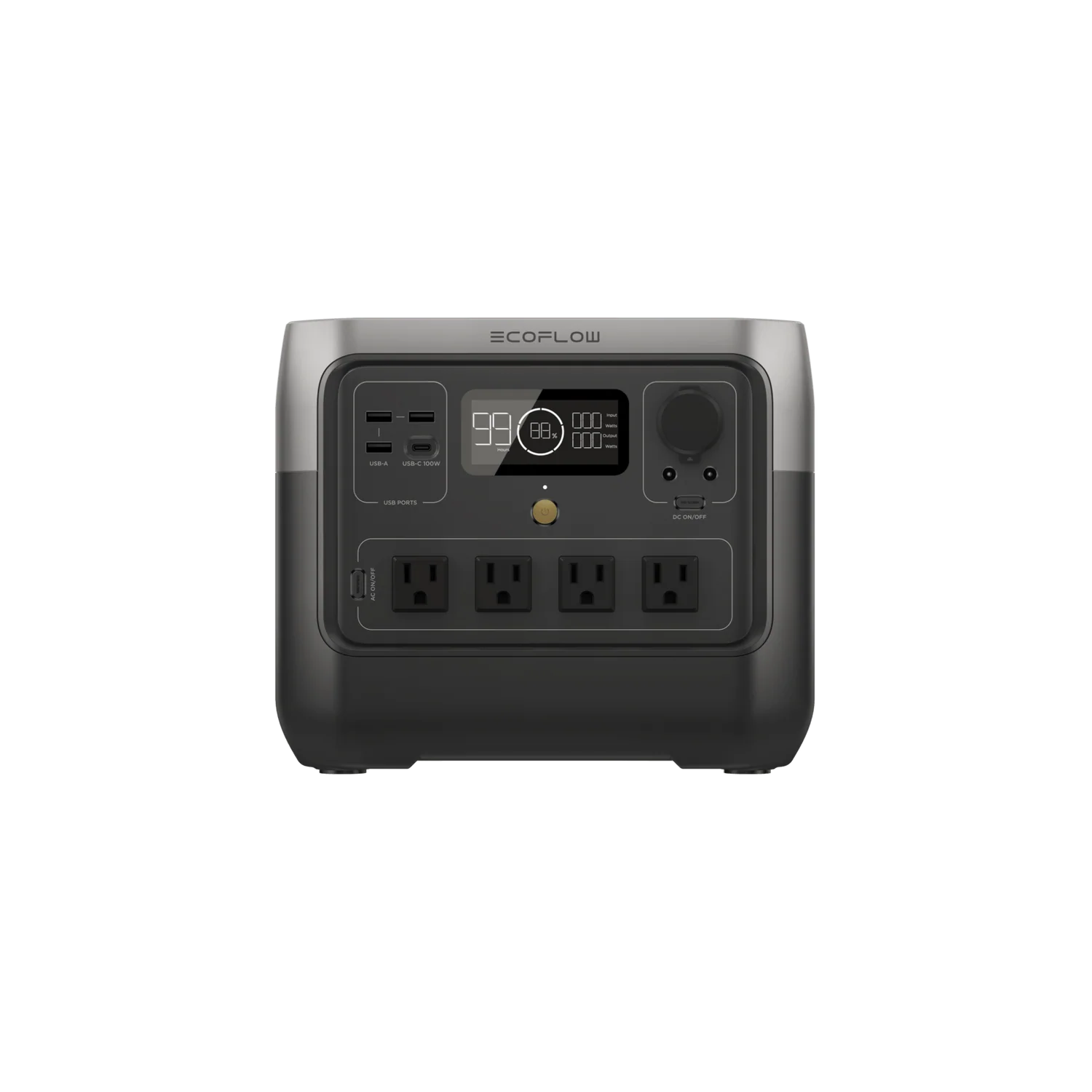
$389.00 · direct from EcoFlow
Last checked 1 day ago. Prices move — check before you buy.
Spec deltas
Take the DELTA 3 Max Plus, unless your entire load list fits inside one CPAP night. That isn't a figure of speech. Of the six scenarios modeled on this page, the RIVER 2 Pro's 768Wh clears one of them; the DELTA clears four, and the two it misses are ones nothing in this size class wins.
The lifetime-cost column hands the DELTA the win too, and it's the least important thing here. Two cents per delivered kilowatt-hour is the entire margin, and it never grows into real money beside the $850 that separates these at the register. Running costs aren't deciding this. A load list is.
The RIVER's real case is that it weighs 17.2 lb and the DELTA weighs 50.7. One goes in a hand. The other goes in a trunk, once. If your power needs are a phone, a laptop and a CPAP, the small one is the right answer and the rest of this page is you talking yourself out of a good purchase.
What the Numbers Reveal
Each conclusion stated first — the numbers behind it on one line, the full analysis below.
That distinction decides the purchase, because inverter limits are about what you plug in and battery limits are about how long you leave it there, and only one of those has a fix. The DELTA's answer to "I need more" is a Smart Extra BatteryA4. The RIVER's answer is a second RIVER. Watch it happen on the Tailgate Party load: 670Wh is 103% of what the RIVER can deliver, so it starts the party and quits three percentage points short of the end.
RIVER 2 Pro: 800W continuous output, 1,600W surgeThe engine marks the RIVER 2 Pro able to power the peak load in all six scenariosThe RIVER 2 Pro clears only CPAP Overnight on capacity (49%); the other five land between 103% and 718%RIVER 2 Pro: not expandable, fixed at 768Wh
Why it mattersIf your list is small and stays small, the RIVER's ceiling is fine. If it's a list that grows, this is the one purchase on the page you can't add to.
rated cycles
Then the flip turns out not to matter. Two cents across the 2,304 kWh the RIVER will ever deliver comes to about $46 (2,304 × $0.02), roughly one-sixteenth of the $850 between them at checkout. The lifetime-value section crowns the DELTA the cheaper unit to own on a margin you could lose in a tank of gas.
RIVER 2 Pro: $349, $0.45 per watt-hour of capacityDELTA 3 Max Plus: $1,199, $0.54 per watt-hour of capacityCycle life: 4,000 for the DELTA against 3,000 for the RIVERLifetime energy: 8,192 kWh against 2,304 kWh; $0.13 against $0.15 per delivered kWh
Why it mattersDon't let the cost-per-kilowatt-hour column pick this for you. Buy the DELTA for what it runs or keep the $850, but don't buy either one to save money per kilowatt-hour.
The recharge is the loud partB2, which puts the unit that must recharge daily and the 62 dB fan in the same story, on the same nightstand. One owner disliked that fan enough to open the case, cut away internal plastic and fit a quieter oneB1. In a blackout you don't get to schedule the refill for while you're out of the room.
RIVER 2 Pro rated 62 dBA; up to 62 dB specifically when charging or discharging at high wattageB2DELTA 3 Max Plus rated 30 dBA; testers with meters barely separated it from room noise at one meter even at full chargeA2CPAP Overnight needs 320Wh: 18% of what the DELTA delivers, 49% of the RIVERRIVER 2 Pro: 768Wh fixed capacity
Why it mattersThe buyer sleeping two feet from the box should spend the $850, or at minimum plan on recharging the RIVER somewhere that isn't the bedroom.
solar input
Over a multi-day outage that inverts what portable means. The DELTA covers a full outage day at 94% and buys the whole thing back over a morning. The RIVER covers under half of that same day, then spends longer than the DELTA did recovering roughly a third as much energy. Day two the gap is wider than day one, and it keeps widening.
DELTA 3 Max Plus: 2,048Wh capacity, 1,000W maximum solar inputRIVER 2 Pro: 768Wh capacity, 220W maximum solar input8-Hour Blackout needs 1,645Wh: 94% of what the DELTA delivers, 252% of the RIVER
Why it mattersAnyone buying for storm season rather than picnics should stop comparing capacity and start comparing refill rate.
The specific dimensions that decide these two units — everything else is a tie.
Your Life, Your Pick
Selected because: The RIVER 2 Pro covers one of the six modeled loads and the DELTA 3 Max Plus covers four. That is the comparison.
The scoreboard reads four to one with two abstentions, and the abstentions are the honest part. Weekend Camping wants 2,100Wh and Van Life Daily wants 4,685Wh; the DELTA lands at 121% and 269% of what it can deliver, so it loses those too. It just loses them by less.
What separates them is the middle of the list. An 8-hour outage at 1,645Wh sits at 94% for the DELTA, which is what covered actually looks like: finished, with nothing to spare. The RIVER is at 252% of the same load. A remote workday is 139% of it. A tailgate is 103%, and that's the cruelest number on the page, because the RIVER 2 Pro misses a tailgate by three percentage points.
Runtime: Will It Power Your Gear?
Selected because: Refill rate splits these harder than capacity does: 1,000W of solar input against 220W.
continuous output
Refilling is where the size difference stops behaving the way you'd expect. 2,048Wh through a 1,000W solar input is about two hours from empty; 768Wh through 220W is about three and a half. The smaller battery is the one that spends the afternoon tethered to a panel. On AC it isn't close either, with the DELTA measured at 80% in roughly 50 minutes and full in about 70A3.
Low-draw runtime genuinely flatters the RIVER, and that's worth saying: 320Wh overnight is 49% of it, so a CPAP or a router gets a full night out of a 17.2 lb box you carried in one hand. Add a compressor or a heating element and the two stop being close and start being different categories of product.
Portability & Form Factor
Selected because: 17.2 lb against 50.7 lb is the RIVER 2 Pro's entire case, and it's a real one.
weight
Seventeen pounds is a one-hand carry from the trunk to the picnic table. Fifty is a two-hands, bent-knees lift you perform once and then leave wherever you set it down. That 33.5 lb difference is the RIVER's whole argument, and it's a good one, because the unit you actually bring beats the unit that stayed in the garage.
It's also why buy the bigger one isn't automatic here. Nothing about 50.7 lb is difficult for a healthy adult with a car. Everything about it is difficult for one person, up basement stairs, in the dark, at the far end of a campsite.
What the Specs Don't Tell You
Selected because: A 30 dBA rating against 62 matters most in the one scenario the RIVER 2 Pro actually clears.
rated cycles
Sixty-two decibels is a conversation happening in your bedroom. That's the RIVER 2 Pro's rating when it's charging or discharging hardB2, and one owner responded by opening the case and fitting a quieter fanB1. The DELTA is rated 30 dBA, and testers with meters couldn't cleanly separate it from room noise at one meter even at full chargeA2.
The rest of the flags are quieter. A 10ms transfer against 30ms, a fixed 768Wh against an expandable base, identical 5-year warranties. None of them would move a buyer on its own, and stacked beside a 62 dB fan they don't have to.
Lifetime Value
Selected because: Cost per delivered kilowatt-hour separates these by two cents, worth seeing precisely so you can stop weighing it.
Both of these outlive the reason you bought them. The DELTA's 4,000 cycles work out to about 11 years of daily use and the RIVER's 3,000 to about 8.2, against a 5-year warranty on each. You'll replace these for reasons that have nothing to do with dead cells.
Which makes the cheaper-to-own verdict a technicality. The DELTA wins the per-delivered-kilowatt-hour column by two cents, and two cents never catches $850. Spend the difference on capability or keep it in your pocket, but don't file either choice under investment.
Strengths & trade-offs
EcoFlow DELTA 3 Max Plus
Strengths
- +Larger battery capacity
- +Higher AC output
- +Faster solar charging
- +Rated for 4,000 charge cycles — much longer battery lifespan
Trade-offs
- –Substantially more expensive (+$850) than the RIVER 2 Pro.
- –Significantly heavier (+33.5 lbs), making it harder to move.
EcoFlow RIVER 2 Pro
Strengths
- +Costs $850 less
- +Lighter by 33.5 lb
Trade-offs
- –Weaker inverter (-2,200W) limits appliance compatibility.
- –Can receive complaints about fan noise under heavy load.
- –Sealed capacity — the DELTA 3 Max Plus can add batteries to grow past 768Wh; this one can't.
- –Shorter-lived battery — rated for 3,000 charge cycles vs the DELTA 3 Max Plus's 4,000, so it wears out sooner.
Will It Power Your Gear?
Scenario math and per-appliance runtimes, modeled from the spec record.
Scenario verdicts
We ran the math on six real-world scenarios. Here's which unit survives your actual life.
SCN-01 · 2 nights · needs 2,100Wh
Weekend Camping
Two nights off-grid with essential comfort
Neither unit
Nobody wins this one. A weekend asks for 2,100Wh, which is 121% of what the DELTA 3 Max Plus can put out and 322% of the RIVER 2 Pro. Both come up short, but short by 21 points and short by three times over are different problems: one is a mid-weekend top-up through a 1,000W solar input, the other is a dark campsite on Saturday night.
Battery budget usedlower = more headroom
LOAD Phone Charger 15W×6h · LED Lights 40W×8h · Box Fan 75W×14h · CPAP Machine 40W×16h
SCN-02 · 8 hours · needs 1,645Wh
8-Hour Blackout
Keep the essentials running through a night without power
DELTA 3 Max Plus
This is the scenario the DELTA 3 Max Plus exists for. An 8-hour outage draws 1,645Wh, or 94% of what it can deliver, so it finishes the outage with the tank nearly empty and the lights never off. The RIVER 2 Pro is at 252% of the same load, which covers under half the night and then hands you a flashlight.
Battery budget usedlower = more headroom
LOAD Fridge 150W×8h · Router + Modem 20W×8h · LED Lights (4 bulbs) 40W×6h · Phone Charger 15W×3h
SCN-03 · 8 hours · needs 320Wh
CPAP Overnight
Sleep therapy without interruption — the #1 medical use case
DELTA 3 Max Plus
Both clear a night, so this comes down to the second one. A CPAP night is 18% of the DELTA 3 Max Plus and 49% of the RIVER 2 Pro, meaning one goes about five nights on a charge and the other about two. When an outage runs longer than a single night, the DELTA is the one you don't lie awake doing math about.
Battery budget usedlower = more headroom
LOAD CPAP Machine 40W×8h
SCN-04 · 8 hours · needs 910Wh
Remote Workday
Full work day off-grid without power anxiety
DELTA 3 Max Plus
A full remote workday comes to 910Wh: 52% of the DELTA 3 Max Plus and 139% of the RIVER 2 Pro. The DELTA signs off at about half charge. The RIVER 2 Pro doesn't make it to signing off, which turns lunch into a charging break whether or not you wanted one.
Battery budget usedlower = more headroom
LOAD Laptop 60W×8h · External Monitor 30W×8h · Router + Modem 20W×8h · Phone Charger 15W×2h
SCN-05 · 4 hours · needs 670Wh
Tailgate Party
Game day power for the crew
DELTA 3 Max Plus
The RIVER 2 Pro misses this by three percentage points. A tailgate draws 670Wh, which is 103% of what it can deliver and 38% of the DELTA 3 Max Plus. Three points is nothing, and it's still the wrong side of the line, with the speaker cutting out somewhere in the fourth quarter.
Battery budget usedlower = more headroom
LOAD Blender 400W×0.5h · LED TV (55") 80W×4h · Bluetooth Speaker 15W×4h · Phone Charger (×3) 45W×2h
SCN-06 · 24 hours · needs 4,685Wh
Van Life Daily
A full day of mobile living — the ultimate endurance test
Neither unit
Neither of these is a van's electrical system. Daily van living wants 4,685Wh, or 269% of the DELTA 3 Max Plus and 718% of the RIVER 2 Pro. The difference is that the DELTA takes EcoFlow expansion batteries and can be grown toward that number, while the RIVER 2 Pro is sealed at 768Wh. Neither wins today. Only one has a route.
Battery budget usedlower = more headroom
LOAD Mini-Fridge 150W×24h · Laptop 60W×4h · Phone Charger 15W×3h · LED Lights 40W×5h · Fan 75W×8h
The Load Test
RUNTIME = (Wh × 0.85) ÷ LOAD
None of the scenarios above exactly yours? Build it. Toggle what you'd plug in; both units are tested against the combined draw.
Essentials
Comfort & Convenience
High-Draw Appliances
Test duration
8h
Continuous draw
205W
Projected runtime
For this load: DELTA 3 Max Plus runs 8.5h vs 3.2h.
$1,199 list · direct from EcoFlow
Modeled from the spec record — same math as the tables below. Methodology
Runtime by appliance
Real-world runtime estimates for common appliances, modeled at 85% inverter efficiency.¹
Essentials
The basics you need runningscale 0–116.1hComfort & Convenience
Makes off-grid life actually enjoyablescale 0–23.2hHigh-Draw Appliances
These reveal the real limitsscale 0–1.7h¹ Runtime = (capacity × 0.85) ÷ appliance watts. Within each group, all bars share one time scale (the group's longest runtime), so lengths are comparable across appliances; identical runtimes collapse into a single blue/orange bar. Actual runtime varies with battery age, temperature, and simultaneous loads — see methodology.
Conclusion
August 1, 2026
Verdict: the DELTA 3 Max Plus, on Power Score margin
The DELTA 3 Max Plus covers four of the six scenarios modeled here and the RIVER 2 Pro covers one, which is the whole argument: 2,048Wh against 768Wh, with 3,000W of output behind it against 800W. The lifetime-cost column also favors the DELTA at 13 cents per delivered kilowatt-hour against 15, but a two-cent margin is not why anyone buys a power station. Confidence sits at 7 rather than 9 because the RIVER 2 Pro isn't beaten so much as smaller: at $349 and 17.2 lb it's the right unit for a short, stable load list, and $850 is real money to spend on headroom you may never reach. Decide by writing down what you'll actually plug in. If an 8-hour outage, a fridge, or a full workday is on that list, the RIVER 2 Pro can start those loads but can't carry them to the end.
Editor-assigned confidence, based on cited owner research and spec analysis.
List prices as of August 1, 2026. The links below open EcoFlow's current price.
$1,199.00 · direct from EcoFlow
Last checked 1 day ago. Prices move — check before you buy.
or check the RIVER 2 Pro price$389.00 list
Written by Ian Schneider, Solar & Off-Grid Tester · Station Arena Test Desk · Updated August 1, 2026
Measured Data
Benchmark scores and the full spec record, side by side.
Benchmark scores
Not rated for both units (minimum threshold unmet): UPS, RV Living, Home Backup, Food Truck, Camping.
Full specifications
ᵈ Derived: price ÷ rated capacity. See the data behind our comparisons →
Comparison ToolAdd more power stations, side by sideOpen Tool →How these numbers are produced
Numeric verification
Every figure on this page traces to our spec database or arithmetic on it — no estimated numbers.
Owner claims
Statements about owner experience are cited to published reviews — see Sources & Research Notes below.
Runtime model
Runtime = (rated capacity × 0.85 inverter efficiency) ÷ device wattage. Solar recharge estimates assume panels deliver 70% of rated output. Cold weather, battery age, and stacked loads reduce real-world results.
Power Score
Computed from 14 published spec dimensions, weighted per use-case bench. Higher is better; a unit must meet a bench's minimum threshold to be rated.
See the full weight table and data sourcing on our methodology page →Class ranking (the star rating)
Each unit's star score is a category ranking, not customer reviews — no buyer opinions feed it. We score every station on size-independent quality (value, output, portability, endurance, ports, warranty, and more), then percentile-rank it against the other units in its capacity class, so a class-leading compact unit and a class-leading whole-home unit can both earn 5★. Here, DELTA 3 Max Plus rates 4.2/5 (52nd percentile of 26 Large-class units), and RIVER 2 Pro rates 4.7/5 (84th percentile of 20 Compact-class units).
How the class ranking is computed →Test Notes & Caveats
Hidden gotchas and advantages we spotted that you won't find on the product page.
62 dB is a conversation you didn't invite
The RIVER 2 Pro is rated up to 62 dB when it's charging or discharging at high wattage. The DELTA 3 Max Plus is rated 30 dBA. That gap is irrelevant in a garage and decisive in a bedroom, and a 768Wh unit tends to end up in the bedroom: running a CPAP, refilling overnight, two feet from your head.
Fixed at 768Wh, which is fine until it isn't
The RIVER 2 Pro can't take an expansion battery, and that's only a con if you expected to grow it. At 768Wh and $349 it's a finished object rather than a platform, priced accordingly. The DELTA 3 Max Plus starts at 2,048Wh and accepts EcoFlow expansion batteries on top. The reason to care isn't that expandability is a nice word, it's that the expanded ceiling reaches loads neither unit reaches today.
10ms against 30ms, and who actually notices
Thirty milliseconds is invisible to a laptop, which carries its own battery, and to most small wall-wart gear. The machine that notices is the desktop tower with nothing to coast on. If a PC is the reason you're shopping for backup at all, the DELTA 3 Max Plus's 10ms handoff is the one that keeps it running instead of rebooting.
Warranty: No Difference
Both units carry the same 5-year warranty, so coverage isn't a tiebreaker here. Worth saying because the per-dollar framing can suggest otherwise: the RIVER 2 Pro works out at 14.3 years of cover per $1,000 spent against the DELTA 3 Max Plus's 4.2, but that spread is the price gap, not the terms.
Both outlast the warranty by years
Cycled daily, the DELTA 3 Max Plus's 4,000 cycles run about 11 years and the RIVER 2 Pro's 3,000 run about 8.2, against a 5-year warranty on both. Cycle life doesn't decide this comparison. It only promises that whichever one you pick will still be working long after you've stopped thinking about which one you picked.
Full record above — the Test Desk pick is the DELTA 3 Max Plus.
Check DELTA 3 Max Plus price →or check the RIVER 2 Pro priceOwnership Analysis
What happens after you buy — true cost of ownership, brand trust, and growth potential.
Lifetime value
Service lifeyears at one full cycle per day
Lifetime energy delivered
Cost per delivered kWh
│ warranty ends · Reaching the cycle rating means ~80% capacity remains — degraded, not dead.
Analyst note
Both units cost the same to own over their rated lives — $0.15/kWh each. Lifetime cost can't separate them, so decide on the sticker price and everything else.
Growth path
DELTA 3 Max Plus
EXPANDABLESupports EcoFlow expansion batteries, so you can add capacity later without replacing the base unit — useful if your needs may climb past 2,048Wh.
Accepts up to 1,000W of solar. Enough for a serious multi-panel array.
Generous port selection supports complex multi-device setups.
Expansion batteries are EcoFlow-specific. You're investing in the EcoFlow ecosystem.
RIVER 2 Pro
FIXED CAPACITYFixed at 768Wh, with no expansion — so size it for your needs up front rather than planning to add capacity later.
Accepts up to 220W of solar. Limited to a single portable panel.
Adequate ports for most setups, but heavy users may want a power strip.
Realistic full solar rechargeat 70% of rated panel output — see methodology
Analyst note
The RIVER 2 Pro is sealed at 768Wh, which is fine if that covers you. The DELTA 3 Max Plus starts at 2,048Wh and can grow beyond it with EcoFlow expansion batteries — real headroom the RIVER 2 Pro doesn't have if your needs climb toward partial-home backup.
What Owners Report
Patterns from published owner reports and long-term reviews — every claim cited to its source below.
EcoFlow DELTA 3 Max Plus
Field evidence on the Max Plus is review-desk evidence, not three-winters-in evidence, and it's consistent as far as it goes. Testers describe a unit that stays genuinely quiet under normal loads, with a meter barely separating it from room noise at one meter even while charging at full powerA2, and one that refills fast: 80% in about 50 minutes, full in around 70A3. The step to 3,000W continuous and 6,000W surge over the DELTA 3 Max is the change reviewers keep returning toA1, alongside an expansion path running from 2kWh to 10kWh on Smart Extra Batteries that they describe as effortless in practiceA4. What nobody can tell you yet is how it behaves in year fourA1A4.
“Bumps output to 3,000W continuous with a 6,000W surge — a significant upgrade over the DELTA 3 Max's 2,400W and 4,800W surge.”
Sources
storagereview.com · androidguys.com · t3.com · trustedreviews.com
EcoFlow RIVER 2 Pro
The RIVER 2 Pro's field record is thin, and what exists is mostly about the fan. Its own spec footnotes concede up to 62 dB when charging or discharging at high wattageB2, and at least one owner cared enough to perform a fan swap that involved cutting away internal plasticB1. That's the one clear pattern: the noise is real, acknowledged, and severe enough that people modify the unit over itB1B2.
Beyond the fan, confidently model-verified reports are scarce, because most forum discussion blends the RIVER 2, RIVER 2 Max and RIVER 2 Pro together. The two other entries that survived vetting are a van-dwelling CPAP user in a RIVER 2 Pro thread who runs an AirSense 11 overnight through a DC-DC cable without troubleB4, and an owner asking whether leaving it in UPS mode shortens battery lifeB3. Four entries is a thin ledger, and it's thin because the honest ones were the only ones countedB1B2B3B4.
“Will using River 2 Pro as a UPS affect battery life ...”
Sources
ctrl-alt-rees.com
Sources & Research Notes
Every owner claim in this report is traceable to a published source. The bracketed references above resolve here.
Recurring owner themes
- The Max Plus delivers more output and surge than the Max, plus a larger expansion ceiling, while staying quiet and fast-charging — a polished, higher-power take on the same platform. [DELTA 3 Max Plus · 3 entries]
- Fan noise at high wattage charging/discharging is a consistent owner and manufacturer-acknowledged complaint, severe enough that some owners physically mod the unit with quieter fans. [RIVER 2 Pro · 2 entries]
- A1
“Bumps output to 3,000W continuous with a 6,000W surge — a significant upgrade over the DELTA 3 Max's 2,400W and 4,800W surge.”
storagereview.com / androidguys.com — DELTA 3 Max Plus review · 2026 · [positive]
- A2
“Stays genuinely quiet under typical loads, only spinning up its fans briefly during shutdown; even charging at full power the decibel meter barely registered above room noise at one meter.”
t3.com / trustedreviews.com — DELTA 3 Max Plus review · 2026 · [positive]
- A3
“Fast charging — reached 80% in about 50 minutes and full in around 70 minutes.”
t3.com — DELTA 3 Max Plus review · 2026 · [positive]
- A4
“Scalable — supports expandable capacity from 2kWh up to 10kWh via Smart Extra Batteries, with 5 charging methods; reviewers describe it as polished and effortless.”
storagereview.com / t3.com — DELTA 3 Max Plus review · 2026 · [positive]
- B1
“I've since performed the same mod on my RIVER 2 PRO and it works great for that unit, too - although it did involve cutting away some of the internal plastic.”
ctrl-alt-rees.com blog — 'EcoFlow RIVER 2 Noisy Fan Fix!' · 2022-11-17 · [negative]
- B2
“When charging and discharging at high wattage, RIVER 2 Max and RIVER 2 Pro may make a noise up to 62db.”
EcoFlow official product page — RIVER 2 Series specs/FAQ footnotes · unknown · [negative]
- B3
“Will using River 2 Pro as a UPS affect battery life ...”
Facebook — EcoFlow Club group post title · unknown · [mixed]
- B4
“I'm very new to CPAP (1 week) and I live in a van. I have solar and a decent battery bank and I've got the ResMed DC-DC cable which powers my AirSense 11 AutoSet overnight no problem.”
Apnea Board forum — '[Equipment] EcoFlow River 2 Pro' thread · 2025-07 · [mixed]
Research compiled August 1, 2026.
Who Should Buy Which
Buy the DELTA 3 Max Plus if you…
- →You're buying for the storm, not the picnic. An 8-hour outage is 1,645Wh, the DELTA covers it at 94%, and 1,000W of solar input buys the whole thing back over a morning.
- →You work a full day off the box. A remote workday is 910Wh, which is 52% of it, so the day ends with half a battery instead of a hunt for an outlet.
- →You suspect your needs are climbing toward partial-home backup. This is the only one of the two you can bolt an expansion battery onto.
- →The unit lives where people sleep. 30 dBA against 62 is the difference between background and roommate.
Buy the RIVER 2 Pro if you…
- →Your list is a CPAP, a phone and a laptop, and it isn't going to change. A CPAP night is 49% of it, and you keep $850.
- →You carry it more than you run it. 17.2 lb goes from the trunk to the picnic table in one hand; 50.7 lb does not.
- →You're buying a first power station to find out what you actually need. At $349 the RIVER 2 Pro is the cheapest honest way to learn your own load list, and 768Wh is enough to be useful while you learn it.
If neither fits
If the number you're chasing is Van Life Daily's 4,685Wh, full-time living out of a van, neither of these is your answer and the DELTA only looks closer at 269%. That job wants a wired 12V house bank with alternator charging, or a DELTA-class unit with expansion batteries budgeted in from day one rather than added in a panic. Buying the RIVER 2 Pro for it means spending more hours charging than using.
The Bottom Line
Buy the DELTA 3 Max Plus unless your load list already fits inside one CPAP night. Of the six loads modeled here the RIVER 2 Pro clears exactly one, and its inverter isn't what stops it, since it starts every peak on the list. The 768Wh behind that inverter is the ceiling, and there's no expansion port to raise it later. The cost-per-kilowatt-hour column agrees with this verdict by two cents, which is the least persuasive reason on the page to follow it.
And if the small one is enough, take it without apology. Seventeen pounds, $349, a full CPAP night at 49% of capacity: that's a good purchase, and $850 kept beats headroom you never reach. Just be honest about the list first, because this is the one buy on the page you can't add to.
Frequently Asked Questions
Answers drawn from the spec record and cited owner research.
Is the DELTA 3 Max Plus worth $850 more than the RIVER 2 Pro?
If an outage, a fridge or a full workday is on your list, yes. The RIVER 2 Pro clears one of the six loads modeled here and the DELTA 3 Max Plus clears four, and the difference is 2,048Wh against 768Wh. If your list is a CPAP, phones and a laptop, no. You'd be paying $850 for headroom you'll never touch.
Can the RIVER 2 Pro run a fridge through a blackout?
It can start one, but it can't finish the night. Its 800W inverter with a 1,600W surge handles the peak in every scenario modeled here, so starting isn't the problem. An 8-hour outage load of 1,645Wh is 252% of what its 768Wh can deliver, which means under half the outage, not all of it.
Which one is better for a CPAP?
The DELTA 3 Max Plus, and the margin is nights rather than decibels. A CPAP night is 18% of what it delivers against 49% for the RIVER 2 Pro, so one goes about five nights between charges and the other about two. The RIVER 2 Pro does clear a single night comfortably, so at $349 it's a legitimate one-night-outage buy. Just don't recharge it in the bedroom, since it's rated up to 62 dB under a hard charge against the DELTA's 30 dBA.
Can you add a battery to the RIVER 2 Pro later?
No. It's sealed at 768Wh, so size it correctly the first time. The DELTA 3 Max Plus is the expandable one in this pair, starting at 2,048Wh and accepting Smart Extra Batteries up to 10kWh, which is what makes it the safer buy if you think you're heading toward partial-home backup.
Is the RIVER 2 Pro loud?
Under heavy charging or discharging, yes: it's rated up to 62 dB, and that figure comes from EcoFlow's own RIVER 2 series footnotes rather than from a critic. At low draw it's fine, which is why the complaint clusters around recharging rather than running, and one owner went as far as fitting a quieter fan himself. The DELTA 3 Max Plus is rated 30 dBA, and testers with meters struggled to separate it from room noise at one meter even at full charge.
Where to buy
EcoFlow DELTA 3 Max PlusPick
$1,199.00
$1,199.00 · direct from EcoFlow
Last checked 1 day ago. Prices move — check before you buy.
EcoFlow RIVER 2 Pro
$389.00
$389.00 · direct from EcoFlow
Last checked 1 day ago. Prices move — check before you buy.
Prices may vary by retailer and are subject to change.