Head-to-head test
EcoFlow DELTA Pro Ultra + 1 Battery vs EcoFlow RIVER 2 Pro
At 48 cents a watt-hour against 45, EcoFlow isn't selling you cheaper energy in the big box, it's selling you a 293.6 lb installation instead of 17.2 lbs you carry.
Full profiles: EcoFlow DELTA Pro Ultra + 1 Battery → · EcoFlow RIVER 2 Pro →

Written by Gunner GustafsonUpdated
Whole-Home Backup Tester, Station Arena Test Desk

$6,199.00 · direct from EcoFlow
Last checked 1 day ago. Prices move — check before you buy.
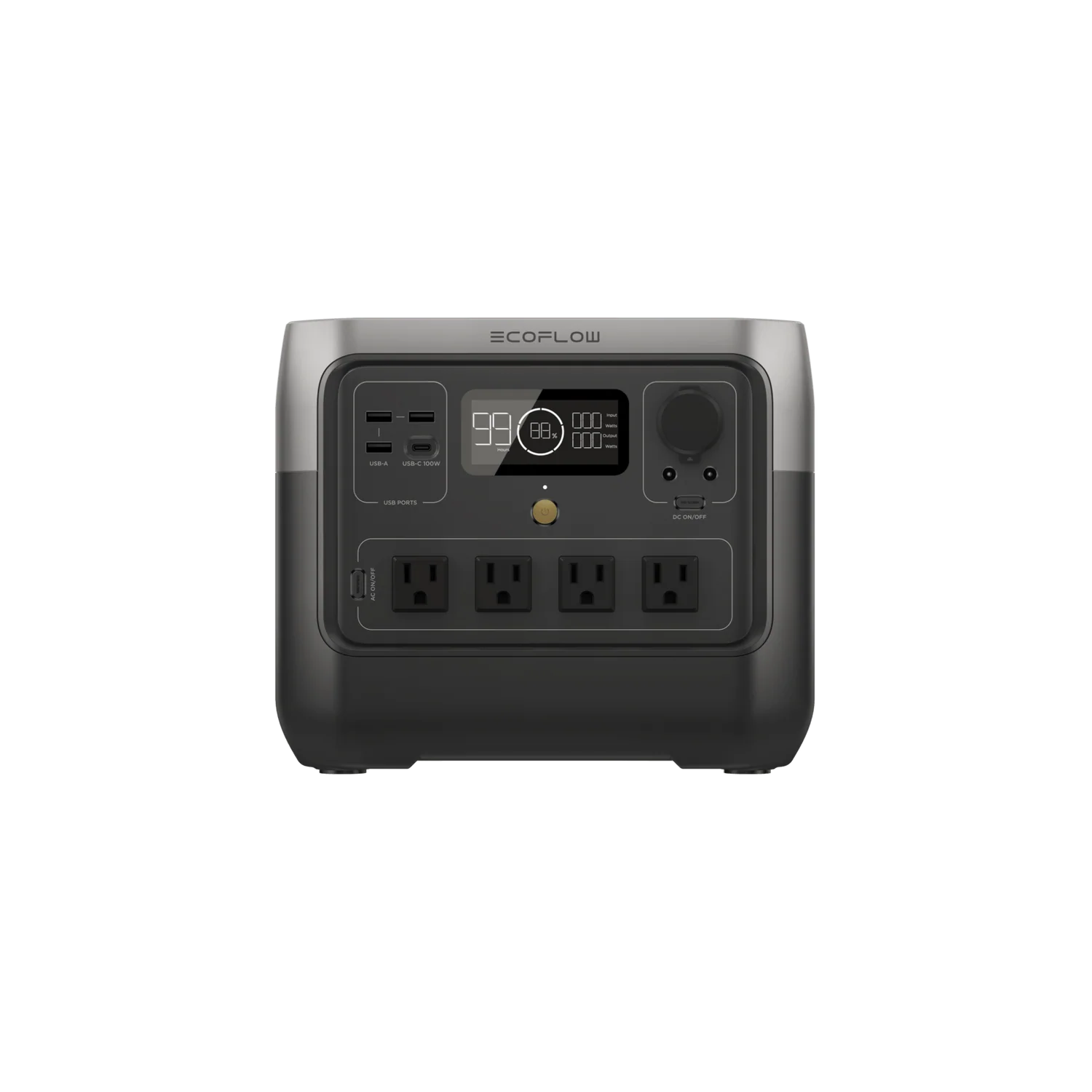
$389.00 · direct from EcoFlow
Last checked 1 day ago. Prices move — check before you buy.
Spec deltas
The DELTA Pro Ultra + 1 Battery is a 293.6 lb appliance. The RIVER 2 Pro is 17.2 lbs, a one-hand carry. 12,288Wh against 768Wh is sixteen times the energy, and $5,999 against $349 is 16.9 times the money, so nobody here is getting a volume discount and price on its own settles nothing.
Run the six load profiles and the DELTA Pro Ultra wins all six, which is the least surprising result on this site. The number worth reading isn't the win column, it's the misses. The RIVER 2 Pro falls 257Wh short of a remote workday, 992Wh short of an eight-hour blackout, 1,447Wh short of a weekend camp, and 4,032Wh short of a day of van living. Those are not near-misses. Only the tailgate row is close, and it isn't close for the reason the scoreboard gives.
So the question isn't which is better. It's where your load list sits against 653Wh of usable capacity and an 800W continuous ceiling. Under both, the RIVER 2 Pro is the buy and the rest of this page is you confirming it. Over either one, nothing about the RIVER 2 Pro gets you closer, and the DELTA Pro Ultra stops looking expensive and starts looking like the only option on the page.
What the Numbers Reveal
Each conclusion stated first — the numbers behind it on one line, the full analysis below.
continuous output
Which turns this into a wattage question rather than a capacity one. 12,288Wh of storage does nothing for a load the inverter won't accept, and the RIVER 2 Pro's ceiling is 800W continuous no matter how full it is. Meanwhile the port most people use every day is a dead heat: 100W USB-C on both. The 7,200W inverter is the part you can't buy your way around after the fact.
DELTA Pro Ultra + 1 Battery: $5,999 for 12,288Wh, a listed $.48 per WhRIVER 2 Pro: $349 for 768Wh, a listed $.45 per WhContinuous output: 7,200W against 800W; surge ceiling 10,800W against 1,600WUSB-C tops out at 100W on both units
Why it mattersWrite down your single biggest appliance before you write down your total. Under 800W, the gap between these two buys hours. Over it, the gap buys the only unit here that will run the thing at all.
That separates one arithmetic artifact from four real misses. Every other RIVER 2 Pro failure on this page is larger than the 115Wh the derate removes, so those are the battery genuinely running dry rather than the model second-guessing it. Five losses out of six looks like a pattern. It's four.
Tailgate Party needs 670WhRIVER 2 Pro nameplate is 768Wh; the scenario engine applies a flat 0.85 usable factor to every unit, giving 653WhRecorded shortfall on that row: 17WhThe other four RIVER 2 Pro failures are 257Wh, 992Wh, 1,447Wh and 4,032Wh
Why it mattersDon't let the tailgate row talk you out of the RIVER 2 Pro. Do let the 4,032Wh van-life row talk you out of it if you live in a van.
Quiet-at-40W isn't documented either, though. What is documented is one owner who opened the case and swapped the fanB1, alongside a manufacturer footnote conceding 62dB at high wattageB2. The 30dBA DELTA Pro Ultra is not a clean escape from the question: the only genuinely model-specific fan comment in our file is a complaint that the fans run constantly even at the expensive end of the lineA1.
RIVER 2 Pro rated 62dBA; DELTA Pro Ultra + 1 Battery rated 30dBAEcoFlow's own product page scopes the 62dB figure to charging and discharging at high wattageB2The CPAP scenario is 320Wh across an eight-hour night, which works out to 40WOne owner replaced the fan in their RIVER 2 Pro, cutting away internal plastic to make it fitB1
Why it mattersIf this is going next to your pillow, buy it somewhere with a return window and spend one night listening. Neither spec sheet answers it, and neither do the forums.
cost / lifetime kWh
And the years column is counting cycles, not time. A cycle is 12,288Wh on one unit and 768Wh on the other, so 11 years against 8.2 is quietly comparing two completely different days. Per warranty year the same data reads $590 against $70, which is the one row here denominated in money you either spend or don't.
DELTA Pro Ultra + 1 Battery: $0.12 per lifetime kWh, from 12.288kWh × 4,000 cycles = 49,152 kWhRIVER 2 Pro: $0.15 per lifetime kWh, from 0.768kWh × 3,000 cycles = 2,304 kWhThe same table prints 11 years against 8.2 years at daily useCost per warranty year: $590 against $70
Why it mattersSkip the lifetime column on this pair. It prices energy you'd have to go out of your way to consume, and it never reorders anything you'd actually notice.
The specific dimensions that decide these two units — everything else is a tie.
Your Life, Your Pick
Selected because: The RIVER 2 Pro misses four of these six loads by 257Wh or more, and a fifth by 17Wh. The difference between those two facts is the whole section.
The scoreboard reads 6-0 and it should not be read in that form. Our scenario suite has no class for an installed system: Weekend Camping and Tailgate Party score a 293.6 lb appliance as though it drove itself to the site, and their copy rewards the lighter unit right before handing the win to the heavier one. The DELTA Pro Ultra sweeps this table the way a delivery truck sweeps a comparison of grocery runs. Read the individual shortfalls instead.
Those shortfalls do real work. The RIVER 2 Pro misses a remote workday by 257Wh, an eight-hour blackout by 992Wh, a weekend camp by 1,447Wh, and a day of van living by 4,032Wh, which is more than six times the 653Wh it holds usable. It passes the CPAP night with 333Wh spare. And the one load it fumbles narrowly, the tailgate, it fumbles on arithmetic rather than on charge. Four genuine misses, one artifact, one clean pass.
Portability & Form Factor
Selected because: 293.6 lbs against 17.2 lbs isn't a portability score, it's the product category, and it decides more of this page than capacity does.
weight
293.6 lbs isn't a number you carry, it's a number you plan around. A doorway, a floor that can take it, and a decision you make once. The RIVER 2 Pro's 17.2 lbs goes in the back seat next to the cooler. There is no continuum between those two facts, which is why the usual which-is-more-portable framing collapses on contact here.
One thing to know before you read the weight card. 293.6 lbs is the system total for a build EcoFlow itself names "+ 1 Battery", so it's more than one box, and our record carries no per-box weight to give you. That doesn't make it lighter. It does mean the honest advice is pick the room, not get a friend.
What the Specs Don't Tell You
Selected because: Seven cards fire on this pair. The two that should change a decision are the 293.6 lb weight and the RIVER 2 Pro's 62dB fan rating.
rated cycles
The weight card and the fan card are the two that should move you, and they point in opposite directions. 293.6 lbs decides where the DELTA Pro Ultra lives for the next decade. 62dB decides whether you can sleep beside the RIVER 2 Pro, except that 62dB is the rating for charging and discharging at high wattage, and the load people actually buy it to sleep beside draws 40W (320Wh across an eight-hour night). The card doesn't draw that distinction. We do.
Two other cards state more than the data supports. The UPS card reads 0ms as a measured switchover; in our record a zero in that field can't be told apart from a figure nobody published, so we won't hand you a guarantee we can't source. And the cycle-life card converts 4,000 and 3,000 cycles into 11 years and 8.2 with no capacity term anywhere in the arithmetic, which is how a 12,288Wh box and a 768Wh box end up described in the same units of time.
Growth Path
Selected because: The RIVER 2 Pro is sealed at 768Wh, and on this page that ceiling is the thing doing the losing.
solar input
"Not expandable" is usually a non-complaint. Here it isn't. The RIVER 2 Pro is sealed at 768Wh and misses four of six load profiles on capacity, so if you're buying it while eyeing the edge of that ceiling, your growth path is a second purchase rather than a second battery.
The DELTA Pro Ultra's expansion is genuinely open, and we're deliberately not quoting a ceiling for it: the figures in circulation disagree with each other and none of them appear in our spec record. What's verifiable is the starting point, 12,288Wh, and the fact that adding to it means adding to a 293.6 lb installation you already can't move.
Lifetime Value
Selected because: $0.12 per lifetime kWh against $0.15 is a real gap that takes 49,152 kWh of throughput to collect.
cost / lifetime kWh
$0.12 per lifetime kWh against $0.15 is the DELTA Pro Ultra's win, and it's worth close to nothing to you. Banking it means running 49,152 kWh through the unit (12.288kWh × 4,000 cycles), and if that figure describes your life you were never choosing between these two in the first place.
What the table doesn't price is the $5,650 between $5,999 and $349 staying in your account. Per warranty year, the same numbers read $70 against $590. That's the version of this comparison denominated in something you'll actually feel.
Strengths & trade-offs
EcoFlow DELTA Pro Ultra + 1 Battery
Strengths
- +Larger battery capacity
- +Higher AC output
- +Longer warranty
- +Faster solar charging
- +Rated for 4,000 charge cycles — much longer battery lifespan
Trade-offs
- –Substantially more expensive (+$5,650) than the RIVER 2 Pro.
- –Significantly heavier (+276.4 lbs), making it harder to move.
- –Very heavy unit that may be difficult for one person to lift.
EcoFlow RIVER 2 Pro
Strengths
- +Costs $5,650 less
- +Lighter by 276.4 lb
Trade-offs
- –Weaker inverter (-6,400W) limits appliance compatibility.
- –Can receive complaints about fan noise under heavy load.
- –Sealed capacity — the DELTA Pro Ultra + 1 Battery can add batteries to grow past 768Wh; this one can't.
- –Shorter-lived battery — rated for 3,000 charge cycles vs the DELTA Pro Ultra + 1 Battery's 4,000, so it wears out sooner.
Will It Power Your Gear?
Scenario math and per-appliance runtimes, modeled from the spec record.
Scenario verdicts
We ran the math on six real-world scenarios. Here's which unit survives your actual life.
SCN-01 · 2 nights · needs 2,100Wh
Weekend Camping
Two nights off-grid with essential comfort
Neither unit
The RIVER 2 Pro is 1,447Wh short of a 2,100Wh weekend, which is more than twice the 653Wh it has usable. That's not rationing, it's a different trip. The DELTA Pro Ultra covers the same weekend and could run it three more times on what's left (8,345Wh ÷ 2,100Wh).
Battery budget usedlower = more headroom
LOAD Phone Charger 15W×6h · LED Lights 40W×8h · Box Fan 75W×14h · CPAP Machine 40W×16h
SCN-02 · 8 hours · needs 1,645Wh
8-Hour Blackout
Keep the essentials running through a night without power
DELTA Pro Ultra + 1 Battery
The eight-hour load is 1,645Wh and the RIVER 2 Pro holds 653Wh usable, so it covers about two-fifths of the outage (653 ÷ 1,645) and then it's a torch. The DELTA Pro Ultra finishes the whole thing having spent 16% of itself, with 8,800Wh untouched. Outages don't schedule themselves, and neither does the second one.
Battery budget usedlower = more headroom
LOAD Fridge 150W×8h · Router + Modem 20W×8h · LED Lights (4 bulbs) 40W×6h · Phone Charger 15W×3h
SCN-03 · 8 hours · needs 320Wh
CPAP Overnight
Sleep therapy without interruption — the #1 medical use case
DELTA Pro Ultra + 1 Battery
This is the one load both units genuinely cover, and the tiebreak isn't the noise rating. A 320Wh night against 653Wh usable gives the RIVER 2 Pro two nights with 13Wh to spare (320 × 2 = 640Wh). The same night against 10,445Wh usable gives the DELTA Pro Ultra 32 of them (10,445 ÷ 320). That's why it takes this row: not because it looks quieter on paper, but because two nights and a month are different products. If your outages last one night, the cheap one does cover it.
Battery budget usedlower = more headroom
LOAD CPAP Machine 40W×8h
SCN-04 · 8 hours · needs 910Wh
Remote Workday
Full work day off-grid without power anxiety
DELTA Pro Ultra + 1 Battery
A 910Wh workday against 653Wh usable leaves the RIVER 2 Pro 257Wh short, the narrowest real miss on this page and still enough to end the day early. The DELTA Pro Ultra spends 9% of itself on the same day and has 9,535Wh left, which is ten more workdays (9,535 ÷ 910) before anything needs plugging in.
Battery budget usedlower = more headroom
LOAD Laptop 60W×8h · External Monitor 30W×8h · Router + Modem 20W×8h · Phone Charger 15W×2h
SCN-05 · 4 hours · needs 670Wh
Tailgate Party
Game day power for the crew
Neither unit
The 17Wh miss here is the derate, not the battery. A flat 0.85 factor turns the RIVER 2 Pro's 768Wh into 653Wh usable against a 670Wh load; on nameplate it clears by 98Wh (768 minus 670). Call it a coin flip rather than a loss. The DELTA Pro Ultra takes the row properly, with 9,775Wh spare, but if this is the load you're sizing for, the $349 unit is not out of the running.
Battery budget usedlower = more headroom
LOAD Blender 400W×0.5h · LED TV (55") 80W×4h · Bluetooth Speaker 15W×4h · Phone Charger (×3) 45W×2h
SCN-06 · 24 hours · needs 4,685Wh
Van Life Daily
A full day of mobile living — the ultimate endurance test
DELTA Pro Ultra + 1 Battery
4,685Wh a day is where the argument stops being close. The RIVER 2 Pro is 4,032Wh short, more than six times the 653Wh it holds usable. It's also the only row where the DELTA Pro Ultra breaks a sweat: 45% used, 5,760Wh left, which is a second full day (5,760 minus 4,685) and then you're relying on the 5,600W of solar input the thing is built around.
Battery budget usedlower = more headroom
LOAD Mini-Fridge 150W×24h · Laptop 60W×4h · Phone Charger 15W×3h · LED Lights 40W×5h · Fan 75W×8h
The Load Test
RUNTIME = (Wh × 0.85) ÷ LOAD
None of the scenarios above exactly yours? Build it. Toggle what you'd plug in; both units are tested against the combined draw.
Essentials
Comfort & Convenience
High-Draw Appliances
Test duration
8h
Continuous draw
205W
Projected runtime
For this load: DELTA Pro Ultra + 1 Battery runs 51h vs 3.2h.
$5,999 list · direct from EcoFlow
Modeled from the spec record — same math as the tables below. Methodology
Runtime by appliance
Real-world runtime estimates for common appliances, modeled at 85% inverter efficiency.¹
Essentials
The basics you need runningscale 0–696.3hComfort & Convenience
Makes off-grid life actually enjoyablescale 0–139.3hHigh-Draw Appliances
These reveal the real limitsscale 0–10.4h¹ Runtime = (capacity × 0.85) ÷ appliance watts. Within each group, all bars share one time scale (the group's longest runtime), so lengths are comparable across appliances; identical runtimes collapse into a single blue/orange bar. Actual runtime varies with battery age, temperature, and simultaneous loads — see methodology.
Conclusion
August 9, 2026
Verdict: the EcoFlow RIVER 2 Pro
Buy the RIVER 2 Pro at $349 and keep the $5,650 that separates it from the $5,999 DELTA Pro Ultra + 1 Battery, unless one specific load on your list won't take no for an answer. These aren't two sizes of the same product. The RIVER 2 Pro is 768Wh behind an 800W inverter and weighs 17.2 lbs; the DELTA Pro Ultra + 1 Battery is 12,288Wh behind a 7,200W inverter and weighs 293.6 lbs. The line between them is sharp and you can find yourself on it in about a minute. If your biggest single appliance draws under 800W and your worst night is a CPAP, the RIVER 2 Pro covers it with 653Wh usable against a 320Wh night. If your list has a fridge running through a weekend at 2,100Wh, or a van's 4,685Wh day, the RIVER 2 Pro isn't a compromise, it's the wrong appliance, and the DELTA Pro Ultra is the only unit here that answers.
Editor-assigned confidence, based on cited owner research and spec analysis.
List prices as of August 9, 2026. The links below open EcoFlow's current price.
$389.00 · direct from EcoFlow
Last checked 1 day ago. Prices move — check before you buy.
or check the DELTA Pro Ultra + 1 Battery price$6,199.00 list
Written by Gunner Gustafson, Whole-Home Backup Tester · Station Arena Test Desk · Updated August 9, 2026
Measured Data
Benchmark scores and the full spec record, side by side.
Benchmark scores
Not rated for both units (minimum threshold unmet): Home Backup, CPAP, Solar Generator, Tailgating, Food Truck, Apartment Balcony, Camping.
Full specifications
ᵈ Derived: price ÷ rated capacity. See the data behind our comparisons →
Comparison ToolAdd more power stations, side by sideOpen Tool →How these numbers are produced
Numeric verification
Every figure on this page traces to our spec database or arithmetic on it — no estimated numbers.
Owner claims
Statements about owner experience are cited to published reviews — see Sources & Research Notes below.
Runtime model
Runtime = (rated capacity × 0.85 inverter efficiency) ÷ device wattage. Solar recharge estimates assume panels deliver 70% of rated output. Cold weather, battery age, and stacked loads reduce real-world results.
Power Score
Computed from 14 published spec dimensions, weighted per use-case bench. Higher is better; a unit must meet a bench's minimum threshold to be rated.
See the full weight table and data sourcing on our methodology page →Class ranking (the star rating)
Each unit's star score is a category ranking, not customer reviews — no buyer opinions feed it. We score every station on size-independent quality (value, output, portability, endurance, ports, warranty, and more), then percentile-rank it against the other units in its capacity class, so a class-leading compact unit and a class-leading whole-home unit can both earn 5★. Here, DELTA Pro Ultra + 1 Battery rates 3.7/5 (25th percentile of 29 Whole-Home / Off-Grid-class units), and RIVER 2 Pro rates 4.7/5 (84th percentile of 20 Compact-class units).
How the class ranking is computed →Test Notes & Caveats
Hidden gotchas and advantages we spotted that you won't find on the product page.
293.6 lbs Is a System Total, Not a Lift
293.6 lbs is the weight of the whole build. EcoFlow's own name for it, "+ 1 Battery", tells you it's more than one box, and our record carries no per-box figure. So "grab a friend and bend your knees" is the wrong advice here; "pick the room and the floor before it arrives" is the right one. Once it's placed, it stays placed. Against the RIVER 2 Pro's 17.2 lbs, this is the difference between owning a battery and installing one.
62dB vs 30dB, and When Each One Applies
The RIVER 2 Pro is rated 62dB and the DELTA Pro Ultra 30dB, but the 62 is scoped: it's the figure for charging and discharging at high wattage, not an idle rating. A CPAP pulling 40W (320Wh across an eight-hour night) is 5% of the RIVER 2 Pro's 800W ceiling, nowhere near that condition. What nobody has published is what the fan actually does at 40W. If quiet matters to you, treat this as untested rather than settled, and listen to it yourself for one night.
RIVER 2 Pro: Fixed Capacity
The RIVER 2 Pro is sealed at 768Wh — fine if that covers you, but it's the ceiling. By contrast the DELTA Pro Ultra + 1 Battery can add expansion batteries, though the first thing it has over the RIVER 2 Pro is its own 12,288Wh base — expansion is the step after that, for the buyer who would outgrow 12,288Wh as well.
Surge Power: Ratio and Ceiling Disagree
The RIVER 2 Pro holds the higher surge-to-continuous ratio (2× vs 1.5×), but the DELTA Pro Ultra + 1 Battery holds the higher absolute surge ceiling — 10,800W against 1,600W. These measure different things. The ratio says how much headroom an inverter keeps above its own rating; the ceiling says how big a startup spike it can actually swallow. A motor draws a number of watts at switch-on, not a multiple of someone else's rating, so on raw starting ability the DELTA Pro Ultra + 1 Battery is the stronger unit here — while the RIVER 2 Pro is the one running further below its own limit at steady state.
Only One of These Has a Switchover Figure We'd Quote
The RIVER 2 Pro is rated at 30ms. The DELTA Pro Ultra reads 0ms in our record, and a zero in that field can't be distinguished from a value nobody published, so we're not going to call it uninterruptible on the strength of it. Practically: a laptop rides through a 30ms gap on its own battery without noticing. A desktop, or anything that reboots on a blink, is worth testing rather than assuming, on either unit.
Warranty: 10 Years vs 5
The DELTA Pro Ultra + 1 Battery is covered for 10 years against the RIVER 2 Pro's 5 years. The cheaper RIVER 2 Pro does buy more warranty per dollar (14.3 years per $1,000 against 1.7), but that is a statement about price, not about coverage — if a fault appears in year 6, only one of these is still covered. An underrated factor if you're keeping this unit for years.
4,000 Cycles vs 3,000, in Very Different Units
A cycle isn't a unit of time, it's a unit of energy, and here it's 12,288Wh on one unit against 768Wh on the other. So when this section converts 4,000 and 3,000 cycles into 11 years and 8.2 at daily use, it's describing two completely different days as though they were the same day. The cycle counts are real. The years are only comparable if you'd work both units equally hard, and nobody works a 768Wh box the way they work a 12,288Wh one.
Full record above — the Test Desk pick is the RIVER 2 Pro.
Check RIVER 2 Pro price →or check the DELTA Pro Ultra + 1 Battery priceOwnership Analysis
What happens after you buy — true cost of ownership, brand trust, and growth potential.
Lifetime value
Service lifeyears at one full cycle per day
Lifetime energy delivered
Cost per delivered kWh
│ warranty ends · Reaching the cycle rating means ~80% capacity remains — degraded, not dead.
Analyst note
The RIVER 2 Pro is cheaper to buy, but the DELTA Pro Ultra + 1 Battery is cheaper to own. At $0.12/kWh over its lifetime vs $0.15/kWh, the DELTA Pro Ultra + 1 Battery's higher cycle life and capacity make each dollar go further over the years.
Growth path
DELTA Pro Ultra + 1 Battery
EXPANDABLESupports EcoFlow expansion batteries, so you can add capacity later without replacing the base unit — useful if your needs may climb past 12,288Wh.
Accepts up to 5,600W of solar. Enough for a serious multi-panel array.
Adequate ports for most setups, but heavy users may want a power strip.
Expansion batteries are EcoFlow-specific. You're investing in the EcoFlow ecosystem.
RIVER 2 Pro
FIXED CAPACITYFixed at 768Wh, with no expansion — so size it for your needs up front rather than planning to add capacity later.
Accepts up to 220W of solar. Limited to a single portable panel.
Adequate ports for most setups, but heavy users may want a power strip.
Realistic full solar rechargeat 70% of rated panel output — see methodology
Analyst note
The RIVER 2 Pro is sealed at 768Wh, which is fine if that covers you. The DELTA Pro Ultra + 1 Battery starts at 12,288Wh and can grow beyond it with EcoFlow expansion batteries — real headroom the RIVER 2 Pro doesn't have if your needs climb toward partial-home backup.
What Owners Report
Patterns from published owner reports and long-term reviews — every claim cited to its source below.
EcoFlow DELTA Pro Ultra + 1 Battery
Almost everything we have on the DELTA Pro Ultra comes from a single DIY Solar Forum thread dated February 2024A4A5A6A7A8A9, and it isn't a happy one. The owner reports the unit radiating interference across common frequencies including 146.520MHz even with the inverter idle, and the emission disappearing the moment the unit is switched offA6. EcoFlow support's suggestion was a faraday cageA7. He also found no real manual beyond a thin web guideA5, no state-of-charge graph in the app despite input and output charts being presentA8, and a metering oddity where the pack read 90% after an overnight recharge and then fell to 8%A9. His own summary was that he's unlikely to expand it or integrate it into the houseA4, which is a striking conclusion about a unit whose whole pitch is expansion and integration. A second EcoFlow owner in the same thread framed it as brand-wide rather than product-specific: good for certain use cases, with some hardware issues and a lot of firmware onesA10.
Two caveats, both load-bearing. The reassuring fan notes in our file, an inverter silent with an ear against the caseA2 and fans cutting in at 6.3kW then back out around 4.5kWA3, were recorded on an EG4 unit in a blog that compares it to the DELTA Pro Ultra, so they don't attest to this hardware at all. The only model-specific fan comment we have is the complaint that they run constantlyA1. And none of these reports identifies which battery configuration it was written againstA4A6A9, which matters on a product sold in several. Worth separating the two kinds of complaint: the state-of-charge behaviourA8A9 is firmware-shaped and eighteen months old at this point, so it may well be patched. The interferenceA6 is physics, and probably isn't.
“When the fans are not on, the inverter emits zero noise...even when I put my ear against the case.”
Sources
windinmyface.com · diysolarforum.com
EcoFlow RIVER 2 Pro
The RIVER 2 Pro's field record is four items deep and two of them aren't about the unit doing anything. One is a Facebook group post title asking whether UPS duty affects battery life, which never reaches an answerB3. The other is an Apnea Board post filed under the RIVER 2 Pro in which a van dweller describes running an AirSense 11 overnight off their van's own battery bank through a ResMed DC-DC cableB4. A real setup, just not this product's.
What's left is consistent, and it's about the fan. EcoFlow's own product page concedes up to 62dB when charging or discharging at high wattageB2, and one owner thought the noise was worth opening the case for, fitting a quieter fan and cutting away internal plastic to make it sitB1. Two sources agreeing is the most this record does. Long-term durability, cold-weather behaviour, and what it actually sounds like through a real CPAP night are simply not in itB1B2.
“Will using River 2 Pro as a UPS affect battery life ...”
Sources
ctrl-alt-rees.com
Sources & Research Notes
Every owner claim in this report is traceable to a published source. The bracketed references above resolve here.
Recurring owner themes
- SoC/battery metering appears unreliable, with reported percentage dropping much faster than expected after resuming charge cycles [DELTA Pro Ultra + 1 Battery · 2 entries]
- Support interactions were unhelpful or dismissive when owners raised specific technical issues (manual gaps, RFI, missing SoC graph) [DELTA Pro Ultra + 1 Battery · 3 entries]
- Fan behavior/noise is a recurring point of owner scrutiny, though direct DPU-specific noise data is thin and partly inferred from sibling EG4 units [DELTA Pro Ultra + 1 Battery · 3 entries]
- Fan noise at high wattage charging/discharging is a consistent owner and manufacturer-acknowledged complaint, severe enough that some owners physically mod the unit with quieter fans. [RIVER 2 Pro · 2 entries]
- A1
“Yuck—fans always run even on the expensive high end Delta Pro Ultra?”
windinmyface.com blog — 'Fan Noise with Solar Power / Solar Generators (Anker, Ecoflow, EG4)' (comment thread) · 2024-12 · [negative]
- A2
“When the fans are not on, the inverter emits zero noise...even when I put my ear against the case.”
windinmyface.com blog — 'Fan Noise with Solar Power / Solar Generators (Anker, Ecoflow, EG4)' (owner test notes, related EG4 12kPV/18kPV comparison to DPU) · 2024-12 · [positive]
- A3
“At 6.3kW of load, the fan turned on... The fans turned off when I reached about 4.5kW. This is probably the expected hysteresis behavior.”
windinmyface.com blog — 'Fan Noise with Solar Power / Solar Generators (Anker, Ecoflow, EG4)' (thermal/fan behavior test, note: performed on EG4 18kPV, referenced as comparison point to DPU) · 2024-12 · [mixed]
- A4
“Pulled the trigger on an EcoFlow Delta Pro Ultra (DPU) and I'm kind of meh on it and unlikely to expand or integrate it into the house.”
diysolarforum.com — 'EcoFlow Delta Pro Ultra issues' · 2024-02 · [negative]
- A5
“No real manual. All they have is the web user guide which is superficial if I'm being generous.”
diysolarforum.com — 'EcoFlow Delta Pro Ultra issues' · 2024-02 · [negative]
- A6
“Even when the inverter is not running, it interferes with common frequencies like 146.520MHz... Turn off the DPU, emission goes away.”
diysolarforum.com — 'EcoFlow Delta Pro Ultra issues' · 2024-02 · [negative]
- A7
“I contacted EcoFlow support and they told me I could put it in a "faraday cage".”
diysolarforum.com — 'EcoFlow Delta Pro Ultra issues' · 2024-02 · [negative]
- A8
“No State of Charge graph in the app. Figured if they were showing charts of Input and Output over time, they must have a SoC chart. Nope.”
diysolarforum.com — 'EcoFlow Delta Pro Ultra issues' · 2024-02 · [negative]
- A9
“After a few days of using it overnight and letting it charge back up to "90%", it'd go from "90%" down to "8%".”
diysolarforum.com — 'EcoFlow Delta Pro Ultra issues' · 2024-02 · [negative]
- A10
“They're great for certain use cases but some hardware issues and lots of firmware issues.”
diysolarforum.com — 'EcoFlow Delta Pro Ultra issues' (reply from another EcoFlow product owner, D2M, discussing brand-wide pattern) · 2024-02 · [negative]
- B1
“I've since performed the same mod on my RIVER 2 PRO and it works great for that unit, too - although it did involve cutting away some of the internal plastic.”
ctrl-alt-rees.com blog — 'EcoFlow RIVER 2 Noisy Fan Fix!' · 2022-11-17 · [negative]
- B2
“When charging and discharging at high wattage, RIVER 2 Max and RIVER 2 Pro may make a noise up to 62db.”
EcoFlow official product page — RIVER 2 Series specs/FAQ footnotes · unknown · [negative]
- B3
“Will using River 2 Pro as a UPS affect battery life ...”
Facebook — EcoFlow Club group post title · unknown · [mixed]
- B4
“I'm very new to CPAP (1 week) and I live in a van. I have solar and a decent battery bank and I've got the ResMed DC-DC cable which powers my AirSense 11 AutoSet overnight no problem.”
Apnea Board forum — '[Equipment] EcoFlow River 2 Pro' thread · 2025-07 · [mixed]
Research compiled August 9, 2026.
Who Should Buy Which
Buy the DELTA Pro Ultra + 1 Battery if you…
- →You're wiring backup into a house, shop or barn and it will sit in one place for years. 293.6 lbs stops being a drawback the moment nothing is asking it to move.
- →Your load list has something an 800W inverter won't accept. A well pump, a compressor, a table saw: 7,200W continuous with a 10,800W surge ceiling starts those, and no amount of stored energy substitutes for it.
- →You live in a van and need 4,685Wh a day. That's 45% of the DELTA Pro Ultra's 10,445Wh usable, the one load on this page it genuinely notices, and roughly seven times what the RIVER 2 Pro holds after derate (4,685Wh against 653Wh).
- →You're building around solar rather than wall charging. 5,600W of input is a roof array; the RIVER 2 Pro tops out at 220W.
Buy the RIVER 2 Pro if you…
- →Your worst night is a CPAP. 653Wh usable against a 320Wh night is two nights (320 × 2 = 640Wh, leaving 13Wh), and the second one finishes on fumes.
- →You need to pick it up. 17.2 lbs goes wherever you go, and nothing about a 293.6 lb build does.
- →You charge laptops and phones and not much else. USB-C tops out at 100W on both units, so the port you'll touch most is identical and one version of it costs $349.
- →You want a desk UPS and can live with a 30ms gap. That's a real rated figure; the 0ms our record carries for the DELTA Pro Ultra is one we won't vouch for.
If neither fits
Your actual need sits in the middle and neither of these lives there. An eight-hour blackout is 1,645Wh and a weekend camp is 2,100Wh. The RIVER 2 Pro misses both, and answering them with 12,288Wh and 293.6 lbs is buying a van because you needed a bike rack. Shop the portable class sized above the 2,100Wh weekend load and well below 12,288Wh: it exists precisely for this gap, and you'll still be able to lift it.
The Bottom Line
Take the RIVER 2 Pro. At $349 it covers the night most people are actually worried about, weighs 17.2 lbs, and charges a laptop at the same 100W the $5,999 unit does. The four load profiles it genuinely misses are all recognisable from a distance: a fridge through a weekend, a full workday, a day of van living. If none of those are on your list, the DELTA Pro Ultra is 293.6 lbs of answer to a question you didn't ask.
And if they are on your list, don't split the difference. The DELTA Pro Ultra isn't a stretch purchase from here, it's a different appliance with a 7,200W inverter and an installation to plan for, and the moment your loads need it nothing about the RIVER 2 Pro gets you closer. These two sit far enough apart that the only genuinely wrong answer is buying the big one because it won a table.
Frequently Asked Questions
Answers drawn from the spec record and cited owner research.
Is the DELTA Pro Ultra just a bigger RIVER 2 Pro?
No, and treating it that way is the main mistake people make on this comparison. 12,288Wh against 768Wh is sixteen times the capacity, but the bigger change is 7,200W continuous against 800W, which is a whole class of appliance that one will run and the other won't accept. It also weighs 293.6 lbs against 17.2, so it's an installation rather than a purchase.
Can the RIVER 2 Pro run a CPAP all night?
Yes, twice over. The scenario here is 320Wh across an eight-hour night and the RIVER 2 Pro holds 653Wh usable, so two nights (320 × 2 = 640Wh) leaves 13Wh in the tank. The honest caveat is noise rather than capacity: the 62dB rating describes charging and discharging at high wattage, a 40W CPAP is nowhere near that condition, and nobody has published what the fan does at 40W.
Why does the RIVER 2 Pro fail the tailgate scenario by only 17Wh?
Because of a derate, not the battery. Our scenario engine applies a flat 0.85 usable factor to every unit, turning 768Wh of nameplate into 653Wh against a 670Wh load. On nameplate the RIVER 2 Pro clears it by 98Wh (768 minus 670). Treat that row as a coin flip rather than a failure, and note that every other miss on this page is larger than the 115Wh the derate removes.
Is the DELTA Pro Ultra + 1 Battery a two-person lift?
It's more than that. 293.6 lbs is the system total for a configuration EcoFlow itself names "+ 1 Battery", so it isn't one object, and we have no per-box weight to quote you. Plan a location with a floor and a doorway that work, and plan on setting it up once.
Which one is cheaper to own over its life?
The DELTA Pro Ultra, at $0.12 per lifetime kWh against $0.15, and it's a hollow win. That rate assumes you actually run 49,152 kWh through it (12.288kWh × 4,000 cycles), which is 21 times the RIVER 2 Pro's 2,304 kWh lifetime total. Per warranty year the picture inverts: $70 against $590.
Related comparisons
Where to buy
EcoFlow DELTA Pro Ultra + 1 Battery
$6,199.00
$6,199.00 · direct from EcoFlow
Last checked 1 day ago. Prices move — check before you buy.
EcoFlow RIVER 2 ProPick
$389.00
$389.00 · direct from EcoFlow
Last checked 1 day ago. Prices move — check before you buy.
Prices may vary by retailer and are subject to change.