Head-to-head test
DJI Power 1000 V2 vs DJI Power 2000
DJI Power 1000 V2 vs DJI Power 2000: Buy the Power 1000 V2 unless your biggest single-session load crosses about 900Wh, in which case buy the Power 2000.
Full profiles: DJI Power 1000 V2 → · DJI Power 2000 →

Written by Ian SchneiderUpdated
Solar & Off-Grid Tester, Station Arena Test Desk
Spec deltas
The Power 2000 is two Power 1000 V2s in one shell: double the capacity (2,048Wh vs 1,024Wh) for a hair under double the price ($1,299 vs $699), on the same 4,000-cycle pack. Neither is the better unit, because they're the same unit. When two stations share a brand, a cell chemistry, a cycle rating, and, to the penny, a lifetime cost per kilowatt-hour, you aren't choosing a product. You're choosing a size.
The size that's right for you is set by one number: the most energy you'll pull between recharges. The 1000 V2 gives you about 870Wh of usable capacity; the 2000 about 1,741Wh. Under the smaller figure, both finish and you've overspent on the 2000. Over it, the 1000 V2 quits early and the 2000 is the only one that gets you through the job.
So this page is a sizing exercise with a $600 answer. Below roughly 900Wh in a session, which covers the bulk of camping, CPAP, tailgate, and daytime-backup use, the cheaper, lighter 1000 V2 is the smart buy. Whole-evening blackout backup or a heavy off-grid day pushes you to the 2000. Everything else about these two is, genuinely, a coin flip.
What the Numbers Reveal
Each conclusion stated first — the numbers behind it on one line, the full analysis below.
cost / lifetime kWh
Because the per-kWh economics are a tie, stepping up to the 2000 doesn't buy you a better-built or longer-lived battery. It buys more of the identical battery, and the $600 gap is capacity, full stop.
Power 1000 V2: $699 for 1,024WhPower 2000: $1,299 for 2,048Whboth rated 4,000 cycleslifetime cost per kWh: $0.17 (1000 V2) vs $0.16 (2000)
Why it mattersIf your loads sit under the 1000 V2's roughly 870Wh usable, that second battery-half never discharges, and you've paid $600 for energy you'll never reach.
Past that line the 1000 V2 doesn't lose gracefully; it stops. An eight-hour blackout (1,645Wh) leaves it 775Wh short, roughly half the night, while the 2000 rides it out with 96Wh in reserve, and the gap only widens on bigger loads.
1000 V2 usable energy: about 870Wh2000 usable energy: about 1,741Wh8-hour blackout needs 1,645Wh: the 1000 V2 is 775Wh short, the 2000 has 96Wh to spareremote workday needs 910Wh: the 1000 V2 falls 40Wh short after the usable-capacity derate
Why it mattersAnyone sizing for whole-evening blackout backup or a heavy off-grid day should skip straight to the 2000; the 1000 V2 is a daytime-and-essentials unit, not an all-nighter.
weight
At 31.3 lbs the 1000 V2 is a one-person carry, if an awkward one one-handed per reviewersA11; at 48.5 lbs the 2000 is a two-hands, plant-your-feet lift in and out of the trunk. Paying $600 more to haul 17 extra pounds of capacity you won't use is the trade backwards.
1000 V2 weighs 31.3 lbs; 2000 weighs 48.5 lbs (a 17-pound gap)the tailgate load is 670Wh, which both units cover (77% used vs 38%)reviewers note the 1000 V2's side handles feel unbalanced carried one-handedA11price gap is $600 ($699 vs $1,299)
Why it mattersCampers, tailgaters, and anyone who loads and unloads the unit often should default to the 1000 V2 unless a real capacity need forces the upgrade.
The 2000 at least gives you a 30dB floor to point at; the 1000 V2 gives you nothing on paper. The rescue is field data: independent testers called it nearly silent even while fast-charging around 1,400WA1, the only giveaway a faint warm smell rather than any soundA2. The disclosure gap is real on the spec sheet and mostly closed in practice.
the 2000 publishes a 30dB noise floor; the 1000 V2 publishes no noise figureCPAP overnight is about 320Wh: both cover it easily, the 1000 V2 keeping 550Wh in reserveindependent testers called the 1000 V2 nearly silent even while fast-charging around 1,400WA1
Why it mattersA CPAP buyer can take the cheaper, lighter 1000 V2 with reasonable confidence on noise; if you need a published number to trust, that's a small, honest reason to pay up for the 2000.
The specific dimensions that decide these two units — everything else is a tie.
Lifetime Value
Selected because: The two land a penny apart on lifetime cost per kilowatt-hour ($0.17 vs $0.16), the clearest sign this is a sizing decision, not a value one.
cost / lifetime kWh
A penny separates these two on lifetime cost per kilowatt-hour, $0.17 for the 1000 V2 against $0.16 for the 2000, and that near-tie is the whole story. Same 4,000-cycle pack, same brand, double the capacity for a hair under double the price. The 2000 isn't a better-built battery; it's two 1000 V2s wearing one shell.
So the spreadsheet won't pick for you here. Both are, to the penny, the same deal per unit of stored energy, which means the $600 between them isn't buying quality or longevity. It's buying headroom. What you're actually deciding is how much of that energy you'll ever call on at once.
Your Life, Your Pick
Selected because: Where the capacity gap actually bites: the 1000 V2's 870Wh usable clears light loads but not an eight-hour, 1,645Wh blackout.
The dividing line sits right around 900Wh of draw in a single session. Under it, both units finish and the choice comes down to weight and money. Over it, the 1000 V2 quits early: an eight-hour blackout (1,645Wh) leaves it 775Wh short, call it half the night, while the 2000 rides it out with 96Wh in reserve. Even a full remote workday (910Wh) tips the smaller unit under by 40Wh once you count the usable-capacity derate; its nameplate 1,024Wh would clear it, but you don't get nameplate in the real world.
Two scenarios beat both units outright: weekend camping at 2,100Wh and van life at 4,685Wh. If either of those is your daily reality, neither of these is the answer, and you want a bigger single station rather than a choice between these two.
Portability & Form Factor
Selected because: When both units cover the load, the 17-pound spread (31.3 vs 48.5 lbs) is the only difference you'll feel.
weight
When both units cover the load, the only difference you'll feel is 17 pounds. The 1000 V2 is 31.3 lbs, a one-person lift, though reviewers note the side handles leave it a little unbalanced carried one-handedA11. The 2000 is 48.5 lbs, which is a two-hands, mind-your-back lift into the trunk and back out at the campsite.
For a tailgate or a car-camping weekend where either unit has capacity to spare, paying $600 to carry an extra 17 pounds is the wrong trade. Buy the weight you need, not the weight you can afford.
What the Specs Don't Tell You
Selected because: DJI publishes a 30dB noise floor for the 2000 but none for the 1000 V2, the main watch-out for bedroom and CPAP buyers.
DJI publishes a 30dB noise floor for the 2000 and no figure at all for the 1000 V2, the only gotcha that fires on this pair. That blank isn't evidence the smaller unit is louder; it's just nothing to hold it to, and for a bedroom, an apartment, or a CPAP, that's exactly where you'd want a number.
Field reports mostly fill the gap. Independent testers called the 1000 V2 nearly silent even while fast-charging around 1,400WA1, the only tell a faint warm-plastic smell rather than any soundA2. Take the 2000's 30dB as the one published figure on the table, a spec-sheet floor rather than a measurement, and the 1000 V2 as quiet by reputation until you've heard it in your own room.
Growth Path
Selected because: Both take expansion batteries, but the 2000's 1,800W solar ceiling beats the 1000 V2's 1,200W for off-grid growth.
solar input
Both units take DJI expansion batteries, so neither boxes you in: outgrow the base pack and you bolt on more rather than starting over. Where they part is the solar ceiling feeding that growing bank. The 2000 accepts up to 1,800W (a full solar refill in about 75 minutes, per testersB1) against the 1000 V2's 1,200W, so if you're building toward a panel-fed off-grid setup, the 2000 has more headroom to grow into.
One caution on the 1000 V2's solar specifically: reviewers found its adapter proprietary and expensive, priced near $329 and hard to justify once you add the panelsA6. Expansion capacity is there on both, but solar is the least attractive way to feed the smaller unit.
Strengths & trade-offs
DJI Power 1000 V2
Strengths
- +Costs $600 less
- +Lighter by 17.2 lb
Trade-offs
- –No major technical downsides compared to rival.
DJI Power 2000
Strengths
- +Larger battery capacity
- +Higher AC output
- +Faster solar charging
Trade-offs
- –Substantially more expensive (+$600) than the Power 1000 V2.
- –Significantly heavier (+17.2 lbs), making it harder to move.
Will It Power Your Gear?
Scenario math and per-appliance runtimes, modeled from the spec record.
Scenario verdicts
We ran the math on six real-world scenarios. Here's which unit survives your actual life.
SCN-01 · 2 nights · needs 2,100Wh
Weekend Camping
Two nights off-grid with essential comfort
Neither unit
Neither unit covers this scenario's 2,100Wh: the Power 1000 V2 comes up 1,230Wh short (about 41% covered), the Power 2000 359Wh (83%). Treat this as partial cover — enough for the essentials in it, not the whole list.
Battery budget usedlower = more headroom
LOAD Phone Charger 15W×6h · LED Lights 40W×8h · Box Fan 75W×14h · CPAP Machine 40W×16h
SCN-02 · 8 hours · needs 1,645Wh
8-Hour Blackout
Keep the essentials running through a night without power
Power 2000
The Power 1000 V2 doesn't finish — 870Wh usable against the 1,645Wh this needs leaves it 775Wh short, about 53% of the scenario covered. The Power 2000 covers it with 96Wh to spare.
Battery budget usedlower = more headroom
LOAD Fridge 150W×8h · Router + Modem 20W×8h · LED Lights (4 bulbs) 40W×6h · Phone Charger 15W×3h
SCN-03 · 8 hours · needs 320Wh
CPAP Overnight
Sleep therapy without interruption — the #1 medical use case
Either unit
A CPAP sips about 40W, roughly 320Wh across the night, so both units wake up barely touched, the 1000 V2 still holding 550Wh. Capacity decides nothing here. This is the one night where the smaller, lighter, cheaper unit is arguably the smarter buy, provided you're at peace with a fan DJI never put a number on.
Battery budget usedlower = more headroom
LOAD CPAP Machine 40W×8h
SCN-04 · 8 hours · needs 910Wh
Remote Workday
Full work day off-grid without power anxiety
Power 2000
The Power 1000 V2 comes up just short — it needs 910Wh and has 870Wh usable, a 40Wh gap (its nameplate 1,024Wh actually clears this — the flat 15% conversion allowance is what tips it under). Trim that much — one small appliance's worth across the day — and it finishes. The Power 2000 covers it outright with 831Wh to spare.
Battery budget usedlower = more headroom
LOAD Laptop 60W×8h · External Monitor 30W×8h · Router + Modem 20W×8h · Phone Charger 15W×2h
SCN-05 · 4 hours · needs 670Wh
Tailgate Party
Game day power for the crew
Power 2000
Both handle game day; the Power 2000 keeps more in reserve (38% used vs 77%). Tailgating is a light load, though, so the number you'll feel is weight: 31.3 lbs for the Power 1000 V2 against 48.5 lbs for the Power 2000, from the trunk to the setup spot.
Battery budget usedlower = more headroom
LOAD Blender 400W×0.5h · LED TV (55") 80W×4h · Bluetooth Speaker 15W×4h · Phone Charger (×3) 45W×2h
SCN-06 · 24 hours · needs 4,685Wh
Van Life Daily
A full day of mobile living — the ultimate endurance test
Neither unit
Neither unit covers this scenario's 4,685Wh: the Power 1000 V2 comes up 3,815Wh short (about 19% covered), the Power 2000 2,944Wh (37%). This is well outside what either unit is for; the right answer here is a larger station, not a choice between these two.
Battery budget usedlower = more headroom
LOAD Mini-Fridge 150W×24h · Laptop 60W×4h · Phone Charger 15W×3h · LED Lights 40W×5h · Fan 75W×8h
The Load Test
RUNTIME = (Wh × 0.85) ÷ LOAD
None of the scenarios above exactly yours? Build it. Toggle what you'd plug in; both units are tested against the combined draw.
Essentials
Comfort & Convenience
High-Draw Appliances
Test duration
8h
Continuous draw
205W
Projected runtime
For this load: Power 2000 runs 8.5h vs 4.2h.
$1,299 list · direct from DJI
Planning for more than this? Describe your whole setup and get it sized →
Modeled from the spec record — same math as the tables below. Methodology
Runtime by appliance
Real-world runtime estimates for common appliances, modeled at 85% inverter efficiency.¹
Essentials
The basics you need runningscale 0–116.1hComfort & Convenience
Makes off-grid life actually enjoyablescale 0–23.2hHigh-Draw Appliances
These reveal the real limitsscale 0–1.7h¹ Runtime = (capacity × 0.85) ÷ appliance watts. Within each group, all bars share one time scale (the group's longest runtime), so lengths are comparable across appliances; identical runtimes collapse into a single blue/orange bar. Actual runtime varies with battery age, temperature, and simultaneous loads — see methodology.
Conclusion
August 30, 2026
Verdict: the Power 2000, on Power Score margin
Buy the Power 1000 V2 unless your biggest single-session load crosses about 900Wh, in which case buy the Power 2000. These are the same DJI pack at two sizes: identical 4,000-cycle life, the same 10ms UPS switchover and 140W USB-C, and a lifetime cost per kilowatt-hour a penny apart ($0.17 vs $0.16). The $600 premium buys capacity and nothing else. The bulk of buyers, from campers to CPAP users to tailgaters to daytime-backup, stay under that line and should take the cheaper, 17-pound-lighter 1000 V2. Blackout-backup and heavy off-grid buyers who need a full evening's energy should step up to the 2000, which finishes loads the 1000 V2 can't.
Editor-assigned confidence, based on cited owner research and spec analysis.
Written by Ian Schneider, Solar & Off-Grid Tester · Station Arena Test Desk · Updated August 30, 2026
Black Friday · 38 days out
Prices to beat:Power 1000 V2 $699Power 2000 $1,299
We have never seen either discounted, so any real cut would be a first.
Measured Data
Benchmark scores and the full spec record, side by side.
Benchmark scores
Full specifications
ᵈ Derived: price ÷ rated capacity. See the data behind our comparisons →
Comparison ToolAdd more power stations, side by sideOpen Tool →How these numbers are produced
Numeric verification
Every figure on this page traces to our spec database or arithmetic on it — no estimated numbers.
Owner claims
Statements about owner experience are cited to published reviews — see Sources & Research Notes below.
Runtime model
Runtime = (rated capacity × 0.85 inverter efficiency) ÷ device wattage. Solar recharge estimates assume panels deliver 70% of rated output. Cold weather, battery age, and stacked loads reduce real-world results.
Power Score
Computed from 14 published spec dimensions, weighted per use-case bench. Higher is better; a unit must meet a bench's minimum threshold to be rated.
See the full weight table and data sourcing on our methodology page →Class ranking (the star rating)
Each unit's star score is a category ranking, not customer reviews — no buyer opinions feed it. We score every station on size-independent quality (value, output, portability, endurance, ports, warranty, and more), then percentile-rank it against the other units in its capacity class, so a class-leading compact unit and a class-leading whole-home unit can both earn 5★. Here, Power 1000 V2 rates 4.9/5 (92nd percentile of 27 Everyday-class units), and Power 2000 rates 4.3/5 (60th percentile of 26 Large-class units).
How the class ranking is computed →Test Notes & Caveats
Hidden gotchas and advantages we spotted that you won't find on the product page.
Warranty: No Difference
Both units carry the same 5-year warranty, so coverage isn't a tiebreaker here. Both figures are maximums rather than guarantees — they depend on buying from DJI's own store, which is where the full five years is advertised. Worth saying because the per-dollar framing can suggest otherwise: the Power 1000 V2 works out at 7.2 years of cover per $1,000 spent against the Power 2000's 3.8, but that spread is the price gap, not the terms.
Power 1000 V2: Noise Level Not Disclosed
The Power 2000 publishes its noise level (30dB); the Power 1000 V2 doesn't publish one. That isn't evidence the Power 1000 V2 is louder — it means there's no figure to hold it to, and no way to compare the two on this without hearing them. If you're buying for a bedroom, a CPAP, or an apartment, treat the Power 2000's 30dB as the only published number on the table — a spec-sheet figure, not a measurement — and look for hands-on reports of the Power 1000 V2 before deciding.
Ownership Analysis
What happens after you buy — true cost of ownership, brand trust, and growth potential.
Lifetime value
Service lifeyears at one full cycle per day
Lifetime energy delivered
Cost per delivered kWh
│ warranty ends · Reaching the cycle rating means ~80% capacity remains — degraded, not dead.
Analyst note
The Power 1000 V2 is cheaper to buy, but the Power 2000 is cheaper to own. At $0.16/kWh over its lifetime vs $0.17/kWh, the Power 2000's higher cycle life and capacity make each dollar go further over the years. One thing to know reading the table: both carry the same 4,000-cycle rating, so the lifetime rows are sticker price and capacity in disguise — the wear horizon is identical and decides nothing here.
Growth path
Power 1000 V2
EXPANDABLESupports DJI expansion batteries, so you can add capacity later without replacing the base unit — useful if your needs may climb past 1,024Wh.
Accepts up to 1,200W of solar. Enough for a serious multi-panel array.
Adequate ports for most setups, but heavy users may want a power strip.
Expansion batteries are DJI-specific. You're investing in the DJI ecosystem.
Power 2000
EXPANDABLESupports DJI expansion batteries, so you can add capacity later without replacing the base unit — useful if your needs may climb past 2,048Wh.
Accepts up to 1,800W of solar. Enough for a serious multi-panel array.
Generous port selection supports complex multi-device setups.
Expansion batteries are DJI-specific. You're investing in the DJI ecosystem.
Realistic full solar rechargeat 70% of rated panel output — see methodology
Analyst note
Both expand, but the Power 2000's higher solar ceiling (1,800W vs 1,200W) gives it the stronger off-grid growth path — more panels can feed a bigger bank as it grows.
What Owners Report
Patterns from published owner reports and long-term reviews — every claim cited to its source below.
DJI Power 1000 V2
Field coverage on the 1000 V2 is better than most six-month-old units get: five independent outlets with hands-on time, though notably no organic owner-forum chatter, so read these as expert-tester reports rather than long-haul owner sentimentA0. The refrain is quiet. Reviewers repeatedly called it one of the quietest stations in its class, nearly silent under normal loads and even at around 1,400W chargingA1, with a couple noting the fans announce themselves by a faint warm smell before any soundA2. Build quality draws the same praise DJI's drone gear does, nothing cheap or fragile and at home in an office or studioA3, and charging is a standout at empty to full in 56 minutesA4.
The gripes are specific and worth weighing. The AC charging cable is a non-standard C19 that's easy to lose and awkward to replace on the roadA5; the two shared expansion ports turn into a bottleneck once a battery and a solar accessory are both plugged in, leaving nowhere for the 12V outletA7; and standby draw around 18W will quietly flatten the pack in about two and a half days if you leave it on with nothing connectedA8. On the plus side, the 10ms switchover drew specific praise for home-office and networking useA9, and a few reviewers flagged that the side handles make the 31-pound unit feel unbalanced carried one-handedA11.
“The fan barely makes a sound even during full-speed charging around 1,400-1,450W — one of the quietest power stations in its class, nearly silent under normal loads.”
DJI Power 2000
The 2000's field record is shorter: strong recent review coverage but little long-term owner data, given how new it isB0. What's there is consistently glowing on the same three things. It's among the fastest chargers tested, a full wall charge in about 90 minutes and a full solar charge near 75B1; one of the quietest units measured, at roughly 29dB even under heavy loadB2; and unusually over-built for safety, with flame-retardant materials, 26 temperature sensors, 21 fuses, and a chassis rated to take a one-ton static loadB3. Reviewers also noted it handled every surge they threw at it without complaintB4, which matters because DJI doesn't publish a surge headroom figure for it.
“Among the fastest-charging tested — a full wall charge in about 90 minutes (reviewers measured even faster, roughly an hour), and up to 1,800W of solar input for a full solar charge in about 75 minutes.”
Sources
bobvila.com · t3.com · thesolarlab.com · campingsolar.us · protoolreviews.com · greenerideal.com · dronexl.co
Sources & Research Notes
Every owner claim in this report is traceable to a published source. The bracketed references above resolve here.
Recurring owner themes
- Quiet operation is the standout, consistently praised across independent reviewers, though a couple of testers separately noticed a faint smell when the fans do spin up. [Power 1000 V2 · 2 entries]
- Charging is dramatically faster than the original Power 1000, but real-world charging setups bring their own friction: a non-standard AC cable and, for solar, an expensive proprietary adapter with limited throughput. [Power 1000 V2 · 3 entries]
- The two shared SDC expansion ports are a recurring bottleneck — using them for an expansion battery or solar accessory can leave no capacity for other add-ons. [Power 1000 V2 · 2 entries]
- UPS switchover speed and overall build quality are the two things independent reviewers most directly credit as concrete improvements over the original Power 1000. [Power 1000 V2 · 2 entries]
- Standout fast charging (wall and 1800W solar), near-silent operation, and an unusually robust safety-focused build are the consistent praise. [Power 2000 · 3 entries]
- A1
“The fan barely makes a sound even during full-speed charging around 1,400-1,450W — one of the quietest power stations in its class, nearly silent under normal loads.”
DroneXL / Haye Kesteloo (Medium mirror) — DJI Power 1000 V2 Review: 2,600W Output In A Package That Won't Wake The Neighbors · 2026-01 · [positive]
- A2
“It's easier to notice when the fans are on by a faint, warm, plasticky smell rather than by sound; a separate reviewer likewise noted an unusual electronics smell on first use but confirmed via the app that internal temperature stayed normal.”
T3 — I tested the DJI Power 1000 v2, and it's the best power station upgrade you shouldn't ignore (month-long test) / corroborated by Android Authority — DJI Power 1000 V2 review · 2026 · [mixed]
- A3
“DJI gear tends to feel really premium — nothing feels cheap or fragile, and it wouldn't look out of place in an office or studio.”
T3 — I tested the DJI Power 1000 v2, and it's the best power station upgrade you shouldn't ignore · 2026 · [positive]
- A4
“Can be recharged from empty to full in 56 minutes — your lunch break, or maybe while cooking dinner.”
GadgetGuy (Australia) — DJI Power 1000 V2 power station review · 2026 · [positive]
- A5
“The non-standard C19 AC charging cable is just asking to get lost, since most people won't have a spare on hand the way they would for a common C13 cable.”
Android Authority — DJI Power 1000 V2 review: Mobile power for drone lovers and more · 2026 · [negative]
- A6
“Solar charging is where things get a little odd: the $329 adapter only allows 600W of solar input despite '1.8kW' branding on the box; pairing solar panels with the adapter runs close to $1,000, which is extremely difficult to justify.”
TheSolarLab — DJI Power 1000 V2 Review: A Quieter, Faster Upgrade? · 2026 · [negative]
- A7
“You only get two SDC expansion ports, and if both are occupied (e.g. an expansion battery plus an MPPT solar accessory) that leaves no spare socket for something like the 12-volt cigarette outlet — described as really odd and potentially annoying in real-world use.”
TheSolarLab — DJI Power 1000 V2 Review: A Quieter, Faster Upgrade? · 2026 · [negative]
- A8
“Idle/standby consumption was measured at roughly 18 watts in testing, enough to drain the battery in about two and a half days if left connected with nothing else drawing power.”
TheSolarLab — DJI Power 1000 V2 Review: A Quieter, Faster Upgrade? · 2026 · [mixed]
- A9
“The 10ms switchover is twice as fast as the original Power 1000, making it ideal for home offices, computers, networking gear, and studio setups.”
DroneXL / Haye Kesteloo (Medium mirror) — DJI Power 1000 V2 Review: 2,600W Output In A Package That Won't Wake The Neighbors · 2026-01 · [positive]
- A11
“Side-positioned handles make one-handed carrying feel very unbalanced at just over 31 lbs.”
Android Authority — DJI Power 1000 V2 review: Mobile power for drone lovers and more · 2026 · [negative]
- B1
“Among the fastest-charging tested — a full wall charge in about 90 minutes (reviewers measured even faster, roughly an hour), and up to 1,800W of solar input for a full solar charge in about 75 minutes.”
bobvila.com / t3.com — DJI Power 2000 review · 2025-2026 · [positive]
- B2
“One of the quietest power stations tested — only about 29 dB at 5 feet when the fan kicked in, virtually silent, and it stayed among the quietest units even under the heaviest loads.”
bobvila.com / thesolarlab.com — DJI Power 2000 review · 2025-2026 · [positive]
- B3
“Built with an eightfold protection system — flame-retardant materials, a nano-coated BMS, 26 temperature sensors, 21 fuses, and structural reinforcement rated to support a one-ton static load — positioning it as one of the safest, most robust units on the market.”
campingsolar.us / protoolreviews.com — DJI Power 2000 review · 2025-2026 · [positive]
- B4
“Ran everything reviewers threw at it, handled surges consistently, and recharged incredibly fast, especially from solar; deep integration for DJI drone users is a unique advantage.”
greenerideal.com / dronexl.co — DJI Power 2000 review · 2025-2026 · [positive]
Research compiled August 30, 2026.
Who Should Buy Which
Buy the Power 1000 V2 if you…
- →The campsite or tailgate buyer whose loads are lights, phones, a fan, a small cooler, anything under about 870Wh in a session. You'll cover it, save $600, and carry 17 fewer pounds to the site.
- →CPAP users: overnight draw is around 320Wh, so you'll use a third of the pack, and reviewers say the fan is nearly silentA1. The lighter, cheaper unit is the sensible bedside box, as long as you're fine buying on field reports rather than a published dB number.
- →Anyone who moves the unit often. At 31.3 lbs it's a genuine one-person lift, and most single-appliance and daytime jobs never reach the point where you'd miss the extra capacity.
Buy the Power 2000 if you…
- →Blackout-backup buyers who want to ride out a full evening. The 2000 clears an eight-hour, 1,645Wh outage with reserve to spare; the 1000 V2 stops around the halfway mark.
- →Heavy off-grid or work-from-anywhere days that push past 900Wh, a full workday's gear or a weekend of camping loads, where the smaller unit runs out and you don't want to ration.
- →Buyers building toward a solar setup: the 1,800W input ceiling and the five-year warranty give the 2000 more room and more cushion to grow into.
If neither fits
If your daily need is a van-life 4,685Wh, or even the weekend-camping 2,100Wh, both units come up short, and the fix is a bigger single station (or a base-plus-expansion build), not either of these alone. And if all you run is a phone, a laptop, and a few charges a week, even the 1000 V2 is more battery than you need; a 300 to 500Wh unit will be lighter, cheaper, and plenty.
The Bottom Line
This isn't a better-or-worse call; it's a how-much call. The Power 1000 V2 and Power 2000 are the same DJI battery at two sizes: same 4,000-cycle life, near-identical cost per lifetime kilowatt-hour, the same UPS and USB-C. So the $600 between them buys capacity and nothing else. Below roughly 870Wh in a single session, the 1000 V2 covers the job for less money and 17 fewer pounds, and that covers most campers, tailgaters, CPAP users, and daytime-backup buyers.
Cross that line, a full eight-hour blackout, a heavy off-grid day, a weekend of camping loads, and the 1000 V2 stops before the finish while the 2000 keeps going. So don't buy the bigger number for comfort. Figure out the most you'll pull between recharges, and let that one figure pick the unit. If it's under 900Wh, save the $600. If it's over, the 2000 is the one that actually finishes.
Frequently Asked Questions
Answers drawn from the spec record and cited owner research.
Is the DJI Power 2000 just two Power 1000 V2s?
Essentially, on the numbers. The 2000 has exactly double the capacity (2,048Wh vs 1,024Wh), the same 4,000-cycle pack, and costs a hair under double ($1,299 vs $699), so the lifetime cost per kilowatt-hour lands within a penny either way. It's more capacity, not a better battery, which is why the right pick comes down to how much energy you need at once rather than which unit is stronger.
Can the DJI Power 1000 V2 run a house during a blackout?
For a few hours of essentials, yes; for a full evening, no. Its roughly 870Wh of usable energy covers a fridge-plus-lights stretch but comes up about 775Wh short of a typical eight-hour, 1,645Wh outage. If whole-evening backup is the goal, the Power 2000 covers that same outage with room to spare.
Which DJI power station is quieter, the 1000 V2 or the 2000?
On paper only the 2000 answers, with a published 30dB floor, while DJI lists no noise figure for the 1000 V2. But independent testers described the 1000 V2 as nearly silent even while fast-charging, so the real-world gap is small. If you specifically want a published number to rely on, the 2000 has it; if you'll trust hands-on reports, the 1000 V2 is quiet too.
Is the DJI Power 2000 worth the extra money over the 1000 V2?
Only if you'll use the extra capacity. Because both cost about the same per stored kilowatt-hour, the $600 premium buys you energy, not quality; it's worth it if your loads cross about 900Wh in a session and wasted if they don't. Size to your biggest single-session draw and the answer picks itself.
How much do the DJI Power 1000 V2 and Power 2000 weigh?
The 1000 V2 is 31.3 lbs and the 2000 is 48.5 lbs, a 17-pound difference you'll feel every time you load and unload. The 1000 V2 is a one-person carry, if a slightly unbalanced one-handed lift per reviewers; the 2000 is a two-hands, bend-your-knees lift. If you move the unit often and both cover your load, the lighter one is the easy call.
Where to buy

DJI Power 1000 V2
$699.00
$699.00 · direct from DJI
Last checked 16 days ago. Prices move — check before you buy.
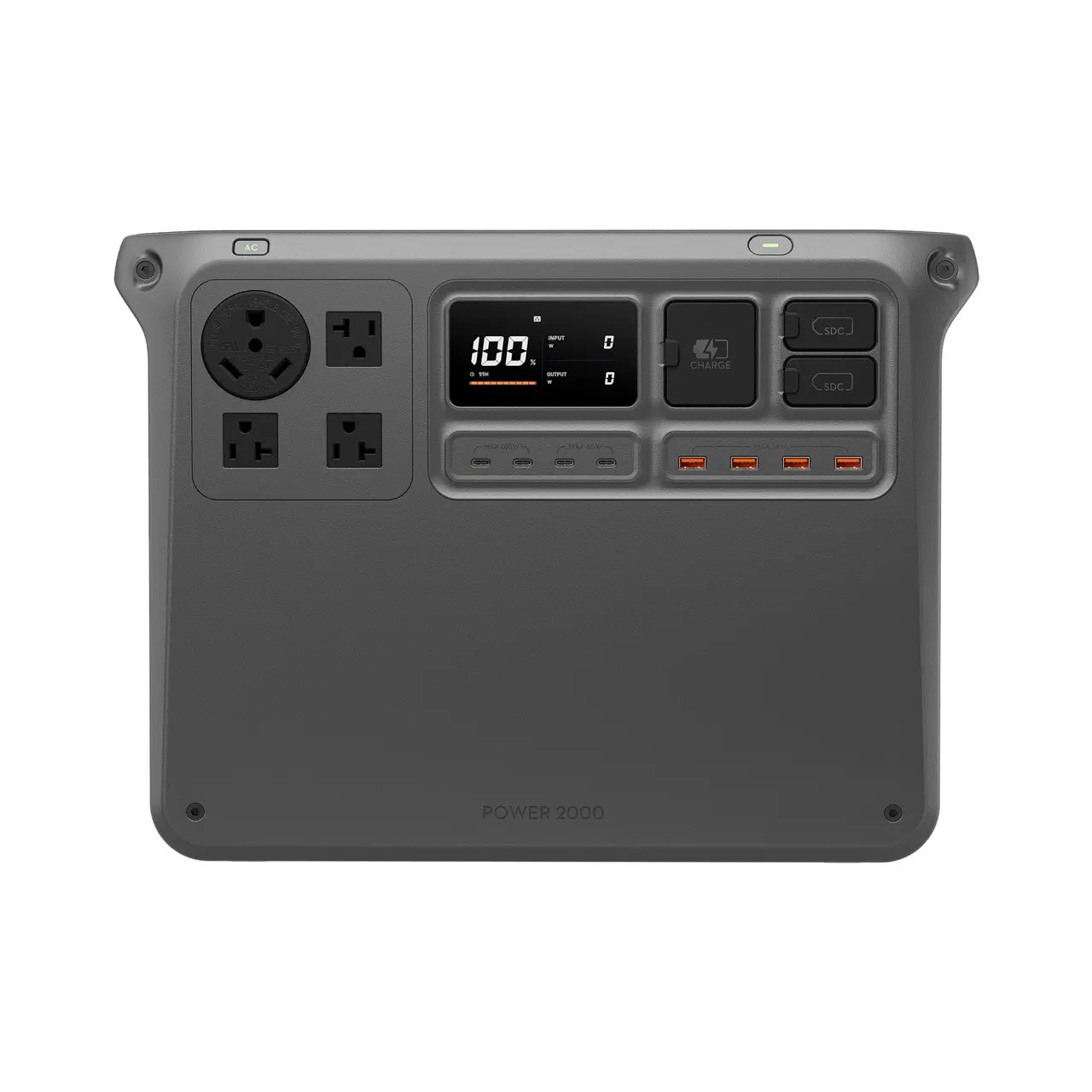
DJI Power 2000
$1,299.00
$1,299.00 · direct from DJI
Last checked 16 days ago. Prices move — check before you buy.
Prices may vary by retailer and are subject to change.