Head-to-head test
EcoFlow DELTA 3 Classic vs BLUETTI AC50B
This comes down to whether you're buying watt-hours or a one-hand carry, because the $100 step up to the DELTA 3 Classic is the cheapest energy on the page.
Full profiles: EcoFlow DELTA 3 Classic → · BLUETTI AC50B →

Written by Ian SchneiderUpdated
Solar & Off-Grid Tester, Station Arena Test Desk
Spec deltas
The expensive one is the cheap one. The DELTA 3 Classic costs $100 more than the AC50B ($499 against $399) and gives you 576Wh more (1,024Wh against 448Wh), which works out to 33 cents per added watt-hour. That is under the 46 cents the DELTA charges for its own storage and well under the AC50B's 62. Buying less here costs more per unit of the thing you came to buy.
Both are rated for 3,000 cycles and both carry five-year warranties, so none of that price gap is longevity you'd otherwise pay for. It's fixed overhead. A case, an inverter, a screen and a battery-management board all get bought before a station stores its first watt-hour, and the AC50B spreads that cost over less than half the cells. Across a full rated life it comes to 15 cents a lifetime kilowatt-hour against 21.
The AC50B's case is real, and it's short: 14.8 lbs against 26.7. That's a one-hand grab off a shelf versus a deliberate two-hand pickup, and if the unit lives in a trunk and comes out for phones, a laptop and a CPAP, the extra 576Wh is capacity you'll never reach the bottom of. Everyone else is better served by the bigger box. And four of the six load profiles we model are too big for both of them anyway, which is the other thing this page is here to tell you.
What the Numbers Reveal
Each conclusion stated first — the numbers behind it on one line, the full analysis below.
Capacity
Nothing in that gap is longevity. Identical cycle ratings and identical warranty terms mean the cheaper unit isn't buying you a longer-lived product, it's buying you a smaller one wrapped in the same fixed overhead. Spread across a rated life, that's 3,072 kilowatt-hours out of the DELTA against 1,344 out of the AC50B, or 15 cents a lifetime kilowatt-hour against 21. The unit with the bigger sticker is the one that charges less for everything it will ever deliver.
DELTA 3 Classic: $499 for 1,024WhAC50B: $399 for 448WhBoth rated 3,000 cycles and both carry a 5-year warranty
Why it mattersIf you can lift 26.7 lbs and find $100, the upgrade is the best-value energy on this page and the arithmetic doesn't get closer with time.
That margin is permanent. BLUETTI's own FAQ scopes the B80 pack to Power Bank Mode over an Aviation-to-XT60 cableB4, which means it recharges the station rather than joining it as one battery, so your inverter still sees 448Wh on night one and on night five hundred. The DELTA starts the same night with two-thirds of its energy untouched and can take a real expansion battery if the load ever grows. The AC50B is a one-night unit exactly, not a one-night unit with room.
AC50B usable energy is 381Wh (448Wh derated 15% for inverter losses)A CPAP overnight draws about 40W for eight hours, or 320WhAC50B expandable: No, fixed at 448Wh
Why it mattersIf anything else shares the box overnight, a humidifier, a phone, a lamp, you're arguing with the AC50B's last sixteen percent and should buy the DELTA.
solar input
The 500W cap is a fair complaint measured against EcoFlow's own faster siblings, and two outlets independently make itA5A9. Measured against the AC50B it's the wrong complaint entirely: the smaller unit is the slower one per watt-hour delivered. The intuition that a little station is quicker to top up from a panel is backwards for this pair, and it's backwards by a margin that grows with every cloudy hour, because 200W of ceiling gives you less to catch a good window with.
DELTA 3 Classic: 500W max solar input into 1,024WhAC50B: 200W max solar input into 448WhReviewers flag the 500W cap as low for a 2026-era releaseA5A9
Why it mattersOff-grid buyers choosing the AC50B to keep solar days short are choosing the unit that takes longer to fill and holds less when it's full.
continuous output
Double headroom starts things. Forty percent headroom is enough for a heating element and not much else, and the AC50B's 700W continuous ceiling rules out the fridge-and-power-tool class of load before surge even enters the conversation. A tester confirmed the DELTA's inverter gets a small window AC turning over, though not for longA10, which is the honest shape of it: the DELTA can start what it can't sustain, and the AC50B can't start it at all.
DELTA 3 Classic: 1,800W continuous, 3,600W surgeAC50B: 700W continuous, 1,000W surgeOne tester found the 1,800W inverter starts a small window AC, with short runtimeA10
Why it mattersAnyone whose list includes a refrigerator, a pump, or a corded power tool should stop reading at the 700W line and buy the DELTA.
The specific dimensions that decide these two units — everything else is a tie.
Lifetime Value
Selected because: The DELTA 3 Classic delivers 3,072 kilowatt-hours across its rated life against the AC50B's 1,344, which is why the pricier unit is the cheaper one to own: 15 cents a lifetime kilowatt-hour against 21.
cost / lifetime kWh
3,072 kilowatt-hours against 1,344. That isn't a durability difference, because both units are rated for the same 3,000 cycles. It's just what happens when you multiply the same cycle count by batteries of different sizes. The AC50B will deliver every cycle it promised and still hand you less than half the total energy for about 60% of the money.
Where that bites is the second purchase. Buy small now and bigger later and you've paid for two cases, two inverters, two screens and two battery-management boards to end up with capacity you could have bought once. The AC50B is a good $399. It just isn't a down payment on anything.
Your Life, Your Pick
Selected because: Four of these six load profiles are too big for either unit, so the table's real job is telling you whether you're on the right shelf at all.
Four of these six loads are too big for both units, which is the most useful thing the table tells you. Weekend camping wants 2,100Wh, van life wants 4,685Wh, and the larger of these two boxes has 870Wh usable once you derate for inverter losses. If your list looks like either of those, the answer isn't on this page. It's a larger station.
Where they do split, they split hard. The tailgate load is 670Wh: the AC50B has 381Wh usable and is finished before the game is, while the DELTA covers the whole thing on 77% of what it holds. The remote workday is the interesting near-miss at 910Wh, where the DELTA lands 40Wh short. That's one appliance or one hour of the evening, not a category failure. The AC50B is 529Wh short of the same day, which is.
Portability & Form Factor
Selected because: 26.7 lbs against 14.8 is the AC50B's one clear win, and for a buyer who lifts the unit more often than they drain it, it's the only number here that matters.
weight
11.9 lbs is the difference between a grab-handle and a commitment. 14.8 lbs comes out of a hatchback one-handed and crosses a campsite without you thinking about it. 26.7 lbs is a two-hand pickup and a thing you set down before you open a door. Testers found the DELTA's handle solid and well-centredA11 and the unit noticeably lighter than the DELTA 2 they'd been runningA8, which helps at the margin and doesn't change the arithmetic.
This is the one axis where the AC50B needs no qualification at all. If the station's job is to move, between a car, a tent, a job site, a friend's spare room, then every pound is a pound you personally carry, and the AC50B asks for roughly 45% fewer of them. Weight is the one spec on this page that can honestly outrank price.
Growth Path
Selected because: One of these takes expansion batteries and one is sealed at 448Wh, and BLUETTI's B80 pack doesn't change that because it recharges the AC50B rather than extending it.
solar input
BLUETTI sells a B80 pack for the AC50B, and what it actually does is worth being precise about, because the marketing invites the wrong reading. The company's own FAQ scopes it to Power Bank Mode over an Aviation-to-XT60 cableB4. The pack recharges the station rather than joining it, so your inverter still sees 448Wh. You've bought a refill, not a bigger tank. That's genuinely handy on a long weekend away from an outlet. It is not expansion, and this site doesn't count it as such.
The distinction decides whether buy-small-now-grow-later is a plan or a wish. On the DELTA 3 Classic it's a plan, because EcoFlow expansion batteries add capacity the base unit draws from. On the AC50B it's a wish. The fair reading is that this needn't be a mark against it: 448Wh is a complete, coherent product at $399 and plenty of buyers never see the bottom of it. It only turns into a problem if you suspect you'll grow, in which case you're about to buy the wrong unit twice.
What the Specs Don't Tell You
Selected because: Both units carry the same five-year warranty and the same 3,000-cycle rating, so the cards worth your time are surge headroom and the 10ms versus 20ms switchover.
Two of the cards below are non-events, and saying so is more useful than pretending otherwise. The warranties are identical, five years each on both units, so that comparison reduces to dividing two sticker prices by five and tells you about price rather than coverage. The cycle ratings match too, at 3,000 apiece. Neither card should move your decision by a dollar.
The switchover gap deserves one honest sentence. 10ms against 20ms is a genuine doubling in ratio and a very small gap in absolute terms, and neither of these is an online UPS: both hand over after the power has already gone. If you're riding a desktop through brownouts, the DELTA is the better of the two and that's the end of the point. If you're protecting something that truly cannot blink, buy a device built for that job instead of grading these two against each other.
Strengths & trade-offs
EcoFlow DELTA 3 Classic
Strengths
- +Larger battery capacity
- +Higher AC output
- +Faster solar charging
Trade-offs
- –Significantly heavier (+11.9 lbs), making it harder to move.
BLUETTI AC50B
Strengths
- +Costs $100 less
- +Lighter by 11.9 lb
Trade-offs
- –Weaker inverter (-1,100W) limits appliance compatibility.
Will It Power Your Gear?
Scenario math and per-appliance runtimes, modeled from the spec record.
Scenario verdicts
We ran the math on six real-world scenarios. Here's which unit survives your actual life.
SCN-01 · 2 nights · needs 2,100Wh
Weekend Camping
Two nights off-grid with essential comfort
Neither unit
Neither unit covers this scenario's 2,100Wh: the DELTA 3 Classic comes up 1,230Wh short (about 41% covered), the AC50B 1,719Wh (18%). This is well outside what either unit is for; the right answer here is a larger station, not a choice between these two.
Battery budget usedlower = more headroom
LOAD Phone Charger 15W×6h · LED Lights 40W×8h · Box Fan 75W×14h · CPAP Machine 40W×16h
SCN-02 · 8 hours · needs 1,645Wh
8-Hour Blackout
Keep the essentials running through a night without power
Neither unit
Neither of these gets you through it. 1,645Wh is more than either box holds: the DELTA 3 Classic covers about 53% of the night and the AC50B about 23%. If riding out a real outage is why you're shopping, both units are the wrong size, and the only thing separating them is that the DELTA can take an expansion battery to close the gap while the AC50B cannot.
Battery budget usedlower = more headroom
LOAD Fridge 150W×8h · Router + Modem 20W×8h · LED Lights (4 bulbs) 40W×6h · Phone Charger 15W×3h
SCN-03 · 8 hours · needs 320Wh
CPAP Overnight
Sleep therapy without interruption — the #1 medical use case
Either unit
Both cover a 40W CPAP for eight hours, so the percentages here are bookkeeping. What separates them is what's left afterwards: 320Wh is 84% of everything the AC50B has usable, against 37% for the DELTA 3 Classic. One of these reaches morning with sixteen percent in hand and nothing spare for a phone. The other barely notices the night. The rated fan noise points the same way, 30dB against 45dB, though that figure is coarse enough that it should confirm the pick rather than make it.
Battery budget usedlower = more headroom
LOAD CPAP Machine 40W×8h
SCN-04 · 8 hours · needs 910Wh
Remote Workday
Full work day off-grid without power anxiety
Neither unit
910Wh, and the DELTA 3 Classic misses it by 40. That's 870Wh usable against 910 needed, which is one appliance or one hour of the evening rather than a category failure, and trimming either gets you there on the day. The AC50B is 529Wh short of the same workday, which is a category failure.
Battery budget usedlower = more headroom
LOAD Laptop 60W×8h · External Monitor 30W×8h · Router + Modem 20W×8h · Phone Charger 15W×2h
SCN-05 · 4 hours · needs 670Wh
Tailgate Party
Game day power for the crew
DELTA 3 Classic
670Wh against 381Wh usable, so the AC50B is done before the game is. The DELTA 3 Classic covers the whole thing on 77% of its usable energy and still has around 13 hours of phone charging left in it for the drive home. This is the load where the capacity gap stops being a spreadsheet argument and starts being a cooler that goes warm.
Battery budget usedlower = more headroom
LOAD Blender 400W×0.5h · LED TV (55") 80W×4h · Bluetooth Speaker 15W×4h · Phone Charger (×3) 45W×2h
SCN-06 · 24 hours · needs 4,685Wh
Van Life Daily
A full day of mobile living — the ultimate endurance test
Neither unit
Neither unit covers this scenario's 4,685Wh: the DELTA 3 Classic comes up 3,815Wh short (about 19% covered), the AC50B 4,304Wh (8%). This is well outside what either unit is for; the right answer here is a larger station, not a choice between these two.
Battery budget usedlower = more headroom
LOAD Mini-Fridge 150W×24h · Laptop 60W×4h · Phone Charger 15W×3h · LED Lights 40W×5h · Fan 75W×8h
The Load Test
RUNTIME = (Wh × 0.85) ÷ LOAD
None of the scenarios above exactly yours? Build it. Toggle what you'd plug in; both units are tested against the combined draw.
Essentials
Comfort & Convenience
High-Draw Appliances
Test duration
8h
Continuous draw
205W
Projected runtime
For this load: DELTA 3 Classic runs 4.2h vs 1.9h.
$499 list · direct from EcoFlow
Planning for more than this? Describe your whole setup and get it sized →
Modeled from the spec record — same math as the tables below. Methodology
Runtime by appliance
Real-world runtime estimates for common appliances, modeled at 85% inverter efficiency.¹
Essentials
The basics you need runningscale 0–58hComfort & Convenience
Makes off-grid life actually enjoyablescale 0–11.6hHigh-Draw Appliances
These reveal the real limitsscale 0–0.9h¹ Runtime = (capacity × 0.85) ÷ appliance watts. Within each group, all bars share one time scale (the group's longest runtime), so lengths are comparable across appliances; identical runtimes collapse into a single blue/orange bar. Actual runtime varies with battery age, temperature, and simultaneous loads — see methodology.
Conclusion
August 9, 2026
Verdict: the DELTA 3 Classic, on Power Score margin
Take the DELTA 3 Classic. It's the cheaper unit per watt-hour on both counts, what you pay at the till and what you pay across a rated life, and it's the only one of the two that starts a compressor, covers a tailgate, or has anywhere to grow. The AC50B's wins are real but narrow: 11.9 lbs lighter at 14.8 against 26.7, and $100 less to walk out with. If one of those is a hard constraint, a unit you lift one-handed or a $399 ceiling, buy it and don't look back. It will carry a CPAP, a laptop and phones through a night without complaint. Absent that constraint, the money belongs in the bigger box, and it isn't close.
Editor-assigned confidence, based on cited owner research and spec analysis.
List prices as of August 9, 2026. The links below open EcoFlow's and BLUETTI's current prices.
$499.00 · direct from EcoFlow
Last checked 16 days ago. Prices move — check before you buy.
or check the AC50B price$399.00 list
Written by Ian Schneider, Solar & Off-Grid Tester · Station Arena Test Desk · Updated August 9, 2026
Black Friday · 38 days out
Prices to beat:DELTA 3 Classic $449AC50B $279
The lowest we have recorded for each. A Black Friday price above it is a sale that unit has already had.
Measured Data
Benchmark scores and the full spec record, side by side.
Benchmark scores
Not rated for both units (minimum threshold unmet): RV Living, Home Backup, Food Truck.
Full specifications
ᵈ Derived: price ÷ rated capacity. See the data behind our comparisons →
Comparison ToolAdd more power stations, side by sideOpen Tool →How these numbers are produced
Numeric verification
Every figure on this page traces to our spec database or arithmetic on it — no estimated numbers.
Owner claims
Statements about owner experience are cited to published reviews — see Sources & Research Notes below.
Runtime model
Runtime = (rated capacity × 0.85 inverter efficiency) ÷ device wattage. Solar recharge estimates assume panels deliver 70% of rated output. Cold weather, battery age, and stacked loads reduce real-world results.
Power Score
Computed from 14 published spec dimensions, weighted per use-case bench. Higher is better; a unit must meet a bench's minimum threshold to be rated.
See the full weight table and data sourcing on our methodology page →Class ranking (the star rating)
Each unit's star score is a category ranking, not customer reviews — no buyer opinions feed it. We score every station on size-independent quality (value, output, portability, endurance, ports, warranty, and more), then percentile-rank it against the other units in its capacity class, so a class-leading compact unit and a class-leading whole-home unit can both earn 5★. Here, DELTA 3 Classic rates 4.1/5 (46th percentile of 27 Everyday-class units), and AC50B rates 4.6/5 (78th percentile of 24 Personal-class units).
How the class ranking is computed →Test Notes & Caveats
Hidden gotchas and advantages we spotted that you won't find on the product page.
45dB, With a Caveat About the Number
The AC50B is rated 45dB under load against the DELTA 3 Classic's 30dB, and the direction of that is not in doubt. Treat the size of it as approximate. These are coarse manufacturer figures taken under conditions nobody publishes, and how hard you're loading the unit moves the reading more than the badge does. It's a fair reason to prefer the DELTA next to a bed. It is not, on its own, a reason to spend $100.
Surge Headroom: Double Versus 1.4x
3,600W of peak on an 1,800W inverter is exactly double the rated output. The AC50B's 1,000W on 700W is about 1.4 times. That ratio is the closest thing on a spec sheet to an inverter-quality tell, because it's the margin the unit holds in reserve for the half-second a motor spins up. Double headroom starts compressors. Forty percent headroom is sized for a heating element.
10ms Versus 20ms, and What It's Actually Worth
A genuine doubling in ratio, a very small gap in absolute terms. For desk gear riding out a brownout, the DELTA 3 Classic is the better of the two and that's the whole point. Worth knowing for anyone shopping specifically on this spec: neither unit is an online UPS, so both hand over after the power has already gone rather than carrying the load continuously. If your equipment truly cannot blink, this comparison isn't the one to be having.
Warranty: Identical Terms, Five Years Each
Both units carry five years, so this card is not a tiebreak and shouldn't be read as one. The only thing that differs is what those five years cost you: $94 a year of coverage on the DELTA 3 Classic against $56 on the AC50B, which is just the sticker price divided by five. It tells you about the prices, which you already knew, and nothing about the coverage, which is the same.
Full record above — the Test Desk pick is the DELTA 3 Classic.
Check DELTA 3 Classic price →or check the AC50B priceOwnership Analysis
What happens after you buy — true cost of ownership, brand trust, and growth potential.
Lifetime value
Service lifeyears at one full cycle per day
Lifetime energy delivered
Cost per delivered kWh
│ warranty ends · Reaching the cycle rating means ~80% capacity remains — degraded, not dead.
Analyst note
The AC50B is cheaper to buy, but the DELTA 3 Classic is cheaper to own. At $0.16/kWh over its lifetime vs $0.30/kWh, the DELTA 3 Classic's higher cycle life and capacity make each dollar go further over the years. One thing to know reading the table: both carry the same 3,000-cycle rating, so the lifetime rows are sticker price and capacity in disguise — the wear horizon is identical and decides nothing here.
Delivers each lifetime kWh for $0.14 less — check the DELTA 3 Classic price →
Brand trust
EcoFlow
Ecosystem
Largest in portable power — 12-15 models across DELTA Pro, DELTA 3, and RIVER 3 series, plus solar panels and smart home panels
Support
US-based phone, email and chat, with outcomes that split hard. Prepaid-label replacements handled without argument at one end, long waits and refurbished units against new claims at the other. Buying through Costco or Amazon gives you a second return path that doesn't depend on which of those you draw.
Community
Largest community in the space — Reddit r/Ecoflow_community (~31K members), multiple Facebook groups, and an official community forum
App experience
Rated 4.6/5 iOS (~8,400 ratings) · 4.2/5 Android (~17,000 ratings)
Unique strength
Fastest-charging technology (X-Stream), deepest product ecosystem, and most active innovation cadence. At the top of the range sit two whole-home paths: the TITAN line, one 5 kWh unit that grows to 30 kWh, and the DELTA Pro Ultra platform, which stacks batteries and inverters further — flagship paths, not line-wide features.
Worth knowing
EcoFlow recalled the DELTA Max 2000 in October 2025 over an overheating and fire risk after six incidents. Different product line, but it tells you something about who you're buying from. They also floated a subscription tier for advanced app features in early 2025 and shelved it after the community pushed back, and they offer nothing out of warranty.
BLUETTI
Ecosystem
One of the broadest lineups — 15-20+ models from budget (AC2A) to flagship portable (Apex 300, 2764.8Wh). Includes specialized products: vehicle solar hubs, sodium-ion cold-weather units, and balcony storage systems.
Support
The weakest link in a BLUETTI purchase. It's email-first across a China timezone gap, and the experience swings from efficient to weeks of runaround, with discounts on new units sometimes offered in place of repairs. Buying direct from BLUETTI rather than through a marketplace tends to go better when something goes wrong.
Community
Active and growing — Reddit r/bluetti has a dedicated community. Second-largest after EcoFlow in engagement.
App experience
Rated 4.5/5 iOS and Android — tied for best app experience in the category. V3.0 UI redesign was well-received.
Unique strength
Among the best capacity-to-price ratios available — several Elite and Apex units are the lowest $/Wh in the catalog. Widest product diversity including industry-firsts like sodium-ion cold-weather units and dual solar+alternator vehicle hubs. LFP across the rest of the range, though rated cycle life spans 2,500 (EB3A) to 6,000, and it varies WITHIN the Elite range rather than tracking it — the Elite 300 and Elite 200 V2 are rated 6,000 while the Elite 30 V2, Elite 10 Mini, Elite 320 and Elite 400 are rated 3,000+ and the Elite 100 V2 4,000+, so check the specific model. Dual-voltage (120V/240V) in flagships.
Worth knowing
BLUETTI's reputation for cheap watt-hours is earned across the range, and the AC50B is not where it shows. At 62 cents a watt-hour it's the pricier of these two per unit of storage. The other thing to know is the parts policy: some older models become unrepairable once they're discontinued.
Analyst note
Neither brand is a reason to change your answer here, but they aren't equivalent. EcoFlow answers a US phone number and has the biggest community in the category to troubleshoot in. BLUETTI is email-first across a timezone gap with the most inconsistent record in the space. The cheap insurance either way is buying from a retailer with its own returns desk, which shortens the path considerably if the first year goes wrong.
Growth path
DELTA 3 Classic
FIXED CAPACITYFixed at 1,024Wh, with no expansion — so size it for your needs up front rather than planning to add capacity later.
Accepts up to 500W of solar. Suitable for a 1-2 panel setup.
Adequate ports for most setups, but heavy users may want a power strip.
AC50B
FIXED CAPACITYFixed at 448Wh, with no expansion — so size it for your needs up front rather than planning to add capacity later.
Accepts up to 200W of solar. Limited to a single portable panel.
Limited ports. You'll likely need a power strip or splitter.
Realistic full solar rechargeat 70% of rated panel output — see methodology
Analyst note
Neither expands, and that's no knock on either — each is a complete unit at a fixed size. Buy the capacity that covers your needs now (the DELTA 3 Classic gives you the larger ceiling); you can't add to either later.
What Owners Report
Patterns from published owner reports and long-term reviews — every claim cited to its source below.
EcoFlow DELTA 3 Classic
The DELTA 3 Classic launched in March 2026, so what exists is a launch-window snapshot from review desksA1A5A10 rather than anything you could call long-term ownership. The consistent thread is that it runs quieter and lower-drain than its price suggests, with independent testers flagging both the fan behaviour and a measured idle draw around 17WA2A3, and one clocking a full wall recharge from empty at just under 55 minutesA1. The port layout drew specific praise, AC and USB on the front with charging inputs on the backA4, and the app and its Storm Guard auto-charge feature get called out as standoutsA6A12.
The recurring complaint is the 500W solar ceiling, raised independently by two outlets as low for a 2026 releaseA5A9. One tester confirmed the 1,800W inverter starts a small window AC with the caveat that runtime is shortA10. We've discounted the retailer review page feeding this ledger: its content blends in another model, to the point where one reviewer describes ordering a DELTA 2 and receiving something else entirelyA15. Treat everything here as early-adopter evidence, not durability evidence.
“In our tests, the DELTA 3 Classic charged from empty to full plugged into a standard wall outlet in just shy of 55 minutes.”
Sources
thesolarlab.com · vantour.net · smartenergyedge.com · walmart.com
BLUETTI AC50B
Field data on the AC50B is thin, and what exists is review-roundup material rather than lived-with ownershipB1B2B3. The points that recur are ones the spec sheet already implies: a genuinely portable sub-15-lb LFP station that undercuts its own siblings on priceB2, with standard AC charging around three hours and an optional 480W Turbo charger that cuts it to roughly 1.25B3.
Two things to hold at arm's length. The roundups put the cell rating at 2,500-plus cyclesB1 where our spec table holds 3,000, and we've used the more generous 3,000 throughout, which means the AC50B is still the pricier unit per lifetime kilowatt-hour even with the benefit of the doubt. And the expandability question is answered by BLUETTI's own FAQ rather than by anyone in the fieldB4, which is why we treat the B80 as the manufacturer claim it is: scoped to Power Bank Mode, it recharges the station instead of extending it.
“A 448Wh LiFePO4 battery with 700W output (1,000W Power Lifting), rated for 2,500+ cycles to 80% — years of reliable use.”
Sources
amazon.com · backuppowerhub.com · the-gadgeteer.com · t3.com · bluettipower.com
Sources & Research Notes
Every owner claim in this report is traceable to a published source. The bracketed references above resolve here.
Recurring owner themes
- Multiple independent reviewers note the unit is quieter than expected for its price point, with low idle drain. [DELTA 3 Classic · 2 entries]
- The 500W solar input cap is flagged as a limiting factor by more than one review outlet, seen as low for a 2026-era release. [DELTA 3 Classic · 2 entries]
- Reviewers praise the app and Storm Guard/smart features as standout software elements. [DELTA 3 Classic · 2 entries]
- Affordable, genuinely portable LFP unit with 700W output, 3,000+ rated cycles (BLUETTI), fast Turbo charging, and B80 support in Power Bank Mode (recharge, not expansion). [AC50B · 3 entries]
- A1
“In our tests, the DELTA 3 Classic charged from empty to full plugged into a standard wall outlet in just shy of 55 minutes.”
thesolarlab.com — EcoFlow DELTA 3 Classic Review: Cheap, Quiet & Useful? · unknown (post-launch 2026) · [positive]
- A2
“We measured the idle draw to be roughly 17W per hour.”
thesolarlab.com — EcoFlow DELTA 3 Classic Review: Cheap, Quiet & Useful? · unknown (post-launch 2026) · [positive]
- A3
“we expected the cooling fans to break that trend given the price point for this unit”
thesolarlab.com — EcoFlow DELTA 3 Classic Review: Cheap, Quiet & Useful? · unknown (post-launch 2026) · [positive]
- A4
“EcoFlow moved back to a more sensible front-facing layout: AC outlets and USB ports on the front, charging inputs on the back”
thesolarlab.com — EcoFlow DELTA 3 Classic Review: Cheap, Quiet & Useful? · unknown (post-launch 2026) · [positive]
- A5
“the screen only showed 500 W input”
vantour.net — EcoFlow Delta 3 Classic: Our review, test and promo code · 3 weeks ago (~June 2026) · [negative]
- A6
“it is clearly one of the best-designed apps on the market”
vantour.net — EcoFlow Delta 3 Classic: Our review, test and promo code · 3 weeks ago (~June 2026) · [positive]
- A8
“It also seems noticeably lighter than the EcoFlow DELTA 2 that we currently have in the motorhome.”
vantour.net — EcoFlow Delta 3 Classic: Our review, test and promo code · 3 weeks ago (~June 2026) · [positive]
- A9
“EcoFlow pushes the fast charging hard, but the DELTA 3 Classic is capped at 500W solar input”
smartenergyedge.com — EcoFlow DELTA 3 Classic Review: Better Than the DELTA 2? · 1 week ago (~July 2026) · [negative]
- A10
“The 1,800W inverter handles the startup surge of a small window AC unit just fine, but the runtime is short.”
smartenergyedge.com — EcoFlow DELTA 3 Classic Review: Better Than the DELTA 2? · 1 week ago (~July 2026) · [mixed]
- A11
“The handle is solid and centered well.”
smartenergyedge.com — EcoFlow DELTA 3 Classic Review: Better Than the DELTA 2? · 1 week ago (~July 2026) · [positive]
- A12
“The Storm Guard auto-charge feature is smart and genuinely useful.”
smartenergyedge.com — EcoFlow DELTA 3 Classic Review: Better Than the DELTA 2? · 1 week ago (~July 2026) · [positive]
- A15
“I pay for an Ecoflow delta 2 1024wh but I receive something totally different. An Ecoflow 950 wh that doesn't fit my expertise or what I need.”
walmart.com — Customer reviews for EF EcoFlow DELTA 3 Classical 1000 · unknown · [negative]
- B1
“A 448Wh LiFePO4 battery with 700W output (1,000W Power Lifting), rated for 2,500+ cycles to 80% — years of reliable use.”
amazon.com / backuppowerhub.com — AC50B review · 2026 · [positive]
- B2
“At 14.8 lbs it's meaningfully lighter than the AC70 (21.4 lbs) — a genuinely portable sub-15-lb unit with a long-cycle battery and 700W output at an easy-to-justify price.”
backuppowerhub.com / the-gadgeteer.com — AC50B review · 2026 · [positive]
- B3
“Standard AC charging is about 3 hours, dropping to 1.25 hours with the optional 480W Turbo charger; 0-80% in 45 minutes.”
amazon.com / t3.com — AC50B review · 2026 · [positive]
- B4
“The B80 can add 806Wh, but BLUETTI scopes this to "capacity expansion with B80 battery in Power Bank Mode" over an Aviation-to-XT60 cable — the pack recharges the unit rather than extending it as one system, so this is not expandability in the sense this site uses. At $279 it is BLUETTI's most affordable LiFePO4 station.”
bluettipower.com AC50B FAQ (primary) · 2026 · [positive]
Research compiled August 9, 2026.
Who Should Buy Which
Buy the DELTA 3 Classic if you…
- →You need a refrigerator, a water pump, a circular saw or a small window AC to actually start. 1,800W continuous with 3,600W of surge behind it does that. 700W with 1,000W behind it doesn't reach the starting line.
- →You're buying one station for a mixed job: a tailgate, a long power cut, a week in a cabin. The 670Wh tailgate load is the clean example, and only one of these two finishes it.
- →You suspect your needs will climb. This is the only one of the pair with somewhere to go, and paying the case-and-inverter overhead once beats paying it twice.
- →You charge a large laptop off USB-C. A 100W port keeps pace with the machine's own charger; 65W tops it up but loses ground while you're working.
Buy the AC50B if you…
- →The station's whole job is to move. 14.8 lbs is a one-hand lift off a shelf, into a trunk, across a campsite, and if you'll be carrying it more often than you'll be draining it, weight is the spec that should decide.
- →Your load list is phones, a laptop, lights, a camera kit, or a CPAP for the night. 381Wh usable covers all of that, and the bigger unit's extra capacity is money you'd never reach.
- →$399 is a real ceiling rather than a preference. This is a full LFP station with a five-year warranty at the bottom of the category, and there's nothing apologetic about owning one.
- →You already have a big station at home and want a small second one that travels. Buying another 1,024Wh box for that job puts the money in the wrong place.
If neither fits
Anyone sizing for genuine house backup or a lived-in van should close this tab. An eight-hour outage in our model wants 1,645Wh and weekend camping wants 2,100Wh, while the larger of these two holds 870Wh usable, so it covers roughly half the outage and neither unit covers the camping trip. Van life wants 4,685Wh, which isn't the same conversation. If that's you, shop the multi-kilowatt-hour class, or a DELTA 3 Classic with expansion batteries attached, and treat these two as the wrong shelf rather than a close call.
The Bottom Line
Take the DELTA 3 Classic. Every dollar you add on top of the AC50B buys watt-hours at a better rate than either unit's own sticker price, the cycle ratings and warranties are identical so none of that gap is longevity you're paying for twice, and it's the only one of the two that starts a compressor or has anywhere to grow.
The AC50B keeps one honest claim and it deserves respect: 14.8 lbs against 26.7 is a real difference in what you'll actually carry, and $399 is a real ceiling for a real buyer. If that's your constraint, buy it, run your phones and your CPAP off it, and don't feel talked down to. If it isn't your constraint, spend the $100. It's the cheapest energy on this page.
Frequently Asked Questions
Answers drawn from the spec record and cited owner research.
Is the EcoFlow DELTA 3 Classic worth $100 more than the BLUETTI AC50B?
Yes, unless weight or a hard budget ceiling decides it for you. That $100 buys 576Wh, which works out to 33 cents per watt-hour, cheaper than the rate either unit charges on its own sticker. You also move from 700W of output to 1,800W and gain a unit that can take an expansion battery later. The AC50B is the right call only when 14.8 lbs or $399 is genuinely the constraint.
Can the BLUETTI AC50B run a refrigerator?
Not reliably, and the limit is output rather than capacity. The AC50B runs 700W continuous with 1,000W of surge behind it, roughly 1.4 times headroom, and a compressor's startup draw is exactly the moment that thin margin gets tested. Even if it started, 381Wh of usable energy is a few hours of cycling rather than a night. The DELTA 3 Classic's 1,800W inverter with 3,600W of surge is the one built for that load.
Does the B80 expansion battery work with the AC50B?
It attaches, but it isn't expansion. BLUETTI scopes the B80 to Power Bank Mode over an Aviation-to-XT60 cable, so the pack recharges the AC50B rather than running with it as one larger battery, and your inverter still sees 448Wh. That's useful for stretching a weekend away from an outlet. If you're planning to grow the system, though, the DELTA 3 Classic takes true expansion batteries and the AC50B is sealed at what you bought.
Which one is better for a CPAP?
The DELTA 3 Classic, though both will work. A CPAP is roughly 40W for eight hours, about 320Wh, which is 84% of everything the AC50B has usable against 37% of the DELTA's. The AC50B gets you to morning, it just won't get you there with anything else running or through a second night without a recharge. If the machine is the only load and you're recharging daily, the AC50B is fine and it's lighter.
How long does each take to recharge from solar?
About the same, which surprises people. The DELTA 3 Classic accepts 500W into 1,024Wh, so a full refill at rated input is roughly two hours of strong sun, while the AC50B accepts 200W into 448Wh for roughly two and a quarter. Real panels rarely hit rated output, so treat both as best cases. The point stands either way: the smaller unit is not the faster one to fill.
Brand matchup
EcoFlow vs BLUETTI: measured across every matchup →Where to buy

EcoFlow DELTA 3 ClassicPick
$499.00
$499.00 · direct from EcoFlow
Last checked 16 days ago. Prices move — check before you buy.
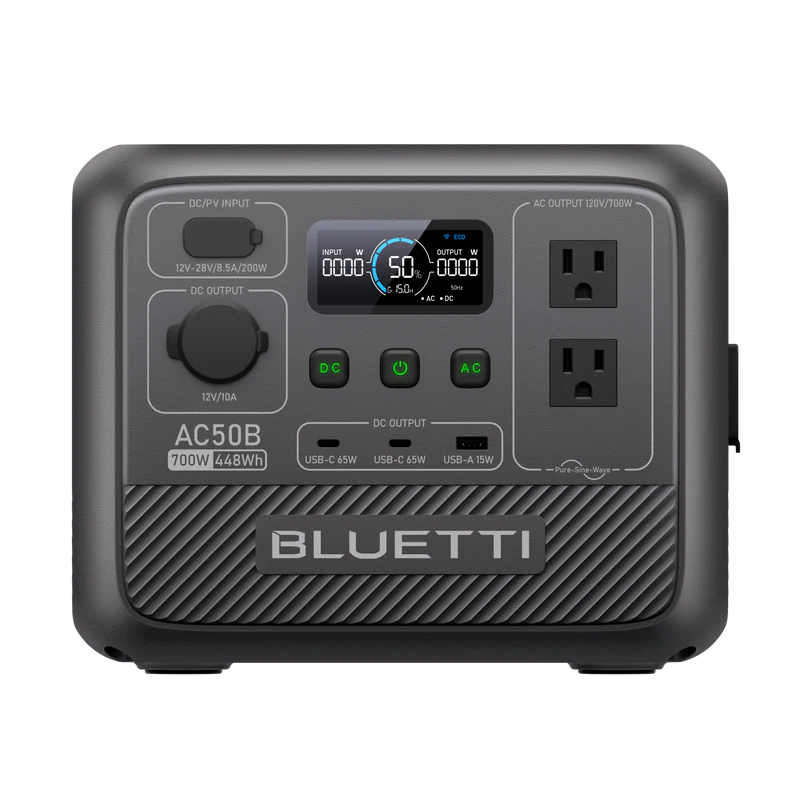
BLUETTI AC50B
$399.00
$399.00 · direct from BLUETTI
Last checked 16 days ago. Prices move — check before you buy.
Prices may vary by retailer and are subject to change.