Head-to-head test
EcoFlow DELTA 3 1500 vs EcoFlow DELTA 3 Max
The DELTA 3 1500 has left EcoFlow's range, so the only live question is whether the DELTA 3 Max's 2,048Wh is worth hauling 50.7 lb for, and if you bought a power station for the blackout, it is, because the 1500 doesn't finish one.
Full profiles: EcoFlow DELTA 3 1500 → · EcoFlow DELTA 3 Max →

Written by Ian SchneiderUpdated
Solar & Off-Grid Tester, Station Arena Test Desk
Spec deltas
EcoFlow has stopped selling the DELTA 3 1500. Nothing in the current range sits at 1,536Wh, and the successor on our record is the DELTA 3 Max, which happens to be the other unit on this page. That makes this an unusual comparison: not a choice between two boxes, but a straight answer to the question you actually arrived with, which is what changes if you step into the one that replaced it.
What changes is 512Wh more battery (2,048 against 1,536), a 2,400W inverter where the 1500 ran 1,800W, 4,800W of surge against 3,600W, and a thousand more rated cycles. It also changes in the other direction. The Max is 14.7 lb heavier, carries two USB-A ports instead of four, and tops out at 100W on USB-C where the 1500 did 140W. Bigger everywhere the battery is, smaller everywhere your desk is.
The verdict is the Max at $899, and it earns the position rather than inheriting it. Of the six load profiles we run, the extra capacity flips exactly one: the eight-hour blackout, which is the night most people buy one of these for. Everywhere else the two either both finish or both fall short. If you already own a 1500 that works, that single flip is the entire case for replacing it, and for most people it won't be enough.
What the Numbers Reveal
Each conclusion stated first — the numbers behind it on one line, the full analysis below.
Capacity
That one is the blackout, and it lands there without room to spare: the 1500 stops 339Wh short, the Max finishes with 96Wh in hand. Spread 1,645Wh across eight hours and the average draw is about 206W, so 96Wh is roughly half an hour of margin. The Max passes this scenario. It doesn't stroll through it.
DELTA 3 1500: 1,536Wh nameplate, 1,306Wh usable after the flat 85% derate applied to every unit on this siteDELTA 3 Max: 2,048Wh nameplate, 1,741Wh usable under the same derateThe 8-hour blackout profile needs 1,645Wh; weekend camping needs 2,100Wh; van life daily needs 4,685Wh
Why it mattersIf home backup is why you're shopping, the Max is the one that gets through the night. If it's camping at 2,100Wh or van life at 4,685Wh, both come up short and you should be sizing up rather than choosing between these two.
rated cycles
That's the shape of the entire upgrade. The Max is better at holding energy and exactly as good at collecting it. Over the rated life it delivers 8,192 kWh against 4,608, about 78% more energy for the life of the box, because it stacks a thousand more cycles on a bigger pack. But on any given off-grid afternoon it's the unit still charging when the small one is already full.
Both units cap solar input at 500W1,536Wh of capacity against 2,048Wh3,000 rated cycles against 4,000, for 4,608 kWh against 8,192 kWh of lifetime energy
Why it mattersGrid-tied backup buyers can ignore the refill gap completely. Anyone running sun-only should buy panels to match the tank instead of assuming the step-up comes free.
weight
And the desk load was never in question: the 1500 finishes a remote workday at 70% used with 396Wh spare. A laptop that wants the full 140W gets it from the discontinued unit and won't get it from its replacement. That's a strange sentence to write about a successor, and an honest one.
DELTA 3 1500: USB-C rated at 140W, four USB-A ports, 36 lbDELTA 3 Max: USB-C rated at 100W, two USB-A ports, 50.7 lbBoth carry six AC outlets and a 12V car socketThe remote workday profile needs 910Wh; the 1500 covers it at 70% used with 396Wh left
Why it mattersIf you own a 1500 and your heaviest day is a laptop, a monitor and a phone charger, replacing it is a downgrade at the only panel you actually touch.
The spec sheet points the same direction the thin evidence does. The 1500 is rated no worse than 15ms on UPS switchover against the Max's 10ms ceiling, and posters put its cutover at that same 15ms while describing the electronics behind it as carried over from the older DELTA 2A3A5. Both figures are ratings rather than measurements, but when the published ceiling and the forum folklore agree, a fussy desktop power supply is the load that finds out.
Our field record for the 1500 is thin and secondhand, assembled from search-indexed forum snippets rather than owner threadsA0One poster relayed a neighbour who lost three 1500s in roughly eight monthsA1, and forum consensus put the DELTA 3 line ahead of the DELTA 2 on failure reportsA2Posters describe the 1500 as a hybrid: DELTA 2 UPS-cutover electronics in a new caseA3, with the cutover pegged at the same 15ms the spec sheet carriesA5A reviewer ran a Max through a 105F garage, near-freezing operation and truck-bed transport with capacity holding between one-month and three-month checksB3
Why it mattersIf the thing behind the UPS socket is a computer with unsaved work, that's the Max's argument to win, and the 1500's rating sits right on the line where those supplies start complaining.
The specific dimensions that decide these two units — everything else is a tie.
Runtime: Will It Power Your Gear?
Selected because: The entire case for the bigger unit is 435Wh of usable energy, 1,741Wh against 1,306Wh once the flat 85% derate is applied, so this is where the decision actually gets made.
continuous output
Usable energy is the only figure that decides anything here, and it's smaller than either label suggests. Apply the flat 85% derate this site uses on every unit and 2,048Wh becomes 1,741Wh while 1,536Wh becomes 1,306Wh. The gap you're actually buying is 435Wh. Against the 910Wh remote-workday profile that's about half a day of desk, which is useful, but it is not a second day of anything.
Where 435Wh matters is a narrow band. Any load under 1,306Wh usable is a job both units finish, and anything over 1,741Wh is a job neither finishes. The Max only wins outright in between, and the eight-hour blackout is the profile that lives there.
Your Life, Your Pick
Selected because: Six load profiles run against both units, and the extra capacity changes the answer on exactly one of them.
Six profiles, one flip. The Max wins the blackout because it finishes it. It wins the workday and the tailgate the way a bigger wallet wins a lunch bill, with more left over on a job both units had already done. Camping at 2,100Wh and van life at 4,685Wh are losses for both, and being less short on camping (359Wh against 794Wh) is not the same as being enough.
Read the reserve figures as planning headroom rather than as a reason to spend. The useful question isn't which unit has more left at the end of game day, it's whether your real list looks like the blackout, which is a fridge and lights and a router and a whole night of it, or like the workday. One of those is the Max's argument. The other the 1500 had already answered.
Portability & Form Factor
Selected because: 36 lb against 50.7 lb is what the bigger battery costs you on the stairs, and it is the one spec where the discontinued unit still wins.
weight
36 lb is a unit you pick up with one hand and resent by the second flight of stairs. 50.7 lb is two hands, bent knees, and a decision about where it's going to live, because you won't want to move it twice. That's 14.7 lb more to lift, about 41% more unit, and you feel percentage increases like that in your lower back rather than in a spec table.
This is the one place the discontinued unit is simply better, and it's worth saying out loud before the rest of the page talks you into the bigger box. If the job is to move, trunk to campsite, garage to tailgate, one room to another, the 1500 was the easier object to live with and its replacement isn't. If the job is to sit in a basement on UPS duty, weight is a problem for delivery day and nothing after that.
What the Specs Don't Tell You
Selected because: Same 5-year warranty and the same 500W solar ceiling, so the separations that survive are the UPS class (10ms against 15ms, both rated ceilings) and 4,000 cycles against 3,000.
rated cycles
Two of the four cards here are non-events wearing the costume of a difference. The warranty is five years on both and the solar ceiling is 500W on both, so neither one separates anything. What survives is the UPS class, rated no worse than 10ms against no worse than 15ms, and cycle life, where 4,000 against 3,000 on a bigger pack compounds into 8,192 kWh of lifetime energy against 4,608.
The noise card is the honest one, and it cuts against the unit people will be nostalgic for. The Max publishes 30dB and the 1500 publishes nothing at all. That's not evidence the 1500 is louder; it's the absence of a number, which for a bedroom or a CPAP nightstand is its own kind of problem. You can't hold a maker to a figure it never printed, and you can't go hear a unit that's no longer on a shelf.
Strengths & trade-offs
EcoFlow DELTA 3 1500
Strengths
- +Lighter by 14.7 lb
Trade-offs
- –Weaker inverter (-600W) limits appliance compatibility.
- –Shorter-lived battery — rated for 3,000 charge cycles vs the DELTA 3 Max's 4,000, so it wears out sooner.
EcoFlow DELTA 3 Max
Strengths
- +Larger battery capacity
- +Higher AC output
- +Rated for 4,000 charge cycles — much longer battery lifespan
Trade-offs
- –Significantly heavier (+14.7 lbs), making it harder to move.
Will It Power Your Gear?
Scenario math and per-appliance runtimes, modeled from the spec record.
Scenario verdicts
We ran the math on six real-world scenarios. Here's which unit survives your actual life.
SCN-01 · 2 nights · needs 2,100Wh
Weekend Camping
Two nights off-grid with essential comfort
Neither unit
Neither unit finishes this one. 2,100Wh is more than either holds once the derate is applied, and the DELTA 3 Max's smaller shortfall, 359Wh against 794Wh, buys a later bedtime rather than a covered weekend. Whichever box you're carrying, plan on a midday solar top-up or a shorter list.
Battery budget usedlower = more headroom
LOAD Phone Charger 15W×6h · LED Lights 40W×8h · Box Fan 75W×14h · CPAP Machine 40W×16h
SCN-02 · 8 hours · needs 1,645Wh
8-Hour Blackout
Keep the essentials running through a night without power
DELTA 3 Max
This is the one scenario that separates them, and it separates them completely: the DELTA 3 Max finishes the night with 96Wh left while the DELTA 3 1500 stops 339Wh short of it. Spread 1,645Wh over eight hours and the average draw is about 206W, so the Max's margin is about half an hour. It passes. It doesn't stroll.
Battery budget usedlower = more headroom
LOAD Fridge 150W×8h · Router + Modem 20W×8h · LED Lights (4 bulbs) 40W×6h · Phone Charger 15W×3h
SCN-03 · 8 hours · needs 320Wh
CPAP Overnight
Sleep therapy without interruption — the #1 medical use case
Either unit
Both sleep through this without trying: 320Wh against 1,306Wh and 1,741Wh usable, so capacity decides nothing and the tiebreak moves to the nightstand. The DELTA 3 Max publishes 30dB; the DELTA 3 1500 publishes no figure at all, which isn't the same as being louder but does mean there's nothing to hold it to. If the unit is going to sit eighteen inches from your head, take the one with a printed number.
Battery budget usedlower = more headroom
LOAD CPAP Machine 40W×8h
SCN-04 · 8 hours · needs 910Wh
Remote Workday
Full work day off-grid without power anxiety
DELTA 3 Max
Both clear the workday; the DELTA 3 Max just clears it by more, 52% used against 70%, with 831Wh banked against 396Wh. The figure that would actually change your day is on the port panel rather than in the battery: the DELTA 3 1500 rates its USB-C at 140W where the Max stops at 100W, so a laptop that wants full-speed charging prefers the unit that isn't sold any more. That's a real loss, and on this scenario it isn't enough to move the pick.
Battery budget usedlower = more headroom
LOAD Laptop 60W×8h · External Monitor 30W×8h · Router + Modem 20W×8h · Phone Charger 15W×2h
SCN-05 · 4 hours · needs 670Wh
Tailgate Party
Game day power for the crew
DELTA 3 Max
Both handle game day; the DELTA 3 Max keeps more in reserve (38% used vs 51%). Tailgating is a light load, though, so the number you'll feel is weight: 36 lbs for the DELTA 3 1500 against 50.7 lbs for the DELTA 3 Max, from the trunk to the setup spot.
Battery budget usedlower = more headroom
LOAD Blender 400W×0.5h · LED TV (55") 80W×4h · Bluetooth Speaker 15W×4h · Phone Charger (×3) 45W×2h
SCN-06 · 24 hours · needs 4,685Wh
Van Life Daily
A full day of mobile living — the ultimate endurance test
Neither unit
Neither unit is a van's daily supply. The load is 4,685Wh; the DELTA 3 Max covers 37% of it and the DELTA 3 1500 28%, which makes this an expansion-battery problem or a two-unit problem rather than a choice. Both take EcoFlow expansion batteries, so the route exists. Just don't expect a bare box to walk it.
Battery budget usedlower = more headroom
LOAD Mini-Fridge 150W×24h · Laptop 60W×4h · Phone Charger 15W×3h · LED Lights 40W×5h · Fan 75W×8h
The Load Test
RUNTIME = (Wh × 0.85) ÷ LOAD
None of the scenarios above exactly yours? Build it. Toggle what you'd plug in; both units are tested against the combined draw.
Essentials
Comfort & Convenience
High-Draw Appliances
Test duration
8h
Continuous draw
205W
Projected runtime
For this load: DELTA 3 Max runs 8.5h vs 6.4h.
$899 list · direct from EcoFlow
Planning for more than this? Describe your whole setup and get it sized →
Modeled from the spec record — same math as the tables below. Methodology
Runtime by appliance
Real-world runtime estimates for common appliances, modeled at 85% inverter efficiency.¹
Essentials
The basics you need runningscale 0–116.1hComfort & Convenience
Makes off-grid life actually enjoyablescale 0–23.2hHigh-Draw Appliances
These reveal the real limitsscale 0–1.7h¹ Runtime = (capacity × 0.85) ÷ appliance watts. Within each group, all bars share one time scale (the group's longest runtime), so lengths are comparable across appliances; identical runtimes collapse into a single blue/orange bar. Actual runtime varies with battery age, temperature, and simultaneous loads — see methodology.
Conclusion
September 19, 2026
Verdict: the DELTA 3 Max, on Power Score margin
Buy the DELTA 3 Max, and not only because it's the one you can still buy. EcoFlow has folded the DELTA 3 1500 out of its range and the Max is the successor on our record, which settles the shopping question before the specs get a vote. The specs vote the same way anyway: 1,741Wh usable against 1,306Wh is the difference between finishing an eight-hour blackout and stopping 339Wh short of it, and 4,000 rated cycles on a 2,048Wh pack works out to 8,192 kWh of lifetime energy against the 1500's 4,608. What you pay for that is 14.7 lb (50.7 against 36), two of the four USB-A ports, and 40W off the top USB-C rate (100W against 140W). If you already own a 1500 and your heaviest day is a laptop, a monitor and a phone, keep it. Nothing on this page is worth replacing a working unit for.
Editor-assigned confidence, based on cited owner research and spec analysis.
List prices as of September 19, 2026. The links below open EcoFlow's current price.
$899.00 · direct from EcoFlow
Last checked 16 days ago. Prices move — check before you buy.
Written by Ian Schneider, Solar & Off-Grid Tester · Station Arena Test Desk · Updated September 19, 2026
Black Friday · 38 days out
Price to beat:DELTA 3 Max $829
The lowest we have recorded. A Black Friday price above it is a sale this unit has already had.
Measured Data
Benchmark scores and the full spec record, side by side.
Benchmark scores
Not rated for both units (minimum threshold unmet): Camping.
Full specifications
ᵈ Derived: price ÷ rated capacity. See the data behind our comparisons →
Comparison ToolAdd more power stations, side by sideOpen Tool →How these numbers are produced
Numeric verification
Every figure on this page traces to our spec database or arithmetic on it — no estimated numbers.
Owner claims
Statements about owner experience are cited to published reviews — see Sources & Research Notes below.
Runtime model
Runtime = (rated capacity × 0.85 inverter efficiency) ÷ device wattage. Solar recharge estimates assume panels deliver 70% of rated output. Cold weather, battery age, and stacked loads reduce real-world results.
Power Score
Computed from 14 published spec dimensions, weighted per use-case bench. Higher is better; a unit must meet a bench's minimum threshold to be rated.
See the full weight table and data sourcing on our methodology page →Class ranking (the star rating)
Each unit's star score is a category ranking, not customer reviews — no buyer opinions feed it. We score every station on size-independent quality (value, output, portability, endurance, ports, warranty, and more), then percentile-rank it against the other units in its capacity class, so a class-leading compact unit and a class-leading whole-home unit can both earn 5★. Here, DELTA 3 1500 rates 5.0/5 (99th percentile of 27 Everyday-class units), and DELTA 3 Max rates 4.2/5 (52nd percentile of 26 Large-class units).
How the class ranking is computed →Test Notes & Caveats
Hidden gotchas and advantages we spotted that you won't find on the product page.
UPS Switchover: ≤10ms vs ≤15ms
Both list a UPS mode, at different rated speeds. The DELTA 3 Max is rated ≤10ms — quick enough on paper that desktop PCs and routers should ride through, treating that as the rating it is. The DELTA 3 1500 is rated ≤15ms — fine on paper for routers and most electronics; the fussiest PC power supplies sit right at this line. If a computer with unsaved work is the thing being protected, the stated class is worth the attention; nothing here is a lab result.
Warranty: Five Years Each, One Clock Running
Five years on both, same maker, same terms. Coverage is the one column on this page where the two units are genuinely identical, so it decides nothing. The difference isn't in the paperwork, it's in who can start the clock: only the DELTA 3 Max can begin a fresh five years today. On a unit that has sat on a shelf or passed through a previous owner, how much cover is left is a question for the seller rather than an assumption you get to make.
What a Thousand More Cycles Actually Buys
Rated cycles are only half the sum, because a cycle isn't the same size on each unit. The DELTA 3 Max is rated for 4,000 cycles of 2,048Wh; the DELTA 3 1500 for 3,000 of 1,536Wh. Multiply through and the life of the box is 8,192 kWh against 4,608, about 78% more energy rather than the 33% more cycles the headline suggests. In years that's 11 against 8.2 at daily use, or 38 against 29 at weekends. And the rating isn't a death date: past it the pack still holds roughly 80% of its original capacity, which is a long way from useless.
One Published Number, One Silence
The DELTA 3 Max publishes 30dB. The DELTA 3 1500 publishes nothing at all, and that absence deserves more attention than it usually gets. It isn't evidence the 1500 is louder; it means there's no figure to hold it to and no way to compare the two on paper. Even the Max's number is a spec-sheet figure rather than a measurement taken in your bedroom, and makers publish these differently, some as a quiet-mode floor and some as a loaded ceiling, so don't read it as a promise. For a bedroom, a nursery or a CPAP nightstand the honest instruction is to hear the unit first, and the retired one is much harder to go hear.
Full record above — the Test Desk pick is the DELTA 3 Max.
Check DELTA 3 Max price →Ownership Analysis
What happens after you buy — true cost of ownership, brand trust, and growth potential.
Lifetime value
Service lifeyears at one full cycle per day
Lifetime energy delivered
Cost per delivered kWh
│ warranty ends · Reaching the cycle rating means ~80% capacity remains — degraded, not dead.
Analyst note
The DELTA 3 1500 is no longer sold, so there is no price to work its cost per kWh from, and this comparison doesn't quote one. On what you can actually buy today, the DELTA 3 Max works out at $0.11/kWh over its rated life. If you already own the DELTA 3 1500, the hardware comparison still holds: over its rated life the DELTA 3 1500 delivers about 4,608 kWh and the DELTA 3 Max about 8,192 kWh.
Growth path
DELTA 3 1500
EXPANDABLESupports EcoFlow expansion batteries, so you can add capacity later without replacing the base unit — useful if your needs may climb past 1,536Wh.
Accepts up to 500W of solar. Suitable for a 1-2 panel setup.
Generous port selection supports complex multi-device setups.
Expansion batteries are EcoFlow-specific. You're investing in the EcoFlow ecosystem.
DELTA 3 Max
EXPANDABLESupports EcoFlow expansion batteries, so you can add capacity later without replacing the base unit — useful if your needs may climb past 2,048Wh.
Accepts up to 500W of solar. Suitable for a 1-2 panel setup.
Adequate ports for most setups, but heavy users may want a power strip.
Expansion batteries are EcoFlow-specific. You're investing in the EcoFlow ecosystem.
Realistic full solar rechargeat 70% of rated panel output — see methodology
Analyst note
Growth only counts if you can still buy in, and the DELTA 3 1500 is no longer sold, replaced by the DELTA 3 Max beside it. That leaves the DELTA 3 Max: it starts at 2,048Wh and takes EcoFlow expansion batteries, so the ceiling moves if your needs do. The DELTA 3 1500's expandability still matters if you already own one, but it isn't a reason to pick it over the DELTA 3 Max.
What Owners Report
Patterns from published owner reports and long-term reviews — every claim cited to its source below.
EcoFlow DELTA 3 1500
Start with what we don't have. Our field record for the DELTA 3 1500 is thin and secondhand, assembled from search-indexed forum snippets rather than owner threads, with no Reddit, YouTube or Amazon material specific to this SKU, and the two forum threads that do discuss it refused direct fetchingA0. Read what follows as one venue's opinion, not a consensus.
What's there doesn't flatter it. One poster relayed a neighbour who went through three 1500s in roughly eight monthsA1, and the broader thread leaned toward the DELTA 3 line drawing more failure reports than the DELTA 2, with one poster contrasting two DELTA 2 units that had never given him troubleA2. Posters also described the 1500 as a hybrid design, DELTA 2 UPS-cutover electronics in a new case with what one called larger grade B cellsA3, and pegged its cutover at the same 15ms the spec sheet carries, slower than what they associated with the standard DELTA 3A5. Idle draw came up too, somewhere around 25 to 30W by some accounts and cut from about 40W to 17W by a firmware update according to others, with nobody sure whether the 1500 ever got that fix and our researcher unable to confirm the thread was even about this modelA4. Treat that last one as character, not as a spec to hold it to.
“Posters described the Delta 3 1500 as essentially a Delta 2/Delta 3 hybrid — UPS-cutover electronics carried over from the Delta 2, housed in a new case with what one called "larger grade B cells."”
Sources
diysolarforum.com
EcoFlow DELTA 3 Max
The Max's record is the opposite shape: no large owner threads, but real hands-on testingB0. One reviewer kept a unit through a 105F garage, ran it near 34F, hauled it in a truck bed, and found capacity holding steady between the one-month and three-month checksB3, rating it strongly against the rest of the 2kWh classB4. That's the kind of evidence that matters for a box you expect to still be working in a decade.
On noise, reviewers describe it as essentially silent at conversational distance under moderate load, with the fans rising under heavy load but staying quieter than most of the class, and the app adding a quiet mode and a custom charge-speed limit if it bothers youB1. The app itself comes up repeatedly as the reason people stay inside EcoFlow's ecosystem rather than as a feature anyone shops forB2. One caveat across all of it: some sources blur the Max with the Max Plus variant, so the ecosystem claims are firmer than any single figure attributed to one variantB0.
“Whisper-quiet under moderate load — essentially silent at conversational distance; the app adds a low-power quiet mode and a custom charge-speed limit if fan noise bothers you. Fans rise under heavy load but stay quieter than most competitors in the 2kWh class.”
Sources
backuppowerhub.com · thesolarlab.com · androidguys.com
Sources & Research Notes
Every owner claim in this report is traceable to a published source. The bracketed references above resolve here.
Recurring owner themes
- Forum posters flagged the Delta 3 1500 as less reliable than EcoFlow's earlier Delta 2, both from direct failure reports and from its unusual hybrid Delta 2/Delta 3 hardware platform. [DELTA 3 1500 · 3 entries]
- Idle power draw and UPS cutover time are both discussed as possible regressions or open questions relative to the standard Delta 3 / Delta 3 Plus, without firm confirmation for the 1500 variant specifically. [DELTA 3 1500 · 2 entries]
- Reviewers consistently praise practical quietness (with app-based quiet/charge-limit modes) and the EcoFlow app/ecosystem as differentiators. [DELTA 3 Max · 2 entries]
- A1
“A poster's neighbor had three separate Delta 3 1500 units fail on him over roughly eight months.”
diysolarforum.com — "Ecoflow Delta 3 1500 (the newer one), refurbed from EF for $360pt, shipped free" · 2026-02 · [negative]
- A2
“Forum consensus leaned toward the Delta 3 line seeing more failure reports than the Delta 2 — one poster said their two Delta 2 units never gave them a single issue by comparison.”
diysolarforum.com — "Ecoflow Delta 3 1500 (the newer one), refurbed from EF for $360pt, shipped free" · 2026-02 · [negative]
- A3
“Posters described the Delta 3 1500 as essentially a Delta 2/Delta 3 hybrid — UPS-cutover electronics carried over from the Delta 2, housed in a new case with what one called "larger grade B cells."”
diysolarforum.com — "Ecoflow Delta 3 1500 (the newer one), refurbed from EF for $360pt, shipped free" · 2026-02 · [mixed]
- A4
“Idle power draw for the Delta 3 line was debated — some cite roughly 25-30W, others said a firmware update cut it from about 40W to 17W — and posters weren't sure whether the 1500 specifically had received that fix.”
diysolarforum.com — "EcoFlow Delta 3 1500? Any user experiences" and "...refurbed from EF for $360pt" threads · 2026-02 to 2026-03 · [mixed]
- A5
“The Delta 3 1500's UPS cutover was pegged at 15ms in forum discussion, versus a sub-10ms cutover reported for the standard Delta 3 and Delta 3 Plus.”
diysolarforum.com — "EcoFlow Delta 3 1500? Any user experiences" · 2026-03 · [mixed]
- B1
“Whisper-quiet under moderate load — essentially silent at conversational distance; the app adds a low-power quiet mode and a custom charge-speed limit if fan noise bothers you. Fans rise under heavy load but stay quieter than most competitors in the 2kWh class.”
backuppowerhub.com — EcoFlow DELTA 3 Max Review; thesolarlab.com — DELTA 3 Max Review · 2026 · [positive]
- B2
“The EcoFlow app is one of the main reasons people migrate to the ecosystem: deep control including a custom charge-speed limit and quiet mode, well beyond the on-device interface.”
androidguys.com / thesolarlab.com — EcoFlow DELTA 3 Max line · 2026 · [positive]
- B3
“Capacity stayed consistent between 1-month and 3-month tests (within measurement error). The unit survived truck-bed transport, storage in a ~105°F garage, and operation near freezing (~34°F) without issue.”
backuppowerhub.com — EcoFlow DELTA 3 Max Review (hands-on) · 2026 · [positive]
- B4
“Rated 8.5/10 overall — strong across nearly every metric in the 2kWh class, with fast recharge and LFP longevity called one of the best value propositions in the segment.”
backuppowerhub.com — EcoFlow DELTA 3 Max Review · 2026 · [positive]
Research compiled September 19, 2026.
Who Should Buy Which
Buy the DELTA 3 1500 if you…
- →You already own one and your heaviest day is a laptop, a monitor and a phone. It finishes that workday at 70% used with 396Wh spare, and its 140W USB-C is better than what replaced it. Keep it.
- →You own one doing UPS duty behind a router or a TV. A rating of no worse than 15ms is fine for that load, and swapping out a working unit to shave a few milliseconds off a published ceiling is not a project worth starting.
- →You're eyeing leftover retailer stock because you want the lighter body. Go in with your eyes open: the maker has moved on, our field record for this unit is thin and what exists of it is unflatteringA0A1A2, and nobody is going to write new coverage for a withdrawn SKU.
Buy the DELTA 3 Max if you…
- →You're buying for the blackout. 1,741Wh usable clears the eight-hour profile with 96Wh left where the 1500 stops 339Wh short, and that single flip is the whole reason to spend $899.
- →You want the box to outlive the decision. 4,000 cycles on a 2,048Wh pack is 8,192 kWh of lifetime energy, and at weekend use the rated life runs to 38 years, which is well past the point the question still matters.
- →You want inverter headroom for the loads we don't profile. 2,400W continuous and 4,800W of surge against 1,800W and 3,600W is real room for a compressor's startup kick, and since none of our six profiles asks for more than 400W of peak, that headroom is margin for the appliance you haven't told us about.
If neither fits
If your whole list is a CPAP and a couple of phones, that's 320Wh, about a quarter of even the smaller unit's usable stock, and you're buying four times the battery you need. Drop a size and you'll get something lighter and cheaper that does the same night. At the other end, if your list looks like van life daily at 4,685Wh, stop choosing: the Max covers 37% of it and the 1500 28%, so that's a two-unit problem or an expansion-battery problem, and no amount of careful shopping between these two solves it.
The Bottom Line
Buy the DELTA 3 Max. It's the only one of these two EcoFlow still sells, and it doesn't need that default to win the argument: 1,741Wh usable against 1,306Wh is the difference between getting through the eight-hour blackout and stopping 339Wh short of it, and that's the night people buy these for in the first place.
What it costs is worth repeating: 14.7 lb more to lift, two fewer USB-A ports, and a USB-C jack that tops out 40W below the unit it replaced. If you already own a 1500 and it's running your desk, none of that adds up to a reason to replace it. If you're shopping today, there's one box left on the shelf, and it happens to be the right one.
Frequently Asked Questions
Answers drawn from the spec record and cited owner research.
Is the EcoFlow DELTA 3 1500 discontinued?
Yes. EcoFlow has folded it out of its range as of September 2026, and nothing the company currently sells sits at 1,536Wh. The DELTA 3 Max is the successor on our record. You may still find leftover retailer stock, but the maker has moved on and this page exists mainly for people who already own one.
What replaced the EcoFlow DELTA 3 1500?
The DELTA 3 Max, which is the other unit on this page. It's larger in every battery dimension: 2,048Wh against 1,536Wh, 2,400W continuous against 1,800W, 4,800W of surge against 3,600W, and 4,000 rated cycles against 3,000. It's also heavier at 50.7 lb against 36 lb, and it gives up two of the four USB-A ports while dropping the top USB-C rate from 140W to 100W.
Should I upgrade from the DELTA 3 1500 to the DELTA 3 Max?
Only if your load sits between them. The 1500 covers anything up to 1,306Wh usable and the Max anything up to 1,741Wh, so the upgrade buys you the 435Wh band in between. In practice that band holds one thing: the eight-hour blackout profile at 1,645Wh, which the 1500 misses by 339Wh. If your heaviest real day is a workday or a tailgate, both units already finish it and the upgrade is 14.7 lb of nothing.
Can the EcoFlow DELTA 3 1500 get through an eight-hour blackout?
Not the profile we run. That load is 1,645Wh and the 1500 has 1,306Wh usable after the flat 85% derate, so it stops about 79% of the way through the night, 339Wh short. The DELTA 3 Max covers the same night with 96Wh to spare, which at the profile's average draw of about 206W (1,645Wh over eight hours) is roughly half an hour of margin. Both numbers assume the unit starts full.
Is the EcoFlow DELTA 3 Max quiet enough to sleep next to?
Probably, with the caveat that its 30dB is a published spec-sheet figure rather than a measurement taken at your bedside. Reviewers describe it as essentially silent at conversational distance under moderate load, with a quiet mode and a charge-speed limit in the app if the fans bother you. A CPAP is about 40W and 320Wh over a night, which uses 18% of the Max's usable capacity, so this is the easy case for it. The 1500 publishes no noise figure at all, which isn't evidence it's louder, just nothing to hold it to.
Where to buy
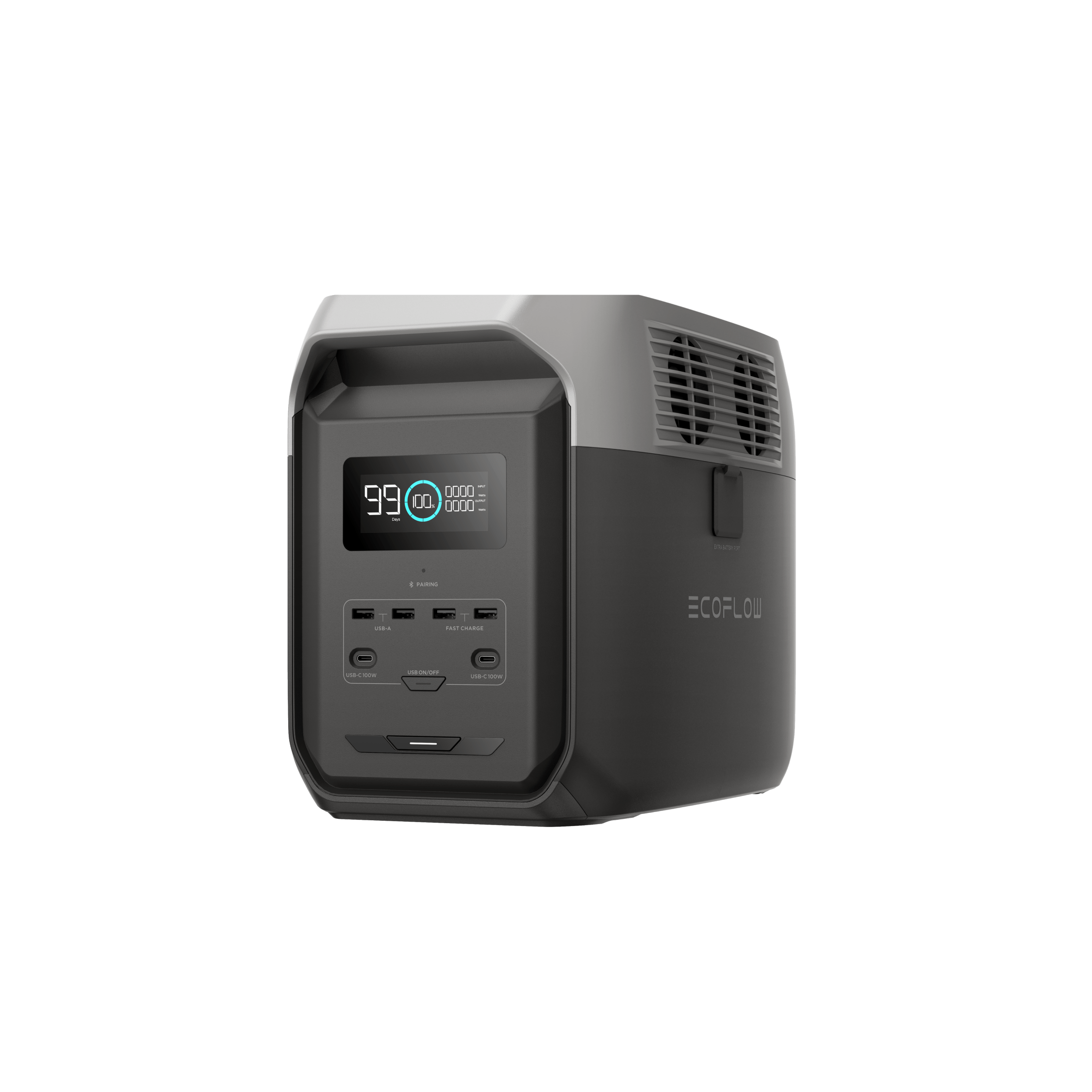
EcoFlow DELTA 3 1500
No longer sold

EcoFlow DELTA 3 MaxPick
$899.00
$899.00 · direct from EcoFlow
Last checked 16 days ago. Prices move — check before you buy.
Prices may vary by retailer and are subject to change.