Head-to-head test
EcoFlow DELTA 2 vs EcoFlow RIVER 3
EcoFlow DELTA 2 vs EcoFlow RIVER 3: The DELTA 2 packs 779Wh more capacity and can grow later with EcoFlow's own add-on batteries; the RIVER 3 weighs less than a third as much and disappears into a backpack — the real decision here is carry-it versus set-it-down, not which one's better.
Full profiles: EcoFlow DELTA 2 → · EcoFlow RIVER 3 →

Written by Wenny ZhengUpdated
Portable Power Tester, Station Arena Test Desk
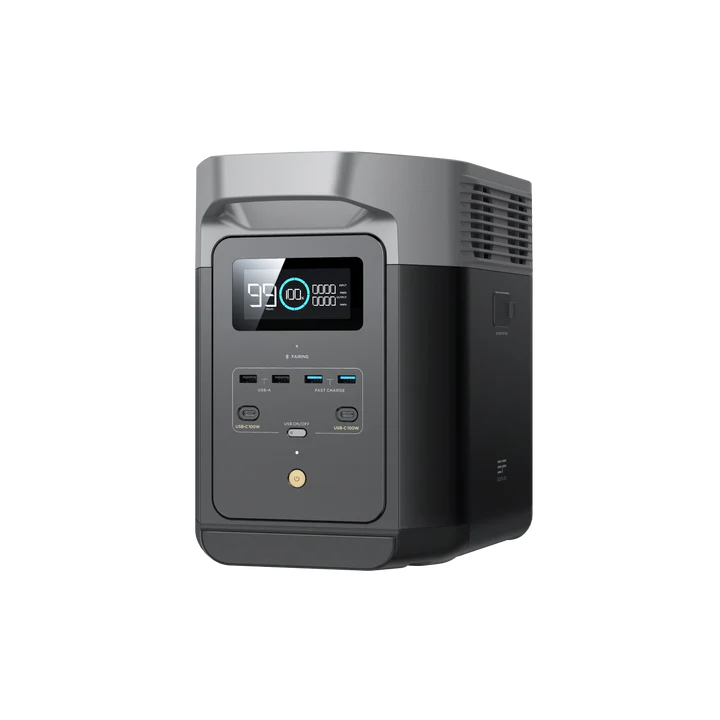
$499.00 · direct from EcoFlow
Last checked 58 days ago. Prices move — check before you buy.

$239.00 · direct from EcoFlow
Last checked 14 days ago. Prices move — check before you buy.
Spec deltas
The RIVER 3 weighs 7.8 pounds. The DELTA 2 weighs 27 pounds. That's the whole opening argument before a single watt-hour gets counted: one of these you carry, and one of these you set down near an outlet and leave alone.
Once you count watt-hours, the DELTA 2 pulls way ahead: 1,024Wh against the RIVER 3's 245Wh, a gap of 779Wh that shows up everywhere downstream — in the scenarios each one can actually finish, in the five-year math, in the price. It costs more than double up front, $499 against $199, and it still works out cheaper to run once that price gets spread across everything the bigger battery can do over its life.
Both numbers are real, and neither cancels the other out. The DELTA 2 is the better-value, more-capable, more-expandable box by every measure that doesn't involve picking it up. The RIVER 3 is the one that actually leaves the house.
What the Numbers Reveal
Each conclusion stated first — the numbers behind it on one line, the full analysis below.
Capacity
The RIVER 3 isn't the 'lesser' unit chemistry-wise — at daily use it lasts exactly as many years as its bigger sibling, 8.2 either way. What's different is how much use each cycle buys: the DELTA 2 can carry a CPAP, a router, and a laptop through that cycle; the RIVER 3 carries a phone and a headlamp.
Both units are rated for 3,000 charge cycles.At daily use, the ownership math gives both the DELTA 2 and the RIVER 3 the same 8.2-year span before cycle life runs out.Rated capacity: 1,024Wh (DELTA 2) vs 245Wh (RIVER 3).
Why it mattersIf cycle-life durability was the worry, drop it — both units clear their 5-year warranty at daily use with room to spare. Choose on capacity and weight instead, because the battery itself won't be the reason either one gets replaced.
245Wh reads fine on a spec sheet next to 1,024Wh, until it tries to do an actual night's work. At 320Wh of demand the RIVER 3 needs more capacity than it has; the DELTA 2 uses well under half of what it's got. The RIVER 3 was built to keep small things alive for a few hours, not to carry a load through the night.
CPAP Overnight needs 320Wh: the DELTA 2 uses 37% of its usable capacity, the RIVER 3 needs 154%.Tailgate Party needs 670Wh: the DELTA 2 covers it at 77%, the RIVER 3 needs 100% of everything it has.Those are the only two of six scenarios where either unit is marked able to handle the load solo — and both go to the DELTA 2.
Why it mattersIf either scenario here resembles your actual use — a CPAP, a tailgate spread — the RIVER 3 isn't a smaller version of the right answer, it's the wrong size class. That's a DELTA 2 job, or a bigger station's.
continuous output
That headroom doesn't move much at RIVER 3's scale: 600W of surge still won't start a residential fridge compressor or a window AC, the appliances that actually need surge margin. The DELTA 2's lower ratio still lands at a far higher absolute ceiling, and absolute watts are what decide whether a compressor-driven appliance starts at all.
DELTA 2 surges to 2,700W off an 1,800W rated output (1.5x).RIVER 3 surges to 600W off a 300W rated output (2x).The DELTA 2's absolute surge ceiling is 2,100W higher than the RIVER 3's.
Why it mattersDon't shop surge ratio on its own. For anything with a compressor, the DELTA 2's bigger absolute number is what gets you a working fridge; the RIVER 3's better ratio is a nice inverter spec attached to a unit too small for the appliances that would ever test it.
The DELTA 2's higher cost-per-warranty-year buys optionality the RIVER 3 structurally can't offer: if power needs grow — a new appliance, a longer trip, one more person depending on the same box — the DELTA 2 absorbs that with an add-on battery, and the RIVER 3's answer is a second, unrelated unit.
The DELTA 2 supports EcoFlow add-on expansion batteries beyond its 1,024Wh base; the RIVER 3 has no expansion path at 245Wh.Cost per warranty year works out to $100 for the DELTA 2 and $40 for the RIVER 3, over the same 5-year term.Both units carry an identical 5-year warranty.
Why it mattersIf you're confident your needs are fixed and small, the RIVER 3's lower per-year cost is real and there's no reason to pay for headroom you won't use. If there's any chance you'll want more later, that low number is the price of a ceiling, not a bargain.
The specific dimensions that decide these two units — everything else is a tie.
Portability & Form Factor
Selected because: Weight is the single biggest practical differentiator here — 27 lb vs 7.8 lb decides who can actually carry it daily.
weight
Twenty-seven pounds off a shelf is a two-hand lift out of a trunk. The RIVER 3's 7.8 pounds is grab-and-go — clip it to a backpack, hand it to a kid, don't think about it again until it's empty.
This isn't a small edge. At nearly three and a half times the weight, the DELTA 2 is built to be positioned once — by an outlet, in a shed, wired into a van — and left there. The RIVER 3 is the one built to move with you every day, light enough to forget you're holding it, with a fan ceiling of 30 decibels so it can sit within earshot of a bed without becoming the reason you're awake.
Lifetime Value
Selected because: cheaperToOwn is p1, and the per-kWh gap is the clearest number-based case for the DELTA 2 despite its higher sticker price.
cost / lifetime kWh
The sticker prices and the running costs point in opposite directions. The DELTA 2 costs more than double up front and still ends up the cheaper unit to run, because 3,000 cycles against 1,024Wh of capacity is a much bigger bucket than 3,000 cycles against 245Wh — more total energy moves through the same number of charge cycles, so the purchase price spreads thinner per kWh over the unit's life.
Neither number is wrong; they answer different questions. The cost-per-kWh math answers 'which box is cheaper to run into the ground.' The $199 price tag answers 'which box can I actually afford today.' If cash on hand is the binding constraint, the RIVER 3's math is the only math that matters right now, regardless of what happens per kWh five years out.
Your Life, Your Pick
Selected because: Only 2 of 6 scenarios have any winner and both go to p1; the other 4 fail both units, which sets honest expectations.
Run the numbers on six real situations and the RIVER 3 wins zero of them outright — not because the scenarios are unfair, but because 245Wh is a small bucket once anything runs for hours instead of minutes. The DELTA 2 clears two: CPAP Overnight, where the RIVER 3 would need 154% of its own usable capacity to make it to morning, and Tailgate Party, where the RIVER 3 needs all of what it has with nothing held back.
The other four — Weekend Camping, 8-Hour Blackout, Remote Workday, Van Life Daily — beat both units. Van Life Daily alone needs 4,685Wh, well beyond either unit's usable capacity; that's not a knock on either one, it's a reminder that 'portable power station' covers everything from a phone charger to a home battery, and these two sit at the small-to-midsize end of that range.
Growth Path
Selected because: Expandability is the structural fact behind the value story — DELTA 2 grows, RIVER 3 is a sealed ceiling.
solar input
The RIVER 3 is the whole story on day one: 245Wh, no expansion battery exists for it, what you buy is what you'll have for the life of the unit. The DELTA 2 starts bigger, at 1,024Wh, and EcoFlow sells batteries that snap onto it for more — so the DELTA 2's real ceiling isn't a spec, it's a budget.
That only matters if you're the kind of buyer whose needs move. Plenty of RIVER 3 buyers aren't: they know exactly what they're charging — a phone, a camera, a small backup battery — and 245Wh sealed forever is a feature, not a limit, because it's also why the unit stays light. Expansion is only worth paying for if you'll use it; otherwise it's capacity you're funding, not carrying.
What the Specs Don't Tell You
Selected because: All 4 firing gotchas (noise, expansion, surgeRatio, warranty) are directly decision-relevant to a carry-it vs plant-it choice.
Four things worth flagging beyond the spec table. Noise: the DELTA 2 is rated up to 50 decibels under load against the RIVER 3's 30 — a real gap, though it only matters if the DELTA 2 will run near where you sleep or work. Expansion: the RIVER 3's 245Wh is fixed, permanently, which is either irrelevant or the whole ballgame depending on whether your needs are done growing.
Surge headroom: the RIVER 3's inverter actually surges to twice its rated output (300W to 600W) while the DELTA 2 only adds half again (1,800W to 2,700W) — a better ratio on the smaller unit, though the DELTA 2's absolute ceiling is still 2,100W higher, and absolute watts are what start a compressor. Warranty: both carry an identical 5-year term, so coverage length isn't a tiebreaker here — it's a wash by design.
Strengths & trade-offs
EcoFlow DELTA 2
Strengths
- +Larger battery capacity
- +Higher AC output
- +Faster solar charging
Trade-offs
- –Substantially more expensive (+$300) than the RIVER 3.
- –Significantly heavier (+19.2 lbs), making it harder to move.
EcoFlow RIVER 3
Strengths
- +Costs $300 less
- +Lighter by 19.2 lb
Trade-offs
- –Weaker inverter (-1,500W) limits appliance compatibility.
- –Sealed capacity — the DELTA 2 can add batteries to grow past 245Wh; this one can't.
Will It Power Your Gear?
Scenario math and per-appliance runtimes, modeled from the spec record.
Scenario verdicts
We ran the math on seven real-world scenarios. Here's which unit survives your actual life.
SCN-01 · 2 nights · needs 2,100Wh
Weekend Camping
Two nights off-grid with essential comfort
Neither unit
A weekend of camping loads needs about 2,100Wh — 241% of the DELTA 2's usable capacity and 1,008% of the RIVER 3's. Both units fall well short; this load calls for a larger station or a way to recharge mid-trip that neither of these is sized to make painless on its own.
Battery budget usedlower = more headroom
LOAD Phone Charger 15W×6h · LED Lights 40W×8h · Box Fan 75W×14h · CPAP Machine 40W×16h
SCN-02 · 8 hours · needs 1,645Wh
8-Hour Blackout
Keep the essentials running through a night without power
Neither unit
An 8-hour blackout draws roughly 1,645Wh by this scenario's math — 189% of the DELTA 2's usable capacity and 790% of the RIVER 3's. Neither covers a full outage of this length on a single charge; the DELTA 2 gets meaningfully closer, but closer isn't there.
Battery budget usedlower = more headroom
LOAD Fridge 150W×8h · Router + Modem 20W×8h · LED Lights (4 bulbs) 40W×6h · Phone Charger 15W×3h
SCN-03 · 8 hours · needs 320Wh
CPAP Overnight
Sleep therapy without interruption — the #1 medical use case
DELTA 2
A CPAP overnight is a light, steady 320Wh draw — 37% of the DELTA 2's usable capacity, comfortably inside its range. The RIVER 3 would need 154% of its own usable capacity to match it, which is another way of saying it can't.
Battery budget usedlower = more headroom
LOAD CPAP Machine 40W×8h
SCN-04 · 8 hours · needs 910Wh
Remote Workday
Full work day off-grid without power anxiety
Neither unit
A full remote workday — laptop, monitor, router, the usual — runs about 910Wh, which is 105% of the DELTA 2's usable capacity and 437% of the RIVER 3's. The DELTA 2 comes close enough to tempt you and still comes up just short; plan on a midday top-up if this is the daily pattern.
Battery budget usedlower = more headroom
LOAD Laptop 60W×8h · External Monitor 30W×8h · Router + Modem 20W×8h · Phone Charger 15W×2h
SCN-05 · 4 hours · needs 670Wh
Tailgate Party
Game day power for the crew
DELTA 2
Tailgate Party gear needs about 670Wh — 77% of the DELTA 2's usable capacity, leaving real room to spare. The RIVER 3 needs 100% of everything it has to reach the same number, with nothing held back, which is why it's marked a no here despite technically having enough capacity on paper.
Battery budget usedlower = more headroom
LOAD Blender 400W×0.5h · LED TV (55") 80W×4h · Bluetooth Speaker 15W×4h · Phone Charger (×3) 45W×2h
SCN-06 · 24 hours · needs 4,685Wh
Van Life Daily
A full day of mobile living — the ultimate endurance test
Neither unit
Van Life Daily's 4,685Wh need is the biggest ask on this page — 538% of the DELTA 2's usable capacity and 2,250% of the RIVER 3's. This is a solar-plus-large-battery-bank problem, not a single-unit problem; neither of these is what you'd build a van's daily power budget around.
Battery budget usedlower = more headroom
LOAD Mini-Fridge 150W×24h · Laptop 60W×4h · Phone Charger 15W×3h · LED Lights 40W×5h · Fan 75W×8h
SCN-07 · an afternoon · needs 100Wh
Afternoon Off-Grid
Phones and a speaker at the park, beach, or campsite — the small-unit job description
Either unit
This row is here for the RIVER 3's class of job: phones and a speaker, 100Wh across an afternoon. Both cover it — the RIVER 3 finishes at 48% used, and the DELTA 2 barely notices it. For this job the DELTA 2's extra capacity is dead weight, not headroom; take the RIVER 3 at 7.8 lbs and leave the rest at home.
Battery budget usedlower = more headroom
LOAD Phone Charger (×2) 30W×2h · Bluetooth Speaker 10W×4h
The Load Test
RUNTIME = (Wh × 0.85) ÷ LOAD
None of the scenarios above exactly yours? Build it. Toggle what you'd plug in; both units are tested against the combined draw.
Essentials
Comfort & Convenience
High-Draw Appliances
Test duration
8h
Continuous draw
205W
Projected runtime
For this load: DELTA 2 runs 4.2h vs 1h.
$499 list · direct from EcoFlow
Modeled from the spec record — same math as the tables below. Methodology
Runtime by appliance
Real-world runtime estimates for common appliances, modeled at 85% inverter efficiency.¹
Essentials
The basics you need runningscale 0–58hComfort & Convenience
Makes off-grid life actually enjoyablescale 0–11.6hHigh-Draw Appliances
These reveal the real limitsscale 0–0.9h¹ Runtime = (capacity × 0.85) ÷ appliance watts. Within each group, all bars share one time scale (the group's longest runtime), so lengths are comparable across appliances; identical runtimes collapse into a single blue/orange bar. Actual runtime varies with battery age, temperature, and simultaneous loads — see methodology.
Conclusion
July 28, 2026
Verdict: the DELTA 2, on Power Score margin
Call it a tie, but not a hedge: on every axis the numbers can settle outright, the DELTA 2 wins — cheaper per lifetime kWh ($0.16 vs the RIVER 3's $0.27), both of the scenarios either unit can actually cover on its own (CPAP Overnight, Tailgate Party), and it's the only one of the two you can add capacity to later. None of that matters if the DELTA 2's weight is why it stays in the garage. The RIVER 3 gives up 779Wh of capacity but comes back with less than a third the weight and a fan that stays 20 decibels quieter, for $199 against the DELTA 2's $499. Buy on cost per watt-hour and room to grow, and it's the DELTA 2, no contest. Buy on 'rides in a backpack, gets carried one-handed, forgotten about until it's needed,' and it's the RIVER 3, also no contest. This tie is between two different jobs, not two similar boxes.
Editor-assigned confidence, based on cited owner research and spec analysis.
Written by Wenny Zheng, Portable Power Tester · Station Arena Test Desk · Updated July 28, 2026
Measured Data
Benchmark scores and the full spec record, side by side.
Benchmark scores
Not rated for both units (minimum threshold unmet): RV Living, Home Backup, Solar Generator, Food Truck.
Full specifications
ᵈ Derived: price ÷ rated capacity. See the data behind our comparisons →
Comparison ToolAdd more power stations, side by sideOpen Tool →How these numbers are produced
Numeric verification
Every figure on this page traces to our spec database or arithmetic on it — no estimated numbers.
Owner claims
Statements about owner experience are cited to published reviews — see Sources & Research Notes below.
Runtime model
Runtime = (rated capacity × 0.85 inverter efficiency) ÷ device wattage. Solar recharge estimates assume panels deliver 70% of rated output. Cold weather, battery age, and stacked loads reduce real-world results.
Power Score
Computed from 14 published spec dimensions, weighted per use-case bench. Higher is better; a unit must meet a bench's minimum threshold to be rated.
See the full weight table and data sourcing on our methodology page →Class ranking (the star rating)
Each unit's star score is a category ranking, not customer reviews — no buyer opinions feed it. We score every station on size-independent quality (value, output, portability, endurance, ports, warranty, and more), then percentile-rank it against the other units in its capacity class, so a class-leading compact unit and a class-leading whole-home unit can both earn 5★. Here, DELTA 2 rates 4.1/5 (46th percentile of 27 Everyday-class units), and RIVER 3 rates 4.4/5 (67th percentile of 22 Personal-class units).
How the class ranking is computed →Test Notes & Caveats
Hidden gotchas and advantages we spotted that you won't find on the product page.
50 Decibels Is the DELTA 2's Ceiling, Not Its Average
Idle and light loads are quiet; the fans ramp up once output climbs, and at the DELTA 2's top end they run continuously near the rated 50-decibel ceiling. The RIVER 3 tops out at 30 decibels because it's never moving enough power to need the same cooling. If either unit will sit within earshot of where you sleep or work, that's the number to weigh against the DELTA 2's extra capacity.
RIVER 3 Is Sealed at 245Wh, Permanently
There's no expansion battery for the RIVER 3 at any price — 245Wh on day one is 245Wh for the life of the unit. The DELTA 2 starts more than four times larger at 1,024Wh and can still grow further with EcoFlow's add-on batteries. Fine if 245Wh already covers the use case; worth knowing before six months in and wishing for more.
The RIVER 3's Inverter Has the Better Ratio, the DELTA 2 Has the Bigger Number
The RIVER 3 surges to 600W off a 300W rating — double its rated output. The DELTA 2 surges to 2,700W off 1,800W rated — one and a half times. Proportionally the RIVER 3's inverter has more headroom, but in absolute terms the DELTA 2's surge ceiling is still far higher, and absolute watts are what decide whether a compressor-driven appliance actually starts.
Same Warranty Term, Different Cost of Getting It
Both units carry a 5-year warranty, so coverage length isn't a differentiator here. What differs is what that warranty is protecting: $499 of DELTA 2 versus $199 of RIVER 3, or $100 a year of coverage against $40 a year. Identical protection, different amounts of product behind it.
Ownership Analysis
What happens after you buy — true cost of ownership, brand trust, and growth potential.
Lifetime value
Service lifeyears at one full cycle per day
Lifetime energy delivered
Cost per delivered kWh
│ warranty ends · Reaching the cycle rating means ~80% capacity remains — degraded, not dead.
Analyst note
The RIVER 3 is cheaper to buy, but the DELTA 2 is cheaper to own. At $0.16/kWh over its lifetime vs $0.27/kWh, the DELTA 2's higher cycle life and capacity make each dollar go further over the years. One thing to know reading the table: both carry the same 3,000-cycle rating, so the lifetime rows are sticker price and capacity in disguise — the wear horizon is identical and decides nothing here.
Growth path
DELTA 2
EXPANDABLESupports EcoFlow expansion batteries, so you can add capacity later without replacing the base unit — useful if your needs may climb past 1,024Wh.
Accepts up to 500W of solar. Suitable for a 1-2 panel setup.
Generous port selection supports complex multi-device setups.
Expansion batteries are EcoFlow-specific. You're investing in the EcoFlow ecosystem.
RIVER 3
FIXED CAPACITYFixed at 245Wh, with no expansion — so size it for your needs up front rather than planning to add capacity later.
Accepts up to 110W of solar. Limited to a single portable panel.
Limited ports. You'll likely need a power strip or splitter.
Realistic full solar rechargeat 70% of rated panel output — see methodology
Analyst note
The RIVER 3 is sealed at 245Wh, which is fine if that covers you. The DELTA 2 starts at 1,024Wh and can grow beyond it with EcoFlow expansion batteries — though at this size expansion means longer runtimes on the same loads, not a path to home backup. More hours, not more house.
What Owners Report
Patterns from published owner reports and long-term reviews — every claim cited to its source below.
EcoFlow DELTA 2
The complaint that shows up again and again is fan noise: owners consistently report the fans trigger once load climbs past about 120W and then run audibly for the rest of a session at the DELTA 2's higher output levelsA1A2A4. One reviewer likened full-speed charging to sitting next to a gaming laptop, though that same source notes you can cap the charge rate in the EcoFlow app to quiet it downA2.
Set the fan noise aside and the field reports are strong: after extended real-world use across outages, camping trips, and daily home-office duty, reviewers credit the DELTA 2 for fast charging, dependable LiFePO4 chemistry, and the expansion path that backs up its growth storyA3. EcoFlow has reportedly told reviewers a firmware update addressing the fan behavior is coming, consistent with how it's handled noise complaints on other models after launchA4.
“When charging at 1200W the fans sound like a gaming laptop, though you can lower the charging speed in the app to silence it.”
Sources
portablepowerlab.com
EcoFlow RIVER 3
Coverage here is thinner and mostly framed as RIVER 3-versus-RIVER 2 rather than long-term standalone ownership, but what exists is consistently positive: reviewers describe it as noticeably quieter than the RIVER 2, under 30 decibels, with EcoFlow calling it whisper-quietB1. Against the RIVER 2, reviewers also credit it with a faster UPS switchover and a lighter, more compact buildB2.
The throughline is that the RIVER 3 reads as a strict upgrade on its own platform — more capacity and less weight than the RIVER 2, at a lower priceB4 — and multiple reviewers name it the better buy for camping, van life, or home UPS backup specifically because of the noise and durability improvementsB3. There isn't yet the volume of long-term field data the DELTA 2 has, so take this as a strong early signal rather than a multi-year track record.
“The RIVER 3 operates under 30 dB — EcoFlow calls it 'whisper quiet,' quieter than a library — one of the most significant upgrades over the louder RIVER 2.”
Sources
backuppowerhub.com · ecoflow.com · rv.com · versus.com
Sources & Research Notes
Every owner claim in this report is traceable to a published source. The bracketed references above resolve here.
Recurring owner themes
- Fan noise under moderate-to-high load is the dominant, repeatedly-cited complaint; the fan spins up above ~120W. [DELTA 2 · 3 entries]
- The RIVER 3 improves on the RIVER 2 across the board — quieter (sub-30 dB), IP54-rugged, faster UPS, more capacity, lighter, and cheaper — a rare strict upgrade. [RIVER 3 · 3 entries]
- A1
“Fans trigger at anything above 120 watts; at maximum load (1,500–1,800W) they run continuously at ~48–55 dB. Powering medical equipment above 120W in a bedroom means listening to the fans or running an extension cable out of the room.”
portablepowerlab.com — EcoFlow Delta 2 Review: 6 Months of Real Use; PCWorld — EcoFlow Delta 2 review · 2026 · [negative]
- A2
“When charging at 1200W the fans sound like a gaming laptop, though you can lower the charging speed in the app to silence it.”
PCWorld — EcoFlow Delta 2 power station review · 2026 · [mixed]
- A3
“After 18 months of real-world testing through multiple power outages, camping trips, and daily home-office use, the unit earned recognition for fast charging, reliable LiFePO4 battery chemistry, and expandability.”
portablepowerlab.com — EcoFlow Delta 2 Review: 6 Months of Real Use · 2026 · [positive]
- A4
“EcoFlow officials indicated they plan to address the fan noise in an upcoming firmware update, as they have for other models after release.”
portablepowerlab.com — EcoFlow Delta 2 Review · 2026 (dated claim — may be partially addressed) · [mixed]
- B1
“The RIVER 3 operates under 30 dB — EcoFlow calls it 'whisper quiet,' quieter than a library — one of the most significant upgrades over the louder RIVER 2.”
backuppowerhub.com / ecoflow.com — RIVER 2 vs RIVER 3 · 2026 · [positive]
- B2
“Over the RIVER 2, the RIVER 3 adds IP54 waterproofing, a faster UPS switchover, a 2x runtime mode, and a more compact, lighter form factor.”
backuppowerhub.com — RIVER 2 vs RIVER 3 · 2026 · [positive]
- B3
“Recommended as the better buy for most in 2026 — for camping, van life, or home UPS backup, where durability and noise matter, the data consistently favors the RIVER 3.”
backuppowerhub.com / rv.com — RIVER 3 review · 2026 · [positive]
- B4
“Holds more capacity and weighs less than the RIVER 2 while costing less, making it effectively a strict upgrade on the same platform.”
ecoflow.com / versus.com — RIVER 2 vs RIVER 3 · 2026 · [positive]
Research compiled July 28, 2026.
What Owners Actually Report
Drawn from 176 comments on independent review channels — not from retailer reviews, which skew to the first week of ownership. Each line is our summary of one commenter's claim, linked to the original. We record what they said, including where it contradicts the spec sheet.
EcoFlow DELTA 2
224 claims from 155 comments · 178 from owners · 60 with figures
- Runtime
- 32 · 13% negative
- Price & value
- 38 · 4% negative
- Charging
- 17 · 23% negative
- Durability
- 22 · 67% negative
- Warranty & support
- 22 · 59% negative
What owners complain about
Ignores solar unless he unplugs it from the wall, so he switched to the AC180.
Solar inputowner63 agreedsource →
His Delta 2 went bad three months after purchase and EcoFlow agreed it was defective.
Durabilityownerafter 3 months236 agreedsource →
Past 30 days the five-year warranty only gets a refurbished unit covered for 30 days.
Warranty & supportowner236 agreedsource →
What owners praise
DELTA 2 plus extra battery and 600W solar cost ~$1200 and paid for itself in under 2 years in California.
Price & valuemeasuredowner736 agreedsource →
Batteries still hold 98%+ capacity, ahead of the 80%-at-10-years warranty curve.
Durabilitymeasuredowner736 agreedsource →
Gets 180-190W into it from a 100Ah LiFePO4 via XT60i cable, no converter needed.
Chargingmeasuredowner106 agreedsource →
EcoFlow RIVER 3
35 claims from 21 comments · 30 from owners · 9 with figures
- UPS switchover
- 5 · 47% negative
- Price & value
- 6 · 17% negative
- Runtime
- 2 · 0% negative
- Warranty & support
- 6 · 73% negative
- Other
- 2 · 100% negative
What owners complain about
Accepts 80V-170V before switching over, which he calls poor for a home-office UPS.
UPS switchovermeasuredowner34 agreedsource →
Surge protection is only 150J, so he keeps it behind an older UPS's surge-only port.
Othermeasuredowner34 agreedsource →
Screen showed jumbled alphanumeric symbols, and the returned unit came back with Wi-Fi disabled.
Durabilityowner6 agreedsource →
What owners praise
Kept router and switch alive about 4 hours per charge during the 5 day post-Milton outage.
Runtimemeasuredowner38 agreedsource →
Happy sticking with their RIVER 3 units at $169 each.
Price & valuemeasuredowner45 agreedsource →
Works awesome as a UPS for Starlink router, switch and camera through rural spikes and outages.
UPS switchoverowner38 agreedsource →
Claims are weighted by how specific they are, whether the commenter owns the unit, and how many readers agreed. Comments that mention a product under a rival's review count for more, because the commenter had no reason to be there. This is what buyers report, not our test results — for measurements we ran ourselves, see the methodology.
Who Should Buy Which
Buy the DELTA 2 if you…
- →You're powering something that needs to run for hours, not minutes — a CPAP, a mini-fridge, a router and a laptop through a work-from-home day — and you have somewhere fixed to set a heavier unit down and leave it. The DELTA 2 clears CPAP Overnight and Tailgate Party outright, and its lower cost-per-lifetime-kWh rewards you for keeping it around for years, not just one trip.
- →You also want room to grow. If there's a real chance you'll add a fridge, a second device, or a longer trip to the plan, the DELTA 2's expansion batteries mean you're adding to the unit you already own instead of buying a second, separate one.
Buy the RIVER 3 if you…
- →You're charging small things and carrying the unit yourself — a phone, a camera, a drone battery, string lights and a fan for a short car-camping trip — and its weight matters more than any other spec on the page. At $199, the RIVER 3 is also the one you can say yes to without a five-year ownership plan behind it.
- →You also don't want to think about fan noise near a bed or a desk. The RIVER 3's 30-decibel ceiling makes it the one you can run in the same room without noticing it's there, which the DELTA 2 doesn't promise once its fans spin up.
If neither fits
If your real scenario looks like Weekend Camping, an 8-hour blackout, a full remote workday, or a vehicle's daily loads, skip this pair entirely — every one of those needs more usable capacity than either unit provides, Van Life Daily by the widest margin at 4,685Wh required. That's a job for a much larger station with fridge-rated continuous output, not a DELTA 2 or a RIVER 3.
The Bottom Line
Neither of these is the wrong power station — they're not aimed at the same trip. The DELTA 2 is the cheaper-per-kWh, expandable, actually-covers-a-CPAP-night choice at $499; the RIVER 3 is the $199, 7.8-pound choice you forget you're carrying. Buy for the job, not for which spec sheet is longer.
If you're still not sure which job is yours, ask what you're doing five minutes after you buy it: setting it down and plugging it in, or picking it up and walking out the door with it. That answer picks the unit.
Frequently Asked Questions
Answers drawn from the spec record and cited owner research.
Is the EcoFlow RIVER 3 basically a smaller DELTA 2?
Not really — they're built for different jobs. The RIVER 3 is 245Wh and 7.8 pounds, sized to charge phones, cameras, and small electronics and to be carried daily. The DELTA 2 is 1,024Wh and 27 pounds, sized to run a CPAP, a mini-fridge, or a work-from-home setup for hours. Same brand and battery chemistry, but not the same category of device.
Which one is cheaper to own long-term, the DELTA 2 or the RIVER 3?
The DELTA 2, on a per-kWh basis: $0.16 per lifetime kilowatt-hour against the RIVER 3's $0.27, because its larger capacity spreads the $499 purchase price across far more total energy over the same 3,000-cycle lifespan. The RIVER 3 still wins on cash needed today, at $199 against $499 — so which one is 'cheaper' depends on whether you're budgeting for the purchase or for the next five years.
Can the EcoFlow RIVER 3 run a CPAP all night?
Not on its own, by the numbers: a CPAP Overnight load runs about 320Wh, which is 154% of the RIVER 3's usable capacity — more than the unit can hold, let alone deliver with any margin. The DELTA 2 covers the same night at 37% of its usable capacity, with plenty in reserve.
Does the DELTA 2 or the RIVER 3 have an expansion battery option?
Only the DELTA 2. It supports EcoFlow's add-on expansion batteries, so you can grow past its 1,024Wh base without buying a second, separate unit. The RIVER 3 is a sealed 245Wh unit with no expansion path — what you buy on day one is the capacity you'll have for the life of the unit.
Is the EcoFlow DELTA 2 loud?
Loud enough to notice, not loud enough to avoid: it's rated up to 50 decibels under load, and owners consistently report the fans kick on well before max output and stay running through a charge cycle. The RIVER 3 stays under 30 decibels because it never has to move enough power to need the same cooling. If the unit will sit in a bedroom or home office, that 20-decibel gap is worth weighing against the DELTA 2's much bigger capacity.
Where to buy
EcoFlow DELTA 2
$499.00
$499.00 · direct from EcoFlow
Last checked 58 days ago. Prices move — check before you buy.
EcoFlow RIVER 3
$239.00
$239.00 · direct from EcoFlow
Last checked 14 days ago. Prices move — check before you buy.
Prices may vary by retailer and are subject to change.