Head-to-head test
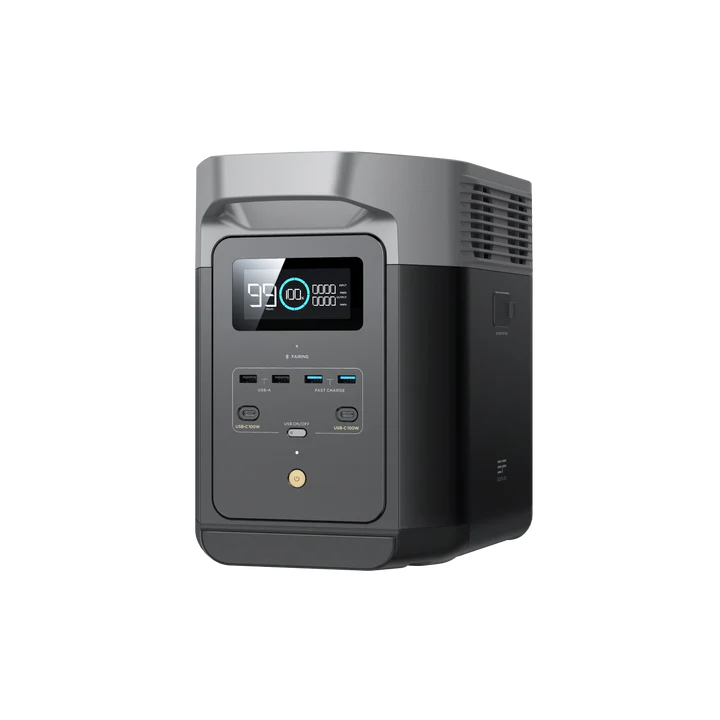
EcoFlow DELTA 2 vs BLUETTI AC180
At $479 the DELTA 2 is now the cheaper box and eight pounds lighter with a growth path, while the AC180 answers with 12% more battery and a quieter fan — a coin-flip that breaks on whether you carry the unit or park it.
Full profiles: EcoFlow DELTA 2 → · BLUETTI AC180 →

Written by Ian SchneiderUpdated
Solar & Off-Grid Tester, Station Arena Test Desk
$499.00 · direct from EcoFlow
Last checked 58 days ago. Prices move — check before you buy.

$449.00 · direct from BLUETTI
down from $499 · 10% below usual
Last checked 1 day ago. Prices move — check before you buy.
Spec deltas
Twenty dollars separate these two, and the cheaper one is the EcoFlow. At $479 the DELTA 2 undercuts the $499 AC180 while weighing 27 pounds to the BLUETTI's 35.3 — an eight-pound difference you feel every time it comes up the basement stairs, and reviewers already name the AC180's weight its most annoying traitB2.
The AC180 spends that $20 on more of everything that stays put. It holds 1,152Wh to the DELTA 2's 1,024, runs a 3,500-cycle battery against 3,000, costs less to run over its life ($0.12 versus $0.16 per lifetime kWh), and sits ten decibels quieter — 40dB, where the DELTA 2's fan is the one thing owners keep complaining aboutA1.
So this isn't better-versus-worse; it's mobile-versus-stationary. The DELTA 2 is the one you lift, move between rooms, and grow later; the AC180 is the bigger, calmer box that outlasts it if it mostly lives in one spot. We can't call a winner without knowing which of those is you — and that's the honest answer, not a dodge.
What the Numbers Reveal
Each conclusion stated first — the numbers behind it on one line, the full analysis below.
weight
The DELTA 2 gives up 128Wh of base capacity but comes back eight pounds easier to carry, twenty dollars cheaper, and able to bolt on a battery later — while the AC180, whose bulk reviewers flag as its worst traitB2, is whatever you bought it as, forever.
the DELTA 2 weighs 27 lbs vs the AC180's 35.3the DELTA 2 costs $479 vs the AC180's $499the DELTA 2 is expandable while the AC180 is sealed at 1,152Wh
Why it mattersIf the unit travels or your power needs might climb, the DELTA 2 bends where the AC180 can only be replaced.
cost / lifetime kWh
That extra 128Wh is the margin between the AC180 finishing a 910Wh remote workday with power to spare and the DELTA 2 running dry before you close the laptop — and the AC180's longer 3,500-cycle life quietly drops its energy to $0.12 a kilowatt-hour against $0.16.
the AC180 holds 1,152Wh vs the DELTA 2's 1,024a laptop-plus-monitor workday draws about 910Whthe AC180 costs $0.12 per lifetime kWh vs the DELTA 2's $0.16
Why it mattersA buyer who runs the unit hard all day in one place gets more, and cheaper, energy from the AC180's $20 premium.
The DELTA 2's fan spins up at anything over 120 watts and holds 48-55dB under load — the complaint owners raise mostA1 — while the AC180 runs quieter and can cap its noise by slowing the chargeB1, the difference between background hum and a gaming laptop in the room at 2 a.m.
the DELTA 2's fan triggers above ~120W and runs 48-55dB under loadA1the AC180 is rated 40dB with a silent charging modeB1both units get used indoors during blackouts and overnight
Why it mattersIf the unit will run in the room you're sitting or sleeping in, the AC180 is the calmer roommate.
The specific dimensions that decide these two units — everything else is a tie.
Portability & Form Factor
Selected because: The DELTA 2's eight-pound weight advantage is its headline case.
weight
This is the DELTA 2's clearest win. At 27 pounds it's 8.3 lighter than the 35.3-pound AC180 — the gap between a one-hand grab and a two-hand, watch-your-back lift — and reviewers single out the AC180's weight as the thing they most dislike about living with itB2.
For a unit that only ever slides under a desk, the pounds don't matter. For one that rides to campsites, loads into a trunk, or moves room to room during an outage, the DELTA 2 is the one you won't resent carrying. Same energy class, very different to actually move.
What the Specs Don't Tell You
Selected because: Capacity, expansion, and noise are where the two split hardest.
rated cycles
The trade sharpens here. The AC180 holds more (1,152Wh vs 1,024) and runs quieter (40dB vs 50), but it's sealed — outgrow it and your only move is a second unit. The DELTA 2 holds less today and hums louder, yet it takes an add-on battery when your needs grow.
That's the whole matchup in miniature: the AC180 is more of a fixed thing, the DELTA 2 is less of a thing you can add to. Whether the bigger sealed box or the smaller expandable one wins comes down entirely to whether you think you'll want more power in two years.
Lifetime Value
Selected because: The AC180's lower cost-to-own anchors its stationary case.
cost / lifetime kWh
The AC180 is the cheaper unit to own despite the higher sticker. Its 3,500-cycle battery and 1,152Wh bring cost-to-own to $0.12 per lifetime kWh against the DELTA 2's $0.16 — the same math that earns it a reputation as the bang-for-buck pick in this classB4.
The DELTA 2 closes the gap upfront ($20 cheaper) and over 18 months of testing earned marks for fast charging and a reliable LFP batteryA3. Neither is a bad buy; the AC180 simply squeezes a bit more energy out of each dollar if you keep it long enough to matter.
Brand Trust
Selected because: Both draw fan complaints and have uneven support; reputations don't break the tie.
Both units share the same headline flaw — fans. It's the DELTA 2's most common gripe, loud above 120WA1, and even the quieter AC180 draws mixed noise reports, with some owners calling its fans aggressive while chargingB1. Call it a wash that the AC180 wins on paper by 10dB.
On reputation the two brands roughly cancel. EcoFlow brings the deepest ecosystem and fast charging; BLUETTI brings the best capacity-per-dollar and the broadest lineup. Support is inconsistent at both, and buying from a retailer with an easy return policy does more for your peace of mind than the badge on the case.
Strengths & trade-offs
EcoFlow DELTA 2
Strengths
- +Lighter by 8.3 lb
Trade-offs
- –No major technical downsides compared to rival.
BLUETTI AC180
Strengths
- +Larger battery capacity
Trade-offs
- –No major technical downsides compared to rival.
Will It Power Your Gear?
Scenario math and per-appliance runtimes, modeled from the spec record.
Scenario verdicts
We ran the math on six real-world scenarios. Here's which unit survives your actual life.
SCN-01 · 2 nights · needs 2,100Wh
Weekend Camping
Two nights off-grid with essential comfort
Neither unit
Neither unit covers this scenario's 2,100Wh: the DELTA 2 comes up 1,230Wh short (about 41% covered), the AC180 1,121Wh (47%). Treat this as partial cover — enough for the essentials in it, not the whole list.
Battery budget usedlower = more headroom
LOAD Phone Charger 15W×6h · LED Lights 40W×8h · Box Fan 75W×14h · CPAP Machine 40W×16h
SCN-02 · 8 hours · needs 1,645Wh
8-Hour Blackout
Keep the essentials running through a night without power
Neither unit
Neither unit covers a fridge-plus-lights-and-devices blackout for a full eight hours on its own — the load wants more than either 1kWh battery holds. The tiebreak is growth: the DELTA 2 can add a battery to chase true whole-outage coverage, while the AC180 is capped at what it ships with. Plan for a partial outage with either, or expand the DELTA 2.
Battery budget usedlower = more headroom
LOAD Fridge 150W×8h · Router + Modem 20W×8h · LED Lights (4 bulbs) 40W×6h · Phone Charger 15W×3h
SCN-03 · 8 hours · needs 320Wh
CPAP Overnight
Sleep therapy without interruption — the #1 medical use case
AC180
Both coast through a CPAP's ~320Wh night with two-plus nights in reserve, so capacity isn't the question — quiet is. Eighteen inches from your head, the AC180's 40dB fan and silent charging mode edge the louder DELTA 2. A genuine tie on runtime that the AC180 wins on noise.
Battery budget usedlower = more headroom
LOAD CPAP Machine 40W×8h
SCN-04 · 8 hours · needs 910Wh
Remote Workday
Full work day off-grid without power anxiety
AC180
This is the one everyday scenario that separates them. A laptop, monitor, and router day lands around 910Wh — just past what the DELTA 2's 1,024Wh comfortably delivers, but inside the AC180's larger 1,152Wh. If a full untethered workday is the job, the AC180's extra headroom is the safer bet; the DELTA 2 will get you close but cut it fine.
Battery budget usedlower = more headroom
LOAD Laptop 60W×8h · External Monitor 30W×8h · Router + Modem 20W×8h · Phone Charger 15W×2h
SCN-05 · 4 hours · needs 670Wh
Tailgate Party
Game day power for the crew
Either unit
Both handle game day easily. Since capacity isn't the deciding factor, weight is: at 27 lbs the DELTA 2 is the one you'll be glad you brought. Fan noise under load is worth a listen too — it's audible in the lulls between songs.
Battery budget usedlower = more headroom
LOAD Blender 400W×0.5h · LED TV (55") 80W×4h · Bluetooth Speaker 15W×4h · Phone Charger (×3) 45W×2h
SCN-06 · 24 hours · needs 4,685Wh
Van Life Daily
A full day of mobile living — the ultimate endurance test
Neither unit
Neither unit covers this scenario's 4,685Wh: the DELTA 2 comes up 3,815Wh short (about 19% covered), the AC180 3,706Wh (21%). This is well outside what either unit is for; the right answer here is a larger station, not a choice between these two.
Battery budget usedlower = more headroom
LOAD Mini-Fridge 150W×24h · Laptop 60W×4h · Phone Charger 15W×3h · LED Lights 40W×5h · Fan 75W×8h
The Load Test
RUNTIME = (Wh × 0.85) ÷ LOAD
None of the scenarios above exactly yours? Build it. Toggle what you'd plug in; both units are tested against the combined draw.
Essentials
Comfort & Convenience
High-Draw Appliances
Test duration
8h
Continuous draw
205W
Projected runtime
For this load: AC180 runs 4.8h vs 4.2h.
$499 list · direct from BLUETTI
Modeled from the spec record — same math as the tables below. Methodology
Runtime by appliance
Real-world runtime estimates for common appliances, modeled at 85% inverter efficiency.¹
Essentials
The basics you need runningscale 0–65.3hComfort & Convenience
Makes off-grid life actually enjoyablescale 0–13.1hHigh-Draw Appliances
These reveal the real limitsscale 0–1h¹ Runtime = (capacity × 0.85) ÷ appliance watts. Within each group, all bars share one time scale (the group's longest runtime), so lengths are comparable across appliances; identical runtimes collapse into a single blue/orange bar. Actual runtime varies with battery age, temperature, and simultaneous loads — see methodology.
Conclusion
July 13, 2026
Verdict: the AC180
This is the closest call in the 1kWh class, and it's genuinely a tie that splits on use. The EcoFlow DELTA 2 is $479 to the BLUETTI AC180's $499, weighs 27 lbs against 35.3 — a real eight-pound gap — and can take an add-on battery, where the AC180 is sealed. The AC180 spends its extra $20 on things that sit still: 1,152Wh to the DELTA 2's 1,024, a 3,500-cycle battery against 3,000, a lower cost-to-own ($0.12 vs $0.16 per lifetime kWh), and a quieter 40dB fan next to the DELTA 2's most-cited flaw. Carry the unit, or expect your needs to grow? DELTA 2. Keep it home for backup and want more battery and less fan noise? AC180. Neither choice is wrong.
At today's prices the AC180 is the cheaper unit ($449 against $499, with the AC180 $50 under its typical $499). At typical prices the two list the same ($499), and that is what the verdict weighs. Prices checked 1 day ago.
Editor-assigned confidence, based on cited owner research and spec analysis.
Written by Ian Schneider, Solar & Off-Grid Tester · Station Arena Test Desk · Updated July 13, 2026
Measured Data
Benchmark scores and the full spec record, side by side.
Benchmark scores
Full specifications
ᵈ Derived: price ÷ rated capacity. See the data behind our comparisons →
Comparison ToolAdd more power stations, side by sideOpen Tool →How these numbers are produced
Numeric verification
Every figure on this page traces to our spec database or arithmetic on it — no estimated numbers.
Owner claims
Statements about owner experience are cited to published reviews — see Sources & Research Notes below.
Runtime model
Runtime = (rated capacity × 0.85 inverter efficiency) ÷ device wattage. Solar recharge estimates assume panels deliver 70% of rated output. Cold weather, battery age, and stacked loads reduce real-world results.
Power Score
Computed from 14 published spec dimensions, weighted per use-case bench. Higher is better; a unit must meet a bench's minimum threshold to be rated.
See the full weight table and data sourcing on our methodology page →Class ranking (the star rating)
Each unit's star score is a category ranking, not customer reviews — no buyer opinions feed it. We score every station on size-independent quality (value, output, portability, endurance, ports, warranty, and more), then percentile-rank it against the other units in its capacity class, so a class-leading compact unit and a class-leading whole-home unit can both earn 5★. Here, DELTA 2 rates 4.1/5 (46th percentile of 27 Everyday-class units), and AC180 rates 4.3/5 (58th percentile of 27 Everyday-class units).
How the class ranking is computed →Test Notes & Caveats
Hidden gotchas and advantages we spotted that you won't find on the product page.
The DELTA 2 is the louder one — by 10dB
The DELTA 2 is rated 50dB under load to the AC180's 40, and it's the unit's most common complaint: the fan spins up above roughly 120 watts. If it'll run beside a CPAP or in your living room during an outage, that gap is audible. The fix is real but manual — slow the charge in the app and it quiets down. The AC180 does the same trick with a dedicated silent mode.
The AC180 holds more, but only the DELTA 2 can grow
The AC180 gives you more battery on day one (1,152Wh vs 1,024) and no way to add to it — what you buy is the ceiling. The DELTA 2 starts smaller but takes an add-on battery when your needs climb. If you're confident 1kWh is plenty forever, the AC180's bigger sealed pack is the better deal. If you're not sure, the DELTA 2 buys you the option.
Warranty: No Difference
Both units carry the same 5-year warranty, so coverage isn't a tiebreaker here. The AC180's figure is a maximum rather than a guarantee — it depends on buying direct from BLUETTI or registering the unit, since reseller purchases carry a shorter term.
Ownership Analysis
What happens after you buy — true cost of ownership, brand trust, and growth potential.
Lifetime value
Service lifeyears at one full cycle per day
Lifetime energy delivered
Cost per delivered kWh
│ warranty ends · Reaching the cycle rating means ~80% capacity remains — degraded, not dead.
Analyst note
The DELTA 2 is cheaper to buy, but the AC180 is cheaper to own. At $0.12/kWh over its lifetime vs $0.16/kWh, the AC180's higher cycle life and capacity make each dollar go further over the years.
Brand trust
EcoFlow
Ecosystem
Largest in portable power — 12-15 models across DELTA Pro, DELTA 3, and RIVER 3 series, plus solar panels and smart home panels
Support
US-based phone/email/chat support (1-800-368-8604). Experiences are polarized — many report hassle-free prepaid-label replacements, but others report long waits and refurbished units sent for new claims. Pro tip: buying from Costco or Amazon gives you a stronger return safety net.
Community
Largest community in the space — Reddit r/Ecoflow_community (~31K members), multiple Facebook groups, and an official community forum
App experience
Rated 4.6/5 iOS (~8,400 ratings) · 4.2/5 Android (~17,000 ratings)
Unique strength
Fastest-charging technology (X-Stream), deepest product ecosystem, and most active innovation cadence. At the very top of the range, the DELTA Pro Ultra platform stacks batteries and inverters into whole-home backup — a flagship path, not a line-wide feature.
Worth knowing
Tested subscription paywalls for advanced app features in early 2025 before community backlash paused the plan. No parts or service offered out of warranty.
BLUETTI
Ecosystem
One of the broadest lineups — 15-20+ models from budget (AC2A) to flagship portable (Apex 300, 2764.8Wh). Includes specialized products: vehicle solar hubs, sodium-ion cold-weather units, and balcony storage systems.
Support
The most inconsistent support in the space. Heavily email-based with China timezone delays. Some users get smooth, efficient service; others report weeks of troubleshooting runarounds, being offered discounts on new units instead of repairs, and confusing third-party purchase claim processes. Buying direct from Bluetti's website tends to produce better support outcomes.
Community
Active and growing — Reddit r/bluetti has a dedicated community. Second-largest after EcoFlow in engagement.
App experience
Rated 4.5/5 iOS and Android — tied for best app experience in the category. V3.0 UI redesign was well-received.
Unique strength
Among the best capacity-to-price ratios available — several Elite and Apex units are the lowest $/Wh in the catalog. Widest product diversity including industry-firsts like sodium-ion cold-weather units and dual solar+alternator vehicle hubs. LFP across the rest of the range, though rated cycle life spans 2,500 (EB3A) to 6,000, and it varies WITHIN the Elite range rather than tracking it — the Elite 300 and Elite 200 V2 are rated 6,000 while the Elite 30 V2, Elite 10 Mini, Elite 320 and Elite 400 are rated 3,000+ and the Elite 100 V2 4,000+, so check the specific model. Dual-voltage (120V/240V) in flagships.
Worth knowing
Customer support inconsistency is the #1 risk factor. Older/discontinued units may become unrepairable — no spare parts policy for some models. Some reports of erratic communication from support agents.
Analyst note
EcoFlow brings the deepest lineup in portable power and the fastest charging tech; BLUETTI brings the best capacity-per-dollar and the widest range of form factors. Both have the same weak spot — support that's inconsistent and slow when it goes wrong, heavily email-based at BLUETTI and polarized at EcoFlow. Neither reputation is clean enough to break this tie, so the smartest move is to buy from a retailer with a painless return window and let portability-versus-capacity, not the badge, decide it.
Growth path
DELTA 2
EXPANDABLESupports EcoFlow expansion batteries, so you can add capacity later without replacing the base unit — useful if your needs may climb past 1,024Wh.
Accepts up to 500W of solar. Suitable for a 1-2 panel setup.
Generous port selection supports complex multi-device setups.
Expansion batteries are EcoFlow-specific. You're investing in the EcoFlow ecosystem.
AC180
FIXED CAPACITYFixed at 1,152Wh, with no expansion — so size it for your needs up front rather than planning to add capacity later.
Accepts up to 500W of solar. Suitable for a 1-2 panel setup.
Adequate ports for most setups, but heavy users may want a power strip.
Realistic full solar rechargeat 70% of rated panel output — see methodology
Analyst note
Don't read the DELTA 2's expandability as a straight win here: it starts at 1,024Wh, below the AC180's 1,152Wh, so a first expansion battery largely buys back capacity the AC180 already includes. It only pulls ahead if you'd grow past 1,152Wh — short of that, the AC180's larger fixed capacity is the simpler value.
What Owners Report
Patterns from published owner reports and long-term reviews — every claim cited to its source below.
EcoFlow DELTA 2
The DELTA 2 has 18 months of field data behind it, and the verdict is consistent: fast charging, a dependable LiFePO4 battery, and expandability are what owners keep it forA3. It's a known, proven quantity in this class.
The one recurring knock is noise. The fan kicks on above roughly 120 watts and runs at 48-55dB under loadA1; you can slow the charge in the app to quiet itA2, and EcoFlow has said a firmware fix is comingA4, but today it's the unit's defining complaint.
“When charging at 1200W the fans sound like a gaming laptop, though you can lower the charging speed in the app to silence it.”
Sources
portablepowerlab.com
BLUETTI AC180
Reviewers frame the AC180 as the definition of bang for buck — not the lightest or smartest, but the most capacity and power for the price, built on quality LFP cells rated past 3,500 cycles with a 5-year warrantyB3B4.
The caveats are weight and, under load, noise: at 35+ pounds it's called heavy for its classB2, and while it's the quieter unit on paper, some owners still find its fans loud during chargingB1. A value-and-capacity pick you accept a little bulk for.
“Fan noise draws mixed reports — some find it fairly quiet from a few feet, others call the fans aggressive and loud, especially during charging; a silent charging mode caps the noise by limiting charge speed.”
Sources
outdoorgearlab.com · storagereview.com · kenrockwell.com · voltagebasics.com · bluettipower.com · backuppowerhub.com · solarwithwatts.com · pcworld.com
Sources & Research Notes
Every owner claim in this report is traceable to a published source. The bracketed references above resolve here.
Recurring owner themes
- Fan noise under moderate-to-high load is the dominant, repeatedly-cited complaint; the fan spins up above ~120W. [DELTA 2 · 3 entries]
- Best-in-class value and capacity-per-dollar are the consistent praise; the weight and aggressive fans under load are the recurring caveats. [AC180 · 2 entries]
- A1
“Fans trigger at anything above 120 watts; at maximum load (1,500–1,800W) they run continuously at ~48–55 dB. Powering medical equipment above 120W in a bedroom means listening to the fans or running an extension cable out of the room.”
portablepowerlab.com — EcoFlow Delta 2 Review: 6 Months of Real Use; PCWorld — EcoFlow Delta 2 review · 2026 · [negative]
- A2
“When charging at 1200W the fans sound like a gaming laptop, though you can lower the charging speed in the app to silence it.”
PCWorld — EcoFlow Delta 2 power station review · 2026 · [mixed]
- A3
“After 18 months of real-world testing through multiple power outages, camping trips, and daily home-office use, the unit earned recognition for fast charging, reliable LiFePO4 battery chemistry, and expandability.”
portablepowerlab.com — EcoFlow Delta 2 Review: 6 Months of Real Use · 2026 · [positive]
- A4
“EcoFlow officials indicated they plan to address the fan noise in an upcoming firmware update, as they have for other models after release.”
portablepowerlab.com — EcoFlow Delta 2 Review · 2026 (dated claim — may be partially addressed) · [mixed]
- B1
“Fan noise draws mixed reports — some find it fairly quiet from a few feet, others call the fans aggressive and loud, especially during charging; a silent charging mode caps the noise by limiting charge speed.”
outdoorgearlab.com / storagereview.com — BLUETTI AC180 review · 2025-2026 · [mixed]
- B2
“At roughly 35-37 lbs it's heavy for its class — one reviewer named the weight their biggest frustration when moving it around.”
kenrockwell.com / voltagebasics.com — AC180 review · 2025-2026 · [negative]
- B3
“Quality LiFePO4 cells rated for 3,500-plus full cycles before capacity degrades to 80%, backed by a 5-year warranty.”
bluettipower.com / backuppowerhub.com — AC180 review · 2025-2026 · [positive]
- B4
“The definition of bang for buck — not the lightest or smartest, but the most raw power and capacity for the price; widely called the best value in the mid-range at around $499.”
solarwithwatts.com / pcworld.com — BLUETTI AC180 review · 2025-2026 · [positive]
Research compiled July 13, 2026.
What Owners Actually Report
Drawn from 205 comments on independent review channels — not from retailer reviews, which skew to the first week of ownership. Each line is our summary of one commenter's claim, linked to the original. We record what they said, including where it contradicts the spec sheet.
EcoFlow DELTA 2
224 claims from 155 comments · 178 from owners · 60 with figures
- Runtime
- 32 · 13% negative
- Price & value
- 38 · 4% negative
- Charging
- 17 · 23% negative
- Durability
- 22 · 67% negative
- Warranty & support
- 22 · 59% negative
What owners complain about
Ignores solar unless he unplugs it from the wall, so he switched to the AC180.
Solar inputowner63 agreedsource →
His Delta 2 went bad three months after purchase and EcoFlow agreed it was defective.
Durabilityownerafter 3 months236 agreedsource →
Past 30 days the five-year warranty only gets a refurbished unit covered for 30 days.
Warranty & supportowner236 agreedsource →
What owners praise
DELTA 2 plus extra battery and 600W solar cost ~$1200 and paid for itself in under 2 years in California.
Price & valuemeasuredowner736 agreedsource →
Batteries still hold 98%+ capacity, ahead of the 80%-at-10-years warranty curve.
Durabilitymeasuredowner736 agreedsource →
Gets 180-190W into it from a 100Ah LiFePO4 via XT60i cable, no converter needed.
Chargingmeasuredowner106 agreedsource →
BLUETTI AC180
77 claims from 50 comments · 53 from owners · 20 with figures
- Price & value
- 17 · 10% negative
- Solar input
- 8 · 7% negative
- Size & weight
- 6 · 55% negative
- Runtime
- 4 · 38% negative
- Other
- 6 · 70% negative
What owners complain about
Is 30% larger and 25% heavier than the Anker, which the comparison chart never mentioned.
Size & weightmeasuredowner198 agreedsource →
The AC inverter eats 22W on its own, his major disappointment with the unit.
Idle drainmeasuredowner18 agreedsource →
Low-wattage loads get about 50% less runtime; a 700Wh/day fridge gets ~20 h, not 1.5 days.
Runtimemeasuredowner18 agreedsource →
What owners praise
BLUETTI's eBay refurb units are near-new with full warranty at 50-60% under MSRP.
Price & valuemeasuredowner56 agreedsource →
1800W and 1152Wh at 30 lbs is his current sweet spot for moving between house and camper.
Size & weightmeasuredowner42 agreedsource →
Pulled 390W from a 400W panel into the AC180; calls it a perfect fit.
Solar inputmeasuredowner17 agreedsource →
Claims are weighted by how specific they are, whether the commenter owns the unit, and how many readers agreed. Comments that mention a product under a rival's review count for more, because the commenter had no reason to be there. This is what buyers report, not our test results — for measurements we ran ourselves, see the methodology.
Who Should Buy Which
Buy the DELTA 2 if you…
The Bottom Line
Call it a tie, because it is one. The DELTA 2 is cheaper, eight pounds lighter, and expandable; the AC180 holds more, runs quieter, and costs less over its life. Those aren't the same virtues, and no amount of staring at the spec sheet turns one set into the other.
So decide on your life, not the numbers. If the unit travels or you might want more power in two years, the DELTA 2 is the one you won't outgrow or resent carrying. If it lives at home and you'd rather have more battery and a quieter fan for $20 more, the AC180 is right there. Pick the box that matches how you'll actually use it and you can't lose this one.
Frequently Asked Questions
Answers drawn from the spec record and cited owner research.
EcoFlow DELTA 2 vs BLUETTI AC180 — which should I buy?
It's close. Take the DELTA 2 ($479) if you carry the unit or want to expand it later — it's 8 pounds lighter, $20 cheaper, and accepts an add-on battery. Take the AC180 ($499) if it stays home: you get more capacity (1,152Wh vs 1,024), a longer 3,500-cycle battery, lower cost-to-own, and a quieter fan.
Which one is quieter?
The AC180, rated 40dB with a silent charging mode that caps noise by slowing the charge. The DELTA 2's fan is its most-cited flaw — it triggers above about 120 watts and runs 48-55dB under load. You can quiet the DELTA 2 by lowering its charge speed in the app, but for in-room use the AC180 starts ahead.
Which is cheaper to own over time?
The AC180, at $0.12 per lifetime kWh versus the DELTA 2's $0.16. Its 3,500-cycle battery and larger 1,152Wh capacity stretch each dollar further over the unit's life, which is why reviewers call it the value pick in this class. The DELTA 2 is the one that's cheaper the day you buy it.
Can either one be expanded?
Only the DELTA 2. It accepts an add-on battery to grow capacity without replacing the base unit; the AC180 is sealed at 1,152Wh. So the AC180 holds more out of the box, but the DELTA 2 is the one that can keep up if your needs grow later.
Brand matchup
EcoFlow vs BLUETTI: measured across every matchup →Where to buy
EcoFlow DELTA 2
$499.00
$499.00 · direct from EcoFlow
Last checked 58 days ago. Prices move — check before you buy.
BLUETTI AC180
$449.00
$449.00 · direct from BLUETTI
down from $499 · 10% below usual
Last checked 1 day ago. Prices move — check before you buy.
Prices may vary by retailer and are subject to change.