Head-to-head test
EcoFlow DELTA 2 Max vs EcoFlow RIVER 3 MAX PLUS
The RIVER 3 Max Plus clears two of the six real scenarios here — a CPAP overnight and a tailgate afternoon — while the DELTA 2 Max clears those two plus an 8-hour blackout and a full remote workday, and that capability gap is what should decide this, not the price tag.
Full profiles: EcoFlow DELTA 2 Max → · EcoFlow RIVER 3 MAX PLUS →

Written by Ian SchneiderUpdated
Solar & Off-Grid Tester, Station Arena Test Desk
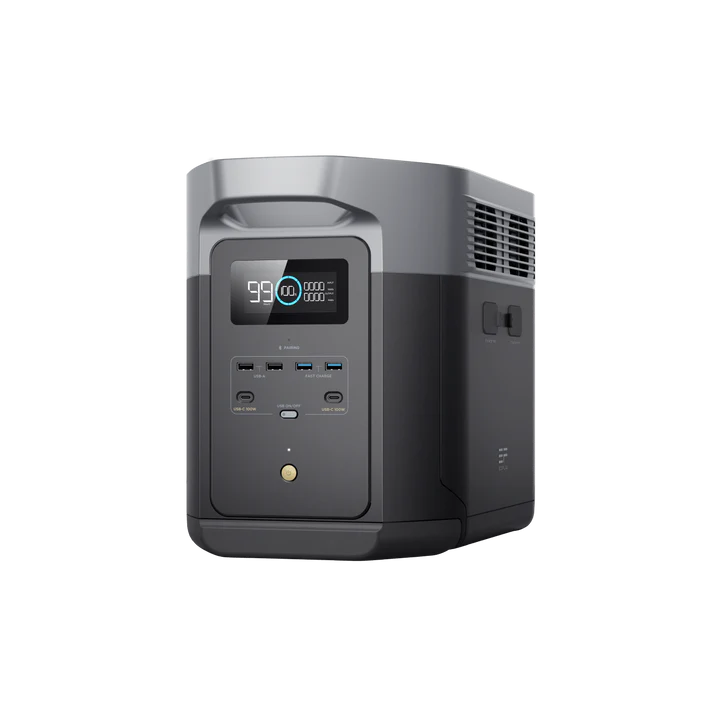
$1,049.00 · direct from EcoFlow
Last checked 1 day ago. Prices move — check before you buy.

No longer sold
EcoFlow no longer sells the RIVER 3 Max Plus. At this size the closest unit EcoFlow still sells is the RIVER 2 Pro — 768Wh with a stronger 800W inverter, typically for less money. If you'd rather step up in capacity, the DELTA 3 Classic (1,024Wh, 1,800W) is the move.
RIVER 2 Pro · $389.00Spec deltas
Take the DELTA 2 Max unless you're sure your power needs stay small. It's the only one of these two that clears an 8-hour blackout (94% of its 2,048Wh capacity) and a full remote workday (52%), and it does the CPAP overnight and the tailgate afternoon with room to spare too (18% and 38%). The RIVER 3 Max Plus only makes it through those last two — and barely on the tailgate, at 92% of its 858Wh with nothing left in reserve.
That capability gap costs $1,049 against $359 — a $690 difference. It isn't a quality markup: cost per lifetime kilowatt-hour comes out to $0.15 on the DELTA 2 Max and $0.14 on the RIVER 3 Max Plus, close enough to call a tie. What the extra money buys is 2,048Wh of capacity instead of 858Wh, and the gap between those two numbers is exactly the difference between surviving a real outage and running out partway through it.
The RIVER 3 Max Plus does have one genuine edge: it switches to battery power in under 10 milliseconds against the DELTA 2 Max's 20, a gap reviewers call a real, tested advantage for anyone running it as a UPS for sensitive gearB3B5. It's also 20.8 lbs to the DELTA 2 Max's 50.7 — a bag you grab one-handed instead of a two-hand lift out of a trunk. Neither wins the main argument, but they're the honest reasons to still look at the smaller box.
What the Numbers Reveal
Each conclusion stated first — the numbers behind it on one line, the full analysis below.
Capacity
At the tailgate, the RIVER 3 Max Plus is already at 92% of capacity before anyone plugs in a second phone charger. The DELTA 2 Max does the identical job at 38%, with almost two-thirds of its battery still in reserve — reserve that's exactly what a real blackout or workday spends.
8-Hour Blackout needs 1,645Wh; DELTA 2 Max covers it at 94% of its 2,048Wh capacity8-Hour Blackout needs 1,645Wh; RIVER 3 Max Plus would need 226% of its 858Wh capacityTailgate Party needs 670Wh; RIVER 3 Max Plus uses 92% of capacity against DELTA 2 Max's 38%
Why it mattersIf your load will ever beat a CPAP and a phone — a blackout, a full workday, a bigger tailgate — buy the DELTA 2 Max; the RIVER 3 Max Plus has no margin left to give on anything past its smallest jobs.
Typical price
The two units are priced almost exactly in proportion to their capacity, not their quality. The DELTA 2 Max's $190-a-year warranty cost against the RIVER 3 Max Plus's $72 is the same battery-size math showing up a second way.
DELTA 2 Max costs $1,049 with a cost per lifetime kWh of $0.15RIVER 3 Max Plus costs $359 with a cost per lifetime kWh of $0.14DELTA 2 Max costs $190 per warranty year against RIVER 3 Max Plus's $72 per warranty year
Why it mattersStop asking which unit is the better deal per dollar — on that basis they're tied — and ask only how much capacity you actually need; that's the entire question the price difference is answering.
Twenty milliseconds won't bother a lamp or a fridge, but a NAS or desktop rebooting mid-task notices the difference between 10 and 20 — which makes the RIVER 3 Max Plus the technically correct choice for exactly that one job, capacity gap and all.
RIVER 3 Max Plus switches to battery power in under 10ms (line-interactive)DELTA 2 Max switches to battery power in under 20ms (standby)Reviewers repeatedly cite sub-10ms UPS switchover as a standout, real-world-tested feature across the RIVER 3 familyB3B5
Why it mattersAnyone using this specifically as a UPS for sensitive electronics should weigh this rare case where the smaller, cheaper unit wins outright before defaulting to the DELTA 2 Max.
solar input
Add an expansion battery to either unit later and the bottleneck doesn't move: the RIVER 3 Max Plus's 200W ceiling still has to refill whatever gets bolted on, while the DELTA 2 Max's larger intake keeps pace as the bank grows.
DELTA 2 Max accepts up to 1,000W of solar input against 2,048Wh of capacityRIVER 3 Max Plus accepts up to 200W of solar input against 858Wh of capacityBoth units expand with EcoFlow add-on batteries
Why it mattersOff-grid or storm-prep buyers who might expand later should weigh the solar ceiling now, not just the base capacity — it's the spec that decides how fast either unit actually comes back online.
The specific dimensions that decide these two units — everything else is a tie.
Your Life, Your Pick
Selected because: Only section that answers 'can it actually do my job' — RIVER3 clears 2 of 6 scenarios, DELTA2Max clears 4 of 6, decisively separating them.
Line up the six scenarios and the RIVER 3 Max Plus only survives the two smallest: a CPAP overnight at 44% of capacity, and a tailgate afternoon at 92% — comfortable on the first, tapped out on the second. Cross into an 8-hour blackout or a full remote workday and it needs more than its entire battery holds (226% and 125% of capacity), which isn't a rounding error, it's a hard no.
The DELTA 2 Max clears all four of those loads with real margin, never climbing past 94% even on the blackout. Both units fail the same two oversized scenarios — a full weekend off-grid and true daily van-life power — so that's not a mark against the smaller unit specifically; it just means neither is built for jobs that size. Match the unit to the biggest single job you'll actually ask it to do, not the average one.
Lifetime Value
Selected because: Explains why the $690 price gap isn't a value gap — cost per kWh is nearly identical, so this is a capacity purchase, not a quality one.
cost / lifetime kWh
Run the ownership math and the price gap nearly disappears as a value question: $0.15 per lifetime kilowatt-hour on the DELTA 2 Max against $0.14 on the RIVER 3 Max Plus. Neither unit is the 'cheap' one or the 'expensive' one once you divide by everything it'll ever deliver — they're priced almost exactly in proportion to their capacity.
Where the gap does show up is the warranty math: $190 a year of coverage on the DELTA 2 Max against $72 a year on the RIVER 3 Max Plus, on the same five-year term. That's not a better or worse warranty — it's the natural result of a bigger battery costing more to insure per year. If you're optimizing dollars-per-year-of-coverage and your load is genuinely small, that number argues for the RIVER 3 Max Plus.
What the Specs Don't Tell You
Selected because: Both firing gotchas cut against the obvious pick in small, honest ways — worth naming before the reader assumes the bigger unit wins everything.
UPS switchover favors the RIVER 3 Max Plus, not the DELTA 2 Max: under 10 milliseconds, line-interactive, against 20 milliseconds, standby. Twenty milliseconds won't bother a lamp or a fridge, but it's the real reason to pick the smaller unit if you're protecting a NAS or desktop that hates even a flicker.
The warranty gotcha is the price gap wearing a different costume. Both units carry the same five-year term, but that coverage costs $190 a year on the DELTA 2 Max against $72 a year on the RIVER 3 Max Plus — proof the price difference tracks battery size, not a markup on one unit over the other.
Growth Path
Selected because: Both units already expand with add-on batteries, so the real differentiator is solar refill speed, which matters most for off-grid/storm-prep buyers.
solar input
Both units expand with EcoFlow's add-on batteries, so 'can it grow' isn't the differentiator — 'how fast can it refill while it's growing' is. The DELTA 2 Max accepts up to 1,000W of solar against 2,048Wh of capacity, about 2 hours for a full theoretical refill in strong sun. The RIVER 3 Max Plus's 200W input against 858Wh works out to about 4.5 hours for the same job, despite holding less than half the energy.
That solar gap compounds if you expand later: every battery bolted onto the RIVER 3 Max Plus still has to refill through the same 200W ceiling, while the DELTA 2 Max's larger intake keeps pace as the bank grows.
Portability & Form Factor
Selected because: 50.7 lbs vs 20.8 lbs is a real daily-use cost the price tag alone doesn't capture, and matters most for anyone who moves their unit rather than mounting it once.
weight
50.7 lbs is a two-hand, watch-your-back lift — the kind of weight you set down carefully getting it out of a trunk or up a step. 20.8 lbs is a bag you grab with one hand on the way out the door.
Both units are rated for the same jobs on paper, but that weight difference is why the RIVER 3 Max Plus is the better fit for anyone hauling their power station to a new spot daily, rather than treating it as a fixed home-backup box.
Strengths & trade-offs
EcoFlow DELTA 2 Max
Strengths
- +Larger battery capacity
- +Higher AC output
- +Faster solar charging
Trade-offs
- –Substantially more expensive (+$690) than the RIVER 3 MAX PLUS.
- –Significantly heavier (+29.9 lbs), making it harder to move.
EcoFlow RIVER 3 MAX PLUS
Strengths
- +Costs $690 less
- +Lighter by 29.9 lb
Trade-offs
- –Weaker inverter (-1,800W) limits appliance compatibility.
Will It Power Your Gear?
Scenario math and per-appliance runtimes, modeled from the spec record.
Scenario verdicts
We ran the math on six real-world scenarios. Here's which unit survives your actual life.
SCN-01 · 2 nights · needs 2,100Wh
Weekend Camping
Two nights off-grid with essential comfort
Neither unit
A full weekend off-grid needs 2,100Wh. The DELTA 2 Max comes up just short at 121% of that load, and the RIVER 3 Max Plus isn't close at 288%. Bring a way to recharge mid-trip, or look at a larger unit for weekends this demanding.
Battery budget usedlower = more headroom
LOAD Phone Charger 15W×6h · LED Lights 40W×8h · Box Fan 75W×14h · CPAP Machine 40W×16h
SCN-02 · 8 hours · needs 1,645Wh
8-Hour Blackout
Keep the essentials running through a night without power
DELTA 2 Max
Eight hours of blackout draw runs about 1,645Wh. The DELTA 2 Max covers it at 94% of capacity with a sliver to spare; the RIVER 3 Max Plus would need more than double what it holds. This is where the extra capacity earns its price.
Battery budget usedlower = more headroom
LOAD Fridge 150W×8h · Router + Modem 20W×8h · LED Lights (4 bulbs) 40W×6h · Phone Charger 15W×3h
SCN-03 · 8 hours · needs 320Wh
CPAP Overnight
Sleep therapy without interruption — the #1 medical use case
Either unit
A CPAP overnight draws about 320Wh, and both units clear it easily — 18% of the DELTA 2 Max, 44% of the RIVER 3 Max Plus. Either gets you through the night; the DELTA 2 Max just has more than double the spare capacity if the power stays out past morning.
Battery budget usedlower = more headroom
LOAD CPAP Machine 40W×8h
SCN-04 · 8 hours · needs 910Wh
Remote Workday
Full work day off-grid without power anxiety
DELTA 2 Max
A full remote workday pulls around 910Wh. The DELTA 2 Max handles it at 52% of capacity; the RIVER 3 Max Plus would need 25% more than it has. For work-from-anywhere days, that's a hard no on the smaller unit.
Battery budget usedlower = more headroom
LOAD Laptop 60W×8h · External Monitor 30W×8h · Router + Modem 20W×8h · Phone Charger 15W×2h
SCN-05 · 4 hours · needs 670Wh
Tailgate Party
Game day power for the crew
DELTA 2 Max
A tailgate setup draws about 670Wh. The RIVER 3 Max Plus can just barely do it at 92% of capacity — speakers, a cooler, some lights, and nothing left over. The DELTA 2 Max does the same job at 38%, with room for a second cooler or a blender.
Battery budget usedlower = more headroom
LOAD Blender 400W×0.5h · LED TV (55") 80W×4h · Bluetooth Speaker 15W×4h · Phone Charger (×3) 45W×2h
SCN-06 · 24 hours · needs 4,685Wh
Van Life Daily
A full day of mobile living — the ultimate endurance test
Neither unit
Full-time van life power draw runs around 4,685Wh a day — more than double what the DELTA 2 Max holds, and well over five times the RIVER 3 Max Plus. Neither is built to be your only battery for that life; pair one with solar and a larger bank, or step up to a bigger station.
Battery budget usedlower = more headroom
LOAD Mini-Fridge 150W×24h · Laptop 60W×4h · Phone Charger 15W×3h · LED Lights 40W×5h · Fan 75W×8h
The Load Test
RUNTIME = (Wh × 0.85) ÷ LOAD
None of the scenarios above exactly yours? Build it. Toggle what you'd plug in; both units are tested against the combined draw.
Essentials
Comfort & Convenience
High-Draw Appliances
Test duration
8h
Continuous draw
205W
Projected runtime
For this load: DELTA 2 Max runs 8.5h vs 3.6h.
$1,049 list · direct from EcoFlow
Modeled from the spec record — same math as the tables below. Methodology
Runtime by appliance
Real-world runtime estimates for common appliances, modeled at 85% inverter efficiency.¹
Essentials
The basics you need runningscale 0–116.1hComfort & Convenience
Makes off-grid life actually enjoyablescale 0–23.2hHigh-Draw Appliances
These reveal the real limitsscale 0–1.7h¹ Runtime = (capacity × 0.85) ÷ appliance watts. Within each group, all bars share one time scale (the group's longest runtime), so lengths are comparable across appliances; identical runtimes collapse into a single blue/orange bar. Actual runtime varies with battery age, temperature, and simultaneous loads — see methodology.
Conclusion
July 26, 2026
Verdict: the DELTA 2 Max, on Power Score margin
Buy the DELTA 2 Max unless your power needs are provably small. It wins all four scenarios either unit can actually finish — the 8-hour blackout (94% of its 2,048Wh capacity), the CPAP overnight (18%), the remote workday (52%), and the tailgate afternoon (38%). The RIVER 3 Max Plus keeps up on two of those — CPAP and tailgate — but with far less room (44% and 92% of its 858Wh), and can't finish the blackout or the workday at all (226% and 125% of capacity, over its limit). The $1,049 versus $359 gap — $690 — isn't a quality premium: cost per lifetime kWh is $0.15 on the DELTA 2 Max against $0.14 on the RIVER 3 Max Plus, close enough to call even. What it buys is 2,048Wh instead of 858Wh, and 50.7 lbs instead of 20.8 to carry it. If your real load never exceeds a CPAP and a phone, keep the $690 and the 30 fewer pounds; if it might ever look like a normal blackout or workday, pay for the bigger tank.
Editor-assigned confidence, based on cited owner research and spec analysis.
List prices as of July 26, 2026. The links below open EcoFlow's current price.
$1,049.00 · direct from EcoFlow
Last checked 1 day ago. Prices move — check before you buy.
or check the RIVER 3 MAX PLUS price$359.00 list
Written by Ian Schneider, Solar & Off-Grid Tester · Station Arena Test Desk · Updated July 26, 2026
Measured Data
Benchmark scores and the full spec record, side by side.
Benchmark scores
Not rated for both units (minimum threshold unmet): RV Living, Home Backup, Food Truck, Camping.
Full specifications
ᵈ Derived: price ÷ rated capacity. See the data behind our comparisons →
Comparison ToolAdd more power stations, side by sideOpen Tool →How these numbers are produced
Numeric verification
Every figure on this page traces to our spec database or arithmetic on it — no estimated numbers.
Owner claims
Statements about owner experience are cited to published reviews — see Sources & Research Notes below.
Runtime model
Runtime = (rated capacity × 0.85 inverter efficiency) ÷ device wattage. Solar recharge estimates assume panels deliver 70% of rated output. Cold weather, battery age, and stacked loads reduce real-world results.
Power Score
Computed from 14 published spec dimensions, weighted per use-case bench. Higher is better; a unit must meet a bench's minimum threshold to be rated.
See the full weight table and data sourcing on our methodology page →Class ranking (the star rating)
Each unit's star score is a category ranking, not customer reviews — no buyer opinions feed it. We score every station on size-independent quality (value, output, portability, endurance, ports, warranty, and more), then percentile-rank it against the other units in its capacity class, so a class-leading compact unit and a class-leading whole-home unit can both earn 5★. Here, DELTA 2 Max rates 3.8/5 (28th percentile of 26 Large-class units), and RIVER 3 MAX PLUS rates 4.9/5 (95th percentile of 20 Compact-class units).
How the class ranking is computed →Test Notes & Caveats
Hidden gotchas and advantages we spotted that you won't find on the product page.
UPS speed: the smaller unit is actually the faster one
Line-interactive switching under 10 milliseconds on the RIVER 3 Max Plus, against the DELTA 2 Max's 20-millisecond standby switch. Twenty milliseconds is fine for a lamp or a fridge; if you're running a NAS or desktop that can't tolerate even a flicker, this is the one spec where the cheaper, smaller unit wins outright.
Same five years, different price per year
Both units carry a 5-year warranty, but that coverage costs $190 a year on the DELTA 2 Max against $72 a year on the RIVER 3 Max Plus. That's not a better or worse warranty term — it's the same five years on a battery that costs more to begin with.
Full record above — the Test Desk pick is the DELTA 2 Max.
Check DELTA 2 Max price →or check the RIVER 3 MAX PLUS priceOwnership Analysis
What happens after you buy — true cost of ownership, brand trust, and growth potential.
Lifetime value
Service lifeyears at one full cycle per day
Lifetime energy delivered
Cost per delivered kWh
│ warranty ends · Reaching the cycle rating means ~80% capacity remains — degraded, not dead.
Analyst note
Both units have similar long-term ownership costs ($0.17/kWh vs $0.14/kWh). The price difference is what you see on the sticker — neither is a hidden bargain or rip-off. One thing to know reading the table: both carry the same 3,000-cycle rating, so the lifetime rows are sticker price and capacity in disguise — the wear horizon is identical and decides nothing here.
Growth path
DELTA 2 Max
EXPANDABLESupports EcoFlow expansion batteries, so you can add capacity later without replacing the base unit — useful if your needs may climb past 2,048Wh.
Accepts up to 1,000W of solar. Enough for a serious multi-panel array.
Generous port selection supports complex multi-device setups.
Expansion batteries are EcoFlow-specific. You're investing in the EcoFlow ecosystem.
RIVER 3 MAX PLUS
EXPANDABLESupports EcoFlow expansion batteries, so you can add capacity later without replacing the base unit — useful if your needs may climb past 858Wh.
Accepts up to 200W of solar. Limited to a single portable panel.
Adequate ports for most setups, but heavy users may want a power strip.
Expansion batteries are EcoFlow-specific. You're investing in the EcoFlow ecosystem.
Realistic full solar rechargeat 70% of rated panel output — see methodology
Analyst note
Both expand, but the DELTA 2 Max's higher solar ceiling (1,000W vs 200W) gives it the stronger off-grid growth path — more panels can feed a bigger bank as it grows.
What Owners Report
Patterns from published owner reports and long-term reviews — every claim cited to its source below.
EcoFlow DELTA 2 Max
Owners consistently praise two things about the DELTA 2 Max: fast recharging on AC power, with reviewers clocking roughly 50 minutes to a strong chargeA2, and real staying power — after 6 months of use, its LiFePO4 cells show no structural degradation and still feel as solid as day oneA3.
The recurring complaint is fan noise: cooling fans get loud under heavy load or while charging, though a Quiet Charging mode trades that noise for a longer top-upA1. Reviewers still call it worth buying, caveats included, largely for its expandability and ecosystem fitA4.
“Fast AC wall charging — 0 to 80% in about 50 minutes and a full charge in roughly 80 minutes.”
Sources
powerstationadvisor.com · pcworld.com · thesolarlab.com · protoolsadvisor.com · trailandkale.com
EcoFlow RIVER 3 MAX PLUS
Field data on this exact model is thin — most of what's available covers the sibling RIVER 3 and RIVER 3 Plus rather than the Max Plus bundle specifically, and there's no long-term commentary to draw on yet. What does exist points to real strengths: a full recharge from empty in a bit over two hours on mains powerB1, and sub-10ms UPS switchover that reviewers call a standout, real-world-tested feature across the RIVER 3 familyB3B5.
One reviewer also flagged that its extended 1,200W output is built for resistive loads like heaters, not sensitive electronics such as a desktop PCB7 — worth knowing before you lean on it for anything delicate.
“The RIVER 3 Max Plus (Wireless) can go from empty to full from mains in around 2.3 hours, which is very quick given its capacity.”
Sources
wandering-bird.com · root-nation.com · phonearena.com
Sources & Research Notes
Every owner claim in this report is traceable to a published source. The bracketed references above resolve here.
Recurring owner themes
- Solid LFP durability, fast charging, and ecosystem/expandability are the praise; loud fans under heavy load or charging are the recurring complaint. [DELTA 2 Max · 3 entries]
- Owners/reviewers consistently note the Max Plus is a modular upgrade (base unit + EB600 battery) rather than a distinct unit, and reference its 858Wh combined capacity — this conflicts with the 1196Wh figure given in the task brief, suggesting a possible spec discrepancy or regional/bundle variant not covered by available sources. [RIVER 3 MAX PLUS · 3 entries]
- Reviewers agree the extended 1200W X-Boost output is best suited to resistive/heating loads, not sensitive electronics like PCs. [RIVER 3 MAX PLUS · 2 entries]
- Sub-10ms UPS switchover is repeatedly highlighted as a standout, real-world-tested feature across the River 3 Plus/Max/Max Plus family. [RIVER 3 MAX PLUS · 2 entries]
- A1
“Fan noise is a significant issue — cooling fans can get loud, around 52 dB during heavy loads or charging; a Quiet Charging mode reduces noise but extends charge time, and giving it 6 inches of clearance helps airflow.”
powerstationadvisor.com / pcworld.com — DELTA 2 Max review · 2025-2026 · [negative]
- A2
“Fast AC wall charging — 0 to 80% in about 50 minutes and a full charge in roughly 80 minutes.”
thesolarlab.com / protoolsadvisor.com — DELTA 2 Max review · 2025-2026 · [positive]
- A3
“LiFePO4 chemistry rated for 3,000+ cycles to 80% with superior thermal stability; after 6 months of real use there was no structural degradation and it felt as solid as day one.”
powerstationadvisor.com / trailandkale.com — DELTA 2 Max review · 2025-2026 · [positive]
- A4
“Reviewers say it's still worth buying but with caveats — a versatile unit with expandability and ecosystem compatibility.”
thesolarlab.com / powerstationadvisor.com — DELTA 2 Max review · 2025-2026 · [mixed]
- B1
“The RIVER 3 Max Plus (Wireless) can go from empty to full from mains in around 2.3 hours, which is very quick given its capacity.”
wandering-bird.com — REVIEW: Ecoflow River 3 Max Plus- vanlife essential or not? · 2025-11 · [positive]
- B3
“UPS (Uninterruptible Power Supply) switching on the RIVER 3 Plus/Max models is under 10 milliseconds”
wandering-bird.com — REVIEW: Ecoflow River 3 Max Plus- vanlife essential or not? · 2025-11 · [positive]
- B5
“For typical wild parking or a weekend off-grid, the Max Plus version is a brilliant middle ground.”
wandering-bird.com — REVIEW: Ecoflow River 3 Max Plus- vanlife essential or not? · 2025-11 · [positive]
- B7
“the extended output is designed for resistive loads – things like hair dryers, heaters, or compact air conditioners. It's not meant for sensitive electronics like desktop PCs.”
root-nation.com — EcoFlow River 3 Max Review (discusses River 3 Max Plus family) · 2025-05 · [mixed]
Research compiled July 26, 2026.
Who Should Buy Which
Buy the DELTA 2 Max if you…
- →Buy the DELTA 2 Max if your power draw ever gets real — an 8-hour blackout, a full remote workday, or a tailgate load big enough to matter. It never crosses 94% of capacity on any scenario here; the RIVER 3 Max Plus hits 92% just on the tailgate, with nothing left over.
Buy the RIVER 3 MAX PLUS if you…
- →Buy the RIVER 3 Max Plus if your actual use tops out at a CPAP overnight or a tailgate afternoon — it clears both, weighs 20.8 lbs against the DELTA 2 Max's 50.7, costs $359, and its 10-millisecond UPS switchover beats the DELTA 2 Max's 20 if you're protecting something sensitive.
This is you — check the RIVER 3 MAX PLUS price
If neither fits
If your real need is a full weekend off-grid (2,100Wh) or true daily van-life power (4,685Wh), skip both — the DELTA 2 Max only reaches 121% and 269% of those loads, and the RIVER 3 Max Plus doesn't come close at 288% and 642%. Look at a larger-capacity station, not a smaller price tag.
The Bottom Line
The RIVER 3 Max Plus does exactly two jobs on this page — a CPAP overnight and a tailgate afternoon — and does them for $690 less and 30 fewer pounds. Everything past that, an 8-hour blackout, a full workday of laptop-and-monitor draw, belongs to the DELTA 2 Max, which clears every one of those loads with real margin while the smaller unit runs past its own capacity.
That $690 doesn't buy a better battery — cost per lifetime kilowatt-hour comes out to $0.14 and $0.15, close enough to call even. It buys 2,048Wh instead of 858Wh, and on the day your power actually needs more than a phone charger, that's the whole argument. Get the DELTA 2 Max unless you can prove, honestly, that your load never will.
Frequently Asked Questions
Answers drawn from the spec record and cited owner research.
Is the EcoFlow DELTA 2 Max worth $690 more than the RIVER 3 Max Plus?
If your power draw ever tops what a full remote workday pulls (910Wh) or what an 8-hour blackout pulls (1,645Wh), yes — the RIVER 3 Max Plus can't cover either one (125% and 226% of its capacity), while the DELTA 2 Max clears both with room to spare. If you only ever need to run a CPAP or a small tailgate setup, the RIVER 3 Max Plus does that job for $690 less.
Can the EcoFlow RIVER 3 Max Plus run a CPAP all night?
Yes. A CPAP overnight draws about 320Wh, which is only 44% of the RIVER 3 Max Plus's 858Wh capacity. The DELTA 2 Max does the same job at 18%, so it has more spare capacity if the outage runs past morning, but both units comfortably make it through the night.
How much faster does the DELTA 2 Max recharge from solar than the RIVER 3 Max Plus?
The DELTA 2 Max accepts up to 1,000W of solar against its 2,048Wh capacity, about 2 hours for a full theoretical refill in strong sun. The RIVER 3 Max Plus takes in only 200W against 858Wh, about 4.5 hours — more than double the time, despite holding less than half the energy.
What's the real difference between the DELTA 2 Max and RIVER 3 Max Plus in a power outage?
An 8-hour blackout draws about 1,645Wh. The DELTA 2 Max covers that at 94% of its capacity — cutting it close but making it. The RIVER 3 Max Plus would need more than double what it holds (226% of capacity), so it can't finish that job alone.
Is the EcoFlow RIVER 3 Max Plus good enough for van life?
Not as your only battery. Full-time van life power draw runs around 4,685Wh a day, which is 642% of the RIVER 3 Max Plus's capacity and 269% of the DELTA 2 Max's — neither unit is sized to be a daily van-life power source on its own. Pair either with solar and a larger bank, or step up to a bigger station built for that load.
Where to buy
EcoFlow DELTA 2 MaxPick
$1,049.00
$1,049.00 · direct from EcoFlow
Last checked 1 day ago. Prices move — check before you buy.
EcoFlow RIVER 3 MAX PLUS
$359.00
$359.00 · direct from EcoFlow
Last checked 41 days ago. Prices move — check before you buy.
Prices may vary by retailer and are subject to change.