Head-to-head test
EcoFlow DELTA 3 1500 vs EcoFlow DELTA 3 Max Plus
EcoFlow DELTA 3 1500 vs EcoFlow DELTA 3 Max Plus: the 1500 has left EcoFlow's range, so only one of these can still be bought. The Max Plus holds 2,048Wh against 1,536Wh and runs 3,000W against 1,800W, for 50.7 lbs instead of 36. Buy it unless the 1500's size was the point, in which case the DELTA 3 Max is the nearer replacement.
Full profiles: EcoFlow DELTA 3 1500 → · EcoFlow DELTA 3 Max Plus →

Written by Ian SchneiderUpdated
Solar & Off-Grid Tester, Station Arena Test Desk
Spec deltas
EcoFlow has folded the DELTA 3 1500 out of its range, so this page has one live side. The DELTA 3 Max Plus is still on sale at $1,199. The 1500 shows no price and no buy button, and that is not a formatting quirk. One precision worth getting right before anything else: the successor EcoFlow records for the 1500 is the DELTA 3 Max, which is a smaller sibling of the unit you are looking at rather than the unit itself, and reviewers place the Max Plus above the Max on both continuous output and surgeB1.
On the specs that decide these things, the Max Plus is a genuine size up. It holds 2,048Wh against 1,536Wh, runs 3,000W continuous against 1,800W, takes 1,000W of solar against 500W, and weighs 50.7 lbs against 36. That is the whole functional gap. Whether it is worth carrying depends entirely on which load profile you actually run.
The short version: if you are here because an outage outlasted your 1500, the Max Plus is the one to buy, and its input ceiling matters more than the extra capacity. If you are here because the 1500 died, or because you were about to buy one and found the listing gone, look at the DELTA 3 Max before you pay for an inverter you will never load.
What the Numbers Reveal
Each conclusion stated first — the numbers behind it on one line, the full analysis below.
solar input
Because the margin is that thin, a blackout that runs past one night is settled by refill rate, not by the 512Wh between 1,536 and 2,048Wh. At full rated input the Max Plus puts 2,048Wh back in about two hours against roughly three hours for the 1500's 1,536Wh, and it can do that on a morning of sun while the smaller unit is still working on it.
The 8-hour blackout profile asks for 1,645Wh.The DELTA 3 1500 has 1,306Wh usable after the flat 15% derate, leaving it 339Wh short.The DELTA 3 Max Plus has 1,741Wh usable, covering it with 96Wh to spare.Solar input: 1,000W on the Max Plus against 500W on the 1500.
Why it mattersIf outage cover is why you are replacing a 1500, shop the input ceiling rather than the capacity number. Capacity alone does not buy you a second night.
continuous output
So the 14.7 lbs between 36 and 50.7 is the price of headroom the profiles never ask for, unless your list genuinely includes two large AC loads running together. That is the difference between an upgrade you chose and an upgrade you drifted into.
The 1500 runs 1,800W continuous with a 3,600W published peak; the Max Plus runs 3,000W with a 6,000W peak. Both are exactly double their continuous rating.The heaviest startup anywhere in the six load profiles is the 400W tailgate peak, and both units start every one of them.Weight: 36 lbs against 50.7 lbs.The CPAP profile uses 25% of the 1500's usable energy and 18% of the Max Plus's.
Why it mattersSomeone replacing a 1500 for overnight and workday duty should price the DELTA 3 Max first and pay up for the Max Plus only if multiple big AC loads are the actual plan.
It is also a record that will never fill in, because independent coverage was already redirecting away from the 1500 before it was pulledA0. For anyone shopping, that settles it: you would be buying leftover stock on a spec sheet with no field evidence behind it. If you already own one, it is an argument for knowing where the paperwork is, since our record carries the same five-year term on both units.
Field data on the 1500 is thin and largely secondhand, with no Reddit, YouTube or Amazon material specific to the 1,536Wh unitA0.A forum poster reported a neighbor losing three DELTA 3 1500 units in roughly eight monthsA1, and thread consensus leaned toward the DELTA 3 line drawing more failure reports than the Delta 2A2.Posters described the 1500 as a hybrid, with UPS-cutover electronics carried over from the Delta 2 in a new caseA3, and pegged its cutover at 15ms against sub-10ms for the standard Delta 3A5.Our spec record has the 1500 at a cutover class of no worse than 15ms and the Max Plus at no worse than 10ms.
Why it mattersDo not chase clearance 1500 stock on the strength of its specs. If you already own one, keep the receipt and register it.
The specific dimensions that decide these two units — everything else is a tie.
Your Life, Your Pick
Selected because: Six load profiles, and these two part company on exactly one: the 8-hour blackout, where 1,645Wh is more than the 1500's 1,306Wh usable and less than the Max Plus's 1,741Wh.
The two units agree on five of these six rows. Both start every peak in the set, including the 400W tailgate draw, so surge decides nothing. Both fail the same two profiles: weekend camping wants 2,100Wh and van life wants 4,685Wh, and neither box carries that.
The split is the 8-hour blackout, and it is narrow. 1,645Wh is 339Wh more than the 1500 has to give and 96Wh less than the Max Plus does. One row out of six is what the 512Wh between 1,536 and 2,048Wh actually buys, which is worth knowing before you decide that gap is the reason to spend.
Runtime: Will It Power Your Gear?
Selected because: The 1500 is gone but its runtimes are not, and 1,536Wh against 2,048Wh is the whole functional question for anyone working out how much unit they actually need.
continuous output
What you get to spend is never what is on the label. Every unit here is derated by a flat 15%, which turns 1,536Wh into 1,306Wh usable and 2,048Wh into 1,741Wh, and that is before you decide how low you are willing to run a pack overnight. The 435Wh between those two usable figures is the real-world difference between these boxes.
For a night of CPAP duty both numbers are academic: 320Wh leaves 986Wh untouched on the 1500 and 1,421Wh on the Max Plus. Runtime only starts discriminating once your list has a fridge on it for eight hours.
Portability & Form Factor
Selected because: 36 lbs against 50.7 lbs is the one column the retired unit wins, and the main reason someone who liked that size might want EcoFlow's smaller live models instead.
weight
36 lbs is a carry you make in one trip without planning it. 50.7 lbs is a knees-bent, two-handed lift you think about before you start, and 14.7 lbs is not a rounding error when it is in your hands at the top of a boat ramp.
This is the column the retired unit wins, and it is the one honest reason to hesitate before replacing a 1500 with the Max Plus. If what you liked about your 1500 was swinging it into the back seat without ceremony, the upgrade costs you exactly that.
Growth Path
Selected because: Both take expansion batteries, so the growth question is input rather than ceiling: 1,000W of solar against 500W.
solar input
Both units take EcoFlow expansion batteries, which makes growth a question of input rather than ceiling. The Max Plus accepts 1,000W of solar against the 1500's 500W, so from empty it refills 2,048Wh in roughly two hours at full rated input against roughly three hours for 1,536Wh. Rated input is a ceiling panels rarely hold, so both of those stretch outdoors.
The ceiling is real as well, with reviewers putting the Max Plus's expansion range at 2kWh up to 10kWh across five charging methodsB4. But input is the number to care about, because a bank you cannot refill inside a day is not a bank, it is furniture.
What the Specs Don't Tell You
Selected because: Four cards fire here, including one on a noise figure the 1500 never published and one on a five-year warranty term that is identical on both.
rated cycles
The UPS class is the sharpest of the four cards. Our record has the Max Plus at no worse than 10ms and the 1500 at no worse than 15ms, and both are published ceilings rather than stopwatch results. For a router, a modem or a fridge, either class rides through a cut with nobody noticing. For a desktop with unsaved work, the tighter class is the one worth wanting.
The noise card is the one to read slowly, because it is an absence rather than a finding. The Max Plus publishes 30dB and the 1500 publishes nothing. That is not evidence the 1500 runs louder. It means there is no figure to hold it to, and now that it is out of production, there never will be.
Strengths & trade-offs
EcoFlow DELTA 3 1500
Strengths
- +Lighter by 14.7 lb
Trade-offs
- –Weaker inverter (-1,200W) limits appliance compatibility.
- –Shorter-lived battery — rated for 3,000 charge cycles vs the DELTA 3 Max Plus's 4,000, so it wears out sooner.
EcoFlow DELTA 3 Max Plus
Strengths
- +Larger battery capacity
- +Higher AC output
- +Faster solar charging
- +Rated for 4,000 charge cycles — much longer battery lifespan
Trade-offs
- –Significantly heavier (+14.7 lbs), making it harder to move.
Will It Power Your Gear?
Scenario math and per-appliance runtimes, modeled from the spec record.
Scenario verdicts
We ran the math on six real-world scenarios. Here's which unit survives your actual life.
SCN-01 · 2 nights · needs 2,100Wh
Weekend Camping
Two nights off-grid with essential comfort
Neither unit
Two thousand one hundred watt-hours is more weekend than either of these carries. The 1500 gets about 62% of the way there and the Max Plus about 83%, which in practice means a weekend you plan around rather than one you rule these out for. Leave the kettle at home, run the cooler on a timer, bring panels. If you want a weekend you never have to think about, you are shopping a bigger class than this page.
Battery budget usedlower = more headroom
LOAD Phone Charger 15W×6h · LED Lights 40W×8h · Box Fan 75W×14h · CPAP Machine 40W×16h
SCN-02 · 8 hours · needs 1,645Wh
8-Hour Blackout
Keep the essentials running through a night without power
DELTA 3 Max Plus
This is the only profile where the two genuinely separate. The 1,645Wh it asks for is 339Wh more than the 1500 has to give and 96Wh less than the Max Plus does, which is about half an hour of margin at the profile's 206W average draw. Thin, but a pass is a pass, and the Max Plus's 1,000W solar input is what makes the second night possible.
Battery budget usedlower = more headroom
LOAD Fridge 150W×8h · Router + Modem 20W×8h · LED Lights (4 bulbs) 40W×6h · Phone Charger 15W×3h
SCN-03 · 8 hours · needs 320Wh
CPAP Overnight
Sleep therapy without interruption — the #1 medical use case
Either unit
A CPAP asks for roughly 320Wh a night: 25% of the 1500's usable energy, 18% of the Max Plus's. Capacity decides nothing here and neither does surge. What decides it is the thing you hear at 2 a.m., and only one of these publishes a number for it, 30dB against no figure at all. When both units do the job in their sleep, take the one whose fan behavior somebody wrote down.
Battery budget usedlower = more headroom
LOAD CPAP Machine 40W×8h
SCN-04 · 8 hours · needs 910Wh
Remote Workday
Full work day off-grid without power anxiety
DELTA 3 Max Plus
The DELTA 3 Max Plus clears the workday at 52% used, banking 831Wh — late work, extra calls, or a second laptop charge without arithmetic. The DELTA 3 1500 at 70% also finishes, with 396Wh of slack for the unplanned.
Battery budget usedlower = more headroom
LOAD Laptop 60W×8h · External Monitor 30W×8h · Router + Modem 20W×8h · Phone Charger 15W×2h
SCN-05 · 4 hours · needs 670Wh
Tailgate Party
Game day power for the crew
DELTA 3 Max Plus
Both cover game day with reserves, so the number you actually feel is the one in your hands: 36 lbs against 50.7 across a parking lot. The Max Plus keeps more back (38% used against 51%) and starts the 400W peak without noticing, but so does the 1500. This is the row where the retired unit was the better tool, which is worth saying even though you cannot buy it.
Battery budget usedlower = more headroom
LOAD Blender 400W×0.5h · LED TV (55") 80W×4h · Bluetooth Speaker 15W×4h · Phone Charger (×3) 45W×2h
SCN-06 · 24 hours · needs 4,685Wh
Van Life Daily
A full day of mobile living — the ultimate endurance test
Neither unit
4,685Wh a day is a different class of problem. The 1500 covers about 28% of it and the Max Plus about 37%, and no scheduling trick closes a 2,944Wh shortfall. Treat this as partial cover: the electronics, the lights and the fridge for part of the day, not the whole list. Full-time van power is an expansion bank or a wired-in system, and the Max Plus is where you would start building one rather than where you would finish.
Battery budget usedlower = more headroom
LOAD Mini-Fridge 150W×24h · Laptop 60W×4h · Phone Charger 15W×3h · LED Lights 40W×5h · Fan 75W×8h
The Load Test
RUNTIME = (Wh × 0.85) ÷ LOAD
None of the scenarios above exactly yours? Build it. Toggle what you'd plug in; both units are tested against the combined draw.
Essentials
Comfort & Convenience
High-Draw Appliances
Test duration
8h
Continuous draw
205W
Projected runtime
For this load: DELTA 3 Max Plus runs 8.5h vs 6.4h.
$1,199 list · direct from EcoFlow
Planning for more than this? Describe your whole setup and get it sized →
Modeled from the spec record — same math as the tables below. Methodology
Runtime by appliance
Real-world runtime estimates for common appliances, modeled at 85% inverter efficiency.¹
Essentials
The basics you need runningscale 0–116.1hComfort & Convenience
Makes off-grid life actually enjoyablescale 0–23.2hHigh-Draw Appliances
These reveal the real limitsscale 0–1.7h¹ Runtime = (capacity × 0.85) ÷ appliance watts. Within each group, all bars share one time scale (the group's longest runtime), so lengths are comparable across appliances; identical runtimes collapse into a single blue/orange bar. Actual runtime varies with battery age, temperature, and simultaneous loads — see methodology.
Conclusion
September 19, 2026
Verdict: the DELTA 3 Max Plus, on Power Score margin
The DELTA 3 Max Plus wins by default and then earns it. By default, because EcoFlow has folded the DELTA 3 1500 out of its range and a unit nobody sells cannot be a recommendation at any confidence. On the merits, because the one profile where these two genuinely part company is the 8-hour blackout: 1,645Wh is more than the 1500's 1,306Wh of usable energy and less than the Max Plus's 1,741Wh. Add 1,000W of solar input against 500W and the Max Plus is also the one that comes back for a second night. The honest catch is size. At 50.7 lbs and 3,000W it is a bigger inverter than anything in these six profiles loads, the heaviest peak in the set being 400W, and if that describes your use, the successor EcoFlow records for the 1500 is the DELTA 3 Max, which is not the unit on this page.
Editor-assigned confidence, based on cited owner research and spec analysis.
List prices as of September 19, 2026. The links below open EcoFlow's current price.
$1,199.00 · direct from EcoFlow
Last checked 16 days ago. Prices move — check before you buy.
Written by Ian Schneider, Solar & Off-Grid Tester · Station Arena Test Desk · Updated September 19, 2026
Black Friday · 38 days out
Price to beat:DELTA 3 Max Plus $1,099
The lowest we have recorded. A Black Friday price above it is a sale this unit has already had.
Measured Data
Benchmark scores and the full spec record, side by side.
Benchmark scores
Not rated for both units (minimum threshold unmet): Camping.
Full specifications
ᵈ Derived: price ÷ rated capacity. See the data behind our comparisons →
Comparison ToolAdd more power stations, side by sideOpen Tool →How these numbers are produced
Numeric verification
Every figure on this page traces to our spec database or arithmetic on it — no estimated numbers.
Owner claims
Statements about owner experience are cited to published reviews — see Sources & Research Notes below.
Runtime model
Runtime = (rated capacity × 0.85 inverter efficiency) ÷ device wattage. Solar recharge estimates assume panels deliver 70% of rated output. Cold weather, battery age, and stacked loads reduce real-world results.
Power Score
Computed from 14 published spec dimensions, weighted per use-case bench. Higher is better; a unit must meet a bench's minimum threshold to be rated.
See the full weight table and data sourcing on our methodology page →Class ranking (the star rating)
Each unit's star score is a category ranking, not customer reviews — no buyer opinions feed it. We score every station on size-independent quality (value, output, portability, endurance, ports, warranty, and more), then percentile-rank it against the other units in its capacity class, so a class-leading compact unit and a class-leading whole-home unit can both earn 5★. Here, DELTA 3 1500 rates 5.0/5 (99th percentile of 27 Everyday-class units), and DELTA 3 Max Plus rates 4.3/5 (56th percentile of 26 Large-class units).
How the class ranking is computed →Test Notes & Caveats
Hidden gotchas and advantages we spotted that you won't find on the product page.
UPS: A Rated Class, Not a Stopwatch
Both units list a UPS mode, the Max Plus at no worse than 10ms and the 1500 at no worse than 15ms. Neither figure is a measured result; both are the ceiling the maker publishes. For a router, a modem or a fridge, either class rides through a cut with nobody in the house noticing. The fussiest desktop power supplies sit right around the slower line, so if what you are protecting is a PC with unsaved work, that is the one place this difference is worth a thought rather than a shrug.
Five Years Each, and Retirement Does Not Change That
Our record carries a five-year term on both units, so coverage is not a tiebreaker between them. The card earns its place anyway, because the DELTA 3 1500 is the one people assume loses its cover the moment it leaves the catalogue. It does not. The term a unit shipped with is the term it has, and it runs from your purchase rather than from the maker's product page. If you own one, keep the receipt and the registration somewhere you can find them, because a discontinued model is exactly the one you will be asked to prove.
The Clock That Is Already Running
The Max Plus is rated for at least 4,000 cycles against the 1500's 3,000, which reads like a straight win until you notice the cycles are different sizes: a full cycle is 2,048Wh on one and 1,536Wh on the other. Count lifetime energy instead and it is roughly 8,192kWh against 4,608kWh. If you already own a 1500, the useful version of this number is that the rating is a floor, not an expiry date, and at twice-a-week use it works out around 29 years. Reaching the limit does not kill the pack either. It settles to about 80% of original capacity and keeps going.
One Published Number, One Silence
The DELTA 3 Max Plus publishes 30dB. The DELTA 3 1500 publishes nothing, and now that it is out of production, nobody is going to measure it. Read that as a hole in the record rather than a verdict, because an unpublished figure is not a loud one, it is an unknown one. If the box is going 18 inches from your head to run a CPAP, the Max Plus is the only side of this page carrying a number you can hold it to, and even that number is a spec-sheet claim rather than a measurement taken across loads.
Full record above — the Test Desk pick is the DELTA 3 Max Plus.
Check DELTA 3 Max Plus price →Ownership Analysis
What happens after you buy — true cost of ownership, brand trust, and growth potential.
Lifetime value
Service lifeyears at one full cycle per day
Lifetime energy delivered
Cost per delivered kWh
│ warranty ends · Reaching the cycle rating means ~80% capacity remains — degraded, not dead.
Analyst note
The DELTA 3 1500 is no longer sold, so there is no price to work its cost per kWh from, and this comparison doesn't quote one. On what you can actually buy today, the DELTA 3 Max Plus works out at $0.15/kWh over its rated life. If you already own the DELTA 3 1500, the hardware comparison still holds: over its rated life the DELTA 3 1500 delivers about 4,608 kWh and the DELTA 3 Max Plus about 8,192 kWh.
Growth path
DELTA 3 1500
EXPANDABLESupports EcoFlow expansion batteries, so you can add capacity later without replacing the base unit — useful if your needs may climb past 1,536Wh.
Accepts up to 500W of solar. Suitable for a 1-2 panel setup.
Generous port selection supports complex multi-device setups.
Expansion batteries are EcoFlow-specific. You're investing in the EcoFlow ecosystem.
DELTA 3 Max Plus
EXPANDABLESupports EcoFlow expansion batteries, so you can add capacity later without replacing the base unit — useful if your needs may climb past 2,048Wh.
Accepts up to 1,000W of solar. Enough for a serious multi-panel array.
Adequate ports for most setups, but heavy users may want a power strip.
Expansion batteries are EcoFlow-specific. You're investing in the EcoFlow ecosystem.
Realistic full solar rechargeat 70% of rated panel output — see methodology
Analyst note
Growth only counts if you can still buy in, and the DELTA 3 1500 is no longer sold (EcoFlow points owners to the DELTA 3 Max). That leaves the DELTA 3 Max Plus: it starts at 2,048Wh and takes EcoFlow expansion batteries, so the ceiling moves if your needs do. The DELTA 3 1500's expandability still matters if you already own one, but it isn't a reason to pick it over the DELTA 3 Max Plus.
What Owners Report
Patterns from published owner reports and long-term reviews — every claim cited to its source below.
EcoFlow DELTA 3 1500
Start with what is not here. The field record on this exact SKU is thin and largely secondhand: no Reddit, YouTube or Amazon material specific to the 1,536Wh, 1,800W unit, and the forum threads that do discuss it were reachable only through indexed snippets rather than direct quotesA0. Retirement is part of the reason, since coverage was already redirecting away from the 1500 before EcoFlow pulled itA0.
What does exist is one forum, and it is not flatteringA1A2. A poster reported a neighbor losing three DELTA 3 1500 units in roughly eight monthsA1, and the wider thread consensus leaned toward the DELTA 3 line drawing more failure reports than the Delta 2 that preceded it, with one poster saying their two Delta 2 units never gave a single issueA2. The mechanism posters proposed is the interesting part: they read the 1500 as a hybrid, with UPS-cutover electronics carried over from the Delta 2 housed in a new case and what one called larger grade B cellsA3. That reading lines up with the spec record, which has the 1500 a cutover class slower than the Max Plus, and with forum discussion that pegged the same splitA5.
Idle draw came up too, with figures ranging from roughly 25-30W to a firmware update said to have cut about 40W down to 17W, and nobody certain the 1500 specifically received that fixA4. Treat that one as character rather than spec: our researcher could not confirm which model in the line it describes.
“Posters described the Delta 3 1500 as essentially a Delta 2/Delta 3 hybrid — UPS-cutover electronics carried over from the Delta 2, housed in a new case with what one called "larger grade B cells."”
Sources
diysolarforum.com
EcoFlow DELTA 3 Max Plus
The Max Plus reads well, with the caveat that what exists is review coverage rather than long-term ownership, which is still accumulatingB0. Reviewers describe it as genuinely quiet, with fans that spin up briefly at shutdown and a meter at one meter barely registering above room noise even while charging at full powerB2, and fast, reaching about 80% in 50 minutes and full in around 70B3.
The two structural points reviewers keep making are the ones that matter most hereB1B4. The first is the output and surge step over the DELTA 3 MaxB1. The second is an expansion range running from 2kWh to 10kWh across five charging methods, which reviewers describe as polished rather than fiddlyB4. Nothing in that record fights the spec sheet, which is worth saying on a page where the other unit's evidence is one forum thread deepA0.
“Bumps output to 3,000W continuous with a 6,000W surge — a significant upgrade over the DELTA 3 Max's 2,400W and 4,800W surge.”
Sources
storagereview.com · androidguys.com · t3.com · trustedreviews.com
Sources & Research Notes
Every owner claim in this report is traceable to a published source. The bracketed references above resolve here.
Recurring owner themes
- Forum posters flagged the Delta 3 1500 as less reliable than EcoFlow's earlier Delta 2, both from direct failure reports and from its unusual hybrid Delta 2/Delta 3 hardware platform. [DELTA 3 1500 · 3 entries]
- Idle power draw and UPS cutover time are both discussed as possible regressions or open questions relative to the standard Delta 3 / Delta 3 Plus, without firm confirmation for the 1500 variant specifically. [DELTA 3 1500 · 2 entries]
- The Max Plus delivers more output and surge than the Max, plus a larger expansion ceiling, while staying quiet and fast-charging — a polished, higher-power take on the same platform. [DELTA 3 Max Plus · 3 entries]
- A1
“A poster's neighbor had three separate Delta 3 1500 units fail on him over roughly eight months.”
diysolarforum.com — "Ecoflow Delta 3 1500 (the newer one), refurbed from EF for $360pt, shipped free" · 2026-02 · [negative]
- A2
“Forum consensus leaned toward the Delta 3 line seeing more failure reports than the Delta 2 — one poster said their two Delta 2 units never gave them a single issue by comparison.”
diysolarforum.com — "Ecoflow Delta 3 1500 (the newer one), refurbed from EF for $360pt, shipped free" · 2026-02 · [negative]
- A3
“Posters described the Delta 3 1500 as essentially a Delta 2/Delta 3 hybrid — UPS-cutover electronics carried over from the Delta 2, housed in a new case with what one called "larger grade B cells."”
diysolarforum.com — "Ecoflow Delta 3 1500 (the newer one), refurbed from EF for $360pt, shipped free" · 2026-02 · [mixed]
- A4
“Idle power draw for the Delta 3 line was debated — some cite roughly 25-30W, others said a firmware update cut it from about 40W to 17W — and posters weren't sure whether the 1500 specifically had received that fix.”
diysolarforum.com — "EcoFlow Delta 3 1500? Any user experiences" and "...refurbed from EF for $360pt" threads · 2026-02 to 2026-03 · [mixed]
- A5
“The Delta 3 1500's UPS cutover was pegged at 15ms in forum discussion, versus a sub-10ms cutover reported for the standard Delta 3 and Delta 3 Plus.”
diysolarforum.com — "EcoFlow Delta 3 1500? Any user experiences" · 2026-03 · [mixed]
- B1
“Bumps output to 3,000W continuous with a 6,000W surge — a significant upgrade over the DELTA 3 Max's 2,400W and 4,800W surge.”
storagereview.com / androidguys.com — DELTA 3 Max Plus review · 2026 · [positive]
- B2
“Stays genuinely quiet under typical loads, only spinning up its fans briefly during shutdown; even charging at full power the decibel meter barely registered above room noise at one meter.”
t3.com / trustedreviews.com — DELTA 3 Max Plus review · 2026 · [positive]
- B3
“Fast charging — reached 80% in about 50 minutes and full in around 70 minutes.”
t3.com — DELTA 3 Max Plus review · 2026 · [positive]
- B4
“Scalable — supports expandable capacity from 2kWh up to 10kWh via Smart Extra Batteries, with 5 charging methods; reviewers describe it as polished and effortless.”
storagereview.com / t3.com — DELTA 3 Max Plus review · 2026 · [positive]
Research compiled September 19, 2026.
Who Should Buy Which
Buy the DELTA 3 1500 if you…
- →Nobody, in the only sense that matters: EcoFlow has retired the DELTA 3 1500 and there is nothing on this page to buy. The comparison still earns its keep for the people who already own one, because a unit's specs do not change when its listing comes down.
- →If you own a 1500 and it covers your nights, keep it. Our record carries a five-year term on it, the pack is rated for at least 3,000 cycles, and neither of those was revoked by the retirement. Replace it when a load beats it, not when a product page stops loading.
- →If you are looking at leftover retailer stock, go in knowing the independent record behind this unit was thin before it was pulled and stopped growing afterwardsA0, and that the failure reports which do exist come from a single forumA1A2. We would not buy a discontinued unit on a spec sheet alone.
Buy the DELTA 3 Max Plus if you…
- →The person whose last outage ran past bedtime. The Max Plus covers the 1,645Wh 8-hour blackout profile with 96Wh left over, and takes 1,000W of solar the next morning, which is the spec that decides whether there is a second night.
- →Anyone who runs several large AC loads at once. 3,000W continuous with a 6,000W published peak is what separates this from the rest of the DELTA 3 lineB1, and it is the only thing that justifies the weight.
- →The buyer who wants one box now and a bank later. It takes expansion batteries, and reviewers put its range at 2kWh up to 10kWh with five ways to charge itB4.
- →Light sleepers, cautiously. It publishes 30dB, which is a spec-sheet claim rather than a measurement across loads, and reviewers with a meter found it barely above room noise at one meter even at full charging powerB2. That is still more than the other side of this page offers.
If neither fits
Anyone whose real load is a van's daily list. That profile wants 4,685Wh; the Max Plus covers about 37% of it and the 1500 about 28%, and no amount of clever scheduling closes a 2,944Wh shortfall. That is an expansion bank or a wired-in system, not a box you carry to it. And if 1,536Wh and 36 lbs were exactly what you wanted, do not let this page talk you into 50.7 lbs: the successor EcoFlow records for the 1500 is the DELTA 3 Max, and that is the one to price out first.
The Bottom Line
Take the DELTA 3 Max Plus, and know what you are taking. The 1500 is out of EcoFlow's range, so it is not a candidate at any price, and the Max Plus is the unit that covers the 8-hour blackout the 1500 missed by 339Wh and refills at twice the solar input the following morning. If outages are why you are here, that is a good argument and it holds.
If they are not, if you came looking for the 1500 because 1,536Wh and 36 lbs were exactly right, then the honest read is that this is a size up and EcoFlow's own answer to the 1500 is the DELTA 3 Max. Price that one first. The worst outcome available on this page is hauling 50.7 lbs to a campsite to run a CPAP that asks for 320Wh.
Frequently Asked Questions
Answers drawn from the spec record and cited owner research.
Is the EcoFlow DELTA 3 1500 discontinued?
Yes. EcoFlow retired it in September 2026, its product page now forwards to the base DELTA 3, and that is why this comparison shows no price and no buy button on that side. The specs here are still accurate for anyone who owns one. They just are not a shopping list any more.
What replaced the EcoFlow DELTA 3 1500?
The successor on record is the DELTA 3 Max. That is a different unit from the DELTA 3 Max Plus on this page, and reviewers place the Max Plus above the Max on both continuous output and surge. If you were shopping the 1500, start with the Max and treat the Max Plus as a deliberate step up rather than a like-for-like swap.
Will the DELTA 3 Max Plus get me through an 8-hour blackout?
On our profile, yes, with about half an hour to spare. That profile draws 1,645Wh across the eight hours, roughly 206W on average, and the Max Plus holds 1,741Wh usable after the flat 15% derate applied to every unit here, so it finishes with 96Wh in hand. It is a pass rather than a comfortable one, which is why its 1,000W solar input is the spec that turns one night into several.
Is the DELTA 3 Max Plus quiet enough to sleep next to?
Its published figure is 30dB, which is a spec-sheet number rather than a measurement across loads, and reviewers running a meter at one meter found it barely above room noise even while charging at full power. The DELTA 3 1500 publishes no figure at all, so there is nothing to compare it against. Treat that as missing data, not as evidence it is louder. Either way a CPAP only asks for about 320Wh a night, which is 18% of the Max Plus's usable pack.
I own a DELTA 3 1500. Should I upgrade to the Max Plus?
Only if a real load has been beating it. The test is simple: if you regularly run past what 1,536Wh covers, such as an outage that outlasts the night or a camping weekend that wants 2,100Wh, then 2,048Wh and a 1,000W input fix that. If your routine is a CPAP and a router, your 1500 spends 25% of its usable energy on that and the upgrade buys you 14.7 extra pounds to carry for nothing.
Where to buy
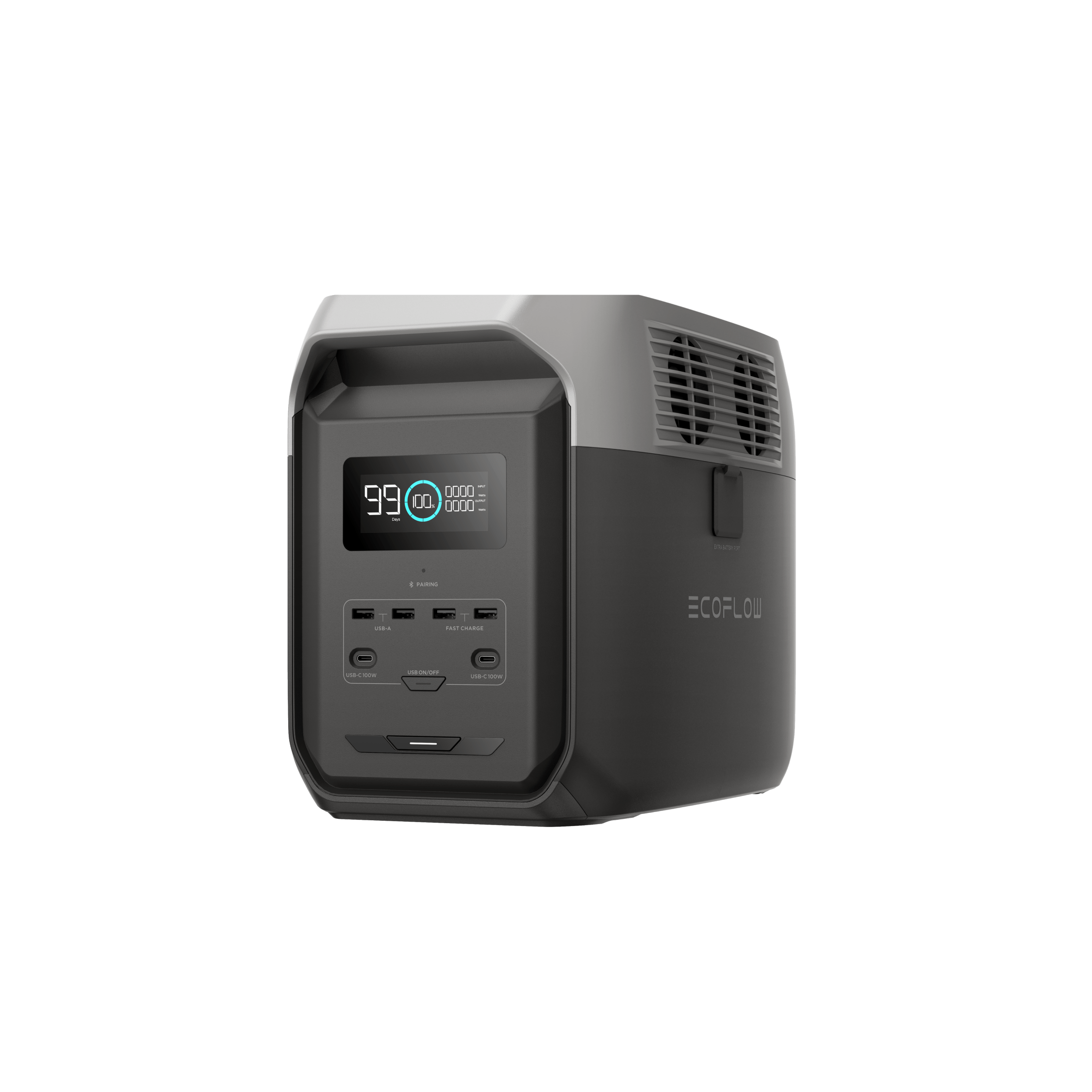
EcoFlow DELTA 3 1500
No longer sold

EcoFlow DELTA 3 Max PlusPick
$1,199.00
$1,199.00 · direct from EcoFlow
Last checked 16 days ago. Prices move — check before you buy.
Prices may vary by retailer and are subject to change.