Head-to-head test
EcoFlow DELTA 2 Max vs BLUETTI Pioneer 150 AC240
The cheaper unit here is also the bigger one, so the only real question left is whether you need a case that shrugs off a rainstorm.
Full profiles: EcoFlow DELTA 2 Max → · BLUETTI Pioneer 150 AC240 →

Written by Ian SchneiderUpdated
Solar & Off-Grid Tester, Station Arena Test Desk
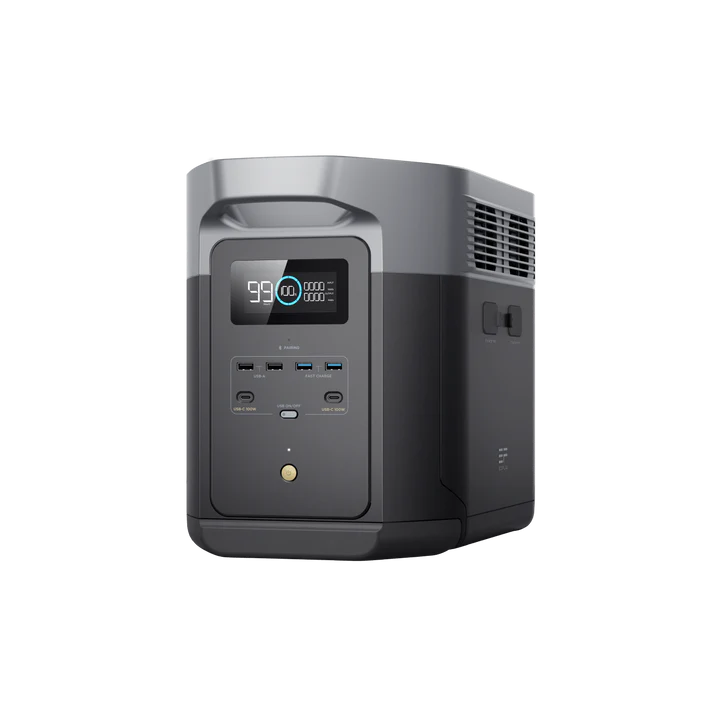
$1,049.00 · direct from EcoFlow
Last checked 1 day ago. Prices move — check before you buy.

$999.00 · direct from BLUETTI
Last checked 1 day ago. Prices move — check before you buy.
Spec deltas
The DELTA 2 Max is $949 for 2,048Wh. The Pioneer 150 is $999 for 1,536Wh. The unit that costs less is the unit that holds a third more, which strips most of the usual back-and-forth out of this comparison before it starts.
After inverter derating the EcoFlow has 1,741Wh to actually spend and the Pioneer has 1,306Wh. Set those beside the standard eight-hour outage load of 1,645Wh and only one of them finishes the night. No app, no warranty year, and no cycle rating closes that.
The Pioneer earns its keep somewhere else entirely. It's IP65 sealed and the field record behind that claim is unusually convincing: water beaded off the case in a rainstorm with the interior bone dry afterward, and one unit came through constant saltwater spray on a sailboat with no moisture insideB2. If your power station's job description includes weather, that's worth money. If it lives in a closet until the grid drops, you're paying an extra 21 pounds of carry and 512Wh of capacity for a feature you'll never use.
What the Numbers Reveal
Each conclusion stated first — the numbers behind it on one line, the full analysis below.
Capacity
That inversion stops being an accounting curiosity at the outage load. The EcoFlow clears 1,645Wh with 96Wh still in reserve; the Pioneer needs 126% of everything it can deliver, so the last stretch of the night happens in the dark. The difference between the two isn't a nicer spec sheet, it's whether the fridge is still cold when the lights come back.
DELTA 2 Max: $949 for 2,048WhPioneer 150 AC240: $999 for 1,536Wh8-Hour Blackout load: 1,645Wh; usable after derating is 1,741Wh (p1) and 1,306Wh (p2)
Why it mattersAnyone buying primarily for grid backup should stop reading here and take the EcoFlow.
rated cycles
So the Pioneer's longevity story pays out in years, not in energy. You get more mornings where the unit still works and less power on each of them, and the warranty follows the same shape: six covered years at $167 each against five at $190. Durability is real value when the battery is big enough to be worth keeping around, and this one is the smaller battery.
Pioneer 150 AC240: 3,500 cycles on 1,536WhDELTA 2 Max: 3,000 cycles on 2,048WhRated lifetime energy: 6,144 kWh (p1) against 5,376 kWh (p2)
Why it mattersIf you're optimizing cost per unit of energy over a decade, the extra warranty year doesn't close the gap; if you're optimizing for the longest possible ownership of a modest battery, it does.
There's a quiet irony in which unit that lands on. The Pioneer is the sealed, 72-pound one you'd carry to a jobsite or bolt into a boat, which is precisely where hard-starting loads live: compressors, pumps, wet saws. It's also the one with less margin for the half second when one of them kicks over. The EcoFlow, the unit you'd expect to stay indoors, is the one that absorbs the spike.
Both units are rated at 2,400W continuousDELTA 2 Max surge: 4,800WPioneer 150 AC240 surge: 3,600W, at 72 lbs and IP65-rated for outdoor useB1B3
Why it mattersIf anything on your load list starts under load rather than easing into it, check its inrush against 3,600W before choosing the Pioneer.
That narrows what you're buying. The Pioneer survives being outdoors rather than operating unattended in weather, so its case earns its premium in the gap between deployments: the truck bed on the drive home, the deck of a boat, the dusty corner of a site. For a unit that spends its working hours under a roof or an awning anyway, that case is 21 pounds of protection against a risk you've already engineered away.
IP65 water- and dust-resistant, not waterproof, with protection applying when the port covers are closedB1Should not be run in the rain with cables plugged in, since water reaching the output ports risks damage or a shortB1Rain beaded off the case with a dry interior; survived constant saltwater spray on a sailboatB2
Why it mattersBuy the sealed unit for where it gets stored and hauled, not for the idea of running it in a downpour.
The specific dimensions that decide these two units — everything else is a tie.
Runtime: Will It Power Your Gear?
Selected because: Same 2,400W inverter on both, with a 512Wh difference in the tank behind it, and that difference decides most of this page.
The 512Wh on paper matters less than where the two land relative to loads people actually plan around. A remote workday takes 52% of the EcoFlow and 70% of the Pioneer; a tailgate takes 38% and 51%. Neither is stressed by an ordinary day. It's the long, unglamorous night that separates them, and the Pioneer runs out of it first.
The Pioneer's counterpunch is refill speed, and it's a fair one: 1,200W of solar input against 1,000W, with less to put back. At those ceilings you're looking at roughly an hour and a half of flawless sun for 1,536Wh against about two hours for 2,048Wh. Flawless sun is the part nobody actually gets. The EcoFlow's answer is the wall, where it runs 0 to 80% in about 50 minutes and full in roughly 80A2, which is the spec that matters when a forecast gives you an hour's notice.
Lifetime Value
Selected because: The cheaper unit is also the one that delivers more energy across its rated life, which is not how this normally goes.
cost / lifetime kWh
BLUETTI genuinely wins the coverage math. Six years at $999 works out to $167 per covered year against EcoFlow's $190 across five, and 3,500 cycles beats 3,000 on the cell rating. Both facts are true and neither one changes the verdict, because they describe how long you keep the unit rather than what it does while you have it.
Run it as a cost of energy instead of a cost of ownership and the order reverses hard. Fifteen cents a lifetime kilowatt-hour against nineteen is the whole argument, and it's the rare case where the unit you'd pick on the shelf and the unit you'd pick on a spreadsheet are the same box.
Your Life, Your Pick
Selected because: Four of the six standard loads go to the DELTA 2 Max and two go to neither unit; the shape of that split is the buying advice.
Two of the six go to nobody, and that's the most useful thing on this table. A camping weekend at 2,100Wh overruns both, and van life at 4,685Wh a day is not a conversation either of these can join. If either of those is your actual use case, the honest read is that you're looking at the wrong size of unit, not the wrong brand.
Of the four that resolve, all four go the same direction, which is what a 512Wh advantage on identical inverters produces. The blackout is the only one where it changes an outcome rather than a margin. Everything else is the EcoFlow winning by having more left over, and nobody has ever regretted the leftovers.
What the Specs Don't Tell You
Selected because: Weight, surge headroom and fan noise are where these two actually diverge, and the numbers alone don't tell you what they cost you.
rated cycles
Weight is the one that ambushes people, because 72 lbs against 50.7 doesn't read like much until it's on the wrong side of a tailgate. Fifty pounds is a bent-knees, one-person lift you'll grumble about. Seventy-two is a lift you schedule with somebody else, and it's the reason a rugged unit tends to get deployed once and left there.
Take both noise ratings with salt, in both directions. The Pioneer is rated 50 dB under load; the EcoFlow lists 30 dBA on its spec sheet, but its fans have been measured around 52 dB during heavy loads or fast charging, with a Quiet Charging mode that buys calm by charging slower and about six inches of clearance recommended for airflowA1. On paper there's a 20 dB gap between these two. In a room with either one working hard, there isn't much of one.
Brand Trust
Selected because: A six-year warranty is worth exactly what the claims process behind it is worth, and these two companies are not equally easy to reach.
The support risk runs opposite to the hardware. BLUETTI's service is the least predictable in the category, heavily email-based with timezone delays baked in, and buying direct rather than through a marketplace tends to produce better outcomes. EcoFlow's is polarized too, but there's a US phone queue behind it, and picking the unit up from Costco or Amazon layers a return policy over whatever the manufacturer decides to do.
That weighs more here than it usually would, because the Pioneer's entire pitch is that it goes where equipment gets abused. A sealed case is only as good as the repair path behind it, and no spare-parts policy exists for some older BLUETTI models. Six years of warranty is a number until you have to use it.
Strengths & trade-offs
EcoFlow DELTA 2 Max
Strengths
- +Lighter by 21.3 lb
- +Larger battery capacity
Trade-offs
- –No major technical downsides compared to rival.
BLUETTI Pioneer 150 AC240
Strengths
- +Costs $50 less
- +Longer warranty
- +Faster solar charging
Trade-offs
- –Significantly heavier (+21.3 lbs), making it harder to move.
Will It Power Your Gear?
Scenario math and per-appliance runtimes, modeled from the spec record.
Scenario verdicts
We ran the math on six real-world scenarios. Here's which unit survives your actual life.
SCN-01 · 2 nights · needs 2,100Wh
Weekend Camping
Two nights off-grid with essential comfort
Neither unit
Nobody wins this one. A 2,100Wh weekend takes 121% of the EcoFlow's usable capacity and 161% of the Pioneer's, so the DELTA 2 Max gets closer without getting there. Bring a panel, plan on an expansion battery, or accept that Sunday afternoon is going to involve rationing.
Battery budget usedlower = more headroom
LOAD Phone Charger 15W×6h · LED Lights 40W×8h · Box Fan 75W×14h · CPAP Machine 40W×16h
SCN-02 · 8 hours · needs 1,645Wh
8-Hour Blackout
Keep the essentials running through a night without power
DELTA 2 Max
This is the scenario that should decide the purchase. The night asks for 1,645Wh; the EcoFlow has 1,741Wh to give and finishes with something in hand, while the Pioneer's 1,306Wh needs 126% of what it holds. Backup power that gets you most of the way through an outage is just a delay with a handle on it.
Battery budget usedlower = more headroom
LOAD Fridge 150W×8h · Router + Modem 20W×8h · LED Lights (4 bulbs) 40W×6h · Phone Charger 15W×3h
SCN-03 · 8 hours · needs 320Wh
CPAP Overnight
Sleep therapy without interruption — the #1 medical use case
DELTA 2 Max
Both of these sleep through a CPAP without noticing it. A 320Wh night is 18% of the EcoFlow's usable capacity and 25% of the Pioneer's, so the EcoFlow wins on margin that neither of you will ever use. What actually matters 18 inches from a pillow is fan behavior at low load, and on that neither one is silent when it decides to spin up.
Battery budget usedlower = more headroom
LOAD CPAP Machine 40W×8h
SCN-04 · 8 hours · needs 910Wh
Remote Workday
Full work day off-grid without power anxiety
DELTA 2 Max
The DELTA 2 Max clears the workday at 52% used, banking 831Wh — late work, extra calls, or a second laptop charge without arithmetic. The Pioneer 150 AC240 at 70% also finishes, with 396Wh of slack for the unplanned.
Battery budget usedlower = more headroom
LOAD Laptop 60W×8h · External Monitor 30W×8h · Router + Modem 20W×8h · Phone Charger 15W×2h
SCN-05 · 4 hours · needs 670Wh
Tailgate Party
Game day power for the crew
DELTA 2 Max
Both handle game day; the DELTA 2 Max keeps more in reserve (38% used vs 51%). Tailgating is a light load, though, so the number you'll feel is weight: 50.7 lbs for the DELTA 2 Max against 72 lbs for the Pioneer 150 AC240, from the trunk to the setup spot.
Battery budget usedlower = more headroom
LOAD Blender 400W×0.5h · LED TV (55") 80W×4h · Bluetooth Speaker 15W×4h · Phone Charger (×3) 45W×2h
SCN-06 · 24 hours · needs 4,685Wh
Van Life Daily
A full day of mobile living — the ultimate endurance test
Neither unit
Not close, and not a knock on either unit. A 4,685Wh day is 269% of what the EcoFlow can deliver and 359% of the Pioneer's, which puts both of them a full class below the requirement. This is a job for a base unit plus expansion batteries, or a bigger station entirely.
Battery budget usedlower = more headroom
LOAD Mini-Fridge 150W×24h · Laptop 60W×4h · Phone Charger 15W×3h · LED Lights 40W×5h · Fan 75W×8h
The Load Test
RUNTIME = (Wh × 0.85) ÷ LOAD
None of the scenarios above exactly yours? Build it. Toggle what you'd plug in; both units are tested against the combined draw.
Essentials
Comfort & Convenience
High-Draw Appliances
Test duration
8h
Continuous draw
205W
Projected runtime
For this load: DELTA 2 Max runs 8.5h vs 6.4h.
$1,049 list · direct from EcoFlow
Modeled from the spec record — same math as the tables below. Methodology
Runtime by appliance
Real-world runtime estimates for common appliances, modeled at 85% inverter efficiency.¹
Essentials
The basics you need runningscale 0–116.1hComfort & Convenience
Makes off-grid life actually enjoyablescale 0–23.2hHigh-Draw Appliances
These reveal the real limitsscale 0–1.7h¹ Runtime = (capacity × 0.85) ÷ appliance watts. Within each group, all bars share one time scale (the group's longest runtime), so lengths are comparable across appliances; identical runtimes collapse into a single blue/orange bar. Actual runtime varies with battery age, temperature, and simultaneous loads — see methodology.
Conclusion
August 9, 2026
Verdict: the DELTA 2 Max, on Power Score margin
Buy the DELTA 2 Max unless this box is going to live outdoors. It costs $949 against the Pioneer's $999, holds 2,048Wh against 1,536Wh, weighs 50.7 lbs against 72, and carries twice its continuous rating in surge headroom where the Pioneer carries half again. Over the rated life of the cells that shakes out to 15 cents per lifetime kilowatt-hour against 19. The Pioneer wins the things a rugged unit should win: an IP65 case that has held up in real weatherB1B2, six years of warranty instead of five, 1,200W of solar input instead of 1,000W, and 3,500 cycles instead of 3,000. None of that fills a 512Wh hole on an outage night, and only the sealed case is worth paying a premium for. So the decision is simply whether this thing gets rained on.
Editor-assigned confidence, based on cited owner research and spec analysis.
List prices as of August 9, 2026. The links below open EcoFlow's and BLUETTI's current prices.
$1,049.00 · direct from EcoFlow
Last checked 1 day ago. Prices move — check before you buy.
or check the Pioneer 150 AC240 price$999.00 list
Written by Ian Schneider, Solar & Off-Grid Tester · Station Arena Test Desk · Updated August 9, 2026
Measured Data
Benchmark scores and the full spec record, side by side.
Benchmark scores
Not rated for both units (minimum threshold unmet): CPAP, Apartment Balcony.
Full specifications
ᵈ Derived: price ÷ rated capacity. See the data behind our comparisons →
Comparison ToolAdd more power stations, side by sideOpen Tool →How these numbers are produced
Numeric verification
Every figure on this page traces to our spec database or arithmetic on it — no estimated numbers.
Owner claims
Statements about owner experience are cited to published reviews — see Sources & Research Notes below.
Runtime model
Runtime = (rated capacity × 0.85 inverter efficiency) ÷ device wattage. Solar recharge estimates assume panels deliver 70% of rated output. Cold weather, battery age, and stacked loads reduce real-world results.
Power Score
Computed from 14 published spec dimensions, weighted per use-case bench. Higher is better; a unit must meet a bench's minimum threshold to be rated.
See the full weight table and data sourcing on our methodology page →Class ranking (the star rating)
Each unit's star score is a category ranking, not customer reviews — no buyer opinions feed it. We score every station on size-independent quality (value, output, portability, endurance, ports, warranty, and more), then percentile-rank it against the other units in its capacity class, so a class-leading compact unit and a class-leading whole-home unit can both earn 5★. Here, DELTA 2 Max rates 3.8/5 (28th percentile of 26 Large-class units), and Pioneer 150 AC240 rates 4.5/5 (69th percentile of 27 Everyday-class units).
How the class ranking is computed →Test Notes & Caveats
Hidden gotchas and advantages we spotted that you won't find on the product page.
72 lbs is a two-person lift, not a heavy one
The gap is 72 lbs against 50.7, and it lands exactly where you feel it: the tailgate, the basement stairs, the back of an SUV at the end of a long day. Fifty pounds is a bent-knees lift you do alone. Seventy-two is a lift you plan, which in practice means the Pioneer gets put somewhere and stays there.
Read the decibel numbers as different tests, not different units
Fifty decibels under load is conversation volume: fine in a garage, irritating in a tent. Don't take the EcoFlow's much quieter 30 dBA rating as a promise of silence either, because a fan-cooled inverter is loudest exactly when it's working hardest, and both of these are fan-cooled. If sleeping next to it matters, solve it with distance or a door rather than with a spec sheet.
Same 2,400W running, very different half-second
Both units run 2,400W all day. The difference shows up in the instant a compressor or a saw kicks over: the EcoFlow has 4,800W available, exactly double its continuous rating, and the Pioneer has 3,600W, half again. Identical running specs, different tolerance for a hard start, and it's the start that trips inverters.
Both standby, neither online
20ms and 15ms are the same class of promise. Either one hands over fast enough that a desktop, a router or a modem never notices, and neither is the zero-gap switch a server rack or a medical device wants. Five milliseconds apart is not a reason to choose one of these over the other.
Warranty: 6 Years vs 5
The Pioneer 150 AC240 is covered for 6 years against the DELTA 2 Max's 5 years. An underrated factor if you're keeping this unit for years.
Full record above — the Test Desk pick is the DELTA 2 Max.
Check DELTA 2 Max price →or check the Pioneer 150 AC240 priceOwnership Analysis
What happens after you buy — true cost of ownership, brand trust, and growth potential.
Lifetime value
Service lifeyears at one full cycle per day
Lifetime energy delivered
Cost per delivered kWh
│ warranty ends · Reaching the cycle rating means ~80% capacity remains — degraded, not dead.
Analyst note
The Pioneer 150 AC240 is cheaper to buy, but the DELTA 2 Max is cheaper to own. At $0.17/kWh over its lifetime vs $0.19/kWh, the DELTA 2 Max's higher cycle life and capacity make each dollar go further over the years. One caution on the lifespan row: the Pioneer 150 AC240 takes longer to reach its cycle rating, but a cycle moves a different amount of energy on each unit — the DELTA 2 Max still delivers more over its shorter horizon (6,144 vs 5,376 kWh). Years measure wear, not usefulness.
Brand trust
EcoFlow
Ecosystem
Largest in portable power — 12-15 models across DELTA Pro, DELTA 3, and RIVER 3 series, plus solar panels and smart home panels
Support
US-based phone, email and chat, with genuinely polarized outcomes: prepaid-label replacements that go smoothly for some, long waits and refurbished units against new claims for others. Buying through Costco or Amazon layers a return policy over whichever version you get.
Community
Largest community in the space — Reddit r/Ecoflow_community (~31K members), multiple Facebook groups, and an official community forum
App experience
Rated 4.6/5 iOS (~8,400 ratings) · 4.2/5 Android (~17,000 ratings)
Unique strength
Fastest-charging technology (X-Stream), deepest product ecosystem, and most active innovation cadence. At the very top of the range, the DELTA Pro Ultra platform stacks batteries and inverters into whole-home backup — a flagship path, not a line-wide feature.
Worth knowing
What applies here with EcoFlow: no parts or service once the 5-year warranty runs out, and the company tested subscription paywalls for advanced app features in early 2025 before backlash paused the plan.
BLUETTI
Ecosystem
One of the broadest lineups — 15-20+ models from budget (AC2A) to flagship portable (Apex 300, 2764.8Wh). Includes specialized products: vehicle solar hubs, sodium-ion cold-weather units, and balcony storage systems.
Support
The least predictable service in the category, and the main risk in owning one. Heavily email-based with timezone delays built in, occasionally offering a discount on a new unit rather than a repair, and buying direct rather than through a third party tends to produce better outcomes.
Community
Active and growing — Reddit r/bluetti has a dedicated community. Second-largest after EcoFlow in engagement.
App experience
Rated 4.5/5 iOS and Android — tied for best app experience in the category. V3.0 UI redesign was well-received.
Unique strength
Full LFP standardization across the lineup, quoted at 3,500 to 6,000+ cycles, with the Pioneer 150 sitting at the floor of that range at 3,500. The rugged and specialized end of the catalog, sodium-ion cold-weather units and dual solar-plus-alternator vehicle hubs, is where BLUETTI does things no one else is doing.
Worth knowing
Support inconsistency is the risk you're accepting, and it compounds with age: some older and discontinued models have no spare-parts policy behind them and can become unrepairable. Weigh that against the six-year warranty rather than reading the two separately.
Analyst note
EcoFlow has the deeper ecosystem and the larger community; BLUETTI has the better-liked app on Android (4.5 against 4.2) and effectively matches it on iOS (4.5 against 4.6). The split that should influence a purchase is service. EcoFlow gives you a US phone queue and a marketplace return path, BLUETTI gives you email and patience. On a unit whose whole selling point is that it goes where equipment gets abused, the repair path is part of the product.
Growth path
DELTA 2 Max
EXPANDABLESupports EcoFlow expansion batteries, so you can add capacity later without replacing the base unit — useful if your needs may climb past 2,048Wh.
Accepts up to 1,000W of solar. Enough for a serious multi-panel array.
Generous port selection supports complex multi-device setups.
Expansion batteries are EcoFlow-specific. You're investing in the EcoFlow ecosystem.
Pioneer 150 AC240
EXPANDABLESupports BLUETTI expansion batteries, so you can add capacity later without replacing the base unit — useful if your needs may climb past 1,536Wh.
Accepts up to 1,200W of solar. Enough for a serious multi-panel array.
Adequate ports for most setups, but heavy users may want a power strip.
Expansion batteries are BLUETTI-specific. You're investing in the BLUETTI ecosystem.
Realistic full solar rechargeat 70% of rated panel output — see methodology
Analyst note
Both expand, so neither locks you out of growth — decide on capacity, price, and the rest, not the expansion checkbox.
What Owners Report
Patterns from published owner reports and long-term reviews — every claim cited to its source below.
EcoFlow DELTA 2 Max
The record on the DELTA 2 Max is short and consistent: it charges fast and it isn't quiet. Wall charging runs 0 to 80% in about 50 minutes with a full charge in roughly 80A2, while the cooling fans climb to around 52 dB under heavy load or during charging, mitigated by a Quiet Charging mode that trades speed for calm and by giving the unit about six inches of breathing roomA1. Durability reads well, with LFP cells rated 3,000+ cycles to 80% and a six-month check-in that found no structural degradation and a unit that felt like day oneA3.
Worth naming what this evidence actually is: reviewer testing rather than years of lived ownership, and the summary judgement is a qualified yes, a versatile unit worth buying with caveatsA4. Nobody in this record has kept one long enough to tell you how it ages past six monthsA3A4.
“Fast AC wall charging — 0 to 80% in about 50 minutes and a full charge in roughly 80 minutes.”
Sources
powerstationadvisor.com · pcworld.com · thesolarlab.com · protoolsadvisor.com · trailandkale.com
BLUETTI Pioneer 150 AC240
The Pioneer's rugged claim survives contact with actual weather, which is rarer than it should be. Water beaded off the case in a rainstorm and the interior was bone dry afterward, and one unit took constant saltwater spray on a sailboat with no moisture intrusion once wiped downB2. The caveat is precise and worth reading twice: IP65 is water- and dust-resistant rather than waterproof, the rating assumes the port covers are closed, and running it in the rain with cables plugged in risks water reaching the output portsB1.
Past the case, the field record is thin and mostly structural. This is the standard 1,536Wh AC240 sharing a platform with the higher-capacity AC240P, same 2,400W output and same IP65 buildB3, with LFP cells, quick charging, and headroom to expand into a much larger bankB4.
“IP65 water- and dust-resistant, not truly waterproof — protection applies with the port covers closed, and it should not be used in the rain with cables plugged in, as water ingress to the output ports risks damage or short circuits.”
Sources
backuppowerhub.com · bluettipower.com · makeuseof.com · storagereview.com · amazon.com · batteryessence.com
Sources & Research Notes
Every owner claim in this report is traceable to a published source. The bracketed references above resolve here.
Recurring owner themes
- Solid LFP durability, fast charging, and ecosystem/expandability are the praise; loud fans under heavy load or charging are the recurring complaint. [DELTA 2 Max · 3 entries]
- Same IP65 ruggedness and expandability as the AC240P at a lower price and capacity; water-resistant not waterproof is the key caveat. [Pioneer 150 AC240 · 3 entries]
- A1
“Fan noise is a significant issue — cooling fans can get loud, around 52 dB during heavy loads or charging; a Quiet Charging mode reduces noise but extends charge time, and giving it 6 inches of clearance helps airflow.”
powerstationadvisor.com / pcworld.com — DELTA 2 Max review · 2025-2026 · [negative]
- A2
“Fast AC wall charging — 0 to 80% in about 50 minutes and a full charge in roughly 80 minutes.”
thesolarlab.com / protoolsadvisor.com — DELTA 2 Max review · 2025-2026 · [positive]
- A3
“LiFePO4 chemistry rated for 3,000+ cycles to 80% with superior thermal stability; after 6 months of real use there was no structural degradation and it felt as solid as day one.”
powerstationadvisor.com / trailandkale.com — DELTA 2 Max review · 2025-2026 · [positive]
- A4
“Reviewers say it's still worth buying but with caveats — a versatile unit with expandability and ecosystem compatibility.”
thesolarlab.com / powerstationadvisor.com — DELTA 2 Max review · 2025-2026 · [mixed]
- B1
“IP65 water- and dust-resistant, not truly waterproof — protection applies with the port covers closed, and it should not be used in the rain with cables plugged in, as water ingress to the output ports risks damage or short circuits.”
backuppowerhub.com / bluettipower.com — AC240 review · 2026 · [mixed]
- B2
“Real-world testing was positive — water beaded off the case in a rainstorm and the interior was bone dry afterward; the unit survived constant saltwater spray on a sailboat with no moisture intrusion after wiping down.”
makeuseof.com / storagereview.com — AC240 review · 2026 · [positive]
- B3
“The standard AC240 (Pioneer 150) holds 1,536Wh at a lower price than the AC240P, with the same 2,400W output and IP65 rugged build.”
bluettipower.com / amazon.com — Pioneer 150 (AC240) listing · 2026 · [positive]
- B4
“LFP battery with a fast charge reaching most of full quickly, and expandable to a very large multi-kWh bank; sits at the premium end of the lineup but is frequently discounted.”
amazon.com / batteryessence.com — Pioneer 150 (AC240) review · 2026 · [positive]
Research compiled August 9, 2026.
Who Should Buy Which
Buy the DELTA 2 Max if you…
- →You're buying for the grid going down. 1,741Wh of usable capacity covers the 1,645Wh eight-hour outage load, and the wall puts 80% of it back in about 50 minutes when a forecast gives you warningA2.
- →You'll be the one carrying it. 50.7 lbs is a lift you do alone and mildly resent; 72 is a lift you negotiate.
- →Something on your list starts hard. A compressor, a well pump, a saw: 4,800W of surge is double the continuous rating, where the Pioneer's 3,600W is half again.
- →You want the most watt-hours per dollar in this price bracket and the unit will spend its life indoors, where a sealed case buys you nothing.
Buy the Pioneer 150 AC240 if you…
- →The unit is going to live outside. Open truck bed, boat deck, jobsite corner: IP65 with the covers closed, backed by a rainstorm and repeated saltwater spray that left the inside dryB1B2.
- →Your real draw sits under 1,306Wh and you intend to keep this thing for a decade. 3,500 cycles and six years of coverage at $167 a year is the better ownership horizon.
- →You charge almost entirely from panels and have the array to use 1,200W of input rather than the EcoFlow's 1,000W.
If neither fits
Van lifers and long-weekend campers should close this tab. A 4,685Wh day is 269% of what the EcoFlow can deliver and 359% of the Pioneer's, and even a 2,100Wh camping weekend overruns both at 121% and 161%. Both units accept expansion batteries, so the honest answer is a base unit plus a pack, or a larger class of station outright, rather than either of these on its own and a lot of rationing.
The Bottom Line
Take the DELTA 2 Max. It costs less, holds more, weighs 21 pounds less, and absorbs a harder start, and it's the one that carries a household through the eight-hour outage these units mostly exist for. The Pioneer's extra cycles and extra warranty year are genuine, and they're attached to a battery that runs out sooner, which is an odd thing to pay a premium for.
The exception is a real exception rather than a hedge. If this box is going to sit in weather, on a deck or in a truck bed or on a site, the Pioneer is built for it and the evidence backs the claimB1B2. Everyone else buys the bigger, cheaper, lighter one and stops thinking about it.
Frequently Asked Questions
Answers drawn from the spec record and cited owner research.
Which is better value, the EcoFlow DELTA 2 Max or the BLUETTI Pioneer 150?
The DELTA 2 Max, and the money isn't close. It holds 2,048Wh against the Pioneer's 1,536Wh while costing less, which works out to roughly 46 cents per watt-hour ($949 / 2,048Wh) against 65 cents ($999 / 1,536Wh). Spread across the rated life of the cells that becomes 15 cents per lifetime kilowatt-hour against 19. The Pioneer's price is buying a rugged case, not capacity.
Can either one run my fridge through an 8-hour power cut?
The EcoFlow can. A standard eight-hour outage load runs about 1,645Wh and the DELTA 2 Max has roughly 1,741Wh usable after inverter losses. The Pioneer 150 has about 1,306Wh usable, so the same night would take 126% of everything it has. Both units start a fridge without complaint; only one keeps it running to morning.
Is the BLUETTI Pioneer 150 waterproof?
No. It's IP65 water- and dust-resistant, which is a different promise. The rating holds with the port covers closed, and it shouldn't be run in the rain with cables plugged in, since water reaching the output ports risks damage or a short. In practice that resistance has held up unusually well, with rain beading off the case and the interior staying dry, and no moisture intrusion after repeated saltwater spray on a boat.
Which one is quieter?
Neither is a bedroom appliance when it's working, and the spec sheets oversell the difference between them. The Pioneer is rated at 50 dB under load. The EcoFlow lists 30 dBA, but its fans have been measured around 52 dB during heavy loads or fast charging, and its Quiet Charging mode buys quiet by charging slower. If it has to run near where someone sleeps, plan on distance or a closed door rather than on a number.
Can I add more battery to either of these later?
Both accept expansion batteries, so neither one locks you out of growth and the expansion checkbox shouldn't decide this purchase. Judge them on the capacity you get on day one, 2,048Wh against 1,536Wh, and treat extra packs as a later option rather than a tiebreak. If you already know you'll need a much bigger bank, price the full stack for each brand before committing to either base unit.
Brand matchup
EcoFlow vs BLUETTI: measured across every matchup →Where to buy
EcoFlow DELTA 2 MaxPick
$1,049.00
$1,049.00 · direct from EcoFlow
Last checked 1 day ago. Prices move — check before you buy.
BLUETTI Pioneer 150 AC240
$999.00
$999.00 · direct from BLUETTI
Last checked 1 day ago. Prices move — check before you buy.
Prices may vary by retailer and are subject to change.