Head-to-head test
DJI Power 1000 vs DJI Power 2000
DJI Power 1000 vs DJI Power 2000: These are the same battery at two sizes: 4,000 cycles, a five-year warranty, and a 140W USB-C port on both.
Full profiles: DJI Power 1000 → · DJI Power 2000 →

Written by Ian SchneiderUpdated
Solar & Off-Grid Tester, Station Arena Test Desk

Superseded — buy the V2
DJI has superseded the Power 1000 with the Power 1000 V2 — same $699, with 2,600W output against 2,200W. The original may still be purchasable while stock lasts, but unless it is meaningfully discounted, buy the V2.
Power 1000 V2 · $699.00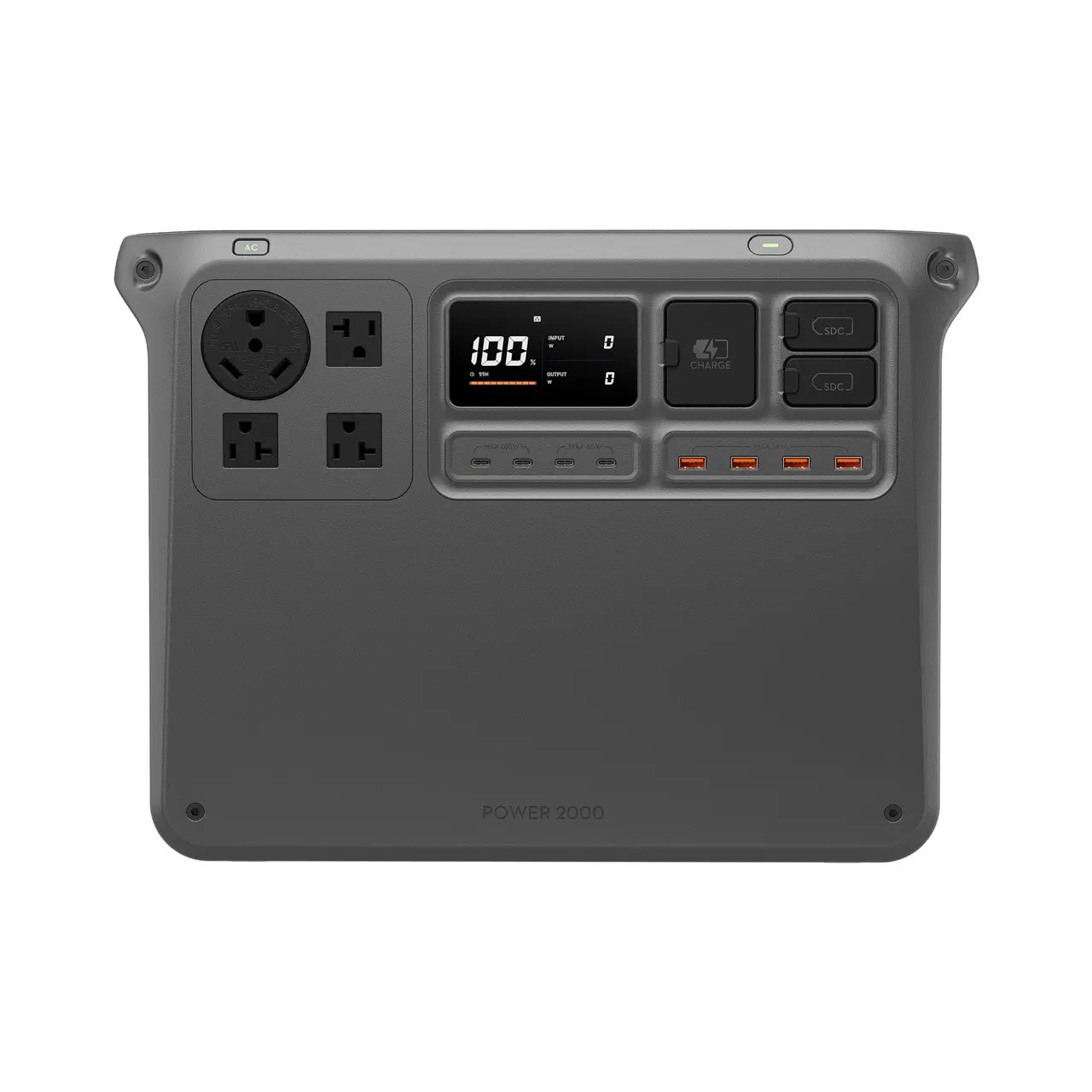
$1,299.00 · direct from DJI
Last checked 1 day ago. Prices move — check before you buy.
Spec deltas
DJI built the same battery twice here, once at 1,024Wh and once at 2,048Wh. Both carry 4,000-cycle LFP cells, a five-year warranty, and a 140W USB-C port, and both cost almost exactly the same to own over their lives — $0.17 per lifetime kilowatt-hour on the Power 1000, $0.16 on the Power 2000. Doubling the battery doubles the price and not much else in the cost math, which is unusually fair scaling.
So the whole decision collapses to one question: does 1,024Wh cover you? The Power 1000 clears a CPAP night, a tailgate, and a week of camping loads without complaint, and it does it at 28.7 lb, 23 dBA, and $699 — while keeping a 4,400W surge that's double its 2,200W rating, the hardest standing-start punch either unit throws. The Power 2000 answers with the two scenarios the little one can't: a full 8-hour blackout and a complete remote workday, plus an expansion path and 1,800W of solar the 1000 doesn't have.
Step up to the Power 2000 if you're buying for outages or backup, because 1,024Wh runs out mid-evening and 2,048Wh doesn't. Stay with the Power 1000 if you're buying for the road — it's lighter, quieter, cheaper, and does everything a portable job asks. The premium is honest either way; it just buys runtime you either need or you don't.
What the Numbers Reveal
Each conclusion stated first — the numbers behind it on one line, the full analysis below.
cost / lifetime kWh
That's the rare upgrade where the bigger model isn't the worse value. The $600 buys 1,024Wh more storage at the same price-per-watt-hour, and it drags along expansion, faster solar, and a quicker UPS at no extra charge on the math. The only way the Power 1000 is the better buy is if you'd never use the second kilowatt-hour.
Power 1000: 1,024Wh at $699; Power 2000: 2,048Wh at $1,299Lifetime cost: $0.17/kWh vs $0.16/kWhBoth: 4,000-cycle LFP, five-year warranty
Why it mattersIf you're unsure 1,024Wh is enough, the scaling is fair enough that stepping up isn't a splurge — it's insurance priced at cost.
Capacity
The two scenarios people actually buy backup power for — riding out an outage and working through one — are exactly the two the Power 1000 can't finish and the Power 2000 can. This isn't a spec-sheet edge; it's the lights staying on past 9 p.m. versus not.
8-Hour Blackout basket needs 1,645Wh; Remote Workday needs 910WhPower 1000 holds 1,024Wh; usable energy is roughly 85% after inverter lossesPower 2000 holds 2,048Wh
Why it mattersIf backup during outages is the job, the Power 1000's capacity disqualifies it and the choice is made for you.
weight
For a stubborn old fridge or a pump that starts hard, the Power 1000's double surge headroom is the spec that gets it running, and reviewers pushed it above its rating for 20 minutes without a shutdownA2. The big Power 2000 wins the marathon on capacity; the little one wins the standing start and the walk back to the car.
Power 1000: 28.7 lb, 23 dBA, 4,400W surge on a 2,200W inverterPower 2000: 48.5 lb, 30 dBACompressors and pumps spike 2-3x their rated draw at startup
Why it mattersPortable, motor-heavy, or carried-often use tilts to the Power 1000 despite its smaller tank.
solar input
Because both are DJI, this isn't a brand gamble — it's the same lineup asking how far down its own upgrade path you want to walk. The Power 2000 is where DJI put the features that matter over years of ownership: expansion for growing loads, 1,800W solar for daily off-grid cycling, and the faster UPS for sensitive gear.
Power 2000: expandable, 1,800W solar, sub-10ms UPS switchoverPower 1000: sealed at 1,024Wh, 800W solar, sub-20ms UPS switchoverBoth share the same brand and battery platform
Why it mattersBuyers who expect their needs to grow, or who run desktops and solar daily, should start at the Power 2000 rather than upgrade into it later.
The specific dimensions that decide these two units — everything else is a tie.
Lifetime Value
Selected because: Fair 2x-for-2x scaling is the frame — the upgrade isn't a per-watt-hour premium.
cost / lifetime kWh
The cost math here is almost boringly fair. Double the battery, double the price, and the cost per lifetime kilowatt-hour actually improves a hair, from $0.17 to $0.16. That's not how upgrades usually price — normally the bigger model taxes you per unit of capacity — so the Power 2000 doesn't ask you to overpay for its size.
What that means practically: the choice isn't 'is the big one worth the premium,' because there barely is one per watt-hour. The choice is only whether you'll use the extra 1,024Wh. If you will, the Power 2000 is the same value at a bigger size with expansion and a faster UPS for free. If you won't, you're paying $600 to carry energy you never spend.
Your Life, Your Pick
Selected because: The blackout and workday baskets are the exact line the 1000 can't cross and the 2000 can.
The load baskets draw the line exactly where it counts. The Power 1000 sails through a CPAP night, a tailgate, and a week of camping — all the portable stuff. It's the two backup scenarios where it stalls: an 8-hour blackout wants 1,645Wh, well past its tank, and even a 910Wh workday overruns its roughly 870Wh of usable energy once you account for inverter losses.
The Power 2000 clears both. If your reason for buying is a grid that drops, this section is the entire decision — the smaller unit doesn't finish the night and the bigger one does. If your reason is a campsite, both pass and you should be reading the portability section instead.
Portability & Form Factor
Selected because: 20-lb, 7-dBA gap is the whole case for staying with the smaller unit.
weight
Twenty pounds is the difference between a one-hand grab and a two-hand carry. The Power 1000 is 28.7 lb and 23 dBA; the Power 2000 is 48.5 lb and 30 dBA. Neither needs wheels, but only one disappears into a car footwell without you thinking about it, and only one stays whisper-quiet in a tent at night.
This is the Power 1000's whole argument, and it's a good one for the right buyer. If the unit's life is trips — trailheads, tailgates, tent sites — the smaller DJI does the job at two-thirds the weight, a few dBA less, and $600 in your pocket. Weight you carry every weekend outvalues capacity you'd only spend during an outage that may not come.
Growth Path
Selected because: Same-brand upgrade axis — expansion, solar, UPS all live on the 2000; consolidate the forward-looking story here.
solar input
Here's where staying in one brand pays off: choosing between these two is walking DJI's own upgrade path, not gambling on a new maker. And DJI loaded the far end. The Power 2000 accepts expansion batteries, takes 1,800W of solar to the 1000's 800W, and switches over as a sub-10ms UPS where the 1000 is sub-20ms standby. Every feature meant to matter across years of ownership sits on the bigger unit.
The Power 1000 is sealed at 1,024Wh — outgrow it and your upgrade is a second purchase, quite possibly this exact Power 2000. So if there's real chance your loads climb, or you run a desktop and panels daily, the honest move is to start at the 2000 rather than buy the 1000 twice. The one thing the 1000 keeps that the 2000's sheet doesn't advertise is that 4,400W surge — the little one is the better standing-start artist, even as the big one is the better long-haul battery.
What the Specs Don't Tell You
Selected because: Expansion warning and UPS card both fire toward the 2000; surge stays the 1000's counterpoint in prose.
Two cards fire and both lean the same way. Expansion is a warning against the Power 1000 — it can't grow — and the UPS card favors the Power 2000's faster sub-10ms cutover for desktops and sensitive electronics. Read together, they say the Power 2000 is the better system to keep around for years.
The counterweight the cards don't show is surge. The Power 1000's 4,400W peak is double its continuous rating, the strongest startup headroom on this page, and it's the reason a hard-starting compressor comes to life without drama. The 2000 wins the durable, grow-with-you argument; the 1000 wins the instant a motor demands everything at once.
Strengths & trade-offs
DJI Power 1000
Strengths
- +Costs $600 less
- +Lighter by 19.8 lb
Trade-offs
- –Weaker inverter (-800W) limits appliance compatibility.
- –Sealed capacity — the Power 2000 can add batteries to grow past 1,024Wh; this one can't.
DJI Power 2000
Strengths
- +Larger battery capacity
- +Higher AC output
- +Faster solar charging
Trade-offs
- –Substantially more expensive (+$600) than the Power 1000.
- –Significantly heavier (+19.8 lbs), making it harder to move.
Will It Power Your Gear?
Scenario math and per-appliance runtimes, modeled from the spec record.
Scenario verdicts
We ran the math on six real-world scenarios. Here's which unit survives your actual life.
SCN-01 · 2 nights · needs 2,100Wh
Weekend Camping
Two nights off-grid with essential comfort
Neither unit
A 2,100Wh weekend outruns both — the Power 1000 badly, the Power 2000 by a little. Neither single unit finishes this one out of the box, so if weekend camping is your real basket, it's the Power 2000 plus an expansion battery or nothing smaller.
Battery budget usedlower = more headroom
LOAD Phone Charger 15W×6h · LED Lights 40W×8h · Box Fan 75W×14h · CPAP Machine 40W×16h
SCN-02 · 8 hours · needs 1,645Wh
8-Hour Blackout
Keep the essentials running through a night without power
Power 2000
The Power 2000 covers the full 1,645Wh basket; the Power 1000's 1,024Wh doesn't reach it. This is the scenario that justifies the step up — if outages are why you're buying, the smaller unit simply runs out before the grid comes back.
Battery budget usedlower = more headroom
LOAD Fridge 150W×8h · Router + Modem 20W×8h · LED Lights (4 bulbs) 40W×6h · Phone Charger 15W×3h
SCN-03 · 8 hours · needs 320Wh
CPAP Overnight
Sleep therapy without interruption — the #1 medical use case
Power 1000
A 320Wh night uses a fraction of either tank, so both pass with ease. Decide at the pillow instead: the Power 1000 is rated 23 dBA to the 2000's 30, and it's the lighter unit to keep on the nightstand.
Battery budget usedlower = more headroom
LOAD CPAP Machine 40W×8h
SCN-04 · 8 hours · needs 910Wh
Remote Workday
Full work day off-grid without power anxiety
Power 2000
A 910Wh workday slips past the Power 1000 once you count inverter losses — its usable energy lands around 870Wh — while the Power 2000 covers it with half the tank to spare. For a full day of desk backup, the bigger unit is the one that doesn't quit at 4 p.m.
Battery budget usedlower = more headroom
LOAD Laptop 60W×8h · External Monitor 30W×8h · Router + Modem 20W×8h · Phone Charger 15W×2h
SCN-05 · 4 hours · needs 670Wh
Tailgate Party
Game day power for the crew
Power 2000
670Wh of tailgate leaves both units most of their capacity. The tiebreak is the walk from the lot: the Power 1000 is 20 lb lighter in the hand that isn't holding the cooler.
Battery budget usedlower = more headroom
LOAD Blender 400W×0.5h · LED TV (55") 80W×4h · Bluetooth Speaker 15W×4h · Phone Charger (×3) 45W×2h
SCN-06 · 24 hours · needs 4,685Wh
Van Life Daily
A full day of mobile living — the ultimate endurance test
Neither unit
A 4,685Wh day is more than double even the Power 2000's tank, so both bow out. This is expansion-battery territory at minimum, and only the Power 2000's platform can grow that far — the 1000 can't come along.
Battery budget usedlower = more headroom
LOAD Mini-Fridge 150W×24h · Laptop 60W×4h · Phone Charger 15W×3h · LED Lights 40W×5h · Fan 75W×8h
The Load Test
RUNTIME = (Wh × 0.85) ÷ LOAD
None of the scenarios above exactly yours? Build it. Toggle what you'd plug in; both units are tested against the combined draw.
Essentials
Comfort & Convenience
High-Draw Appliances
Test duration
8h
Continuous draw
205W
Projected runtime
For this load: Power 2000 runs 8.5h vs 4.2h.
$1,299 list · direct from DJI
Modeled from the spec record — same math as the tables below. Methodology
Runtime by appliance
Real-world runtime estimates for common appliances, modeled at 85% inverter efficiency.¹
Essentials
The basics you need runningscale 0–116.1hComfort & Convenience
Makes off-grid life actually enjoyablescale 0–23.2hHigh-Draw Appliances
These reveal the real limitsscale 0–1.7h¹ Runtime = (capacity × 0.85) ÷ appliance watts. Within each group, all bars share one time scale (the group's longest runtime), so lengths are comparable across appliances; identical runtimes collapse into a single blue/orange bar. Actual runtime varies with battery age, temperature, and simultaneous loads — see methodology.
Conclusion
July 16, 2026
Verdict: the Power 2000, on Power Score margin
These are the same battery at two sizes: 4,000 cycles, a five-year warranty, and a 140W USB-C port on both. The Power 2000 doubles the capacity to 2,048Wh for roughly double the price at $1,299, which is why the cost per lifetime kilowatt-hour barely moves — $0.16 against the Power 1000's $0.17. You're not overpaying per watt-hour to step up; you're paying in proportion, and you get expansion, faster 1,800W solar, and a quicker sub-10ms UPS thrown in. The reason to step up is the load list: the Power 1000's 1,024Wh can't finish an 8-hour blackout or a full workday, and the Power 2000 can. The reason to stay is everything you carry — the 1000 is 20 lb lighter, quieter at 23 dBA, cheaper by $600, and it keeps a 4,400W surge that doubles its own rating. Buy the 2000 if this is backup. Buy the 1000 if this is a trip.
Editor-assigned confidence, based on cited owner research and spec analysis.
List prices as of July 16, 2026. The links below open DJI's current price.
$1,299.00 · direct from DJI
Last checked 1 day ago. Prices move — check before you buy.
or check the Power 1000 price$699.00 list
Written by Ian Schneider, Solar & Off-Grid Tester · Station Arena Test Desk · Updated July 16, 2026
Measured Data
Benchmark scores and the full spec record, side by side.
Benchmark scores
Full specifications
ᵈ Derived: price ÷ rated capacity. See the data behind our comparisons →
Comparison ToolAdd more power stations, side by sideOpen Tool →How these numbers are produced
Numeric verification
Every figure on this page traces to our spec database or arithmetic on it — no estimated numbers.
Owner claims
Statements about owner experience are cited to published reviews — see Sources & Research Notes below.
Runtime model
Runtime = (rated capacity × 0.85 inverter efficiency) ÷ device wattage. Solar recharge estimates assume panels deliver 70% of rated output. Cold weather, battery age, and stacked loads reduce real-world results.
Power Score
Computed from 14 published spec dimensions, weighted per use-case bench. Higher is better; a unit must meet a bench's minimum threshold to be rated.
See the full weight table and data sourcing on our methodology page →Class ranking (the star rating)
Each unit's star score is a category ranking, not customer reviews — no buyer opinions feed it. We score every station on size-independent quality (value, output, portability, endurance, ports, warranty, and more), then percentile-rank it against the other units in its capacity class, so a class-leading compact unit and a class-leading whole-home unit can both earn 5★. Here, Power 1000 rates 3.8/5 (31st percentile of 27 Everyday-class units), and Power 2000 rates 4.3/5 (56th percentile of 26 Large-class units).
How the class ranking is computed →Test Notes & Caveats
Hidden gotchas and advantages we spotted that you won't find on the product page.
The Power 1000's ceiling is welded on
The Power 1000 is sealed at 1,024Wh — that's what you buy and what you keep, and outgrowing it means a second unit rather than a bigger battery. The Power 2000 accepts expansion packs, so its ceiling is an add-on. Since both cost about the same per watt-hour, upgrading into the 2000 later means paying twice for capacity you could have bought once. If growth is on your horizon, this card points you to the bigger unit from the start.
Sub-10ms line-interactive vs sub-20ms standby
Both switch fast enough for a router or a fridge, but the Power 2000's sub-10ms cutover is the one you trust under a desktop mid-save; the Power 1000's sub-20ms standby design is a step slower and a step less certain for sensitive electronics. If blackout desk duty is part of the plan, this point goes to the 2000 — another feature DJI reserved for the larger model.
Warranty: No Difference
Both units carry the same 5-year warranty, so coverage isn't a tiebreaker here. Both figures are maximums rather than guarantees — they depend on buying from DJI's own store, which is where the full five years is advertised. Worth saying because the per-dollar framing can suggest otherwise: the Power 1000 works out at 7.2 years of cover per $1,000 spent against the Power 2000's 3.8, but that spread is the price gap, not the terms.
Full record above — the Test Desk pick is the Power 2000.
Check Power 2000 price →or check the Power 1000 priceOwnership Analysis
What happens after you buy — true cost of ownership, brand trust, and growth potential.
Lifetime value
Service lifeyears at one full cycle per day
Lifetime energy delivered
Cost per delivered kWh
│ warranty ends · Reaching the cycle rating means ~80% capacity remains — degraded, not dead.
Analyst note
The Power 1000 is cheaper to buy, but the Power 2000 is cheaper to own. At $0.16/kWh over its lifetime vs $0.17/kWh, the Power 2000's higher cycle life and capacity make each dollar go further over the years. One thing to know reading the table: both carry the same 4,000-cycle rating, so the lifetime rows are sticker price and capacity in disguise — the wear horizon is identical and decides nothing here.
Growth path
Power 1000
FIXED CAPACITYFixed at 1,024Wh, with no expansion — so size it for your needs up front rather than planning to add capacity later.
Accepts up to 800W of solar. Suitable for a 1-2 panel setup.
Adequate ports for most setups, but heavy users may want a power strip.
Power 2000
EXPANDABLESupports DJI expansion batteries, so you can add capacity later without replacing the base unit — useful if your needs may climb past 2,048Wh.
Accepts up to 1,800W of solar. Enough for a serious multi-panel array.
Generous port selection supports complex multi-device setups.
Expansion batteries are DJI-specific. You're investing in the DJI ecosystem.
Realistic full solar rechargeat 70% of rated panel output — see methodology
Analyst note
The Power 1000 is sealed at 1,024Wh, which is fine if that covers you. The Power 2000 starts at 2,048Wh and can grow beyond it with DJI expansion batteries — real headroom the Power 1000 doesn't have if your needs climb toward partial-home backup.
What Owners Report
Patterns from published owner reports and long-term reviews — every claim cited to its source below.
DJI Power 1000
Field reports on the Power 1000 are unusually consistent about one thing: it's quiet. Reviewers call it one of the quietest in its class, nearly silent under normal loads, with sound only creeping in past 1,500W and even then a soft whoosh rather than the high-pitched whir they associate with BLUETTI or EcoFlowA1. It also punches above its rating — one test ran it at 2,400W, past its 2,200W spec, for 20 minutes with no loud fan and no shutdownA2. AC charging lands around 70 minutes to full, about 50 to 80%, and even at full speed the fan barely registersA3. Over a week of camping it carried a 45W compressor fridge, phones, laptops, and lights, and drone pilots favor it for fast-charging flight batteries while everything else stays poweredA4.
“Whisper-quiet operation — one of the quietest power stations in its class, nearly silent under normal loads; sound only becomes noticeable past 1,500W, and even then it's a soft whoosh rather than the high-pitched whirring you'd get from BLUETTI or EcoFlow.”
Sources
thesolarlab.com · trailandkale.com · offgridbenchmark.com · superfashion.us · dronexl.co
DJI Power 2000
The Power 2000's reviews lead with speed and stamina. It's among the fastest-charging units tested — a full wall charge in about 90 minutes, and a full solar charge in roughly 75 on 1,800W of inputB1. Testers report it ran everything they threw at it, handled surges consistently, and recharged incredibly fast, especially from solar, with the same deep DJI-drone integration the 1000 offersB4. The build is the other headline: an eightfold protection system with flame-retardant materials, a nano-coated BMS, a stack of temperature sensors and fuses, and reinforcement rated to take a one-ton static loadB3. It stays quiet too, around 29 dBA even under heavy load, though the smaller 1000 edges it on noiseB2. Both ledgers are review-based rather than multi-year — DJI is new to power stations.
“Among the fastest-charging tested — a full wall charge in about 90 minutes (reviewers measured even faster, roughly an hour), and up to 1,800W of solar input for a full solar charge in about 75 minutes.”
Sources
bobvila.com · t3.com · thesolarlab.com · campingsolar.us · protoolreviews.com · greenerideal.com · dronexl.co
Sources & Research Notes
Every owner claim in this report is traceable to a published source. The bracketed references above resolve here.
Recurring owner themes
- Standout quiet operation (quieter than EcoFlow/BLUETTI), robust real-world output above its rating, and appeal to drone pilots and campers are the consistent themes. [Power 1000 · 3 entries]
- Standout fast charging (wall and 1800W solar), near-silent operation, and an unusually robust safety-focused build are the consistent praise. [Power 2000 · 3 entries]
- A1
“Whisper-quiet operation — one of the quietest power stations in its class, nearly silent under normal loads; sound only becomes noticeable past 1,500W, and even then it's a soft whoosh rather than the high-pitched whirring you'd get from BLUETTI or EcoFlow.”
thesolarlab.com / trailandkale.com — DJI Power 1000 review · 2026 · [positive]
- A2
“Tested at 2,400W — slightly above its 2,200W output rating — for 20 minutes and handled it without loud noise or automatic shut-offs.”
offgridbenchmark.com / superfashion.us — DJI Power 1000 review · 2026 · [positive]
- A3
“AC charging takes about 70 minutes from 0% to 100% (about 50 minutes to 80%), and during full-speed charging the fan barely makes a sound.”
thesolarlab.com — DJI Power 1000 review · 2026 · [positive]
- A4
“Over a week-long camping trip it powered a 45W compressor fridge, phones, laptops, and LED lights; it's also a favorite of drone pilots for fast-charging DJI batteries while running other devices.”
offgridbenchmark.com / dronexl.co — DJI Power 1000 review · 2026 · [positive]
- B1
“Among the fastest-charging tested — a full wall charge in about 90 minutes (reviewers measured even faster, roughly an hour), and up to 1,800W of solar input for a full solar charge in about 75 minutes.”
bobvila.com / t3.com — DJI Power 2000 review · 2025-2026 · [positive]
- B2
“One of the quietest power stations tested — only about 29 dB at 5 feet when the fan kicked in, virtually silent, and it stayed among the quietest units even under the heaviest loads.”
bobvila.com / thesolarlab.com — DJI Power 2000 review · 2025-2026 · [positive]
- B3
“Built with an eightfold protection system — flame-retardant materials, a nano-coated BMS, 26 temperature sensors, 21 fuses, and structural reinforcement rated to support a one-ton static load — positioning it as one of the safest, most robust units on the market.”
campingsolar.us / protoolreviews.com — DJI Power 2000 review · 2025-2026 · [positive]
- B4
“Ran everything reviewers threw at it, handled surges consistently, and recharged incredibly fast, especially from solar; deep integration for DJI drone users is a unique advantage.”
greenerideal.com / dronexl.co — DJI Power 2000 review · 2025-2026 · [positive]
Research compiled July 16, 2026.
What Owners Actually Report
Drawn from 221 comments on independent review channels — not from retailer reviews, which skew to the first week of ownership. Each line is our summary of one commenter's claim, linked to the original. We record what they said, including where it contradicts the spec sheet.
DJI Power 1000
200 claims from 131 comments · 98 from owners · 31 with figures
- Price & value
- 33 · 11% negative
- Charging
- 22 · 20% negative
- Solar input
- 28 · 52% negative
- App & firmware
- 27 · 79% negative
- Other
- 20 · 53% negative
What owners complain about
Bought and tested it: 140W is out of the USB-C port's league.
Chargingmeasuredowner9 agreedsource →
The 400W MPPT modules run hot and throttle solar watts until he added copper heatsinks.
Build qualitymeasuredowner5 agreedsource →
Says the inverter draws about 50W, which DJI never mentions but which decides real autonomy.
Idle drainmeasuredowner1 agreedsource →
What owners praise
Ordered one on Amazon for under $400 in a November deal.
Price & valuemeasuredowner11 agreedsource →
SDC ports charge Mavic 3 batteries about 50% faster than the 120V fast charger; USB-C rated 140W.
Chargingmeasuredowner5 agreedsource →
Confirms DJI's quietness claim while charging is not exaggerated.
Noiseowner38 agreedsource →
DJI Power 2000
143 claims from 90 comments · 58 from owners · 5 with figures
- App & firmware
- 24 · 42% negative
- Other
- 21 · 36% negative
- Build quality
- 25 · 72% negative
- Durability
- 11 · 100% negative
- Warranty & support
- 8 · 34% negative
What owners complain about
With the expansion battery he only gets 2800Wh on DC.
Runtimemeasuredownersource →
DJI told him all Power 2000 units have an EMI issue with no fix; his Mac Mini coil-whined.
Build qualityowner5 agreedsource →
3600W surge is not bad but lower than some comparable units.
Inverter & surgemeasuredownersource →
What owners praise
Claims are weighted by how specific they are, whether the commenter owns the unit, and how many readers agreed. Comments that mention a product under a rival's review count for more, because the commenter had no reason to be there. This is what buyers report, not our test results — for measurements we ran ourselves, see the methodology.
Who Should Buy Which
Buy the Power 1000 if you…
- →The trip buyer: 28.7 lb and 23 dBA make the Power 1000 the one you actually carry and sleep besideA1.
- →Motor-heavy portable loads: a 4,400W surge on a 2,200W inverter is double headroom, and it starts hard-starting gear the spec sheet says it shouldn'tA2.
- →The budget-conscious camper: $699 covers a CPAP night, a tailgate, and a week of camping loads without stepping up.
- →DJI drone pilots on the move who mainly need to keep flight batteries and a few devices topped upA4.
This is you — check the Power 1000 price
Buy the Power 2000 if you…
- →The backup buyer: 2,048Wh finishes an 8-hour blackout and a full workday that the Power 1000 can't.
- →Anyone whose needs might grow: the Power 2000 expands and the Power 1000 is sealed at 1,024Wh.
- →Solar-first and desktop users: 1,800W of input and a sub-10ms UPS are both a class up from the 1000.
- →The buyer who'd otherwise upgrade later: the 2x-for-2x pricing means starting big costs the same per watt-hour as starting small.
If neither fits
If your day looks like our Weekend Camping basket at 2,100Wh or Van Life at 4,685Wh, even the Power 2000 comes up short of the bigger one. That's a case for the Power 2000 plus an expansion battery from the start, or a larger platform entirely. Buying the 1,024Wh unit for either of those is signing up to recharge before the day is over.
The Bottom Line
This is one question wearing a comparison's clothes: is 1,024Wh enough? The Power 2000 doubles it for a fair 2x price, keeps the cost per watt-hour flat at $0.16, and adds expansion, 1,800W solar, and a faster UPS — the features that earn their keep over years. It's also the only one that finishes an 8-hour blackout or a full workday.
The Power 1000 is the answer when the job is portable: 20 lb lighter, quieter at 23 dBA, $600 cheaper, and holder of the harder standing-start surge. Buy the 2000 for the house and the years; buy the 1000 for the trail and the trunk. Either way you're getting the same DJI battery — just as much of it as your load list actually needs.
Frequently Asked Questions
Answers drawn from the spec record and cited owner research.
Is the DJI Power 2000 worth double the price of the Power 1000?
On the math, yes — it's double the capacity for roughly double the price, so the cost per watt-hour barely changes ($0.16 vs $0.17), and you get expansion, faster solar, and a quicker UPS on top. Whether it's worth it to you comes down to whether you'll use the extra 1,024Wh. For outage backup you will; for camping trips you probably won't.
Can the DJI Power 1000 run my house during a blackout?
For a short one, partially. Our full 8-hour blackout basket needs 1,645Wh and the Power 1000 holds 1,024Wh, so it covers only part of the night. Trim to just the fridge, a router, and phones and it stretches much further, but if riding out full outages is the goal, the Power 2000's 2,048Wh is the one that finishes the evening.
Which DJI power station is quieter and easier to carry?
The Power 1000, on both. It's 28.7 lb to the Power 2000's 48.5, and rated at 23 dBA against 30, so it's the lighter carry and the quieter tentmate. If the unit's job is trips rather than home backup, those two specs are its strongest argument for saving the $600.
Does the Power 1000 or Power 2000 handle a fridge or pump starting up better?
The Power 1000, surprisingly. Its inverter surges to 4,400W, double its 2,200W continuous rating, which is the headroom a compressor or pump needs in the first instant of startup. The Power 2000 wins on sustained capacity, but for the standing-start punch a hard-starting motor demands, the smaller unit actually has the deeper reserve.
Should I buy the Power 1000 now and upgrade to the Power 2000 later?
Usually not, if you already suspect you'll need more. The Power 1000 is sealed, so 'upgrading' means buying a second unit rather than adding to the first, and because the 2000 costs the same per watt-hour, you'd effectively pay twice for capacity you could have bought once. If growth is likely, start at the Power 2000.
Where to buy
DJI Power 1000
$699.00
$699.00 · direct from DJI
Last checked 1 day ago. Prices move — check before you buy.
DJI Power 2000Pick
$1,299.00
$1,299.00 · direct from DJI
Last checked 1 day ago. Prices move — check before you buy.
Prices may vary by retailer and are subject to change.