Head-to-head test
BLUETTI Elite 30 V2 vs Goal Zero Yeti 700
Real-world runtimes, scenario verdicts, and ownership costs compared — which wins for your use case.

Written by Wenny ZhengUpdated
Portable Power Tester, Station Arena Test Desk

BLUETTI
Elite 30 V2
1,541Power Score · Device Hub
$449.00 · direct from BLUETTI
Last checked 6 days ago. Prices move — check before you buy.
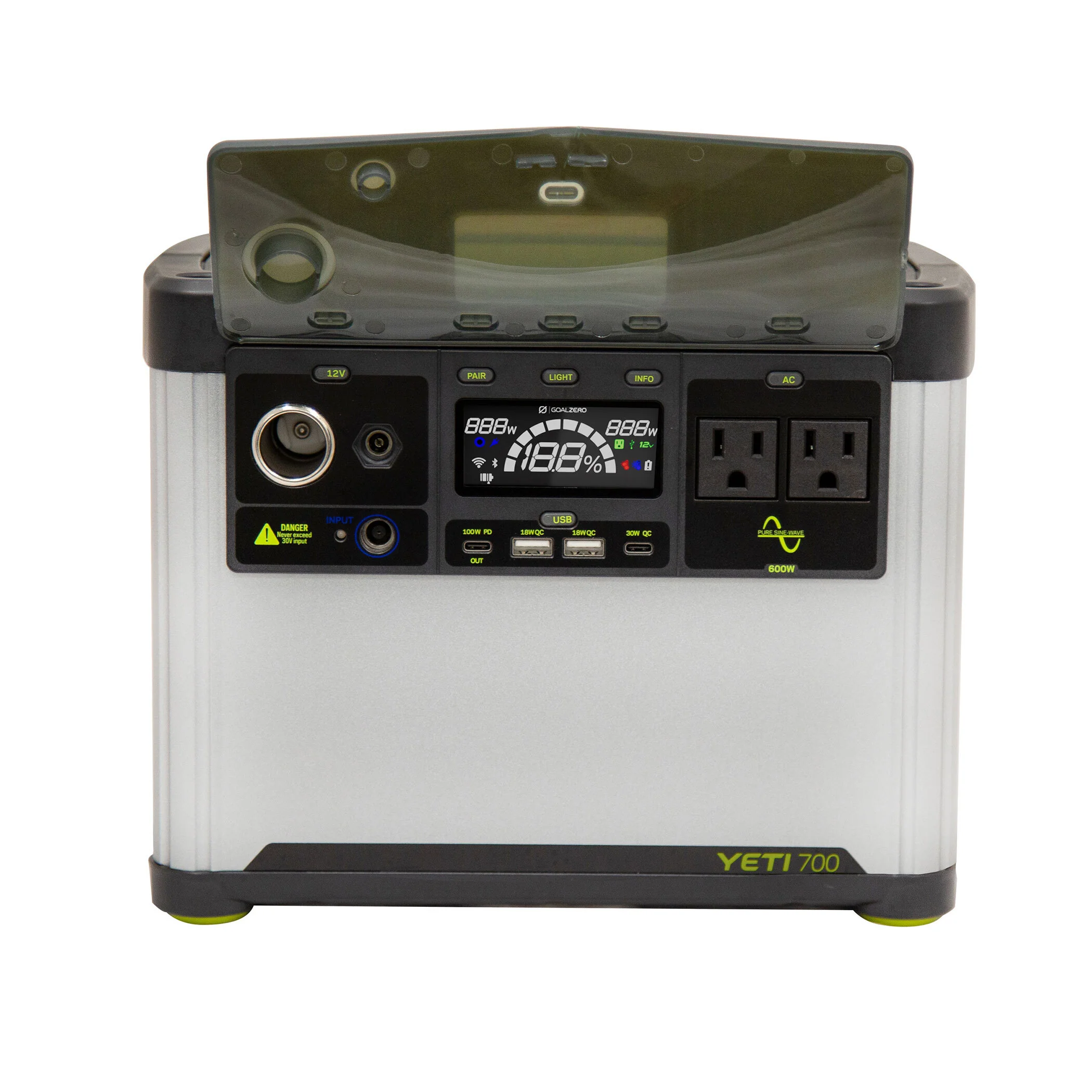
Goal Zero
Yeti 700
1,833Power Score · Device Hub
$699.95 · direct from Goal Zero
Last checked 6 days ago. Prices move — check before you buy.
Spec deltas
The BLUETTI Elite 30 V2 (288Wh) and Goal Zero Yeti 700 (677Wh) sit in different weight classes. The real question: do your power needs justify the larger unit, or would you be overpaying for capacity that sits unused? We'd buy the Elite 30 V2.
The Yeti 700 holds 389Wh more than the Elite 30 V2 — about 4 hours on a fridge against 2 — a real but modest edge that shows up mainly on longer outages. For camping, tailgating, or keeping devices charged, both have the headroom, so price, weight, and longevity lead the decision instead.
Pick the Elite 30 V2 if you want the unit that wins the head-to-head on balance. Go with the Yeti 700 if you primarily need it for cpap overnight. Most buyers stop at the sticker price and miss this: over a full lifespan the Yeti 700 works out to about $0.26/kWh against the Elite 30 V2's $0.52, a gap that compounds in the Yeti 700's favor the more you cycle it. Keep scrolling for the full breakdown. The scenario verdicts below hold a few surprises.
Bench Notes
What each unit does well, where it falls short, and the trade-offs that matter.
BLUETTI Elite 30 V2
At 600W, this unit is strictly for personal electronics (phones, laptops) and small CPAP machines. Do not expect to run kitchen appliances. At only 10.3 lbs, it is exceptionally portable. You can easily carry it one-handed to a campsite or tailgating party.
Strengths
- +Costs $251 less
- +Lighter by 10 lb
Trade-offs
- –Shorter-lived battery — rated for 3,000 charge cycles vs the Yeti 700's 4,000, so it wears out sooner.
Goal Zero Yeti 700
At 600W, this unit is strictly for personal electronics (phones, laptops) and small CPAP machines. Do not expect to run kitchen appliances. At only 20.3 lbs, it is exceptionally portable. You can easily carry it one-handed to a campsite or tailgating party.
Strengths
- +Larger battery capacity
- +Rated for 4,000 charge cycles — much longer battery lifespan
Trade-offs
- –Substantially more expensive (+$251) than the Elite 30 V2.
Will It Power Your Gear?
Scenario math and per-appliance runtimes, modeled from the spec record.
Scenario verdicts
We ran the math on seven real-world scenarios. Here's which unit survives your actual life.
SCN-01 · 2 nights · needs 2,100Wh
Weekend Camping
Two nights off-grid with essential comfort
Neither unit
Neither unit covers this scenario's 2,100Wh: the Elite 30 V2 comes up 1,855Wh short (about 12% covered), the Yeti 700 1,525Wh (27%). This is well outside what either unit is for; the right answer here is a larger station, not a choice between these two.
Battery budget usedlower = more headroom
LOAD Phone Charger 15W×6h · LED Lights 40W×8h · Box Fan 75W×14h · CPAP Machine 40W×16h
SCN-02 · 8 hours · needs 1,645Wh
8-Hour Blackout
Keep the essentials running through a night without power
Neither unit
Neither unit covers this scenario's 1,645Wh: the Elite 30 V2 comes up 1,400Wh short (about 15% covered), the Yeti 700 1,070Wh (35%). This is well outside what either unit is for; the right answer here is a larger station, not a choice between these two.
Battery budget usedlower = more headroom
LOAD Fridge 150W×8h · Router + Modem 20W×8h · LED Lights (4 bulbs) 40W×6h · Phone Charger 15W×3h
SCN-03 · 8 hours · needs 320Wh
CPAP Overnight
Sleep therapy without interruption — the #1 medical use case
Yeti 700
The Elite 30 V2 doesn't finish — 245Wh usable against the 320Wh this needs leaves it 75Wh short, about 76% of the scenario covered. The Yeti 700 covers it with 255Wh to spare.
Battery budget usedlower = more headroom
LOAD CPAP Machine 40W×8h
SCN-04 · 8 hours · needs 910Wh
Remote Workday
Full work day off-grid without power anxiety
Neither unit
Neither unit covers this scenario's 910Wh: the Elite 30 V2 comes up 665Wh short (about 27% covered), the Yeti 700 335Wh (63%). Treat this as partial cover — enough for the essentials in it, not the whole list.
Battery budget usedlower = more headroom
LOAD Laptop 60W×8h · External Monitor 30W×8h · Router + Modem 20W×8h · Phone Charger 15W×2h
SCN-05 · 4 hours · needs 670Wh
Tailgate Party
Game day power for the crew
Neither unit
Neither unit covers this scenario's 670Wh: the Elite 30 V2 comes up 425Wh short (about 36% covered), the Yeti 700 95Wh (86%) (its nameplate 677Wh actually clears this — the flat 15% conversion allowance is what tips it under). Treat this as partial cover — enough for the essentials in it, not the whole list.
Battery budget usedlower = more headroom
LOAD Blender 400W×0.5h · LED TV (55") 80W×4h · Bluetooth Speaker 15W×4h · Phone Charger (×3) 45W×2h
SCN-06 · 24 hours · needs 4,685Wh
Van Life Daily
A full day of mobile living — the ultimate endurance test
Neither unit
Neither unit covers this scenario's 4,685Wh: the Elite 30 V2 comes up 4,440Wh short (about 5% covered), the Yeti 700 4,110Wh (12%). This is well outside what either unit is for; the right answer here is a larger station, not a choice between these two.
Battery budget usedlower = more headroom
LOAD Mini-Fridge 150W×24h · Laptop 60W×4h · Phone Charger 15W×3h · LED Lights 40W×5h · Fan 75W×8h
SCN-07 · an afternoon · needs 100Wh
Afternoon Off-Grid
Phones and a speaker at the park, beach, or campsite — the small-unit job description
Either unit
This is the job small stations are actually for, and both do it: the Elite 30 V2 finishes at 41% used, the Yeti 700 at 17%. At this size the decider is what rides in the bag — 10.3 lbs for the Elite 30 V2 against 20.3 for the Yeti 700 — and price, not the leftover watt-hours.
Battery budget usedlower = more headroom
LOAD Phone Charger (×2) 30W×2h · Bluetooth Speaker 10W×4h
The Load Test
RUNTIME = (Wh × 0.85) ÷ LOAD
None of the scenarios above exactly yours? Build it. Toggle what you'd plug in; both units are tested against the combined draw.
Essentials
Comfort & Convenience
High-Draw Appliances
Test duration
8h
Continuous draw
205W
Projected runtime
For this load: Yeti 700 runs 2.8h vs 1.2h.
$699.95 list · direct from Goal Zero
Modeled from the spec record — same math as the tables below. Methodology
Runtime by appliance
Real-world runtime estimates for common appliances, modeled at 85% inverter efficiency.¹
Essentials
The basics you need runningscale 0–38.4hComfort & Convenience
Makes off-grid life actually enjoyablescale 0–7.7hHigh-Draw Appliances
These reveal the real limits¹ Runtime = (capacity × 0.85) ÷ appliance watts. Within each group, all bars share one time scale (the group's longest runtime), so lengths are comparable across appliances; identical runtimes collapse into a single blue/orange bar. Actual runtime varies with battery age, temperature, and simultaneous loads — see methodology.
Conclusion
July 10, 2026
Verdict: the Elite 30 V2
The Elite 30 V2 outperforms the Yeti 700 in key areas. It offers . Crucially, it costs $251 less, making it the smarter financial choice.
Overall score margin: 1,541 vs 1,833 (−18.9%)
List prices as of July 10, 2026. The links below open BLUETTI's and Goal Zero's current prices.
$449.00 · direct from BLUETTI
Last checked 6 days ago. Prices move — check before you buy.
or check the Yeti 700 price$699.95 list
Written by Wenny Zheng, Portable Power Tester · Station Arena Test Desk · Updated July 10, 2026
Measured Data
Benchmark scores and the full spec record, side by side.
Benchmark scores
Full specifications
ᵈ Derived: price ÷ rated capacity. See the data behind our comparisons →
Comparison ToolAdd more power stations, side by sideOpen Tool →How these numbers are produced
Numeric verification
Every figure on this page traces to our spec database or arithmetic on it — no estimated numbers.
Owner claims
Statements about owner experience are cited to published reviews.
Runtime model
Runtime = (rated capacity × 0.85 inverter efficiency) ÷ device wattage. Solar recharge estimates assume panels deliver 70% of rated output. Cold weather, battery age, and stacked loads reduce real-world results.
Power Score
Computed from 14 published spec dimensions, weighted per use-case bench. Higher is better; a unit must meet a bench's minimum threshold to be rated.
See the full weight table and data sourcing on our methodology page →Class ranking (the star rating)
Each unit's star score is a category ranking, not customer reviews — no buyer opinions feed it. We score every station on size-independent quality (value, output, portability, endurance, ports, warranty, and more), then percentile-rank it against the other units in its capacity class, so a class-leading compact unit and a class-leading whole-home unit can both earn 5★. Here, Elite 30 V2 rates 4.3/5 (57th percentile of 22 Personal-class units), and Yeti 700 rates 3.6/5 (16th percentile of 20 Compact-class units).
How the class ranking is computed →Test Notes & Caveats
Hidden gotchas and advantages we spotted that you won't find on the product page.
Surge Power: Inverter Quality Indicator
The Elite 30 V2 has a 2.5× surge-to-continuous ratio vs the Yeti 700's 1.7×, and the higher absolute ceiling with it — 1,500W against 1,000W. A higher ratio (≥2×) means the inverter absorbs motor startup surges better, which matters for fridges, AC compressors, and power tools that briefly draw 2-3× their rated wattage. With both measures pointing the same way, the Yeti 700 is the one more likely to trip when starting these appliances.
UPS Switchover: ≤10ms vs ≤20ms
Both list a UPS mode, at different rated speeds. The Elite 30 V2 is rated ≤10ms — quick enough on paper that desktop PCs and routers should ride through, treating that as the rating it is. The Yeti 700 is rated ≤20ms — fine on paper for routers and most electronics; the fussiest PC power supplies sit right at this line. If a computer with unsaved work is the thing being protected, the stated class is worth the attention; nothing here is a lab result.
Warranty: No Difference
Both units carry the same 5-year warranty, so coverage isn't a tiebreaker here. Worth saying because the per-dollar framing can suggest otherwise: the Elite 30 V2 works out at 11.1 years of cover per $1,000 spent against the Yeti 700's 7.1, but that spread is the price gap, not the terms.
Battery Lifespan in Real Years
The Yeti 700 is rated for 4,000 cycles vs 3,000. In real life: at daily use, that's 11 vs 8.2 years. At weekend use (twice a week), it's 38 vs 29 years. One caution reading years across different sizes: a cycle is 677Wh on the Yeti 700 and 288Wh on the Elite 30 V2, so count lifetime energy — roughly 2,708 kWh against 864 kWh over the rated life. After hitting the cycle limit, the battery doesn't die — it drops to ~80% of original capacity, which is still very usable.
Yeti 700: Noise Level Not Disclosed
The Elite 30 V2 publishes its noise level (30dB); the Yeti 700 doesn't publish one. That isn't evidence the Yeti 700 is louder — it means there's no figure to hold it to, and no way to compare the two on this without hearing them. If you're buying for a bedroom, a CPAP, or an apartment, treat the Elite 30 V2's 30dB as the only published number on the table — a spec-sheet figure, not a measurement — and look for hands-on reports of the Yeti 700 before deciding.
Full record above — the Test Desk pick is the Elite 30 V2.
Check Elite 30 V2 price →or check the Yeti 700 priceOwnership Analysis
What happens after you buy — true cost of ownership, brand trust, and growth potential.
Lifetime value
Service lifeyears at one full cycle per day
Lifetime energy delivered
Cost per delivered kWh
│ warranty ends · Reaching the cycle rating means ~80% capacity remains — degraded, not dead.
Analyst note
The Elite 30 V2 is cheaper to buy, but the Yeti 700 is cheaper to own. At $0.26/kWh over its lifetime vs $0.52/kWh, the Yeti 700's higher cycle life and capacity make each dollar go further over the years.
Brand trust
BLUETTI
Ecosystem
One of the broadest lineups — 15-20+ models from budget (AC2A) to flagship portable (Apex 300, 2764.8Wh). Includes specialized products: vehicle solar hubs, sodium-ion cold-weather units, and balcony storage systems.
Support
The most inconsistent support in the space. Heavily email-based with China timezone delays. Some users get smooth, efficient service; others report weeks of troubleshooting runarounds, being offered discounts on new units instead of repairs, and confusing third-party purchase claim processes. Buying direct from Bluetti's website tends to produce better support outcomes.
Community
Active and growing — Reddit r/bluetti has a dedicated community. Second-largest after EcoFlow in engagement.
App experience
Rated 4.5/5 iOS and Android — tied for best app experience in the category. V3.0 UI redesign was well-received.
Unique strength
Among the best capacity-to-price ratios available — several Elite and Apex units are the lowest $/Wh in the catalog. Widest product diversity including industry-firsts like sodium-ion cold-weather units and dual solar+alternator vehicle hubs. Full LFP standardization across the lineup, though rated cycle life spans 2,500 (EB3A) to 6,000 (Elite units) — check the specific model. Dual-voltage (120V/240V) in flagships.
Worth knowing
Customer support inconsistency is the #1 risk factor. Older/discontinued units may become unrepairable — no spare parts policy for some models. Some reports of erratic communication from support agents.
Goal Zero
Ecosystem
Focused — a compact current line (6th-gen Yeti and Yeti Pro series), the previous-gen X series still widely sold, Sherpa power banks for the under-100Wh tier, plus Alta coolers, Nomad/Ranger solar panels, and vehicle integration kits
Support
US-based company (Salt Lake City, owned by NRG Energy). Historically considered premium support, but 2025-2026 reports describe long wait times, unresponsive email communication, and tickets going unaddressed for weeks. The "premium support justifies premium pricing" argument is weakening.
Community
Small but loyal — strong following in overlanding and preparedness communities. Official community forums were recently shuttered, frustrating long-time users.
App experience
Rated 4.4/5 iOS (~1,200 ratings) but recent reviews skew negative — recurring connectivity issues, crashes, and stability problems.
Unique strength
Pioneer of the portable power market — strongest brand heritage. US-based company with ruggedized, weather-resistant designs (IP ratings vary by model). Integrated "Yeti-Ready" ecosystem with coolers, lights, and vehicle kits.
Worth knowing
Typically the priciest brand per watt-hour — though individual pairings vary, and on some pages the Yeti is the cheaper energy. Support quality has declined from its "premium" standard. Perceived as competitively stagnant vs. faster-innovating Chinese competitors. Reliability reports on newer models are concerning.
Analyst note
Goal Zero positions itself as a premium brand with stronger support infrastructure, while BLUETTI competes on value. The question is whether the Goal Zero ecosystem and support premium is worth it for your use case.
Growth path
Elite 30 V2
FIXED CAPACITYFixed at 288Wh, with no expansion — so size it for your needs up front rather than planning to add capacity later.
Accepts up to 200W of solar. Limited to a single portable panel.
Limited ports. You'll likely need a power strip or splitter.
Yeti 700
FIXED CAPACITYFixed at 677Wh, with no expansion — so size it for your needs up front rather than planning to add capacity later.
Accepts up to 200W of solar. Limited to a single portable panel.
Adequate ports for most setups, but heavy users may want a power strip.
Realistic full solar rechargeat 70% of rated panel output — see methodology
Analyst note
Neither expands, and that's no knock on either — each is a complete unit at a fixed size. Buy the capacity that covers your needs now (the Yeti 700 gives you the larger ceiling); you can't add to either later.
The Bottom Line
The full picture comes down to this. The Elite 30 V2 edges ahead on our overall analysis, but the margin is narrow enough that your specific use case should drive the decision. Review the scenario verdicts above — if the Yeti 700 wins in the scenarios that match your life, it's the right choice regardless of aggregate scores.
If neither the Elite 30 V2 nor the Yeti 700 feels like the right fit, your power needs probably sit outside what these two target. If you're planning whole-home backup or running power-hungry appliances (electric heaters, window AC), you'll want a larger system in the 3,000–5,000Wh range with expansion battery support. Prices on portable power stations fluctuate frequently. Both BLUETTI and Goal Zero discount regularly, so check the current price before committing. Prime Day and Black Friday pricing typically drops 20-30%.
Frequently Asked Questions
Answers drawn from the spec record and cited owner research.
Is the Yeti 700 worth $251 more than the Elite 30 V2?
The short answer: yes, if you'll actually use the extra capability. The Yeti 700 costs $251 more, but that premium buys you 389Wh more battery capacity (that's 2 extra hours of running a mini-fridge); a longer-lasting battery rated for 4,000 cycles — that's 11 years at daily use. On a cost-per-watt-hour basis, you're paying $1.03/Wh vs $1.56/Wh. Factor in cycle life and the math flips: the Yeti 700 costs $0.26/kWh over its lifetime vs $0.52/kWh. The "expensive" unit is actually cheaper to own. For regular use, we'd pay the premium.
"4,000 vs 3,000 cycles" — what does that actually mean for me?
In real years: the Yeti 700 (4,000 cycles) lasts 11.0 years at daily use, 38 years at weekend use (twice a week), or 167 years at twice-monthly camping trips. The Elite 30 V2 (3,000 cycles): 8.2 years daily, 29 years weekends, or 125 years twice-monthly. What most people miss: hitting the cycle limit doesn't kill your battery. Capacity drops to about 80%. Your 677Wh unit becomes a ~542Wh unit. Still very usable. For weekend users, both batteries will outlast the warranty by years.
Is BLUETTI or Goal Zero more reliable for long-term ownership?
Both brands have strengths and trade-offs. BLUETTI: 2-6 years depending on model (up to 10 years on home backup systems). Response times vary significantly. Some reports of units being deemed unrepairable with no parts available for older models. Goal Zero: 5 years on LFP models, 2 years on older NMC models. Battery must be charged within 7 days of purchase and every 6 months to maintain warranty (strict). Product reliability concerns have increased — repeat "Battery Fault" errors reported even on newer Yeti Pro 4000. One piece of advice from the power station community: regardless of brand, buy from Costco or Amazon. Their return policies provide a safety net that manufacturer warranties alone can't match, especially for a product you'll rely on in emergencies. Both brands use LFP (lithium iron phosphate) batteries in their current lineup, the most proven chemistry for longevity and safety.
Bottom line: should I buy the Elite 30 V2 or the Yeti 700?
We'd buy the Elite 30 V2. Strong value at a lower price, and for most real-world use cases the spec gaps don't translate to meaningful capability gaps. The Yeti 700 makes sense only if you specifically need its higher capacity for demanding sustained loads like full-home backup or commercial use.
Where to buy
BLUETTI Elite 30 V2Pick
$449.00
$449.00 · direct from BLUETTI
Last checked 6 days ago. Prices move — check before you buy.
Goal Zero Yeti 700
$699.95
$699.95 · direct from Goal Zero
Last checked 6 days ago. Prices move — check before you buy.
Prices may vary by retailer and are subject to change.