Head-to-head test
BLUETTI AC50B vs Goal Zero Yeti 700
Goal Zero charges $301 more for 229 extra watt-hours and 100 fewer watts of output, and unless this box is going to live outdoors, that trade never gets any better.
Full profiles: BLUETTI AC50B → · Goal Zero Yeti 700 →

Written by Wenny ZhengUpdated
Portable Power Tester, Station Arena Test Desk
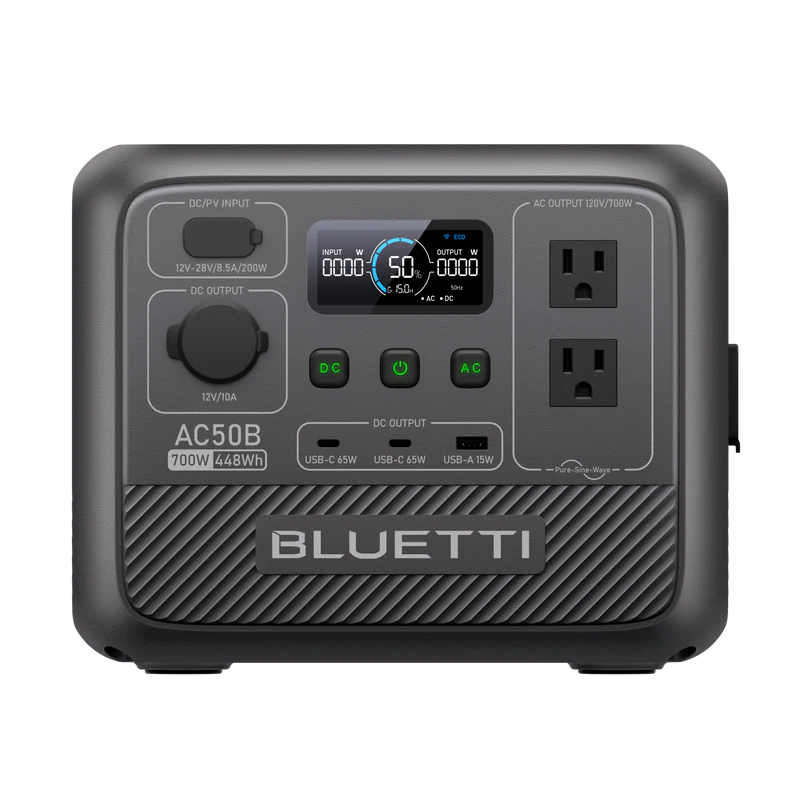
$399.00 · direct from BLUETTI
Last checked 1 day ago. Prices move — check before you buy.
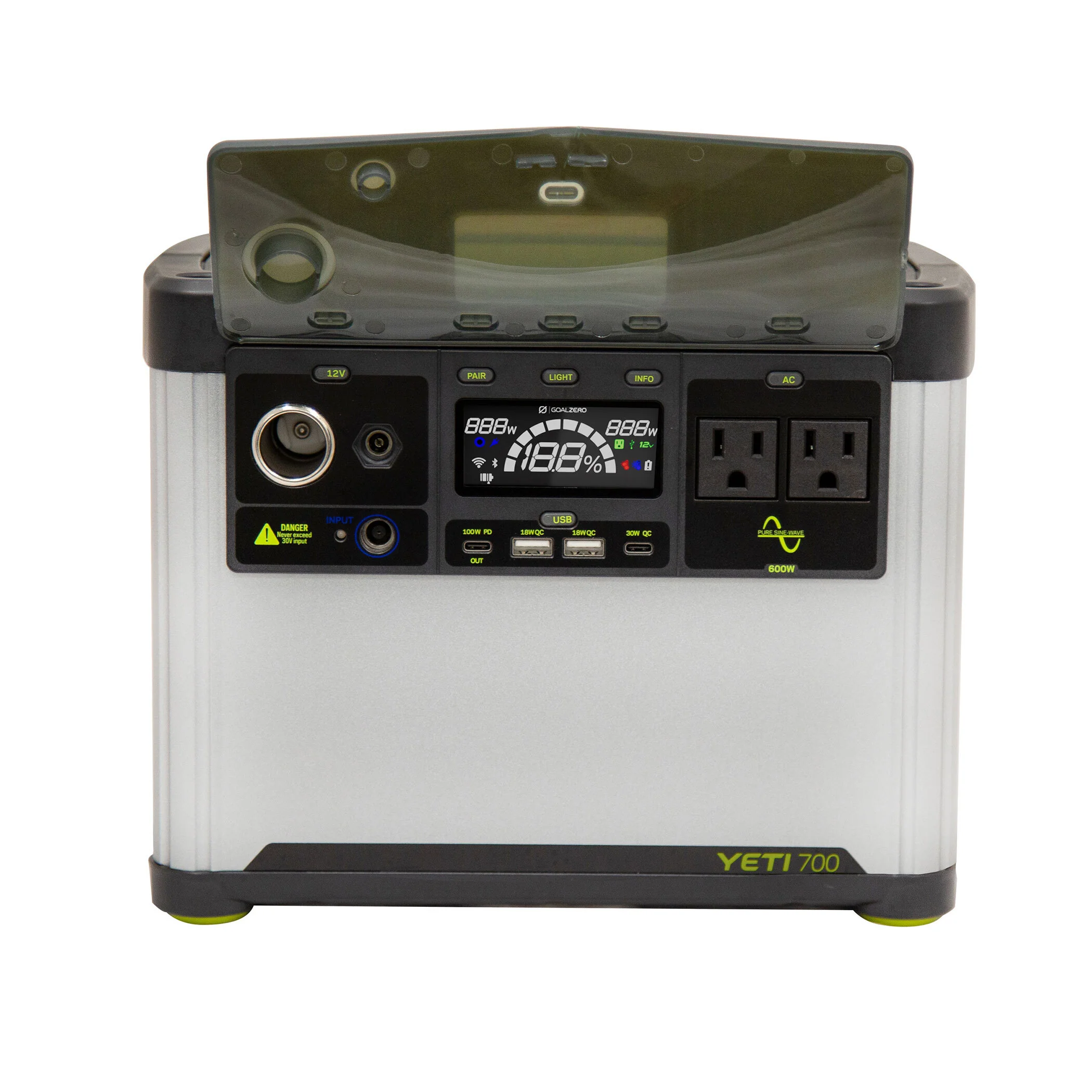
$699.95 · direct from Goal Zero
Last checked 1 day ago. Prices move — check before you buy.
Spec deltas
The cheaper box is the stronger one. The AC50B runs 700W continuous for $399; the Yeti 700 runs 600W for $700. Both surge to 1,000W, both take 200W of solar, both carry five-year warranties, and both hand off to battery in 20ms. The Yeti's case rests almost entirely on holding 677Wh to the BLUETTI's 448.
That extra 229Wh is real, and so is the rest of what the premium buys: 4,000 cycles against 3,000, a 100W USB-C port instead of 65W, and an IPX4 water-resistance ratingB2. None of it is marketing. The question is whether it adds up to $301, and for most of what people actually plug into a box this size, it doesn't.
Buy the AC50B. Take the Yeti if the unit lives strapped to a rack in the weather, or if you're running a CPAP through a multi-night outage with no outlet coming, because those are the two places its shell and its capacity earn the difference. Everywhere else, you're paying a premium to get less inverter.
What the Numbers Reveal
Each conclusion stated first — the numbers behind it on one line, the full analysis below.
continuous output
So the premium isn't buying watt-hours, it's buying consolidation. If capacity per dollar were the reason to size up, the money buys more of it in the small box. What the Yeti genuinely sells is one thing to carry instead of two, one charger instead of two, and 677Wh available to a single load, which a pair of AC50Bs can't do because neither one alone goes past 700W.
AC50B: $399 for 448WhYeti 700: $700 for 677WhAC50B holds 700W continuous; Yeti 700 holds 600W
Why it mattersIf you're stepping up purely for capacity, buy two of the cheap ones and keep the change; step up only when the energy has to come out of one outlet.
Capacity
That second night is the single concrete thing the premium buys, and it evaporates the moment you have a wall outlet or a sunny morning. It also arrives with a blank where a number should be. The AC50B tells you it runs 45 dB under load and the Yeti tells you nothing, so the person paying more to sleep beside it finds out how loud it is in bed.
A CPAP night draws 320WhAC50B usable energy is about 381Wh (448Wh at the standard 85% after inverter losses)Yeti 700 usable energy is about 575Wh (677Wh at 85%)BLUETTI publishes 45 dB under load for the AC50B; Goal Zero publishes no noise figure for the Yeti 700
Why it mattersCPAP users planning for multi-night outages with no solar and no generator should take the Yeti; anyone who can top up daily is paying for a night they'll never sleep.
rated cycles
Nobody collects it. Cycled every weekend, the Yeti's rated life runs 38.5 years against the AC50B's 28.8, and a weekend owner runs out of decades long before either pack runs out of cycles. The only promise with a date on it is the warranty, and the same five years costs $140 a year on the Yeti against $56 on the AC50B, which is two and a half times as much for identical coverage.
AC50B: 21 cents per lifetime kWh across 3,000 cyclesYeti 700: 26 cents per lifetime kWh across 4,000 cyclesYeti 700 banks 2,708 lifetime kWh; the AC50B banks 1,344Both carry a five-year warranty, at $140 a year against $56
Why it mattersIf you're justifying the Yeti with 'it'll last longer,' count the cycles you'll really put through it before you pay for the ones you won't.
Add the IPX4 ratingB2 and the Yeti's case finally takes a shape: a box that gets rained on, rides on a rack, and earns its mass. That's a specific person rather than a general upgrade. If your unit lives in a closet between trips, none of it applies and you've bought something heavier that runs fewer watts.
Yeti 700: 677Wh at 19.3 lbs, or 35 watt-hours per poundAC50B: 448Wh at 14.8 lbs, or 30 watt-hours per poundGoal Zero rates the Yeti 700 IPX4, with tolerance for extreme temperaturesB2The AC50B's record is a price, weight and charge-time story: 14.8 lbs against BLUETTI's own AC70 at 21.4A2, about three hours on standard ACA3
Why it mattersOverlanders, boaters and anyone whose gear sleeps outside should pay up; everyone storing it indoors should not.
The specific dimensions that decide these two units — everything else is a tie.
Runtime: Will It Power Your Gear?
Selected because: The bigger battery sits behind the smaller inverter: 677Wh at 600W on the Yeti, 448Wh at 700W on the AC50B.
continuous output
The bigger battery sits behind the smaller inverter. 677Wh through a 600W ceiling on the Yeti, 448Wh through 700W on the AC50B, which leaves a 100W band of load that the cheap unit takes and the expensive one turns away. Surge is identical at 1,000W, so anything with a compressor kicks on the same either way. The difference is never in starting a load. It's in holding one.
Derate for the inverter and the honest figures are about 381 usable watt-hours in the AC50B and 575 in the Yeti, at the standard 85% of rated capacity. That 194Wh of real headroom is the Yeti's strongest card. Outside of a rainstorm, it's also the only thing the premium reliably delivers.
Your Life, Your Pick
Selected because: Neither unit covers five of the six load profiles, and the one they both cover is the only place the extra capacity earns anything.
Both units start every peak load in all six profiles, and neither finishes five of them. That's the shape of this size class: the inverter is never what fails, the battery is. The blackout profile wants 1,645Wh and the larger of these two holds about a third of that after losses. That isn't a near miss.
The useful takeaway is what these two are actually for. A tailgate at 670Wh, a remote workday at 910, a camping weekend at 2,100 — every one of them asks for more than either box holds. What fits is a phones-laptop-router-CPAP evening, and both handle that comfortably. Read the pair as small boxes for small nights, and the extra 229Wh stops looking like an upgrade and starts looking like a rounding error against what the big profiles need.
Lifetime Value
Selected because: Across full rated life the gap narrows to five cents a kilowatt-hour, which is where you learn the $301 isn't really about energy.
cost / lifetime kWh
Twenty-one cents a lifetime kilowatt-hour against twenty-six is a far narrower gap than a $399 box beating a $700 one ought to produce. The Yeti earns it by banking 2,708 kWh across its rated life against the AC50B's 1,344. On a long enough horizon, most of the sticker difference really is energy.
The horizon is the catch, and there's one clean test for it. Cycled daily, the two rated lives compress to 11 years against 8.2, and the Yeti's extra thousand cycles become something you might genuinely reach. If this box works every single day, the lifetime column is a real argument. If it comes out for camping trips, it's a number describing a future you won't be in.
What the Specs Don't Tell You
Selected because: BLUETTI publishes 45 dB under load for the AC50B; Goal Zero publishes no noise figure at all for the Yeti 700.
rated cycles
BLUETTI puts the AC50B at 45 dB under load. Goal Zero publishes nothing for the Yeti 700, which is its own kind of answer if you were planning to sleep next to it. The Yeti may well be the quieter box. You'd find that out in your bedroom rather than on the spec sheet.
Take that 45 dB as the honest catch against the cheaper unit, because it isn't a quiet number and BLUETTI could have kept it to itself. A published spec you can plan around beats an unpublished one you can't. This is the rare matchup where the value pick is also the more transparent one.
Strengths & trade-offs
BLUETTI AC50B
Strengths
- +Costs $301 less
- +Lighter by 5.5 lb
- +Higher AC output
Trade-offs
- –Shorter-lived battery — rated for 3,000 charge cycles vs the Yeti 700's 4,000, so it wears out sooner.
Goal Zero Yeti 700
Strengths
- +Larger battery capacity
- +Rated for 4,000 charge cycles — much longer battery lifespan
Trade-offs
- –Substantially more expensive (+$301) than the AC50B.
Will It Power Your Gear?
Scenario math and per-appliance runtimes, modeled from the spec record.
Scenario verdicts
We ran the math on six real-world scenarios. Here's which unit survives your actual life.
SCN-01 · 2 nights · needs 2,100Wh
Weekend Camping
Two nights off-grid with essential comfort
Neither unit
Neither unit covers this scenario's 2,100Wh: the AC50B comes up 1,719Wh short (about 18% covered), the Yeti 700 1,525Wh (27%). This is well outside what either unit is for; the right answer here is a larger station, not a choice between these two.
Battery budget usedlower = more headroom
LOAD Phone Charger 15W×6h · LED Lights 40W×8h · Box Fan 75W×14h · CPAP Machine 40W×16h
SCN-02 · 8 hours · needs 1,645Wh
8-Hour Blackout
Keep the essentials running through a night without power
Neither unit
Neither of these is a blackout box. The profile wants 1,645Wh, and the larger one holds about a third of that once inverter losses come off the top, so the question isn't which unit gets you through the night. It's how far into the evening you get. If the fridge is the reason you're shopping, both of these are the wrong size.
Battery budget usedlower = more headroom
LOAD Fridge 150W×8h · Router + Modem 20W×8h · LED Lights (4 bulbs) 40W×6h · Phone Charger 15W×3h
SCN-03 · 8 hours · needs 320Wh
CPAP Overnight
Sleep therapy without interruption — the #1 medical use case
Either unit
Both get you to morning. A 320Wh night spends 84% of what the AC50B can usefully give and 56% of the Yeti's, so the split isn't whether you wake up powered, it's whether you wake up hunting for an outlet. The AC50B does. The Yeti has most of a second night still in it.
Battery budget usedlower = more headroom
LOAD CPAP Machine 40W×8h
SCN-04 · 8 hours · needs 910Wh
Remote Workday
Full work day off-grid without power anxiety
Neither unit
Neither unit covers this scenario's 910Wh: the AC50B comes up 529Wh short (about 42% covered), the Yeti 700 335Wh (63%). Treat this as partial cover — enough for the essentials in it, not the whole list.
Battery budget usedlower = more headroom
LOAD Laptop 60W×8h · External Monitor 30W×8h · Router + Modem 20W×8h · Phone Charger 15W×2h
SCN-05 · 4 hours · needs 670Wh
Tailgate Party
Game day power for the crew
Neither unit
The Yeti gets closest, and closest doesn't count. A 670Wh afternoon runs it 16% past empty, and the AC50B gives out well before that. Both start every load on the table; neither keeps it running to the final whistle.
Battery budget usedlower = more headroom
LOAD Blender 400W×0.5h · LED TV (55") 80W×4h · Bluetooth Speaker 15W×4h · Phone Charger (×3) 45W×2h
SCN-06 · 24 hours · needs 4,685Wh
Van Life Daily
A full day of mobile living — the ultimate endurance test
Neither unit
Neither unit covers this scenario's 4,685Wh: the AC50B comes up 4,304Wh short (about 8% covered), the Yeti 700 4,110Wh (12%). This is well outside what either unit is for; the right answer here is a larger station, not a choice between these two.
Battery budget usedlower = more headroom
LOAD Mini-Fridge 150W×24h · Laptop 60W×4h · Phone Charger 15W×3h · LED Lights 40W×5h · Fan 75W×8h
The Load Test
RUNTIME = (Wh × 0.85) ÷ LOAD
None of the scenarios above exactly yours? Build it. Toggle what you'd plug in; both units are tested against the combined draw.
Essentials
Comfort & Convenience
High-Draw Appliances
Test duration
8h
Continuous draw
205W
Projected runtime
For this load: Yeti 700 runs 2.8h vs 1.9h.
$699.95 list · direct from Goal Zero
Modeled from the spec record — same math as the tables below. Methodology
Runtime by appliance
Real-world runtime estimates for common appliances, modeled at 85% inverter efficiency.¹
Essentials
The basics you need runningscale 0–38.4hComfort & Convenience
Makes off-grid life actually enjoyablescale 0–7.7hHigh-Draw Appliances
These reveal the real limits¹ Runtime = (capacity × 0.85) ÷ appliance watts. Within each group, all bars share one time scale (the group's longest runtime), so lengths are comparable across appliances; identical runtimes collapse into a single blue/orange bar. Actual runtime varies with battery age, temperature, and simultaneous loads — see methodology.
Conclusion
August 2, 2026
Verdict: the AC50B
Buy the BLUETTI AC50B. At $399 it holds 700W continuous against the Yeti 700's 600W, matches it on 1,000W surge, 200W solar input, a five-year warranty and 20ms switchover, and gives up only 229Wh of capacity. The Yeti's real advantages are an IPX4 shellB2, 4,000 cycles against 3,000, a 100W USB-C port instead of 65W, and about 194 more usable watt-hours after inverter losses. Those are genuine, and they are not $301 genuine for anyone whose unit sleeps indoors, because the extra capacity doesn't unlock a single load profile the AC50B fails. The two buyers who should pay up are specific: the one whose box gets rained on, and the one running a CPAP through a multi-night outage with no way to recharge.
Editor-assigned confidence, based on cited owner research and spec analysis.
List prices as of August 2, 2026. The links below open BLUETTI's and Goal Zero's current prices.
$399.00 · direct from BLUETTI
Last checked 1 day ago. Prices move — check before you buy.
or check the Yeti 700 price$699.95 list
Written by Wenny Zheng, Portable Power Tester · Station Arena Test Desk · Updated August 2, 2026
Measured Data
Benchmark scores and the full spec record, side by side.
Benchmark scores
Not rated for both units (minimum threshold unmet): Tailgating.
Full specifications
ᵈ Derived: price ÷ rated capacity. See the data behind our comparisons →
Comparison ToolAdd more power stations, side by sideOpen Tool →How these numbers are produced
Numeric verification
Every figure on this page traces to our spec database or arithmetic on it — no estimated numbers.
Owner claims
Statements about owner experience are cited to published reviews — see Sources & Research Notes below.
Runtime model
Runtime = (rated capacity × 0.85 inverter efficiency) ÷ device wattage. Solar recharge estimates assume panels deliver 70% of rated output. Cold weather, battery age, and stacked loads reduce real-world results.
Power Score
Computed from 14 published spec dimensions, weighted per use-case bench. Higher is better; a unit must meet a bench's minimum threshold to be rated.
See the full weight table and data sourcing on our methodology page →Class ranking (the star rating)
Each unit's star score is a category ranking, not customer reviews — no buyer opinions feed it. We score every station on size-independent quality (value, output, portability, endurance, ports, warranty, and more), then percentile-rank it against the other units in its capacity class, so a class-leading compact unit and a class-leading whole-home unit can both earn 5★. Here, AC50B rates 4.6/5 (76th percentile of 22 Personal-class units), and Yeti 700 rates 3.6/5 (16th percentile of 20 Compact-class units).
How the class ranking is computed →Test Notes & Caveats
Hidden gotchas and advantages we spotted that you won't find on the product page.
45 dB is a number, not a promise of quiet
BLUETTI publishes 45 dB under load for the AC50B, and that's the honest catch on the cheaper unit: it isn't silence, and a CPAP user sleeps an arm's length from it. The value here isn't that it's quiet. It's that you know what you're getting before you buy.
AC50B: Power Lifting to 1,000W
The AC50B has BLUETTI's Power Lifting mode, which runs a resistive appliance rated up to 1,000W from its 700W inverter. It does that by delivering less power than the appliance asks for, not more than the inverter has: the heater still works, it just heats more slowly. Two things follow. BLUETTI scopes the mode to purely resistive loads — a heater, a kettle, an incandescent lamp — so it does nothing for a fridge compressor, a pump or a power tool, and this record publishes no surge figure at all, so read the mode as a resistive-load feature rather than as starting ability. And it is not a reason to size down, because running a load that big from 448Wh is a short session either way. Genuinely useful if a heater or a kettle is why you're buying; beside the point otherwise. The Yeti 700 publishes no equivalent.
Warranty: No Difference
Both units carry the same 5-year warranty, so coverage isn't a tiebreaker here. The AC50B's figure is a maximum rather than a guarantee — it depends on buying direct from BLUETTI or registering the unit, since reseller purchases carry a shorter term. Worth saying because the per-dollar framing can suggest otherwise: the AC50B works out at 12.5 years of cover per $1,000 spent against the Yeti 700's 7.1, but that spread is the price gap, not the terms.
Both outlive the warranty by decades
Cycle ratings are the least decisive spec on this page. On anything short of daily use, both packs run past their five-year warranties by decades, so unless this box works every day, the thousand-cycle gap is life you'll never spend.
Goal Zero doesn't publish a figure at all
There's no dB rating for the Yeti 700 to set against the AC50B's 45. It may genuinely be the quieter unit. You'd learn that in your own bedroom rather than on the spec sheet, which is an odd thing to discover after paying the higher price in this pair.
Ownership Analysis
What happens after you buy — true cost of ownership, brand trust, and growth potential.
Lifetime value
Service lifeyears at one full cycle per day
Lifetime energy delivered
Cost per delivered kWh
│ warranty ends · Reaching the cycle rating means ~80% capacity remains — degraded, not dead.
Analyst note
The AC50B is cheaper to buy, but the Yeti 700 is cheaper to own. At $0.26/kWh over its lifetime vs $0.3/kWh, the Yeti 700's higher cycle life and capacity make each dollar go further over the years.
Brand trust
BLUETTI
Ecosystem
One of the broadest lineups — 15-20+ models from budget (AC2A) to flagship portable (Apex 300, 2764.8Wh). Includes specialized products: vehicle solar hubs, sodium-ion cold-weather units, and balcony storage systems.
Support
The most inconsistent support in the space. Heavily email-based with China timezone delays. Some users get smooth, efficient service; others report weeks of troubleshooting runarounds, being offered discounts on new units instead of repairs, and confusing third-party purchase claim processes. Buying direct from Bluetti's website tends to produce better support outcomes.
Community
Active and growing — Reddit r/bluetti has a dedicated community. Second-largest after EcoFlow in engagement.
App experience
Rated 4.5/5 iOS and Android — tied for best app experience in the category. V3.0 UI redesign was well-received.
Unique strength
Among the best capacity-to-price ratios available — several Elite and Apex units are the lowest $/Wh in the catalog. Widest product diversity including industry-firsts like sodium-ion cold-weather units and dual solar+alternator vehicle hubs. LFP across the rest of the range, though rated cycle life spans 2,500 (EB3A) to 6,000, and it varies WITHIN the Elite range rather than tracking it — the Elite 300 and Elite 200 V2 are rated 6,000 while the Elite 30 V2, Elite 10 Mini, Elite 320 and Elite 400 are rated 3,000+ and the Elite 100 V2 4,000+, so check the specific model. Dual-voltage (120V/240V) in flagships.
Worth knowing
Customer support inconsistency is the #1 risk factor. Older/discontinued units may become unrepairable — no spare parts policy for some models. Some reports of erratic communication from support agents.
Goal Zero
Ecosystem
Focused — a compact current line (6th-gen Yeti and Yeti Pro series), the previous-gen X series now out of stock across every model on Goal Zero's own store (checked 2026-09-13: 200X, 500X, 1000X, 1500X, 3000X, 6000X, some listed only as open-box), so buying one new means finding retailer stock, Sherpa power banks for the under-100Wh tier, plus Alta coolers, Nomad/Ranger solar panels, and vehicle integration kits
Support
US-based company (Salt Lake City, owned by NRG Energy). Historically considered premium support, but 2025-2026 reports describe long wait times, unresponsive email communication, and tickets going unaddressed for weeks. The "premium support justifies premium pricing" argument is weakening.
Community
Small but loyal — strong following in overlanding and preparedness communities. Official community forums were recently shuttered, frustrating long-time users.
App experience
Rated 4.4/5 iOS (~1,200 ratings) but recent reviews skew negative — recurring connectivity issues, crashes, and stability problems.
Unique strength
Pioneer of the portable power market — strongest brand heritage. US-based company with ruggedized, weather-resistant designs (IP ratings vary by model). Integrated "Yeti-Ready" ecosystem with coolers, lights, and vehicle kits.
Worth knowing
Typically the priciest brand per watt-hour — though individual pairings vary, and on some pages the Yeti is the cheaper energy. Support quality has declined from its "premium" standard. Perceived as competitively stagnant vs. faster-innovating Chinese competitors. Reliability reports on newer models are concerning.
Analyst note
The price difference isn't buying you support. Goal Zero is US-based out of Salt Lake City and was the premium answer in this category for years, but the current picture is long waits and tickets going unanswered, and the official community forums have been shut. BLUETTI's support is the most inconsistent in the space, though buying direct rather than through a marketplace tends to go better. Neither brand is selling peace of mind at this price, so decide on the hardware.
Growth path
AC50B
FIXED CAPACITYFixed at 448Wh, with no expansion — so size it for your needs up front rather than planning to add capacity later.
Accepts up to 200W of solar. Limited to a single portable panel.
Limited ports. You'll likely need a power strip or splitter.
Yeti 700
FIXED CAPACITYFixed at 677Wh, with no expansion — so size it for your needs up front rather than planning to add capacity later.
Accepts up to 200W of solar. Limited to a single portable panel.
Adequate ports for most setups, but heavy users may want a power strip.
Realistic full solar rechargeat 70% of rated panel output — see methodology
Analyst note
Neither expands, and that's no knock on either — each is a complete unit at a fixed size. Buy the capacity that covers your needs now (the Yeti 700 gives you the larger ceiling); you can't add to either later.
What Owners Report
Patterns from published owner reports and long-term reviews — every claim cited to its source below.
BLUETTI AC50B
Field material on the AC50B is thin and skews reviewer-side rather than long-term-owner sideA1A2A3. What exists is consistent about the same three things: LFP chemistry behind 700W of outputA1, a weight that lands well under BLUETTI's own AC70 at 21.4 lbsA2, and a recharge of about three hours on standard AC, or 0-80% in 45 minutes with the optional 480W Turbo chargerA3.
That charge time is the most useful thing anyone has published about this unitA3. A box that refills over a lunch break is a different box in an outage than one needing a full day of sun, and it's the practical answer to its smaller battery.
“A 448Wh LiFePO4 battery with 700W output (1,000W Power Lifting), rated for 2,500+ cycles to 80% — years of reliable use.”
Sources
amazon.com · backuppowerhub.com · the-gadgeteer.com · t3.com · bluettipower.com
Goal Zero Yeti 700
The Yeti 700's record is manufacturer and reviewer material rather than accumulated owner historyB1B2B4. The claims worth carrying into a decision: a sixth-generation LFP pack rated 4,000+ cyclesB1, an IPX4 water-resistance rating with tolerance for extreme temperaturesB2, and outdoorgearlab's read that it isn't the most powerful or capable unit but is light and simple, aimed at buyers who care about portabilityB3.
That last line is the fairest sentence written about this unitB3, and it happens to be the case against its price. Light and simple describes the $399 box in this matchup too, and that one pushes more watts.
“A 6th-generation 677Wh compact power station on upgraded LiFePO4 chemistry rated for 4,000+ cycles — daily use for over 10 years.”
Sources
goalzero.com · amazon.com · campingsolar.us · outdoorgearlab.com
Sources & Research Notes
Every owner claim in this report is traceable to a published source. The bracketed references above resolve here.
Recurring owner themes
- Affordable, genuinely portable LFP unit with 700W output, 2,500+ cycles, fast Turbo charging, and B80 expandability. [AC50B · 3 entries]
- Modern LFP (4,000+ cycles), IPX4 ruggedness, and light, simple portability are the highlights; modest power and capacity. [Yeti 700 · 3 entries]
- A1
“A 448Wh LiFePO4 battery with 700W output (1,000W Power Lifting), rated for 2,500+ cycles to 80% — years of reliable use.”
amazon.com / backuppowerhub.com — AC50B review · 2026 · [positive]
- A2
“At 14.8 lbs it's meaningfully lighter than the AC70 (21.4 lbs) — a genuinely portable sub-15-lb unit with a long-cycle battery and 700W output at an easy-to-justify price.”
backuppowerhub.com / the-gadgeteer.com — AC50B review · 2026 · [positive]
- A3
“Standard AC charging is about 3 hours, dropping to 1.25 hours with the optional 480W Turbo charger; 0-80% in 45 minutes.”
amazon.com / t3.com — AC50B review · 2026 · [positive]
- B1
“A 6th-generation 677Wh compact power station on upgraded LiFePO4 chemistry rated for 4,000+ cycles — daily use for over 10 years.”
goalzero.com / amazon.com — Yeti 700 · 2026 · [positive]
- B2
“Carries an IPX4 water-resistance rating and can handle extreme temperatures — a rugged, outdoor-ready design.”
goalzero.com / campingsolar.us — Yeti 700 review · 2026 · [positive]
- B3
“Ideal for quick camping trips and device charging — not the most powerful or capable, but lightweight and simple, appealing to portability-focused users.”
outdoorgearlab.com — Yeti 700 review · 2026 · [mixed]
- B4
“Part of Goal Zero's 6th-gen LiFePO4 Yeti family — a modern LFP replacement for the older NMC X-series.”
goalzero.com — Yeti 6th-gen family · 2026 · [positive]
Research compiled August 2, 2026.
Who Should Buy Which
Buy the AC50B if you…
- →You're packing phones, a laptop, lights and a fan for a couple of nights in the car, and you'd rather keep the $301 for the rest of the trip.
- →Your load sits in the band between 600W and 700W. The AC50B runs it; the Yeti is over its ceiling.
- →You'd rather have two boxes than one. $558 buys a pair holding 896Wh, one in the truck and one at the site, still under the Yeti's price.
- →You run a CPAP and you have a wall outlet or 200W of panels in the morning. One night is all you need, and one night is what it gives.
Buy the Yeti 700 if you…
- →The unit lives outside: roof rack, boat deck, uncovered patio, winter truck bed. The IPX4 ratingB2 is the one thing here you can't get for less.
- →You run a CPAP through outages with no recharge in sight. 575 usable watt-hours against a 320Wh night is a second morning the smaller box can't offer.
- →You charge a laptop over USB-C and want the full 100W rather than 65W.
- →You're weight-budgeting a long carry and counting watt-hours per pound, where 35 beats 30.
If neither fits
If you're shopping because of the fridge during an outage, close this tab and go up a class. That profile calls for 1,645Wh and the larger unit here has 575 usable watt-hours, so you want the next size band, which both of these brands build. Buying either of these two for whole-home backup is buying a very good phone charger.
The Bottom Line
Take the AC50B. It's the cheaper box and the stronger one, running 700W continuous where the Yeti stops at 600, and the capacity it gives up doesn't unlock a single load profile the Yeti unlocks either. In five of the six profiles neither finishes; in the sixth they both do.
The Yeti isn't a bad unit. It's denser per pound, tougher, longer-cycling, and it carries a rain ratingB2. If yours is going to ride a roof rack through weather, or carry a CPAP into a second night off-grid, pay the difference with a clear conscience. If it's going to live in a closet and come out for camping trips, buy the AC50B and put the rest toward a panel.
Frequently Asked Questions
Answers drawn from the spec record and cited owner research.
Is the Goal Zero Yeti 700 worth $301 more than the BLUETTI AC50B?
Only if the box lives outdoors, or you need a second CPAP night with no way to recharge. The premium buys 229Wh, a thousand more cycles, a 100W USB-C port and an IPX4 shell, and it costs you 100W of continuous output. For indoor backup and car camping, the AC50B does the same jobs for less.
Which one can run more at once?
The AC50B. It holds 700W continuous against the Yeti's 600W, so there's a band of load the cheaper unit takes and the pricier one doesn't. Peak surge is identical at 1,000W on both, so anything that kicks on hard behaves the same either way.
Will either one run a fridge through an 8-hour blackout?
No. That profile calls for 1,645Wh, and after inverter losses the Yeti has about 575 usable watt-hours and the AC50B about 381. You'd get part of an evening out of either. This pair is built for phones, laptops, lights and a CPAP, not for backing up a kitchen.
Do these work as a UPS for a desk or a router?
Both hand off to battery in 20ms, identically, so switchover can't break the tie between them. Twenty milliseconds is standby-class timing rather than online double conversion, which is fine for a router, a modem or a laptop dock. The AC50B's higher continuous ceiling makes it the better fit for a desk with a monitor and peripherals on it.
How fast does the BLUETTI AC50B recharge?
About three hours on standard AC, or 0-80% in 45 minutes with the optional 480W Turbo charger. On solar, 448Wh at the 200W input ceiling works out to roughly two and a quarter hours in ideal sun, against about three and a half for the Yeti's 677Wh at the same 200W. Real conditions are slower for both, but the smaller pack is back first.
Where to buy
BLUETTI AC50BPick
$399.00
$399.00 · direct from BLUETTI
Last checked 1 day ago. Prices move — check before you buy.
Goal Zero Yeti 700
$699.95
$699.95 · direct from Goal Zero
Last checked 1 day ago. Prices move — check before you buy.
Prices may vary by retailer and are subject to change.