Head-to-head test
Anker SOLIX F3800 vs BLUETTI Apex 300 + B500K
The BLUETTI stores just over twice the energy, the Anker pushes half again the watts for $1,299 less, and exactly one scenario on this page forces you to care which.
Full profiles: Anker SOLIX F3800 → · BLUETTI Apex 300 + B500K →

Written by Gunner GustafsonUpdated
Whole-Home Backup Tester, Station Arena Test Desk
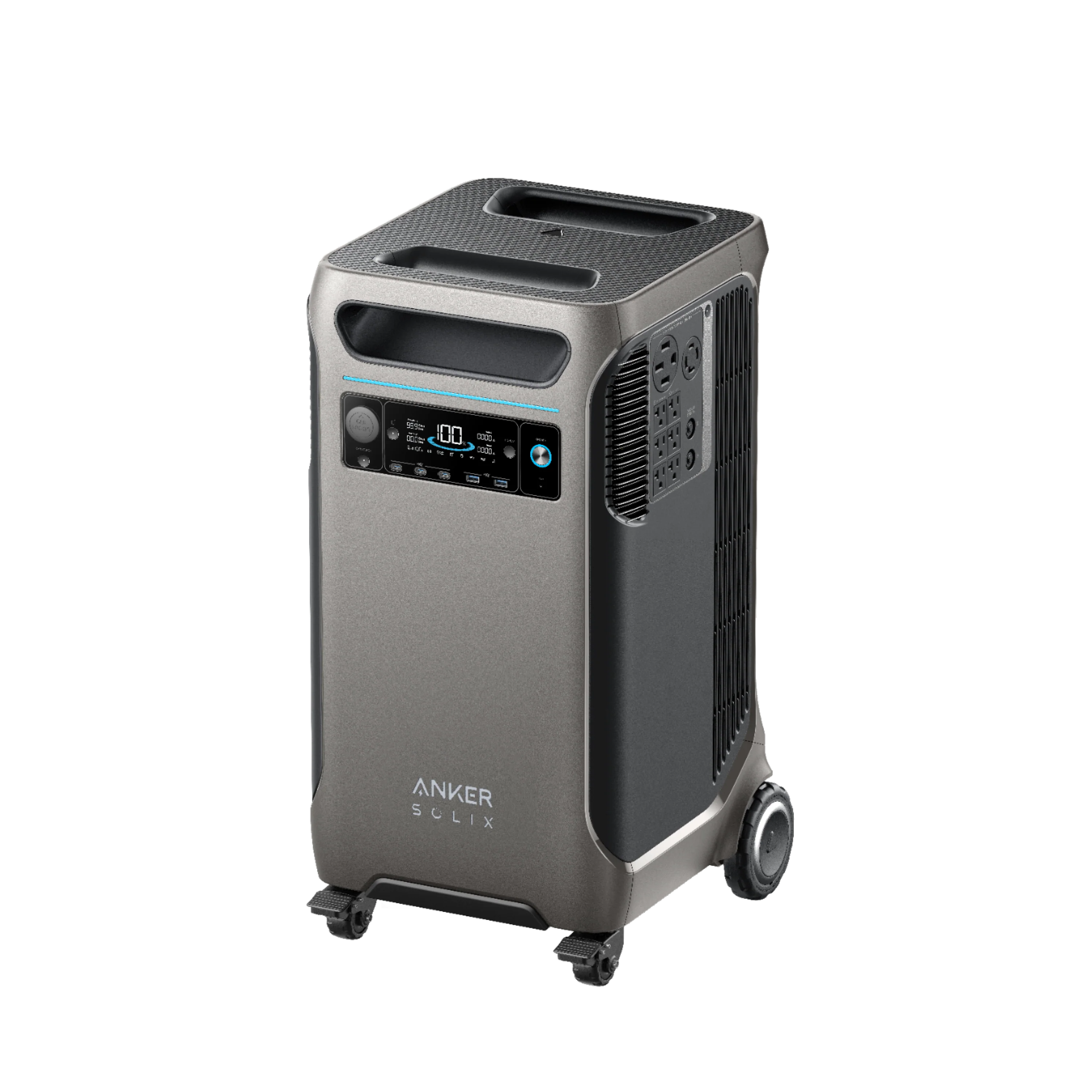
$2,199.99 · direct from Anker
Last checked 1 day ago. Prices move — check before you buy.
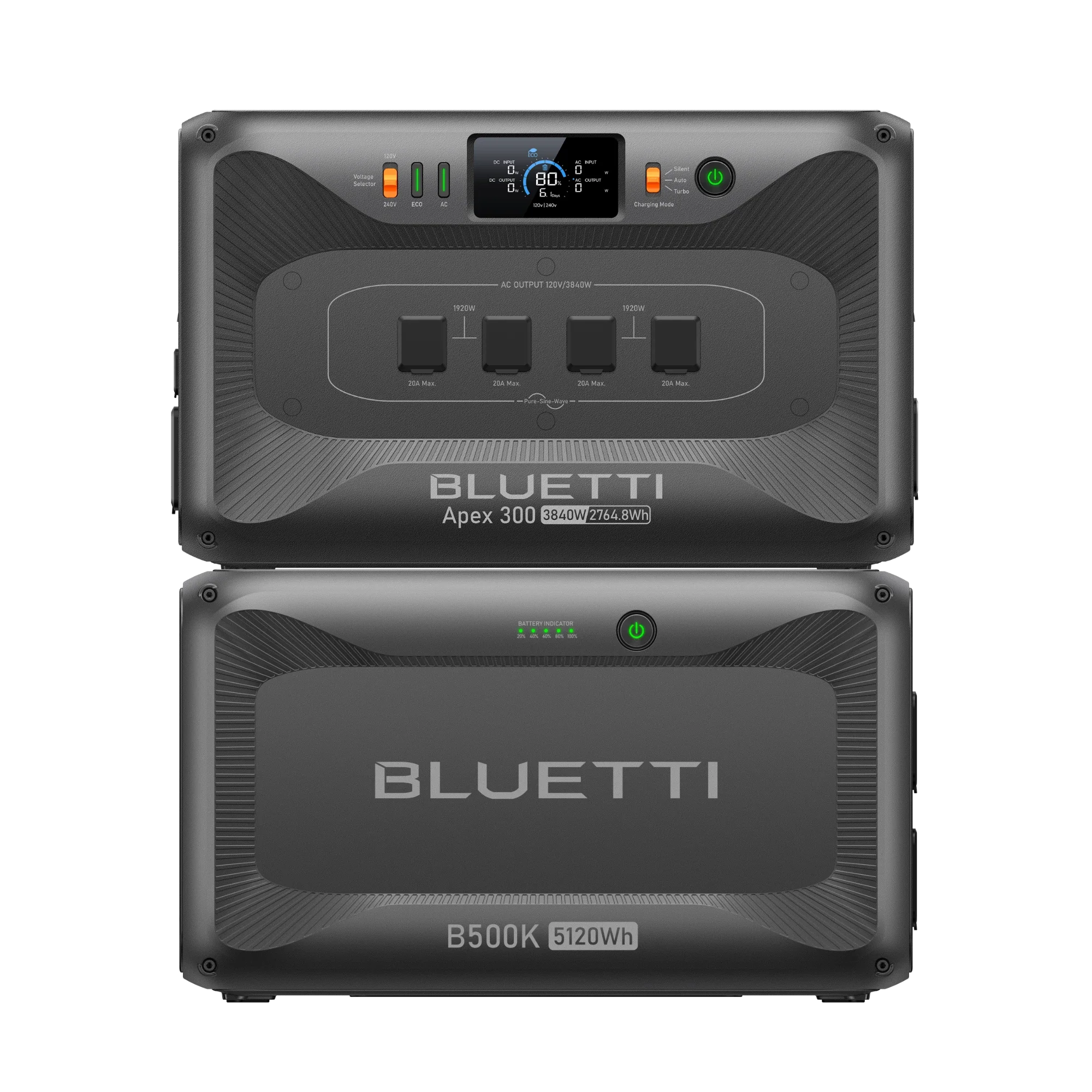
$3,299.00 · direct from BLUETTI
Last checked 1 day ago. Prices move — check before you buy.
Spec deltas
Take the F3800 unless your day runs past 3,264Wh. That's what the Anker actually delivers after inverter losses, and five of the six loads we model finish under it with room to spare. The sixth is a full van-life day at 4,685Wh, and the F3800 doesn't make it. That single miss is the only thing on this page worth $1,299.
What's odd about this matchup is which box is the muscle. Add $1,299 to the Anker's $2,000 and you get 65% more price and just over twice the battery, but the Apex 300 + B500K's inverter tops out at 3,840W against the F3800's 6,000W, with 7,680W of surge against 9,000W. You aren't buying up. You're trading watts for hours.
The catch on our pick, said out loud before you find it yourself: the F3800 is the one that runs dry on a heavy off-grid day, and Anker doesn't publish a noise figure for it at all. If you're going to take a pack to the floor every night, the Apex is the machine, and its extra 4,044.8Wh is priced at $0.32 a watt-hour, cheaper than either unit charges for its own energy ($0.52 and $0.42). Just don't pay for hours you'll never spend.
What the Numbers Reveal
Each conclusion stated first — the numbers behind it on one line, the full analysis below.
Capacity
So this isn't a spectrum, it's a threshold at roughly 3,264Wh per run. Below the line the extra $1,299 buys reserve you carry around and never spend; above it, the F3800 isn't the cheaper choice, it's the wrong one.
F3800: 3,840Wh, 3,264Wh usable after inverter deratingApex 300 + B500K: 7,884.8Wh, 6,702Wh usableVan Life Daily needs 4,685Wh; the other five modeled loads top out at 2,100Wh
Why it mattersAdd up your actual worst day in watt-hours before you shop. That one number, not the spec table, decides this.
continuous output
Fairly priced isn't the same as worth buying, because the upgrade isn't additive. You hand back 2,160W of continuous inverter and 1,320W of surge to get those hours. The Apex is a bigger fuel tank bolted to a smaller engine.
Price gap: $3,299 minus $2,000 is $1,299Capacity gap: 7,884.8Wh minus 3,840Wh is 4,044.8WhContinuous output: 6,000W (Anker) vs 3,840W (BLUETTI)
Why it mattersIf your loads are big and short (a well pump, a compressor, a window AC starting against a running fridge), the cheaper unit is also the stronger one and you should stop here.
A compressor doesn't know your continuous rating, so it can't be impressed by your ratio. What it sees is whether the inverter can deliver its inrush without folding, and 9,000W covers a startup spike that 7,680W might not, on top of a continuous rating that's 2,160W higher before anything even surges.
Anker surge: 9,000W on a 6,000W continuous rating, a 1.5x ratioBLUETTI surge: 7,680W on 3,840W continuous, a 2x ratioFridge and AC compressors draw two to three times their rated load at startup
Why it mattersAnyone planning to run a whole panel through a transfer switch, rather than a chosen handful of circuits, takes the Anker on this alone.
Cycle it on weekends and both units run out of calendar decades before they run out of cells, so the per-kWh figure is quietly measuring a lifespan nobody will reach. What a backup buyer really pays is $660 a warranty year against $400, and that gap arrives on the credit card statement rather than in year 30.
Lifetime energy cost: $0.12/kWh (Apex) vs $0.17/kWh (F3800)Cost per warranty year: $660 vs $400Time to exhaust cycles on weekend use: 33.7 years vs 28.8 years
Why it mattersDaily off-grid cyclers should weight the twelve cents. Anyone buying a box that sits at full charge waiting for a storm should ignore it entirely and look at the sticker.
The specific dimensions that decide these two units — everything else is a tie.
Your Life, Your Pick
Selected because: The only load here the F3800 can't finish is the 4,685Wh van-life day; it clears the other five with at least a third of the pack in reserve.
Five of these six are wins the Apex didn't need to show up for. Weekend camping leaves the F3800 at 64% used, an eight-hour blackout at 50%, a CPAP night at 10%. Finishing with a third of the pack untouched is not a defeat, and the scenario column reads harder on the Anker than the physics does.
Van Life Daily is the exception, and it isn't close. 4,685Wh against 3,264Wh usable leaves the F3800 1,421Wh short before the day ends, while the Apex closes out at 70% used with a morning's reserve behind it. If you live in the vehicle, this section already made your decision and the rest of the page is confirmation.
Lifetime Value
Selected because: $0.12 per lifetime kWh against $0.17 reads decisive until you notice it assumes you'll actually spend 27,597kWh.
cost / lifetime kWh
Twelve cents a kilowatt-hour against seventeen. The Apex earns that on 3,500 cycles across a 7,884.8Wh pack, and if you're draining it daily it's a number you'll actually collect: 9.6 years of daily cycling against the Anker's 8.2.
The assumption buried underneath is that you spend the energy. Cycle these on weekends and the engine has them lasting 33.7 and 28.8 years, which is a polite way of saying the calendar kills them first. The figure a backup buyer really pays is $660 per warranty year against $400. Lifetime cost per kWh is a daily cycler's metric; for everyone else the honest number is the $1,299 at checkout.
What the Specs Don't Tell You
Selected because: Surge ratio, UPS class and two very different noise stories all cut against the direction the price tag implies.
rated cycles
Read the surge cards in the right order. The Apex doubles its continuous rating when something kicks on, 3,840W to 7,680W, while the F3800 manages only 1.5x. But 1.5x of 6,000W is 9,000W, and a compressor has no opinion about ratios. Absolute watts start motors.
The noise pair is where this pair gets awkward for our own pick. BLUETTI publishes 45 dBA under load; Anker publishes nothing for the F3800. A single published figure for a variable-speed fan is a soft promise rather than a measurement, so it shouldn't decide a $1,299 question. Silence on the spec sheet isn't a point in Anker's favour either. On UPS class the Apex is straightforwardly ahead, line-interactive under 10ms against standby under 20ms, which matters if a desktop with a marginal power supply is on the protected side.
Portability & Form Factor
Selected because: 132.3 lb against 183 lb decides where each unit lives, and for neither of them is the answer 'wherever you need it'.
weight
132.3 lb and 183 lb. Neither of these is a two-hands-and-a-grunt lift. Both are a two-person, clear-the-hallway, absolutely-not-on-stairs proposition, and the 50.7 lb between them mostly changes how much you swear. One reviewer couldn't get the BLUETTI onto a table at allB11.
Where the weight actually decides something is installation. Buy either of these expecting it to live where you first set it down, and if that spot is a van floor or a utility room shelf, weigh the mounting before you weigh the specs. The lighter one is still heavier than most people picture when they read 'portable power station'.
Brand Trust
Selected because: Anker's support is drifting down from excellent and BLUETTI's has always been a coin flip, which on a purchase this size is a line item rather than a footnote.
Support is the risk you're really buying at this price, and these two fail differently. Anker's was the category benchmark and the SOLIX line is straining it: one owner describes being ignored after spending over 20k across the range, while another calls them consistently responsive and has had an advance replacement handled without frictionA8A9. BLUETTI's has never pretended to be consistent, and buying direct rather than through a marketplace is the one lever you control.
The Apex's field record is also thinner and stranger. Firmware updates have locked one owner's unit in Backup mode, broken another's app connection until a later patch, and thrown an inverter output failure on a third, most of them eventually resolvedB7B8B9B10. That's a young-product signature rather than a death sentence, but this exact 7,884.8Wh pairing has essentially no long-term ownership record behind it, while the Anker at least has a forum thread full of people who've lived with oneA1A5.
Strengths & trade-offs
Anker SOLIX F3800
Strengths
- +Costs $1,299 less
- +Lighter by 50.7 lb
- +Higher AC output
Trade-offs
- –Very heavy unit that may be difficult for one person to lift.
- –Shorter-lived battery — rated for 3,000 charge cycles vs the Apex 300 + B500K's 6,000, so it wears out sooner.
BLUETTI Apex 300 + B500K
Strengths
- +Larger battery capacity
- +Rated for 6,000 charge cycles — much longer battery lifespan
Trade-offs
- –Substantially more expensive (+$1,299) than the SOLIX F3800.
- –Significantly heavier (+50.7 lbs), making it harder to move.
- –Weaker inverter (-2,160W) limits appliance compatibility.
- –Very heavy unit that may be difficult for one person to lift.
Will It Power Your Gear?
Scenario math and per-appliance runtimes, modeled from the spec record.
Scenario verdicts
We ran the math on six real-world scenarios. Here's which unit survives your actual life.
SCN-01 · 2 nights · needs 2,100Wh
Weekend Camping
Two nights off-grid with essential comfort
Neither unit
2,100Wh over a weekend leaves the F3800 at 64% used and the Apex at 31%. Both drive home with charge in the bank. The Apex takes this one on margin, which is a legitimate win right up until you notice the margin cost $1,299.
Battery budget usedlower = more headroom
LOAD Phone Charger 15W×6h · LED Lights 40W×8h · Box Fan 75W×14h · CPAP Machine 40W×16h
SCN-02 · 8 hours · needs 1,645Wh
8-Hour Blackout
Keep the essentials running through a night without power
Apex 300 + B500K
Neither of these breaks a sweat on 1,645Wh: half the F3800's usable pack, a quarter of the Apex's. Stretch that same 206W average past the eight hours and the Anker runs about 16 hours while the Apex runs about 32.5. That, not the evening itself, is what the Apex's win is actually buying you: the next day.
Battery budget usedlower = more headroom
LOAD Fridge 150W×8h · Router + Modem 20W×8h · LED Lights (4 bulbs) 40W×6h · Phone Charger 15W×3h
SCN-03 · 8 hours · needs 320Wh
CPAP Overnight
Sleep therapy without interruption — the #1 medical use case
Either unit
320Wh is a rounding error for both of these, 10% of the F3800's usable pack and 5% of the Apex's, so it's rightly scored for both. If capacity can't separate them, the tiebreak is what you hear at 3 a.m., and only one of them publishes a number at all: 45 dBA under load for the Apex, nothing for the F3800. That's a disclosure gap rather than a measurement, so weigh it gently. Then go look at something far smaller.
Battery budget usedlower = more headroom
LOAD CPAP Machine 40W×8h
SCN-04 · 8 hours · needs 910Wh
Remote Workday
Full work day off-grid without power anxiety
Apex 300 + B500K
The Apex 300 + B500K clears the workday at 14% used, banking 5,792Wh — late work, extra calls, or a second laptop charge without arithmetic. The SOLIX F3800 at 28% also finishes, with 2,354Wh of slack for the unplanned.
Battery budget usedlower = more headroom
LOAD Laptop 60W×8h · External Monitor 30W×8h · Router + Modem 20W×8h · Phone Charger 15W×2h
SCN-05 · 4 hours · needs 670Wh
Tailgate Party
Game day power for the crew
Neither unit
Scoring these two at a tailgate is a category error: neither travels — the SOLIX F3800 is 132.3 lbs and the Apex 300 + B500K 183 lbs, and at those weights they roll off a truck bed if they go anywhere at all. The 670Wh here is trivial for either — it's the going that doesn't happen. If you need power away from the building, you're shopping the wrong class.
Battery budget usedlower = more headroom
LOAD Blender 400W×0.5h · LED TV (55") 80W×4h · Bluetooth Speaker 15W×4h · Phone Charger (×3) 45W×2h
SCN-06 · 24 hours · needs 4,685Wh
Van Life Daily
A full day of mobile living — the ultimate endurance test
Apex 300 + B500K
This is where the comparison stops being a comparison. A 4,685Wh day against 3,264Wh usable leaves the F3800 1,421Wh short before you've finished dinner, and no amount of careful load management invents that back. The Apex closes the same day at 70% and still has a morning in reserve.
Battery budget usedlower = more headroom
LOAD Mini-Fridge 150W×24h · Laptop 60W×4h · Phone Charger 15W×3h · LED Lights 40W×5h · Fan 75W×8h
The Load Test
RUNTIME = (Wh × 0.85) ÷ LOAD
None of the scenarios above exactly yours? Build it. Toggle what you'd plug in; both units are tested against the combined draw.
Essentials
Comfort & Convenience
High-Draw Appliances
Test duration
8h
Continuous draw
205W
Projected runtime
For this load: Apex 300 + B500K runs 32.7h vs 15.9h.
$3,299 list · direct from BLUETTI
Modeled from the spec record — same math as the tables below. Methodology
Runtime by appliance
Real-world runtime estimates for common appliances, modeled at 85% inverter efficiency.¹
Essentials
The basics you need runningscale 0–446.8hComfort & Convenience
Makes off-grid life actually enjoyablescale 0–89.4hHigh-Draw Appliances
These reveal the real limitsscale 0–6.7h¹ Runtime = (capacity × 0.85) ÷ appliance watts. Within each group, all bars share one time scale (the group's longest runtime), so lengths are comparable across appliances; identical runtimes collapse into a single blue/orange bar. Actual runtime varies with battery age, temperature, and simultaneous loads — see methodology.
Conclusion
August 9, 2026
Verdict: the SOLIX F3800
Take the Anker SOLIX F3800. It costs $1,299 less, starts harder loads (6,000W continuous and 9,000W of surge against the Apex's 3,840W and 7,680W), weighs 50.7 lb less, and clears five of the six loads we model with at least a third of the pack still in reserve. Our scoring engine rates the Apex 300 + B500K higher, and it's right to: 7,884.8Wh, 3,500 cycles and a sub-10ms switchover are genuinely better numbers. They're just numbers most buyers of a $2,000 backup box will never cash. Buy the Apex if your day is the 4,685Wh one, because the F3800 physically cannot finish it. Otherwise the Anker does the same work and leaves you $1,299 for panels.
Editor-assigned confidence, based on cited owner research and spec analysis.
List prices as of August 9, 2026. The links below open Anker's and BLUETTI's current prices.
$2,199.99 · direct from Anker
Last checked 1 day ago. Prices move — check before you buy.
or check the Apex 300 + B500K price$3,299.00 list
Written by Gunner Gustafson, Whole-Home Backup Tester · Station Arena Test Desk · Updated August 9, 2026
Measured Data
Benchmark scores and the full spec record, side by side.
Benchmark scores
Not rated for both units (minimum threshold unmet): RV Living, Solar Generator.
Full specifications
ᵈ Derived: price ÷ rated capacity. See the data behind our comparisons →
Comparison ToolAdd more power stations, side by sideOpen Tool →How these numbers are produced
Numeric verification
Every figure on this page traces to our spec database or arithmetic on it — no estimated numbers.
Owner claims
Statements about owner experience are cited to published reviews — see Sources & Research Notes below.
Runtime model
Runtime = (rated capacity × 0.85 inverter efficiency) ÷ device wattage. Solar recharge estimates assume panels deliver 70% of rated output. Cold weather, battery age, and stacked loads reduce real-world results.
Power Score
Computed from 14 published spec dimensions, weighted per use-case bench. Higher is better; a unit must meet a bench's minimum threshold to be rated.
See the full weight table and data sourcing on our methodology page →Class ranking (the star rating)
Each unit's star score is a category ranking, not customer reviews — no buyer opinions feed it. We score every station on size-independent quality (value, output, portability, endurance, ports, warranty, and more), then percentile-rank it against the other units in its capacity class, so a class-leading compact unit and a class-leading whole-home unit can both earn 5★. Here, SOLIX F3800 rates 4.7/5 (80th percentile of 16 Home Backup-class units), and Apex 300 + B500K rates 3.5/5 (11th percentile of 29 Whole-Home / Off-Grid-class units).
How the class ranking is computed →Test Notes & Caveats
Hidden gotchas and advantages we spotted that you won't find on the product page.
Both Are Two-Person Objects
132.3 lb and 183 lb are both bent-knees, plan-the-route, get-a-friend lifts. The 50.7 lb between them changes how much you swear, not whether you need help. Assume either one lives permanently wherever you first set it down, and pick that spot before it arrives rather than after.
45 dBA Is a Promise, Not a Measurement
BLUETTI publishes 45 dBA under load for the Apex 300 + B500K, which is a real disclosure and more than its rival offers. It's also one figure standing in for a variable-speed fan that ramps with load and ambient temperature, so read it as the number BLUETTI is willing to be held to rather than what you'll hear at 2 a.m. under a heavy draw.
Ratio Flatters the BLUETTI, Ceiling Favours the Anker
The Apex doubles its continuous rating on surge, 3,840W to 7,680W, against the F3800's 1.5x. But 1.5x of 6,000W is 9,000W, so the Anker is 1,320W higher on the ceiling and 2,160W higher before anything surges at all. A compressor's inrush cares about absolute watts, not about how generous the multiplier looks.
10ms vs 20ms: Real, and Narrow
The Apex switches over line-interactive under 10ms; the F3800 is standby class under 20ms. Both are fast enough that a router, a modem or a fridge will never notice the handoff. The place it earns its keep is a desktop with a marginal power supply or a NAS mid-write, and if either of those sits on the protected side of your transfer switch, the extra margin is worth having.
Warranty: No Difference
Both units carry the same 5-year warranty, so coverage isn't a tiebreaker here. The Apex 300 + B500K's figure is a maximum rather than a guarantee — it depends on buying direct from BLUETTI or registering the unit, since reseller purchases carry a shorter term. Worth saying because the per-dollar framing can suggest otherwise: the SOLIX F3800 works out at 2.5 years of cover per $1,000 spent against the Apex 300 + B500K's 1.5, but that spread is the price gap, not the terms.
Battery Lifespan in Real Years
The Apex 300 + B500K is rated for 6,000 cycles vs 3,000. In real life: at daily use, that's 16.4 vs 8.2 years. At weekend use (twice a week), it's 58 vs 29 years. One caution reading years across different sizes: a cycle is 7,885Wh on the Apex 300 + B500K and 3,840Wh on the SOLIX F3800, so count lifetime energy — roughly 47,309 kWh against 11,520 kWh over the rated life. After hitting the cycle limit, the battery doesn't die — it drops to ~80% of original capacity, which is still very usable.
Anker Publishes No Noise Figure At All
There is no manufacturer dBA rating for the F3800, which is our pick, so we'll say it plainly: you cannot compare these two on noise using published specs, because only one of them published anything. That's not evidence the Anker is loud. It's evidence that if quiet is your top requirement on a 6,000W inverter you may sleep near, you're buying on faith.
Full record above — the Test Desk pick is the SOLIX F3800.
Check SOLIX F3800 price →or check the Apex 300 + B500K priceOwnership Analysis
What happens after you buy — true cost of ownership, brand trust, and growth potential.
Lifetime value
Service lifeyears at one full cycle per day
Lifetime energy delivered
Cost per delivered kWh
│ warranty ends · Reaching the cycle rating means ~80% capacity remains — degraded, not dead.
Analyst note
The SOLIX F3800 is cheaper to buy, but the Apex 300 + B500K is cheaper to own. At $0.07/kWh over its lifetime vs $0.17/kWh, the Apex 300 + B500K's higher cycle life and capacity make each dollar go further over the years.
Brand trust
Anker
Ecosystem
7-8 SOLIX portable power stations across C-series (compact) and F-series (flagship), plus the X1 home energy system
Support
US-based, and historically the no-hassle replacement standard the rest of the category was measured against. The SOLIX line strains that model: first-line contact is increasingly automated and generic, and returning something in this weight class means hazmat freight rather than a prepaid label. The brand equity is still there; the SOLIX-specific execution is trending the wrong way.
Community
Moderate — active Reddit (r/Anker, r/AnkerSOLIXCommunity) and growing. Benefits from Anker's massive consumer electronics brand awareness.
App experience
Rated 4.5/5 iOS (~1,100 ratings) · 4.3/5 Android
Unique strength
Anker's strongest suit at this size is $/Wh discipline. The F-series and the larger C-series units are consistently among the better buys per watt-hour in our catalogue, and InfiniPower cells back that with cycle life rather than just a low sticker.
Worth knowing
Firmware updates have removed features without notice before, and the expansion ecosystem is narrower than EcoFlow's. If a specific behaviour is the reason you're buying, confirm it survives the current firmware.
BLUETTI
Ecosystem
One of the broadest lineups — 15-20+ models from budget (AC2A) to flagship portable (Apex 300, 2764.8Wh). Includes specialized products: vehicle solar hubs, sodium-ion cold-weather units, and balcony storage systems.
Support
The least predictable support in the category, email-first with China-timezone lag. Outcomes swing between smooth and weeks of runaround, sometimes ending in a discount on a new unit instead of a repair. Buying direct from BLUETTI rather than a marketplace tends to produce the better outcome, and on a $3,299 purchase that's worth whatever it costs you.
Community
Active and growing — Reddit r/bluetti has a dedicated community. Second-largest after EcoFlow in engagement.
App experience
Rated 4.5/5 iOS and Android — tied for best app experience in the category. V3.0 UI redesign was well-received.
Unique strength
Capacity per dollar, and a genuinely broad catalogue behind it including sodium-ion cold-weather units and vehicle solar hubs. BLUETTI quotes 3,500 to 6,000+ cycles across its LFP lineup, and this pairing sits at the floor of that range at 3,500. That's still 500 more than the Anker, and still more cycles than most owners will ever spend.
Worth knowing
Older and discontinued BLUETTI models have run into a spare-parts wall, which is worth remembering when you're buying a modular stack rather than a single sealed box. Every module you add is another part that has to still exist in year six.
Analyst note
Two different failure modes, not a good one and a bad one. Anker's support set the benchmark and is drifting down from it; BLUETTI's has always been a coin flip and hasn't changed. What levels them at this weight class is logistics: a warranty claim on a 132.3 lb or a 183 lb unit means freight and paperwork whichever badge is on the front. Pick the brand you'd rather have on the other end of that conversation, and buy direct either way.
Growth path
SOLIX F3800
EXPANDABLESupports Anker expansion batteries, so you can add capacity later without replacing the base unit — useful if your needs may climb past 3,840Wh.
Accepts up to 2,400W of solar. Enough for a serious multi-panel array.
Generous port selection supports complex multi-device setups.
Expansion batteries are Anker-specific. You're investing in the Anker ecosystem.
Apex 300 + B500K
EXPANDABLESupports BLUETTI expansion batteries, so you can add capacity later without replacing the base unit — useful if your needs may climb past 7,885Wh.
Accepts up to 2,400W of solar. Enough for a serious multi-panel array.
Generous port selection supports complex multi-device setups.
Expansion batteries are BLUETTI-specific. You're investing in the BLUETTI ecosystem.
Realistic full solar rechargeat 70% of rated panel output — see methodology
Analyst note
Both expand, so neither locks you out of growth — decide on capacity, price, and the rest, not the expansion checkbox.
What Owners Report
Patterns from published owner reports and long-term reviews — every claim cited to its source below.
Anker SOLIX F3800
The F3800's one consistent complaint is solar. Owners report that the DC input's constraints make third-party arrays genuinely difficult to configure, pushing you toward Anker's own pricier panels if you want to reach the rated input, with one saying he only uses solar when there's no other way to chargeA1A2A13A14. Another backed his wall charging down from 1,800W to 600-800W because the line cord ran hot at the full rateA3. Set against that, one owner has run his through a Reliance transfer switch off a single 120V outlet and says it handles everything he throws at it including a water pumpA5, and another who came from months of EcoFlow firmware trouble reports zero issues by comparisonA10.
On noise the reports describe intermittent rather than loud: fans that go silent and then cycle in and outA12, plus a brief buzz or rattle as a heavy AC load ramps up, which one owner traced with Anker's help to a vibrating ferrite bead and later lost entirely after repositioning his batteriesA6A7. There's a real hole in the evidence too. No CPAP-specific reports and nothing at six months or beyond surfaced for this unit, and some of the available 'review' material reads more like marketing than ownershipA11.
“I have been using the F3800 for a couple weeks now, using only a single 120V outlet into a reliance transfer switch and it runs everything I throw at it including a water pump.”
Sources
diysolarforum.com · thesolarlab.com
BLUETTI Apex 300 + B500K
Read the Apex evidence with an asterisk, because almost none of it is confirmed to be this exact 7,884.8Wh pairing. Most first-hand posts concern the bare Apex 300 or the smaller B300K combination, and a good share of the favourable material is press-loan review work rather than ownershipB1B2B13. Nobody in the sources has lived with this configuration for six months, so treat its reliability as unproven rather than proven good.
The recurring theme in what does exist is firmware. One owner's unit stuck in Backup mode after an updateB7, another lost app connectivity until a later patch cleared itB8, and a third saw charging stop with an E004 inverter output failure straight after updatingB9, while a Home Assistant user finally got his stack reporting again following an outageB10. Owners running units or expansion batteries in parallel also report them charging at different rates, with community-devised workarounds standing in for an official fixB3B4. The good news is consistent across independent reviewers: the cooling is described as even and quiet for this output classB1B2B13, and one owner bought his specifically for the 240V output and reports it working well with external batteriesB5.
“Turns out the Apex 300's noise control is on par with the quietest power stations on the market, like those on offer from EcoFlow and DJI.”
Sources & Research Notes
Every owner claim in this report is traceable to a published source. The bracketed references above resolve here.
Recurring owner themes
- Owners consistently complain that the solar/DC input is restrictive, effectively locking users into pricier Anker-branded panels rather than generic arrays. [SOLIX F3800 · 4 entries]
- Fan/inverter noise is generally reported as quiet at idle but with occasional intermittent buzzing/rattling under load or fault conditions. [SOLIX F3800 · 3 entries]
- Anker support experiences are polarized — some owners report fast, responsive replacements while at least one reports being ignored after a major purchase. [SOLIX F3800 · 3 entries]
- Multiple independent reviewers describe the dual-fan cooling as noticeably quiet/even for a unit of this output class, even under load. [Apex 300 + B500K · 3 entries]
- Firmware and app updates have repeatedly caused mode-lock, download failures, or inverter error codes; several threads show the issue eventually resolved after further updates or support contact. [Apex 300 + B500K · 4 entries]
- When running multiple Apex 300 units or expansion batteries in parallel, owners report uneven charge rates between units, with community-devised (unofficial) workarounds needed to keep them in sync. [Apex 300 + B500K · 2 entries]
- The stripped-down, modular design draws criticism for real-world handling: extreme weight makes it hard to move, and lack of native USB/DC ports forces reliance on a separate paid hub accessory. [Apex 300 + B500K · 2 entries]
- A1
“The solar input for charging is a pain, so much so that I'm only using it if there is no other way to charge the F3800.”
diysolarforum.com — 'Anker F3800 user reviews and opinions welcome' · 2024-07 · [negative]
- A2
“The limitations of the inputs make it very difficult to use solar panels other than Anker's panels, which are pricey for a "full up" config.”
diysolarforum.com — 'Anker F3800 user reviews and opinions welcome' · 2024-07 · [negative]
- A3
“if you charge the F3800 from a 120VAC wall outlet at full rate (1800 watts), the line cord gets very hot. I've backed off the charge rate to 600-800 watts.”
diysolarforum.com — 'Anker F3800 user reviews and opinions welcome' · 2024-07 · [negative]
- A5
“I have been using the F3800 for a couple weeks now, using only a single 120V outlet into a reliance transfer switch and it runs everything I throw at it including a water pump.”
diysolarforum.com — 'Anker F3800 user reviews and opinions welcome' · 2024-07 · [positive]
- A6
“I have 4 BP3800s and one of them made similar buzzing/rattling noise when a heavy AC load was starting up... only for around a second while inverter was ramping up.”
diysolarforum.com — 'Big issue with Anker Solix F3800 plus battery pack' · 2025-08 · [mixed]
- A7
“Anker support told me it was a ferrite bead vibrating inside the unit... This reduced the noise, initially. At some point, I moved the batteries around and now the noise is gone.”
diysolarforum.com — 'Big issue with Anker Solix F3800 plus battery pack' · 2025-08 · [mixed]
- A8
“Anker support is ghosting me after I spent over 20k on their solix line and solar panels within a month... they are not answering/returning my calls or emails.”
diysolarforum.com — 'Big issue with Anker Solix F3800 plus battery pack' · 2025-08 · [negative]
- A9
“I've called them and submitted tickets via their portal, always very responsive. They've even done advanced replacement for me.”
diysolarforum.com — 'Big issue with Anker Solix F3800 plus battery pack' · 2025-08 · [positive]
- A10
“I've had zero issues - especially compared to the EcoFlow firmware issues I fought with for months.”
diysolarforum.com — 'Anker solix f-3800 diy solar array' · 2024-02 · [positive]
- A11
“producing between 50 and 60 decibels when engaged, making it almost inaudible during regular use... until you try to lift it, that is.”
thesolarlab.com — 'Anker SOLIX F3800 Review: Did It Kill the Competition?' · unknown · [positive]
- A12
“Sometimes the fans are completely silent, then they kick in and out intermittently.”
thesolarlab.com — 'Anker SOLIX F3800 Review: Did It Kill the Competition?' · unknown · [mixed]
- A13
“no one on Youtube is addressing the solar input problem directly. But People smarter than myself with secondary charge controllers... are able to navigate around the problem.”
diysolarforum.com — 'Anker F3800 user reviews and opinions welcome' · 2024-07 · [negative]
- A14
“other than the solar input problem having limited panel array choices to max out it's input capability it's a great unit so far.”
diysolarforum.com — 'Anker F3800 user reviews and opinions welcome' · 2024-07 · [mixed]
- B1
“Turns out the Apex 300's noise control is on par with the quietest power stations on the market, like those on offer from EcoFlow and DJI.”
The Solar Lab — "Bluetti Apex 300 Review: Cheap, Practical Home Backup?" · unknown · [positive]
- B2
“Some units sound like small jet engines under load, but the Apex 300's fans are relatively tame.”
Techspective — "Bluetti Apex 300 with B300K Review" · 2025-09 · [positive]
- B3
“The Apex 300 have some major charging problems... When the units are charging from the grid they charge at different rates and not together.”
DIY Solar Power Forum — "Bluetti Apex 300 problems" · 2025-09 · [negative]
- B4
“I have found a simple way to get around some of the solar charging limitations with multiple APEX 300s hooked up in parallel... So far, I have not had any problems with my setup.”
DIY Solar Power Forum — "Bluetti Apex 300 problems" · 2025-09 · [mixed]
- B5
“So far so good. Works with external batteries. For small applications the solar available works OK. For me the 240V output is great.”
DIY Solar Power Forum — "Bluetti Apex 300 launched today… anyone have thoughts?" (page 2) · 2025-05 · [positive]
- B7
“I updated my Apex 300 to the latest firmware yesterday. Now it's stuck in 'Backup' mode... when I go into the app to try to change it back, it flashes to...”
BLUETTI Community — "Apex 300 stuck in Backup mode after last firmware update" · 2025-11 · [negative]
- B8
“There was an update on my Apex 300 a few days ago IOT v8026.12... Problem is every time I connect to the power st[ation]... Edit - This seems fixed now hooray!”
BLUETTI Community — "Check For Update App issue" · 2025-09 · [mixed]
- B9
“After the update completed, the charging stopped and I received Error 004... I have error E004 Inverter Output Failure.”
BLUETTI Community — "Error E004 Apex 300" · 2025-11 · [negative]
- B10
“I had a power outage in the middle of the night, so I hooked everything (Hub A1 and all 300's) back up and now HA is populating. YEA!!!”
GitHub bluetti-official/bluetti-home-assistant — "APEX 300 and Hub A1 now working" (Issue #95) · 2026-05 · [mixed]
- B11
“it's so heavy I can hardly carry it more than a few feet at a time and have been unable to lift it onto a table.”
T3 — "Bluetti Apex 300 review: transform your off-grid life" · 2025-11 · [negative]
- B13
“Fan noise remains even, with no distracting pitch or rattle. This makes the Apex 300 usable near sleeping areas or indoor workspaces without disturbance.”
Yanko Design — "BLUETTI Apex 300 Review" · 2025-05 · [positive]
Research compiled August 9, 2026.
Who Should Buy Which
Buy the SOLIX F3800 if you…
- →You're wiring a transfer switch for outages and your worst night looks like eight hours, not thirty. That load uses half the F3800's usable 3,264Wh, and one owner already runs exactly this setup off a single 120V outlet, water pump includedA5.
- →You start hard things: a well pump, a shop compressor, a window AC kicking on while the fridge is already running. 6,000W continuous with 9,000W of surge is the bigger hammer here, and it's also the cheaper one.
- →You want to commit $2,000 now and decide about capacity later. The F3800 takes Anker expansion batteries, so 3,840Wh is a starting point rather than a ceiling.
Buy the Apex 300 + B500K if you…
- →Your day is the 4,685Wh one: a van you actually live in, a job site, an off-grid cabin taking the pack down and back every night. The F3800 doesn't finish that day at any price.
- →You want the battery to be the last thing you think about. 6,702Wh usable, 3,500 cycles and a line-interactive switchover under 10ms is a pack you stop managing and start ignoring.
- →You'll genuinely cycle it. At $0.12 per lifetime kWh the Apex is the cheaper energy of the two, but only for someone who uses the energy.
If neither fits
If your real load is a CPAP, a laptop and a couple of phones, that's 320Wh a night, or 5-10% of either pack, and you should close this tab. You're comparing two units north of $2,000 to solve a problem a nightstand-sized station handles without noticing. Buy that instead, keep the difference, and put some of it toward panels.
The Bottom Line
Take the F3800. It does five of the six jobs on this page with reserve left over, starts harder loads than the unit costing $1,299 more, and asks 50.7 lb less of you every time it has to move. The Apex's advantages are all real, and all of them are denominated in energy you have to actually spend before they pay you back.
The exception is worth saying once more in plain words: a 4,685Wh day. If that's your Tuesday, whether it's a van, a cabin or a job site, the F3800 isn't the thrifty option, it's the wrong one, and BLUETTI's extra capacity at $0.32 a watt-hour is a fair deal on hours you'll genuinely burn. Everyone else, buy the Anker and put the $1,299 toward panels.
Frequently Asked Questions
Answers drawn from the spec record and cited owner research.
Should I get the Anker SOLIX F3800 or the BLUETTI Apex 300 + B500K for home backup?
The F3800 for most backup setups. An eight-hour outage on our model load uses half its usable 3,264Wh, and its 6,000W inverter starts bigger loads than the Apex's 3,840W. Choose the Apex if you're planning for multi-day outages without reliable sun, because 6,702Wh usable roughly doubles how long you last before the panels have to rescue you.
Why does the cheaper Anker have more output than the more expensive BLUETTI?
Because with the Apex you're paying for the battery, not the electronics. The $3,299 Apex 300 + B500K carries 7,884.8Wh against the F3800's 3,840Wh, and BLUETTI put the money there: 3,840W continuous and 7,680W surge, versus 6,000W and 9,000W on the $2,000 Anker. It's a different shape of product rather than a worse one.
How long will each one run a fridge and the essentials in a blackout?
Our eight-hour blackout load works out to about 206W average, from 1,645Wh spread over eight hours. At that draw the F3800's 3,264Wh usable lasts roughly 16 hours and the Apex's 6,702Wh roughly 32.5 hours. Both cover the evening without drama; only the Apex covers the following day as well.
Is the BLUETTI worth $1,299 more than the Anker?
Only if you'll use the energy. The extra 4,044.8Wh comes out to $0.32 per watt-hour, below either unit's own rate of $0.52 and $0.42, so it's fairly priced rather than a markup. But you also hand back 2,160W of continuous output and take on 50.7 lb, and five of the six loads we model never touch the extra capacity.
Can I add capacity to the F3800 later instead of buying the bigger BLUETTI now?
Yes. The F3800 accepts Anker expansion batteries, so 3,840Wh is a floor rather than a ceiling, and both units expand, so neither locks you out of growth. We don't have current pricing for Anker's expansion packs, so use this bundle as the yardstick: BLUETTI is effectively selling its extra 4,044.8Wh at $0.32 per watt-hour. If an Anker expansion quote lands well above that, the bundle was the better buy after all.
Where to buy
Anker SOLIX F3800Pick
$2,199.99
$2,199.99 · direct from Anker
Last checked 1 day ago. Prices move — check before you buy.
BLUETTI Apex 300 + B500K
$3,299.00
$3,299.00 · direct from BLUETTI
Last checked 1 day ago. Prices move — check before you buy.
Prices may vary by retailer and are subject to change.