Head-to-head test
Anker SOLIX F3800 vs BLUETTI AC500 + 2×B300K
Your daily draw against 3,264Wh usable settles this one: under that line the BLUETTI stack is $1,748 of headroom you never touch, and over it the Anker doesn't finish the day at any price.
Full profiles: Anker SOLIX F3800 → · BLUETTI AC500 + 2×B300K →

Written by Gunner GustafsonUpdated
Whole-Home Backup Tester, Station Arena Test Desk
Spec deltas
The Anker SOLIX F3800 costs $2,200 and clears five of the six loads on this page with energy left over. The BLUETTI AC500 with two B300K batteries costs $3,948 and clears all six. The whole decision is what you would pay for the sixth.
What the extra $1,748 buys is 1,690Wh, the gap between 3,840Wh and 5,530Wh. Divide the money by the energy and the additional capacity lands at about $1.15 a watt-hour, while the F3800 sells its own at 52 cents. You are paying more than double the going rate for the part of the battery you may never reach.
The stack buys more than watt-hours, and the honest list runs both ways. It is rated for 3,500 cycles against 3,000, it peaks at 10,000W against 9,000W, and it is the only unit here that finishes a 4,685Wh van-life day. It also surrenders 1,000W of continuous output and arrives 64 lbs heavier. Take the Anker knowing exactly which of those you are waving off.
What the Numbers Reveal
Each conclusion stated first — the numbers behind it on one line, the full analysis below.
Capacity
That premium only pays if you reach the top 1,690Wh, and on five of these six loads nothing above 2,100Wh is ever touched. The F3800 ends the 8-hour blackout at 50% used and the CPAP night at 10%. On nights like those, the stack's price difference buys the top of a battery and leaves it full.
SOLIX F3800: 3,840Wh at $2,200, which the data puts at 52 cents per watt-hourAC500 + 2×B300K: 5,530Wh at $3,948Five of the six scenarios here ask for 2,100Wh or less, against the F3800's 3,264Wh usable
Why it mattersIf you can name your largest daily load and it lands under 3,264Wh, stop reading and take the F3800.
solar input
For a grid-tied backup box that is a footnote, because the wall does the refilling. For anyone whose recharge comes off a roof it changes the arithmetic: the money saved on the unit goes back out on brand-matched panels, so the cheaper box is not automatically the cheaper system. We have no equivalent complaint on record against the AC500's 3,000W input, though the field record for that stack is thinB0.
SOLIX F3800 accepts 2,400W of solar; the AC500 stack accepts 3,000WOwners consistently report the F3800's solar input is restrictive enough to push you onto Anker's own pricier panelsA1A2A142,400W into a 3,840Wh pack is an hour and a half of strong sun on paper
Why it mattersSolar-first buyers should price the panels before they price the box, because the price advantage is the part most likely to evaporate there.
continuous output
On peaks, the figure that decides whether a motor spins up is the absolute ceiling, and the BLUETTI is the higher of the two at 10,000W with twice its continuous rating in reserve. The practical gap is still small: the heaviest startup any scenario here asks for is 400W, and both units take it without noticing. Check the startup draw of the biggest motor you own against 9,000W, and if it clears, the output columns are decoration.
SOLIX F3800: 6,000W continuous, 9,000W peak, a 1.5× ratioAC500 + 2×B300K: 5,000W continuous, 10,000W peak, a 2× ratioF3800 usable energy: 3,264Wh
Why it mattersOnly a buyer with a specific known-heavy startup load, a well pump or a shop compressor, should let the inverter numbers move them, and they should check the real figure rather than the ratio.
The F3800's miss is a different species. At 1,421Wh short, no careful evening closes that gap, so if 4,685Wh is your daily number the F3800 as sold is out of the running. But both units take expansion batteries, which means the honest question for a load that size is not which of these two wins the row. It is which platform you want to keep adding batteries to, and that is a question about panel compatibility and service, not about capacity.
Van Life Daily needs 4,685Wh; the stack has 4,701Wh usable, a 16Wh marginThe F3800 lands 1,421Wh short of the same load, roughly 69% of it coveredBoth platforms accept manufacturer expansion batteries
Why it mattersVan-lifers and full-time off-gridders should treat either of these as a base unit and budget for one more battery whichever way they go.
The specific dimensions that decide these two units — everything else is a tie.
Runtime: Will It Power Your Gear?
Selected because: The one fact that changes the answer is whether your day fits inside the F3800's 3,264Wh of usable energy or needs the stack's 4,701Wh.
continuous output
Both units run everything on this page except one thing, and that exception is the entire case for spending more. A CPAP asks 320Wh a night, which the F3800 covers using 10% of its usable energy. A full workday at 910Wh takes 28%. An 8-hour blackout at 1,645Wh takes half of it. The F3800 only breaks at 4,685Wh a day, and by then you are describing a house that runs on batteries, not a backup plan.
The usable figures here, 3,264Wh and 4,701Wh, come from a flat 85% derate applied to every unit in the catalog rather than a measurement of these two, so read them as a consistent yardstick instead of a promise. The ordering they produce is the durable part, and it does not move: the stack has roughly 1,400Wh more left after any given load.
Lifetime Value
Selected because: $2,200 against $3,948, and the price gap survives the durability math: $0.17 a lifetime kilowatt-hour against $0.20.
cost / lifetime kWh
The cheaper box is also the cheaper energy, which does not always happen. Across 3,000 rated cycles the F3800 delivers 11,520 kWh, and at $2,200 that is $0.17 a lifetime kilowatt-hour. The stack's 3,500 cycles and bigger pack deliver 19,355 kWh, more total energy than the Anker will ever produce, but at $3,948 it works out to $0.20. You pay a modest premium per unit of energy for the privilege of holding more of it at once.
The composite score above leans the BLUETTI's way, narrowly, and that is fair. It is the bigger machine with the longer rated life and the higher ceiling. Scores do not spend, though. On five of the six loads here the F3800 does identical work and the difference stays in your account.
Your Life, Your Pick
Selected because: Four of the six rows come out level or unwinnable for both units, so the two that split are the only ones to check yourself against.
Four of these six rows cannot be won. Two of them, the campsite and the tailgate, are not losses so much as categories these boxes do not belong in. The other two, the CPAP night and the workday, are covered so easily by both that capacity stops being a variable at all. That leaves the blackout and the van-life day, and both go to the BLUETTI.
Read those two closely before you pay for them. The blackout row is about duration, not survival: both units clear eight hours, and the stack has nearly two more nights like it in reserve where the F3800 has one. If your outages end when the utility truck arrives the next morning, that is a difference you will never bill. The van-life row is the one that should actually change a mind, and only if 4,685Wh a day is genuinely your number.
What the Specs Don't Tell You
Selected because: Two things genuinely diverge here: 64 lbs of mass, and a surge ceiling of 10,000W against 9,000W that runs the other way.
rated cycles
The weight card is the one place the cheaper unit's advantage looks bigger than it is. Both of these are two-person lifts and both are built to sit still, so the 64 lb gap is a problem you solve once on installation day with a helper and a hand truck, not a tax you pay every weekend. Work out where each one would live before you let mass decide anything.
The surge card runs against the cheaper unit, so take it seriously. The BLUETTI holds twice its continuous rating in reserve and tops out at 10,000W; the Anker holds 1.5× and tops out at 9,000W. The ratio is the tidier number, but the ceiling is what decides whether your well pump starts, and 9,000W is a lot of ceiling. Look up the startup draw of the heaviest motor in the house, compare it to that figure, and then stop thinking about surge.
Brand Trust
Selected because: Neither of these goes back in a box easily at 132.3 and 196.1 lbs, so support quality and parts policy carry more weight than usual.
Anker and BLUETTI fail in different directions and neither is clean. Anker's support reputation was built on no-hassle replacements and is sliding: first-line answers now come from AI agents, and returns get complicated fast when the failed unit is heavy enough to move as hazmat freight. BLUETTI runs the most inconsistent support in the category, email-based and on China time, with outcomes that swing from efficient to weeks of runaround. Buying direct rather than through a reseller improves the odds on both.
Two facts bear on a modular purchase specifically. BLUETTI's catalog is the broadest in the business, which is how a 5,530Wh two-battery configuration exists to compare against, and also why some older models have gone effectively unrepairable with no spare-parts policy behind them. Anker's ecosystem is smaller and its firmware has removed features without warning. Buy either one direct from the maker and keep the purchase record somewhere you can find it in three years.
Strengths & trade-offs
Anker SOLIX F3800
Strengths
- +Costs $1,748 less
- +Lighter by 63.8 lb
- +Higher AC output
- +Longer warranty
Trade-offs
- –Very heavy unit that may be difficult for one person to lift.
BLUETTI AC500 + 2×B300K
Strengths
- +Larger battery capacity
- +Faster solar charging
Trade-offs
- –Substantially more expensive (+$1,748) than the SOLIX F3800.
- –Significantly heavier (+63.8 lbs), making it harder to move.
- –Weaker inverter (-1,000W) limits appliance compatibility.
- –Very heavy unit that may be difficult for one person to lift.
Will It Power Your Gear?
Scenario math and per-appliance runtimes, modeled from the spec record.
Scenario verdicts
We ran the math on six real-world scenarios. Here's which unit survives your actual life.
SCN-01 · 2 nights · needs 2,100Wh
Weekend Camping
Two nights off-grid with essential comfort
Neither unit
Neither of these goes camping. The 2,100Wh a weekend asks for is nothing to either unit, with the F3800 ending it at 64% used and the stack at 45%, but 132.3 lbs and 196.1 lbs do not get carried to a site. They get sited. If this row is why you are shopping, you want a class of unit with a handle on it.
Battery budget usedlower = more headroom
LOAD Phone Charger 15W×6h · LED Lights 40W×8h · Box Fan 75W×14h · CPAP Machine 40W×16h
SCN-02 · 8 hours · needs 1,645Wh
8-Hour Blackout
Keep the essentials running through a night without power
AC500 + 2×B300K
Both get you through the night. The difference is what is left at dawn: the stack finishes at 35% used with nearly two more nights like it in reserve, the F3800 at 50% with one. If your outages end when the sun comes up, that reserve is insurance you buy and never cash.
Battery budget usedlower = more headroom
LOAD Fridge 150W×8h · Router + Modem 20W×8h · LED Lights (4 bulbs) 40W×6h · Phone Charger 15W×3h
SCN-03 · 8 hours · needs 320Wh
CPAP Overnight
Sleep therapy without interruption — the #1 medical use case
Either unit
A CPAP needs about 320Wh overnight, 10% of the F3800's usable energy and 7% of the stack's, so capacity decides nothing here. Fan behavior would, and neither maker publishes a noise figure, which leaves nothing to hold either one to on the spec that actually matters at 3 a.m. Worth picturing as well: one of these 132.3 lb and 196.1 lb boxes is going to live in your bedroom.
Battery budget usedlower = more headroom
LOAD CPAP Machine 40W×8h
SCN-04 · 8 hours · needs 910Wh
Remote Workday
Full work day off-grid without power anxiety
Either unit
A day of laptop, monitor and phone comes to 910Wh, which is 28% of the F3800's usable energy and 19% of the stack's, and USB-C tops out at 100W either way. Nothing about a workday separates these two. If this is your main use case, you are choosing between two machines that are both far larger than the job.
Battery budget usedlower = more headroom
LOAD Laptop 60W×8h · External Monitor 30W×8h · Router + Modem 20W×8h · Phone Charger 15W×2h
SCN-05 · 4 hours · needs 670Wh
Tailgate Party
Game day power for the crew
Neither unit
Scoring these two at a tailgate is a category error: neither travels — the SOLIX F3800 is 132.3 lbs and the AC500 + 2×B300K 196.1 lbs, and at those weights they roll off a truck bed if they go anywhere at all. The 670Wh here is trivial for either — it's the going that doesn't happen. If you need power away from the building, you're shopping the wrong class.
Battery budget usedlower = more headroom
LOAD Blender 400W×0.5h · LED TV (55") 80W×4h · Bluetooth Speaker 15W×4h · Phone Charger (×3) 45W×2h
SCN-06 · 24 hours · needs 4,685Wh
Van Life Daily
A full day of mobile living — the ultimate endurance test
AC500 + 2×B300K
This is the row the stack wins, and the margin deserves a look before you celebrate it. A 4,685Wh day leaves the AC500 with 16Wh unused, a rounding error rather than a cushion, and one unplanned device puts it out too. The F3800 is not close: 1,421Wh short, roughly 69% of the day covered. If this is genuinely your daily number, buy the stack and plan on another battery.
Battery budget usedlower = more headroom
LOAD Mini-Fridge 150W×24h · Laptop 60W×4h · Phone Charger 15W×3h · LED Lights 40W×5h · Fan 75W×8h
The Load Test
RUNTIME = (Wh × 0.85) ÷ LOAD
None of the scenarios above exactly yours? Build it. Toggle what you'd plug in; both units are tested against the combined draw.
Essentials
Comfort & Convenience
High-Draw Appliances
Test duration
8h
Continuous draw
205W
Projected runtime
For this load: AC500 + 2×B300K runs 22.9h vs 15.9h.
$3,948 list · direct from BLUETTI
Planning for more than this? Describe your whole setup and get it sized →
Modeled from the spec record — same math as the tables below. Methodology
Runtime by appliance
Real-world runtime estimates for common appliances, modeled at 85% inverter efficiency.¹
Essentials
The basics you need runningscale 0–313.4hComfort & Convenience
Makes off-grid life actually enjoyablescale 0–62.7hHigh-Draw Appliances
These reveal the real limitsscale 0–4.7h¹ Runtime = (capacity × 0.85) ÷ appliance watts. Within each group, all bars share one time scale (the group's longest runtime), so lengths are comparable across appliances; identical runtimes collapse into a single blue/orange bar. Actual runtime varies with battery age, temperature, and simultaneous loads — see methodology.
Conclusion
September 13, 2026
Verdict: the SOLIX F3800
Buy the SOLIX F3800. It costs $2,200 against $3,948, and the $1,748 you keep buys nothing back on five of the six loads on this page: both units cover the 8-hour blackout, the CPAP night, the workday and a 2,100Wh weekend with energy to spare. What the BLUETTI stack genuinely adds is 1,690Wh, 500 more rated cycles and a 10,000W surge ceiling against 9,000W, and what it gives back is 1,000W of continuous output and 64 lbs more mass to get into position. That trade earns its price in exactly one case: a daily habit that runs past the F3800's 3,264Wh of usable energy, like the 4,685Wh Van Life load, where the Anker lands 1,421Wh short and money stops being the argument.
Today the AC500 + 2×B300K is $3,299, $649 under its typical $3,948. The verdict weighs typical prices, not today's. Prices checked 16 days ago.
Editor-assigned confidence, based on cited owner research and spec analysis.
List prices as of September 13, 2026. The links below open Anker's and BLUETTI's current prices.
Sold on Amazon · today’s price is on the listing
or check the AC500 + 2×B300K price$3,299.00 list
Written by Gunner Gustafson, Whole-Home Backup Tester · Station Arena Test Desk · Updated September 13, 2026
Black Friday · 38 days out
Price to beat:AC500 + 2×B300K $3,299
The lowest we have recorded. A Black Friday price above it is a sale this unit has already had.
Measured Data
Benchmark scores and the full spec record, side by side.
Benchmark scores
Not rated for both units (minimum threshold unmet): RV Living, Solar Generator.
Full specifications
ᵈ Derived: price ÷ rated capacity. See the data behind our comparisons →
Comparison ToolAdd more power stations, side by sideOpen Tool →How these numbers are produced
Numeric verification
Every figure on this page traces to our spec database or arithmetic on it — no estimated numbers.
Owner claims
Statements about owner experience are cited to published reviews — see Sources & Research Notes below.
Runtime model
Runtime = (rated capacity × 0.85 inverter efficiency) ÷ device wattage. Solar recharge estimates assume panels deliver 70% of rated output. Cold weather, battery age, and stacked loads reduce real-world results.
Power Score
Computed from 14 published spec dimensions, weighted per use-case bench. Higher is better; a unit must meet a bench's minimum threshold to be rated.
See the full weight table and data sourcing on our methodology page →Class ranking (the star rating)
Each unit's star score is a category ranking, not customer reviews — no buyer opinions feed it. We score every station on size-independent quality (value, output, portability, endurance, ports, warranty, and more), then percentile-rank it against the other units in its capacity class, so a class-leading compact unit and a class-leading whole-home unit can both earn 5★. Here, SOLIX F3800 rates 4.5/5 (68th percentile of 20 Home Backup-class units), and AC500 + 2×B300K rates 4.1/5 (47th percentile of 20 Home Backup-class units).
How the class ranking is computed →Test Notes & Caveats
Hidden gotchas and advantages we spotted that you won't find on the product page.
Where it lands is where it lives
Both of these are two-person lifts, so the question is not whether you can carry it. You cannot, not alone and not far. The question is whether the path from the tailgate to the spot exists. Measure the doorway, count the stairs, and line up a second pair of hands for installation day. The 64 lb gap between them is real on that one afternoon and invisible afterwards, which is why it should not settle the purchase.
AC500 + 2×B300K: Power Lifting to 6,000W
The AC500 + 2×B300K has BLUETTI's Power Lifting mode, which runs a resistive appliance rated up to 6,000W from its 5,000W inverter. It does that by delivering less power than the appliance asks for, not more than the inverter has: the heater still works, it just heats more slowly. Two things follow. BLUETTI scopes the mode to purely resistive loads — a heater, a kettle, an incandescent lamp — so it does nothing for a fridge compressor, a pump or a power tool; for motor loads the figure to read is the AC500 + 2×B300K's separate 10,000W surge peak, not this one. And it is not a reason to size down, because running a load that big from 5,530Wh is a short session either way. Genuinely useful if a heater or a kettle is why you're buying; beside the point otherwise. The SOLIX F3800 publishes no equivalent.
The surge card goes to BLUETTI, and here is what it is worth
The AC500 stack holds twice its continuous rating in reserve and peaks at 10,000W; the F3800 holds 1.5× and peaks at 9,000W. That is a genuine point for the BLUETTI and a real signal of inverter margin, since fridge and AC compressors pull two to three times their rated draw for the instant they start. What decides whether your particular motor starts is the ceiling rather than the ratio, though, and 9,000W is a high ceiling. Find the startup figure for the heaviest thing you plan to run, check it against 9,000W, and let that answer decide instead of the ratio.
Warranty: 5 Years vs 4
The SOLIX F3800 is covered for 5 years against the AC500 + 2×B300K's 4 years. An underrated factor if you're keeping this unit for years.
Full record above — the Test Desk pick is the SOLIX F3800.
Check SOLIX F3800 price →or check the AC500 + 2×B300K priceOwnership Analysis
What happens after you buy — true cost of ownership, brand trust, and growth potential.
Lifetime value
Service lifeyears at one full cycle per day
Lifetime energy delivered
Cost per delivered kWh
│ warranty ends · Reaching the cycle rating means ~80% capacity remains — degraded, not dead.
Analyst note
Both units have similar long-term ownership costs ($0.19/kWh vs $0.20/kWh). The price difference is what you see on the sticker — neither is a hidden bargain or rip-off.
Brand trust
Anker
Ecosystem
7-8 SOLIX portable power stations across C-series (compact) and F-series (flagship), plus the X1 home energy system
Support
US-based, and historically the best no-hassle replacement record in the category. That has been sliding: first responses now tend to come from AI agents with generic answers, and return logistics get complicated quickly when the thing that failed has to move as hazmat freight. The Anker name still carries weight; SOLIX-specific service is trending the wrong way.
Community
Moderate — active Reddit (r/Anker, r/AnkerSOLIXCommunity) and growing. Benefits from Anker's massive consumer electronics brand awareness.
App experience
Rated 4.5/5 iOS (~1,100 ratings) · 4.3/5 Android
Unique strength
Anker's consumer-electronics track record, plus genuinely strong dollars-per-watt-hour in the mid and large sizes. That value position is most of why this page reads the way it does.
Worth knowing
Firmware updates have removed features without warning, and the expansion ecosystem is smaller than EcoFlow's.
BLUETTI
Ecosystem
The broadest lineup in the business, from budget units up through sodium-ion cold-weather models and balcony storage. That breadth is exactly why a 5,530Wh two-battery configuration exists to be compared here at all.
Support
The most inconsistent support in the category. Email-based, on China time, and the outcomes split hard, from efficient service to weeks of troubleshooting runaround, sometimes with a discount on a new unit offered in place of a repair. Buying direct from BLUETTI rather than through a reseller tends to end better.
Community
Active and growing — Reddit r/bluetti has a dedicated community. Second-largest after EcoFlow in engagement.
App experience
Rated 4.5/5 iOS and Android — tied for best app experience in the category. V3.0 UI redesign was well-received.
Unique strength
Among the best capacity-to-price ratios available — several Elite and Apex units are the lowest $/Wh in the catalog. Widest product diversity including industry-firsts like sodium-ion cold-weather units and dual solar+alternator vehicle hubs. LFP across the rest of the range, though rated cycle life spans 2,500 (EB3A) to 6,000, and it varies WITHIN the Elite range rather than tracking it — the Elite 300 and Elite 200 V2 are rated 6,000 while the Elite 30 V2, Elite 10 Mini, Elite 320 and Elite 400 are rated 3,000+ and the Elite 100 V2 4,000+, so check the specific model. Dual-voltage (120V/240V) in flagships.
Worth knowing
Some older and discontinued models have become effectively unrepairable, with no spare-parts policy behind them. That is worth weighing on a modular system you intend to keep adding batteries to for years.
Analyst note
Neither company is the reason to pick its unit. Anker is the safer support bet on reputation and is giving some of that back; BLUETTI is the riskier one, and the one whose catalog made this configuration possible in the first place. Both reward buying direct, and both build hardware heavy enough that you want to know how a claim gets handled before you find out the hard way.
Growth path
SOLIX F3800
EXPANDABLESupports Anker expansion batteries, so you can add capacity later without replacing the base unit — useful if your needs may climb past 3,840Wh.
Accepts up to 2,400W of solar. Enough for a serious multi-panel array.
Generous port selection supports complex multi-device setups.
Expansion batteries are Anker-specific. You're investing in the Anker ecosystem.
AC500 + 2×B300K
EXPANDABLESupports BLUETTI expansion batteries, so you can add capacity later without replacing the base unit — useful if your needs may climb past 5,530Wh.
Accepts up to 3,000W of solar. Enough for a serious multi-panel array.
Adequate ports for most setups, but heavy users may want a power strip.
Expansion batteries are BLUETTI-specific. You're investing in the BLUETTI ecosystem.
Realistic full solar rechargeat 70% of rated panel output — see methodology
Analyst note
Both expand, so neither locks you out of growth — decide on capacity, price, and the rest, not the expansion checkbox.
What Owners Report
Patterns from published owner reports and long-term reviews — every claim cited to its source below.
Anker SOLIX F3800
The F3800's recurring complaint is its solar input, not its battery. Owners consistently report the DC input is restrictive enough to push you onto Anker's own panels, which get expensive in a full configurationA1A2A14. One says he now charges from solar only when there is no other wayA1, and another describes navigating the problem with a secondary charge controllerA13. The other side of the ledger: an owner running the unit into a Reliance transfer switch from a single 120V outlet says it handles everything he throws at it, water pump includedA5.
Two smaller field notes are worth having. One owner reports the AC line cord runs very hot at the full charge rate and has deliberately throttled it backA3. Another, running several expansion packs, describes a brief buzz or rattle as the inverter ramps for a heavy AC startup, traced by Anker support to a vibrating ferrite bead and gone after he moved the batteriesA6A7. A review outlet describes the fans as silent at times and then cycling in and outA12, though our own coverage note flags that outlet's material as closer to marketing than verified ownershipA0.
There is also a claim we cannot reconcile, and we would rather say so than pick a side. One owner states the F3800 has no pass-through, so you cannot charge from the 120V input while dischargingA4, which is hard to square with the transfer time of no worse than 20ms that sits in its spec row. Support experience is genuinely split: one owner reports fast ticket responses and even advance replacementA9, while another says he was ignored after a very large SOLIX order, and that account may concern a sibling model rather than this oneA8. Note the hole in the record too. We found no CPAP-specific reports and nothing past six months of ownershipA0.
“I have been using the F3800 for a couple weeks now, using only a single 120V outlet into a reliance transfer switch and it runs everything I throw at it including a water pump.”
Sources
diysolarforum.com · thesolarlab.com
BLUETTI AC500 + 2×B300K
Start with what the record actually covers: nobody has reviewed this exact two-battery stack, so every entry below describes the same AC500 inverter with one B300K attachedB0. Double the runtime figures, take the rest at face value. The most detailed source is a named owner's dated install log, and his verdict after wiring it in as house backup was that he is happy with it and that it runs quieter than the smaller Pecron unit he already hadB1.
The complaints are consistent and they are about polish rather than power. The display gives percentage but no time-remaining and no pack voltageB2, there is no hard reset to recover from a glitchB8, the expansion battery has to be physically disconnected before the unit will shut down because it keeps the BMS awakeB4, and the indicator lights are bright enough that one reviewer advises against putting it in a room you sleep inB11. Fan noise reads intermittent rather than constant, and loud enough to notice while charging or under loadB10.
The entries that would cost you money are the out-of-box ones. A review outlet had two AC500-class units where the battery powered up but the inverter did notB7, and the install-log owner's kit shipped without the cable that connects the battery to the inverterB6. That is two separate arrival failures on hardware too heavy to casually send back, both needing support contact. The same owner also measured roughly 35W more draw than his actual load once the system switched to grid powerB3, which is worth knowing if you plan to leave it inline as an always-on UPS. One other owner reports it performed near flawlessly from day oneB12.
“So far pretty darn happy, and it's much quieter than the small Pecron E1500LFP I have.”
Sources
firewoodhoardersclub.com · thesolarlab.com · freshlycharged.com · diysolarforum.com
Sources & Research Notes
Every owner claim in this report is traceable to a published source. The bracketed references above resolve here.
Recurring owner themes
- Owners consistently complain that the solar/DC input is restrictive, effectively locking users into pricier Anker-branded panels rather than generic arrays. [SOLIX F3800 · 4 entries]
- Fan/inverter noise is generally reported as quiet at idle but with occasional intermittent buzzing/rattling under load or fault conditions. [SOLIX F3800 · 3 entries]
- Anker support experiences are polarized — some owners report fast, responsive replacements while at least one reports being ignored after a major purchase. [SOLIX F3800 · 3 entries]
- Multiple sources report AC500 units arriving with hardware faults — a dead inverter or a missing battery-link cable — that required contacting Bluetti support. [AC500 + 2×B300K · 2 entries]
- Fan noise is intermittent but noticeable during charging/heavy load across sources, though one owner found it quieter than a competing unit. [AC500 + 2×B300K · 2 entries]
- The app covers the basics but owners want more detail (time-remaining, battery voltage), and the unit lacks a hard-reset option to recover from glitches. [AC500 + 2×B300K · 2 entries]
- A1
“The solar input for charging is a pain, so much so that I'm only using it if there is no other way to charge the F3800.”
diysolarforum.com — 'Anker F3800 user reviews and opinions welcome' · 2024-07 · [negative]
- A2
“The limitations of the inputs make it very difficult to use solar panels other than Anker's panels, which are pricey for a "full up" config.”
diysolarforum.com — 'Anker F3800 user reviews and opinions welcome' · 2024-07 · [negative]
- A3
“if you charge the F3800 from a 120VAC wall outlet at full rate (1800 watts), the line cord gets very hot. I've backed off the charge rate to 600-800 watts.”
diysolarforum.com — 'Anker F3800 user reviews and opinions welcome' · 2024-07 · [negative]
- A4
“the lack of passthru mode, you cannot charge via the 120VAC input while discharging.”
diysolarforum.com — 'Anker F3800 user reviews and opinions welcome' · 2024-07 · [negative]
- A5
“I have been using the F3800 for a couple weeks now, using only a single 120V outlet into a reliance transfer switch and it runs everything I throw at it including a water pump.”
diysolarforum.com — 'Anker F3800 user reviews and opinions welcome' · 2024-07 · [positive]
- A6
“I have 4 BP3800s and one of them made similar buzzing/rattling noise when a heavy AC load was starting up... only for around a second while inverter was ramping up.”
diysolarforum.com — 'Big issue with Anker Solix F3800 plus battery pack' · 2025-08 · [mixed]
- A7
“Anker support told me it was a ferrite bead vibrating inside the unit... This reduced the noise, initially. At some point, I moved the batteries around and now the noise is gone.”
diysolarforum.com — 'Big issue with Anker Solix F3800 plus battery pack' · 2025-08 · [mixed]
- A8
“Anker support is ghosting me after I spent over 20k on their solix line and solar panels within a month... they are not answering/returning my calls or emails.”
diysolarforum.com — 'Big issue with Anker Solix F3800 plus battery pack' · 2025-08 · [negative]
- A9
“I've called them and submitted tickets via their portal, always very responsive. They've even done advanced replacement for me.”
diysolarforum.com — 'Big issue with Anker Solix F3800 plus battery pack' · 2025-08 · [positive]
- A12
“Sometimes the fans are completely silent, then they kick in and out intermittently.”
thesolarlab.com — 'Anker SOLIX F3800 Review: Did It Kill the Competition?' · unknown · [mixed]
- A13
“no one on Youtube is addressing the solar input problem directly. But People smarter than myself with secondary charge controllers... are able to navigate around the problem.”
diysolarforum.com — 'Anker F3800 user reviews and opinions welcome' · 2024-07 · [negative]
- A14
“other than the solar input problem having limited panel array choices to max out it's input capability it's a great unit so far.”
diysolarforum.com — 'Anker F3800 user reviews and opinions welcome' · 2024-07 · [mixed]
- B1
“So far pretty darn happy, and it's much quieter than the small Pecron E1500LFP I have.”
firewoodhoardersclub.com — jtakeman, "Bluetti AC500 w/B300K battery for our home backup/supplement system install and review" · 2025-02 · [positive]
- B2
“One other odd thing — it doesn't have a time-of-charge-remaining readout like my EF or Pecron units, just battery percentage. They don't even display battery voltage.”
firewoodhoardersclub.com — jtakeman, AC500 w/B300K install and review thread · 2025-02 · [negative]
- B3
“Only thing I see so far... when it switched to grid power it was drawing approximately 35 watts more than the actual usage.”
firewoodhoardersclub.com — jtakeman, AC500 w/B300K install and review thread · 2025-02 · [negative]
- B4
“Only drawback is it needs to be disconnected to shut the Bluetti unit down, as it keeps the BMS active and won't let it shut down.”
firewoodhoardersclub.com — jtakeman, AC500 w/B300K install and review thread · 2025-03 · [negative]
- B6
“Got a hold of Bluetti support — seems they forgot to ship the cable connecting the main unit to the battery.”
firewoodhoardersclub.com — jtakeman, AC500 w/B300K install and review thread · 2025-02 · [negative]
- B7
“Both the AC300 and AC500 we tested had issues where the battery would turn on but not the inverter itself — dead on arrival, essentially.”
thesolarlab.com — Bluetti AC500 Review: Pros, Cons & the Ugly Truth · unknown · [negative]
- B8
“The lack of a hard reset button on these units is also really frustrating.”
thesolarlab.com — Bluetti AC500 Review: Pros, Cons & the Ugly Truth · unknown · [negative]
- B10
“The fan can get loud, though it's only intermittent and doesn't run constantly.”
freshlycharged.com — Powering A Room with Solar: Bluetti AC500 & B300K Review · unknown · [mixed]
- B11
“The indicator lights are quite bright and remain on all the time, so it's best not to keep the AC500 in a room where you'll be sleeping.”
freshlycharged.com — Powering A Room with Solar: Bluetti AC500 & B300K Review · unknown · [negative]
- B12
“Performed near flawlessly from day one, with easy-to-understand setup and a nice app for monitoring.”
diysolarforum.com — "Bluetti ac 500" owner thread · unknown · [positive]
Research compiled September 13, 2026.
Who Should Buy Which
Buy the SOLIX F3800 if you…
- →You want backup for outages that end the next morning. The F3800 finishes a 1,645Wh, 8-hour blackout at 50% used, with 1,619Wh still in reserve.
- →You have a heavy-startup load and want the strongest sustained inverter on the page: 6,000W continuous is the higher of the two, and 9,000W of peak covers most single motors in a house.
- →Your daily draw is a known quantity under 3,264Wh and you would rather put the difference toward panels, a transfer switch, or the electrician who installs both.
Buy the AC500 + 2×B300K if you…
- →Your outages run past one evening. After the same 8-hour blackout the stack sits at 35% used with nearly two more nights like it in the tank, and that is the one thing money cannot substitute for at 2 a.m.
- →You are living off it daily at something like 4,685Wh, and this is a house system rather than a backup plan. It is the only configuration here that finishes that day.
- →You want the highest peak on the page for a motor you have not measured yet: 10,000W, with twice the continuous rating held in reserve.
If neither fits
If you want to take it anywhere, close this page. At 132.3 lbs and 196.1 lbs these are appliances you site once, which is exactly why both away-from-home rows here score as non-events for both units. A 2,100Wh weekend is a job for a mid-size portable with a handle on it, and that is a different shelf entirely, and a cheaper one. Same conclusion if your whole load is a CPAP: 320Wh a night uses 10% of the smaller unit's usable energy, so you would be siting a 3,840Wh appliance to do a job a nightstand-sized box does.
The Bottom Line
Take the Anker SOLIX F3800. At $2,200 it covers the blackout, the CPAP night, the workday and a weekend's load with energy left over every time, and the BLUETTI stack's reply to all of that is 1,690Wh bought at more than double the rate the F3800 charges for its own. That premium is real energy and genuinely useful energy. It is just not energy these nights ask for.
The exception is sharp enough to state in a line: if your true daily draw sits near 4,685Wh, the F3800 ends the day 1,421Wh short and no amount of savings fixes that. Everyone else should buy the cheaper box, put part of the difference toward getting it wired in properly, and get on with it.
Frequently Asked Questions
Answers drawn from the spec record and cited owner research.
Is the BLUETTI AC500 with two B300K batteries worth $1,748 more than the Anker SOLIX F3800?
Only if your daily draw crosses about 3,264Wh, which is what the F3800 has usable. Below that line you are paying roughly $1.15 per extra watt-hour for 1,690Wh you never reach, against the 52 cents a watt-hour the F3800 charges for the capacity it already has. Above that line the F3800 does not finish the day, and price stops being the question.
Which one is better for a multi-day power outage?
The BLUETTI stack. On a 1,645Wh overnight load it finishes at 35% used with nearly two more nights like it in reserve, while the F3800 finishes at 50% with about one more night. Both clear a single night comfortably, so this only matters if your outages historically run past the next morning.
Can either one run a well pump or a central air conditioner?
Probably both, and you should check rather than assume. The F3800 runs 6,000W continuously and peaks at 9,000W; the stack runs 5,000W and peaks at 10,000W. Motors pull two to three times their rated wattage for the instant they start, so find the startup figure for your specific equipment and hold it against those ceilings. The ratio between peak and continuous is a quality signal, but the ceiling is what decides.
Does the Anker SOLIX F3800 work as a UPS for a home circuit?
Its spec row carries a transfer time of no worse than 20ms, which is UPS territory, but there is a conflict in our record we would rather flag than paper over. One owner states the unit has no pass-through and cannot charge from its 120V input while discharging, which is difficult to reconcile with that rating. If uninterrupted automatic backup is the reason you are buying, get the seller to confirm pass-through behavior for the exact configuration before you commit.
How heavy are these, really?
132.3 lbs for the SOLIX F3800 and 196.1 lbs for the AC500 with two B300K batteries. Both are two-person lifts, and the 64 lb difference between them is a cost you pay once, on the afternoon you put it where it is going to live. Measure the doorway and count the stairs before you weigh it against price.
Where to buy
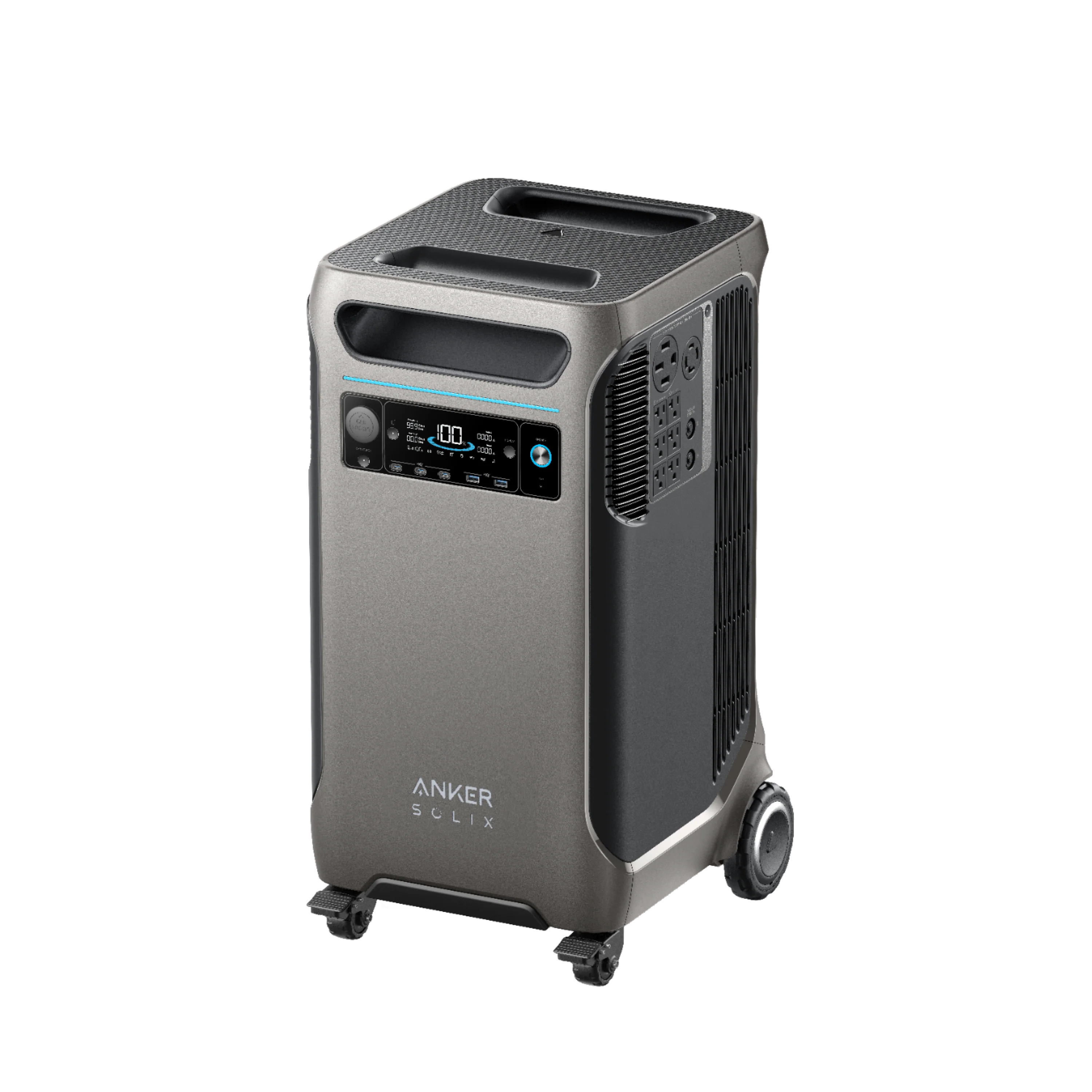
Anker SOLIX F3800Pick
Sold on Amazon · today’s price is on the listing

BLUETTI AC500 + 2×B300K
$3,299.00
$3,299.00 · direct from BLUETTI
down from $3,948 · 16% below usual
Last checked 16 days ago. Prices move — check before you buy.
Prices may vary by retailer and are subject to change.