Head-to-head test
Anker SOLIX F3800 PLUS vs BLUETTI AC500 + 2×B300K
The BLUETTI packs 44% more battery and starts hard motors more gracefully, but unless your outages run past a single night or your off-grid days are genuinely huge, you're paying a premium and hauling 64 extra pounds for reserve you'll never spend. Buy the Anker.
Full profiles: Anker SOLIX F3800 PLUS → · BLUETTI AC500 + 2×B300K →

Written by Gunner GustafsonUpdated
Whole-Home Backup Tester, Station Arena Test Desk
Spec deltas
The BLUETTI AC500 stack runs $3,948 to the Anker F3800 Plus's $2,600 — $1,348 more — and what that premium buys is 1,690 Wh of extra battery, a 44% jump in capacity. Whether that trade is worth it is the whole matchup, and for most buyers it isn't.
Both units are so far past what a normal blackout or a work-from-home day asks that the extra battery mostly sits there charged; the everyday scenarios draw only a fraction of either pack. The BLUETTI's capacity turns into something you can actually feel in just two places: an outage that runs past a single night, and an off-grid day heavy enough that the Anker runs dry and the BLUETTI, barely, doesn't.
So unless you're buying for multi-day outages or a genuinely heavy daily draw, the Anker is the smarter box — cheaper, 64 pounds lighter, 1,000W more continuous output, and a clear 5-year warranty you can point to. The BLUETTI is the better unit on raw capacity and the more graceful starter of hard motors. It just charges a premium, in dollars and on your back, for headroom the median buyer never spends.
What the Numbers Reveal
Each conclusion stated first — the numbers behind it on one line, the full analysis below.
Capacity
That capacity premium only converts to value in the two heavy cases — a multi-night outage or a big off-grid day; in the four common ones, the cheaper Anker delivers the identical result.
BLUETTI 5,530 Wh vs Anker 3,840 Wh (1,690 Wh more)CPAP night uses ~10% of the Anker's usable pack, a workday ~28%, a tailgate ~21%the extra capacity is what the higher price pays for
Why it mattersIf your real loads are everyday-size, you're paying for reserve you'll watch on the display but never actually draw down.
cost / lifetime kWh
That's 9.6 years of cycling it every single day, or 33.7 years of weekend use, and a typical backup owner replaces, resells, or forgets the unit long before the per-kWh math ever repays the higher purchase price.
BLUETTI $0.20 per lifetime kWh vs Anker $0.23BLUETTI 19,355 total lifetime kWh vs Anker 11,520full rated life is 9.6 years of daily cycling or 33.7 years of weekends
Why it mattersOnly a heavy daily cycler — off-grid living, daily solar-shifting — is on the unit long enough to collect BLUETTI's lifetime savings; everyone else is buying it for the capacity, not the economics.
continuous output
If your nightmare is a compressor or well pump that spikes on startup, the BLUETTI's 2x cushion is the safer catch; if it's running a full panel simultaneously, the Anker's 6,000W ceiling is the higher sustained wall.
BLUETTI 10,000W surge over 5,000W continuous (2x)Anker 9,000W surge over 6,000W continuous (1.5x)fridge, AC and pump motors draw 2-3x their rated wattage at startup
Why it mattersBuy to your actual failure mode — one hard-starting motor points to the BLUETTI, a lot of things running at once points to the Anker — not to whichever surge number is bigger.
solar input
In a multi-day outage with daytime sun, that faster daily refill narrows the capacity gap that looks decisive on paper; the BLUETTI's bigger reserve matters most in the one case it can't refill — a sunless stretch.
Anker 3,200W solar input into 3,840 WhBLUETTI 3,000W solar input into 5,530 What rated input from empty: Anker ~1.2h, BLUETTI ~1.8h of perfect sun
Why it mattersIf your emergency plan includes solar, weigh the Anker's quicker daily top-up against raw capacity; if you're planning for days of clouds, the BLUETTI's buffer is what carries you.
The specific dimensions that decide these two units — everything else is a tie.
Lifetime Value
Selected because: The BLUETTI costs $1,348 more, and its only cost advantage — $0.20 per lifetime kWh against $0.23 — takes years of cycling to pay back; whether it ever does is the heart of this decision.
cost / lifetime kWh
Start with the sticker gap, because it's the biggest number here: the BLUETTI costs $1,348 more. In pure energy accounting that premium does buy a lower lifetime cost per kilowatt-hour — $0.20 against the Anker's $0.23 — but two things blunt it. At the nameplate the Anker is actually the cheaper battery, $0.68 per watt-hour to the BLUETTI's $0.71; the BLUETTI only edges ahead once the cost is spread across every cycle of the pack's full rated life.
And that's a long spread. You're fronting a large sum today to save three cents a kilowatt-hour over a couple of decades of use. For someone who will truly cycle the pack to the end of its life, the math is real and the BLUETTI is the cheaper energy. For a backup buyer who runs it a couple dozen times a year, the premium quietly never comes back — the unit will be old news before the per-kWh arithmetic catches up to the purchase price.
Your Life, Your Pick
Selected because: Capacity is what the extra money buys, so it matters which real jobs actually use it: only two of six here draw enough to notice, and four leave it sitting charged.
Run the two through six common jobs and a clean pattern drops out: capacity decides nothing in four of them and everything in two. A CPAP night, a work-from-home day, a tailgate, a weekend away — each pulls only a slice of either pack, so weight and price make the call, not watt-hours.
The extra battery only earns its keep in the two heavy cases: an outage that stretches past a single evening, and an off-grid day big enough that the smaller Anker can't finish it. Review testers running a fridge and freezer together drained an F3800 Plus in about 7.3 hoursA5 — a useful gut-check on how fast a real household load eats a pack. If neither of those two cases is your actual life, the capacity contest is theater, and you should choose on everything else.
What the Specs Don't Tell You
Selected because: A 64-pound weight gap and an each-way inverter split — the BLUETTI surges higher, the Anker sustains 1,000W more — are the daily-use realities the spec table flattens into single rows.
rated cycles
Two things the spec sheet flattens here: what these weigh, and how their inverters really behave. Weight is the one you feel every time you touch it — a 64-pound gap turns 'a lift two people can manage' into 'furniture,' and since both are effectively stationary anyway, that heft is a cost the bigger unit charges for capacity you may not even use.
The inverter question cuts the other way, and it has no single winner. The BLUETTI absorbs a motor's startup surge more gracefully; the Anker sustains 1,000W more continuous load (6,000W to 5,000W). One starts a hard motor better, the other runs a busy panel longer. Which is 'more powerful' depends entirely on which failure you're guarding against — a compressor that won't kick on, or a breaker-tripping pile of simultaneous loads.
Brand Trust
Selected because: On a $2,600-to-$3,948 unit you can't easily ship back, each brand's support record and out-of-box quality is part of what you're paying for.
Both brands ask you to accept some support risk on a unit you can't just drop in a return box. Anker's SOLIX support has slipped from a genuinely excellent baseline toward AI-driven agents that hand out generic answers, with hazmat logistics turning any heavy-unit return into a project — and the field record shows the spread: one owner was ghosted across five emails over a battery-pack fault after spending five figures on the lineA1, even as another reported fast advanced replacementA2.
BLUETTI's is blunter. It has the most inconsistent support in the category, and on a nearly four-thousand-dollar purchase that stings more, because the recurring owner complaint is a unit that needed help straight out of the box — a dead inverter or a missing battery-link cableB6B7. The apps are a wash; both are well-liked, so the difference isn't the software but what happens when the hardware needs a human. The one concrete tiebreaker is the warranty: Anker's 5-year coverage is clear and unconditional, while BLUETTI's is the registration-dependent kind — shorter if you buy through a reseller, longer only if you buy direct and register.
Strengths & trade-offs
Anker SOLIX F3800 PLUS
Strengths
- +Costs $1,348 less
- +Lighter by 63.8 lb
- +Higher AC output
- +Longer warranty
- +Faster solar charging
Trade-offs
- –Very heavy unit that may be difficult for one person to lift.
BLUETTI AC500 + 2×B300K
Strengths
- +Larger battery capacity
Trade-offs
- –Substantially more expensive (+$1,348) than the SOLIX F3800 PLUS.
- –Significantly heavier (+63.8 lbs), making it harder to move.
- –Weaker inverter (-1,000W) limits appliance compatibility.
- –Very heavy unit that may be difficult for one person to lift.
Will It Power Your Gear?
Scenario math and per-appliance runtimes, modeled from the spec record.
Scenario verdicts
We ran the math on six real-world scenarios. Here's which unit survives your actual life.
SCN-01 · 2 nights · needs 2,100Wh
Weekend Camping
Two nights off-grid with essential comfort
Neither unit
Neither of these goes camping. At 132 and 196 pounds, the F3800 Plus and the AC500 stack are appliances you install, not gear you pack — the 2,100 Wh a weekend needs is trivial for either, but the getting-there is the problem. If 'camping' means a built-out trailer with a bay to bolt one into, fine. If it means a tent and a trunk, this is the wrong class of product entirely.
Battery budget usedlower = more headroom
LOAD Phone Charger 15W×6h · LED Lights 40W×8h · Box Fan 75W×14h · CPAP Machine 40W×16h
SCN-02 · 8 hours · needs 1,645Wh
8-Hour Blackout
Keep the essentials running through a night without power
AC500 + 2×B300K
Both make it to morning; the question is what's left at dawn. The AC500 stack ends the night at 35% used, 3,056 Wh still in reserve — most of two more nights like it. The Anker finishes at 50%, 1,619 Wh left, a hair under a second night. If your outages reliably end by breakfast, that gap is academic. If they have a habit of dragging into a second evening, it's the entire reason to buy the bigger pack.
Battery budget usedlower = more headroom
LOAD Fridge 150W×8h · Router + Modem 20W×8h · LED Lights (4 bulbs) 40W×6h · Phone Charger 15W×3h
SCN-03 · 8 hours · needs 320Wh
CPAP Overnight
Sleep therapy without interruption — the #1 medical use case
Either unit
A CPAP pulls about 40W, so a full eight hours is roughly 320 Wh — a tenth of the Anker's usable pack, seven percent of the BLUETTI's. Capacity is a non-issue; either could run your machine for most of a week. And neither maker publishes a fan-noise figure, so the one spec that actually matters two feet from your pillow is the one you can't read off the box. Decide on weight and price instead — and there the lighter, cheaper Anker leads.
Battery budget usedlower = more headroom
LOAD CPAP Machine 40W×8h
SCN-04 · 8 hours · needs 910Wh
Remote Workday
Full work day off-grid without power anxiety
Either unit
Both power your workstation all day without strain, and their USB-C output is a wash — pick on weight, ports, or price.
Battery budget usedlower = more headroom
LOAD Laptop 60W×8h · External Monitor 30W×8h · Router + Modem 20W×8h · Phone Charger 15W×2h
SCN-05 · 4 hours · needs 670Wh
Tailgate Party
Game day power for the crew
Neither unit
Scoring these two at a tailgate is a category error: neither travels — the SOLIX F3800 PLUS is 132.3 lbs and the AC500 + 2×B300K 196.1 lbs, and at those weights they roll off a truck bed if they go anywhere at all. The 670Wh here is trivial for either — it's the going that doesn't happen. If you need power away from the building, you're shopping the wrong class.
Battery budget usedlower = more headroom
LOAD Blender 400W×0.5h · LED TV (55") 80W×4h · Bluetooth Speaker 15W×4h · Phone Charger (×3) 45W×2h
SCN-06 · 24 hours · needs 4,685Wh
Van Life Daily
A full day of mobile living — the ultimate endurance test
AC500 + 2×B300K
This is the one job where the capacity gap stops being theoretical. A 4,685 Wh day is more than the Anker can hold — it covers about 69% and taps out 1,421 Wh short. The AC500 stack finishes the same day with 16 Wh to spare, which is to say it just barely makes it. If your daily off-grid draw is genuinely this high, only one of these two gets you to bedtime; just don't mistake that 16 Wh for comfortable margin.
Battery budget usedlower = more headroom
LOAD Mini-Fridge 150W×24h · Laptop 60W×4h · Phone Charger 15W×3h · LED Lights 40W×5h · Fan 75W×8h
The Load Test
RUNTIME = (Wh × 0.85) ÷ LOAD
None of the scenarios above exactly yours? Build it. Toggle what you'd plug in; both units are tested against the combined draw.
Essentials
Comfort & Convenience
High-Draw Appliances
Test duration
8h
Continuous draw
205W
Projected runtime
For this load: AC500 + 2×B300K runs 22.9h vs 15.9h.
$3,948 list · direct from BLUETTI
Planning for more than this? Describe your whole setup and get it sized →
Modeled from the spec record — same math as the tables below. Methodology
Runtime by appliance
Real-world runtime estimates for common appliances, modeled at 85% inverter efficiency.¹
Essentials
The basics you need runningscale 0–313.4hComfort & Convenience
Makes off-grid life actually enjoyablescale 0–62.7hHigh-Draw Appliances
These reveal the real limitsscale 0–4.7h¹ Runtime = (capacity × 0.85) ÷ appliance watts. Within each group, all bars share one time scale (the group's longest runtime), so lengths are comparable across appliances; identical runtimes collapse into a single blue/orange bar. Actual runtime varies with battery age, temperature, and simultaneous loads — see methodology.
Conclusion
August 30, 2026
Verdict: the SOLIX F3800 PLUS
Buy the Anker F3800 Plus unless you have a specific, capacity-hungry reason not to. It's the cheaper unit, 64 pounds lighter, puts out 1,000W more continuous power, and backs it with a clear 5-year warranty — and in four of the six common scenarios (CPAP, work-from-home, tailgate, weekend) the BLUETTI's extra 1,690 Wh never gets touched. The BLUETTI earns its premium only in the narrow band where capacity actually binds: outages that run past a single night, a daily off-grid draw big enough to sink the Anker, or hard-starting motors that lean on its 2x surge headroom. For the median backup buyer, none of those apply, and the lighter, cheaper unit does the identical job.
Today the AC500 + 2×B300K is $3,299, $649 under its typical $3,948. The verdict weighs typical prices, not today's. Prices checked 16 days ago.
Editor-assigned confidence, based on cited owner research and spec analysis.
List prices as of August 30, 2026. The links below open Anker's and BLUETTI's current prices.
Sold on Amazon · today’s price is on the listing
or check the AC500 + 2×B300K price$3,299.00 list
Written by Gunner Gustafson, Whole-Home Backup Tester · Station Arena Test Desk · Updated August 30, 2026
Black Friday · 38 days out
Price to beat:AC500 + 2×B300K $3,299
The lowest we have recorded. A Black Friday price above it is a sale this unit has already had.
Measured Data
Benchmark scores and the full spec record, side by side.
Benchmark scores
Not rated for both units (minimum threshold unmet): RV Living, Solar Generator.
Full specifications
ᵈ Derived: price ÷ rated capacity. See the data behind our comparisons →
Comparison ToolAdd more power stations, side by sideOpen Tool →How these numbers are produced
Numeric verification
Every figure on this page traces to our spec database or arithmetic on it — no estimated numbers.
Owner claims
Statements about owner experience are cited to published reviews — see Sources & Research Notes below.
Runtime model
Runtime = (rated capacity × 0.85 inverter efficiency) ÷ device wattage. Solar recharge estimates assume panels deliver 70% of rated output. Cold weather, battery age, and stacked loads reduce real-world results.
Power Score
Computed from 14 published spec dimensions, weighted per use-case bench. Higher is better; a unit must meet a bench's minimum threshold to be rated.
See the full weight table and data sourcing on our methodology page →Class ranking (the star rating)
Each unit's star score is a category ranking, not customer reviews — no buyer opinions feed it. We score every station on size-independent quality (value, output, portability, endurance, ports, warranty, and more), then percentile-rank it against the other units in its capacity class, so a class-leading compact unit and a class-leading whole-home unit can both earn 5★. Here, SOLIX F3800 PLUS rates 4.4/5 (63rd percentile of 20 Home Backup-class units), and AC500 + 2×B300K rates 4.1/5 (47th percentile of 20 Home Backup-class units).
How the class ranking is computed →Test Notes & Caveats
Hidden gotchas and advantages we spotted that you won't find on the product page.
Weight Reality Check
Two-person, bent-knees, mind-the-stairs territory for both — but 64 pounds separates them. The Anker's 132 lbs is a lift two people can wrestle into a truck bed; the BLUETTI's 196 is closer to furniture you position once and leave. Whichever you pick, decide where it's going to live before it arrives, because casually relocating either one is not on the menu.
AC500 + 2×B300K: Power Lifting to 6,000W
The AC500 + 2×B300K has BLUETTI's Power Lifting mode, which runs a resistive appliance rated up to 6,000W from its 5,000W inverter. It does that by delivering less power than the appliance asks for, not more than the inverter has: the heater still works, it just heats more slowly. Two things follow. BLUETTI scopes the mode to purely resistive loads — a heater, a kettle, an incandescent lamp — so it does nothing for a fridge compressor, a pump or a power tool; for motor loads the figure to read is the AC500 + 2×B300K's separate 10,000W surge peak, not this one. And it is not a reason to size down, because running a load that big from 5,530Wh is a short session either way. Genuinely useful if a heater or a kettle is why you're buying; beside the point otherwise. The SOLIX F3800 PLUS publishes no equivalent.
The Surge-vs-Sustain Split
The AC500 stack holds a 2x surge ratio — 10,000W peak over 5,000W continuous — against the Anker's 1.5x (9,000W over 6,000W). That extra momentary headroom is what absorbs the 2-3x spike a fridge, AC compressor, or well pump throws at startup, so the BLUETTI is the surer bet for hard-starting motors. The counterpoint: the Anker sustains 1,000W more continuously, so for running many things at once rather than starting one big one, it's the taller wall. Match it to the load you actually have.
Warranty: 5 Years vs 4
The SOLIX F3800 PLUS is covered for 5 years against the AC500 + 2×B300K's 4 years. An underrated factor if you're keeping this unit for years.
Full record above — the Test Desk pick is the SOLIX F3800 PLUS.
Check SOLIX F3800 PLUS price →or check the AC500 + 2×B300K priceOwnership Analysis
What happens after you buy — true cost of ownership, brand trust, and growth potential.
Lifetime value
Service lifeyears at one full cycle per day
Lifetime energy delivered
Cost per delivered kWh
│ warranty ends · Reaching the cycle rating means ~80% capacity remains — degraded, not dead.
Analyst note
The SOLIX F3800 PLUS is cheaper to buy, but the AC500 + 2×B300K is cheaper to own. At $0.20/kWh over its lifetime vs $0.23/kWh, the AC500 + 2×B300K's higher cycle life and capacity make each dollar go further over the years.
Brand trust
Anker
Ecosystem
7-8 SOLIX portable power stations across C-series (compact) and F-series (flagship), plus the X1 home energy system
Support
US-based support. Historically known for incredible no-hassle replacements, but recent reports describe AI-driven support agents giving generic responses and complex return logistics for heavy units (hazmat shipping). The Anker brand reputation is still strong, but SOLIX-specific support quality is trending down.
Community
Moderate — active Reddit (r/Anker, r/AnkerSOLIXCommunity) and growing. Benefits from Anker's massive consumer electronics brand awareness.
App experience
Rated 4.5/5 iOS (~1,100 ratings) · 4.3/5 Android
Unique strength
Parent brand trust from Anker's consumer electronics dominance. InfiniPower technology for long cycle life. Strong $/Wh value in the mid-size and larger units — the S2000, F2600 and C1000 are among the better buys per watt-hour in the catalog.
Worth knowing
Support quality appears to be declining from its historically excellent level. Firmware updates have removed features without warning. Expansion ecosystem is smaller than EcoFlow's.
BLUETTI
Ecosystem
One of the broadest lineups — 15-20+ models from budget (AC2A) to flagship portable (Apex 300, 2764.8Wh). Includes specialized products: vehicle solar hubs, sodium-ion cold-weather units, and balcony storage systems.
Support
The most inconsistent support in the space. Heavily email-based with China timezone delays. Some users get smooth, efficient service; others report weeks of troubleshooting runarounds, being offered discounts on new units instead of repairs, and confusing third-party purchase claim processes. Buying direct from Bluetti's website tends to produce better support outcomes.
Community
Active and growing — Reddit r/bluetti has a dedicated community. Second-largest after EcoFlow in engagement.
App experience
Rated 4.5/5 iOS and Android — tied for best app experience in the category. V3.0 UI redesign was well-received.
Unique strength
Among the best capacity-to-price ratios available — several Elite and Apex units are the lowest $/Wh in the catalog. Widest product diversity including industry-firsts like sodium-ion cold-weather units and dual solar+alternator vehicle hubs. LFP across the rest of the range, though rated cycle life spans 2,500 (EB3A) to 6,000, and it varies WITHIN the Elite range rather than tracking it — the Elite 300 and Elite 200 V2 are rated 6,000 while the Elite 30 V2, Elite 10 Mini, Elite 320 and Elite 400 are rated 3,000+ and the Elite 100 V2 4,000+, so check the specific model. Dual-voltage (120V/240V) in flagships.
Worth knowing
Customer support inconsistency is the #1 risk factor. Older/discontinued units may become unrepairable — no spare parts policy for some models. Some reports of erratic communication from support agents.
Analyst note
Anker and BLUETTI are close competitors. Both have established support channels and growing ecosystems. Compare their specific warranty terms and community size for your peace of mind.
Growth path
SOLIX F3800 PLUS
EXPANDABLESupports Anker expansion batteries, so you can add capacity later without replacing the base unit — useful if your needs may climb past 3,840Wh.
Accepts up to 3,200W of solar. Enough for a serious multi-panel array.
Generous port selection supports complex multi-device setups.
Expansion batteries are Anker-specific. You're investing in the Anker ecosystem.
AC500 + 2×B300K
EXPANDABLESupports BLUETTI expansion batteries, so you can add capacity later without replacing the base unit — useful if your needs may climb past 5,530Wh.
Accepts up to 3,000W of solar. Enough for a serious multi-panel array.
Adequate ports for most setups, but heavy users may want a power strip.
Expansion batteries are BLUETTI-specific. You're investing in the BLUETTI ecosystem.
Realistic full solar rechargeat 70% of rated panel output — see methodology
Analyst note
Both expand, so neither locks you out of growth — decide on capacity, price, and the rest, not the expansion checkbox.
What Owners Report
Patterns from published owner reports and long-term reviews — every claim cited to its source below.
Anker SOLIX F3800 PLUS
Genuine long-term owner reports on the F3800 Plus specifically are thin — a search turned up no Reddit threads and just one owner-forum account, with most of the field record coming from review-site testers who lived with the unit for weeksA0. What exists splits hard on support: one owner spent over $20k on a SOLIX setup and got ghosted across five emails over an alarming battery-pack noiseA1, while another SOLIX owner in the same thread reported fast, no-hassle advanced replacementA2 — though that reply may describe a sibling model, so read it as character, not proofA2. On runtime, testers put light loads (lights, fridge, a laptop) near 17 hours and a fridge-and-freezer pair at about 7.3 hoursA4A5, and fan noise stays in the background until you push past 4,000W or charge at full speedA10A12. The wheels handle a driveway but balk at rough groundA8.
“I've called them and submitted tickets via their portal, always very responsive. They've even done advanced replacement for me.”
Sources
campingsolar.us · cleanenergybusinesscouncil.com
BLUETTI AC500 + 2×B300K
There are no owner reports on the exact two-battery AC500 configuration — every account describes the AC500 with a single B300K, the same inverter and the same battery model just wired one-to-one instead of one-to-two, so the fan, app, and support notes carry over even if you'd double the runtime figuresB0. The recurring worry is what shows up in the box: testers report units arriving with a dead inverter, or missing the cable that links the battery to the main unit — both needing a support ticket to resolveB6B7. Owners do like the quiet, one calling it quieter than his Pecron unitB1, though fan flare-ups under load get flagged tooB10. The gripes are small but real: an app that shows battery percent but no time-remaining or voltageB2, no hard-reset button when it glitchesB8, and status lights bright enough that one reviewer warned against sleeping in the same roomB11. When it works, it 'performed near flawlessly from day one'B12.
“So far pretty darn happy, and it's much quieter than the small Pecron E1500LFP I have.”
Sources
firewoodhoardersclub.com · thesolarlab.com · freshlycharged.com · diysolarforum.com
Sources & Research Notes
Every owner claim in this report is traceable to a published source. The bracketed references above resolve here.
Recurring owner themes
- Owner support experiences with Anker/Solix diverge sharply — some report being ghosted after repeated contact attempts over a hardware fault, while others describe fast, responsive advanced-replacement service. [SOLIX F3800 PLUS · 2 entries]
- Real-world runtime drops off steeply with load: light loads (lights, router, occasional laptop/e-bike charging) stretch toward the ~17-hour mark, but running a fridge and freezer together drains the base unit in around 7 hours. [SOLIX F3800 PLUS · 2 entries]
- Fan noise is reported as low/background during normal household loads and only becomes noticeably audible under heavy loads (4,000W+) or max-speed charging. [SOLIX F3800 PLUS · 2 entries]
- The unit's near-137 lb weight is a recurring friction point: reviewers note the wheels/handles work for moderate use but struggle over rough terrain, and aggregated user feedback flags portability and packaging as concerns despite praise for raw performance. [SOLIX F3800 PLUS · 2 entries]
- Multiple sources report AC500 units arriving with hardware faults — a dead inverter or a missing battery-link cable — that required contacting Bluetti support. [AC500 + 2×B300K · 2 entries]
- Fan noise is intermittent but noticeable during charging/heavy load across sources, though one owner found it quieter than a competing unit. [AC500 + 2×B300K · 2 entries]
- The app covers the basics but owners want more detail (time-remaining, battery voltage), and the unit lacks a hard-reset option to recover from glitches. [AC500 + 2×B300K · 2 entries]
- A1
“I think it may be a fire hazard with this crazy noise it's making. I have emailed Anker support over 5 times... Anker support is ghosting me after I spent over 20k on their solix line and solar panels within a month.”
DIY Solar Forum — "Big issue with Anker Solix F3800 plus battery pack (Large Anker Solix setup)" · 2025-08 · [negative]
- A2
“I've called them and submitted tickets via their portal, always very responsive. They've even done advanced replacement for me.”
DIY Solar Forum — "Big issue with Anker Solix F3800 plus battery pack (Large Anker Solix setup)" (reply from another Solix owner) · 2025-08 · [positive]
- A4
“You would be able to keep a fridge or freezer running, charge a few laptops or phones, maybe charge up an e-Bike and the F3800 Plus base unit would last about 17 hours before needing a recharge.”
Digital Trends — "Anker Solix F3800 Plus review: this power station wins for versatility and value" · 2025-05 · [positive]
- A5
“With both the freezer and my fridge plugged in at the same time, I was about to get 7.34 hours before the unit was completely drained.”
Digital Trends — "Anker Solix F3800 Plus review: this power station wins for versatility and value" · 2025-05 · [mixed]
- A8
“The big wheels in the back are enough to go over grassy terrain, but avoid anything too challenging. Small bumps can be enough to slam everything to a halt.”
AppleInsider — "Anker Solix F3800 Plus portable power station review: investment in reliable home power" · 2025-08 · [mixed]
- A10
“Under normal loads (lights, fridge, TV), the fans are barely audible. It only gets loud when you're pulling over 4,000W or charging at max speed.”
CampingSolar.us — "Anker SOLIX F3800 Plus Review: The Ultimate 240V Home & RV Power" · 2026-02 · [positive]
- A12
“It doesn't match the whisper-quiet performance of the EcoFlow Delta Pro Ultra, which remains one of the quietest power stations we've ever tested, but the F3800 Plus is still surprisingly quiet, even when you're really pushing it.”
TheSolarLab — "Anker SOLIX F3800 Plus Review: Big Power, Big Price?" · unknown · [positive]
- B1
“So far pretty darn happy, and it's much quieter than the small Pecron E1500LFP I have.”
firewoodhoardersclub.com — jtakeman, "Bluetti AC500 w/B300K battery for our home backup/supplement system install and review" · 2025-02 · [positive]
- B2
“One other odd thing — it doesn't have a time-of-charge-remaining readout like my EF or Pecron units, just battery percentage. They don't even display battery voltage.”
firewoodhoardersclub.com — jtakeman, AC500 w/B300K install and review thread · 2025-02 · [negative]
- B6
“Got a hold of Bluetti support — seems they forgot to ship the cable connecting the main unit to the battery.”
firewoodhoardersclub.com — jtakeman, AC500 w/B300K install and review thread · 2025-02 · [negative]
- B7
“Both the AC300 and AC500 we tested had issues where the battery would turn on but not the inverter itself — dead on arrival, essentially.”
thesolarlab.com — Bluetti AC500 Review: Pros, Cons & the Ugly Truth · unknown · [negative]
- B8
“The lack of a hard reset button on these units is also really frustrating.”
thesolarlab.com — Bluetti AC500 Review: Pros, Cons & the Ugly Truth · unknown · [negative]
- B10
“The fan can get loud, though it's only intermittent and doesn't run constantly.”
freshlycharged.com — Powering A Room with Solar: Bluetti AC500 & B300K Review · unknown · [mixed]
- B11
“The indicator lights are quite bright and remain on all the time, so it's best not to keep the AC500 in a room where you'll be sleeping.”
freshlycharged.com — Powering A Room with Solar: Bluetti AC500 & B300K Review · unknown · [negative]
- B12
“Performed near flawlessly from day one, with easy-to-understand setup and a nice app for monitoring.”
diysolarforum.com — "Bluetti ac 500" owner thread · unknown · [positive]
Research compiled August 30, 2026.
Who Should Buy Which
Buy the SOLIX F3800 PLUS if you…
- →You want serious home backup without the BLUETTI's price and bulk: the Anker is the cheaper unit, 64 pounds lighter, and comes with a clear 5-year warranty to fall back on.
- →Your outages are the ordinary kind — a few hours, one evening — where 3,840 Wh is already more than you'll draw and a bigger pack would just sit there charged.
- →You'll move it now and then, even just garage to driveway. At 132 lbs it's a two-person lift you can manage; 196 lbs is a decision you make once and never revisit.
- →You run a lot at the same time. The 6,000W continuous ceiling is 1,000W higher than the BLUETTI's — the taller wall when the whole panel is humming at once.
Buy the AC500 + 2×B300K if you…
- →Your outages have a habit of running long, into a second evening. The AC500 stack ends a normal night with most of two more like it still in reserve; the Anker has under one.
- →Your daily off-grid draw is genuinely big — the kind that runs the Anker dry before bedtime. This is the only one of the two that finishes that day, and it's the clearest reason to accept the weight and the price.
- →You're starting hard motors like a well pump or a big compressor. The 2x surge headroom, up to 10,000W, is the surer catch than the Anker's 1.5x.
- →It's going into one fixed spot and never moving again, so 196 pounds simply stops being a cost you pay.
If neither fits
Shopping for something to take camping or to a tailgate? Close this tab — at 132 and 196 pounds these are install-and-leave appliances, not gear, and a compact station light enough to actually carry will serve you far better. And if your real loads are everyday-size — a CPAP, a laptop, a few phones — even the cheaper Anker here is far more battery than you'll draw down in a night; a mid-size unit costs less, weighs a fraction, and does the same job.
The Bottom Line
The BLUETTI AC500 stack is the bigger, longer-cycling, harder-starting unit, and if you're buying for multi-day outages or a heavy off-grid day, it's the one that actually finishes the job. For everyone else, it's a lot of battery you paid a premium and carried 64 extra pounds to own and never spend.
The small scenarios settle it. A CPAP draws a tenth of the Anker's pack, a workday under a third, and both units shrug off an ordinary blackout — so when capacity almost never binds, the tiebreakers are price, weight, continuous output, and a warranty you can point to. The Anker takes all four. Buy the F3800 Plus, and let the BLUETTI's reserve be someone else's line item to justify.
Frequently Asked Questions
Answers drawn from the spec record and cited owner research.
Is the BLUETTI AC500 stack worth the extra money over the Anker F3800 Plus?
Only if you'll actually use the extra 1,690 Wh. For single-evening outages and everyday loads, both are overkill, so the cheaper, lighter Anker does the same job for less. The premium pays off if your outages run multiple days, your daily off-grid draw is large enough to run the Anker dry, or you're regularly starting hard motors — where the BLUETTI's bigger pack and 2x surge headroom matter.
Which has more power, the Anker F3800 Plus or the BLUETTI AC500?
It's a split, not a knockout. The Anker sustains more continuous power (6,000W vs 5,000W), while the BLUETTI surges higher (10,000W vs 9,000W, a 2x ratio to the Anker's 1.5x). For running many appliances at once, take the Anker; for starting one hard motor like a well pump or AC compressor, take the BLUETTI.
How much do these weigh, and are they portable?
The Anker is 132.3 lbs and the BLUETTI 196.1 lbs — a 64-pound gap, and both are firmly two-person lifts. Neither is portable in any camping sense; they're install-and-leave home units. Decide where it lives before it ships.
Do both the F3800 Plus and the AC500 expand?
Yes. Both accept add-on batteries beyond their base 3,840 Wh (Anker) and 5,530 Wh (BLUETTI), so neither locks you out of more capacity later. Don't let the expansion checkbox decide this one — both pass it — decide instead on price, weight, and how much capacity you need on day one.
Which one lasts longer?
The BLUETTI is rated for 3,500 charge cycles to the Anker's 3,000, and spread across that full life its energy works out cheaper per kilowatt-hour ($0.20 vs $0.23). But 'full life' means roughly 9.6 years of daily cycling or 33.7 years of weekend use — a horizon most backup buyers never reach, which is what blunts the BLUETTI's longevity edge in practice.
Where to buy
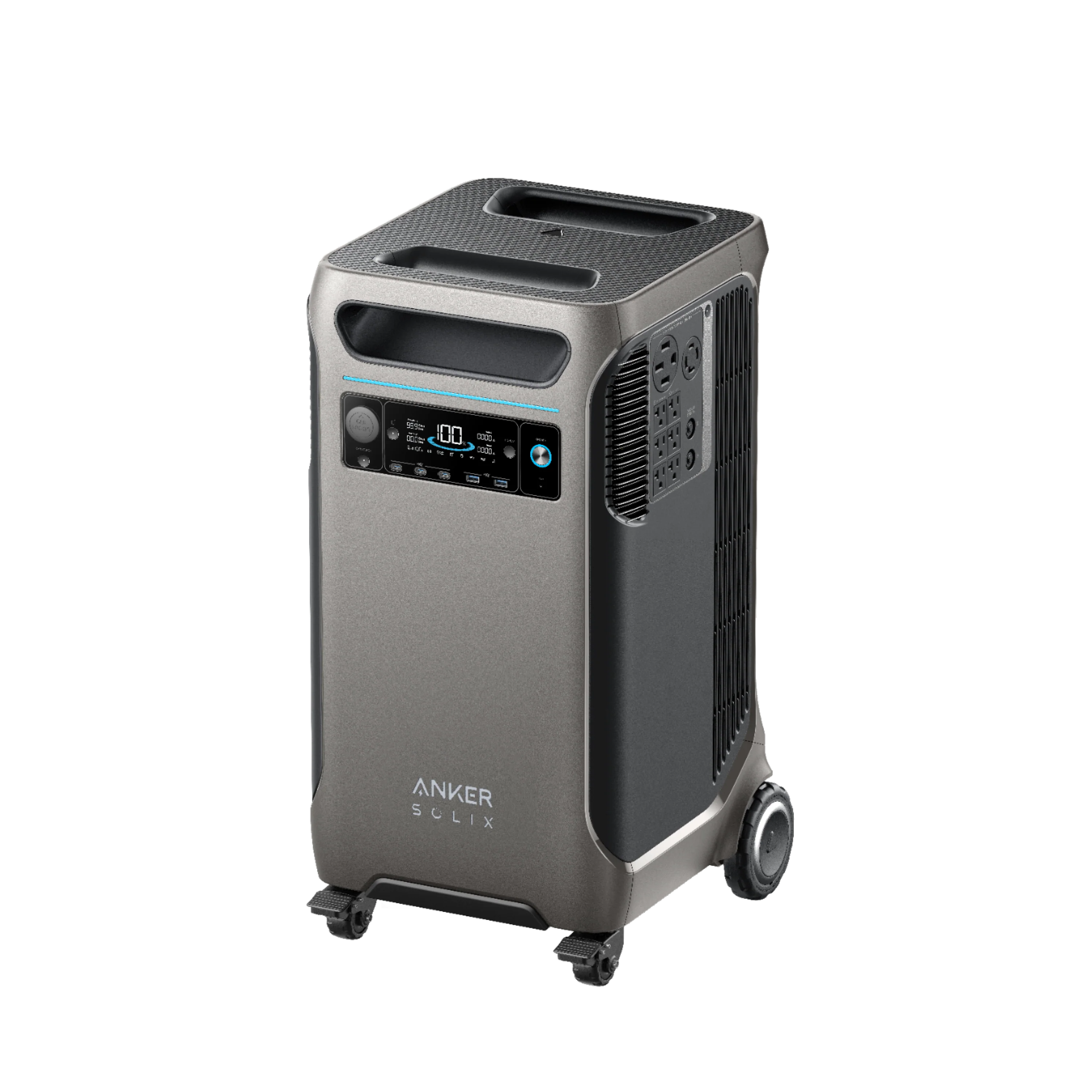
Anker SOLIX F3800 PLUSPick
Sold on Amazon · today’s price is on the listing

BLUETTI AC500 + 2×B300K
$3,299.00
$3,299.00 · direct from BLUETTI
down from $3,948 · 16% below usual
Last checked 16 days ago. Prices move — check before you buy.
Prices may vary by retailer and are subject to change.