Head-to-head test
Anker SOLIX F2000 vs Jackery Explorer 1500 Ultra
Same $999 price tag, but the F2000 packs 512 more watt-hours and an actual expansion path — the only thing standing between you and the bigger unit is that it weighs 67.2 lbs against the Jackery's 38.6, and Anker never says how loud it gets.
Full profiles: Anker SOLIX F2000 → · Jackery Explorer 1500 Ultra →

Written by Ian SchneiderUpdated
Solar & Off-Grid Tester, Station Arena Test Desk
No longer sold
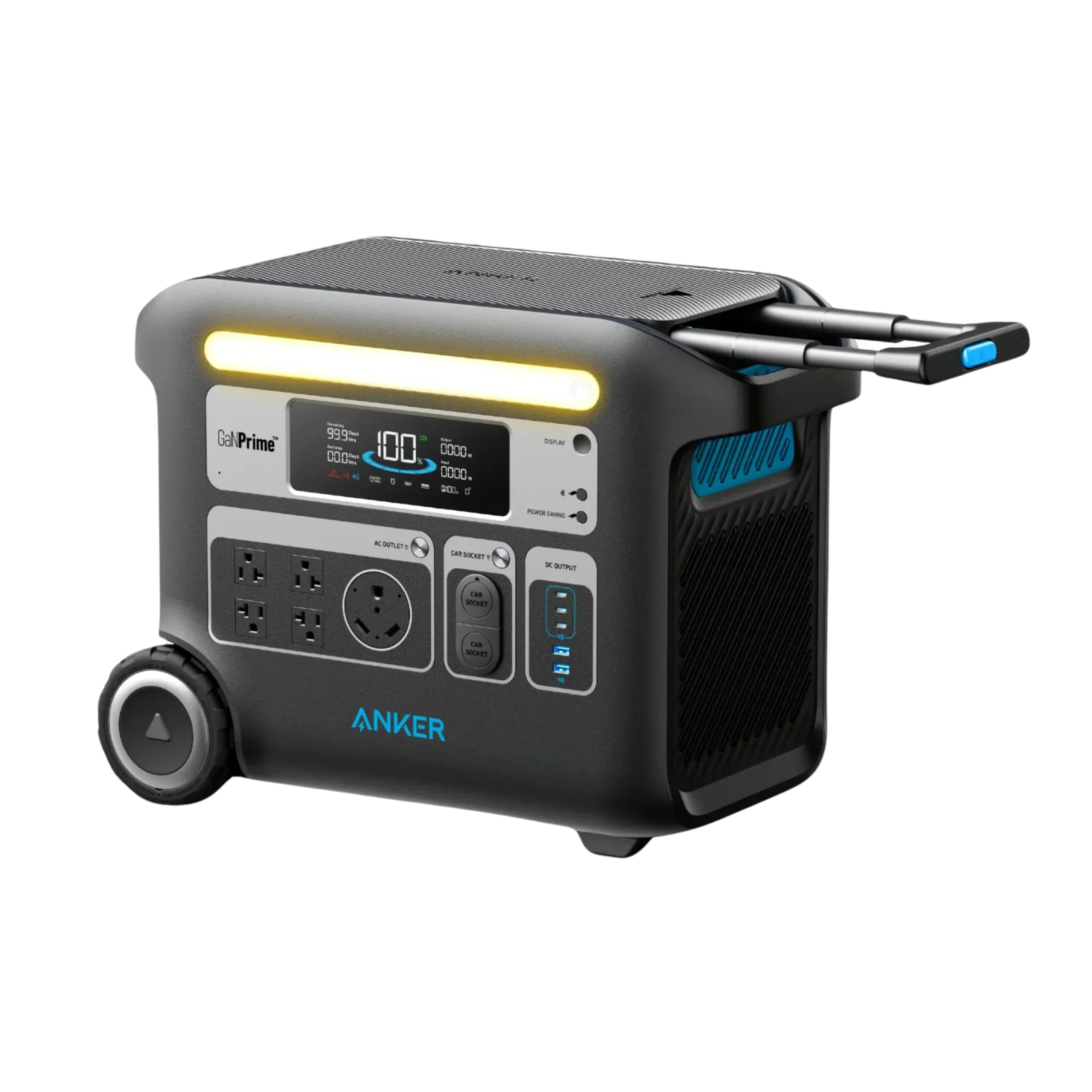
Anker no longer sells the SOLIX F2000 (PowerHouse 767). Its natural replacement is the SOLIX C2000 Gen 2 — the same 2,048Wh capacity and 2,400W output in a newer design.
SOLIX C2000 Gen 2 · $999.99
$1,199.00 · direct from Jackery
Last checked 1 day ago. Prices move — check before you buy.
Spec deltas
The SOLIX F2000 and the Explorer 1500 Ultra both cost exactly $999, and from there the specs pull apart fast. The F2000 holds 2,048Wh against the Jackery's 1,536Wh — 512 more watt-hours for the same dollar — and it's the only one of the two that actually expands: Anker sells add-on batteries, Jackery doesn't sell any at all.
That capacity shows up directly in the scenarios that matter. The F2000 wins the 8-Hour Blackout, Remote Workday, and Tailgate Party outright, finishing each with real capacity to spare while the Jackery runs closer to its ceiling or past it entirely.
None of that is free. The F2000 weighs 67.2 lbs, nearly double the Explorer 1500 Ultra's 38.6, is rated for 1,000 fewer charge cycles, and Anker never discloses a decibel figure for it — you won't know how loud it runs until it's in your living room.
What the Numbers Reveal
Each conclusion stated first — the numbers behind it on one line, the full analysis below.
Capacity
That capacity gap is exactly why the F2000 sweeps the 8-Hour Blackout, Remote Workday, and Tailgate Party scenarios: it's not a marginal win, it's the direct consequence of a battery a third larger doing what a battery its size should do.
The SOLIX F2000 and Explorer 1500 Ultra are both priced at $999The F2000 holds 2,048Wh against the Explorer 1500 Ultra's 1,536Wh
Why it mattersAnyone whose typical use looks like those three jobs should take the F2000 for free — there's no price penalty for the extra capacity here.
weight
The Explorer 1500 Ultra, at 38.6 lbs, is the one you actually pick up with two hands — no wheels, no handle system, just carry it. Which is the better fit depends entirely on your terrain: a driveway and a campsite favor the F2000's wheels, stairs and uneven ground favor the Jackery's true portability.
The F2000 weighs 67.2 lbs against the Explorer 1500 Ultra's 38.6The F2000 ships with 4.72-inch wheels and a retractable EasyTow handle, and owners cite that as the top reason they chose it over similar-spec competitorsA1
Why it mattersBuyers moving this over gravel, sand, or stairs should weight actual lift-and-carry over the spec sheet's raw pound figure; a rolling 67-lb unit can be easier to live with than a hoisted 39-lb one, or the reverse, depending on the ground it crosses.
Weigh that against the F2000's own 3,000-cycle rating against the Jackery's 4,000 — 1,000 fewer cycles on the base unit — and the trade becomes clear: Anker is betting you'll expand into more capacity rather than run the base unit to the end of its own rated life, while Jackery is betting you sized it right the first time.
The F2000 supports true capacity expansion with add-on Anker batteriesThe Explorer 1500 Ultra is a closed system with no expansion path at all
Why it mattersBuyers who expect their power needs to grow — more gear, longer trips, a partial home backup down the line — should value the F2000's expansion path highly; buyers confident their needs are fixed should weight the Jackery's longer base cycle life instead.
continuous output
A fridge or well-pump compressor can briefly draw two to three times its rated wattage at startup. The F2000's cushion between running and surge is thin relative to its own output; the Explorer 1500 Ultra, despite a lower continuous ceiling, has twice its running wattage in reserve for exactly that spike.
The Explorer 1500 Ultra's 3,600W surge is exactly double its own 1,800W continuous ratingThe F2000's 2,800W surge is only about 1.17 times its 2,400W continuous rating
Why it mattersAnyone starting a hungry compressor load close to either unit's continuous limit should check the surge math specifically — the higher-wattage unit isn't automatically the safer bet.
The specific dimensions that decide these two units — everything else is a tie.
Your Life, Your Pick
Selected because: The F2000 sweeps three of six scenarios outright on raw capacity — the clearest evidence for the verdict.
The F2000 wins 8-Hour Blackout, Remote Workday, and Tailgate Party outright, and in each case it finishes with real capacity in reserve while the Explorer 1500 Ultra either exceeds its own tank or leaves much less cushion. Weekend Camping and Van Life Daily beat both units regardless of which you buy — the F2000 gets proportionally closer on both, but neither covers the full load.
CPAP Overnight is the one job where the gap barely matters: both units use well under a quarter of their capacity, so there's no power reason to pick one over the other for that use alone.
Growth Path
Selected because: The F2000's real expansion capability against the Jackery's closed system is the single structural difference between them.
solar input
The F2000 supports genuine capacity expansion through Anker's add-on batteries — you can grow past 2,048Wh without replacing the base unit. The Explorer 1500 Ultra is a closed system for its entire ownership life; whatever you buy today is the ceiling.
That difference has real dollar value if your needs are likely to grow — more camping gear, longer trips, a partial home backup down the line. If you're confident 2,048Wh (or 1,536Wh) covers you for years, the expansion path is worth less, and the Jackery's longer 4,000-cycle base battery becomes the more relevant number instead.
What the Specs Don't Tell You
Selected because: Weight, undisclosed noise, cycle life, and surge ratio all fire for this pair and each cuts a different direction.
rated cycles
Four separate gotchas fire on this pair, and they split evenly. In the F2000's favor: it delivers more headroom in the scenarios that matter. Against it: Anker doesn't publish a decibel rating at all, so the fan behavior under its own 1,000W of solar charging is unknown territory rather than a stated spec. Its 3,000-cycle rating is also 1,000 cycles behind the Jackery's 4,000, a real gap in base battery longevity even before either unit's expansion options enter the picture.
The Explorer 1500 Ultra counters with a surge ratio that's proportionally stronger — double its continuous rating rather than the F2000's roughly 1.17 times — meaning it has more relative cushion to absorb a compressor spike despite the lower continuous number. Neither gotcha is disqualifying on its own; together they're the real substance behind the 512Wh headline.
Portability & Form Factor
Selected because: 67.2 lbs vs 38.6 lbs looks decisive on paper, but the F2000's wheels change the real handling story.
weight
On paper, 67.2 lbs against 38.6 looks like a landslide for the Jackery — the F2000 is nearly double the weight. In practice, owners consistently point to the F2000's 4.72-inch wheels and retractable EasyTow handle as the reason the weight doesn't bother them; it's the top reason cited for choosing it over similarly specced competitorsA1.
The Explorer 1500 Ultra doesn't need that solution because it doesn't have the problem — at 38.6 lbs it's a straightforward two-hand carry with no wheels required, and it adds an IP65 rating the F2000 doesn't claim. Pick the F2000 if you're rolling it across pavement or a driveway; pick the Jackery if you're carrying it over stairs, sand, or anywhere wheels don't help.
Brand Trust
Selected because: Anker's support is trending down from a historically strong baseline; Jackery's has long drawn criticism — worth naming plainly for a cross-brand pick this close.
Anker's SOLIX support was historically excellent, but recent reports describe AI-driven agents giving generic responses and complicated return logistics for a unit this heavy — a decline from the brand's reputation, even as the parent Anker name still carries broad consumer trust. Jackery's support draws similar complaints: slow responses, scripted agents, and strict receipt requirements, with buying through Costco or Amazon recommended for better return protection.
Neither brand's support should factor heavily into this decision — both are mixed at best. Anker's app scores meaningfully higher than Jackery's, though, which matters if you plan to monitor or schedule charging remotely on either unit.
Strengths & trade-offs
Anker SOLIX F2000
Strengths
- +Costs $299 less
- +Larger battery capacity
- +Higher AC output
- +Faster solar charging
Trade-offs
- –Significantly heavier (+28.6 lbs), making it harder to move.
- –Shorter-lived battery — rated for 3,000 charge cycles vs the Explorer 1500 Ultra's 4,000, so it wears out sooner.
Jackery Explorer 1500 Ultra
Strengths
- +Lighter by 28.6 lb
- +Rated for 4,000 charge cycles — much longer battery lifespan
Trade-offs
- –Substantially more expensive (+$299) than the SOLIX F2000.
- –Weaker inverter (-600W) limits appliance compatibility.
- –Sealed capacity — the SOLIX F2000 can add batteries to grow past 1,536Wh; this one can't.
Will It Power Your Gear?
Scenario math and per-appliance runtimes, modeled from the spec record.
Scenario verdicts
We ran the math on six real-world scenarios. Here's which unit survives your actual life.
SCN-01 · 2 nights · needs 2,100Wh
Weekend Camping
Two nights off-grid with essential comfort
Neither unit
Neither unit covers this scenario's 2,100Wh: the SOLIX F2000 comes up 359Wh short (about 83% covered), the Explorer 1500 Ultra 794Wh (62%). Either gets you most of the way, so this is a scenario you plan around rather than one you should rule them out for.
Battery budget usedlower = more headroom
LOAD Phone Charger 15W×6h · LED Lights 40W×8h · Box Fan 75W×14h · CPAP Machine 40W×16h
SCN-02 · 8 hours · needs 1,645Wh
8-Hour Blackout
Keep the essentials running through a night without power
SOLIX F2000
The Explorer 1500 Ultra doesn't finish — 1,306Wh usable against the 1,645Wh this needs leaves it 339Wh short, about 79% of the scenario covered. The SOLIX F2000 covers it with 96Wh to spare.
Battery budget usedlower = more headroom
LOAD Fridge 150W×8h · Router + Modem 20W×8h · LED Lights (4 bulbs) 40W×6h · Phone Charger 15W×3h
SCN-03 · 8 hours · needs 320Wh
CPAP Overnight
Sleep therapy without interruption — the #1 medical use case
Either unit
A CPAP is about 40W for eight hours, so both cover the night with room to spare and capacity decides nothing. Fan noise would — but SOLIX F2000 doesn't publish a figure, so there's nothing to hold it to. Buy on price, weight, and whether you can live with a fan you haven't heard.
Battery budget usedlower = more headroom
LOAD CPAP Machine 40W×8h
SCN-04 · 8 hours · needs 910Wh
Remote Workday
Full work day off-grid without power anxiety
SOLIX F2000
The SOLIX F2000 clears the workday at 52% used, banking 831Wh — late work, extra calls, or a second laptop charge without arithmetic. The Explorer 1500 Ultra at 70% also finishes, with 396Wh of slack for the unplanned.
Battery budget usedlower = more headroom
LOAD Laptop 60W×8h · External Monitor 30W×8h · Router + Modem 20W×8h · Phone Charger 15W×2h
SCN-05 · 4 hours · needs 670Wh
Tailgate Party
Game day power for the crew
SOLIX F2000
Both handle game day; the SOLIX F2000 keeps more in reserve (38% used vs 51%). Tailgating is a light load, though, so the number you'll feel is weight: 38.6 lbs for the Explorer 1500 Ultra against 67.2 lbs for the SOLIX F2000, from the trunk to the setup spot.
Battery budget usedlower = more headroom
LOAD Blender 400W×0.5h · LED TV (55") 80W×4h · Bluetooth Speaker 15W×4h · Phone Charger (×3) 45W×2h
SCN-06 · 24 hours · needs 4,685Wh
Van Life Daily
A full day of mobile living — the ultimate endurance test
Neither unit
Neither unit covers this scenario's 4,685Wh: the SOLIX F2000 comes up 2,944Wh short (about 37% covered), the Explorer 1500 Ultra 3,379Wh (28%). Treat this as partial cover — enough for the essentials in it, not the whole list.
Battery budget usedlower = more headroom
LOAD Mini-Fridge 150W×24h · Laptop 60W×4h · Phone Charger 15W×3h · LED Lights 40W×5h · Fan 75W×8h
The Load Test
RUNTIME = (Wh × 0.85) ÷ LOAD
None of the scenarios above exactly yours? Build it. Toggle what you'd plug in; both units are tested against the combined draw.
Essentials
Comfort & Convenience
High-Draw Appliances
Test duration
8h
Continuous draw
205W
Projected runtime
For this load: SOLIX F2000 runs 8.5h vs 6.4h.
Modeled from the spec record — same math as the tables below. Methodology
Runtime by appliance
Real-world runtime estimates for common appliances, modeled at 85% inverter efficiency.¹
Essentials
The basics you need runningscale 0–116.1hComfort & Convenience
Makes off-grid life actually enjoyablescale 0–23.2hHigh-Draw Appliances
These reveal the real limitsscale 0–1.7h¹ Runtime = (capacity × 0.85) ÷ appliance watts. Within each group, all bars share one time scale (the group's longest runtime), so lengths are comparable across appliances; identical runtimes collapse into a single blue/orange bar. Actual runtime varies with battery age, temperature, and simultaneous loads — see methodology.
Conclusion
July 14, 2026
Verdict: the SOLIX F2000
Take the SOLIX F2000 if you can live with the weight. At an identical $999, it delivers 512 more watt-hours, wins the 8-Hour Blackout, Remote Workday, and Tailgate Party scenarios outright, and — unlike the Jackery — actually supports adding capacity later. The catch is real: it's 67.2 lbs against the Explorer 1500 Ultra's 38.6, rated for 1,000 fewer cycles, and Anker doesn't publish a noise spec at all, so you're taking the fan behavior on faith. If the Jackery's known 30dB rating and easy one-hand carry matter more to you than the extra capacity, that's a defensible reason to pay the same money for less.
Editor-assigned confidence, based on cited owner research and spec analysis.
List prices as of July 14, 2026. The links below open Anker's and Jackery's current prices.
$899.99 · direct from Anker
Last checked 50 days ago. Prices move — check before you buy.
or check the Explorer 1500 Ultra price$1,199.00 list
Written by Ian Schneider, Solar & Off-Grid Tester · Station Arena Test Desk · Updated July 14, 2026
Measured Data
Benchmark scores and the full spec record, side by side.
Benchmark scores
Not rated for both units (minimum threshold unmet): CPAP, Camping.
Full specifications
ᵈ Derived: price ÷ rated capacity. See the data behind our comparisons →
Comparison ToolAdd more power stations, side by sideOpen Tool →How these numbers are produced
Numeric verification
Every figure on this page traces to our spec database or arithmetic on it — no estimated numbers.
Owner claims
Statements about owner experience are cited to published reviews — see Sources & Research Notes below.
Runtime model
Runtime = (rated capacity × 0.85 inverter efficiency) ÷ device wattage. Solar recharge estimates assume panels deliver 70% of rated output. Cold weather, battery age, and stacked loads reduce real-world results.
Power Score
Computed from 14 published spec dimensions, weighted per use-case bench. Higher is better; a unit must meet a bench's minimum threshold to be rated.
See the full weight table and data sourcing on our methodology page →Class ranking (the star rating)
Each unit's star score is a category ranking, not customer reviews — no buyer opinions feed it. We score every station on size-independent quality (value, output, portability, endurance, ports, warranty, and more), then percentile-rank it against the other units in its capacity class, so a class-leading compact unit and a class-leading whole-home unit can both earn 5★. Here, SOLIX F2000 rates 3.7/5 (24th percentile of 26 Large-class units), and Explorer 1500 Ultra rates 3.5/5 (12th percentile of 27 Everyday-class units).
How the class ranking is computed →Test Notes & Caveats
Hidden gotchas and advantages we spotted that you won't find on the product page.
67.2 lbs, But You're Not Lifting It
The F2000's wheels and retractable handle turn the heaviest number on this page into a non-issue on pavement — it's the top reason owners give for choosing it. On stairs or sand, though, there's no wheel that helps, and the Jackery's 38.6 lbs wins outright.
Explorer 1500 Ultra: Fixed Capacity
The Explorer 1500 Ultra is sealed at 1,536Wh — fine if that covers you, but it's the ceiling. By contrast the SOLIX F2000 can add expansion batteries, though the first thing it has over the Explorer 1500 Ultra is its own 2,048Wh base — expansion is the step after that, for the buyer who would outgrow 2,048Wh as well.
Surge Power: Inverter Quality Indicator
The Explorer 1500 Ultra has a 2× surge-to-continuous ratio vs the SOLIX F2000's 1.2×, and the higher absolute ceiling with it — 3,600W against 2,800W. At 2× it clears the 2× rule of thumb for absorbing motor startups — fridges, AC compressors and power tools briefly draw 2-3× their rated wattage. What decides whether a given motor starts is the ceiling, not the ratio: the SOLIX F2000 still surges to 2,800W, so check the startup draw of the heaviest thing you plan to run against that figure rather than assuming it trips.
Warranty: No Difference
Both units carry the same 5-year warranty, so coverage isn't a tiebreaker here. The Explorer 1500 Ultra's figure is a maximum rather than a guarantee — it depends on registering the unit with Jackery, which is what extends the base term to the full period. Worth saying because the per-dollar framing can suggest otherwise: the SOLIX F2000 works out at 5.6 years of cover per $1,000 spent against the Explorer 1500 Ultra's 4.2, but that spread is the price gap, not the terms.
1,000 Fewer Cycles on the Base Battery
The F2000 is rated for 3,000 cycles against the Explorer 1500 Ultra's 4,000. Its expansion path can add capacity later, but it doesn't extend the base unit's own rated lifespan — that gap is real regardless of whether you ever buy an add-on battery.
Anker Doesn't Say How Loud This Gets
No published decibel rating means you're taking the F2000's fan noise on faith. The Explorer 1500 Ultra's 30dB is a known number you can plan a bedroom or office setup around; the F2000 is a guess until it's running in your space.
Full record above — the Test Desk pick is the SOLIX F2000.
Check SOLIX F2000 price →or check the Explorer 1500 Ultra priceOwnership Analysis
What happens after you buy — true cost of ownership, brand trust, and growth potential.
Lifetime value
Service lifeyears at one full cycle per day
Lifetime energy delivered
Cost per delivered kWh
│ warranty ends · Reaching the cycle rating means ~80% capacity remains — degraded, not dead.
Analyst note
The SOLIX F2000 wins on both sticker price and long-term value. At $0.15/kWh over its lifetime, it's meaningfully cheaper to own. Clear value winner. One caution on the lifespan row: the Explorer 1500 Ultra takes longer to reach its cycle rating, but a cycle moves a different amount of energy on each unit — the SOLIX F2000 still delivers more over its shorter horizon (6,144 vs 6,144 kWh). Years measure wear, not usefulness.
Brand trust
Anker
Ecosystem
7-8 SOLIX portable power stations across C-series (compact) and F-series (flagship), plus the X1 home energy system
Support
US-based support. Historically known for incredible no-hassle replacements, but recent reports describe AI-driven support agents giving generic responses and complex return logistics for heavy units (hazmat shipping). The Anker brand reputation is still strong, but SOLIX-specific support quality is trending down.
Community
Moderate — active Reddit (r/Anker, r/AnkerSOLIXCommunity) and growing. Benefits from Anker's massive consumer electronics brand awareness.
App experience
Rated 4.5/5 iOS (~1,100 ratings) · 4.3/5 Android
Unique strength
InfiniPower technology and Anker's broader consumer-electronics trust back the F2000, and its Gen 2 lineup is regarded as offering some of the best dollar-per-watt-hour value in the category.
Worth knowing
Support quality is trending down from Anker's historically excellent standard — recent reports describe generic AI-driven responses and complicated logistics for returning a unit this heavy.
Jackery
Ecosystem
12-15+ models across Explorer (portable) and HomePower (home backup) series, plus SolarSaga panel ecosystem and innovative form factors
Support
US-based support but widely criticized. Reddit reports describe slow/dismissive responses, scripted AI agents, strict receipt requirements for warranty claims, and refurbished replacements for clearly defective units. Strongly recommended: buy from Costco or Amazon for return protection.
Community
Smallest community of the major brands — Reddit r/Jackery has ~2,000 members. YouTube presence is solid due to brand recognition.
App experience
Rated 2.3-3.3/5 iOS and Android — the weakest app experience of the major brands. Multiple confusing apps (Jackery app vs Jackery Home) and mandatory login even offline.
Unique strength
Jackery has the widest retail footprint and strongest name recognition of any brand here, useful if you need a fast in-store replacement.
Worth knowing
Support draws consistent criticism for scripted responses and strict receipt requirements, and the app trails every major competitor, including Anker's.
Analyst note
Anker's app and expansion ecosystem are the stronger technical package; Jackery's brand recognition and retail reach are the stronger safety net if something goes wrong at the store level. Support quality is a wash — neither is fast.
Growth path
SOLIX F2000
EXPANDABLESupports Anker expansion batteries, so you can add capacity later without replacing the base unit — useful if your needs may climb past 2,048Wh.
Accepts up to 1,000W of solar. Enough for a serious multi-panel array.
Generous port selection supports complex multi-device setups.
Expansion batteries are Anker-specific. You're investing in the Anker ecosystem.
Explorer 1500 Ultra
FIXED CAPACITYFixed at 1,536Wh, with no expansion — so size it for your needs up front rather than planning to add capacity later.
Accepts up to 800W of solar. Suitable for a 1-2 panel setup.
Limited ports. You'll likely need a power strip or splitter.
Realistic full solar rechargeat 70% of rated panel output — see methodology
Analyst note
The Explorer 1500 Ultra is sealed at 1,536Wh, which is fine if that covers you. The SOLIX F2000 starts at 2,048Wh and can grow beyond it with Anker expansion batteries — real headroom the Explorer 1500 Ultra doesn't have if your needs climb toward partial-home backup.
What Owners Report
Patterns from published owner reports and long-term reviews — every claim cited to its source below.
Anker SOLIX F2000
The dominant theme in F2000 ownership is the wheels. Despite the size and weight, the durable 4.72-inch wheels and retractable EasyTow handle make it surprisingly easy to move, and most positive reviews name that combination as the top reason owners picked it over similarly specced competitorsA1.
For the loads RVers run most — fridge, CPAP, lights, fans, internet, a TV, small kitchen appliances — it's described as usually quiet, capable, and fast to deployA3, backed by the same LFP reliability as Anker's other models, rated past 3,000 cycles for years of off-grid or backup useA4. The WiFi and Bluetooth app draws praise too, with a meaningful number of owners reporting Anker proactively resolving issues through firmware updates or replacementsA2.
“It's big and full of heavy batteries, but the durable 4.72-inch wheels and retractable EasyTow handle make it surprisingly easy to lug around — most positive reviews cite the wheels and telescoping handle as a top reason owners chose it over similar-spec competitors.”
Sources
rvoutfitting.com · trustedreviews.com · ankersolix.com · storagereview.com · generatorpeak.com
Jackery Explorer 1500 Ultra
Reviewers highlight the Explorer 1500 Ultra's 1.5-hour AC recharge via ChargeShield 2.0, backed by a 4,000-cycle LFP battery and a 5-year warrantyB3 — a longer base cycle life than the F2000 offers, without needing an expansion purchase to get there.
The build itself draws the strongest praise: a true IP65 dustproof and water-resistant rating that's unusual at this price, built around a sealed titanium-alloy cooling structure resistant to dust, low-pressure water jets, heavy rain, and splashesB1. As a newer CES-2026 launch, this is directional review sentiment rather than long-term ownership data, but it's consistent enough to trust: reviewers put the overall package well ahead of its price classB4.
“Built around a 1,536Wh LFP battery with a true IP65 dustproof and water-resistant rating — unique in its price bracket — and a fully sealed titanium-alloy multi-layer cooling structure; totally protected against dust, and resistant to low-pressure water jets, heavy rain, and splashes.”
Sources
backuppowerhub.com · gearbrain.com · protoolreviews.com · jackery.com · thesolarlab.com
Sources & Research Notes
Every owner claim in this report is traceable to a published source. The bracketed references above resolve here.
Recurring owner themes
- The wheels + retractable handle are the standout, repeatedly-cited reason owners pick the F2000; app monitoring and responsive Anker support are also praised. [SOLIX F2000 · 2 entries]
- IP65 ruggedness (unique at its price), fast recharge, and the 4,000-cycle LFP battery are the standout praise; it is a newer CES-2026 launch so long-term owner data is thin. [Explorer 1500 Ultra · 3 entries]
- A1
“It's big and full of heavy batteries, but the durable 4.72-inch wheels and retractable EasyTow handle make it surprisingly easy to lug around — most positive reviews cite the wheels and telescoping handle as a top reason owners chose it over similar-spec competitors.”
rvoutfitting.com / trustedreviews.com — Anker SOLIX F2000 (PowerHouse 767) review · 2025-2026 · [positive]
- A2
“WiFi and Bluetooth app lets you monitor battery, charging, and customize power usage; a meaningful number of owners reported Anker proactively solving issues with firmware updates or replacements.”
ankersolix.com / storagereview.com — F2000 review · 2025-2026 · [positive]
- A3
“For the loads RVers run most — fridge, CPAP, lights, fans, internet, TV, small kitchen appliances — the F2000 is usually quiet, capable, and easy to deploy fast.”
rvoutfitting.com — Anker SOLIX F2000 review · 2026 · [positive]
- A4
“Uses the same long-lasting LFP battery reliability as Anker's other models, rated over 3,000 cycles for years of off-grid or backup use.”
trustedreviews.com / generatorpeak.com — F2000 review · 2025-2026 · [positive]
- B1
“Built around a 1,536Wh LFP battery with a true IP65 dustproof and water-resistant rating — unique in its price bracket — and a fully sealed titanium-alloy multi-layer cooling structure; totally protected against dust, and resistant to low-pressure water jets, heavy rain, and splashes.”
backuppowerhub.com / gearbrain.com — Explorer 1500 Ultra review · 2026 · [positive]
- B3
“1.5-hour AC recharge via ChargeShield 2.0, with a 4,000-cycle LFP battery and a 5-year warranty.”
backuppowerhub.com / thesolarlab.com — Explorer 1500 Ultra review · 2026 · [positive]
- B4
“Reviewers score it 9.1/10; its three defining strengths are the IP65 certification, a 1.5-hour AC recharge, and the 4,000-cycle LFP battery with a 5-year warranty.”
thesolarlab.com / backuppowerhub.com — Explorer 1500 Ultra review · 2026 · [positive]
Research compiled July 14, 2026.
Who Should Buy Which
Buy the SOLIX F2000 if you…
- →You need more capacity than 1,536Wh delivers, or you want a real expansion path for growing power needs down the line.
- →You're rolling this across pavement, a driveway, or a campsite rather than carrying it over stairs — the wheels solve the weight problem for you.
This is you — check the SOLIX F2000 price
Buy the Explorer 1500 Ultra if you…
- →You're carrying this by hand over stairs, sand, or uneven ground where wheels don't help — 38.6 lbs beats 67.2 every time you have to lift it.
- →You want a known, published noise number and the longer 4,000-cycle base battery without paying more for an expansion option you may not use.
If neither fits
If your real need is running a van full-time (about 4,685Wh) or covering a full two-night camping trip (about 2,100Wh) without any gaps, both units fall meaningfully short even though the F2000 gets closer. Look at the F2000 with its expansion batteries actually attached, or a larger single-unit station from either brand, instead of choosing between these two base units.
The Bottom Line
At an identical $999, the F2000's extra 512Wh and real expansion path make it the stronger buy for anyone whose use case looks like a blackout, a full workday, or a tailgate setup — it wins those scenarios outright. The cost is a unit that weighs nearly double the Jackery and never tells you how loud its fan gets.
Take the F2000 if you're rolling it, not carrying it, and might need more capacity later. Take the Explorer 1500 Ultra if stairs, sand, or a known noise number matter more to you than the extra watt-hours.
Frequently Asked Questions
Answers drawn from the spec record and cited owner research.
Is the Anker SOLIX F2000 or Jackery Explorer 1500 Ultra better value at the same price?
The F2000, for most buyers — at an identical $999 it delivers 512 more watt-hours and wins three of six real-world scenarios outright. The trade is weight: 67.2 lbs against the Jackery's 38.6, offset by the F2000's wheels and retractable handle.
Does the Jackery Explorer 1500 Ultra support battery expansion like the Anker SOLIX F2000?
No. The Explorer 1500 Ultra is a closed, fixed-capacity system for its entire ownership life. The F2000 supports genuine capacity expansion through Anker's add-on batteries, a real structural advantage if your power needs might grow.
How loud is the Anker SOLIX F2000 compared to the Jackery Explorer 1500 Ultra?
Anker doesn't publish a decibel rating for the F2000 at all, so there's no stated number to compare. The Explorer 1500 Ultra is rated at 30dB under load, a known quantity that CPAP or bedroom buyers can plan around.
Is the Anker SOLIX F2000 too heavy to be portable?
At 67.2 lbs it's nearly double the Explorer 1500 Ultra's 38.6, but it ships with 4.72-inch wheels and a retractable EasyTow handle that owners consistently cite as making it easy to move despite the weight. It's a rolled unit, not a carried one — fine on pavement or a driveway, harder on stairs or sand.
Check SOLIX F2000 price →
Where to buy
Anker SOLIX F2000Pick
$899.99
$899.99 · direct from Anker
Last checked 50 days ago. Prices move — check before you buy.
Jackery Explorer 1500 Ultra
$1,199.00
$1,199.00 · direct from Jackery
Last checked 1 day ago. Prices move — check before you buy.
Prices may vary by retailer and are subject to change.