Head-to-head test
Anker SOLIX C800 vs Jackery Explorer 1000 v2
At $599, the SOLIX C800 now costs $100 more than the Explorer 1000 v2 for 302Wh less capacity, a thousand fewer charge cycles, and a louder fan — and it still loses the two real-world scenarios that separate this pair.
Full profiles: Anker SOLIX C800 → · Jackery Explorer 1000 v2 →

Written by Ian SchneiderUpdated
Solar & Off-Grid Tester, Station Arena Test Desk
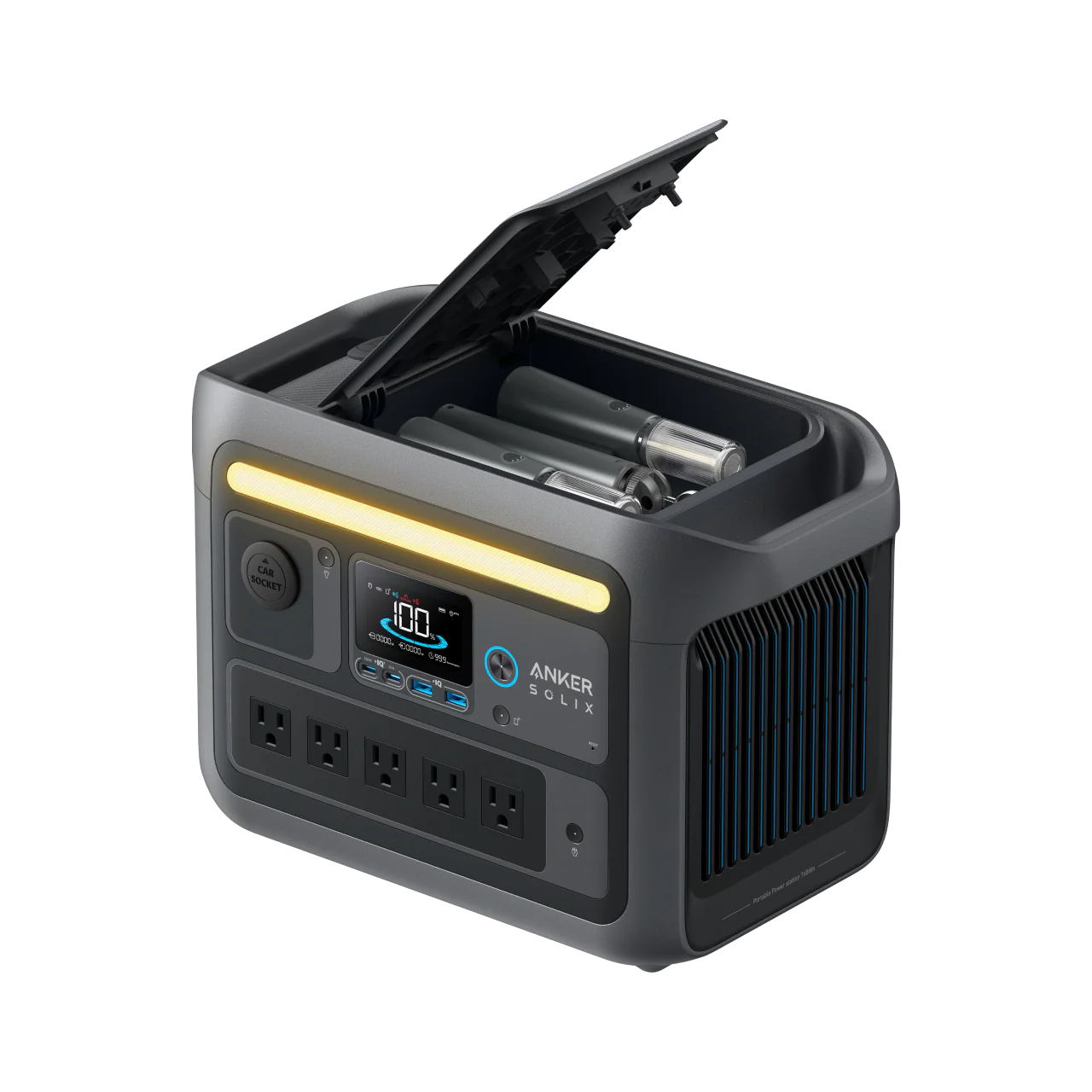
No longer sold
Anker has replaced the C800 line with the C800X — at $449.99 it currently ships with a 100W solar panel included, so the newer unit costs less than the C800 did.
SOLIX C800X · $449.99
$559.00 · direct from Jackery
Last checked 1 day ago. Prices move — check before you buy.
Spec deltas
The Jackery Explorer 1000 v2 is the cheaper unit now, not the pricier one — $499 against the SOLIX C800's $599 — and it was already the better spec sheet before that gap opened. 1,070Wh against 768Wh, 1,500W continuous against 1,200W, 4,000 rated cycles against 3,000: the Jackery leads every column, and now it costs $100 less to get all of it.
Run the lifetime math and the gap only widens. The Anker costs $0.26 per kilowatt-hour delivered over its life against the Jackery's $0.12 — more than double — because a smaller battery with fewer rated cycles is now also the pricier one to buy. Even the identical five-year warranty costs more to attach to the C800: $120 a year against $100 on the Jackery.
Both units weigh the same 23.8 lb, so there's no portability tax to argue about — whichever you carry, your back does identical work. What's left is price and capacity, and on both, the Jackery wins outright. The Anker's remaining case is thin: owners do report a slightly faster AC recharge on the C800A9B3, and that's about it.
What the Numbers Reveal
Each conclusion stated first — the numbers behind it on one line, the full analysis below.
cost / lifetime kWh
Spread that same math over the unit's life and the gap doesn't shrink, it more than doubles: $0.26 per kilowatt-hour on the Anker against $0.12 on the Jackery, because a smaller, fewer-cycle battery got more expensive at the same time its rival didn't move.
Price: SOLIX C800 $599, Explorer 1000 v2 $499 — Jackery is $100 cheaperCapacity: C800 768Wh, Explorer 1000 v2 1,070Wh — 302Wh more on the JackeryLifetime cost: C800 $0.26 per kWh, Explorer 1000 v2 $0.12 per kWh
Why it mattersAnyone comparing sticker price alone already picks the Jackery; anyone who bothers to run the lifetime math has an even stronger reason to.
Typical price
$120 a year on the C800 against $100 on the Jackery means the one dollar-for-dollar argument that could have favored the pricier unit doesn't exist anymore: the Jackery is cheaper to buy and cheaper to insure for the same five years.
Warranty: both units carry a 5-year term — identicalCost per warranty year: C800 $120, Explorer 1000 v2 $100Price: C800 $599, Explorer 1000 v2 $499
Why it mattersA buyer weighing 'at least the Anker's warranty is a better deal' can drop that reasoning — it isn't true at today's prices.
continuous output
That scenario win now arrives at a discount instead of a premium. The Jackery finishes the tailgate with a quarter tank left and does it while costing $100 less, and its wider surge margin means it's also the safer bet for whatever compressor or appliance spikes hard on startup.
Tailgate Party needs 670Wh: C800 requires 103% of its own tank (fails), Explorer 1000 v2 needs 74% (passes)Surge rating: C800 1,600W off 1,200W continuous — about 1.3x; Explorer 1000 v2 3,000W off 1,500W — exactly 2xCPAP Overnight needs 320Wh: C800 uses 49% of its tank, Explorer 1000 v2 uses 35%
Why it mattersIf your real use case looks anything like a tailgate afternoon or a CPAP night, there's no longer a price tradeoff to weigh — the unit that wins those scenarios is also the cheaper one to buy.
It's a real edge, and worth naming honestly rather than pretending the Jackery wins everything: if you refill from empty on AC constantly and those minutes matter to your routine, the C800 gets you there slightly fasterA9B3. It's not close to worth $100 more and 302Wh less capacity for anyone else.
Owners clocked the C800 at a full charge in 58 minutes on a 600W AC adapterA9Owners clocked the Explorer 1000 v2 at 60 to 65 minutes to full via its app's emergency charge modeB3Price: C800 $599, Explorer 1000 v2 $499
Why it mattersOnly a buyer who recharges from empty on AC often enough that a handful of minutes actually matters has a reason to look at the C800 at all; everyone else should bank the $100 and the extra capacity.
The specific dimensions that decide these two units — everything else is a tie.
Lifetime Value
Selected because: Price move flips the cost-per-kWh and cost-per-warranty-year story entirely toward the Jackery — now the core of the verdict.
cost / lifetime kWh
$0.12 per lifetime kilowatt-hour on the Jackery against $0.26 on the Anker — more than double, and the direction that number moves only got worse for the C800 once its price climbed to $599. The warranty math tells the same story: both units carry an identical five-year term, but that coverage now costs $120 a year to attach to the Anker against $100 on the Jackery. There isn't a version of the lifetime math left where paying more for the C800 buys back anything.
What the Specs Don't Tell You
Selected because: All four firing cards (noise, surge ratio, warranty, cycle life) now point the same direction, no split left.
rated cycles
Four cards fire here, and for the first time in this pairing, all four point one way. Cycle life and surge ratio go to the Jackery — 4,000 rated cycles against 3,000, and a 2x surge margin (3,000W off 1,500W continuous) against the Anker's roughly 1.3x (1,600W off 1,200W). Noise favors the Jackery too, 30dB against 45dB. Warranty value, the one card that used to favor the cheaper unit, now belongs to the Jackery as well: $100 a year against $120. There's no longer a card on this page worth trading capacity or price for.
Your Life, Your Pick
Selected because: CPAP Overnight and Tailgate Party are the only two scenarios that differ, and the Jackery wins both outright.
CPAP Overnight and Tailgate Party are the only two scenarios in the model where this pair actually splits, and the Jackery takes both. On a 320Wh CPAP night, both units pass, but the Explorer 1000 v2 uses just 35% of its tank against the C800's 49% — more buffer for a restless night. Tailgate Party is the sharper result: a 670Wh afternoon needs 103% of the C800's own capacity, which means it runs out, while the Jackery clears the same load using only 74% of its tank. Weekend Camping, an 8-Hour Blackout, and Van Life Daily are all well beyond either unit's capacity regardless of pick.
Portability & Form Factor
Selected because: Identical 23.8 lb weight removes any 'lighter for the money' defense of the pricier unit.
Both units land on the scale at an identical 23.8 lb, so there's no lighter-for-the-money argument hiding here — pick either one and your arms do the exact same work. That parity used to matter more when the Anker was the cheaper box; now that it's also the pricier one, the identical weight just removes the last reason a buyer might have leaned Anker.
Brand Trust
Selected because: Cross-brand pair; Anker's stronger app is the one remaining non-hardware argument worth naming.
Anker's app is the stronger piece of software in this pairing — 4.5 on iOS against Jackery's weakest-in-class range of 2.3 to 3.3, split across two separately branded apps that require a login even offline. Jackery counters with the wider retail footprint (Costco, Home Depot, Best Buy) and a hardware case that, at today's prices, is also the cheaper one to buy. Support reputations are close to a wash: Anker's is trending down from a historically strong baseline, and Jackery's is criticized for slow, scripted responses. The app is the one honest reason left to prefer Anker; everything measurable on the box points to the Jackery.
Strengths & trade-offs
Anker SOLIX C800
Strengths
- Solid all-rounder with standard specs.
Trade-offs
- –Shorter-lived battery — rated for 3,000 charge cycles vs the Explorer 1000 v2's 4,000, so it wears out sooner.
Jackery Explorer 1000 v2
Strengths
- +Costs $100 less
- +Larger battery capacity
- +Higher AC output
- +Faster solar charging
- +Rated for 4,000 charge cycles — much longer battery lifespan
Trade-offs
- –No major technical downsides compared to rival.
Will It Power Your Gear?
Scenario math and per-appliance runtimes, modeled from the spec record.
Scenario verdicts
We ran the math on six real-world scenarios. Here's which unit survives your actual life.
SCN-01 · 2 nights · needs 2,100Wh
Weekend Camping
Two nights off-grid with essential comfort
Neither unit
A 2,100Wh weekend outstrips both tanks — the Jackery needs 231% of its own capacity to cover it, the Anker 322%. The Jackery closes more of the gap, and now does it for less money, but neither is a standalone weekend-camping unit.
Battery budget usedlower = more headroom
LOAD Phone Charger 15W×6h · LED Lights 40W×8h · Box Fan 75W×14h · CPAP Machine 40W×16h
SCN-02 · 8 hours · needs 1,645Wh
8-Hour Blackout
Keep the essentials running through a night without power
Neither unit
At 1,645Wh, the Jackery falls short by a smaller margin than the Anker — 181% against 252% of its own tank. Trim the load to essentials for either, or treat this pairing as partial-outage coverage rather than a full one.
Battery budget usedlower = more headroom
LOAD Fridge 150W×8h · Router + Modem 20W×8h · LED Lights (4 bulbs) 40W×6h · Phone Charger 15W×3h
SCN-03 · 8 hours · needs 320Wh
CPAP Overnight
Sleep therapy without interruption — the #1 medical use case
Explorer 1000 v2
Both pass comfortably, but the Jackery leaves more in reserve — 35% of its tank used against the Anker's 49%. If a restless night or an extra device is a real possibility, that buffer is the Jackery's quiet advantage, and it's also the cheaper unit to buy it on.
Battery budget usedlower = more headroom
LOAD CPAP Machine 40W×8h
SCN-04 · 8 hours · needs 910Wh
Remote Workday
Full work day off-grid without power anxiety
Explorer 1000 v2
A 910Wh workday lands right at the Jackery's ceiling and past the Anker's — the Jackery uses effectively its whole tank, the Anker overruns by close to 40%. Neither leaves real slack; bring a laptop charger as backup regardless of pick.
Battery budget usedlower = more headroom
LOAD Laptop 60W×8h · External Monitor 30W×8h · Router + Modem 20W×8h · Phone Charger 15W×2h
SCN-05 · 4 hours · needs 670Wh
Tailgate Party
Game day power for the crew
Explorer 1000 v2
The one basket that splits cleanly: the Jackery covers a 670Wh afternoon at 74% of its tank, the Anker comes up short at 103%. Tailgate loads are where this pairing actually decides itself.
Battery budget usedlower = more headroom
LOAD Blender 400W×0.5h · LED TV (55") 80W×4h · Bluetooth Speaker 15W×4h · Phone Charger (×3) 45W×2h
SCN-06 · 24 hours · needs 4,685Wh
Van Life Daily
A full day of mobile living — the ultimate endurance test
Neither unit
A 4,685Wh day is far beyond either unit — the Jackery would need more than five times its own tank, the Anker more than seven. Van life at this scale needs a dedicated, larger system than either of these.
Battery budget usedlower = more headroom
LOAD Mini-Fridge 150W×24h · Laptop 60W×4h · Phone Charger 15W×3h · LED Lights 40W×5h · Fan 75W×8h
The Load Test
RUNTIME = (Wh × 0.85) ÷ LOAD
None of the scenarios above exactly yours? Build it. Toggle what you'd plug in; both units are tested against the combined draw.
Essentials
Comfort & Convenience
High-Draw Appliances
Test duration
8h
Continuous draw
205W
Projected runtime
For this load: Explorer 1000 v2 runs 4.4h vs 3.2h.
$499 list · direct from Jackery
Modeled from the spec record — same math as the tables below. Methodology
Runtime by appliance
Real-world runtime estimates for common appliances, modeled at 85% inverter efficiency.¹
Essentials
The basics you need runningscale 0–60.6hComfort & Convenience
Makes off-grid life actually enjoyablescale 0–12.1hHigh-Draw Appliances
These reveal the real limitsscale 0–0.9h¹ Runtime = (capacity × 0.85) ÷ appliance watts. Within each group, all bars share one time scale (the group's longest runtime), so lengths are comparable across appliances; identical runtimes collapse into a single blue/orange bar. Actual runtime varies with battery age, temperature, and simultaneous loads — see methodology.
Conclusion
July 26, 2026
Verdict: the Explorer 1000 v2
Take the Explorer 1000 v2. At $499 it's already $100 cheaper than the SOLIX C800's $599, and every other number in this pairing points the same direction: 1,070Wh against 768Wh, 4,000 rated cycles against 3,000, a 30dB fan against 45dB, and a lifetime cost of $0.12 per kilowatt-hour against the Anker's $0.26 — more than double. The five-year warranty is identical on paper, but it now costs $120 a year to attach to the Anker against $100 on the Jackery, so even the warranty math has flipped. The Jackery also wins the two scenarios where this pair actually differs: it clears a 670Wh tailgate load at 74% of its tank while the C800 needs 103% and runs dry, and it leaves more reserve on a CPAP night. The one place the C800 still shows up first is AC recharge speed — owners clocked it at 58 minutes against the Jackery's 60 to 65A9B3 — a real but minor edge that doesn't offset $100 more money for less of everything else. There's no honest case left for paying more for the Anker here.
Editor-assigned confidence, based on cited owner research and spec analysis.
List prices as of July 26, 2026. The links below open Anker's and Jackery's current prices.
$559.00 · direct from Jackery
Last checked 1 day ago. Prices move — check before you buy.
or check the SOLIX C800 price$599.00 list
Written by Ian Schneider, Solar & Off-Grid Tester · Station Arena Test Desk · Updated July 26, 2026
Measured Data
Benchmark scores and the full spec record, side by side.
Benchmark scores
Not rated for both units (minimum threshold unmet): Home Backup.
Full specifications
ᵈ Derived: price ÷ rated capacity. See the data behind our comparisons →
Comparison ToolAdd more power stations, side by sideOpen Tool →How these numbers are produced
Numeric verification
Every figure on this page traces to our spec database or arithmetic on it — no estimated numbers.
Owner claims
Statements about owner experience are cited to published reviews — see Sources & Research Notes below.
Runtime model
Runtime = (rated capacity × 0.85 inverter efficiency) ÷ device wattage. Solar recharge estimates assume panels deliver 70% of rated output. Cold weather, battery age, and stacked loads reduce real-world results.
Power Score
Computed from 14 published spec dimensions, weighted per use-case bench. Higher is better; a unit must meet a bench's minimum threshold to be rated.
See the full weight table and data sourcing on our methodology page →Class ranking (the star rating)
Each unit's star score is a category ranking, not customer reviews — no buyer opinions feed it. We score every station on size-independent quality (value, output, portability, endurance, ports, warranty, and more), then percentile-rank it against the other units in its capacity class, so a class-leading compact unit and a class-leading whole-home unit can both earn 5★. Here, SOLIX C800 rates 4.1/5 (47th percentile of 20 Compact-class units), and Explorer 1000 v2 rates 4.0/5 (38th percentile of 27 Everyday-class units).
How the class ranking is computed →Test Notes & Caveats
Hidden gotchas and advantages we spotted that you won't find on the product page.
15dB apart, and the cheaper unit is now the quieter one
The C800 runs at 45dB, the Explorer 1000 v2 at 30dB — a gap that's genuinely audible, roughly the difference between a running refrigerator and a quiet room. The C800 stays quiet at lighter loads and only becomes noticeable near its ceiling, but the Jackery holds its quieter number across a wider range of use, and it's the less expensive unit besides.
Double the surge headroom, on the unit that also costs less
The Explorer 1000 v2 surges to 3,000W off a 1,500W continuous rating — exactly 2x. The C800 surges to 1,600W off 1,200W — about 1.3x. For a compressor fridge or power tool that spikes hard on startup, the Jackery carries meaningfully more reserve, on top of the bigger continuous number and the lower price.
Same five years, and now it's cheaper to get on the Jackery too
Both carry a 5-year warranty, but that coverage now costs $100 a year to attach to the Explorer 1000 v2 against $120 on the C800 — because the C800's price climbed while the Jackery's didn't. The warranty argument that could once have favored the cheaper unit doesn't exist anymore.
A thousand more cycles, on the cheaper battery
4,000 rated cycles against 3,000 works out to roughly 2.8 more years of daily use (11 years against 8.2) before either battery settles to about 80% of its original capacity — still fully usable at that point. Paired with the lower price, this is most of why the Jackery costs less than half as much per lifetime kilowatt-hour.
Full record above — the Test Desk pick is the Explorer 1000 v2.
Check Explorer 1000 v2 price →or check the SOLIX C800 priceOwnership Analysis
What happens after you buy — true cost of ownership, brand trust, and growth potential.
Lifetime value
Service lifeyears at one full cycle per day
Lifetime energy delivered
Cost per delivered kWh
│ warranty ends · Reaching the cycle rating means ~80% capacity remains — degraded, not dead.
Analyst note
The Explorer 1000 v2 wins on both sticker price and long-term value. At $0.12/kWh over its lifetime, it's meaningfully cheaper to own. Clear value winner.
Delivers each lifetime kWh for $0.14 less — check the Explorer 1000 v2 price →
Brand trust
Anker
Ecosystem
7-8 SOLIX portable power stations across C-series (compact) and F-series (flagship), plus the X1 home energy system
Support
US-based support. Historically known for incredible no-hassle replacements, but recent reports describe AI-driven support agents giving generic responses and complex return logistics for heavy units (hazmat shipping). The Anker brand reputation is still strong, but SOLIX-specific support quality is trending down.
Community
Moderate — active Reddit (r/Anker, r/AnkerSOLIXCommunity) and growing. Benefits from Anker's massive consumer electronics brand awareness.
App experience
Rated 4.5/5 iOS (~1,100 ratings) · 4.3/5 Android
Unique strength
Parent brand trust from Anker's consumer electronics dominance. InfiniPower technology for long cycle life. Strong $/Wh value in the mid-size and larger units — the S2000, F2600 and C1000 are among the better buys per watt-hour in the catalog.
Worth knowing
Anker's app is the stronger piece of software here (4.5 iOS), and its support was long the industry standard, though SOLIX-specific service is reportedly trending down from that historically excellent level.
Jackery
Ecosystem
12-15+ models across Explorer (portable) and HomePower (home backup) series, plus SolarSaga panel ecosystem and innovative form factors
Support
US-based support but widely criticized. Reddit reports describe slow/dismissive responses, scripted AI agents, strict receipt requirements for warranty claims, and refurbished replacements for clearly defective units. Strongly recommended: buy from Costco or Amazon for return protection.
Community
Smallest community of the major brands — Reddit r/Jackery has ~2,000 members. YouTube presence is solid due to brand recognition.
App experience
Rated 2.3-3.3/5 iOS and Android — the weakest app experience of the major brands. Multiple confusing apps (Jackery app vs Jackery Home) and mandatory login even offline.
Unique strength
Highest brand recognition and widest retail distribution (Costco, Home Depot, Best Buy, Amazon). The "Toyota" of power stations — dependable, proven, wide availability. Innovative form factors like the Solar Gazebo and Solar Mars Bot.
Worth knowing
Jackery's retail reach is the widest in the category — Costco, Home Depot, Best Buy — a real advantage for easy returns, but its app is the weakest of the major brands, split across two separately branded apps that require login even offline.
Analyst note
Anker brings the sharper app and a brand name that still carries weight, even as service quality softens. Jackery brings the wider retail footprint and, at today's prices, the stronger and cheaper hardware. Buy Jackery here for what's in the box and what it costs; lean on Anker's software only if that outweighs $100 and 302Wh for you.
Growth path
SOLIX C800
FIXED CAPACITYFixed at 768Wh, with no expansion — so size it for your needs up front rather than planning to add capacity later.
Accepts up to 300W of solar. Limited to a single portable panel.
Adequate ports for most setups, but heavy users may want a power strip.
Explorer 1000 v2
FIXED CAPACITYFixed at 1,070Wh, with no expansion — so size it for your needs up front rather than planning to add capacity later.
Accepts up to 400W of solar. Suitable for a 1-2 panel setup.
Adequate ports for most setups, but heavy users may want a power strip.
Realistic full solar rechargeat 70% of rated panel output — see methodology
Analyst note
Neither expands, and that's no knock on either — each is a complete unit at a fixed size. Buy the capacity that covers your needs now (the Explorer 1000 v2 gives you the larger ceiling); you can't add to either later.
What Owners Report
Patterns from published owner reports and long-term reviews — every claim cited to its source below.
Anker SOLIX C800
The C800's ledger is independent review-site testing rather than a crowd of forum owners, so treat it as careful hands-on data rather than group consensus. What shows up repeatedly is a fast recharge — a full charge in 58 minutes on a 600W AC adapterA9, which lines up with reports that the fans stay quiet under lighter loads and only pick up a mild hum near the top of the rangeA7. It also briefly ran a 1,500W space heater above its 1,200W rating for 25 minutes before throttlingA8, and powered a 1,000W coffee maker for 42 minutes straightA3. The ceiling shows up just as clearly: reviewers note the 1,200W output won't sustain a full-size refrigerator's startup draw plus other essentials for longA11, and its 300W max solar input reads as middling next to similarly sized rivalsA5. Build quality gets consistent praise — a tailgate drop onto gravel left only minor scuffingA1 — though reviewers flag the lack of an IP weather rating as a real caveat for outdoor useA2.
“We dropped it from a tailgate (30 inches) onto gravel—only minor scuffing, no damage.”
Sources
backuppowerhub.com · portablepowergeek.co.uk · batteryskills.com · batteryessence.com · toolsandtoys.net · bikmantech.com
Jackery Explorer 1000 v2
Coverage on the Explorer 1000 v2 is stronger and more consistent, describing it as one of the strongest mid-size power stations of 2026 for its balance of portability, fast charging, quiet operation, and long-term reliability, with 1,500W continuous and a 3,000W surge ceilingB4. The move to LiFePO4 chemistry rated for 4,000 cycles is called a dramatic lifespan improvement over the lithium-ion model it replacedB2, and fast AC charging consistently reached full in about 60 to 65 minutes using the app's emergency charge modeB3 — a few minutes behind the C800's fastest reported timeA9, but not a meaningful gap for most routines. At 23.8 lb, reviewers repeatedly call it light for a 1kWh-class unitB1, notable given it's carrying more energy at that weight than the Anker. No major recurring complaint turns up across the coverage.
“At just 23.8 lbs it's easy to lift and carry — light for a 1kWh-class unit.”
Sources
backuppowerhub.com · outdoortechlab.com · rvoutfitting.com · thesolarlab.com · amusthavething.com
Sources & Research Notes
Every owner claim in this report is traceable to a published source. The bracketed references above resolve here.
Recurring owner themes
- Build quality/chassis is repeatedly called solid and drop-resistant, but reviewers flag the lack of an IP weather rating as a real-world caveat for outdoor use. [SOLIX C800 · 3 entries]
- The 58-minute AC fast-recharge is the single most-mentioned standout feature, praised as faster than rivals like the Jackery 700. [SOLIX C800 · 2 entries]
- Reviewers note the unit can briefly exceed its 1200W rating for heavy appliances, but caution it can't sustain full-size continuous loads like a full-size fridge. [SOLIX C800 · 2 entries]
- Long 5-year warranty and strong retailer star ratings are cited as reassurance/value signals. [SOLIX C800 · 2 entries]
- Weight (~23-24 lbs) is repeatedly flagged as a downside relative to lighter rivals despite the compact footprint. [SOLIX C800 · 2 entries]
- Light weight, fast ~1-hour charging, quiet operation, and a 4,000-cycle LFP battery make it a well-balanced value favorite; the main limit is 1,500W output. [Explorer 1000 v2 · 3 entries]
- A1
“We dropped it from a tailgate (30 inches) onto gravel—only minor scuffing, no damage.”
backuppowerhub.com — Anker SOLIX C800 Review: Best Budget Power Station? · 2025-12 · [positive]
- A2
“However, the C800 lacks IP weather rating. Keep it covered when camping.”
backuppowerhub.com — Anker SOLIX C800 Review: Best Budget Power Station? · 2025-12 · [negative]
- A3
“A 1,000W coffee maker ran 42 minutes straight.”
backuppowerhub.com — Anker SOLIX C800 Review: Best Budget Power Station? · 2025-12 · [positive]
- A5
“Only allows a middling amount of solar charge at 300W max solar panels, when compared to its equivalently-sized models.”
portablepowergeek.co.uk — Anker Solix C800 Review · 2024-11 · [mixed]
- A7
“Zero fan noise under 500W loads, unlike louder competitors (e.g., Bluetti EB55). Only a mild hum at max load.”
batteryskills.com — Anker SOLIX C800 Portable Power Station Review · 2025-10 · [positive]
- A8
“Powered a 1500W space heater (surpassing its 1200W rating) for 25 minutes before throttling—unexpectedly robust for its size.”
batteryskills.com — Anker SOLIX C800 Portable Power Station Review · 2025-10 · [positive]
- A9
“Achieved a full charge in 58 minutes using a 600W AC adapter (matching Anker's claim), while competitors like the Jackery 700 take 2+ hours.”
batteryskills.com — Anker SOLIX C800 Portable Power Station Review · 2025-10 · [positive]
- A11
“The 1200W output won't run a full-size refrigerator (700-800W startup) plus other essentials for long.”
batteryessence.com — Anker SOLIX C800 Portable Power Station 768Wh Review · 2026-03 · [negative]
- B1
“At just 23.8 lbs it's easy to lift and carry — light for a 1kWh-class unit.”
backuppowerhub.com / outdoortechlab.com — Explorer 1000 v2 review · 2026 · [positive]
- B2
“Moves to LiFePO4 chemistry rated for 4,000 charge cycles before capacity drops, dramatically increasing lifespan over the original lithium-ion model.”
backuppowerhub.com / rvoutfitting.com — Explorer 1000 v2 review · 2026 · [positive]
- B3
“Fast AC charging — consistently reached 100% in about 60-65 minutes from empty via the app's emergency charge mode, a big improvement over the original's long wait.”
thesolarlab.com / outdoortechlab.com — Explorer 1000 v2 review · 2026 · [positive]
- B4
“One of the strongest mid-size portable power stations of 2026, striking an excellent balance of portability, fast charging, quiet operation, and long-term battery reliability; pushes 1,500W continuous with a 3,000W surge.”
backuppowerhub.com / amusthavething.com — Explorer 1000 v2 review · 2026 · [positive]
Research compiled July 26, 2026.
Who Should Buy Which
Buy the SOLIX C800 if you…
- →Buyers who recharge from empty on AC often enough that a few extra minutes matters: owners clocked the C800 at 58 minutes to full against the Jackery's 60 to 65A9B3.
- →Anyone already inside Anker's app ecosystem who values its stronger iOS rating over $100 in savings and 302Wh of capacity elsewhere.
- →Buyers who weight a rugged-feeling chassis heavily: the C800 survived a 30-inch tailgate drop onto gravel with only minor scuffingA1 — though it still lacks an IP weather ratingA2.
This is you — check the SOLIX C800 price
Buy the Explorer 1000 v2 if you…
- →Anyone comparing on price alone: $499 against $599, for more capacity, not less.
- →Buyers running near the 670Wh tailgate range: the one basket in this model where the Jackery passes and the C800 doesn't.
- →Noise- and longevity-conscious owners: 15dB quieter and a thousand more rated cycles are both differences you'll feel over years of ownership.
If neither fits
If your basket looks like a full weekend of camping (2,100Wh) or an 8-hour blackout (1,645Wh), skip both — even the bigger Explorer 1000 v2 only covers roughly 55% of a full blackout's demand against its own capacity (100 ÷ 181% ≈ 55%). Look at the 2kWh-plus class instead, or plan on running two units for full-outage coverage.
The Bottom Line
The price gap between these two didn't just narrow, it reversed — the Explorer 1000 v2 is now the cheaper unit by $100, and it was already ahead on capacity, cycle life, and noise before that happened. Run the lifetime math and the case only gets stronger: $0.12 per kilowatt-hour on the Jackery against $0.26 on the Anker, more than double, with an identical five-year warranty that now costs less per year to own on the cheaper unit too.
Take the Explorer 1000 v2. The C800's one remaining edge is a slightly faster AC rechargeA9B3 — real, but not a reason to pay $100 more for 302Wh less. Buy the Jackery, save the money, and get the bigger tank.
Frequently Asked Questions
Answers drawn from the spec record and cited owner research.
Which is cheaper, the Anker SOLIX C800 or the Jackery Explorer 1000 v2?
The Explorer 1000 v2, and by a real margin — $499 against the C800's $599, a $100 gap. It's also the larger-capacity unit at 1,070Wh against 768Wh, so the cheaper price isn't buying less; it's buying more.
Is the SOLIX C800 worth $100 more than the Explorer 1000 v2?
Not on the numbers here. The C800 costs more, holds 302Wh less, is rated for 1,000 fewer charge cycles, and runs at 45dB against the Jackery's 30dB. Its lifetime cost works out to $0.26 per kilowatt-hour against the Jackery's $0.12 — more than double. The one place it still leads is AC recharge speed, a few minutes faster by owner reports, which isn't enough to offset the rest.
Can either handle a tailgate party?
Only the Jackery, cleanly. A typical tailgate basket needs about 670Wh; the Explorer 1000 v2 covers it using 74% of its own tank, leaving a real cushion. The C800 needs 103% of its own capacity for the same load, which means it runs dry before the tailgate does.
Which is quieter, the C800 or the Explorer 1000 v2?
The Jackery, by 15dB — 30dB against the C800's 45dB. The C800 does stay quiet under lighter loads and only becomes noticeable pushing toward its 1,200W ceiling, but across the range the Jackery is the quieter unit.
Which has the longer-lasting battery?
The Explorer 1000 v2, rated for 4,000 cycles against the C800's 3,000 — about 2.8 more years of daily use (11 years against 8.2) before either battery settles to around 80% of its original capacity, which is still fully usable. Combined with its larger tank and lower price, that's the main reason the Jackery costs less than half as much per lifetime kilowatt-hour.
Where to buy
Anker SOLIX C800
$599.00
$599.00 · direct from Anker
Last checked 1 day ago. Prices move — check before you buy.
Jackery Explorer 1000 v2Pick
$559.00
$559.00 · direct from Jackery
Last checked 1 day ago. Prices move — check before you buy.
Prices may vary by retailer and are subject to change.