Head-to-head test
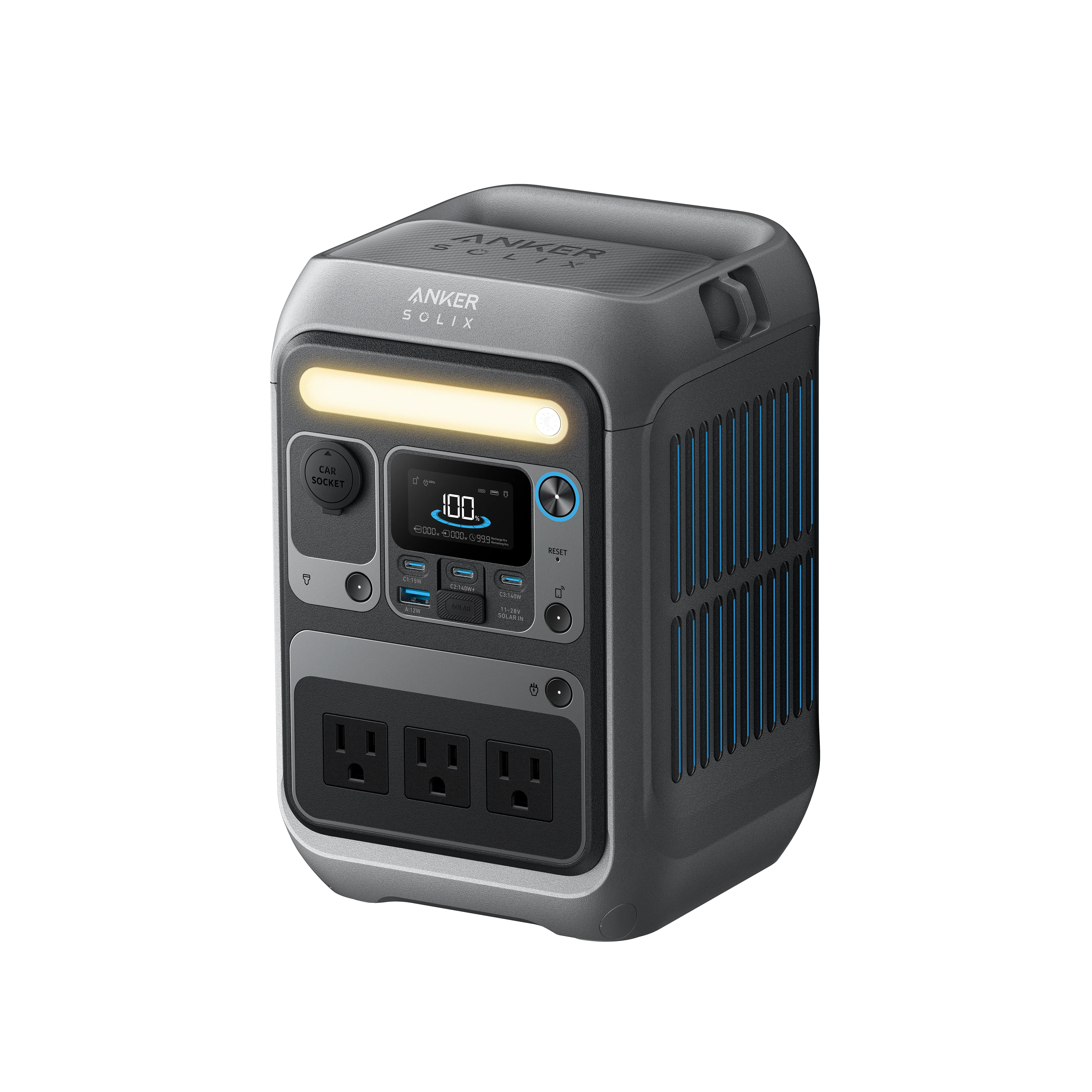
Anker SOLIX C300 vs BLUETTI Apex 300 + 2×B300K
The C300 can't get a CPAP to morning and the Apex stack does it on five percent of its charge, so the only question that settles this is whether you're backing up a household or topping up a backpack.
Full profiles: Anker SOLIX C300 → · BLUETTI Apex 300 + 2×B300K →

Written by Gunner GustafsonUpdated
Whole-Home Backup Tester, Station Arena Test Desk
$329.99 · direct from Anker
Last checked 1 day ago. Prices move — check before you buy.

$3,699.00 · direct from BLUETTI
Last checked 1 day ago. Prices move — check before you buy.
Spec deltas
The smallest load on this page is an overnight CPAP at 320Wh, and the Anker SOLIX C300 can't finish it. It holds 288Wh rated, roughly 85% of which survives the inverter, so call it 245Wh delivered. The machine stops before the morning does. That's the easiest of the six scenarios we model, and the C300 fails all six.
The BLUETTI Apex 300 with two B300K batteries clears every one of them, and its worst showing is a 4,685Wh van-life day that takes 66% of the stack. It costs $3,699 against $330. Then the money inverts: 13 cents per lifetime kilowatt-hour for the expensive one, 35 cents for the cheap one. The expensive box is the cheap energy.
That inversion has a condition bolted to it, and the condition is the whole page. Thirteen cents is a price you only pay by actually drawing 8,294Wh, three thousand five hundred times over. If your real draw is a phone, a laptop and a router, you will never get anywhere near it. You'll have prepaid for kilowatt-hours you never take delivery of, in a form you can't lift.
What the Numbers Reveal
Each conclusion stated first — the numbers behind it on one line, the full analysis below.
The 10ms UPS switchover is legitimately unusual at this size and priceA3, and that spec tells you what the unit is actually for: a desk. Router, modem, laptop, a monitor that shouldn't blink when the street goes dark. Those it holds, and it hands over without dropping the call. What it cannot do is carry a compressor, a medical device or a household through a night, because it does not have the energy to spend.
CPAP Overnight draws 320Wh; the SOLIX C300 holds 288Wh ratedUsable energy runs about 85% of rated after inverter losses, so roughly 245Wh (288 x 0.85)Our model scores that night at 131% of the C300 and 5% of the Apex stackSOLIX C300 switchover: 10ms
Why it mattersIf your outage plan is keeping the router and the laptop alive, buy the C300; if it involves a compressor or a medical device, rule the C300 out before you compare anything else on the page.
Standing by with the inverter on, the Apex system pulls about 20WB15, which is 480Wh a day (20 x 24). More than the entire C300 holds. That's a rounding error when the stack is covering a 4,685Wh van day at 66%, and it's faintly ridiculous when the actual job is a phone and a laptop. The system only gets cheap by working.
Apex 300 + 2×B300K: $0.13 per lifetime kWh, from 29,030 kWh across 3,500 cyclesSOLIX C300: $0.35 per lifetime kWh, from 864 kWh across 3,000 cyclesApex 300 AC idle draw is about 20WB15Van Life Daily draws 4,685Wh and uses 66% of the Apex stack
Why it mattersIf you can't name a daily or weekly load in kilowatt-hours, the 13-cent figure isn't yours to collect, so buy the C300 and keep the other $3,369.
solar input
This is the honest catch on our pick, and an owner put it in one line: a bad choice for off-grid applicationsB3. The complaint never touches the home-backup buyer, who refills from a wall outlet in the calm days between storms. It lands squarely on the van and the cabin, where there is no wall.
Apex stack: 2,400W solar input into 8,294Wh, about three and a half hours from empty on paper (8,294 divided by 2,400)One owner reports BLUETTI could not produce video of an Apex 300 charging above 1,200W, and support called the behavior normalB2B3In multi-unit setups like this 2xB300K configuration, owners report the batteries charging at different rates and ending at mismatched states of charge, one at 100% and one at 50%B1Van Life Daily draws 4,685Wh, 66% of the stack, every day
Why it mattersBuy the Apex stack for blackouts, job sites and shop days; if it's going to be your only power source in a vehicle, budget for more panel than the spec sheet implies you need.
weight
So the buyer about to add the Hub D1 to the cart is choosing between a port panel bolted to a box in the utility room and a complete 288Wh station that fits in a daypack. For a lot of people the right answer is both units and no hub. The stack does the house. The small one does the desk and goes camping.
The Apex 300 has no DC or USB ports on its face; the Hub D1 that adds them is a $330 accessoryB10B17The SOLIX C300 is $330 complete, with dual 140W USB-C built inA1Apex stack max USB-C: 100W. SOLIX C300: 140WC300: 9.1 lbs. Apex 300 + 2×B300K: 213.9 lbs
Why it mattersAnyone already committed to the Apex stack should price the Hub D1 against a complete small station before adding it to the cart, because it's the same money and only one of the two options can leave the house.
The specific dimensions that decide these two units — everything else is a tie.
Your Life, Your Pick
Selected because: The C300 clears none of the six loads we model, down to the 320Wh CPAP night, while the Apex stack clears all six with its deepest draw still leaving 34% in reserve.
Six loads, six identical outcomes, and the interesting part is the shape of the losses. The C300 doesn't fall short on the big scenarios and squeak through the small ones. It misses every one, from the 4,685Wh van day down to the 320Wh CPAP night, which means it isn't a smaller version of the same product. It's a different product wearing the same category name.
Tailgate is where it fails differently. A 670Wh afternoon is already more than double the C300's 288Wh, but the peak draw also clears its 600W surge ceiling, so it can't start the load, never mind hold it. The Apex stack brings 7,680W of surge and finishes the afternoon at 90%. Once a scenario has a compressor in it, capacity was never the first question.
Lifetime Value
Selected because: The $3,699 system delivers energy at 13 cents per lifetime kilowatt-hour and the $330 one at 35 cents, which is only a saving if you actually spend the energy.
cost / lifetime kWh
Thirteen cents against thirty-five is the kind of gap that usually ends an argument, and here it starts one. The Apex figure comes from 29,030 kWh across 3,500 cycles; the C300's from 864 kWh across 3,000. Both are honest arithmetic, and neither is a refund. You collect the 13 cents by cycling the full 8,294Wh three thousand five hundred times, which is roughly a decade of daily van-scale draw and nothing like a decade of weekend use.
Per warranty year the picture flips back: $60 against $740, on identical five-year terms. If you aren't certain which class of unit you need, that asymmetry is worth more than the per-kilowatt-hour number. Buy the small one wrong and you're out $330 and you own a good camping battery. Buy the big one wrong and you own a very heavy piece of furniture.
Portability & Form Factor
Selected because: 9.1 lbs against 213.9 lbs is the one column the C300 wins outright, and for a certain buyer it's the only column that matters.
weight
9.1 lbs is the C300's outright win, and for a certain buyer it's the only line that matters. It goes in a daypack. It rides on the passenger seat. You carry it out to the picnic table and bring it back in without planning the trip, which is how a power station actually gets used instead of stored.
The Apex stack at 213.9 lbs is not portable in any sense a reader would recognize, and it comes apart into a base and two batteries precisely because the whole is not a one-person carry. Reviewers who've handled the base by itself describe it as too heavy for one person to moveB12, and a van builder following the thread called it a lumpB13. Decide where it lives and plan on it staying there. That isn't a flaw. It's what 8,294Wh looks like in the physical world.
What the Specs Don't Tell You
Selected because: Four flags fire here: the Apex stack's weight and its 45dB under load, the C300's fixed 288Wh, and five-year warranties covering twelve times different amounts of money.
rated cycles
Only one of these four flags changes a decision. The Apex stack's 45dB under load sits 20 above the C300's 25, which is a real difference in a van where the battery, the bed and the kitchen share one box, and no difference at all in a garage. The C300's fixed 288Wh gets flagged as a limitation, which has the direction right and the reason wrong: nobody bolts expansion batteries onto a nine-pound unit, and the C300 doesn't lose here for failing to grow. It loses for being small on the day you buy it.
The warranty flag is the one worth sitting with. Both units carry five years, which works out to $60 per covered year on the C300 and $740 on the Apex stack, for identical terms. The bigger unit doesn't buy you more protection. It puts twelve times as much money behind the same promise, made by the service operation with the least consistent record in the category.
Brand Trust
Selected because: At $330 a service record is a footnote; at $3,699, with BLUETTI's the most inconsistent in the category, it is most of the risk you're actually buying.
At $330 the brand question is nearly free. Anker's SOLIX support has slipped from a historically excellent no-hassle standard, with AI-driven agents returning generic responses and hazmat logistics complicating returns on heavy units, and firmware updates have removed features without notice. On a sealed 9.1 lb station, the downside is bounded by the price of the station.
At $3,699 the brand question is the purchase. BLUETTI's support is the most inconsistent in the space, and this exact product shows why that matters: one owner logged two weeks of troubleshooting plus another week waiting on RMA approval, with no reply 48 hours after chasing an updateB4, while the wider record runs from great and helpful to notoriously non-existentB11. Buying direct from BLUETTI rather than through a third-party seller tends to produce better claim outcomes. On a system this expensive that isn't a footnote, it's the checkout instruction.
Strengths & trade-offs
Anker SOLIX C300
Strengths
- +Costs $3,369 less
- +Lighter by 204.8 lb
Trade-offs
- –Weaker inverter (-3,540W) limits appliance compatibility.
- –Sealed capacity — the Apex 300 + 2×B300K can add batteries to grow past 288Wh; this one can't.
- –Shorter-lived battery — rated for 3,000 charge cycles vs the Apex 300 + 2×B300K's 6,000, so it wears out sooner.
BLUETTI Apex 300 + 2×B300K
Strengths
- +Larger battery capacity
- +Higher AC output
- +Faster solar charging
- +Rated for 6,000 charge cycles — much longer battery lifespan
Trade-offs
- –Substantially more expensive (+$3,369) than the SOLIX C300.
- –Significantly heavier (+204.8 lbs), making it harder to move.
- –Very heavy unit that may be difficult for one person to lift.
Will It Power Your Gear?
Scenario math and per-appliance runtimes, modeled from the spec record.
Scenario verdicts
We ran the math on seven real-world scenarios. Here's which unit survives your actual life.
SCN-01 · 2 nights · needs 2,100Wh
Weekend Camping
Two nights off-grid with essential comfort
Neither unit
Neither gives you a powered weekend: the Apex 300 + 2×B300K has the energy but doesn't travel, and the SOLIX C300 covers about 12% of the 2,100Wh. One can't go; the other can't finish.
Battery budget usedlower = more headroom
LOAD Phone Charger 15W×6h · LED Lights 40W×8h · Box Fan 75W×14h · CPAP Machine 40W×16h
SCN-02 · 8 hours · needs 1,645Wh
8-Hour Blackout
Keep the essentials running through a night without power
Apex 300 + 2×B300K
The SOLIX C300 doesn't finish — 245Wh usable against the 1,645Wh this needs leaves it 1,400Wh short, about 15% of the scenario covered. The Apex 300 + 2×B300K covers it with 5,405Wh to spare.
Battery budget usedlower = more headroom
LOAD Fridge 150W×8h · Router + Modem 20W×8h · LED Lights (4 bulbs) 40W×6h · Phone Charger 15W×3h
SCN-03 · 8 hours · needs 320Wh
CPAP Overnight
Sleep therapy without interruption — the #1 medical use case
Apex 300 + 2×B300K
320Wh is the smallest load on this page and the C300 still can't finish it. Rated at 288Wh with roughly 85% surviving the inverter, it has about 245Wh to give against a night that wants 320, so the machine stops before the morning does. The Apex stack spends 5% and wakes up at 95%. On a CPAP night that isn't a close call, it's two different product categories answering the same question.
Battery budget usedlower = more headroom
LOAD CPAP Machine 40W×8h
SCN-04 · 8 hours · needs 910Wh
Remote Workday
Full work day off-grid without power anxiety
Apex 300 + 2×B300K
The SOLIX C300 doesn't finish — 245Wh usable against the 910Wh this needs leaves it 665Wh short, about 27% of the scenario covered. The Apex 300 + 2×B300K covers it with 6,140Wh to spare.
Battery budget usedlower = more headroom
LOAD Laptop 60W×8h · External Monitor 30W×8h · Router + Modem 20W×8h · Phone Charger 15W×2h
SCN-05 · 4 hours · needs 670Wh
Tailgate Party
Game day power for the crew
Neither unit
This is the scenario where the C300 doesn't fall short so much as decline. A 670Wh afternoon is already more than double the 288Wh it holds, but the peak draw also clears its 600W surge ceiling, so it can't start the load, never mind sustain it. The Apex stack brings 7,680W of surge, ends the afternoon at 90%, and never registers the peak.
Battery budget usedlower = more headroom
LOAD Blender 400W×0.5h · LED TV (55") 80W×4h · Bluetooth Speaker 15W×4h · Phone Charger (×3) 45W×2h
SCN-06 · 24 hours · needs 4,685Wh
Van Life Daily
A full day of mobile living — the ultimate endurance test
Apex 300 + 2×B300K
4,685Wh a day is the load that makes $3,699 make sense. It takes 66% out of the Apex stack, which leaves a full cloudy day in reserve without rationing anything. The C300 would need emptying and refilling nineteen times over to cover the same day. This is the scenario the big system was designed around, and the only one where its price stops looking like a lot of money.
Battery budget usedlower = more headroom
LOAD Mini-Fridge 150W×24h · Laptop 60W×4h · Phone Charger 15W×3h · LED Lights 40W×5h · Fan 75W×8h
SCN-07 · an afternoon · needs 100Wh
Afternoon Off-Grid
Phones and a speaker at the park, beach, or campsite — the small-unit job description
Either unit
This row is here for the SOLIX C300's class of job: phones and a speaker, 100Wh across an afternoon. Both cover it — the SOLIX C300 finishes at 41% used, and the Apex 300 + 2×B300K barely notices it. For this job the Apex 300 + 2×B300K's extra capacity is dead weight, not headroom; take the SOLIX C300 at 9.1 lbs and leave the rest at home.
Battery budget usedlower = more headroom
LOAD Phone Charger (×2) 30W×2h · Bluetooth Speaker 10W×4h
The Load Test
RUNTIME = (Wh × 0.85) ÷ LOAD
None of the scenarios above exactly yours? Build it. Toggle what you'd plug in; both units are tested against the combined draw.
Essentials
Comfort & Convenience
High-Draw Appliances
Test duration
8h
Continuous draw
205W
Projected runtime
For this load: Apex 300 + 2×B300K runs 34.4h vs 1.2h.
$3,699 list · direct from BLUETTI
Modeled from the spec record — same math as the tables below. Methodology
Runtime by appliance
Real-world runtime estimates for common appliances, modeled at 85% inverter efficiency.¹
Essentials
The basics you need runningscale 0–470hComfort & Convenience
Makes off-grid life actually enjoyablescale 0–94hHigh-Draw Appliances
These reveal the real limitsscale 0–7.1h¹ Runtime = (capacity × 0.85) ÷ appliance watts. Within each group, all bars share one time scale (the group's longest runtime), so lengths are comparable across appliances; identical runtimes collapse into a single blue/orange bar. Actual runtime varies with battery age, temperature, and simultaneous loads — see methodology.
Conclusion
August 1, 2026
Verdict: the Apex 300 + 2×B300K, on Power Score margin
Take the Apex 300 stack if you can name your load in kilowatt-hours. It clears all six scenarios we model, its deepest draw (a 4,685Wh van-life day) leaves 34% in reserve, and it delivers energy at 13 cents per lifetime kilowatt-hour against the C300's 35. The C300 clears none of the six, including the 320Wh CPAP night that is the easiest thing on the list. That's not a close verdict, but it comes with conditions worth reading: you're handing $3,699 to the company with the most inconsistent support in the category, the system weighs 213.9 lbs and stops being something you move, and owners of this exact multi-battery configuration report charge-rate mismatches and solar input well under the rating, which lands hardest on the pure off-grid buyerB1B2B3. If you can't name a load, the C300 is a genuinely good $330 object and you keep the other $3,369.
Editor-assigned confidence, based on cited owner research and spec analysis.
List prices as of August 1, 2026. The links below open Anker's and BLUETTI's current prices.
$3,699.00 · direct from BLUETTI
Last checked 1 day ago. Prices move — check before you buy.
or check the SOLIX C300 price$329.99 list
Written by Gunner Gustafson, Whole-Home Backup Tester · Station Arena Test Desk · Updated August 1, 2026
Measured Data
Benchmark scores and the full spec record, side by side.
Benchmark scores
Not rated for both units (minimum threshold unmet): UPS, Home Backup, CPAP, Tailgating, Food Truck, Apartment Balcony, Camping.
Full specifications
ᵈ Derived: price ÷ rated capacity. See the data behind our comparisons →
Comparison ToolAdd more power stations, side by sideOpen Tool →How these numbers are produced
Numeric verification
Every figure on this page traces to our spec database or arithmetic on it — no estimated numbers.
Owner claims
Statements about owner experience are cited to published reviews — see Sources & Research Notes below.
Runtime model
Runtime = (rated capacity × 0.85 inverter efficiency) ÷ device wattage. Solar recharge estimates assume panels deliver 70% of rated output. Cold weather, battery age, and stacked loads reduce real-world results.
Power Score
Computed from 14 published spec dimensions, weighted per use-case bench. Higher is better; a unit must meet a bench's minimum threshold to be rated.
See the full weight table and data sourcing on our methodology page →Class ranking (the star rating)
Each unit's star score is a category ranking, not customer reviews — no buyer opinions feed it. We score every station on size-independent quality (value, output, portability, endurance, ports, warranty, and more), then percentile-rank it against the other units in its capacity class, so a class-leading compact unit and a class-leading whole-home unit can both earn 5★. Here, SOLIX C300 rates 4.2/5 (52nd percentile of 22 Personal-class units), and Apex 300 + 2×B300K rates 3.4/5 (7th percentile of 29 Whole-Home / Off-Grid-class units).
How the class ranking is computed →Test Notes & Caveats
Hidden gotchas and advantages we spotted that you won't find on the product page.
213.9 lbs: You Place It Once
This isn't a carry, it's a placement decision. The configuration separates into a base and two batteries because the whole is not a one-person lift, so pick the room, pick the corner, and plan on it staying there through every outage it ever sees. The C300 at 9.1 lbs is the opposite instrument: it goes wherever you're sitting, and it comes back inside with you.
45dB vs 25dB: A Question About Walls
Twenty decibels apart, and whether that gap matters depends entirely on the room. In a garage, a basement or a utility closet, the Apex stack's 45dB under load is inaudible from anywhere you'd actually be. In a van, where the battery, the bed and the kitchen share one box, it's a companion. The C300's 25dB is quiet enough for a nightstand, which is most of what a 288Wh unit is for.
The C300's Fixed 288Wh Is a Description, Not a Defect
Nobody bolts expansion batteries onto a nine-pound backpack unit. If you outgrow 288Wh you buy a different class of box, not an accessory, so the sealed design costs the C300 nothing in this matchup. What costs it everything is the 288Wh itself, which falls short of all six loads on this page on the day you buy it. The Apex stack's expandability is real and its ceiling genuinely clears the C300's by a wide margin, but it's the least interesting thing about it: the system already starts at 8,294Wh.
Same Five Years, Twelve Times the Exposure
Both units carry five-year coverage, which works out to $60 per covered year on the C300 and $740 on the Apex stack. Identical terms, wildly different stakes. The bigger system doesn't buy you more protection, it puts twelve times as much money behind the same promise, backed by the least consistent service operation in the category. Read that as a reason to buy direct rather than through a third-party seller, where claims get complicated.
Battery Lifespan in Real Years
The Apex 300 + 2×B300K is rated for 6,000 cycles vs 3,000. In real life: at daily use, that's 16.4 vs 8.2 years. At weekend use (twice a week), it's 58 vs 29 years. One caution reading years across different sizes: a cycle is 8,294Wh on the Apex 300 + 2×B300K and 288Wh on the SOLIX C300, so count lifetime energy — roughly 49,766 kWh against 864 kWh over the rated life. After hitting the cycle limit, the battery doesn't die — it drops to ~80% of original capacity, which is still very usable.
Full record above — the Test Desk pick is the Apex 300 + 2×B300K.
Check Apex 300 + 2×B300K price →or check the SOLIX C300 priceOwnership Analysis
What happens after you buy — true cost of ownership, brand trust, and growth potential.
Lifetime value
Service lifeyears at one full cycle per day
Lifetime energy delivered
Cost per delivered kWh
│ warranty ends · Reaching the cycle rating means ~80% capacity remains — degraded, not dead.
Analyst note
The SOLIX C300 is cheaper to buy, but the Apex 300 + 2×B300K is cheaper to own. At $0.07/kWh over its lifetime vs $0.38/kWh, the Apex 300 + 2×B300K's higher cycle life and capacity make each dollar go further over the years.
Delivers each lifetime kWh for $0.31 less — check the Apex 300 + 2×B300K price →
Brand trust
Anker
Ecosystem
7-8 SOLIX portable power stations across C-series (compact) and F-series (flagship), plus the X1 home energy system
Support
Anker's US-based service built its name on no-hassle replacements, and that name is now doing work the current desk doesn't fully earn: SOLIX-specific quality is trending down, with AI-driven agents returning generic responses and hazmat shipping turning heavy-unit returns into a project. On a sealed 9.1 lb, $330 station, most of that never reaches you.
Community
Moderate — active Reddit (r/Anker, r/AnkerSOLIXCommunity) and growing. Benefits from Anker's massive consumer electronics brand awareness.
App experience
Rated 4.5/5 iOS (~1,100 ratings) · 4.3/5 Android
Unique strength
The parent brand is the point. Anker's consumer-electronics track record, InfiniPower cell longevity, and genuinely strong dollars-per-watt-hour in the mid-size and larger units mean a C300 buyer is transacting with a company that will still exist and still answer email in year four.
Worth knowing
Firmware updates have removed features without warning, and the SOLIX expansion ecosystem is smaller than EcoFlow's. Neither weighs much on a sealed 288Wh unit. Both would weigh a lot if you were building a system around the brand.
BLUETTI
Ecosystem
One of the broadest lineups — 15-20+ models from budget (AC2A) to flagship portable (Apex 300, 2764.8Wh). Includes specialized products: vehicle solar hubs, sodium-ion cold-weather units, and balcony storage systems.
Support
This is the line item to actually think about at $3,699. BLUETTI's support is the most inconsistent in the category: email-based, subject to China timezone delays, and genuinely unpredictable in outcome rather than uniformly bad. Buying direct from BLUETTI rather than a third-party seller improves your odds when something goes wrong, so do that.
Community
Active and growing — Reddit r/bluetti has a dedicated community. Second-largest after EcoFlow in engagement.
App experience
Rated 4.5/5 iOS and Android — tied for best app experience in the category. V3.0 UI redesign was well-received.
Unique strength
Nobody in the category delivers capacity per dollar like BLUETTI, and the catalog is the broadest there is, from 15 to 20-plus models with LFP across all but its one sodium-ion unit, though the rated cycle life varies model by model rather than across the line, plus sodium-ion cold-weather units and vehicle solar hubs nobody else builds. The app is tied for best in class at 4.5 on both stores. The engineering is not the risk here.
Worth knowing
Older and discontinued BLUETTI units can become unrepairable because the spare parts policy doesn't cover every model. On a system you expect to run for a decade, ask what the parts story looks like before you're the one asking.
Analyst note
Anker sells you a company; BLUETTI sells you a spec sheet. At $330 that trade barely registers, because you're buying an object and if it fails you replace it. At $3,699 you're buying a decade-long relationship with a service desk, and BLUETTI's is the weakest part of an otherwise excellent product. Buy direct, keep your order records, and price the peace of mind honestly instead of pretending it's free.
Growth path
SOLIX C300
FIXED CAPACITYFixed at 288Wh, with no expansion — so size it for your needs up front rather than planning to add capacity later.
Accepts up to 100W of solar. Limited to a single portable panel.
Adequate ports for most setups, but heavy users may want a power strip.
Apex 300 + 2×B300K
EXPANDABLESupports BLUETTI expansion batteries, so you can add capacity later without replacing the base unit — useful if your needs may climb past 8,294Wh.
Accepts up to 2,400W of solar. Enough for a serious multi-panel array.
Generous port selection supports complex multi-device setups.
Expansion batteries are BLUETTI-specific. You're investing in the BLUETTI ecosystem.
Realistic full solar rechargeat 70% of rated panel output — see methodology
Analyst note
The SOLIX C300 is sealed at 288Wh, which is fine if that covers you. The Apex 300 + 2×B300K starts at 8,294Wh and can grow beyond it with BLUETTI expansion batteries — real headroom the SOLIX C300 doesn't have if your needs climb toward partial-home backup.
What Owners Report
Patterns from published owner reports and long-term reviews — every claim cited to its source below.
Anker SOLIX C300
The C300's field record is thin and reviewer-shaped rather than owner-shaped. What exists agrees on three things: 288Wh with 300W output rising to 600W on SurgePad, plus dual 140W USB-C that charge laptops properly instead of tricklingA1; a chassis Anker claims is 30% smaller than competing stations, which reviewers describe as impressively light for the capacity and aimed at keeping phones and gadgets alive on hikes and camping tripsA2; and a 10ms UPS switchover they call legitimately unique in this size and price classA3. The stated target buyer is someone who wants reliability, smart features and compact design, not capacityA4.
None of that coverage has been through a winter or three years of cycling, and no long-term ownership reports turned up at allA1A2A3A4. Read the durability story as unproven rather than as good.
“288Wh capacity with 300W output (600W with SurgePad) and dual 140W USB-C ports for fast device charging.”
Sources
ankersolix.com · trustedreviews.com · im.com.au · solarwaypoint.com · backuppowerhub.com · powerstationlab.com
BLUETTI Apex 300 + 2×B300K
The most consequential complaint is aimed at exactly this configuration. Owners running multiple units report they charge at different rates and end up mismatched, one at 100% and one at 50%B1. One owner asked BLUETTI for video of an Apex 300 charging above 1,200W and says they couldn't produce itB2; support's answer was that the behavior is normal, which the owner read as making them a bad choice for off-gridB3. Separately, the 60V solar input ceiling is the loudest gripe among solar buyers, called misleading and a jokeB8, and a firmware bug drops solar detection until the cables are unplugged and replugged, which BLUETTI has reportedly acknowledged as knownB9.
The praise is specific and worth having. One owner runs the 240V output to charge a plug-in hybrid at 3.3kW from the back of the vehicleB5. A van builder priced an equivalent DIY system, solar charger and split charger and shunt and inverter, and found it came out the same or higher, which is the strongest argument anyone has made for buying the box instead of building itB6. A reviewer running the Apex with a B300K said he could run essentials for more than a full day without rationingB16, and another found the fan noise even, with no distracting pitch or rattle, usable near sleeping areasB14. AC idle draw sits around 20WB15.
Two costs don't appear on the price tag. There are no DC or USB ports on the Apex's face, so the roughly $330 Hub D1 is effectively mandatory for most setups, and owners and reviewers alike flag it as an unbundling surprise rather than an optionB10B17. And the support experience is polarized in the strongest sense, from smooth to unresponsive depending on who picks upB4B11. All of this comes from a 2025 product: nothing found runs past about six months of ownership, and no source covers cold weather at allB1B4B16.
“For me the 240V output is great. I can stick it in the back of my PHEV and use the 240V output to charge at 3.3KW when I stop.”
Sources & Research Notes
Every owner claim in this report is traceable to a published source. The bracketed references above resolve here.
Recurring owner themes
- Compact, light design; dual 140W USB-C fast charging; and a standout 10ms UPS rare at this size are the highlights. [SOLIX C300 · 3 entries]
- When multiple Apex 300 units (as in this 2x-B300K configuration) are charged together, owners report state-of-charge sync problems and solar input capped far below the advertised rating, which Bluetti support has called 'normal' behavior. [Apex 300 + 2×B300K · 3 entries]
- Customer/RMA support experience is inconsistent — some owners report smooth help, others describe multi-week delays and unresponsive tickets. [Apex 300 + 2×B300K · 2 entries]
- The base unit's 60V solar input ceiling and a firmware bug that drops solar detection (requiring an unplug/replug) are the two most-cited technical gripes among solar-focused owners. [Apex 300 + 2×B300K · 2 entries]
- Because the Apex 300 ships with no built-in DC/USB ports, owners and reviewers alike flag the mandatory ~$300 Hub D1 accessory as an unexpected added cost. [Apex 300 + 2×B300K · 2 entries]
- Despite being marketed as 'portable,' the unit's weight (~38kg/85lb base alone, more with B300K batteries) leads multiple sources to describe it as effectively a stationary/semi-permanent installation rather than something carried around. [Apex 300 + 2×B300K · 2 entries]
- A1
“288Wh capacity with 300W output (600W with SurgePad) and dual 140W USB-C ports for fast device charging.”
ankersolix.com / trustedreviews.com — SOLIX C300 review · 2026 · [positive]
- A2
“Anker claims the C300 is 30% smaller than competing power stations; reviewers call it impressively light and compact for the capacity, aimed at keeping phones and gadgets charged on hikes and camping trips.”
im.com.au / solarwaypoint.com — SOLIX C300 review · 2026 · [positive]
- A3
“Its 10ms UPS switchover is legitimately unique in this size and price class.”
backuppowerhub.com / powerstationlab.com — SOLIX C300 review · 2026 · [positive]
- A4
“Targets users who value reliability, smart features, and compact design.”
backuppowerhub.com — SOLIX C300 review · 2026 · [positive]
- B1
“When the units are charging from the grid they charge at different rates and not together... you may have one at 100% and one at 50%.”
DIY Solar Power Forum — thread 'Bluetti Apex 300 problems' · 2025-09 · [negative]
- B2
“I have requested a short video from Bluetti showing an APEX 300 actually charging more than 1200 watts. They have been unable to produce one.”
DIY Solar Power Forum — thread 'Bluetti Apex 300 problems' · 2025-09 · [negative]
- B3
“Bluetti support says this is normal... This makes them a bad choice for off grid applications.”
DIY Solar Power Forum — thread 'Bluetti Apex 300 problems' · 2025-09 · [negative]
- B4
“It has taken me 2 weeks of troubleshooting with them and a week to get an RMA approval... I have asked for updates with NO response 48 hours later.”
DIY Solar Power Forum — thread 'Apex 300 Support issues' · 2025-11 · [negative]
- B5
“For me the 240V output is great. I can stick it in the back of my PHEV and use the 240V output to charge at 3.3KW when I stop.”
DIY Solar Power Forum — thread 'Bluetti Apex 300 launched today… anyone have thoughts?' (page 2) · 2025-05 · [positive]
- B6
“It came in just shy of £1500... Pricing up a similar system from scratch with similar capacity, solar charger, split charger, smart shunt, inverter ect was all coming in at a similar if not slightly higher price.”
VW T6 Transporter Forum — thread 'Bluetti Apex 300' · 2025-07 · [positive]
- B8
“The 60V solar limit is the most common and vociferous complaint, with users calling it "misleading" and a "joke".”
BIKMAN TECH blog aggregating user/forum reports — 'Bluetti APEX 300 - Everything You Need to Know' · 2025-11 · [negative]
- B9
“the unit failing to detect solar input until the cables are physically unplugged and replugged. Bluetti support has reportedly acknowledged this as a known firmware issue”
BIKMAN TECH blog aggregating user/forum reports — 'Bluetti APEX 300 - Everything You Need to Know' · 2025-11 · [negative]
- B10
“widespread frustration over the "unbundling" strategy and the "hidden cost" of the Hub D1 for "missing" DC/USB ports.”
BIKMAN TECH blog aggregating user/forum reports — 'Bluetti APEX 300 - Everything You Need to Know' · 2025-11 · [negative]
- B11
“Customer support is dangerously polarized. User experiences range from "great" and "helpful" to "notoriously non-existent" and "a disaster".”
BIKMAN TECH blog aggregating user/forum reports — 'Bluetti APEX 300 - Everything You Need to Know' · 2025-11 · [mixed]
- B12
“it weighs in at 38kg, and is probably much too big and heavy for most people to carry alone.”
Trusted Reviews — 'Bluetti Apex 300 Review' · 2025-10 · [mixed]
- B13
“Even that is quite a lump though! Keep us posted @RacingSlow you may be the future of van electrics!”
VW T6 Transporter Forum — thread 'Bluetti Apex 300' (van-conversion owner discussion) · 2025-07 · [mixed]
- B14
“Fan noise remains even, with no distracting pitch or rattle. This makes the Apex 300 usable near sleeping areas or indoor workspaces without disturbance.”
Yanko Design — 'BLUETTI Apex 300 Review: The All-in-One Solar, Gas, and Battery Solution' · 2025-05 · [positive]
- B15
“Efficient 20W AC idle drain extends runtime significantly during extended outages.”
Yanko Design — 'BLUETTI Apex 300 Review: The All-in-One Solar, Gas, and Battery Solution' · 2025-05 · [positive]
- B16
“With some portable power stations, I'd have to ration power more carefully, but with this system, I could run essentials for more than a full day if I needed to.”
Techspective — 'Bluetti Apex 300 with B300K Review' · 2025-09 · [positive]
- B17
“Not having DC or USB ports on the face is a tradeoff. The Hub D1 solves the problem—but it's an additional $300 accessory that you then have to bolt on after the fact.”
Techspective — 'Bluetti Apex 300 with B300K Review' · 2025-09 · [mixed]
Research compiled August 1, 2026.
Who Should Buy Which
Buy the SOLIX C300 if you…
- →Your outage plan is keeping the router, the modem and a laptop alive so the call doesn't drop. The 10ms switchover is unusual at this size and priceA3, and those loads are a fraction of anything the scenarios on this page assume.
- →You're car camping or day-hiking with phones, a headlamp and a camera, and the thing has to come out of the trunk with one hand. 9.1 lbs, and reviewers call it impressively light for the capacityA2.
- →You want the fastest USB-C on this page. 140W beats the Apex stack's 100W, out of a unit you can carry to wherever you're actually sitting.
- →You already own a large system and want a small second box for the desk that doesn't need a $330 port accessory bolted to it.
Buy the Apex 300 + 2×B300K if you…
- →You can name your daily draw in kilowatt-hours and it starts with a 4. The van-life day we model is 4,685Wh and takes 66% of the stack, which is a full cloudy day of reserve without rationing anything.
- →You want the fridge, the freezer and a well pump through a multi-day outage. 3,840W continuous and 7,680W of surge start compressors that a 600W surge ceiling won't.
- →You were about to build a DIY van electrical system from components and priced it out. One builder found the parts list came to the same money or more than the finished boxB6.
- →You need 240V out of a battery, whether that's for shop tools or charging a plug-in hybrid from the back of the vehicleB5.
If neither fits
If your actual need is one weekend of camping or one long evening blackout, close this tab and shop the 1,000 to 2,000Wh mid-size class instead. The weekend we model draws 2,100Wh, which is seven times what the C300 holds and a quarter of what the Apex stack carries. Both of these are the wrong shape for that buyer: one is a rounding error against the load, the other is three-quarters of a system you paid for and won't use.
The Bottom Line
Take the Apex 300 stack if you can name your load. It clears all six scenarios and the C300 clears none, including the 320Wh CPAP night that is the easiest thing we test, and the energy is cheaper on top of that at 13 cents a lifetime kilowatt-hour. That's the entire case for spending the money.
The condition attached to it is the only thing worth carrying away. Thirteen cents is a price you redeem by drawing 8,294Wh, three thousand five hundred times over, and a system sitting on standby burns more in a day than the C300 holds. If you can't say out loud what you'd run on it, you aren't buying cheap energy, you're buying a very heavy promise, and the $330 unit that fits in a daypack is the better object for you. Name the load first. Then buy the one shaped like it.
Frequently Asked Questions
Answers drawn from the spec record and cited owner research.
Can the Anker SOLIX C300 run a CPAP all night?
No. A CPAP night draws about 320Wh and the C300 holds 288Wh rated, of which roughly 85% survives the inverter, so call it 245Wh delivered. Our model scores that night at 131% of what the unit can actually give, which means the machine stops before the morning does. If overnight medical power is why you're shopping, you need a larger class of unit than this one.
Is the BLUETTI Apex 300 with two B300K batteries actually portable?
Not in any sense that matters. The configuration weighs 213.9 lbs and separates into a base plus two batteries because nobody is carrying the whole thing anywhere. Reviewers who lifted the base by itself call it too heavy for one person to move. Plan an installation, not a trip.
Do I need the Hub D1 accessory with the Apex 300?
If you want DC or USB ports on the unit itself, yes. The Apex 300 doesn't have them on its face, and the Hub D1 that adds them runs about $330 as a separate purchase. Owners and reviewers both flag this as an unbundling surprise rather than an optional extra, so budget it into the total or plan to run small devices off AC adapters.
Which one is cheaper to own over its lifetime?
The Apex stack, at 13 cents per lifetime kilowatt-hour against the C300's 35. That figure assumes you actually deliver 29,030 kWh across 3,500 cycles, though. If your real use is charging devices, you never redeem it, and the more honest number for your situation is cost per warranty year: $60 on the C300 against $740 on the Apex stack, for the same five years of coverage.
Is BLUETTI support a real risk on a $3,699 purchase?
Yes, and it's the single largest one here. BLUETTI's service is the most inconsistent in the category, ranging from great and helpful to notoriously non-existent depending on who picks up the ticket; one Apex owner reported two weeks of troubleshooting, a further week waiting on RMA approval, and no reply 48 hours after asking for an update. Buying direct from BLUETTI rather than through a third-party seller tends to produce better claim outcomes. Anker's SOLIX support has slipped too, but on a $330 unit the exposure is a twelfth of the size.
Where to buy
Anker SOLIX C300
$329.99
$329.99 · direct from Anker
Last checked 1 day ago. Prices move — check before you buy.
BLUETTI Apex 300 + 2×B300KPick
$3,699.00
$3,699.00 · direct from BLUETTI
Last checked 1 day ago. Prices move — check before you buy.
Prices may vary by retailer and are subject to change.