Head-to-head test
EcoFlow DELTA Pro vs BLUETTI Apex 300 + 2×B300K
Decide where the box lives and you've decided this matchup: 99 lbs follows you to the campsite, and 213.9 lbs stays in the corner two people set it down in, with 8,294Wh behind it.
Full profiles: EcoFlow DELTA Pro → · BLUETTI Apex 300 + 2×B300K →

Written by Gunner GustafsonUpdated
Whole-Home Backup Tester, Station Arena Test Desk
Spec deltas
The Apex 300 with two B300K packs stores 8,294Wh and weighs 213.9 lbs, and those two numbers pull in opposite directions. The DELTA Pro answers with 3,600Wh at 99 lbs. One of them is a heavy solo lift. The other is a two-person set-down you make once and then arrange the room around.
$3,699 against $1,899 looks like the premium tier selling headroom nobody uses, right up until you price the gap on its own terms. The extra money buys 4,694Wh, and it buys them for less per watt-hour than the DELTA Pro charges for its first one. Over the rated life of the packs the bigger unit is also the cheaper one to own, at seven cents a delivered kilowatt-hour against fifteen.
The uncomfortable part is the reason you'd want a bank this size at all. The Apex pairing's off-grid case rests on solar intake, and that ceiling is exactly what its owners dispute: the loudest complaint is a 60V input limit, and one owner asked BLUETTI for footage of the unit charging anywhere near its rating and never got itB2B8. Buy this one for what the batteries hold. Treat the intake as unproven.
What the Numbers Reveal
Each conclusion stated first — the numbers behind it on one line, the full analysis below.
Typical price
Those cheap watt-hours are also the decisive ones. The van-life day asks 4,685Wh, the DELTA Pro comes up 1,625Wh short, and that entire shortfall sits inside the capacity the $1,800 buys. You're not paying a premium for headroom. You're paying a discount for the only headroom on this page that changes an outcome.
DELTA Pro: 3,600Wh for $1,899Apex 300 + 2×B300K: 8,294Wh for $3,699Van Life Daily asks 4,685Wh; the DELTA Pro delivers 3,060Wh usable
Why it mattersIf your daily draw is anywhere near the 4,685Wh van-life profile, stop comparing stickers: the bigger unit is both the better buy per watt-hour and the only one that finishes the day.
solar input
Add the reported firmware fault where solar isn't recognized until the cables are pulled and reseated, plus a support answer that the uneven behavior is normalB3B9, and the off-grid case narrows to what the batteries hold rather than how fast the sun refills them. At 8,294Wh that's still a real case. It just isn't the case the spec sheet is selling.
Apex 300 + 2×B300K is rated for 2,400W of solar input; the DELTA Pro for 1,600WThe stronger off-grid growth path is credited to that 2,400W ceilingOwners call the 60V input limit the loudest complaint, and one could not get BLUETTI to show the unit charging above 1,200WB2B8
Why it mattersSolar-first buyers should get the input ceiling confirmed before paying, or budget for grid and generator top-ups and treat panels as the supplement rather than the plan.
So the scenario table is really one question asked six times: does this box move? The DELTA Pro's 99 lbs answers yes, at 3,600Wh. The Apex pairing answers no, at 8,294Wh, and the no is what pays for the extra nights.
Apex 300 + 2×B300K: 213.9 lbs, listed as a stationary installWeekend Camping and Tailgate Party both go to the DELTA Pro while the Apex pairing sits at 30% and 10% of usable capacityThe eight-hour outage leaves the Apex pairing 5,405Wh, roughly three more nights of the same load
Why it mattersWork out where the unit will live before you read another spec row, because that answer has already made this choice for you.
The spec a CPAP buyer wants most, what the fan does next to a pillow at a 40W draw, isn't published by either maker in a form you can compare. Our record has one hands-on account calling the Apex 300's fan even, with no distracting pitch or rattleB14, while the DELTA Pro line's whine complaint attaches to draws above 2,000W and may describe a sibling modelA4. With sound unresolvable from the page, nights in reserve is the tiebreak you can actually check.
A CPAP night is about 320Wh, roughly 40W held for eight hoursAfter that night the DELTA Pro has 2,740Wh left and the Apex pairing has 6,730WhPublished noise ratings are 45dB and 60dB, each from its own maker's method, neither measured at a 40W draw
Why it mattersIf the load is medical and the outage could run for days, buy the reserve. If it's one night a year, both are far more battery than the machine needs and the cheaper box wins.
The specific dimensions that decide these two units — everything else is a tie.
Portability & Form Factor
Selected because: The matchup turns on one question and this section asks it: 99 lbs against 213.9 lbs, with the Apex pairing listed as a stationary install.
weight
One of these has an address inside your house. The Apex pairing is furniture: you get it into position with a second person, and then it stops being a decision you revisit. The DELTA Pro sits in the awkward middle, a bent-knees lift one person can do, heavier than a packed checked bag, and still light enough that a trunk and a weekend are on the table.
Field sources describe the Apex 300's base unit as effectively a semi-permanent install rather than something you carryB12B13, which is what the stationary flag on the spec row already implies. If your plan involves stairs more than once a year, that's the line to weigh hardest.
Your Life, Your Pick
Selected because: Four of the six profiles go to the Apex pairing, and the two it loses it loses on weight while using 30% and 10% of its usable capacity.
Neither inverter is the constraint here. 3,600W against 3,840W, each doubling for surge, and every profile on this page starts on both units without a stumble. So the rows aren't being decided by power at all; they're being decided by reserve and by weight.
The one profile that genuinely separates them is the van-life day. 4,685Wh of daily draw is past what 3,600Wh can deliver after the flat 85% usable derate these figures are built on, and the DELTA Pro finishes 1,625Wh short, about two-thirds of the way through the day. No configuration trick closes that. Only a second battery or a bigger unit does.
Lifetime Value
Selected because: With 6,000 rated cycles against 3,500, the price that decides this is per kilowatt-hour delivered over the pack's rated life, not the $1,899 against $3,699 on the sticker.
cost / lifetime kWh
Cost per delivered kilowatt-hour is the only price comparison that survives contact with a 6,000-cycle pack, and it reverses the sticker order. That isn't a rounding difference. It's the difference between buying energy once and buying it again, because the cheaper box reaches the end of its rated cycles first and what happens next is a second purchase.
The honest caveat is on the warranty line. Both carry five years, but BLUETTI's full term depends on buying direct or registering the unit, since a reseller purchase carries a shorter one. And read the coverage-per-dollar figures for what they are: a restatement of the price gap, not a difference in terms.
Growth Path
Selected because: Both units take expansion batteries, so the growth difference is solar intake: 2,400W against 1,600W, and that figure is the one owners dispute.
solar input
Both units accept expansion batteries, so the growth question isn't whether you can add capacity. It's what you can push into it. On paper the Apex pairing takes 2,400W of solar against the DELTA Pro's 1,600W, and that single number is why it reads as the better off-grid platform.
It's also the one number on this page with a field record against it. Owners point at a 60V input ceiling as the most-repeated complaint, one asked for and never received footage of the unit charging near its rating, and support reportedly called the behavior normalB2B3B8. There's a reported firmware fault on top of it, where solar input isn't detected until the cables are pulled and reseatedB9. Treat 2,400W as a claim to verify at the point of sale, not as capability in hand.
Brand Trust
Selected because: Support is the live risk on a purchase this size, and it's the one place these two separate on something other than watt-hours.
BLUETTI's support is the risk you underwrite with the bigger purchase. One Apex owner spent two weeks troubleshooting and another week waiting on an RMA approval, then got no reply for 48 hours after asking for an updateB4, and aggregated accounts run the whole distance from helpful to non-existentB11. Buying direct rather than through a reseller is the one lever that moves those odds, and it's the same lever that protects the five-year term.
EcoFlow's record isn't clean either, and its polarized service history includes refurbished units sent against new claims. What it has instead is scale: the deepest lineup in portable power and the busiest community in the category, which is worth something specific at 11pm when a unit does something odd and a few thousand people have already argued about it. Our own research on this SKU ran into the opposite problem, since much of the available coverage describes the newer, heavier DELTA Pro 3 rather than the 99 lb unit listed hereA0.
Strengths & trade-offs
EcoFlow DELTA Pro
Strengths
- +Costs $1,800 less
- +Lighter by 114.9 lb
Trade-offs
- –Very heavy unit that may be difficult for one person to lift.
- –Can receive complaints about fan noise under heavy load.
- –Shorter-lived battery — rated for 3,500 charge cycles vs the Apex 300 + 2×B300K's 6,000, so it wears out sooner.
BLUETTI Apex 300 + 2×B300K
Strengths
- +Larger battery capacity
- +Higher AC output
- +Faster solar charging
- +Rated for 6,000 charge cycles — much longer battery lifespan
Trade-offs
- –Substantially more expensive (+$1,800) than the DELTA Pro.
- –Significantly heavier (+114.9 lbs), making it harder to move.
- –Very heavy unit that may be difficult for one person to lift.
Will It Power Your Gear?
Scenario math and per-appliance runtimes, modeled from the spec record.
Scenario verdicts
We ran the math on six real-world scenarios. Here's which unit survives your actual life.
SCN-01 · 2 nights · needs 2,100Wh
Weekend Camping
Two nights off-grid with essential comfort
DELTA Pro
This row is decided in the driveway. The Apex pairing brings more than three times the capacity the weekend asks for and uses 30% of it, but 213.9 lbs doesn't get loaded into a car for two nights. So camping goes to the DELTA Pro, which covers the 2,100Wh load with 960Wh left over and can be lifted by the person doing the packing.
Battery budget usedlower = more headroom
LOAD Phone Charger 15W×6h · LED Lights 40W×8h · Box Fan 75W×14h · CPAP Machine 40W×16h
SCN-02 · 8 hours · needs 1,645Wh
8-Hour Blackout
Keep the essentials running through a night without power
Apex 300 + 2×B300K
Both units sleep through the night with the fridge running. The difference arrives the next morning: the Apex pairing ends at 23% used with 5,405Wh banked, roughly three more nights of the same load, while the DELTA Pro ends at 54% with most of a second night and then a conversation about the generator. If your outages come in hours, this is a tie in practice. If they come in days, it isn't close.
Battery budget usedlower = more headroom
LOAD Fridge 150W×8h · Router + Modem 20W×8h · LED Lights (4 bulbs) 40W×6h · Phone Charger 15W×3h
SCN-03 · 8 hours · needs 320Wh
CPAP Overnight
Sleep therapy without interruption — the #1 medical use case
Either unit
A CPAP night is about 320Wh, roughly 40W for eight hours, which both of these cover before breakfast. So the real question is how many nights in a row. Divide what's left by the load: 6,730Wh ÷ 320Wh is about 21 more nights on the Apex pairing, 2,740Wh ÷ 320Wh about eight and a half on the DELTA Pro. Nobody buys 8,294Wh for a 40W machine, but if the load is medical and the outage is open-ended, nights in reserve is the spec that earns the money.
Battery budget usedlower = more headroom
LOAD CPAP Machine 40W×8h
SCN-04 · 8 hours · needs 910Wh
Remote Workday
Full work day off-grid without power anxiety
Apex 300 + 2×B300K
The Apex 300 + 2×B300K clears the workday at 13% used, banking 6,140Wh — late work, extra calls, or a second laptop charge without arithmetic. The DELTA Pro at 30% also finishes, with 2,150Wh of slack for the unplanned.
Battery budget usedlower = more headroom
LOAD Laptop 60W×8h · External Monitor 30W×8h · Router + Modem 20W×8h · Phone Charger 15W×2h
SCN-05 · 4 hours · needs 670Wh
Tailgate Party
Game day power for the crew
DELTA Pro
400W of blender, speaker and warming tray is a rounding error against either inverter, so this one is settled in the parking lot rather than on the spec sheet. The DELTA Pro takes it because it can actually get there, with 2,390Wh still in the pack when the game ends.
Battery budget usedlower = more headroom
LOAD Blender 400W×0.5h · LED TV (55") 80W×4h · Bluetooth Speaker 15W×4h · Phone Charger (×3) 45W×2h
SCN-06 · 24 hours · needs 4,685Wh
Van Life Daily
A full day of mobile living — the ultimate endurance test
Apex 300 + 2×B300K
This is the row that isn't a judgment call. The day asks 4,685Wh, the DELTA Pro can deliver 3,060Wh, and it stops 1,625Wh short, about two-thirds of the way through. The Apex pairing covers the same day at 66% used with 2,365Wh in hand, which is the margin that lets a cloudy afternoon happen without a plan B.
Battery budget usedlower = more headroom
LOAD Mini-Fridge 150W×24h · Laptop 60W×4h · Phone Charger 15W×3h · LED Lights 40W×5h · Fan 75W×8h
The Load Test
RUNTIME = (Wh × 0.85) ÷ LOAD
None of the scenarios above exactly yours? Build it. Toggle what you'd plug in; both units are tested against the combined draw.
Essentials
Comfort & Convenience
High-Draw Appliances
Test duration
8h
Continuous draw
205W
Projected runtime
For this load: Apex 300 + 2×B300K runs 34.4h vs 14.9h.
$3,699 list · direct from BLUETTI
Planning for more than this? Describe your whole setup and get it sized →
Modeled from the spec record — same math as the tables below. Methodology
Runtime by appliance
Real-world runtime estimates for common appliances, modeled at 85% inverter efficiency.¹
Essentials
The basics you need runningscale 0–470hComfort & Convenience
Makes off-grid life actually enjoyablescale 0–94hHigh-Draw Appliances
These reveal the real limitsscale 0–7.1h¹ Runtime = (capacity × 0.85) ÷ appliance watts. Within each group, all bars share one time scale (the group's longest runtime), so lengths are comparable across appliances; identical runtimes collapse into a single blue/orange bar. Actual runtime varies with battery age, temperature, and simultaneous loads — see methodology.
Conclusion
September 13, 2026
Verdict: the Apex 300 + 2×B300K, on Power Score margin
Take the Apex 300 with two B300K packs if the unit is going to live in one place. It covers every profile on this page, including the 4,685Wh van-life day the DELTA Pro misses by 1,625Wh, it banks enough after an eight-hour outage to do roughly three more nights of the same thing, and over the rated life of the pack its energy costs less than half as much per kilowatt-hour. The reversal is physical and it's short: at 213.9 lbs this is a two-person install, so if the box has to go camping, to a tailgate, or into a trunk, the $1,899 DELTA Pro takes those rows on capacity it barely needs. Confidence stops at moderate for two reasons, both about the Apex pairing rather than the DELTA Pro: its headline solar intake is the one spec its field record disputesB2B8, and BLUETTI's support is the least predictable in the categoryB4B11.
Today the DELTA Pro is $1,799, $100 under its typical $1,899. The verdict weighs typical prices, not today's. Prices checked 16 days ago.
Editor-assigned confidence, based on cited owner research and spec analysis.
List prices as of September 13, 2026. The links below open EcoFlow's and BLUETTI's current prices.
$3,899.00 · direct from BLUETTI
Last checked 16 days ago. Prices move — check before you buy.
or check the DELTA Pro price$1,799.00 list
Written by Gunner Gustafson, Whole-Home Backup Tester · Station Arena Test Desk · Updated September 13, 2026
Black Friday · 38 days out
Prices to beat:DELTA Pro $1,599Apex 300 + 2×B300K $3,699
The lowest we have recorded for each. We have never seen the Apex 300 + 2×B300K discounted, so any real cut on it would be a first.
Measured Data
Benchmark scores and the full spec record, side by side.
Benchmark scores
Not rated for both units (minimum threshold unmet): UPS, RV Living, Solar Generator.
Full specifications
ᵈ Derived: price ÷ rated capacity. See the data behind our comparisons →
Comparison ToolAdd more power stations, side by sideOpen Tool →How these numbers are produced
Numeric verification
Every figure on this page traces to our spec database or arithmetic on it — no estimated numbers.
Owner claims
Statements about owner experience are cited to published reviews — see Sources & Research Notes below.
Runtime model
Runtime = (rated capacity × 0.85 inverter efficiency) ÷ device wattage. Solar recharge estimates assume panels deliver 70% of rated output. Cold weather, battery age, and stacked loads reduce real-world results.
Power Score
Computed from 14 published spec dimensions, weighted per use-case bench. Higher is better; a unit must meet a bench's minimum threshold to be rated.
See the full weight table and data sourcing on our methodology page →Class ranking (the star rating)
Each unit's star score is a category ranking, not customer reviews — no buyer opinions feed it. We score every station on size-independent quality (value, output, portability, endurance, ports, warranty, and more), then percentile-rank it against the other units in its capacity class, so a class-leading compact unit and a class-leading whole-home unit can both earn 5★. Here, DELTA Pro rates 3.7/5 (26th percentile of 20 Home Backup-class units), and Apex 300 + 2×B300K rates 3.4/5 (7th percentile of 29 Whole-Home / Off-Grid-class units).
How the class ranking is computed →Test Notes & Caveats
Hidden gotchas and advantages we spotted that you won't find on the product page.
One Lift, Then Never Again
The Apex pairing is a 213.9 lb installation, not luggage: two people, a hand truck, and a spot you don't plan to change. The DELTA Pro at 99 lbs is the heavy-but-solo end of manageable, more than a large checked suitcase and less than furniture. That 115 lb gap gets paid exactly once if the big one stays put, and it gets paid again every single weekend if it doesn't.
Two Ratings, Two Rulers
45dB for the Apex pairing, 60dB for the DELTA Pro, and no shared test method behind either one. Each maker publishes its own figure, some as a best-case floor in a quiet mode, others as a maximum under heavy charging, so subtracting one from the other produces a gap nobody measured. Use it to decide which way to lean, then judge the fan yourself in the room it will live in. Around 45dB and up is where sleep starts to suffer, and neither number tells you what happens at a 40W draw.
Apex 300 + 2×B300K: Power Lifting to 7,680W
The Apex 300 + 2×B300K has BLUETTI's Power Lifting mode, which runs a resistive appliance rated up to 7,680W from its 3,840W inverter. It does that by delivering less power than the appliance asks for, not more than the inverter has: the heater still works, it just heats more slowly. Two things follow. BLUETTI scopes the mode to purely resistive loads — a heater, a kettle, an incandescent lamp — so it does nothing for a fridge compressor, a pump or a power tool, and this record publishes no surge figure at all, so read the mode as a resistive-load feature rather than as starting ability. And it is not a reason to size down, because running a load that big from 8,294Wh is a short session either way. Genuinely useful if a heater or a kettle is why you're buying; beside the point otherwise. The DELTA Pro publishes no equivalent.
Both Are Ratings, Not Stopwatches
The Apex pairing lists a transfer no worse than 10ms, the DELTA Pro no worse than 20ms. Both are ceilings the makers publish rather than times anyone clocked for you, and both sit inside what a router, a modem or a NAS rides through without noticing. The faster class earns its keep in one place: a desktop with unsaved work and a fussy power supply, the kind of load that sits right at the 20ms line. Protecting a work machine? Weigh the rating. Protecting the internet and the fridge? This row decides nothing.
Warranty: No Difference
Both units carry the same 5-year warranty, so coverage isn't a tiebreaker here. The Apex 300 + 2×B300K's figure is a maximum rather than a guarantee — it depends on buying direct from BLUETTI or registering the unit, since reseller purchases carry a shorter term. Worth saying because the per-dollar framing can suggest otherwise: the DELTA Pro works out at 2.6 years of cover per $1,000 spent against the Apex 300 + 2×B300K's 1.4, but that spread is the price gap, not the terms.
Count Energy, Not Years
6,000 rated cycles against 3,500 sounds like the whole story until you notice a cycle isn't the same size on both units: 8,294Wh on the Apex pairing, 3,600Wh on the DELTA Pro. Multiply it out and the rated lives are roughly 49,766 kWh against 12,600 kWh, which is about four times the energy rather than twice the years. Both counts are minimums, and neither pack dies at the limit. It settles to about 80% of the capacity it started with, which is still a working battery.
Full record above — the Test Desk pick is the Apex 300 + 2×B300K.
Check Apex 300 + 2×B300K price →or check the DELTA Pro priceOwnership Analysis
What happens after you buy — true cost of ownership, brand trust, and growth potential.
Lifetime value
Service lifeyears at one full cycle per day
Lifetime energy delivered
Cost per delivered kWh
│ warranty ends · Reaching the cycle rating means ~80% capacity remains — degraded, not dead.
Analyst note
The DELTA Pro is cheaper to buy, but the Apex 300 + 2×B300K is cheaper to own. At $0.07/kWh over its lifetime vs $0.15/kWh, the Apex 300 + 2×B300K's higher cycle life and capacity make each dollar go further over the years.
Brand trust
EcoFlow
Ecosystem
Largest in portable power — 12-15 models across DELTA Pro, DELTA 3, and RIVER 3 series, plus solar panels and smart home panels
Support
US-based phone/email/chat support (1-800-368-8604). Experiences are polarized — many report hassle-free prepaid-label replacements, but others report long waits and refurbished units sent for new claims. Pro tip: buying from Costco or Amazon gives you a stronger return safety net.
Community
Largest community in the space — Reddit r/Ecoflow_community (~31K members), multiple Facebook groups, and an official community forum
App experience
Rated 4.6/5 iOS (~8,400 ratings) · 4.2/5 Android (~17,000 ratings)
Unique strength
Fastest-charging technology (X-Stream), deepest product ecosystem, and most active innovation cadence. At the top of the range sit two whole-home paths: the TITAN line, one 5 kWh unit that grows to 30 kWh, and the DELTA Pro Ultra platform, which stacks batteries and inverters further — flagship paths, not line-wide features.
Worth knowing
EcoFlow's scale is the practical benefit: the deepest lineup in portable power and the busiest community in the category, which is what you're actually using when a unit behaves oddly on a Sunday. Two asterisks. There's no parts or service path once the warranty ends, and an early-2025 attempt to paywall advanced app features was paused after backlash rather than abandoned on principle.
BLUETTI
Ecosystem
One of the broadest lineups — 15-20+ models from budget (AC2A) to flagship portable (Apex 300, 2764.8Wh). Includes specialized products: vehicle solar hubs, sodium-ion cold-weather units, and balcony storage systems.
Support
The most inconsistent support in the space. Heavily email-based with China timezone delays. Some users get smooth, efficient service; others report weeks of troubleshooting runarounds, being offered discounts on new units instead of repairs, and confusing third-party purchase claim processes. Buying direct from Bluetti's website tends to produce better support outcomes.
Community
Active and growing — Reddit r/bluetti has a dedicated community. Second-largest after EcoFlow in engagement.
App experience
Rated 4.5/5 iOS and Android — tied for best app experience in the category. V3.0 UI redesign was well-received.
Unique strength
Among the best capacity-to-price ratios available — several Elite and Apex units are the lowest $/Wh in the catalog. Widest product diversity including industry-firsts like sodium-ion cold-weather units and dual solar+alternator vehicle hubs. LFP across the rest of the range, though rated cycle life spans 2,500 (EB3A) to 6,000, and it varies WITHIN the Elite range rather than tracking it — the Elite 300 and Elite 200 V2 are rated 6,000 while the Elite 30 V2, Elite 10 Mini, Elite 320 and Elite 400 are rated 3,000+ and the Elite 100 V2 4,000+, so check the specific model. Dual-voltage (120V/240V) in flagships.
Worth knowing
BLUETTI sells some of the best capacity-per-dollar in the catalog and the least consistent support in it, and at this price those two facts are linked. Buying direct instead of through a reseller is what gets you the full five-year term and the better odds on a claim. Check the model too: rated cycle life across the lineup runs from 2,500 to 6,000, and only some units earn the high number.
Analyst note
Choose the brand column by what you think will go wrong. If it's a firmware quirk or a settings question, EcoFlow's community gets you an answer faster. If it's a dead unit under warranty, neither record is clean, and BLUETTI's is the one where buying direct materially changes how the story ends.
Growth path
DELTA Pro
EXPANDABLESupports EcoFlow expansion batteries, so you can add capacity later without replacing the base unit — useful if your needs may climb past 3,600Wh.
Accepts up to 1,600W of solar. Enough for a serious multi-panel array.
Generous port selection supports complex multi-device setups.
Expansion batteries are EcoFlow-specific. You're investing in the EcoFlow ecosystem.
Apex 300 + 2×B300K
EXPANDABLESupports BLUETTI expansion batteries, so you can add capacity later without replacing the base unit — useful if your needs may climb past 8,294Wh.
Accepts up to 2,400W of solar. Enough for a serious multi-panel array.
Limited ports. You'll likely need a power strip or splitter.
Expansion batteries are BLUETTI-specific. You're investing in the BLUETTI ecosystem.
Realistic full solar rechargeat 70% of rated panel output — see methodology
Analyst note
Both expand, but the Apex 300 + 2×B300K's higher solar ceiling (2,400W vs 1,600W) gives it the stronger off-grid growth path — more panels can feed a bigger bank as it grows.
What Owners Report
Patterns from published owner reports and long-term reviews — every claim cited to its source below.
EcoFlow DELTA Pro
Start with a caveat about the evidence itself: much of the available coverage of the DELTA Pro describes the newer, heavier DELTA Pro 3, a different-spec model, so platform-level traits carry across and specific measured figures don'tA0. What survives that filter is consistent. The DELTA Pro line has been treated as a home-backup default for years, running a fridge, lighting and a space heater through outagesA1, and one multi-month account has it serving as primary backup across repeated overnight outages with essentials on it at onceA3.
Two of the most-repeated notes ride as character rather than measurement, because the source model couldn't be confirmed: that the wheels and telescoping handle only really help on flat, smooth ground and a cart is needed on anything uneven, and that above roughly 2,000W of draw the fans take on a high-pitched whine that's distracting in a quiet roomA2A4. Both are plausible for a 3,600W inverter. Neither should be read as a figure for this SKU.
“Long regarded as a gold standard for home backup — designed for high-draw appliances and full-scale battery expansion, running home essentials like a fridge, lighting, and a space heater through outages.”
Sources
backuppowerhub.com · us.ecoflow.co · outdoorgearlab.com · bobvila.com · powerstationadvisor.com · robbsutton.com
BLUETTI Apex 300 + 2×B300K
The Apex 300 launched in 2025 and there is no long-term ownership record yet: no threads specific to this exact configuration surfaced, nothing on file exceeds about six months of use, and cold-weather behavior isn't covered by any source we foundB0. What exists comes from forum owners and hands-on reviewers rather than from anyone who has taken it through a winterB0B16.
The positives are specific. One reviewer running an Apex 300 with a B300K found essentials could run for more than a full day without rationingB16, another credits an efficient 20W AC idle drain with stretching long outagesB15, and the fan is described as even, with no distracting pitch or rattle, which is the part that matters if it lives near a bedB14. One van owner uses the 240V output to charge a plug-in hybrid at 3.3kW from the back of the vanB5, and another priced an equivalent DIY build with charger, shunt and inverter and landed at the same money or slightly moreB6.
The complaints cluster, and they're the kind worth knowing before delivery. Owners running more than one pack report them charging from the grid at different rates, one sitting at 100% while the other reads 50%B1. Solar is the sore spot: a 60V input ceiling owners call misleading, a firmware fault where input isn't detected until the cables are reseated, and a support answer that this is normalB2B3B8B9. And the port layout draws a steady objection, because the roughly $300 Hub D1 is how you get 12V DC alongside the onboard 100W USB-CB10B17.
“For me the 240V output is great. I can stick it in the back of my PHEV and use the 240V output to charge at 3.3KW when I stop.”
Sources
bluettipower.com
Sources & Research Notes
Every owner claim in this report is traceable to a published source. The bracketed references above resolve here.
Recurring owner themes
- Established home-backup platform with wheeled portability and massive expandability; the consistent knock is fan noise under heavy load. [DELTA Pro · 3 entries]
- When multiple Apex 300 units (as in this 2x-B300K configuration) are charged together, owners report state-of-charge sync problems and solar input capped far below the advertised rating, which Bluetti support has called 'normal' behavior. [Apex 300 + 2×B300K · 3 entries]
- Customer/RMA support experience is inconsistent — some owners report smooth help, others describe multi-week delays and unresponsive tickets. [Apex 300 + 2×B300K · 2 entries]
- The base unit's 60V solar input ceiling and a firmware bug that drops solar detection (requiring an unplug/replug) are the two most-cited technical gripes among solar-focused owners. [Apex 300 + 2×B300K · 2 entries]
- Because the Apex 300 ships with no built-in DC/USB ports, owners and reviewers alike flag the mandatory ~$300 Hub D1 accessory as an unexpected added cost. [Apex 300 + 2×B300K · 2 entries]
- Despite being marketed as 'portable,' the unit's weight (~38kg/85lb base alone, more with B300K batteries) leads multiple sources to describe it as effectively a stationary/semi-permanent installation rather than something carried around. [Apex 300 + 2×B300K · 2 entries]
- A1
“Long regarded as a gold standard for home backup — designed for high-draw appliances and full-scale battery expansion, running home essentials like a fridge, lighting, and a space heater through outages.”
backuppowerhub.com / us.ecoflow.com — EcoFlow DELTA Pro review · 2025-2026 · [positive]
- A2
“Heavy but wheeled — integrated wheels and a telescoping handle help move its considerable weight, though they work best on flat, smooth surfaces; a cart is needed for uneven ground.”
outdoorgearlab.com / bobvila.com — DELTA Pro-line review · 2025-2026 · [mixed]
- A3
“Reliable through extended outage use — served as primary backup across multiple overnight outages over months, powering essentials simultaneously; LFP battery rated for thousands of cycles and 10+ years of daily use.”
powerstationadvisor.com / robbsutton.com — DELTA Pro-line review · 2025-2026 · [positive]
- A4
“Not silent under heavy load — under 2000W-plus draws the fans emit a noticeable high-pitched whine that's distracting in a quiet room, though it runs quietly enough at lighter loads.”
outdoorgearlab.com — DELTA Pro-line noise testing · 2025-2026 · [negative]
- B1
“When the units are charging from the grid they charge at different rates and not together... you may have one at 100% and one at 50%.”
DIY Solar Power Forum — thread 'Bluetti Apex 300 problems' · 2025-09 · [negative]
- B2
“I have requested a short video from Bluetti showing an APEX 300 actually charging more than 1200 watts. They have been unable to produce one.”
DIY Solar Power Forum — thread 'Bluetti Apex 300 problems' · 2025-09 · [negative]
- B3
“Bluetti support says this is normal... This makes them a bad choice for off grid applications.”
DIY Solar Power Forum — thread 'Bluetti Apex 300 problems' · 2025-09 · [negative]
- B4
“It has taken me 2 weeks of troubleshooting with them and a week to get an RMA approval... I have asked for updates with NO response 48 hours later.”
DIY Solar Power Forum — thread 'Apex 300 Support issues' · 2025-11 · [negative]
- B5
“For me the 240V output is great. I can stick it in the back of my PHEV and use the 240V output to charge at 3.3KW when I stop.”
DIY Solar Power Forum — thread 'Bluetti Apex 300 launched today… anyone have thoughts?' (page 2) · 2025-05 · [positive]
- B6
“It came in just shy of £1500... Pricing up a similar system from scratch with similar capacity, solar charger, split charger, smart shunt, inverter ect was all coming in at a similar if not slightly higher price.”
VW T6 Transporter Forum — thread 'Bluetti Apex 300' · 2025-07 · [positive]
- B8
“The 60V solar limit is the most common and vociferous complaint, with users calling it "misleading" and a "joke".”
BIKMAN TECH blog aggregating user/forum reports — 'Bluetti APEX 300 - Everything You Need to Know' · 2025-11 · [negative]
- B9
“the unit failing to detect solar input until the cables are physically unplugged and replugged. Bluetti support has reportedly acknowledged this as a known firmware issue”
BIKMAN TECH blog aggregating user/forum reports — 'Bluetti APEX 300 - Everything You Need to Know' · 2025-11 · [negative]
- B10
“widespread frustration over the "unbundling" strategy and the "hidden cost" of the Hub D1 for "missing" DC/USB ports.”
BIKMAN TECH blog aggregating user/forum reports — 'Bluetti APEX 300 - Everything You Need to Know' · 2025-11 · [negative]
- B11
“Customer support is dangerously polarized. User experiences range from "great" and "helpful" to "notoriously non-existent" and "a disaster".”
BIKMAN TECH blog aggregating user/forum reports — 'Bluetti APEX 300 - Everything You Need to Know' · 2025-11 · [mixed]
- B12
“it weighs in at 38kg, and is probably much too big and heavy for most people to carry alone.”
Trusted Reviews — 'Bluetti Apex 300 Review' · 2025-10 · [mixed]
- B13
“Even that is quite a lump though! Keep us posted @RacingSlow you may be the future of van electrics!”
VW T6 Transporter Forum — thread 'Bluetti Apex 300' (van-conversion owner discussion) · 2025-07 · [mixed]
- B14
“Fan noise remains even, with no distracting pitch or rattle. This makes the Apex 300 usable near sleeping areas or indoor workspaces without disturbance.”
Yanko Design — 'BLUETTI Apex 300 Review: The All-in-One Solar, Gas, and Battery Solution' · 2025-05 · [positive]
- B15
“Efficient 20W AC idle drain extends runtime significantly during extended outages.”
Yanko Design — 'BLUETTI Apex 300 Review: The All-in-One Solar, Gas, and Battery Solution' · 2025-05 · [positive]
- B16
“With some portable power stations, I'd have to ration power more carefully, but with this system, I could run essentials for more than a full day if I needed to.”
Techspective — 'Bluetti Apex 300 with B300K Review' · 2025-09 · [positive]
- B17
“Not having DC or USB ports on the face is a tradeoff. The Hub D1 solves the problem—but it's an additional $300 accessory that you then have to bolt on after the fact.”
Techspective — 'Bluetti Apex 300 with B300K Review' · 2025-09 · [mixed]
Research compiled September 13, 2026.
Who Should Buy Which
Buy the DELTA Pro if you…
- →You camp, tailgate, or put the box in a trunk more than twice a year. 99 lbs is about the heaviest thing worth loading alone, and the DELTA Pro covers the 2,100Wh camping weekend with 960Wh still in the pack.
- →Your outage plan is one evening of fridge, lights, router and phones rather than a week of them. It clears the eight-hour profile with enough left for a slow morning after.
- →You want the deeper ecosystem and the busier community behind the unit you're troubleshooting at 11pm, and you'd rather spend $1,899 now and add an expansion battery later if your needs climb past 3,600Wh.
Buy the Apex 300 + 2×B300K if you…
- →The unit is going into a basement, a garage, or a van bay and it isn't coming back out. At 213.9 lbs that isn't a compromise, it's the design brief.
- →Your daily draw lands near the 4,685Wh van-life profile. This is the only one of the two that finishes that day, and the watt-hours that close the gap are the cheapest ones in the comparison.
- →You plan for outages in days rather than hours. Ending the eight-hour profile at 23% used, with 5,405Wh banked, is roughly three more nights of the same load before anything changes.
- →You're buying direct from BLUETTI, which is what secures the full five-year term and tends to produce the better outcome if you ever need a claim.
If neither fits
If your real load is a laptop, a phone, a CPAP and some lights, both of these are several times the battery you need, and even the DELTA Pro is $1,899 spent on reserve you'll never touch. Shop one class down, at the units built around a single evening rather than a week of them, and put the difference toward panels. And if what you actually want is whole-home backup that switches over on its own with no watt-hour arithmetic at all, neither of these is that either: that's a hardwired system, and the shopping starts with an electrician.
The Bottom Line
The call is the Apex 300 with two B300K packs, and the reason runs through every section above: it's the unit that doesn't have to move, and once you accept that, it wins on nights in reserve, on cost per delivered kilowatt-hour, and on the only profile here that one of them outright fails. 4,685Wh a day is where the DELTA Pro stops and the Apex pairing keeps going with margin left.
The counter-case is one sentence and it's physical. If the box has to ride in a car, 213.9 lbs ends the argument and the DELTA Pro is the right buy, a unit one person can load that still covers a camping weekend with reserve to spare. Work out where it lives, and the rest of this page is confirmation.
Frequently Asked Questions
Answers drawn from the spec record and cited owner research.
Is the Apex 300 + 2×B300K worth $1,800 more than the DELTA Pro?
If it stays in one place, yes. The extra money works out to less per watt-hour than the DELTA Pro charges for its own energy, and it's the difference between finishing a 4,685Wh day and coming up 1,625Wh short of it. If the unit has to travel, no amount of capacity fixes 213.9 lbs, and the DELTA Pro is the better $1,899.
Can the DELTA Pro run a house during a blackout?
For an evening of essentials, comfortably. The eight-hour profile here draws 1,645Wh against 3,060Wh usable, and the line has been used exactly this way for years, running a fridge, lighting and a space heater through outages. What it won't do is a multi-day event without a recharge, and at 3,500 rated cycles it's the pack that reaches the end of its rated life first.
Does the Apex 300 really take 2,400W of solar?
That's the rating, and it's the most disputed number on the unit. Owners point to a 60V input ceiling as the loudest complaint, one asked BLUETTI for footage of it charging above 1,200W and got none, and support is reported to have called the behavior normal. There's also a reported firmware fault where solar isn't detected until the cables are unplugged and reseated. If panels are your primary source, get the real input confirmed before you buy.
Which one is quieter to sleep next to?
The published numbers can't tell you. The Apex pairing is rated 45dB and the DELTA Pro 60dB, but each figure comes from its own maker's testing, and makers don't publish the same kind of number: some quote a best-case floor in a quiet mode, others a maximum under heavy charging. The useful evidence is thinner and more honest. One hands-on account calls the Apex 300's fan even, with no distracting pitch or rattle, while the DELTA Pro line's whine complaint attaches to draws above 2,000W and may describe a sibling model. At a 40W CPAP load, neither rating applies.
Do I have to buy the Hub D1 with the Apex 300?
Only if you want 12V DC. The Apex 300's face carries a 100W USB-C, but 12V comes from the roughly $300 Hub D1 accessory, and that unbundled cost is a recurring objection. Budget it if you run a 12V fridge or anything on a car socket. Skip it if everything you own plugs into AC or USB-C.
Brand matchup
EcoFlow vs BLUETTI: measured across every matchup →Where to buy
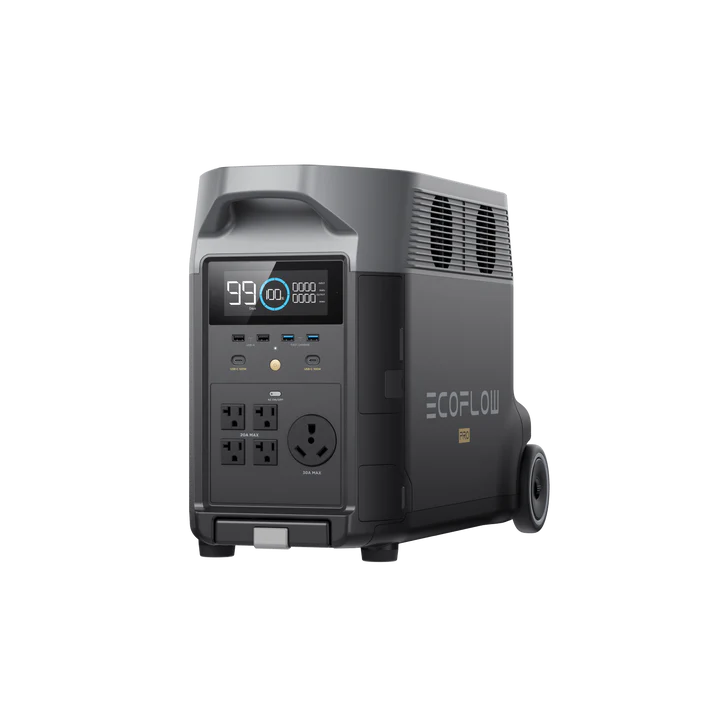
EcoFlow DELTA Pro
$1,799.00
$1,799.00 · direct from EcoFlow
down from $1,899 · 5% below usual
Last checked 16 days ago. Prices move — check before you buy.

BLUETTI Apex 300 + 2×B300KPick
$3,899.00
$3,899.00 · direct from BLUETTI
Last checked 16 days ago. Prices move — check before you buy.
Prices may vary by retailer and are subject to change.