Head-to-head test
Anker SOLIX C200 DC vs Goal Zero Sherpa 100PD
Neither of these has a wall outlet, so the question isn't power: it's whether you're flying with it, because at 94.7Wh the Sherpa 100PD clears airport security and at 192Wh the SOLIX C200 DC does not.
Full profiles: Anker SOLIX C200 DC → · Goal Zero Sherpa 100PD →

Written by Wenny ZhengUpdated
Portable Power Tester, Station Arena Test Desk
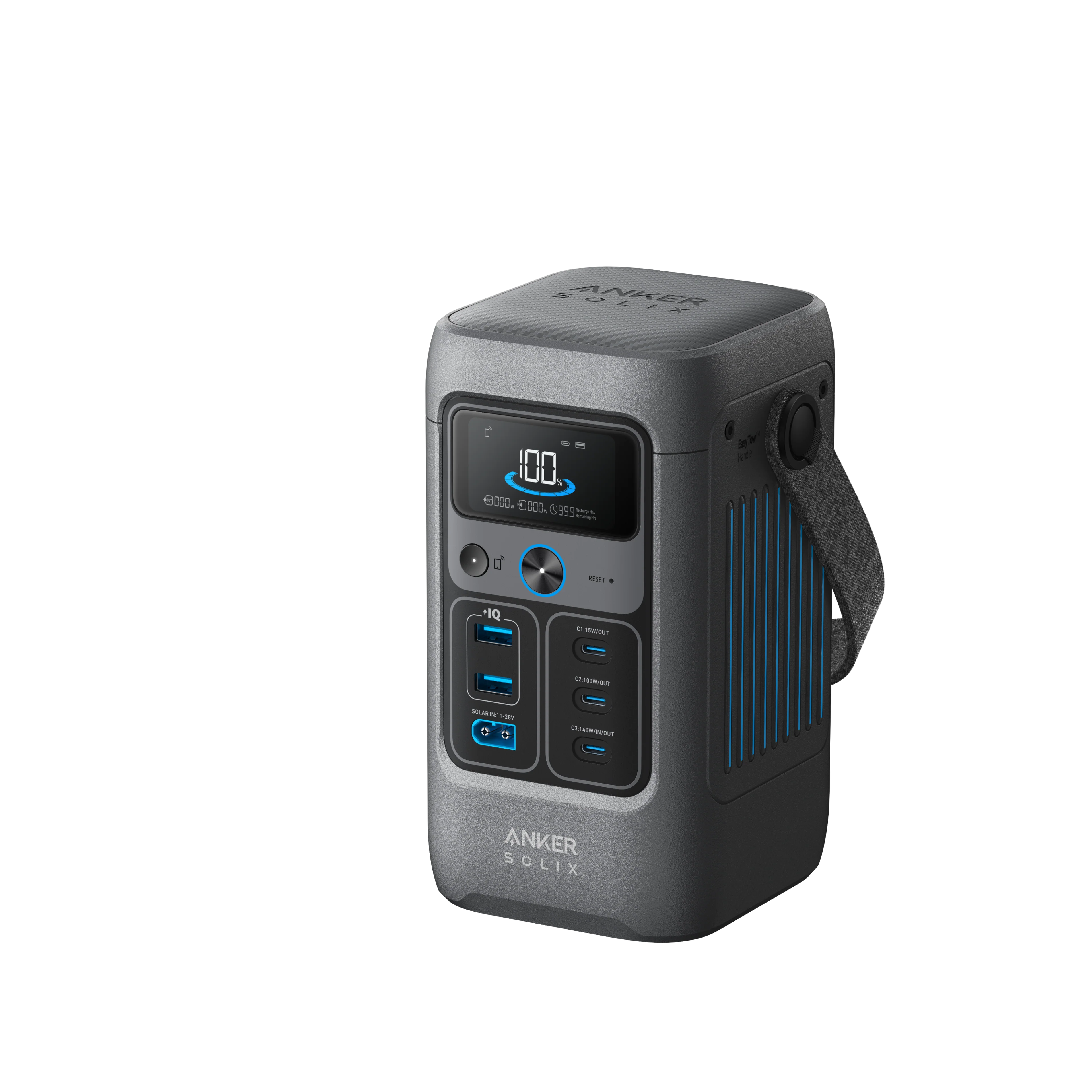
$149.99 · direct from Anker
Last checked 1 day ago. Prices move — check before you buy.
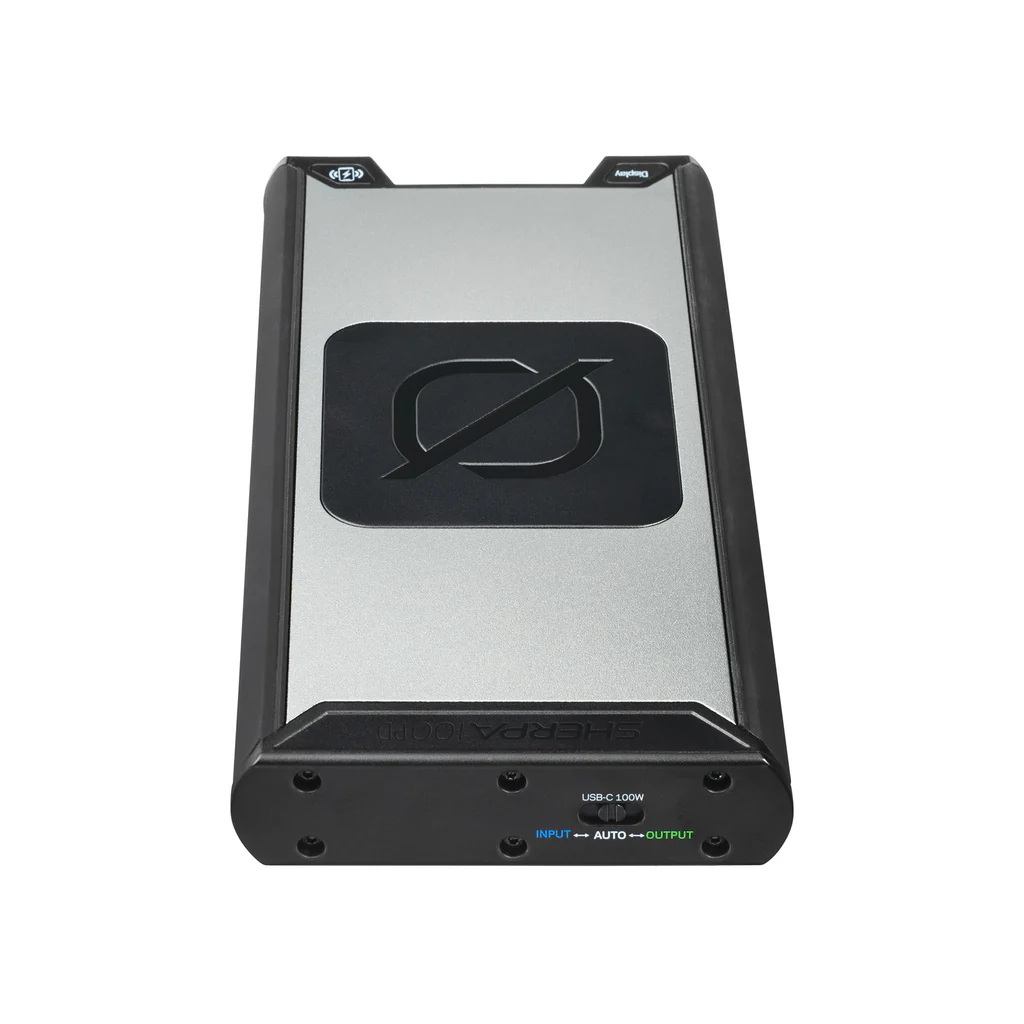
$199.95 · direct from Goal Zero
Last checked 1 day ago. Prices move — check before you buy.
Spec deltas
The Anker SOLIX C200 DC costs $140 and holds 192Wh. The Goal Zero Sherpa 100PD costs $200 and holds 94.7Wh. Those two lines settle most of it, and the rest of the specs run the same direction: 3,000 charge cycles against 500, 200W of total output against 100W, 100W of solar input against 20W, three years of warranty against two.
Before any of that matters, know what you're buying. Neither of these is a power station in the sense the scenario tables further down assume. There is no wall outlet on either one. The Anker's output is USB-C and DC, which is why one owner bought it specifically to run a Starlink Mini with no inverter anywhere in the chainA4, and why another wished for a three-pin household socket and admitted the model with one was outside his budgetA8. The Sherpa is a metal power bank with a single USB-C port and a wireless pad on the lidB10B11. Laptops, phones, tablets, cameras, a Starlink Mini. Not a fridge, not a CPAP, not a coffee maker.
So the Sherpa has to win on something other than power, and it has exactly one thing. 94.7Wh is an odd capacity to design toward until you notice what it sits just under: the watt-hour ceiling airlines apply to lithium batteries in carry-on baggage. 192Wh is over it, and one Anker owner put it flatly, saying this isn't airport friendly and not to even tryA9. If your battery's job is business travel, stop reading and buy the Sherpa. Everybody else is buying the Anker.
What the Numbers Reveal
Each conclusion stated first — the numbers behind it on one line, the full analysis below.
rated cycles
Lay the prices on top and the Anker comes out at $0.24 per lifetime kilowatt-hour against the Sherpa's $4.22, while also being the cheaper box on the shelf. The Sherpa isn't the premium version of this decision. It's a smaller battery with a shorter life at a higher price, and the only spec that survives that framing is its weight.
SOLIX C200 DC: 3,000 cycles at 192Wh, which the lifetime table totals at 576 kWhSherpa 100PD: 500 cycles at 94.7Wh, totalling 47 kWhthe lifespan row reads 8.2 years against 1.4 at daily useprices are $140 and $200
Why it mattersIf this battery goes into weekly rotation rather than a drawer, the cycle rating is the number that decides it, and it decides it early.
continuous output
That reframes the price gap entirely. You aren't paying more for a worse battery, you're paying for the only one of the two that travels, and the 1.5 lb compounds the same advantage, though the same reviewer still notices it in the bagB5. The Anker is the better battery and the worse carry-on, and no other line on this page changes either half of that sentence.
Sherpa 100PD: 94.7Wh and 1.5 lbSOLIX C200 DC: 192Wh and 4.2 lbone C200 DC owner reports it isn't airport friendly and advises against tryingA9a reviewer has carried the Sherpa in a backpack on every business trip for monthsB4
Why it mattersFly with it more than a couple of times a year and the Sherpa is the buy. Otherwise the weight saving costs you half the capacity for nothing.
That's not academic, because trickle-charging small things unattended is a real reason people buy a battery this size: a watch, a headlamp, a camera, a sensor. We can't resolve the conflict from the evidence in front of us, and neither can the manual, which one owner describes as four pages of warnings per language with no operating instructionsA7. The Sherpa has no equivalent report, but its record is thin on long-term use, so that's silence rather than a clean bill.
a forum poster reports the C200 DC's spec shuts its USB ports off after 2 hours with no way to change the timerA1an owner runs continuous USB-C power to a Linux single-board computer and says it never loses powerA6a delivery driver keeps a phone and tablet running across an 8-hour shift and never drops below 75%A3an iPad with the screen off draws 0-1 wattA14
Why it mattersIf overnight low-draw charging is the actual job, test the Anker inside the return window instead of trusting the spec sheet or the reviews.
solar input
Off-grid, the smaller battery is also the slower one to refill, and those two failings multiply rather than add. By the third morning the Sherpa is holding less and taking longer to get it back. The Anker takes any panel and, at 140W in, a laptop-class USB-C brick, so it has a second route home when the sky doesn't cooperate.
C200 DC: 100W solar input and 140W USB-CSherpa 100PD: 20W solarthe Sherpa's solar path requires Goal Zero's own Nomad 20 panel rather than a standard inputB7owners ran a Starlink Mini off the C200 DC for 5 or 6 hours and still had 40% leftA4, with clean pass-through while chargingA5
Why it mattersAnyone going off-grid past a single night should take the Anker, and should budget for a panel either way.
The specific dimensions that decide these two units — everything else is a tie.
Lifetime Value
Selected because: cost per lifetime kilowatt-hour is $0.24 against $4.22, and that gap comes straight from 3,000 charge cycles against 500.
cost / lifetime kWh
The column to be careful with here is years. 8.2 against 1.4 at daily use counts charge cycles and stops there, so it quietly treats one unit's 192Wh cycle and the other's 94.7Wh cycle as equivalent events. They aren't, and correcting for it widens the gap rather than narrowing it: 576 kWh of delivered energy across the Anker's life against 47 kWh across the Sherpa's.
There's no counter-argument available to the Sherpa on this table, because it loses on both terms at once, fewer cycles and less energy inside each one, at the higher price. When two units share a cycle rating this section is decoration. When one carries 3,000 cycles against 500, it's the verdict, and everything below it is commentary.
Runtime: Will It Power Your Gear?
Selected because: these are USB-C batteries, so the number that matters is hours of laptop and phone, not anything on the appliance list.
continuous output
The useful runtime figures for these two aren't on any chart, they're in what owners actually plugged in. A delivery driver ran a phone and a tablet through an 8-hour shift on the C200 DC and never went below 75%A3. Another got 2.5 days out of an iPad connected directly, with the tablet drawing 4-5 watts at half brightnessA14. Two more ran a Starlink Mini for 5 or 6 hours with 40% still showingA4A5. That's the shape of this product: it doesn't run appliances, it keeps working devices from stopping.
The Sherpa's numbers are smaller in roughly the same proportion, and one of them is unusually honest. PCWorld measured 77.2Wh actually delivered out of the rated 94.7, an efficiency of 81.52 percentB3. That's the only real delivered-energy measurement in either unit's evidence, and it lands slightly below the flat 85% these tables assume for both. Read every usable-watt-hour figure on this page as a modelling convention rather than a measurement, on both units.
Portability & Form Factor
Selected because: 1.5 lb against 4.2 lb is the Sherpa 100PD's one clear win, and for the buyer who flies it's the only one that counts.
weight
1.5 lb is a thing you forget you packed. 4.2 lb is a thing you decide to bring. That's the whole portability story and it's the one place the Sherpa's price makes sense: a reviewer has carried it on every business trip for months and says it replaced the power strip he used to packB4B5, and the metal shell holds up outdoors with no gaps or production marksB9B13. The Anker's owners split on its size, some finding it genuinely compact, others noticing it the moment it's loaded in a bagA8A15.
Weight alone is a thinner tiebreak than it looks, though. Going from 4.2 lb down to 1.5 lb, a saving of 2.7 lb, costs you 97Wh of capacity (192 against 94.7) and 2,500 charge cycles (3,000 against 500). That's a lot of battery to trade for less than the weight of a paperback. Unless the bag is the binding constraint and nothing else is, the trade doesn't clear.
Your Life, Your Pick
Selected because: all six profiles come back with neither unit covering them, and the reason is worth reading before the table is.
Every row below returns neither, and that isn't these two units failing the test so much as the test not applying to them. All six profiles are built around household AC appliances, and neither unit has an AC outlet. The blackout profile's 150W peak and the tailgate's 400W aren't loads the C200 DC starts and then drops, they're loads with nowhere to plug in. So when a row reports that a unit can power the peak, take it narrowly: it compares that unit's total port output against the biggest appliance in the profile and knows nothing else. It reads yes for the C200 DC on the 8-hour blackout's 150W peak, a load it has no socket to accept.
The percentages need reading correctly too. Each one runs the load against 85% of nameplate, a flat factor applied across the whole catalogue rather than anything measured on these two boxes, which is why 192Wh appears as 163Wh usable and 94.7Wh as 80Wh. Take the CPAP row seriously and the rest as scale: a 320Wh night against 163Wh of usable capacity in the larger unit isn't partial coverage, it's the machine stopping in the small hours. If any row below is genuinely your use case, neither of these is your unit.
Strengths & trade-offs
Anker SOLIX C200 DC
Strengths
- +Costs $60 less
- +Larger battery capacity
- +Higher AC output
- +Longer warranty
- +Faster solar charging
- +Rated for 3,000 charge cycles — much longer battery lifespan
Trade-offs
- –No major technical downsides compared to rival.
Goal Zero Sherpa 100PD
Strengths
- +Lighter by 2.7 lb
Trade-offs
- –Substantially more expensive (+$60) than the SOLIX C200 DC.
- –Lacks smartphone app control for remote monitoring.
- –Shorter-lived battery — rated for 500 charge cycles vs the SOLIX C200 DC's 3,000, so it wears out sooner.
Will It Power Your Gear?
Scenario math and per-appliance runtimes, modeled from the spec record.
Scenario verdicts
We ran the math on seven real-world scenarios. Here's which unit survives your actual life.
SCN-01 · 2 nights · needs 2,100Wh
Weekend Camping
Two nights off-grid with essential comfort
Neither unit
Neither, and not narrowly. The profile wants 2,100Wh; the C200 DC finishes 1,937Wh short and the Sherpa 100PD 2,020Wh short. It's also an AC appliance list, and neither unit has an AC outlet. Take one of these camping to keep phones, a headlamp and a tablet alive. Take a real power station if the cooler is coming.
Battery budget usedlower = more headroom
LOAD Phone Charger 15W×6h · LED Lights 40W×8h · Box Fan 75W×14h · CPAP Machine 40W×16h
SCN-02 · 8 hours · needs 1,645Wh
8-Hour Blackout
Keep the essentials running through a night without power
Neither unit
Neither. The profile needs 1,645Wh and the larger of these two covers 163Wh of it. The peak matters less than it appears: at 200W and 100W of total port output these are USB and DC devices, so the question isn't whether they can start a 150W appliance, it's that there's nowhere to plug one in. Through an outage they'll keep phones charged and a laptop alive, and that's the honest scope of it.
Battery budget usedlower = more headroom
LOAD Fridge 150W×8h · Router + Modem 20W×8h · LED Lights (4 bulbs) 40W×6h · Phone Charger 15W×3h
SCN-03 · 8 hours · needs 320Wh
CPAP Overnight
Sleep therapy without interruption — the #1 medical use case
Neither unit
Neither, and this is the row to read rather than skim. A 320Wh night against 163Wh usable in the C200 DC and 80Wh in the Sherpa 100PD means the machine stops in the small hours, not that you get a shortened night. Add that neither unit has an AC outlet and most machines arrive with an AC brick, and it isn't close. This job needs a station with an inverter and enough capacity to cover the whole night with room to spare.
Battery budget usedlower = more headroom
LOAD CPAP Machine 40W×8h
SCN-04 · 8 hours · needs 910Wh
Remote Workday
Full work day off-grid without power anxiety
Neither unit
Neither on the profile as written, which asks for 910Wh and leaves the C200 DC 747Wh short and the Sherpa 100PD 830Wh short. But a real remote workday is a laptop, a phone and a pair of headphones, not this appliance list, and that is precisely what both of these are built for. Judge them on hours of laptop, not on this row.
Battery budget usedlower = more headroom
LOAD Laptop 60W×8h · External Monitor 30W×8h · Router + Modem 20W×8h · Phone Charger 15W×2h
SCN-05 · 4 hours · needs 670Wh
Tailgate Party
Game day power for the crew
Neither unit
Neither, and here the output ratings say so before capacity gets a turn: the profile's largest load peaks at 400W against 200W and 100W of total port output. Capacity wouldn't have rescued it anyway, with 670Wh needed against 163Wh and 80Wh usable. A tailgate is a power station job, not a power bank job.
Battery budget usedlower = more headroom
LOAD Blender 400W×0.5h · LED TV (55") 80W×4h · Bluetooth Speaker 15W×4h · Phone Charger (×3) 45W×2h
SCN-06 · 24 hours · needs 4,685Wh
Van Life Daily
A full day of mobile living — the ultimate endurance test
Neither unit
Neither, by the widest margin on the board. 4,685Wh a day against 163Wh and 80Wh usable leaves the C200 DC 4,522Wh short and the Sherpa 100PD 4,605Wh short. Van electrics are a wired house battery and an inverter. These two are what you put in the day bag when you leave the van.
Battery budget usedlower = more headroom
LOAD Mini-Fridge 150W×24h · Laptop 60W×4h · Phone Charger 15W×3h · LED Lights 40W×5h · Fan 75W×8h
SCN-07 · an afternoon · needs 100Wh
Afternoon Off-Grid
Phones and a speaker at the park, beach, or campsite — the small-unit job description
SOLIX C200 DC
The Sherpa 100PD doesn't finish — 80Wh usable against the 100Wh this needs leaves it 20Wh short, about 81% of the scenario covered. The SOLIX C200 DC covers it with 63Wh to spare.
Battery budget usedlower = more headroom
LOAD Phone Charger (×2) 30W×2h · Bluetooth Speaker 10W×4h
The Load Test
RUNTIME = (Wh × 0.85) ÷ LOAD
None of the scenarios above exactly yours? Build it. Toggle what you'd plug in; both units are tested against the combined draw.
Essentials
Comfort & Convenience
High-Draw Appliances
Test duration
8h
Continuous draw
205W
Projected runtime
Neither unit has an AC outlet — drop the wall-plug loads to test what these DC stations actually run.
Modeled from the spec record — same math as the tables below. Methodology
Runtime by appliance
Real-world runtime estimates for common appliances, modeled at 85% inverter efficiency.¹
Essentials
The basics you need runningscale 0–10.9hComfort & Convenience
Makes off-grid life actually enjoyableHigh-Draw Appliances
These reveal the real limits¹ Runtime = (capacity × 0.85) ÷ appliance watts. Within each group, all bars share one time scale (the group's longest runtime), so lengths are comparable across appliances; identical runtimes collapse into a single blue/orange bar. Actual runtime varies with battery age, temperature, and simultaneous loads — see methodology.
Conclusion
August 9, 2026
Verdict: the SOLIX C200 DC
Buy the Anker SOLIX C200 DC. It costs $140 against $200, holds 192Wh against 94.7Wh, and is rated for 3,000 charge cycles against 500, which is a $60 premium for half the energy and a fraction of the life. Priced across that life it works out to $0.24 per kilowatt-hour against $4.22. It also takes 140W of USB-C in and 100W of solar against the Sherpa's 20W, so it refills faster from both wall and sun. The Sherpa 100PD earns its place in exactly one bag: 94.7Wh keeps it inside the watt-hour limit airlines put on carry-on lithium batteries, 1.5 lb against 4.2 lb means it disappears into a backpack, and it has a wireless pad built in. If you fly with your battery, that's the whole argument and it's enough. If you don't, nothing about the Sherpa closes the gap.
Editor-assigned confidence, based on cited owner research and spec analysis.
List prices as of August 9, 2026. The links below open Anker's and Goal Zero's current prices.
$149.99 · direct from Anker
Last checked 1 day ago. Prices move — check before you buy.
or check the Sherpa 100PD price$199.95 list
Written by Wenny Zheng, Portable Power Tester · Station Arena Test Desk · Updated August 9, 2026
Measured Data
Benchmark scores and the full spec record, side by side.
Benchmark scores
Not rated for both units (minimum threshold unmet): Apartment Balcony.
Full specifications
ᵈ Derived: price ÷ rated capacity. See the data behind our comparisons →
Comparison ToolAdd more power stations, side by sideOpen Tool →How these numbers are produced
Numeric verification
Every figure on this page traces to our spec database or arithmetic on it — no estimated numbers.
Owner claims
Statements about owner experience are cited to published reviews — see Sources & Research Notes below.
Runtime model
Runtime = (rated capacity × 0.85 inverter efficiency) ÷ device wattage. Solar recharge estimates assume panels deliver 70% of rated output. Cold weather, battery age, and stacked loads reduce real-world results.
Power Score
Computed from 14 published spec dimensions, weighted per use-case bench. Higher is better; a unit must meet a bench's minimum threshold to be rated.
See the full weight table and data sourcing on our methodology page →Class ranking (the star rating)
Each unit's star score is a category ranking, not customer reviews — no buyer opinions feed it. We score every station on size-independent quality (value, output, portability, endurance, ports, warranty, and more), then percentile-rank it against the other units in its capacity class, so a class-leading compact unit and a class-leading whole-home unit can both earn 5★. Here, SOLIX C200 DC rates 4.0/5 (43rd percentile of 22 Personal-class units), and Sherpa 100PD rates 3.4/5 (5th percentile of 22 Personal-class units).
How the class ranking is computed →Test Notes & Caveats
Hidden gotchas and advantages we spotted that you won't find on the product page.
App Control, on a Battery You're Already Holding
The C200 DC has phone-side monitoring and alerts, the Sherpa 100PD doesn't, and it's worth being straight about how much that's worth at this size. You're usually within arm's reach of a 192Wh battery and the display is right there. Where it earns its keep is when the battery isn't with you, powering something on a boat, in a van or at a remote setup while you're elsewhere, and a low-battery alert stops being a novelty. If that's not your use, don't let this column move you.
Warranty: 3 Years vs 2
The SOLIX C200 DC is covered for 3 years against the Sherpa 100PD's 2 years. An underrated factor if you're keeping this unit for years.
3,000 Cycles Against 500, and Why the Years Understate It
The years figures count charge cycles and nothing else, which quietly flatters the smaller unit: 8.2 years against 1.4 at daily use treats a 192Wh cycle and a 94.7Wh cycle as the same event. Measured in energy actually delivered across the battery's life it's 576 kWh against 47. Worth knowing too that hitting the cycle limit isn't death; capacity drifts down toward roughly 80% of original and the unit keeps working.
Full record above — the Test Desk pick is the SOLIX C200 DC.
Check SOLIX C200 DC price →or check the Sherpa 100PD priceOwnership Analysis
What happens after you buy — true cost of ownership, brand trust, and growth potential.
Lifetime value
Service lifeyears at one full cycle per day
Lifetime energy delivered
Cost per delivered kWh
│ warranty ends · Reaching the cycle rating means ~80% capacity remains — degraded, not dead.
Analyst note
The SOLIX C200 DC wins on both sticker price and long-term value. At $0.24/kWh over its lifetime, it's meaningfully cheaper to own. Clear value winner.
Delivers each lifetime kWh for $3.98 less — check the SOLIX C200 DC price →
Brand trust
Anker
Ecosystem
7-8 SOLIX portable power stations across C-series (compact) and F-series (flagship), plus the X1 home energy system
Support
US-based support. Historically known for incredible no-hassle replacements, but recent reports describe AI-driven support agents giving generic responses and complex return logistics for heavy units (hazmat shipping). The Anker brand reputation is still strong, but SOLIX-specific support quality is trending down.
Community
Moderate — active Reddit (r/Anker, r/AnkerSOLIXCommunity) and growing. Benefits from Anker's massive consumer electronics brand awareness.
App experience
Rated 4.5/5 iOS (~1,100 ratings) · 4.3/5 Android
Unique strength
Parent brand trust from Anker's consumer electronics dominance. InfiniPower technology for long cycle life. Strong $/Wh value in the mid-size and larger units — the S2000, F2600 and C1000 are among the better buys per watt-hour in the catalog.
Worth knowing
Support quality appears to be declining from its historically excellent level. Firmware updates have removed features without warning. Expansion ecosystem is smaller than EcoFlow's.
Goal Zero
Ecosystem
Focused — a compact current line (6th-gen Yeti and Yeti Pro series), the previous-gen X series now out of stock across every model on Goal Zero's own store (checked 2026-09-13: 200X, 500X, 1000X, 1500X, 3000X, 6000X, some listed only as open-box), so buying one new means finding retailer stock, Sherpa power banks for the under-100Wh tier, plus Alta coolers, Nomad/Ranger solar panels, and vehicle integration kits
Support
US-based company (Salt Lake City, owned by NRG Energy). Historically considered premium support, but 2025-2026 reports describe long wait times, unresponsive email communication, and tickets going unaddressed for weeks. The "premium support justifies premium pricing" argument is weakening.
Community
Small but loyal — strong following in overlanding and preparedness communities. Official community forums were recently shuttered, frustrating long-time users.
App experience
Rated 4.4/5 iOS (~1,200 ratings) but recent reviews skew negative — recurring connectivity issues, crashes, and stability problems.
Unique strength
Pioneer of the portable power market — strongest brand heritage. US-based company with ruggedized, weather-resistant designs (IP ratings vary by model). Integrated "Yeti-Ready" ecosystem with coolers, lights, and vehicle kits.
Worth knowing
Goal Zero's Yeti-Ready ecosystem, the coolers, lights and vehicle kits, is built around its power stations. The Sherpa 100PD sits alongside that line rather than inside it, and its solar input runs through Goal Zero's own Nomad panel rather than a standard connector, so plan the accessory before you plan the trip.
Analyst note
The brand difference on this page reduces to one number: $0.73 per watt-hour against $2.11. Goal Zero prices at a premium across its range and this pair is a clean example of it, so the question isn't whether you're paying more, it's whether the metal shell, the 1.5 lb and carry-on capacity are worth the gap between $140 and $200. Anker's advantage here is the one it has held for years in this size class, more watt-hours per dollar and a cycle rating that keeps them.
Growth path
SOLIX C200 DC
FIXED CAPACITYFixed at 192Wh, with no expansion — so size it for your needs up front rather than planning to add capacity later.
Accepts up to 100W of solar. Limited to a single portable panel.
Limited ports. You'll likely need a power strip or splitter.
Sherpa 100PD
FIXED CAPACITYFixed at 95Wh, with no expansion — so size it for your needs up front rather than planning to add capacity later.
Accepts up to 20W of solar. Limited to a single portable panel.
Limited ports. You'll likely need a power strip or splitter.
Realistic full solar rechargeat 70% of rated panel output — see methodology
Analyst note
Neither expands, and that's no knock on either — each is a complete unit at a fixed size. Buy the capacity that covers your needs now (the SOLIX C200 DC gives you the larger ceiling); you can't add to either later.
What Owners Report
Patterns from published owner reports and long-term reviews — every claim cited to its source below.
Anker SOLIX C200 DC
Field data on the C200 DC is real but narrow, coming almost entirely from verified Amazon purchases, Anker's own review widget and the comments under a single YouTube reviewA10A11A15, which is worth knowing before you weigh any of it. What's there is consistent. Sustained duty holds up better than owners expected: an 8-hour delivery shift ending above 75%A3, continuous USB-C power to a single-board computer that never drops outA6, 2.5 days on an iPadA14. Two separate owners bought it for a Starlink Mini and both got what they came for, including working pass-through while the unit itself chargesA4A5.
The complaints cluster in one place. There's no wall charger in the box, and getting the fast recharge means sourcing a high-wattage USB-C brick yourselfA2A7A10. One owner couldn't charge the unit at all until he worked that out, and found the manual no helpA7. Separately, one YouTube commenter reports going through three units that all developed USB-C port failuresA12. Nothing else corroborates it, so treat it as a single data point rather than a pattern, but it's the failure mode worth watching on a device whose ports are the entire product.
“But in the specs it says the usb ports will shut off in 2 hours and that time can't be changed... I'm deciding between it and the Jackery 240D which keeps the ports on for 12 hours. But the Anker is lighter, cheaper and has a better warranty.”
Sources
diysolarforum.com · amazon.com · ankersolix.com · judge.me
Goal Zero Sherpa 100PD
The Sherpa's record is professional reviewers rather than long-term ownersB1B4B9, with no six-month reports and no support-experience threads in evidence, so how it holds up over years is genuinely unknown. What the reviews agree on is the build: metal, tight tolerances, no gaps or obvious production marks, dependable outdoorsB9B13. One reviewer kept it in a backpack through months of business travel and stopped packing a power stripB4B5.
The wireless pad is the recurring disappointment. It's rated at 15WB11 but measured around 10W in practice with an iPhone 11 Pro and a Galaxy S20+B8, and one reviewer calls it among the slowest pads he's tested and suggests using a cableB1. Two smaller notes worth having: the metal trim can scratch a caseless phone over timeB2, and solar charging only works through Goal Zero's own Nomad panel rather than a standard inputB7.
“In testing, the Sherpa 100PD pumped out 77.2Wh, giving it an efficiency of 81.52 percent; that's just below the average of 82.64 percent efficiency in our testing.”
Sources & Research Notes
Every owner claim in this report is traceable to a published source. The bracketed references above resolve here.
Recurring owner themes
- No wall charger is included, and getting decent charge speed means sourcing a high-wattage (18W+, ideally 140W PD3.1) USB-C charger yourself — a recurring source of either mild annoyance or, for one reviewer who lacked a compatible charger on hand, a full return-to-sender experience. [SOLIX C200 DC · 3 entries]
- Independently of Anker's own marketing, multiple owners specifically bought and use the C200 DC to run a Starlink Mini off-grid (boat, remote site), reporting flawless pass-through power and multi-hour runtime without an inverter. [SOLIX C200 DC · 3 entries]
- Sustained, continuous-duty use (an 8-hour delivery shift, always-on passthrough to a Linux SBC, a multi-day iPad session) holds up better than owners expected, with battery percentage staying higher than they anticipated. [SOLIX C200 DC · 3 entries]
- Despite Anker's "39% smaller than peers" marketing claim, real-world size/weight impressions are split — some owners find it genuinely pocketable, others notice real heft once it's actually loaded in a bag. [SOLIX C200 DC · 2 entries]
- Owners and reviewers consistently praise the rugged metal build quality and durability for travel/outdoor use. [Sherpa 100PD · 3 entries]
- Wireless (Qi) charging is repeatedly noted as slow/underwhelming compared to wired charging, though still useful in a pinch. [Sherpa 100PD · 3 entries]
- Solar recharging is seen as a limitation since it requires Goal Zero's proprietary Nomad panel/USB port rather than a standard input. [Sherpa 100PD · 1 entries]
- Real-world charging reliability at lower charge levels or with laptops shows some inconsistency versus spec claims. [Sherpa 100PD · 2 entries]
- A1
“But in the specs it says the usb ports will shut off in 2 hours and that time can't be changed... I'm deciding between it and the Jackery 240D which keeps the ports on for 12 hours. But the Anker is lighter, cheaper and has a better warranty.”
diysolarforum.com — thread "SOLIX C200 DC question" · 2025-11 · [mixed]
- A2
“It's lightweight, easy to carry, and has enough power for phones, lights, a fan, and smaller devices... I like how quiet it is compared to larger units. My only complaint is I wish it included the wall charger instead of having to buy one separately.”
amazon.com customer review (Verified Purchase, Style: Anker SOLIX C200 DC) — "Handy Little Power Station" · 2026-05 · [positive]
- A3
“I have used this unit every day as a delivery driver to keep my phone and tablet running and so far I've never gotten below 75%... over an eight hour shift with the phone plugged in constantly.”
amazon.com customer review (Verified Purchase, Style: Anker SOLIX C200 DC) — "Perfect for top ups and small emergencies" · 2025-12 · [positive]
- A4
“I bought this to power my starlink mini on my fishing boat, I used it the other day for 5 or 6 hours and it still had 40% power left, great product and works great for a mini with no need for inverter.”
amazon.com customer review (Verified Purchase, Style: Anker SOLIX C200 DC) — "Works great for starlink mini!" · 2026-06 · [positive]
- A5
“The Starlink Mini worked flawlessly utilizing the Starlink cable connected to the adapter plugged into the USB-C 100w output outlet on the Anker... the pass through charging worked with no issues. Should power the Starlink mini for 6-8 hrs without charging.”
amazon.com customer review (Verified Purchase, Style: Anker SOLIX C200 DC) — "Powers Starlink Mini" · 2026-04 · [positive]
- A6
“It has continuous pd to a linux sbc when i plug in to charge and unplug to go remote the computer never loses power. That's a big deal for performance that other batteries can't match. The WiFi battery health monitoring is also amazing.”
amazon.com customer review (Verified Purchase, Style: Anker SOLIX C200 DC) — "Best battery for continuous PD" · 2026-06 · [positive]
- A7
“Can't get this battery to charge. Just discovered I have to now spend a small fortune for a 140W adapter, which it did not come with, in order to get it to charge... The User Guide has 4 pages of warnings per language but no operational instructions.”
amazon.com customer review (Verified Purchase, Style: Anker SOLIX C200 DC) — "140W adapter needed to charge, not included." · 2025-12 · [negative]
- A8
“It's surprisingly compact - said to be almost 40% smaller than its peers, but its weight is not inconsiderable - you know when it's in your bag!... I would have liked a 3 pin plug for household items, but didn't have the budget for the next model up.”
amazon.com customer review (Verified Purchase, reviewer in UK, Style: Anker SOLIX C200 DC) — "Compact Powerhouse For When You're Away From The Mains" · 2026-01 · [positive]
- A9
“You can charge multiple devices at once and not have to recharge it for days... this isn't airport friendly so don't even try it... I recommend you get a anker fast charging cable it's compatible and it speeds up the charging process.”
amazon.com customer review (Verified Purchase, Style: Anker SOLIX C200 DC) — "Awesome" · 2026-07 · [positive]
- A10
“Holds true to its capacity. Charging to full is quick if you have correct charge block. The price was okay but you do get Anker Solix backing.”
ankersolix.com product reviews (Judge.me widget on /products/c200-dc) · 2026-03 · [positive]
- A11
“Great compact power station for phones and laptops. This is my fifth Anker purchase, as I already have three other power stations... I keep coming back to Anker because their power products are higher quality than competitors like Bluetti.”
ankersolix.com product reviews (Judge.me widget on /products/c200-dc) · 2026-01 · [positive]
- A12
“Gone through 3 of these now. All 3 developed issues with the USB-C ports.”
YouTube — "Review: Anker SOLIX C200 DC Power Bank Station (60,000mAh), 192Wh Portable Power Station" (The Breakdown With Luke) — comment · 2025 · [negative]
- A14
“If I keep the screen brightness at 50% the iPad draws 4-5 watts... at 90% brightness 14-15 watts... with screen off just sound 0-1 watt... I'm getting 2.5 days direct connected to IPad.”
YouTube — "Review: Anker SOLIX C200 DC Power Bank Station (60,000mAh), 192Wh Portable Power Station" (The Breakdown With Luke) — comment · 2025 · [positive]
- A15
“Customers find the power bank reliable, with one mentioning it works well with Starlink Mini... appreciate its fast 140W recharging capability, providing up to 10-12 hours of use... The compact size receives mixed feedback, with some finding it sufficiently large while others consider it too big.”
amazon.com "Customers say" AI-generated review summary (943 ratings, ASIN B0D62P85ZR) · unknown · [mixed]
- B1
“That makes this one of the slowest wireless charging pads I've tested, so unless you plan on leaving your phone on the pad overnight, I'd suggest using a wired connection.”
PCWorld — Goal Zero Sherpa 100PD review: A heavy battery pack that's become my go-to for trips · 2019-12 · [negative]
- B2
“If you're like me and don't use a case for your phone, that trim is going to scratch the back of your handset over time.”
PCWorld — Goal Zero Sherpa 100PD review · 2019-12 · [negative]
- B3
“In testing, the Sherpa 100PD pumped out 77.2Wh, giving it an efficiency of 81.52 percent; that's just below the average of 82.64 percent efficiency in our testing.”
PCWorld — Goal Zero Sherpa 100PD review · 2019-12 · [mixed]
- B4
“For the past few months, the Goal Zero Sherpa 100PD has been in my backpack for every business trip I've gone on, and I don't see that changing anytime soon.”
PCWorld — Goal Zero Sherpa 100PD review · 2019-12 · [positive]
- B5
“It's not the lightest battery pack, weighing in at 1.4 pounds, and I definitely notice that it's in my bag, but it has essentially replaced the power strip I would bring with me on trips.”
PCWorld — Goal Zero Sherpa 100PD review · 2019-12 · [positive]
- B7
“The Sherpa 100PD can also be powered by solar, but it requires Goal Zero's proprietary Nomad 20 solar panel.”
GearJunkie — Goal Zero Sherpa 100AC & 100PD Review · 2022-11 · [negative]
- B8
“The fastest I ever got out of it was 10W with an iPhone 11 Pro and a Galaxy S20+, which is right around what I expected.”
Android Central — Goal Zero Sherpa 100 PD Qi review · 2023-09 · [mixed]
- B9
“Overall, the materials feel high-quality, and the construction is excellent, with no gaps or obvious production marks.”
Android Central — Goal Zero Sherpa 100 PD Qi review · 2023-09 · [positive]
- B10
“While the included cable and sole USB-C port hold it back, it still has strong Power Delivery to multiple devices and a convenient design.”
Android Central — Goal Zero Sherpa 100 PD Qi review · 2023-09 · [mixed]
- B11
“Sherpa's built-in, 15W wireless charging saved the day by getting the phone filled up quickly within the limited amount of time we spent around camp.”
REI product reviews — Goal Zero Sherpa 100PD Power Bank · unknown · [positive]
- B13
“Externally, the Sherpa 100PD is rugged and well-built for the outdoors where dependability is a requirement for me.”
REI product reviews — Goal Zero Sherpa 100PD Power Bank · unknown · [positive]
Research compiled August 9, 2026.
Who Should Buy Which
Buy the SOLIX C200 DC if you…
- →You charge laptops, phones, tablets and camera batteries, and you have never once wanted a wall socket on the thing. 192Wh at $140 with 3,000 cycles is the best version of that product on this page.
- →You work out of a vehicle. The delivery-driver case is the cleanest evidence in either ledger: a phone and a tablet running all shift, still showing above 75% at the endA3.
- →You run a Starlink Mini off-grid. Two owners bought it for exactly that and got 5 or 6 hours with 40% leftA4A5, and 100W of solar input means you can put it back the same afternoon.
- →You want it to still be worth carrying in five years. At 3,000 cycles it outlasts the decision. At 500, the Sherpa does not.
Buy the Sherpa 100PD if you…
- →You fly with your battery. 94.7Wh stays in the carry-on where 192Wh doesn't, and that one fact is worth paying $200 where the Anker is $140.
- →Your bag already weighs too much. 1.5 lb against 4.2 lb is the difference between packing it every trip and leaving it in a drawer.
- →You want a wireless pad built in and a metal shell you don't have to babyB9B13. Just don't buy it for the pad's speed, which measured around 10W in testingB8.
If neither fits
Anyone whose list has a wall plug on it. A CPAP, a mini fridge, a coffee maker, a TV, power tools: neither of these has an AC outlet, and neither holds enough energy to matter if it did. The CPAP row is the honest illustration, a 320Wh night against 163Wh of usable capacity in the larger of the two. If that's you, close this tab and shop actual power stations several times this size with a real inverter, and read the surge rating before you read the capacity.
The Bottom Line
Buy the SOLIX C200 DC. It's the cheaper box, it holds twice the energy, and it's rated for 3,000 charge cycles against 500, which is why the cost of energy across its life lands at $0.24 per kilowatt-hour against $4.22. No feature reaches across a gap that wide, and the Sherpa's real strengths, the metal shell and the wireless pad, are comfort rather than capability.
The one exception is genuine, and it goes last so you don't miss it. If you fly with your battery, 94.7Wh gets on the plane and 192Wh does not. That isn't a tiebreak, it's a different product category, and it's the only version of this decision where paying $200 instead of $140 for half the capacity is the right call. Everyone else: take the Anker, and put the difference toward the charger it doesn't include.
Frequently Asked Questions
Answers drawn from the spec record and cited owner research.
Does the Anker SOLIX C200 DC have an AC outlet?
No. It's a DC and USB-C unit, which is what the DC in the name is doing. One owner bought it precisely because a Starlink Mini needs no inverter in the chain, and another wished for a three-pin household socket and noted the model that has one was outside his budget. Its 200W output rating describes ports, not an inverter, so anything that ends in a wall plug needs a different class of product.
Can I take either of these on a plane?
The Sherpa 100PD's 94.7Wh sits under the watt-hour limit airlines apply to lithium batteries in carry-on baggage. The C200 DC's 192Wh is above it, and one owner's advice was simply not to try. Confirm with your specific airline before you fly, since the rules are theirs to enforce, but the capacity difference is the whole story.
Will either one run a CPAP overnight?
No. The overnight profile on this page needs 320Wh, and the larger of these two offers 163Wh usable after the standard 85% derate. That's half a night at best, and it assumes your machine will take DC power at all, since neither unit has an AC outlet. Buy a power station with a real inverter instead.
Does the SOLIX C200 DC come with a charger?
No, and that's the most common complaint in its reviews. Hitting the 140W USB-C recharge means supplying a matching high-wattage brick yourself, which one owner discovered only after finding he couldn't charge the unit at all. Budget for one, or use a laptop charger you already own and accept a slower refill.
Why does the Sherpa 100PD cost more than the C200 DC when it holds less?
You're paying $2.11 per watt-hour against $0.73. Some of that is the metal build and the wireless pad, some is Goal Zero's pricing across its whole range, and the part genuinely worth money is 1.5 lb and carry-on legality. If none of those three describes you, the premium buys nothing you'll notice.
Related buying guides
Where to buy
Anker SOLIX C200 DCPick
$149.99
$149.99 · direct from Anker
Last checked 1 day ago. Prices move — check before you buy.
Goal Zero Sherpa 100PD
$199.95
$199.95 · direct from Goal Zero
Last checked 1 day ago. Prices move — check before you buy.
Prices may vary by retailer and are subject to change.