Head-to-head test
Goal Zero Sherpa 100PD vs Goal Zero Yeti 200X
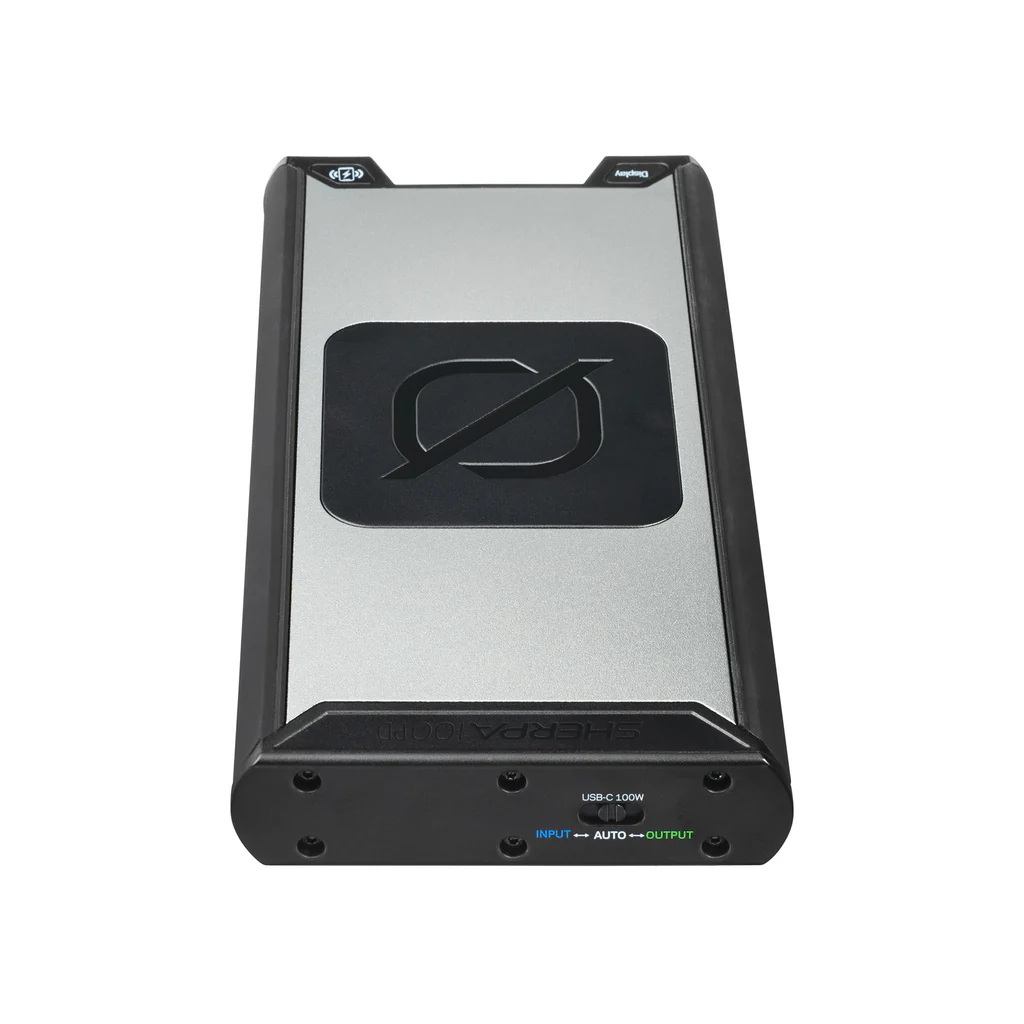
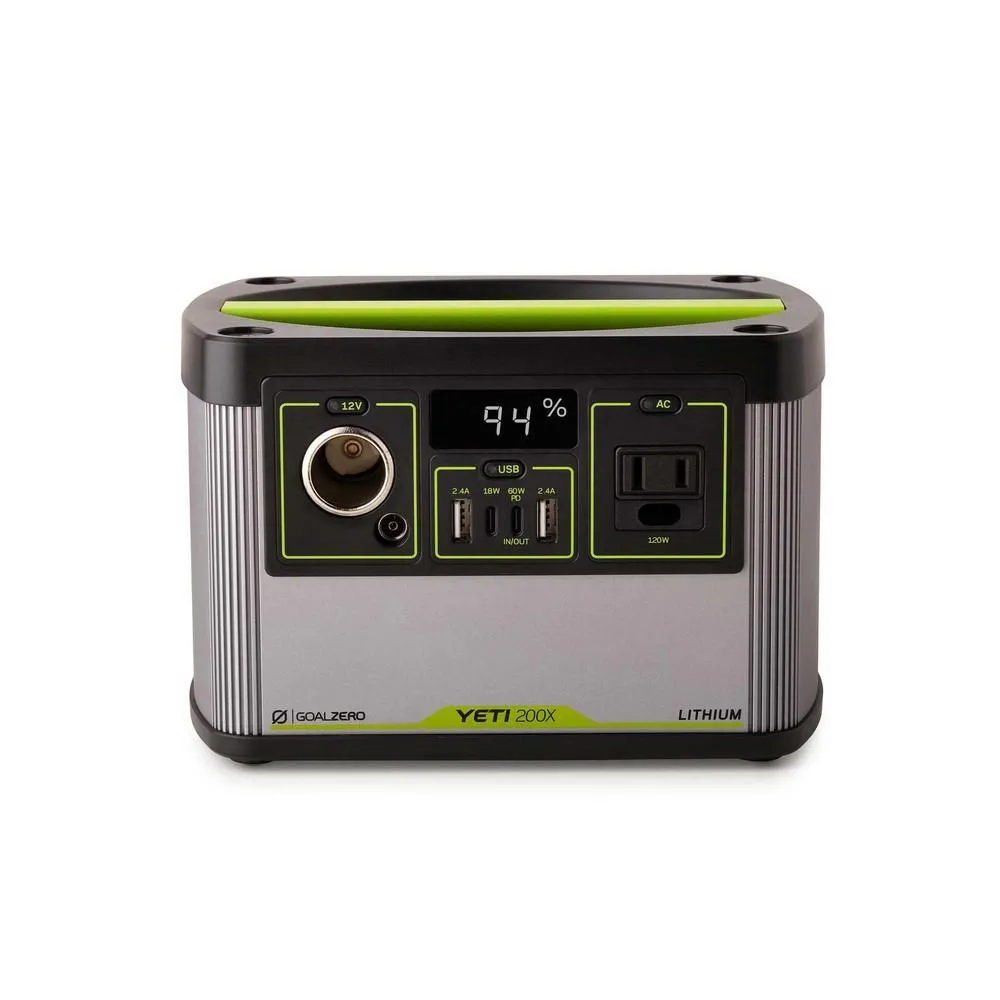
Whether your gear ends in a wall plug decides this before capacity or price gets a vote: the Sherpa 100PD is a 1.5-pound USB-C bank with no AC outlet, the Yeti 200X a 5-pound station with a real one.
Full profiles: Goal Zero Sherpa 100PD → · Goal Zero Yeti 200X →

Written by Wenny ZhengUpdated
Portable Power Tester, Station Arena Test Desk
Spec deltas
These sit twenty dollars apart and look like the same shelf, but they're different machines. The Sherpa 100PD is a 1.5-pound USB-C power bank with no AC outlet at all. The Yeti 200X is a 5-pound power station with a real, if small, one. Settle which of those you actually need and this comparison is most of the way over before capacity or price says a word.
For the buyer who could go either way, the Yeti is the pick. Twenty dollars more buys nearly double the usable energy, 159 watt-hours against 80, plus a 120W AC inverter and six times the solar input. And it costs less per lifetime kilowatt-hour despite carrying the bigger battery. The Sherpa's higher price is not paying for capacity, because it has less of it.
What the Sherpa's price buys is the carry. At under a third of the Yeti's weight, with 100W USB-C against the Yeti's 60, it's the one to grab if your whole world is a phone, a laptop, and a camera and you'd rather not feel the battery in your bag. If anything you own ends in a wall plug, though, it's the Yeti or nothing. The Sherpa simply won't take it.
What the Numbers Reveal
Each conclusion stated first — the numbers behind it on one line, the full analysis below.
continuous output
The catch is that the Yeti's inverter is tiny. Of seven modeled loads, only the smallest, a 100Wh afternoon off-grid, actually finishes on it, because 120W continuous is a lamp-and-phone-charger outlet, not a fridge-or-blender one. So the Yeti's AC port is real but modest: it wins you a few small plug-in things, not household power.
Sherpa 100PD: 0 AC outlets, DC-only, its 100W is a USB and 12V port total, not an inverterYeti 200X: 120W continuous inverter, 200W surge, behind 1 AC outlet
Why it mattersIf your gear is all USB-C, USB, and 12V, that AC outlet is a feature you'll never use and the Sherpa's other strengths take over. If you need to plug in even one small wall wart, the Sherpa is out before capacity matters.
Capacity
Both packs carry the same 500-cycle rating and the same 2-year warranty, so the Yeti isn't buying cheaper energy by cutting longevity. It's simply more battery per dollar, $2.35 per lifetime kilowatt-hour to the Sherpa's $4.22. The Sherpa's premium is buying grams and USB-C watts, not capacity.
Yeti 200X: 187Wh at $220 (last listed price), $1.18 per WhSherpa 100PD: 94.7Wh at $200, $2.11 per WhLifetime cost $2.35 vs $4.22 per kWh, both rated 500 cycles
Why it mattersA buyer choosing on capacity-per-dollar takes the Yeti without much thought. The Sherpa only pays off if you specifically want what the extra money buys: the light body and the fast USB-C.
weight
Reviewers describe the Sherpa as a bag-permanent travel battery that replaced their travel power stripA4A5, with a wireless pad for a top-up on the sideA11. Its 100W USB-C fast-charges even a 16-inch laptop at full tilt, where the Yeti's 60W throttles the same machine. That is a device you carry; the Yeti is a device you park.
Sherpa 100PD: 1.5 lb, 100W USB-CYeti 200X: 5 lb, 60W USB-C
Why it mattersThe frequent flyer, the photographer, the laptop-in-a-cafe buyer wants the Sherpa. The car-camper who leaves the battery on a table wants the Yeti.
The specific dimensions that decide these two units — everything else is a tie.
What the Specs Don't Tell You
Selected because: The Sherpa has no AC outlet and the Yeti does, the single biggest difference between them and the one that settles most of the matchup before capacity or price.
The Sherpa's 100W is a DC-port total across USB-C, USB-A, and 12V, not an inverter. There is no AC outlet on it, so a lamp, a TV, a coffee maker, most fans, anything that ends in a two-prong plug, never runs on it at any wattage. That's a design choice rather than a fault: skipping the inverter is how it stays silent and 1.5 pounds. But it draws a hard line, and you have to know which side of it your gear lives on.
The Yeti crosses that line with a real inverter, though a small one: 120W continuous, 200W surge, behind a single AC outlet. That's enough for a lamp, a phone brick, a small fan, and not much past a laptop. So the AC outlet is the Yeti's to claim, but read it as a few small plug-in things, not household power. On warranty the two are identical at 2 years, so that settles nothing either way.
Lifetime Value
Selected because: Twenty dollars separates them, yet the Yeti holds nearly double the energy (187Wh to 95) and costs less per lifetime kilowatt-hour, $2.35 against $4.22.
Twenty dollars is the entire price gap, and it buys nearly double the battery: 187Wh against 94.7, or about 159 usable watt-hours against 80. Per watt-hour that's $1.18 on the Yeti and $2.11 on the Sherpa. Over 500 charge cycles, the same rating on both, the Yeti delivers energy at $2.35 per lifetime kilowatt-hour and the Sherpa at $4.22.
So the Sherpa's premium is not buying capacity, because it has less of it. You're paying for grams and for USB-C watts, which is a fair thing to pay for if you carry the battery. If you're choosing on how much energy a dollar buys, though, it's the Yeti and it isn't close.
Portability & Form Factor
Selected because: At 1.5 pounds with 100W USB-C the Sherpa is built to carry; the 5-pound, 60W-USB-C Yeti is built to set down. This is where the Sherpa earns its price.
weight
1.5 pounds against 5. The Sherpa is a throw-it-in-the-backpack battery you forget is there; the Yeti is a set-it-on-the-table box. That gap is the Sherpa's whole reason to cost what it costs, and for the traveler it's decisive. A power bank you won't carry is a power bank you left at home.
The Sherpa also charges harder over USB-C: 100W to the Yeti's 60. That's the difference between fast-charging a 16-inch laptop at full tilt and merely keeping it topped up during use. At under a third of the Yeti's weight and with 100W USB-C against 60, the Sherpa is plainly the one built to travel. If you carry your power more than you park it, the weight and the watts flip this verdict toward it.
Your Life, Your Pick
Selected because: Both are small: of seven modeled loads, six ask for more than even the Yeti's 187Wh, so this section is mostly about what neither can do.
Point either unit at a real household load and the answer is the same: no. Of seven scenarios modeled here, six ask for more than even the Yeti's 187Wh. A weekend's camping wants 2,100Wh; an eight-hour blackout about 1,645. These are batteries for devices, not for rooms.
The one load that resolves is the smallest, an afternoon off-grid at 100Wh, and it goes to the Yeti with 59Wh to spare while the Sherpa lands 20Wh short. Even a single CPAP night at 320Wh beats both, with the Yeti covering about half and the Sherpa about a quarter. Notice too how often the Sherpa's no is really wrong tool: half these loads are AC, which it can't take at all. Size either one for phones, laptops, cameras, and a few 12V odds and ends. Not for the fridge.
Strengths & trade-offs
Goal Zero Sherpa 100PD
Strengths
- +Lighter by 3.5 lb
Trade-offs
- –Lacks smartphone app control for remote monitoring.
Goal Zero Yeti 200X
Strengths
- +Larger battery capacity
- +Higher AC output
- +Faster solar charging
Trade-offs
- –Lacks smartphone app control for remote monitoring.
Will It Power Your Gear?
Scenario math and per-appliance runtimes, modeled from the spec record.
Scenario verdicts
We ran the math on seven real-world scenarios. Here's which unit survives your actual life.
SCN-01 · 2 nights · needs 2,100Wh
Weekend Camping
Two nights off-grid with essential comfort
Neither unit
The Sherpa 100PD has no AC outlets, so the led lights and box fan in this scenario never plug in — it's a DC station for USB and 12V gear, and no wattage figure changes that, so capacity never gets a say. This is the wrong kind of unit for the job rather than a close call. The Yeti 200X doesn't have the energy either — 159Wh usable against 2,100Wh, 1,941Wh short — so neither route works.
Battery budget usedlower = more headroom
LOAD Phone Charger 15W×6h · LED Lights 40W×8h · Box Fan 75W×14h · CPAP Machine 40W×16h
SCN-02 · 8 hours · needs 1,645Wh
8-Hour Blackout
Keep the essentials running through a night without power
Neither unit
Eight hours of a fridge, router, and lights runs to about 1,645Wh, and the Yeti holds 187 while the Sherpa holds 95. Half those loads are wall-plug AC, which the Sherpa can't take at all. This is the wrong tool at both ends: far too little battery, and on the Sherpa no outlet to begin with. For an outage you want a 1,000Wh-plus station with a full inverter.
Battery budget usedlower = more headroom
LOAD Fridge 150W×8h · Router + Modem 20W×8h · LED Lights (4 bulbs) 40W×6h · Phone Charger 15W×3h
SCN-03 · 8 hours · needs 320Wh
CPAP Overnight
Sleep therapy without interruption — the #1 medical use case
Neither unit
A CPAP setup pulls about 320Wh across a night, and neither battery reaches it, with the Yeti covering roughly half and the Sherpa about a quarter. That's not a shorter sleep; it's the machine cutting out at 2 or 3 a.m. and waking you to a problem you didn't have at bedtime. For CPAP backup, both are a size too small. Look one shelf up.
Battery budget usedlower = more headroom
LOAD CPAP Machine 40W×8h
SCN-04 · 8 hours · needs 910Wh
Remote Workday
Full work day off-grid without power anxiety
Neither unit
The Sherpa 100PD has no AC outlets, so the external monitor and router + modem in this scenario never plug in — it's a DC station for USB and 12V gear, and no wattage figure changes that, so capacity never gets a say. This is the wrong kind of unit for the job rather than a close call. The Yeti 200X doesn't have the energy either — 159Wh usable against 910Wh, 751Wh short — so neither route works.
Battery budget usedlower = more headroom
LOAD Laptop 60W×8h · External Monitor 30W×8h · Router + Modem 20W×8h · Phone Charger 15W×2h
SCN-05 · 4 hours · needs 670Wh
Tailgate Party
Game day power for the crew
Neither unit
The Sherpa 100PD has no AC outlets, so the blender and led tv in this scenario never plug in — it's a DC station for USB and 12V gear, and no wattage figure changes that, and the Yeti 200X can't run the 400W peak at all — 200W is the most its inverter will pass even momentarily, so capacity never gets a say. This is the wrong kind of unit for the job rather than a close call.
Battery budget usedlower = more headroom
LOAD Blender 400W×0.5h · LED TV (55") 80W×4h · Bluetooth Speaker 15W×4h · Phone Charger (×3) 45W×2h
SCN-06 · 24 hours · needs 4,685Wh
Van Life Daily
A full day of mobile living — the ultimate endurance test
Neither unit
The Sherpa 100PD has no AC outlets, so the mini-fridge, led lights and the rest in this scenario never plug in — it's a DC station for USB and 12V gear, and no wattage figure changes that, and the Yeti 200X can start the 150W peak but not hold it — 200W of surge gets it going, then the 120W continuous rating takes over, so capacity never gets a say. This is the wrong kind of unit for the job rather than a close call.
Battery budget usedlower = more headroom
LOAD Mini-Fridge 150W×24h · Laptop 60W×4h · Phone Charger 15W×3h · LED Lights 40W×5h · Fan 75W×8h
SCN-07 · an afternoon · needs 100Wh
Afternoon Off-Grid
Phones and a speaker at the park, beach, or campsite — the small-unit job description
Yeti 200X
The Sherpa 100PD doesn't finish — 80Wh usable against the 100Wh this needs leaves it 20Wh short, about 81% of the scenario covered. The Yeti 200X covers it with 59Wh to spare.
Battery budget usedlower = more headroom
LOAD Phone Charger (×2) 30W×2h · Bluetooth Speaker 10W×4h
The Load Test
RUNTIME = (Wh × 0.85) ÷ LOAD
None of the scenarios above exactly yours? Build it. Toggle what you'd plug in; both units are tested against the combined draw.
Essentials
Comfort & Convenience
High-Draw Appliances
Test duration
8h
Continuous draw
205W
Projected runtime
The Sherpa 100PD has no AC outlets for the wall-plug loads here, and the Yeti 200X's 120W can't hold 205W either.
Planning for more than this? Describe your whole setup and get it sized →
Modeled from the spec record — same math as the tables below. Methodology
Runtime by appliance
Real-world runtime estimates for common appliances, modeled at 85% inverter efficiency.¹
Essentials
The basics you need runningscale 0–10.6hComfort & Convenience
Makes off-grid life actually enjoyablescale 0–2.1hHigh-Draw Appliances
These reveal the real limits¹ Runtime = (capacity × 0.85) ÷ appliance watts. Within each group, all bars share one time scale (the group's longest runtime), so lengths are comparable across appliances; identical runtimes collapse into a single blue/orange bar. Actual runtime varies with battery age, temperature, and simultaneous loads — see methodology.
Conclusion
August 30, 2026
Verdict withdrawn: the Yeti 200X is no longer sold
We picked the Yeti 200X, but it's been discontinued (Goal Zero now points buyers to the Yeti 300). The Sherpa 100PD is still on sale, but that alone doesn't make it our pick. The comparison below is still accurate if you own either one.
Editor-assigned confidence, based on cited owner research and spec analysis.
Written by Wenny Zheng, Portable Power Tester · Station Arena Test Desk · Updated August 30, 2026
Black Friday · 38 days out
Price to beat:Sherpa 100PD $150
The lowest we have recorded. A Black Friday price above it is a sale this unit has already had.
Measured Data
Benchmark scores and the full spec record, side by side.
Benchmark scores
Not rated for both units (minimum threshold unmet): Apartment Balcony.
Full specifications
ᵈ Derived: price ÷ rated capacity. See the data behind our comparisons →
Comparison ToolAdd more power stations, side by sideOpen Tool →How these numbers are produced
Numeric verification
Every figure on this page traces to our spec database or arithmetic on it — no estimated numbers.
Owner claims
Statements about owner experience are cited to published reviews — see Sources & Research Notes below.
Runtime model
Runtime = (rated capacity × 0.85 inverter efficiency) ÷ device wattage. Solar recharge estimates assume panels deliver 70% of rated output. Cold weather, battery age, and stacked loads reduce real-world results.
Power Score
Computed from 14 published spec dimensions, weighted per use-case bench. Higher is better; a unit must meet a bench's minimum threshold to be rated.
See the full weight table and data sourcing on our methodology page →Class ranking (the star rating)
Each unit's star score is a category ranking, not customer reviews — no buyer opinions feed it. We score every station on size-independent quality (value, output, portability, endurance, ports, warranty, and more), then percentile-rank it against the other units in its capacity class, so a class-leading compact unit and a class-leading whole-home unit can both earn 5★. Here, Sherpa 100PD rates 3.4/5 (4th percentile of 24 Personal-class units), and Yeti 200X rates 3.4/5 (9th percentile of 24 Personal-class units).
How the class ranking is computed →Test Notes & Caveats
Hidden gotchas and advantages we spotted that you won't find on the product page.
Sherpa 100PD: No AC Outlets At All
The Sherpa 100PD's 100W is a DC port total — USB and 12V — not an inverter rating. Anything with a wall plug (a fridge, a TV, a coffee maker, most fans and lamps) never plugs in, at any wattage. That's the design, not a defect: it buys weight, silence, and efficiency for phone, laptop, camera, and 12V-CPAP loads. The Yeti 200X carries a real inverter behind 1 AC outlet, so it plays in both worlds. Decide which side of that line your gear lives on before weighing anything else on this page.
Warranty: No Difference
Both units carry the same 2-year warranty, so coverage isn't a tiebreaker here.
Ownership Analysis
What happens after you buy — true cost of ownership, brand trust, and growth potential.
Lifetime value
Service lifeyears at one full cycle per day
Lifetime energy delivered
Cost per delivered kWh
│ warranty ends · Reaching the cycle rating means ~80% capacity remains — degraded, not dead.
Analyst note
The Yeti 200X is no longer sold, so there is no price to work its cost per kWh from, and this comparison doesn't quote one. On what you can actually buy today, the Sherpa 100PD works out at $4.22/kWh over its rated life. If you already own the Yeti 200X, the hardware comparison still holds: over its rated life the Sherpa 100PD delivers about 47 kWh and the Yeti 200X about 94 kWh. One thing to know reading the table: both carry the same 500-cycle rating, so the lifetime rows are sticker price and capacity in disguise — the wear horizon is identical and decides nothing here.
Growth path
Sherpa 100PD
FIXED CAPACITYFixed at 95Wh, with no expansion — so size it for your needs up front rather than planning to add capacity later.
Accepts up to 20W of solar. Limited to a single portable panel.
Limited ports. You'll likely need a power strip or splitter.
Yeti 200X
FIXED CAPACITYFixed at 187Wh, with no expansion — so size it for your needs up front rather than planning to add capacity later.
Accepts up to 120W of solar. Limited to a single portable panel.
Limited ports. You'll likely need a power strip or splitter.
Realistic full solar rechargeat 70% of rated panel output — see methodology
Analyst note
Growth only counts if you can still buy in, and the Yeti 200X is no longer sold (Goal Zero points owners to the Yeti 300). That leaves the Sherpa 100PD: it is sealed at 95Wh, so buy the size that covers you now. The Yeti 200X's fixed 187Wh still matters if you already own one, but it isn't a reason to pick it over the Sherpa 100PD.
What Owners Report
Patterns from published owner reports and long-term reviews — every claim cited to its source below.
Goal Zero Sherpa 100PD
Field data on the Sherpa is mostly professional and enthusiast reviews rather than long-term ownersA0, but it's consistent where it counts. Reviewers repeatedly praise the rugged metal build and travel durabilityA4A9A13, and one describes it living in their backpack for months of business trips, having replaced the travel power strip they used to packA4A5. One tester ran a USB fan all night alongside a phone and a watch and still had about half the pack left in the morningA15.
The recurring knock is the wireless pad: rated 15W but nearer 10W in practice, and slow enough that reviewers tell you to use a cable for anything urgentA1A8A11. One lab measured 77.2Wh out of it, about 81.5% efficient, a touch below their tested averageA3. Two smaller cautions worth knowing: solar recharging wants Goal Zero's proprietary Nomad panel rather than any standard inputA7, and the metal trim can scuff a caseless phone over timeA2.
“In testing, the Sherpa 100PD pumped out 77.2Wh, giving it an efficiency of 81.52 percent; that's just below the average of 82.64 percent efficiency in our testing.”
Goal Zero Yeti 200X
Our own research turned up little on the Yeti 200X beyond spec-level reviews, with no long-term owner threadsB0, so treat this as lightly covered. What's there is consistent: at 5 pounds it's Goal Zero's lightest station, well-connected for small gear with USB-A, 60W USB-C, one AC outlet, and 12V, and it recharges quicklyB2B3. The caveat reviewers keep returning to is the chemistry, an older Li-NMC pack rated 500 cycles to 80% sold into a market that has largely moved to longer-lived LFPB1B4. Plan around that 500-cycle number rather than hoping to stretch far past it.
“A 187Wh Li-ion NMC battery rated for 500 lifecycles to 80%, with a 120W AC inverter.”
Sources
walmart.com · pcworld.com · forbes.com · the-gadgeteer.com · geardiary.com · bhphotovideo.com · bestbuy.com
Sources & Research Notes
Every owner claim in this report is traceable to a published source. The bracketed references above resolve here.
Recurring owner themes
- Owners and reviewers consistently praise the rugged metal build quality and durability for travel/outdoor use. [Sherpa 100PD · 3 entries]
- Wireless (Qi) charging is repeatedly noted as slow/underwhelming compared to wired charging, though still useful in a pinch. [Sherpa 100PD · 3 entries]
- Solar recharging is seen as a limitation since it requires Goal Zero's proprietary Nomad panel/USB port rather than a standard input. [Sherpa 100PD · 1 entries]
- Real-world charging reliability at lower charge levels or with laptops shows some inconsistency versus spec claims. [Sherpa 100PD · 2 entries]
- Ultra-light (5 lb) and well-connected for small gear, but tiny NMC capacity (187Wh) with 500-cycle chemistry. [Yeti 200X · 3 entries]
- A1
“That makes this one of the slowest wireless charging pads I've tested, so unless you plan on leaving your phone on the pad overnight, I'd suggest using a wired connection.”
PCWorld — Goal Zero Sherpa 100PD review: A heavy battery pack that's become my go-to for trips · 2019-12 · [negative]
- A2
“If you're like me and don't use a case for your phone, that trim is going to scratch the back of your handset over time.”
PCWorld — Goal Zero Sherpa 100PD review · 2019-12 · [negative]
- A3
“In testing, the Sherpa 100PD pumped out 77.2Wh, giving it an efficiency of 81.52 percent; that's just below the average of 82.64 percent efficiency in our testing.”
PCWorld — Goal Zero Sherpa 100PD review · 2019-12 · [mixed]
- A4
“For the past few months, the Goal Zero Sherpa 100PD has been in my backpack for every business trip I've gone on, and I don't see that changing anytime soon.”
PCWorld — Goal Zero Sherpa 100PD review · 2019-12 · [positive]
- A5
“It's not the lightest battery pack, weighing in at 1.4 pounds, and I definitely notice that it's in my bag, but it has essentially replaced the power strip I would bring with me on trips.”
PCWorld — Goal Zero Sherpa 100PD review · 2019-12 · [positive]
- A7
“The Sherpa 100PD can also be powered by solar, but it requires Goal Zero's proprietary Nomad 20 solar panel.”
GearJunkie — Goal Zero Sherpa 100AC & 100PD Review · 2022-11 · [negative]
- A8
“The fastest I ever got out of it was 10W with an iPhone 11 Pro and a Galaxy S20+, which is right around what I expected.”
Android Central — Goal Zero Sherpa 100 PD Qi review · 2023-09 · [mixed]
- A9
“Overall, the materials feel high-quality, and the construction is excellent, with no gaps or obvious production marks.”
Android Central — Goal Zero Sherpa 100 PD Qi review · 2023-09 · [positive]
- A11
“Sherpa's built-in, 15W wireless charging saved the day by getting the phone filled up quickly within the limited amount of time we spent around camp.”
REI product reviews — Goal Zero Sherpa 100PD Power Bank · unknown · [positive]
- A13
“Externally, the Sherpa 100PD is rugged and well-built for the outdoors where dependability is a requirement for me.”
REI product reviews — Goal Zero Sherpa 100PD Power Bank · unknown · [positive]
- A15
“I have also ran a usb fan all night on a trip and charge my phone and apple watch. While doing that it only went down to 50 ish percent so I was very pleased with it.”
ReadAboutGear — Goal Zero Sherpa 100 PD Review · unknown · [positive]
- B1
“A 187Wh Li-ion NMC battery rated for 500 lifecycles to 80%, with a 120W AC inverter.”
walmart.com / pcworld.com — Yeti 200X review · 2026 · [mixed]
- B2
“Weighs just 5 pounds — Goal Zero's lightest power station — measuring only 7.9 x 5.1 x 5.1 inches.”
forbes.com / the-gadgeteer.com — Yeti 200X review · 2026 · [positive]
- B3
“Perfect for overlanding or car camping, with a good port selection (USB-A, USB-C, 60W USB-C PD, AC, 12V) and rapid charge times, keeping critical gear like lights and phones running for days.”
geardiary.com / bhphotovideo.com — Yeti 200X review · 2026 · [positive]
- B4
“Priced at $299.95 with a 24-month warranty; an older NMC design in a market shifting to LFP.”
bestbuy.com — Yeti 200X · 2026 · [mixed]
Research compiled August 30, 2026.
Who Should Buy Which
Buy the Sherpa 100PD if you…
- →The frequent traveler whose gear is all USB, phone, laptop, camera, watch, who wants 100W USB-C fast-charging and a battery that vanishes into a backpack at 1.5 poundsA4A5.
- →The photographer or creator topping up USB-C gear in the field, who values silence and a body they can carry over an AC outlet they'd never use.
Buy the Yeti 200X if you…
- →The car-camper or overlander who parks the battery on a table and wants one small AC outlet plus 12V and USB to keep lights, phones, and a fan going for a couple of daysB3.
- →The value buyer who just wants the most capacity per dollar in a small Goal Zero unit and doesn't care about grams: nearly double the Sherpa's energy for twenty dollars more.
If neither fits
If you're planning for a real blackout, a CPAP, or anything with a compressor or a heating element, close this tab, because both are too small. A 320Wh CPAP night runs either one flat before morning, and an eight-hour outage needs about 1,645Wh. You want a 1,000Wh-plus station with a full-size inverter; look at that shelf instead.
The Bottom Line
The whole decision is one question asked before any spec: does your gear have a wall plug? If it does, the Sherpa is out. It's a DC-only USB-C bank, and no wattage figure changes that. If it doesn't, you're free to choose on value, and there the Yeti wins going away: nearly double the battery, a small AC outlet you might grow into, and six times the solar input, all for twenty dollars and cheaper per lifetime kilowatt-hour.
The Sherpa keeps one lane and keeps it well, the all-USB traveler who wants 100W charging in a 1.5-pound body that disappears into a backpack. If that's you, buy it without a second thought. If it isn't, the twenty dollars you'd save gets you half the battery and none of the flexibility. Get the Yeti.
Frequently Asked Questions
Answers drawn from the spec record and cited owner research.
Does the Goal Zero Sherpa 100PD have an AC outlet?
No. The Sherpa 100PD is DC-only, and its 100W rating is the total across its USB-C, USB-A, and 12V ports, not an inverter. Anything with a standard wall plug won't run on it at any wattage. If you need an AC outlet, the Yeti 200X has one, rated 120W continuous and 200W surge.
Is the Yeti 200X worth the extra twenty dollars over the Sherpa 100PD?
For most people, yes. The extra twenty dollars roughly doubles your capacity, 187Wh against 95, adds a small AC outlet, and brings 120W of solar input against the Sherpa's 20. It even costs less per lifetime kilowatt-hour. The Sherpa only wins if you specifically want the lighter 1.5-pound body and 100W USB-C charging.
Can the Yeti 200X run a CPAP overnight?
Not a full night. A typical CPAP setup draws around 320Wh over a night, and the Yeti holds 187Wh, about 159 usable, so it covers roughly half before shutting off. The Sherpa covers about a quarter. For dependable bedside CPAP backup, you want a larger station.
Which charges a laptop faster, the Sherpa 100PD or the Yeti 200X?
The Sherpa. Its USB-C port delivers up to 100W, enough to fast-charge even a 16-inch laptop at full speed. The Yeti 200X's USB-C tops out at 60W, which will charge the same laptop but slower, or keep it topped up while you work. If USB-C laptop charging is your main job, the Sherpa is built for it.
Are these Goal Zero units any good for a power outage?
Only a very short one. At 95Wh and 187Wh, these are device batteries, not home-backup stations. An eight-hour outage running a fridge, router, and lights needs roughly 1,645Wh. They'll keep phones, laptops, and a few lights going, but for real backup look at a 1,000Wh-plus unit with a full-size inverter.
Where to buy
Goal Zero Sherpa 100PD
$199.95
$199.95 · direct from Goal Zero
Last checked 16 days ago. Prices move — check before you buy.
Goal Zero Yeti 200X
No longer sold
Prices may vary by retailer and are subject to change.