Head-to-head test
Anker SOLIX C1000X Gen 2 vs Anker SOLIX C800X
Anker SOLIX C1000X Gen 2 vs Anker SOLIX C800X: the two weigh within a pound of each other and cost the same per watt-hour, but the C1000X Gen 2 adds 256Wh, 800W more continuous output, double the solar input and a third more cycles. Buy it unless the lower sticker is your hard limit.
Full profiles: Anker SOLIX C1000X Gen 2 → · Anker SOLIX C800X →

Written by Ian SchneiderUpdated
Solar & Off-Grid Tester, Station Arena Test Desk
Spec deltas
Anker sells you the battery at a flat rate and gives away everything bolted to it. These two carry the same cost per watt-hour, so the $150 between them buys 256Wh of extra cells at the going price, and then throws in 800W more continuous output, 1,400W more surge, double the solar input and a third more rated cycle life for free.
The scale is the tell. The C800X weighs 24 lb and the C1000X Gen 2 weighs 24.9. Nine-tenths of a pound is the entire physical penalty for the larger unit, which means the usual reason to buy down — sparing your back, sparing the trunk — simply isn't on the table. You carry the same box either way.
So the C800X isn't the value pick. It's the price pick, which is a real and respectable thing to be when the budget is fixed. Just go in knowing that the only specs it gives you more of are a fifth AC outlet and a second USB-A port, and neither of those is why anyone buys a power station.
What the Numbers Reveal
Each conclusion stated first — the numbers behind it on one line, the full analysis below.
rated cycles
That reframes the question people actually ask. Nobody's really deciding whether 256Wh is worth $150 — they're deciding whether an inverter rated 800W higher, a solar input twice the size and a third more cycles are worth the same money, and at the same price per watt-hour those are all free riders.
Both records carry the same cost per watt-hourC1000X Gen 2: 1,024Wh, 2,000W continuous, 600W solar input, 4,000 cycles minimumC800X: 768Wh, 1,200W continuous, 300W solar input, 3,000 cycles minimum
Why it mattersIf you've been weighing whether the extra capacity justifies the step up, you're weighing the wrong item on the receipt.
continuous output
Put the two ceilings side by side and the C1000X Gen 2 can start more than the C800X can run. The only published figure that speaks to the smaller unit's real surge behaviour is an affiliate site's own unverified bench reporting a 1,400W air-conditioner startupB18, which fits under the 1,600W peak and tells you nothing about what happens above it. Meanwhile the C800X hands you a fifth AC outlet, inviting you to plug in more than it has headroom to wake up.
C800X: 1,200W continuous, 1,600W peakC1000X Gen 2: 2,000W continuous, 3,000W peakCompressors and motors pull roughly twice their running draw at startupC800X has 5 AC outlets to the C1000X Gen 2's 4
Why it mattersIf a fridge, a pump, a compressor or a power tool is anywhere on your list, the 1,200W on the smaller box is not the number to plan from — 800W is.
weight
Buying down normally buys your hands something back, and here it buys nothing. You give up 256Wh, 800W of inverter and half your solar input in exchange for a weight difference you can't feel. And since neither unit takes an expansion battery, the size you choose is the size you own for the life of the pack.
C800X: 24 lbC1000X Gen 2: 24.9 lbNeither unit expands; both are fixed at nameplate capacity
Why it mattersThe car camper who instinctively sizes down to spare their back should ignore that instinct on this particular pair.
solar input
An outage doesn't schedule itself around your sun. Over a run of grey days the C800X is refilling less capacity more slowly from a 300W ceiling, and that compounds. By day three you aren't comparing two batteries, you're comparing two recharge rates and living with the difference.
C1000X Gen 2: 600W solar input; C800X: 300WC1000X Gen 2: 1,024Wh; C800X: 768WhNeither unit covers the 8-hour blackout list of 1,645Wh on a single charge
Why it mattersAnyone buying for blackouts rather than picnics should be comparing the solar input row, not the capacity row.
The specific dimensions that decide these two units — everything else is a tie.
Lifetime Value
Selected because: Both units carry the same cost per watt-hour, so the only place the money genuinely separates them is over the rated life: at least 4,000 cycles against 3,000.
cost / lifetime kWh
The purchase price says these two are the same deal. The rated life says otherwise. Anker charges an identical rate per watt-hour at the till, then gives the larger pack a third more cycles to spend them over, which is how two units priced at the same rate end up at different costs per lifetime kilowatt-hour.
That gap is small in cents and large in years, and it only matters if you actually intend to keep the thing. A buyer replacing a station every few seasons will never see it. Someone buying one box for the decade should read this row as the larger unit quietly refunding part of its price.
What the Specs Don't Tell You
Selected because: Surge headroom, transfer-time class and cycle rating are the three specs that decide this matchup, and all three are on this card.
rated cycles
The surge row is the one worth slowing down for. A peak rating is a number the inverter can hold for a moment, and a motor asks for that moment every time it wakes up, at roughly twice its running draw. Divide each peak by two and you get what each unit will actually start: about 800W on the C800X, about 1,500W on the C1000X Gen 2. Both sit under their own continuous ratings, which is normal and worth knowing, but the C800X's ceiling is the one that lands somewhere a buyer would not expect.
The transfer-time row is quieter than it looks. Both are ceilings the maker published rather than anything anyone measured, and both are quick enough for the router-and-modem job most people buy a UPS mode for. The ≤10ms class only starts earning money when there's a desktop holding unsaved work on the other end of the cable.
Your Life, Your Pick
Selected because: Two of the six scenarios here turn on a margin under 50Wh, and knowing which two changes what you should plan around.
Read the misses before the wins. The C1000X Gen 2 comes up 40Wh short of a 910Wh remote workday, which is under 5% and reads more like an accounting artifact than a failure: every unit here has a flat 15% knocked off its nameplate before the math runs. The C800X misses a 670Wh tailgate by 17Wh, and its 768Wh nameplate would have cleared that outright.
The wins are less interesting than the shape they make. Both units cover a CPAP night with room to spare and neither comes close to a van-life day or a full weekend camping list, so across six scenarios there's exactly one row where the capacity gap flips an outcome. That's the honest scale of what the extra 256Wh does on its own. It's precisely why the output, surge and solar rows are doing the real work on this page.
Portability & Form Factor
Selected because: The larger unit costs you 0.9 lb, which is the entire physical argument against buying down.
weight
Nothing separates these two in the hands. Both are one-handed for a short walk from the tailgate to the picnic table and two-handed for anything further, and owners of the larger one say exactly that about its handleA6. There is no version of this comparison where the smaller unit is the one you carry and the larger one is the one you wheel.
That matters because portability is usually where a smaller unit wins back what it gave up on the spec sheet. Here it wins back nothing, which leaves the C800X arguing entirely on price.
Growth Path
Selected because: Neither unit accepts an expansion battery, so the capacity you pick today is the capacity you own for the life of the pack.
solar input
Neither unit takes an expansion battery, and for the C1000X Gen 2 that's a genuine loss rather than a design choice you can shrug at. The original C1000X accepted an external pack; this generation dropped it, and that's the single most consistent complaint on its record, raised by owners and by the dedicated review alikeA3A10. If you came to this line planning to bolt capacity on in year two, that door is now shut.
There's a workaround in circulation — feeding an external LiFePO4 pack into the XT-60 solar input — and the same threads immediately rebut it: you pay conversion losses through the charge controller and you've occupied the only charge input the unit hasB12B13, though we can't confirm those particular comments describe this exact model rather than a sibling. On the C800X, with a 300W input to give up, that trade is worse. Size up front, on both.
Strengths & trade-offs
Anker SOLIX C1000X Gen 2
Strengths
- +Larger battery capacity
- +Higher AC output
- +Faster solar charging
- +Rated for 4,000 charge cycles — much longer battery lifespan
Trade-offs
- –Substantially more expensive (+$150) than the SOLIX C800X.
Anker SOLIX C800X
Strengths
- +Costs $150 less
- +Lighter by 0.9 lb
Trade-offs
- –Weaker inverter (-800W) limits appliance compatibility.
- –Shorter-lived battery — rated for 3,000 charge cycles vs the SOLIX C1000X Gen 2's 4,000, so it wears out sooner.
Will It Power Your Gear?
Scenario math and per-appliance runtimes, modeled from the spec record.
Scenario verdicts
We ran the math on six real-world scenarios. Here's which unit survives your actual life.
SCN-01 · 2 nights · needs 2,100Wh
Weekend Camping
Two nights off-grid with essential comfort
Neither unit
Neither unit covers this scenario's 2,100Wh: the SOLIX C1000X Gen 2 comes up 1,230Wh short (about 41% covered), the SOLIX C800X 1,447Wh (31%). Treat this as partial cover — enough for the essentials in it, not the whole list.
Battery budget usedlower = more headroom
LOAD Phone Charger 15W×6h · LED Lights 40W×8h · Box Fan 75W×14h · CPAP Machine 40W×16h
SCN-02 · 8 hours · needs 1,645Wh
8-Hour Blackout
Keep the essentials running through a night without power
Neither unit
Neither unit finishes this list on one charge, so the outage stops being about what you stored and starts being about how fast you put it back. The C1000X Gen 2 covers a little over half of the 1,645Wh here and refills on up to 600W of solar; the C800X covers about 40% and tops out at 300W. One grey afternoon that's a footnote. Three of them in a row is a different week.
Battery budget usedlower = more headroom
LOAD Fridge 150W×8h · Router + Modem 20W×8h · LED Lights (4 bulbs) 40W×6h · Phone Charger 15W×3h
SCN-03 · 8 hours · needs 320Wh
CPAP Overnight
Sleep therapy without interruption — the #1 medical use case
Either unit
A CPAP is about 40W for eight hours, so both of these cover the night at least twice over — capacity isn't the question here. What would separate them is fan noise, but neither maker publishes a fan-noise figure, so there's nothing to hold either of them to. Buy on price, weight, and whether you can live with a fan you haven't heard.
Battery budget usedlower = more headroom
LOAD CPAP Machine 40W×8h
SCN-04 · 8 hours · needs 910Wh
Remote Workday
Full work day off-grid without power anxiety
Neither unit
The C1000X Gen 2 misses this by 40Wh out of 910, which is a rounding error wearing a verdict. It's short only because every unit here has a flat 15% knocked off nameplate before the math runs. Skip one laptop top-up and the day closes. The C800X is 257Wh short, and that one is a real gap rather than an accounting one.
Battery budget usedlower = more headroom
LOAD Laptop 60W×8h · External Monitor 30W×8h · Router + Modem 20W×8h · Phone Charger 15W×2h
SCN-05 · 4 hours · needs 670Wh
Tailgate Party
Game day power for the crew
SOLIX C1000X Gen 2
Seventeen watt-hours is the entire margin by which the C800X misses a 670Wh tailgate, and its 768Wh nameplate would have cleared it outright — the flat 15% allowance is what tips it under. That's close enough to go either way on the day, which is a thing you'd rather not be discovering with a cooler and a speaker already running. The C1000X Gen 2 finishes with 200Wh still in the tank.
Battery budget usedlower = more headroom
LOAD Blender 400W×0.5h · LED TV (55") 80W×4h · Bluetooth Speaker 15W×4h · Phone Charger (×3) 45W×2h
SCN-06 · 24 hours · needs 4,685Wh
Van Life Daily
A full day of mobile living — the ultimate endurance test
Neither unit
Neither unit covers this scenario's 4,685Wh: the SOLIX C1000X Gen 2 comes up 3,815Wh short (about 19% covered), the SOLIX C800X 4,032Wh (14%). This is well outside what either unit is for; the right answer here is a larger station, not a choice between these two.
Battery budget usedlower = more headroom
LOAD Mini-Fridge 150W×24h · Laptop 60W×4h · Phone Charger 15W×3h · LED Lights 40W×5h · Fan 75W×8h
The Load Test
RUNTIME = (Wh × 0.85) ÷ LOAD
None of the scenarios above exactly yours? Build it. Toggle what you'd plug in; both units are tested against the combined draw.
Essentials
Comfort & Convenience
High-Draw Appliances
Test duration
8h
Continuous draw
205W
Projected runtime
For this load: SOLIX C1000X Gen 2 runs 4.2h vs 3.2h.
$599.99 list · direct from Anker
Planning for more than this? Describe your whole setup and get it sized →
Modeled from the spec record — same math as the tables below. Methodology
Runtime by appliance
Real-world runtime estimates for common appliances, modeled at 85% inverter efficiency.¹
Essentials
The basics you need runningscale 0–58hComfort & Convenience
Makes off-grid life actually enjoyablescale 0–11.6hHigh-Draw Appliances
These reveal the real limitsscale 0–0.9h¹ Runtime = (capacity × 0.85) ÷ appliance watts. Within each group, all bars share one time scale (the group's longest runtime), so lengths are comparable across appliances; identical runtimes collapse into a single blue/orange bar. Actual runtime varies with battery age, temperature, and simultaneous loads — see methodology.
Conclusion
September 19, 2026
Verdict: the SOLIX C1000X Gen 2, on Power Score margin
Take the C1000X Gen 2. Both units carry the same cost per watt-hour on our records, so the $150 between them buys 256Wh of extra cells at the going rate and then hands over 800W more continuous output, 1,400W more surge headroom, double the solar input and a third more rated cycles at no rate at all. You pay 0.9 lb for all of it: 24.9 lb against 24. The C800X earns its place in exactly two situations — the budget line is the budget line, or your load list genuinely stops at a laptop, a CPAP and phones. Anything with a compressor in it pushes you up, because halving the C800X's 1,600W peak for the roughly 2x draw a motor pulls at startup leaves you planning around about 800W, which sits under its own 1,200W continuous rating.
Editor-assigned confidence, based on cited owner research and spec analysis.
List prices as of September 19, 2026. The links below open Anker's current price.
$699.99 · direct from Anker
Last checked 16 days ago. Prices move — check before you buy.
or check the SOLIX C800X price$449.99 list
Written by Ian Schneider, Solar & Off-Grid Tester · Station Arena Test Desk · Updated September 19, 2026
Black Friday · 38 days out
Prices to beat:SOLIX C1000X Gen 2 $600SOLIX C800X $450
We have never seen either discounted, so any real cut would be a first.
Measured Data
Benchmark scores and the full spec record, side by side.
Benchmark scores
Not rated for both units (minimum threshold unmet): RV Living, Home Backup, Food Truck.
Full specifications
ᵈ Derived: price ÷ rated capacity. See the data behind our comparisons →
Comparison ToolAdd more power stations, side by sideOpen Tool →How these numbers are produced
Numeric verification
Every figure on this page traces to our spec database or arithmetic on it — no estimated numbers.
Owner claims
Statements about owner experience are cited to published reviews — see Sources & Research Notes below.
Runtime model
Runtime = (rated capacity × 0.85 inverter efficiency) ÷ device wattage. Solar recharge estimates assume panels deliver 70% of rated output. Cold weather, battery age, and stacked loads reduce real-world results.
Power Score
Computed from 14 published spec dimensions, weighted per use-case bench. Higher is better; a unit must meet a bench's minimum threshold to be rated.
See the full weight table and data sourcing on our methodology page →Class ranking (the star rating)
Each unit's star score is a category ranking, not customer reviews — no buyer opinions feed it. We score every station on size-independent quality (value, output, portability, endurance, ports, warranty, and more), then percentile-rank it against the other units in its capacity class, so a class-leading compact unit and a class-leading whole-home unit can both earn 5★. Here, SOLIX C1000X Gen 2 rates 4.0/5 (38th percentile of 27 Everyday-class units), and SOLIX C800X rates 4.3/5 (58th percentile of 20 Compact-class units).
How the class ranking is computed →Test Notes & Caveats
Hidden gotchas and advantages we spotted that you won't find on the product page.
UPS: ≤10ms against ≤20ms, and who actually cares
Both units switch over fast enough for a router, a modem and a phone charger, which is the job most people actually buy a UPS mode for. The C1000X Gen 2's rated ≤10ms ceiling only starts earning its money when there's a desktop holding unsaved work or a drive mid-write on the other end, where the fussiest power supplies sit right around the ≤20ms line. Neither figure is a measurement. Both are ceilings their maker published. If your UPS job is keeping the internet alive through a flicker, this row doesn't decide anything.
Warranty: No Difference
Both units carry the same 5-year warranty, so coverage isn't a tiebreaker here. Worth saying because the per-dollar framing can suggest otherwise: the SOLIX C800X works out at 11.1 years of cover per $1,000 spent against the SOLIX C1000X Gen 2's 8.3, but that spread is the price gap, not the terms.
Cycle life: the third you didn't pay for
The C1000X Gen 2 is rated for at least 4,000 cycles against the C800X's 3,000, and because each of its cycles moves a larger charge, the rated lifetimes work out to roughly 4,096 kWh against 2,304 kWh. That's nearly 80% more energy over the life of the pack in exchange for a third more capacity, which is the clearest sign on the page that the larger unit isn't priced as a premium tier. Neither pack dies at the cycle limit either; both settle to around 80% of original capacity and carry on. If you're buying one station for the decade rather than the season, this is the row that pays you back.
Full record above — the Test Desk pick is the SOLIX C1000X Gen 2.
Check SOLIX C1000X Gen 2 price →or check the SOLIX C800X priceOwnership Analysis
What happens after you buy — true cost of ownership, brand trust, and growth potential.
Lifetime value
Service lifeyears at one full cycle per day
Lifetime energy delivered
Cost per delivered kWh
│ warranty ends · Reaching the cycle rating means ~80% capacity remains — degraded, not dead.
Analyst note
The SOLIX C800X is cheaper to buy, but the SOLIX C1000X Gen 2 is cheaper to own. At $0.15/kWh over its lifetime vs $0.20/kWh, the SOLIX C1000X Gen 2's higher cycle life and capacity make each dollar go further over the years.
Growth path
SOLIX C1000X Gen 2
FIXED CAPACITYFixed at 1,024Wh, with no expansion — so size it for your needs up front rather than planning to add capacity later.
Accepts up to 600W of solar. Suitable for a 1-2 panel setup.
Adequate ports for most setups, but heavy users may want a power strip.
SOLIX C800X
FIXED CAPACITYFixed at 768Wh, with no expansion — so size it for your needs up front rather than planning to add capacity later.
Accepts up to 300W of solar. Limited to a single portable panel.
Adequate ports for most setups, but heavy users may want a power strip.
Realistic full solar rechargeat 70% of rated panel output — see methodology
Analyst note
Neither expands, and that's no knock on either — each is a complete unit at a fixed size. Buy the capacity that covers your needs now (the SOLIX C1000X Gen 2 gives you the larger ceiling); you can't add to either later.
What Owners Report
Patterns from published owner reports and long-term reviews — every claim cited to its source below.
Anker SOLIX C1000X Gen 2
The fan is the one thing the record agrees on, and it disagrees with itself. Under light load a review puts it in a rated 0-20dB band below 200W, quiet enough to leave running in an officeA2. Lean on it and an owner reports the fans getting loud enough that you wouldn't want it in the room while you sleptA1. Both are probably true, and if this is going next to a bed it's the light-load half that decides your night.
The fast-recharge headline comes with a switch attached. Owners praise how quickly it refills at the wall and note it turns up nearly charged out of the boxA4, but the 49-minute figure only happens once you open the Anker app and enable UltraFlash. That isn't how the unit charges by defaultA5. A handful of reviews mention occasional charging hiccups without elaboratingA9. Field data on this exact SKU is thin, and our research deliberately threw out anything that blurred it with the similarly named C1000 and the original C1000X rather than guessA0.
The honest catch against our own pick: this generation dropped the external expansion battery the original C1000X supported, and owners are visibly disappointed about itA3A10. It doesn't change the verdict, but it's the one reason on this page to pause before buying.
“Near-silent under light loads — rated 0 to 20dB under 200W — quiet enough for an office or bedroom when it's just sitting idle or trickle-charging.”
Sources
backuppowerhub.com
Anker SOLIX C800X
Nobody can tell the C800X apart from its siblings, including the people who own one. Owners ask each other whether the X carries the telescoping light pole in the top compartment or whether that's a C800 Plus feature, and conclude that Anker doesn't spell the lineup out anywhere they can findB1B2. One buyer describes the unit as very hard to locate on Anker's own site at allB4. Another chose a sibling specifically to keep the top compartment free for his own lights and cablesB11. Confirm the model number on the box before you pay.
Every measured figure in circulation for this unit traces back to one affiliate site's unverified test: the below-30dB fan claim at a 290W load, the 24-to-30-hour fridge runtime, the 1,400W air-conditioner startB16B17B18. Meanwhile the highest-traffic video review of the unit contains no measurements at all, and its top comment says so in as many wordsB15. We're flagging that rather than laundering it: treat those numbers as claims, not resultsB0.
Two loose threads worth knowing. One owner saw the C800X marked Final Sale on Anker's Canadian storefront in JulyB5 — that's one person reading one country's store page and nothing more, so check stock before you build a plan around the smaller unit. And after-sales support splits hard: one owner describes an order Anker wouldn't put right, another a USB-C warranty repair collected and returned inside three daysB8B10, though our research couldn't confirm both of those comments describe this exact model rather than a sibling.
“I am confused the Anker C800x isn't supposed to have the lights in the top compartment? Those are supposed to be in the Anker solix C800 plus.”
Sources
battenhomesecurity.com
Sources & Research Notes
Every owner claim in this report is traceable to a published source. The bracketed references above resolve here.
Recurring owner themes
- Fans are near-silent at light loads but become loud enough to disturb sleep once output or AC charge current climbs. [SOLIX C1000X Gen 2 · 2 entries]
- Losing the external expansion-battery option available on the original C1000X is the most consistent point of disappointment, raised by both owners and the dedicated review. [SOLIX C1000X Gen 2 · 2 entries]
- Fast, reliable AC recharge and an out-of-box-ready charge level are the headline praise, though the full 49-minute figure requires manually enabling UltraFlash in the app, and a minority of owners mention occasional charging hiccups. [SOLIX C1000X Gen 2 · 3 entries]
- Buyers cannot tell the C800X apart from the C800 and C800 Plus; the top-compartment light pole is the only difference anyone can name, and owners say Anker's own materials never spell the lineup out. [SOLIX C800X · 4 entries]
- Anker's after-sales handling is polarised: one owner describes an order/RMA that Anker would not correct, another a no-quibble USB-C warranty repair returned within three days. [SOLIX C800X · 2 entries]
- Owners work around the absence of an expansion battery by feeding an external LiFePO4 pack into the 11-60V XT-60 solar input; experienced users counter that it costs MPPT conversion losses and occupies the only charge input. [SOLIX C800X · 2 entries]
- The hardware faults on record are all from 2024 units - a false low-temperature reading that shut the inverter off despite current firmware, and a reported reverse-polarity AC outlet on early stock - so they may not describe current production. [SOLIX C800X · 2 entries]
- Owners who kept the unit report it doing exactly the job they bought it for - UPS for a router and PCs, a heater on low, a toaster - with no reliability complaint after roughly a year. [SOLIX C800X · 2 entries]
- Every measured figure in circulation for this unit traces back to one affiliate site's unverified test; the highest-traffic C800X video review contains no measurements at all and viewers called it out. [SOLIX C800X · 4 entries]
- A1
“Under heavy load the fans kick on and get loud enough that you wouldn't want it running in the room while sleeping.”
Home Depot — Anker SOLIX C1000X Gen2 (2,000W/1,024Wh) customer reviews · unknown · [negative]
- A2
“Near-silent under light loads — rated 0 to 20dB under 200W — quiet enough for an office or bedroom when it's just sitting idle or trickle-charging.”
backuppowerhub.com — Anker SOLIX C1000X Gen 2 Review (Dark Grey Flagship Refreshed) · 2026 · [positive]
- A3
“Some owners were disappointed this generation dropped the external expansion-battery option that the original C1000X had, leaving capacity fixed no matter what.”
Home Depot — Anker SOLIX C1000X Gen2 (2,000W/1,024Wh) customer reviews · unknown · [negative]
- A4
“Arrived nearly fully charged and was easy to use right out of the box; recharge from empty to full at the wall is genuinely fast, which matters when you only get a short window of power.”
Best Buy — Anker SOLIX C1000X Gen2 (SOLIX-65-PS) customer reviews · unknown · [positive]
- A5
“The 49-minute headline recharge only happens once you go into the Anker app and switch on UltraFlash mode — it isn't how the unit charges by default.”
backuppowerhub.com — Anker SOLIX C1000X Gen 2 Review · 2026 · [mixed]
- A6
“Display is bright enough to read outdoors and ports are clearly labeled so cables stay untangled; the carry handle is fine for short moves but you'll want two hands over any real distance.”
Best Buy — Anker SOLIX C1000X Gen2 (SOLIX-65-PS) customer reviews · unknown · [positive]
- A7
“10ms UPS switchover — reviewer notes that's below the threshold where a desktop PC loses its session or a NAS drive risks corruption.”
backuppowerhub.com — Anker SOLIX C1000X Gen 2 Review · 2026 · [positive]
- A9
“A handful of reviews mentioned occasional charging hiccups, though these weren't detailed further.”
Home Depot — Anker SOLIX C1000X Gen2 (2,000W/1,024Wh) customer reviews · unknown · [mixed]
- A10
“Does not support an external expansion battery module — capacity is fixed at 1,024Wh with no upgrade path, unlike the original C1000X's optional add-on pack.”
backuppowerhub.com — Anker SOLIX C1000X Gen 2 Review · 2026 · [negative]
- B1
“I am confused the Anker C800x isn't supposed to have the lights in the top compartment? Those are supposed to be in the Anker solix C800 plus.”
youtube The Solar Lab — comment on "Anker C800X - Finally, a REAL Power Station for $499?" · 2025-11 · [mixed]
- B2
“I have same question re: the 800, 800X and 800 Plus. So far, only thing I know fir sure is that the X & + versions have flashlights & telescoping rod in top compartment, while the 800 does not... Anker doesn't spell it out anywhere I can find.”
youtube The Solar Lab — comment reply on "Anker C800X - Finally, a REAL Power Station for $499?" · 2024-10 · [negative]
- B4
“I just bought the c800x with the 200 watt panels..was very hard to locate on the Anker website..cost was $629…could of bought the unit with the 100 watt panels..for $429...very strange way to locate the c800 units.”
youtube The Solar Lab — comment on "What Power Station Do You Actually Need? - Anker SOLIX Edition" · 2026-07 · [mixed]
- B5
“The C800X is showing as "Final Sale" on the Canadian site, so it sounds like it may be phased out soon.”
youtube The Solar Lab — comment on "What Power Station Do You Actually Need? - Anker SOLIX Edition" · 2026-07 · [mixed]
- B8
“A pretty good product, but pray you never need customer support. They made several mistakes with my order... It was their complete lack of willingness to try and correct them. Unless you can roll the dice for $500, I would avoid it.”
youtube The Solar Lab — comment on "Anker C800X - Finally, a REAL Power Station for $499?" · 2024-09 · [negative]
- B10
“I had to do a warranty claim on mine due to the usb c stopped working. So far it's been easy, sent then a video about the issue. sent it in via FedEx label provided by Anker. After 3 days, they just emailed me it's been repaired.”
youtube The Solar Lab — comment reply on "Anker C800X - Finally, a REAL Power Station for $499?" · 2024-11 · [mixed]
- B11
“I already have flashlights and lanterns that take 18650 and 21700 lithium batteries, so I opted for the C800 without the lights for $429. I would rather have the extra storage space on top for my own lights, chargers and cables.”
youtube The Solar Lab — comment on "Anker C800X - Finally, a REAL Power Station for $499?" · 2024-07 · [mixed]
- B12
“Can't expand? Get a 5k to 15k rack mount battery. A cable to attach it to the solar input, done. Expanded... The rack mount battery is 52.1 volts and the solar input on the Anker can handle 60.”
youtube The Solar Lab — comment on "Anker C800X - Finally, a REAL Power Station for $499?" · 2024-08 · [positive]
- B13
“Yes its expandable××there losses going into the solar charge controller and then extra wear on the batteries as you're charging the internal batteries first then discharging them. Plus you're limited to the capacity of the mppt and you can no longer use it to charge the unit.”
youtube The Solar Lab — reply rebutting the XT-60 expansion workaround, on "Anker C800X - Finally, a REAL Power Station for $499?" · 2025-07 · [mixed]
- B15
“You are called 'The Solar Lab' but this video didn't have any tests or performance info? Maybe you should be called the 'Unsponsored Unboxers'.”
youtube The Solar Lab — top comment on "Anker C800X - Finally, a REAL Power Station for $499?" (129k views, the highest-traffic C800X review) · 2024-03 · [negative]
- B16
“Fan noise stayed below 30dB, allowing comfortable indoor use. Multi-device testing at a 290W combined load showed stable long-duration performance.”
battenhomesecurity.com — "Anker SOLIX C800X Review: Serious Emergency Power Station", byline Fabian Raemy; affiliate site claiming a 45-day in-house test (test claim unverified) · 2025-12 · [positive]
- B17
“95°F testing caused no throttling, while 28°F cold testing reduced capacity by only 8%.”
battenhomesecurity.com — "Anker SOLIX C800X Review: Serious Emergency Power Station", byline Fabian Raemy; affiliate site claiming a 45-day in-house test (test claim unverified) · 2025-12 · [positive]
- B18
“Simulated 48-hour winter outage... refrigerator runtime of 24-30 hours. SurgePad supported brief surges, including a 1400W air conditioner startup.”
battenhomesecurity.com — "Anker SOLIX C800X Review: Serious Emergency Power Station", byline Fabian Raemy; affiliate site claiming a 45-day in-house test (test claim unverified) · 2025-12 · [positive]
Research compiled September 19, 2026.
Who Should Buy Which
Buy the SOLIX C1000X Gen 2 if you…
- →The blackout buyer with a fridge and a sump pump in the plan. The 3,000W peak works out to roughly 1,500W of cold start at the 2x a motor pulls, and the 600W solar input is what gets you through day three.
- →Anyone putting a desktop or a NAS behind the UPS mode. The ≤10ms rated ceiling is the one that's comfortably clear of where a machine drops its session, and one reviewer makes exactly that pointA7.
- →The buyer who intends to keep one station for the decade. At least 4,000 cycles against 3,000, bought at the same rate per watt-hour, is the whole argument.
Buy the SOLIX C800X if you…
- →The person whose load list honestly stops at a laptop, a CPAP, phones and a string of lights. 653Wh of usable capacity covers that evening and the $150 stays in your pocket.
- →The buyer with a hard budget ceiling who'd otherwise buy nothing. A right-sized C800X beats a C1000X Gen 2 you didn't buy, and it carries the same 5-year warranty.
- →Someone who wants more sockets than watts: five AC outlets and two USB-A ports against four and one, for spreading small chargers around a campsite table.
If neither fits
The van-lifer and the full-weekend camper should close this tab. A van-life day here runs 4,685Wh and a camping weekend 2,100Wh, and the larger of these two covers 19% and 41% of those. That's not a choice between these units, it's a sign you need a larger station or a proper expandable system with its own panel array. And since neither of these accepts an expansion battery, neither will grow into the job later.
The Bottom Line
Take the C1000X Gen 2. The entire case is that Anker charged a flat rate for the cells and then attached a bigger inverter, twice the solar input and a third more cycle life to the larger box without charging for any of it. What that costs you is $150 and a weight difference you will never once notice carrying it.
The C800X remains a genuinely good unit and the right answer when the budget is the budget. Just size it honestly: its 1,200W rating describes what it will carry, not what it will start, and that distinction shows up the first cold morning you plug in something with a compressor in it. If there's a motor anywhere on your list, spend the $150.
Frequently Asked Questions
Answers drawn from the spec record and cited owner research.
Is the Anker SOLIX C1000X Gen 2 worth the extra money over the C800X?
For most buyers, yes. Both units carry the same cost per watt-hour, so the extra $150 buys 256Wh of additional cells at the going rate and then hands over 800W more continuous output, double the solar input and a third more rated cycles for nothing. The C800X makes sense when your budget line is firm, or when your load list genuinely stops at a laptop, a CPAP and phones.
Can the Anker SOLIX C800X start a refrigerator?
Plan around roughly 800W of motor start, not its 1,200W rating. Compressors pull about twice their running draw at startup, so halving the C800X's 1,600W peak gives you the honest ceiling. A fridge that runs under about 400W should wake up fine. Anything larger belongs on the C1000X Gen 2, whose 3,000W peak works out to roughly 1,500W of cold start, which is more than the C800X can run continuously.
What's the difference between the Anker SOLIX C800X, the C800 and the C800 Plus?
Less than Anker makes clear, and owners say so out loud. The recurring answer in owner threads is that the X and the Plus carry a telescoping light pole in the top compartment while the base C800 does not, with nobody able to find Anker stating it anywhere. Our record covers the C800X specifically, at 768Wh and 1,200W continuous. Check the model number on the carton, because the listings are genuinely easy to confuse.
Can you add a second battery to either of these?
No. Both are fixed at nameplate capacity, and the C1000X Gen 2 specifically dropped the external expansion battery its predecessor accepted, which is the most common complaint on its record. Owners sometimes feed an external LiFePO4 pack into the XT-60 solar input as a workaround, and other owners immediately point out that it costs conversion losses and ties up the only charge input, though we can't confirm those comments describe this exact model. Size up front.
Which one is better for a CPAP?
Either one covers the night, so capacity decides nothing here. A CPAP runs about 40W for eight hours, or 320Wh, and both finish with plenty left: the C1000X Gen 2 with 550Wh of usable capacity spare, the C800X with 333Wh. Neither maker publishes a fan-noise figure, which means the spec that actually matters at 3 a.m. is the one you can't check before you buy.
Where to buy
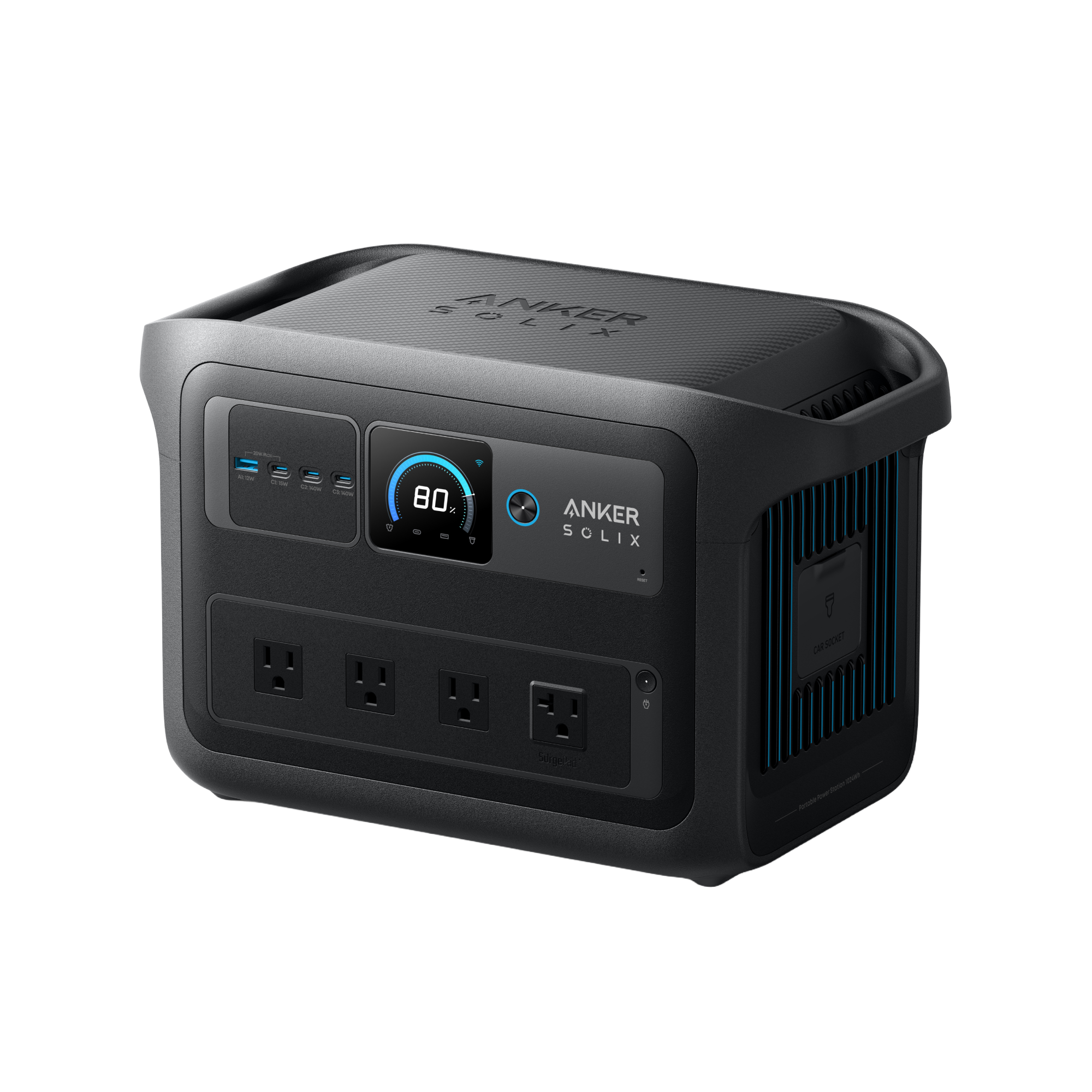
Anker SOLIX C1000X Gen 2Pick
$699.99
$699.99 · direct from Anker
Last checked 16 days ago. Prices move — check before you buy.

Anker SOLIX C800X
$449.99
$449.99 · direct from Anker
Last checked 16 days ago. Prices move — check before you buy.
Prices may vary by retailer and are subject to change.