Head-to-head test
Goal Zero Yeti 700 vs Jackery Explorer 1500 v2
The Explorer 1500 v2 holds 1,536Wh and the Yeti 700 holds 677Wh at $699 against $700, so the only thing the Yeti is really selling is the gap between 20.3 pounds and 32.
Full profiles: Goal Zero Yeti 700 → · Jackery Explorer 1500 v2 →

Written by Ian SchneiderUpdated
Solar & Off-Grid Tester, Station Arena Test Desk
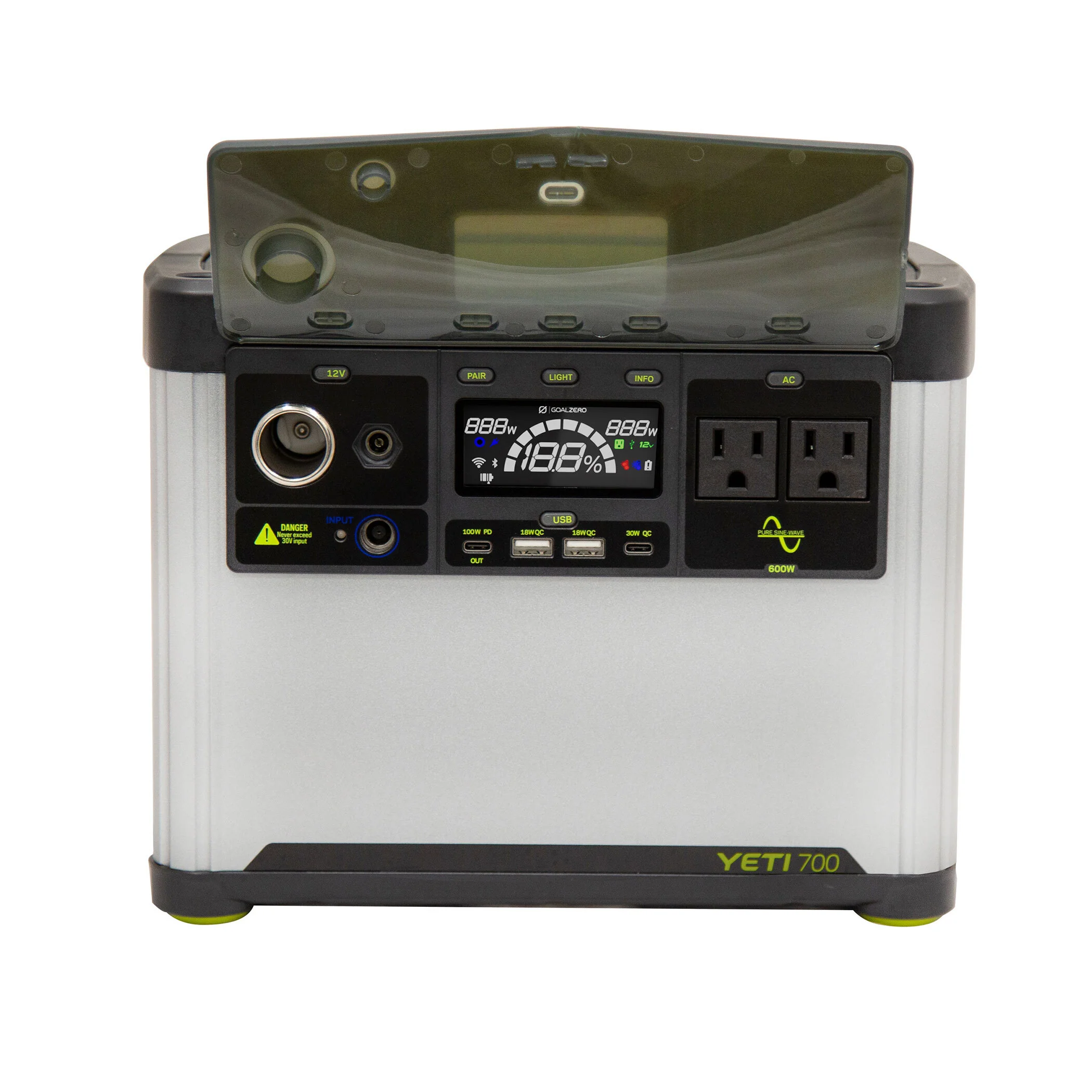
$699.95 · direct from Goal Zero
Last checked 1 day ago. Prices move — check before you buy.

$949.00 · direct from Jackery
Last checked 1 day ago. Prices move — check before you buy.
Spec deltas
Take the Explorer 1500 v2. It's $699 to the Yeti 700's $700 and holds 1,536Wh against 677Wh, which makes this one of the rare matchups where one box is simply more of the same thing for the same money. Same 4,000-cycle rating, same 5-year warranty, same 100W USB-C, same 20ms switchover ceiling.
The Yeti's case is that you can pick it up. 20.3 pounds is a grab-and-go lift and 32 is a set-your-feet lift, and if this thing rides in a canoe or gets carried down a trail that matters more than any figure below it. It's also rated IPX4A2, and the reviewers who build the Explorer's value case build it specifically for buyers who don't need rugged or waterproofB4. That's the whole counter-argument, and it's narrower than the matching price tags suggest.
Set your expectations before you buy either one: neither covers a full 8-hour blackout list. Against that scenario's 1,645Wh the Yeti falls 1,070Wh short and the Explorer 339Wh short, and neither expands, so what you buy is the ceiling. The Explorer just gets much further up it.
What the Numbers Reveal
Each conclusion stated first — the numbers behind it on one line, the full analysis below.
Capacity
The Yeti's per-watt-hour premium isn't buying longevity, coverage, or ports, because all three are level. It's buying 11.7 pounds off your back (32 lbs minus 20.3 lbs), and that is the entire transaction.
Yeti 700: $699.95, 677Wh, $1.03 per WhExplorer 1500 v2: $699.00, 1,536Wh, $0.46 per WhBoth rated 4,000 cycles and both carry 5-year warranties
Why it mattersIf the unit is going to live on a shelf, in a trunk, or beside a desk, there is no argument left for the Yeti.
continuous output
So the Yeti isn't capacity-limited on small loads. It has 255Wh spare after an overnight CPAP. It's inverter-limited on large ones, and a motor load in that surge band will kick on, sound like it's working, and then fall over once it settles into its running draw. The Explorer's 2,000W continuous rating just runs the same appliance.
Yeti 700: 600W continuous output, 1,000W surgeExplorer 1500 v2: 2,000W continuous output, 4,000W surgeYeti 700 clears the 320Wh CPAP Overnight load with 255Wh of its 575Wh usable still spare
Why it mattersAnyone whose list includes a kitchen appliance, a compressor, or a corded power tool should stop comparing capacity and decide on the 600W-versus-2,000W line.
solar input
For the same daylight the Explorer puts back 1,536Wh where the Yeti puts back 677Wh, and across a multi-day outage the refill rate is the survival spec, not the headline capacity. Neither box can be grown into, so the Yeti's 1,070Wh blackout shortfall has no fix except rationing.
Yeti 700: 200W maximum solar input against 677Wh capacityExplorer 1500 v2: 400W maximum solar input against 1,536Wh capacityNeither unit is expandable, and both fail the 8-Hour Blackout scenario (Yeti short 1,070Wh, Explorer short 339Wh)
Why it mattersOutage-prep buyers should treat this as the second decisive gap after price, not a footnote to it.
weight
That narrows the Yeti's win to a specific person: someone carrying it far enough for 20.3 pounds to beat 32, in weather. For that buyer an IPX4 ratingA2 is worth more than 859Wh (1,536Wh minus 677Wh) they'd have to haul anyway.
Yeti 700 carries an IPX4 water-resistance rating and claims extreme-temperature toleranceA2Reviewers pitch the Explorer 1500 v2 as the most cost-efficient path to serious LFP capacity specifically for buyers who don't need rugged or waterproof featuresB4Yeti 700 weighs 20.3 lbs; Explorer 1500 v2 weighs 32 lbs
Why it mattersKayakers, bikepackers and anyone working outdoors in the rain should buy the Yeti. Everyone else is paying for a rating they'll never test.
The specific dimensions that decide these two units — everything else is a tie.
Runtime: Will It Power Your Gear?
Selected because: $700 buys 677Wh here and $699 buys 1,536Wh, so runtime is where this page is decided and everything else is a footnote.
continuous output
Usable energy, not nameplate, is what you actually spend. This site derates every unit by a flat 85%, which puts the Yeti at 575Wh and the Explorer at 1,306Wh. That derate is an engine constant applied identically to both, not a measurement of either, so treat it as a consistent haircut rather than a finding about these two.
On a remote workday the difference stops being abstract. That load is 910Wh: the Explorer covers it and ends the day with 396Wh in hand, while the Yeti comes up 335Wh short and quits before the day does. Same money, and one of them finishes work.
What the Specs Don't Tell You
Selected because: The Yeti 700's 600W continuous ceiling against the Explorer's 2,000W is a harder wall than any capacity figure.
The surge card leads with a ratio, 2× against 1.7×, and the ratio is the least interesting number in it. What decides purchases is the absolute pair: 600W continuous and 1,000W surge on the Yeti, 2,000W and 4,000W on the Explorer. A load sitting between 600W and 1,000W won't be politely refused by the Yeti. It starts on surge headroom and then drops out, which is the worse failure because it happens after you've committed to it.
The noise card is the other one to read carefully. The Explorer publishes 30dB and the Yeti publishes nothing at all. An absent figure is not a quiet unit, and it isn't a loud one either. If you're sleeping next to this, that blank is a research task, not a spec you can compare.
Portability & Form Factor
Selected because: 20.3 lbs against 32 lbs is the Yeti 700's only structural win, and for the right buyer it's a real one.
weight
20.3 pounds is a one-hand grab off a garage shelf. 32 is the lift where you set your feet first, and at the far end of a trail that difference is the only spec you'll be thinking about. That's the Yeti's argument, and it isn't a weak one. It just has a narrow catchment.
The catch runs the other way too. Reviewers call the Explorer the lightest 1.5kWh LFP station going at about 32 lbsB1, so the weight the Yeti saves you is saved against a class leader, and what it costs is the entire capacity gap this page is about. Unless the unit leaves the driveway on foot, that's a bad trade.
Your Life, Your Pick
Selected because: Neither unit covers three of the six scenarios, and the misses run from 95Wh to 4,110Wh — the size of the shortfall matters more than the pass/fail.
Three of the six scenarios come back "neither," and they are not the same kind of failure. Weekend Camping needs 2,100Wh and the Explorer misses by 794Wh, which you plan around by trimming the list. Van Life Daily needs 4,685Wh and it misses by 3,379Wh, which isn't a planning problem but the wrong product category. Read the shortfall, not the verdict word.
Tailgate Party is the one to look at twice. The Yeti misses it by 95Wh out of 670Wh, close enough that a shorter afternoon or one fewer appliance flips it. And ignore the "can power peak load" column while you're there: it reads yes for the Yeti on all six scenarios, including the 4,685Wh one it misses by 4,110Wh, because it only tests continuous output against the single largest appliance and knows nothing about capacity.
Lifetime Value
Selected because: Both are 4,000-cycle units, so this table can only restate cost per watt-hour: $0.26 per lifetime kWh against $0.11.
cost / lifetime kWh
Equal cycle counts make this table decorative. Both units are rated 4,000 cycles, so cost per lifetime kWh — $0.26 against $0.11 — is price per watt-hour with the same divisor applied to both sides. It restates the ranking. It cannot change it.
One row deserves an outright warning. "Years of daily use" reads 11 for both units, because it is 4,000 cycles cycled once a day and carries no capacity term whatsoever. Two boxes with a capacity gap this wide print identical lifespans. Read the cycle rating and ignore the years.
Strengths & trade-offs
Goal Zero Yeti 700
Strengths
- +Costs $249 less
- +Lighter by 11.7 lb
Trade-offs
- –Weaker inverter (-1,400W) limits appliance compatibility.
Jackery Explorer 1500 v2
Strengths
- +Larger battery capacity
- +Higher AC output
- +Faster solar charging
Trade-offs
- –Substantially more expensive (+$249) than the Yeti 700.
- –Significantly heavier (+11.7 lbs), making it harder to move.
Will It Power Your Gear?
Scenario math and per-appliance runtimes, modeled from the spec record.
Scenario verdicts
We ran the math on six real-world scenarios. Here's which unit survives your actual life.
SCN-01 · 2 nights · needs 2,100Wh
Weekend Camping
Two nights off-grid with essential comfort
Neither unit
Neither unit covers the full 2,100Wh weekend. The Yeti 700 falls 1,525Wh short and the Explorer 1500 v2 794Wh short, so the question isn't whether you'll ration but how hard. The Explorer is also the one you can claw it back on: 400W of solar input against the Yeti's 200W means a good afternoon puts meaningfully more back into the bigger box.
Battery budget usedlower = more headroom
LOAD Phone Charger 15W×6h · LED Lights 40W×8h · Box Fan 75W×14h · CPAP Machine 40W×16h
SCN-02 · 8 hours · needs 1,645Wh
8-Hour Blackout
Keep the essentials running through a night without power
Neither unit
Neither covers the whole 1,645Wh list, and the gap between the two misses is the story. The Explorer 1500 v2 comes up 339Wh short; the Yeti 700 is 1,070Wh short of the same list. One of those is a load you trim, the other is a load you abandon. Neither expands, so plan the list down to fit rather than planning to add capacity later.
Battery budget usedlower = more headroom
LOAD Fridge 150W×8h · Router + Modem 20W×8h · LED Lights (4 bulbs) 40W×6h · Phone Charger 15W×3h
SCN-03 · 8 hours · needs 320Wh
CPAP Overnight
Sleep therapy without interruption — the #1 medical use case
Either unit
A CPAP is about 40W for eight hours, so both cover the night with room to spare and capacity decides nothing. Fan noise would — but Yeti 700 doesn't publish a figure, so there's nothing to hold it to. Buy on price, weight, and whether you can live with a fan you haven't heard.
Battery budget usedlower = more headroom
LOAD CPAP Machine 40W×8h
SCN-04 · 8 hours · needs 910Wh
Remote Workday
Full work day off-grid without power anxiety
Explorer 1500 v2
The Explorer 1500 v2 takes this one and it isn't close. The day needs 910Wh: the Explorer's 1,306Wh usable finishes with 396Wh spare, while the Yeti 700's 575Wh usable leaves it 335Wh short of the end of the day. If the workday is why you're buying, the Yeti doesn't make it to five o'clock.
Battery budget usedlower = more headroom
LOAD Laptop 60W×8h · External Monitor 30W×8h · Router + Modem 20W×8h · Phone Charger 15W×2h
SCN-05 · 4 hours · needs 670Wh
Tailgate Party
Game day power for the crew
Explorer 1500 v2
The Explorer 1500 v2 wins, but the Yeti 700's loss here is the narrowest on the page: 95Wh short of the 670Wh this scenario asks for, from 575Wh usable. A shorter afternoon or one fewer appliance and it makes it. The Explorer finishes with 636Wh spare, which is the difference between watching the battery and not thinking about it.
Battery budget usedlower = more headroom
LOAD Blender 400W×0.5h · LED TV (55") 80W×4h · Bluetooth Speaker 15W×4h · Phone Charger (×3) 45W×2h
SCN-06 · 24 hours · needs 4,685Wh
Van Life Daily
A full day of mobile living — the ultimate endurance test
Neither unit
Neither is in the running. This load is 4,685Wh a day: the Yeti 700 is 4,110Wh short and the Explorer 1500 v2 3,379Wh short, and no amount of careful use closes a gap that size. Full-time van power means a larger station or a wired house battery, and since neither of these expands you can't start here and grow into it.
Battery budget usedlower = more headroom
LOAD Mini-Fridge 150W×24h · Laptop 60W×4h · Phone Charger 15W×3h · LED Lights 40W×5h · Fan 75W×8h
The Load Test
RUNTIME = (Wh × 0.85) ÷ LOAD
None of the scenarios above exactly yours? Build it. Toggle what you'd plug in; both units are tested against the combined draw.
Essentials
Comfort & Convenience
High-Draw Appliances
Test duration
8h
Continuous draw
205W
Projected runtime
For this load: Explorer 1500 v2 runs 6.4h vs 2.8h.
$949 list · direct from Jackery
Modeled from the spec record — same math as the tables below. Methodology
Runtime by appliance
Real-world runtime estimates for common appliances, modeled at 85% inverter efficiency.¹
Essentials
The basics you need runningscale 0–87hComfort & Convenience
Makes off-grid life actually enjoyablescale 0–17.4hHigh-Draw Appliances
These reveal the real limitsscale 0–1.3h¹ Runtime = (capacity × 0.85) ÷ appliance watts. Within each group, all bars share one time scale (the group's longest runtime), so lengths are comparable across appliances; identical runtimes collapse into a single blue/orange bar. Actual runtime varies with battery age, temperature, and simultaneous loads — see methodology.
Conclusion
August 9, 2026
Verdict: the Explorer 1500 v2, on Power Score margin
The Explorer 1500 v2 costs $699 and the Yeti 700 costs $700, and for that same money you get 1,536Wh instead of 677Wh, 2,000W of continuous output instead of 600W, and 400W of solar input instead of 200W. Cycle life is identical at 4,000 and the warranty is identical at 5 years, so none of the usual long-run arguments claw any of it back. The Yeti wins exactly two things: it weighs 20.3 lbs against 32, and it carries an IPX4 water-resistance ratingA2 while the reviewers making the Explorer's value case explicitly write it for buyers who don't need rugged or waterproof featuresB4. If you're carrying this a distance or getting it wet, that's a real argument. Otherwise take the Jackery, and don't agonise over it.
Editor-assigned confidence, based on cited owner research and spec analysis.
List prices as of August 9, 2026. The links below open Goal Zero's and Jackery's current prices.
$949.00 · direct from Jackery
Last checked 1 day ago. Prices move — check before you buy.
or check the Yeti 700 price$699.95 list
Written by Ian Schneider, Solar & Off-Grid Tester · Station Arena Test Desk · Updated August 9, 2026
Measured Data
Benchmark scores and the full spec record, side by side.
Benchmark scores
Not rated for both units (minimum threshold unmet): RV Living, Home Backup, Food Truck.
Full specifications
ᵈ Derived: price ÷ rated capacity. See the data behind our comparisons →
Comparison ToolAdd more power stations, side by sideOpen Tool →How these numbers are produced
Numeric verification
Every figure on this page traces to our spec database or arithmetic on it — no estimated numbers.
Owner claims
Statements about owner experience are cited to published reviews — see Sources & Research Notes below.
Runtime model
Runtime = (rated capacity × 0.85 inverter efficiency) ÷ device wattage. Solar recharge estimates assume panels deliver 70% of rated output. Cold weather, battery age, and stacked loads reduce real-world results.
Power Score
Computed from 14 published spec dimensions, weighted per use-case bench. Higher is better; a unit must meet a bench's minimum threshold to be rated.
See the full weight table and data sourcing on our methodology page →Class ranking (the star rating)
Each unit's star score is a category ranking, not customer reviews — no buyer opinions feed it. We score every station on size-independent quality (value, output, portability, endurance, ports, warranty, and more), then percentile-rank it against the other units in its capacity class, so a class-leading compact unit and a class-leading whole-home unit can both earn 5★. Here, Yeti 700 rates 3.6/5 (16th percentile of 20 Compact-class units), and Explorer 1500 v2 rates 3.8/5 (27th percentile of 27 Everyday-class units).
How the class ranking is computed →Test Notes & Caveats
Hidden gotchas and advantages we spotted that you won't find on the product page.
Surge and Output: the 600W Wall
The ratio comparison (2× against 1.7×) is the less useful half of this card. What decides purchases is the absolute pair: the Yeti 700 runs 600W continuous with a 1,000W surge ceiling, the Explorer 1500 v2 runs 2,000W continuous with 4,000W of surge. A motor load sitting between 600W and 1,000W won't be politely refused by the Yeti. It starts on the surge headroom, sounds like it's working, and then drops out once the compressor settles into its running draw — the worse failure mode, because it arrives after you've committed to it. On the Explorer the same appliance is just a plugged-in appliance.
Warranty: No Difference
Both units carry the same 5-year warranty, so coverage isn't a tiebreaker here. The Explorer 1500 v2's figure is a maximum rather than a guarantee — it depends on registering the unit with Jackery, which is what extends the base term to the full period. Worth saying because the per-dollar framing can suggest otherwise: the Yeti 700 works out at 7.1 years of cover per $1,000 spent against the Explorer 1500 v2's 5.3, but that spread is the price gap, not the terms.
Yeti 700: No Published Noise Figure
The Explorer 1500 v2 publishes 30dB and the Yeti 700 publishes nothing. Take that for exactly what it is: an absence of data, not evidence of a loud fan. And treat the 30dB as a published manufacturer figure rather than something measured here, since the operating conditions behind it aren't stated — it's the more comparable number only because it's the only number. If this is going in a bedroom or beside a CPAP, go find a hands-on account of the Yeti 700's fan rather than reading anything into the blank.
Full record above — the Test Desk pick is the Explorer 1500 v2.
Check Explorer 1500 v2 price →or check the Yeti 700 priceOwnership Analysis
What happens after you buy — true cost of ownership, brand trust, and growth potential.
Lifetime value
Service lifeyears at one full cycle per day
Lifetime energy delivered
Cost per delivered kWh
│ warranty ends · Reaching the cycle rating means ~80% capacity remains — degraded, not dead.
Analyst note
The Yeti 700 is cheaper to buy, but the Explorer 1500 v2 is cheaper to own. At $0.15/kWh over its lifetime vs $0.26/kWh, the Explorer 1500 v2's higher cycle life and capacity make each dollar go further over the years. One thing to know reading the table: both carry the same 4,000-cycle rating, so the lifetime rows are sticker price and capacity in disguise — the wear horizon is identical and decides nothing here.
Delivers each lifetime kWh for $0.11 less — check the Explorer 1500 v2 price →
Brand trust
Goal Zero
Ecosystem
Focused — a compact current line (6th-gen Yeti and Yeti Pro series), the previous-gen X series now out of stock across every model on Goal Zero's own store (checked 2026-09-13: 200X, 500X, 1000X, 1500X, 3000X, 6000X, some listed only as open-box), so buying one new means finding retailer stock, Sherpa power banks for the under-100Wh tier, plus Alta coolers, Nomad/Ranger solar panels, and vehicle integration kits
Support
US-based company (Salt Lake City, owned by NRG Energy). Historically considered premium support, but 2025-2026 reports describe long wait times, unresponsive email communication, and tickets going unaddressed for weeks. The "premium support justifies premium pricing" argument is weakening.
Community
Small but loyal — strong following in overlanding and preparedness communities. Official community forums were recently shuttered, frustrating long-time users.
App experience
Rated 4.4/5 iOS (~1,200 ratings) but recent reviews skew negative — recurring connectivity issues, crashes, and stability problems.
Unique strength
Pioneer of the portable power market — strongest brand heritage. US-based company with ruggedized, weather-resistant designs (IP ratings vary by model). Integrated "Yeti-Ready" ecosystem with coolers, lights, and vehicle kits.
Worth knowing
Goal Zero's premium positioning is why this box costs $700 for 677Wh, and this is the page where that positioning stops buying anything. The cycle rating, the warranty and the USB-C output are identical to the cheaper, larger unit sitting beside it.
Jackery
Ecosystem
12-15+ models across Explorer (portable) and HomePower (home backup) series, plus SolarSaga panel ecosystem and innovative form factors
Support
US-based support but widely criticized. Reddit reports describe slow/dismissive responses, scripted AI agents, strict receipt requirements for warranty claims, and refurbished replacements for clearly defective units. Strongly recommended: buy from Costco or Amazon for return protection.
Community
Smallest community of the major brands — Reddit r/Jackery has ~2,000 members. YouTube presence is solid due to brand recognition.
App experience
Rated 2.3-3.3/5 iOS and Android — the weakest app experience of the major brands. Multiple confusing apps (Jackery app vs Jackery Home) and mandatory login even offline.
Unique strength
Highest brand recognition and widest retail distribution (Costco, Home Depot, Best Buy, Amazon). The "Toyota" of power stations — dependable, proven, wide availability. Innovative form factors like the Solar Gazebo and Solar Mars Bot.
Worth knowing
Our brand notes flag that a couple of older Jackery models still ship NMC cells with a shorter rated life. That caveat does not apply here: this unit is rated 4,000 cycles, the same as the Yeti 700.
Analyst note
Support isn't a tiebreaker here, and not because it's good. Our brand assessment is critical of both — long waits and unanswered tickets on the Goal Zero side, scripted responses and strict receipt requirements on the Jackery side — so buy from a retailer with its own return policy whichever way you go. Where they genuinely differ is reach and philosophy: Goal Zero builds fewer, more weather-resistant units and has just shuttered its official forums, while Jackery is on the shelf at every big-box retailer with the widest model range and the weakest app of the major brands.
Growth path
Yeti 700
FIXED CAPACITYFixed at 677Wh, with no expansion — so size it for your needs up front rather than planning to add capacity later.
Accepts up to 200W of solar. Limited to a single portable panel.
Adequate ports for most setups, but heavy users may want a power strip.
Explorer 1500 v2
FIXED CAPACITYFixed at 1,536Wh, with no expansion — so size it for your needs up front rather than planning to add capacity later.
Accepts up to 400W of solar. Suitable for a 1-2 panel setup.
Adequate ports for most setups, but heavy users may want a power strip.
Realistic full solar rechargeat 70% of rated panel output — see methodology
Analyst note
Neither expands, and that's no knock on either — each is a complete unit at a fixed size. Buy the capacity that covers your needs now (the Explorer 1500 v2 gives you the larger ceiling); you can't add to either later.
What Owners Report
Patterns from published owner reports and long-term reviews — every claim cited to its source below.
Goal Zero Yeti 700
There is no long-term ownership record for the Yeti 700 to draw on. What exists is short-run review coverage plus the manufacturer's own materialA1A2A3, and the single most useful independent read calls it lightweight and simple, good for quick camping trips and device charging, and explicitly not the most powerful or capable unit aroundA3. That's a fair summary of what the spec sheet already says, which is itself telling.
Separate the chemistry claim from the field claims. It's a LiFePO4 pack rated for 4,000-plus cyclesA1 carrying an IPX4 rating and cold- and heat-tolerance claimsA2, but both trace at least partly to Goal Zero's own pages. Treat them as manufacturer specification, not as something anyone has verified across a season of use.
“A 6th-generation 677Wh compact power station on upgraded LiFePO4 chemistry rated for 4,000+ cycles — daily use for over 10 years.”
Sources
goalzero.com · amazon.com · campingsolar.us · outdoorgearlab.com
Jackery Explorer 1500 v2
The Explorer 1500 v2's file is four review-site assessments and no owner history — nobody here has lived with one through a winter. The reviews are consistent: lightest 1.5kWh LFP station at about 32 lbsB1, seven simultaneous outputs including three AC sockets, dual USB-C and a 12V car portB2, and a full charge in roughly 64 minutesB3. Our spec sheet carries no AC input rating, so that charge time is a reviewer figure with no manufacturer number behind it to check.
The verdict they hand it is 8.7 out of 10, with one condition attached: it's the most cost-efficient route to serious LFP capacity for buyers who don't need rugged or waterproof featuresB4. That condition is the honest part of the file, and it's the reason the Yeti 700 still has a buyer on this page.
“The world's lightest 1.5kWh LFP power station at about 32 lbs — class-leading weight is one of its defining features.”
Sources
backuppowerhub.com · jackery.com · portablepowernerd.com
Sources & Research Notes
Every owner claim in this report is traceable to a published source. The bracketed references above resolve here.
Recurring owner themes
- Modern LFP (4,000+ cycles), IPX4 ruggedness, and light, simple portability are the highlights; modest power and capacity. [Yeti 700 · 3 entries]
- Class-leading light weight, a versatile 7-port layout, fast ~64-minute charging, and the lowest cost-per-watt in its class are the consistent praise. [Explorer 1500 v2 · 3 entries]
- A1
“A 6th-generation 677Wh compact power station on upgraded LiFePO4 chemistry rated for 4,000+ cycles — daily use for over 10 years.”
goalzero.com / amazon.com — Yeti 700 · 2026 · [positive]
- A2
“Carries an IPX4 water-resistance rating and can handle extreme temperatures — a rugged, outdoor-ready design.”
goalzero.com / campingsolar.us — Yeti 700 review · 2026 · [positive]
- A3
“Ideal for quick camping trips and device charging — not the most powerful or capable, but lightweight and simple, appealing to portability-focused users.”
outdoorgearlab.com — Yeti 700 review · 2026 · [mixed]
- B1
“The world's lightest 1.5kWh LFP power station at about 32 lbs — class-leading weight is one of its defining features.”
backuppowerhub.com / jackery.com — Explorer 1500 v2 review · 2026 · [positive]
- B2
“Seven simultaneous outputs is genuinely useful: three AC outlets cover larger appliances, dual USB-C ports support fast charging for phones and laptops, and the DC car output handles 12V accessories without burning an AC outlet.”
portablepowernerd.com / backuppowerhub.com — Explorer 1500 v2 review · 2026 · [positive]
- B3
“At $699 it's the lightest, fastest-charging, and lowest cost-per-watt 1.5kWh LFP station on the market, undercutting comparable LFP units, with a roughly 64-minute full charge.”
backuppowerhub.com — Explorer 1500 v2 review · 2026 · [positive]
- B4
“Earns 8.7/10; for buyers who don't need rugged or waterproof features, it's the most cost-efficient path to serious LFP capacity in 2026.”
backuppowerhub.com / portablepowernerd.com — Explorer 1500 v2 review · 2026 · [positive]
Research compiled August 9, 2026.
Who Should Buy Which
Buy the Yeti 700 if you…
- →You carry it rather than drive it. 20.3 pounds is a lift you can make one-handed off a shelf and repeat at the far end of a portage. 32 is not.
- →It's going to get rained on. The Yeti carries an IPX4 ratingA2, and the Explorer's own review case is written for people who don't need weather resistanceB4.
- →Your entire list is phones, laptops, lights and a CPAP. The Yeti clears an overnight CPAP with 255Wh of its 575Wh usable still in the tank, and nothing on that list goes near its 600W ceiling.
Buy the Explorer 1500 v2 if you…
- →You want the thing to still be enough in two years. 1,536Wh against 677Wh for the same money, on the same 4,000-cycle rating, is a free upgrade in everything but name.
- →You work through outages. The Explorer covers a 910Wh remote workday with 396Wh spare while the Yeti falls 335Wh short of the end of it.
- →Something on your list draws real current. 2,000W continuous and 4,000W of surge start and hold appliances the Yeti's 600W and 1,000W can only flicker at.
If neither fits
If your day looks like the van-life load — 4,685Wh, which leaves the Yeti 4,110Wh short and the Explorer 3,379Wh short — neither of these is close, and neither expands, so you can't buy your way up later. Shop a larger class with expansion ports, or plan on two units from day one and stop pretending this is a one-box problem.
The Bottom Line
Buy the Explorer 1500 v2. Ninety-five cents (the difference between $699.95 and $699.00) is what separates these on price, and 859Wh (1,536Wh minus 677Wh) is what separates them on the thing you're actually buying. Cycle life, warranty and USB-C output are level, so nothing in the long-run column argues the other way. The Yeti 700 isn't a bad unit. It's a small one at a large one's price.
The exception is worth repeating because it's the only one. If this is going on your back or into the weather, 20.3 pounds and an IPX4 ratingA2 beat capacity you'd have to carry, and the Explorer's own reviewers write its value case for people who don't need thatB4. Everyone else: the money is identical, so take the bigger battery.
Frequently Asked Questions
Answers drawn from the spec record and cited owner research.
The Yeti 700 and the Explorer 1500 v2 cost the same — is the Goal Zero worth it?
Only if you're carrying it or getting it wet. At $700 against $699 the Explorer gives you 1,536Wh instead of 677Wh and 2,000W of output instead of 600W, on an identical 4,000-cycle rating and an identical 5-year warranty. The Yeti's counterweights are 20.3 pounds against 32 and an IPX4 rating. Both are real, and both are specific.
Will the Yeti 700 run kitchen appliances or power tools?
Not reliably. Its inverter is rated 600W continuous with a 1,000W surge ceiling, so anything drawing above 600W steadily will start on surge and then drop out rather than run. The Explorer 1500 v2's 2,000W continuous and 4,000W surge is the difference between briefly and yes. Check the label wattage on whatever you plan to plug in before choosing between these two.
Can either one get me through an 8-hour blackout?
Not the full list. That scenario needs 1,645Wh; the Yeti has 575Wh usable and comes up 1,070Wh short, and the Explorer has 1,306Wh usable and comes up 339Wh short. The Explorer gets most of the way there and can be stretched by dropping loads, while the Yeti is covering essentials only. Neither expands, so you can't patch the plan later with a second battery.
Which one is quieter?
Unknown, and don't let anyone tell you otherwise. The Explorer 1500 v2 publishes 30dB and the Yeti 700 publishes no figure at all, which is an absence of data rather than evidence in either direction. If this is going next to a bed, the published number is the safer bet purely because it exists — find a hands-on account of the Yeti's fan before you decide the blank means silence.
Can I add a second battery to either of these later?
No. Both are sealed at their rated capacity, 677Wh for the Yeti 700 and 1,536Wh for the Explorer 1500 v2, with no expansion port on either. That's not a flaw; each is a complete unit at a fixed size. It does mean you should buy for the load you'll have in three years rather than the one you have now, which is one more point in the Explorer's column.
Where to buy
Goal Zero Yeti 700
$699.95
$699.95 · direct from Goal Zero
Last checked 1 day ago. Prices move — check before you buy.
Jackery Explorer 1500 v2Pick
$949.00
$949.00 · direct from Jackery
Last checked 1 day ago. Prices move — check before you buy.
Prices may vary by retailer and are subject to change.