Head-to-head test
DJI Power 1000 vs Goal Zero Yeti 700
At the same $700 the DJI hands you half again the battery and nearly four times the inverter, and the Yeti's entire answer is 9.4 pounds less to carry.
Full profiles: DJI Power 1000 → · Goal Zero Yeti 700 →

Written by Ian SchneiderUpdated
Solar & Off-Grid Tester, Station Arena Test Desk

Superseded — buy the V2
DJI has superseded the Power 1000 with the Power 1000 V2 — same $699, with 2,600W output against 2,200W. The original may still be purchasable while stock lasts, but unless it is meaningfully discounted, buy the V2.
Power 1000 V2 · $699.00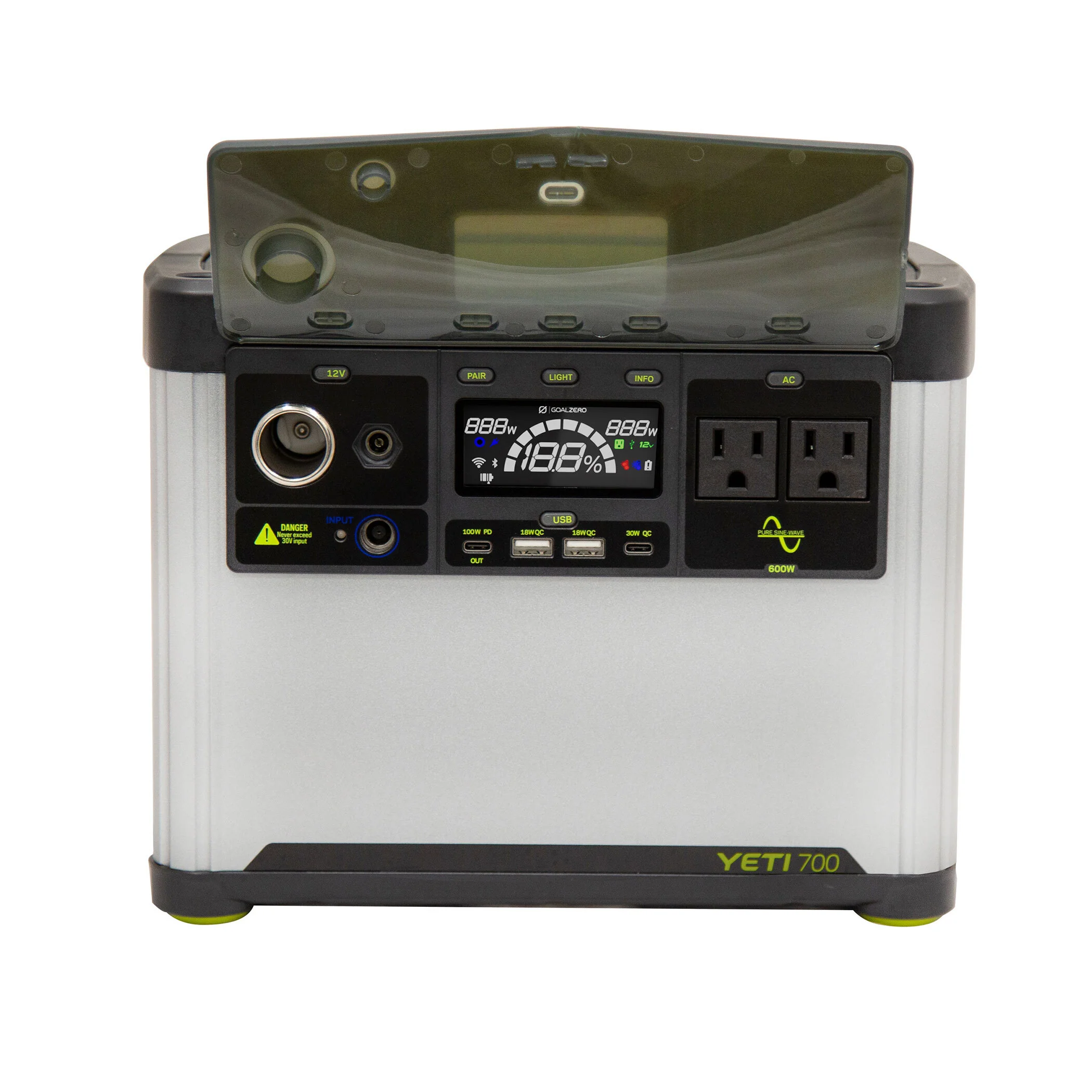
$699.95 · direct from Goal Zero
Last checked 1 day ago. Prices move — check before you buy.
Spec deltas
Take the Power 1000. It costs $699 against the Yeti 700's $700, and that identical price tag is the only thing these two have in common that flatters the Goal Zero. 1,024Wh against 677Wh. 2,200W of continuous output against 600W. Same 4,000-cycle rating, same five-year warranty, same 20ms switchover, and then the specs stop tying and start separating.
The 600W ceiling is the part that decides your actual days. Under it the Yeti is completely competent: a small compressor fridge, two laptops, phones, lights, a fan, all night without complaint. Over it there is nothing at all, and the whole kitchen-counter shelf lives over it. The 1,000W surge rating leaves 400W of headroom above the continuous number, and compressors routinely want two to three times their rated draw for the first half second of startup.
The Power 1000 has two catches you should hear before the recommendation, not after. It's 9.4 pounds heavier, which is the difference between one-handing it into a trunk and thinking about it first. And its 800W solar input has no built-in charge controller behind it, so DJI sells you a separate proprietary adapter to use the number they advertise. Neither catch is enough to hand the matchup to a 677Wh box at the same money.
What the Numbers Reveal
Each conclusion stated first — the numbers behind it on one line, the full analysis below.
continuous output
Bring in the startup physics and these stop being the big one and the small one. They become two different products. The DJI starts whatever you plug into it and then keeps going past its own ratingA2; the Yeti runs electronics and a modest fridge, and that is its complete job description rather than a starting point.
Yeti 700 inverter: 600W continuous, 1,000W surgeDJI Power 1000 inverter: 2,200W continuous, 4,400W surgeFridge and AC compressors draw two to three times their rated wattage at startupReviewers held the Power 1000 at 2,400W, above its 2,200W rating, for 20 minutes with no shutdownA2
Why it mattersIf anything on your list has a heating element or a serious compressor, the Yeti isn't a smaller version of the DJI. It's the wrong tool, at the same price.
solar input
The 20ms handoff is identical, so nothing you plugged into either one reboots when the power cuts. Day two is where they part. The DJI refills before lunch and can do it again in the afternoon; the Yeti spends most of a good solar day recovering two thirds as much energy, and a December outage doesn't hand out many good solar days.
DJI Power 1000: 800W maximum solar input, 1,024Wh capacityYeti 700: 200W maximum solar input, 677Wh capacityBoth units switch to battery in 20msThe modeled 8-hour blackout wants 1,645Wh: 189% of the DJI's usable capacity, 286% of the Yeti's
Why it mattersIf this is emergency gear rather than camping gear, buy for refill speed and budget for DJI's separate solar adapter, because the 800W input isn't wired through a built-in controller.
Capacity
This isn't a chemistry story, and it would be unfair to write it as one. The Yeti runs the modern 6th-generation LiFePO4 pack that replaced Goal Zero's older NMC X-series, rated past 4,000 cyclesB1B4. It's a good battery that will still be working in a decade. It's just 347Wh less of one for the same $700, and it will have moved 1,388 fewer kilowatt-hours by the time it's done.
DJI Power 1000: $699 for 1,024Wh, $0.68 per WhYeti 700: $700 for 677Wh, $1.03 per WhBoth rated 4,000 cycles with a five-year warrantyTotal lifetime energy: 4,096kWh against 2,708kWh
Why it mattersNobody should pay identical money for two thirds of the energy unless the missing third buys something back. Here it buys 9.4 pounds, so the question is whether you're carrying it or driving it.
The trouble is that the scenario where light weight pays off most is also the one where 677Wh runs dry. A tailgate is 670Wh of load, which the DJI covers using 77% of what it can usably deliver while the Yeti needs 116% of its. Portability that runs out before the event does isn't portability, it's a nice walk to the parking lot.
Yeti 700: 19.3 lb, rated IPX4 for water resistance and comfortable in temperature extremesB2DJI Power 1000: 28.7 lbThe tailgate load wants 670Wh: 77% of the DJI's usable capacity, 116% of the Yeti's
Why it mattersTake the Yeti when the load is genuinely small and the walk is genuinely long: a walk-in campsite, a portage, a shoot with cameras and lights. Everywhere else, 9.4 pounds is the cheapest thing being traded.
The specific dimensions that decide these two units — everything else is a tie.
Runtime: Will It Power Your Gear?
Selected because: 1,024Wh behind a 2,200W inverter against 677Wh behind a 600W one, which settles what you can plug in before it settles how long it lasts.
continuous output
The 600W number is a wall, not a slope. Everything below it the Yeti does properly and quietly for a full night. Everything above it it simply refuses, and with only 400W of surge headroom above the continuous rating, the refusal starts before the label suggests it should. A compressor asking two to three times its rated draw at the moment it kicks on eats that headroom in half a second.
The DJI's headroom is a different shape entirely: 2,200W continuous with 4,400W behind it, and one test held it at 2,400W for twenty minutes without an alarm or a shutdownA2. You'll run out of battery on this unit long before you run out of inverter, which is the correct way for a power station to fail.
Lifetime Value
Selected because: At $699 against $700 with the same 4,000-cycle rating and the same five-year warranty, capacity is the only variable left in cost per lifetime kilowatt-hour.
cost / lifetime kWh
Two batteries, the same money, the same rated life, and one of them moves 1,388 more kilowatt-hours before it's finished. Seventeen cents per lifetime kilowatt-hour against twenty-six, and every cent of that gap traces back to the 347Wh you didn't get.
Worth being clear about what this is not: it isn't the old Goal Zero longevity problem. The Yeti 700 is a 6th-generation LiFePO4 unit rated for 4,000-plus cycles, the modern replacement for the NMC X-seriesB1B4. It'll last. It'll just have carried less the whole way.
Portability & Form Factor
Selected because: 19.3 lb against 28.7 lb is the Yeti's one genuine win, and it's the only argument on this page that can beat the DJI.
weight
19.3 pounds is a one-hand carry across a parking lot. 28.7 is two hands, and a pause at the top of the basement stairs. That's a real distinction and the Yeti earns it honestly, which is more than most of its spec sheet manages against this opponent.
It also takes weather better on paper, with an IPX4 rating and tolerance for temperature extremesB2. Both facts serve the same buyer: someone walking it somewhere and leaving it outside. If that's you, take the Yeti and don't feel bad about it. If you're loading a trunk, you're trading 347Wh and 1,600W of inverter for a difference you'd feel for about forty seconds.
Your Life, Your Pick
Selected because: Four of the six modeled loads are past both units, which makes the near-misses more useful than the wins.
Four of the six modeled loads are beyond both units, which is what happens when you point 677Wh and 1,024Wh boxes at a van-life day. The near-misses carry the information. The remote workday wants 105% of the DJI's usable capacity and 158% of the Yeti's, which is one of them arriving late and the other not arriving.
The tailgate is the only clean split on the board: 670Wh of load, 77% of the DJI's usable energy against 116% of the Yeti's. Same afternoon, same $700, and only one of them is still running when the game ends.
Brand Trust
Selected because: The brand that invented this category and is now on its sixth generation against a 2024 entrant with four models and a drone company behind it.
You're choosing between a thin track record and a thinning one. DJI has sold power stations only since 2024, across four models, with no owner community of its own and support borrowed from the drone business. That support network is genuinely good and genuinely large, and it has never had to process battery warranties at scale.
Goal Zero has the heritage, a US company behind it, and the hardware still shows the pedigree. But the premium-support argument that justified premium pricing has weakened: multi-week ticket waits through 2025 and 2026, and the official community forums shut down. None of that is a reason to buy 677Wh instead of 1,024Wh at the same price. It's a reason not to pay a heritage premium expecting heritage service.
Strengths & trade-offs
DJI Power 1000
Strengths
- +Costs $1 less
- +Larger battery capacity
- +Higher AC output
- +Faster solar charging
Trade-offs
- –No major technical downsides compared to rival.
Goal Zero Yeti 700
Strengths
- +Lighter by 8.4 lb
Trade-offs
- –Weaker inverter (-1,600W) limits appliance compatibility.
Will It Power Your Gear?
Scenario math and per-appliance runtimes, modeled from the spec record.
Scenario verdicts
We ran the math on six real-world scenarios. Here's which unit survives your actual life.
SCN-01 · 2 nights · needs 2,100Wh
Weekend Camping
Two nights off-grid with essential comfort
Neither unit
Neither unit covers this scenario's 2,100Wh: the Power 1000 comes up 1,230Wh short (about 41% covered), the Yeti 700 1,525Wh (27%). Treat this as partial cover — enough for the essentials in it, not the whole list.
Battery budget usedlower = more headroom
LOAD Phone Charger 15W×6h · LED Lights 40W×8h · Box Fan 75W×14h · CPAP Machine 40W×16h
SCN-02 · 8 hours · needs 1,645Wh
8-Hour Blackout
Keep the essentials running through a night without power
Neither unit
Neither one covers the full eight hours on a single charge. The load wants 189% of what the Power 1000 can usably deliver and 286% of the Yeti's. Both hand over in 20ms, so nothing you've plugged in reboots when the lights go. What separates them is the morning after: 800W of solar input against 200W.
Battery budget usedlower = more headroom
LOAD Fridge 150W×8h · Router + Modem 20W×8h · LED Lights (4 bulbs) 40W×6h · Phone Charger 15W×3h
SCN-03 · 8 hours · needs 320Wh
CPAP Overnight
Sleep therapy without interruption — the #1 medical use case
Either unit
Both sleep through the night with room left over, at 37% of the Power 1000's usable capacity and 56% of the Yeti's. So the tiebreak isn't capacity, it's the thing sitting eighteen inches from your head. DJI publishes 23dB for the Power 1000. Goal Zero publishes no noise figure at all for the Yeti 700. Neither should be working hard at this load, but only one of them has said so in writing.
Battery budget usedlower = more headroom
LOAD CPAP Machine 40W×8h
SCN-04 · 8 hours · needs 910Wh
Remote Workday
Full work day off-grid without power anxiety
Neither unit
Both miss, and the margins aren't comparable. The Power 1000 comes up five points short at 105% of its usable capacity, the kind of gap any midday sun covers on an 800W input. The Yeti needs 158% of what it can usably deliver and takes 200W to put it back. One of these arrives late; the other doesn't arrive.
Battery budget usedlower = more headroom
LOAD Laptop 60W×8h · External Monitor 30W×8h · Router + Modem 20W×8h · Phone Charger 15W×2h
SCN-05 · 4 hours · needs 670Wh
Tailgate Party
Game day power for the crew
Power 1000
670Wh is the afternoon, and it's 77% of what the Power 1000 can usably deliver against 116% of the Yeti's. The lighter unit is the one you'd be walking back to the car with a quarter of the game left.
Battery budget usedlower = more headroom
LOAD Blender 400W×0.5h · LED TV (55") 80W×4h · Bluetooth Speaker 15W×4h · Phone Charger (×3) 45W×2h
SCN-06 · 24 hours · needs 4,685Wh
Van Life Daily
A full day of mobile living — the ultimate endurance test
Neither unit
Neither unit covers this scenario's 4,685Wh: the Power 1000 comes up 3,815Wh short (about 19% covered), the Yeti 700 4,110Wh (12%). This is well outside what either unit is for; the right answer here is a larger station, not a choice between these two.
Battery budget usedlower = more headroom
LOAD Mini-Fridge 150W×24h · Laptop 60W×4h · Phone Charger 15W×3h · LED Lights 40W×5h · Fan 75W×8h
The Load Test
RUNTIME = (Wh × 0.85) ÷ LOAD
None of the scenarios above exactly yours? Build it. Toggle what you'd plug in; both units are tested against the combined draw.
Essentials
Comfort & Convenience
High-Draw Appliances
Test duration
8h
Continuous draw
205W
Projected runtime
For this load: Power 1000 runs 4.2h vs 2.8h.
Modeled from the spec record — same math as the tables below. Methodology
Runtime by appliance
Real-world runtime estimates for common appliances, modeled at 85% inverter efficiency.¹
Essentials
The basics you need runningscale 0–58hComfort & Convenience
Makes off-grid life actually enjoyablescale 0–11.6hHigh-Draw Appliances
These reveal the real limitsscale 0–0.9h¹ Runtime = (capacity × 0.85) ÷ appliance watts. Within each group, all bars share one time scale (the group's longest runtime), so lengths are comparable across appliances; identical runtimes collapse into a single blue/orange bar. Actual runtime varies with battery age, temperature, and simultaneous loads — see methodology.
Conclusion
August 2, 2026
Verdict: the Power 1000
Buy the DJI Power 1000. It's $699 against the Yeti 700's $700, and for identical money you get 1,024Wh instead of 677Wh, a 2,200W inverter instead of 600W, 4,400W of surge instead of 1,000W, and 800W of solar input instead of 200W. Everything the two share, they share exactly: 4,000 cycles, a five-year warranty, a 20ms handoff when the grid drops. That leaves one real trade on the table, and it's weight. The Yeti is 19.3 lb against 28.7 lb, which is a genuine advantage if your trip involves carrying it somewhere a car can't go. It is not an advantage worth 347Wh and 1,600W of inverter to anyone loading a trunk. The DJI's honest catch: its 800W solar input doesn't run through a built-in charge controller, so the fastest number on this page needs a separate DJI adapter.
Editor-assigned confidence, based on cited owner research and spec analysis.
List prices as of August 2, 2026. The links below open DJI's and Goal Zero's current prices.
$699.00 · direct from DJI
Last checked 1 day ago. Prices move — check before you buy.
or check the Yeti 700 price$699.95 list
Written by Ian Schneider, Solar & Off-Grid Tester · Station Arena Test Desk · Updated August 2, 2026
Measured Data
Benchmark scores and the full spec record, side by side.
Benchmark scores
Not rated for both units (minimum threshold unmet): RV Living, Home Backup, Food Truck.
Full specifications
ᵈ Derived: price ÷ rated capacity. See the data behind our comparisons →
Comparison ToolAdd more power stations, side by sideOpen Tool →How these numbers are produced
Numeric verification
Every figure on this page traces to our spec database or arithmetic on it — no estimated numbers.
Owner claims
Statements about owner experience are cited to published reviews — see Sources & Research Notes below.
Runtime model
Runtime = (rated capacity × 0.85 inverter efficiency) ÷ device wattage. Solar recharge estimates assume panels deliver 70% of rated output. Cold weather, battery age, and stacked loads reduce real-world results.
Power Score
Computed from 14 published spec dimensions, weighted per use-case bench. Higher is better; a unit must meet a bench's minimum threshold to be rated.
See the full weight table and data sourcing on our methodology page →Class ranking (the star rating)
Each unit's star score is a category ranking, not customer reviews — no buyer opinions feed it. We score every station on size-independent quality (value, output, portability, endurance, ports, warranty, and more), then percentile-rank it against the other units in its capacity class, so a class-leading compact unit and a class-leading whole-home unit can both earn 5★. Here, Power 1000 rates 3.8/5 (31st percentile of 27 Everyday-class units), and Yeti 700 rates 3.6/5 (16th percentile of 20 Compact-class units).
How the class ranking is computed →Test Notes & Caveats
Hidden gotchas and advantages we spotted that you won't find on the product page.
4,400W of Surge, Exactly Double the Continuous Rating
The Power 1000's surge ceiling is precisely twice its 2,200W continuous rating, which is what a properly specified inverter looks like: the headline number isn't borrowed from the startup headroom. In practice it's the difference between wondering whether a compressor will spin up and never thinking about it. The Yeti 700's 1,000W surge sits 400W above its 600W continuous rating, and a fridge or a pump routinely wants two to three times its rated draw for the first half second.
Warranty: No Difference
Both units carry the same 5-year warranty, so coverage isn't a tiebreaker here. The Power 1000's figure is a maximum rather than a guarantee — it depends on buying from DJI's own store, which is where the full five years is advertised.
There's No Published Noise Figure for the Yeti 700
Goal Zero doesn't publish a dBA number for this unit, which isn't the same as saying it's loud. It means you can't check. DJI publishes 23dB for the Power 1000, so one side of this comparison is verifiable and the other has to be taken on trust. For a garage that's a shrug. For a bedroom, a van, or anywhere you'll be within arm's reach of it at 3 a.m., the asymmetry matters more than it looks.
Full record above — the Test Desk pick is the Power 1000.
Check Power 1000 price →or check the Yeti 700 priceOwnership Analysis
What happens after you buy — true cost of ownership, brand trust, and growth potential.
Lifetime value
Service lifeyears at one full cycle per day
Lifetime energy delivered
Cost per delivered kWh
│ warranty ends · Reaching the cycle rating means ~80% capacity remains — degraded, not dead.
Analyst note
The Power 1000 wins on both sticker price and long-term value. At $0.17/kWh over its lifetime, it's meaningfully cheaper to own. Clear value winner. One thing to know reading the table: both carry the same 4,000-cycle rating, so the lifetime rows are sticker price and capacity in disguise — the wear horizon is identical and decides nothing here.
Brand trust
DJI
Ecosystem
Four power stations, all of them from 2024 onward: Power 500, Power 1000, Power 1000 Mini and Power 2000. A short catalog, but a deliberate one rather than a thin one.
Support
Handled through DJI's existing global service and repair network from the drone business, which is real coverage attached to no power-station history of its own.
Community
There isn't a dedicated one yet. Power station discussion happens inside r/dji, a room that is overwhelmingly about drones.
App experience
Rated 3.5/5 iOS and Android (DJI Home app ratings reflect entire DJI ecosystem including drones/cameras, not power-station-specific). Users report the on-device screen is more reliable than the app.
Unique strength
Quiet is the signature: 23 to 30dB published across the line, backed by more than 700 battery patents out of drone R&D and LFP packs rated past 4,000 cycles.
Worth knowing
No built-in solar charge controller, so the solar input runs through a separate proprietary adapter. And battery expansion exists on the Power 2000 and the Power 1000 V2 but not on this unit, so check the model number before assuming it grows.
Goal Zero
Ecosystem
Tight and coherent: five or six active Yeti and Yeti Pro units plus Alta coolers, Nomad and Ranger panels, and vehicle kits built to plug into each other.
Support
US-based out of Salt Lake City under NRG Energy, and historically the reason people paid the premium. Through 2025 and 2026 that has slipped, with multi-week ticket waits and unanswered email.
Community
Small and loyal, with real depth in overlanding and preparedness circles, though the official forums were recently shut down.
App experience
Rated 4.4/5 iOS (~1,200 ratings) but recent reviews skew negative — recurring connectivity issues, crashes, and stability problems.
Unique strength
It invented this category and the hardware still shows it: IPX4 weather resistance and a Yeti-Ready ecosystem of coolers, lights and vehicle kits that genuinely interoperate.
Worth knowing
It's the most expensive brand in the category per watt-hour, and on this page that single fact is the whole story.
Analyst note
A heritage brand whose service story is drifting, against a newcomer with deep hardware credentials and no power-station history at all. Neither profile is clean, and neither is decisive: 347Wh at the same price settles this before the badges get a vote.
Growth path
Power 1000
FIXED CAPACITYFixed at 1,024Wh, with no expansion — so size it for your needs up front rather than planning to add capacity later.
Accepts up to 800W of solar. Suitable for a 1-2 panel setup.
Adequate ports for most setups, but heavy users may want a power strip.
Yeti 700
FIXED CAPACITYFixed at 677Wh, with no expansion — so size it for your needs up front rather than planning to add capacity later.
Accepts up to 200W of solar. Limited to a single portable panel.
Adequate ports for most setups, but heavy users may want a power strip.
Realistic full solar rechargeat 70% of rated panel output — see methodology
Analyst note
Neither expands, and that's no knock on either — each is a complete unit at a fixed size. Buy the capacity that covers your needs now (the Power 1000 gives you the larger ceiling); you can't add to either later.
What Owners Report
Patterns from published owner reports and long-term reviews — every claim cited to its source below.
DJI Power 1000
The consistent theme across coverage is that you don't hear it. Reviewers describe near-silent operation under normal loads, with sound only becoming noticeable past 1,500W and reading as a soft whoosh even then rather than the high whine of a BLUETTI or an EcoFlowA1, and the fan staying quiet straight through a full-speed wall recharge that takes about 70 minutes from empty and about 50 to reach 80%A3. Output holds under pressure too: one test ran it at 2,400W, above its 2,200W rating, for 20 minutes with no shutdown and no noise complaintA2.
Real-world use skews camping and drone work. A week-long trip powered a 45W compressor fridge alongside phones, laptops and lights, and it has a following among pilots who fast-charge DJI batteries off it while everything else stays runningA4. The coverage is review-based rather than long-term-owner-based, which is what you'd expect from a line this newA1A3.
“Whisper-quiet operation — one of the quietest power stations in its class, nearly silent under normal loads; sound only becomes noticeable past 1,500W, and even then it's a soft whoosh rather than the high-pitched whirring you'd get from BLUETTI or EcoFlow.”
Sources
thesolarlab.com · trailandkale.com · offgridbenchmark.com · superfashion.us · dronexl.co
Goal Zero Yeti 700
Field evidence on the Yeti 700 is thin and mostly descriptive: what exists comes from Goal Zero's own material and review sites rather than owners years inB1B2B3. The picture they paint is consistent, though. A light, simple, weather-tolerant box, IPX4 and comfortable in temperature extremesB2, aimed at quick trips and device charging rather than at powerB3.
The honest reviews say the limitation out loud: not the most powerful or capable unit, but lightweight and simple, and appealing on exactly those groundsB3. Underneath it is a 6th-generation LiFePO4 pack rated past 4,000 cycles, the modern replacement for the older NMC X-seriesB1B4. There's no noise figure to check any impression against, because Goal Zero doesn't publish one for this unit.
“A 6th-generation 677Wh compact power station on upgraded LiFePO4 chemistry rated for 4,000+ cycles — daily use for over 10 years.”
Sources
goalzero.com · amazon.com · campingsolar.us · outdoorgearlab.com
Sources & Research Notes
Every owner claim in this report is traceable to a published source. The bracketed references above resolve here.
Recurring owner themes
- Standout quiet operation (quieter than EcoFlow/BLUETTI), robust real-world output above its rating, and appeal to drone pilots and campers are the consistent themes. [Power 1000 · 3 entries]
- Modern LFP (4,000+ cycles), IPX4 ruggedness, and light, simple portability are the highlights; modest power and capacity. [Yeti 700 · 3 entries]
- A1
“Whisper-quiet operation — one of the quietest power stations in its class, nearly silent under normal loads; sound only becomes noticeable past 1,500W, and even then it's a soft whoosh rather than the high-pitched whirring you'd get from BLUETTI or EcoFlow.”
thesolarlab.com / trailandkale.com — DJI Power 1000 review · 2026 · [positive]
- A2
“Tested at 2,400W — slightly above its 2,200W output rating — for 20 minutes and handled it without loud noise or automatic shut-offs.”
offgridbenchmark.com / superfashion.us — DJI Power 1000 review · 2026 · [positive]
- A3
“AC charging takes about 70 minutes from 0% to 100% (about 50 minutes to 80%), and during full-speed charging the fan barely makes a sound.”
thesolarlab.com — DJI Power 1000 review · 2026 · [positive]
- A4
“Over a week-long camping trip it powered a 45W compressor fridge, phones, laptops, and LED lights; it's also a favorite of drone pilots for fast-charging DJI batteries while running other devices.”
offgridbenchmark.com / dronexl.co — DJI Power 1000 review · 2026 · [positive]
- B1
“A 6th-generation 677Wh compact power station on upgraded LiFePO4 chemistry rated for 4,000+ cycles — daily use for over 10 years.”
goalzero.com / amazon.com — Yeti 700 · 2026 · [positive]
- B2
“Carries an IPX4 water-resistance rating and can handle extreme temperatures — a rugged, outdoor-ready design.”
goalzero.com / campingsolar.us — Yeti 700 review · 2026 · [positive]
- B3
“Ideal for quick camping trips and device charging — not the most powerful or capable, but lightweight and simple, appealing to portability-focused users.”
outdoorgearlab.com — Yeti 700 review · 2026 · [mixed]
- B4
“Part of Goal Zero's 6th-gen LiFePO4 Yeti family — a modern LFP replacement for the older NMC X-series.”
goalzero.com — Yeti 6th-gen family · 2026 · [positive]
Research compiled August 2, 2026.
Who Should Buy Which
Buy the Power 1000 if you…
- →You want to stop asking whether it'll run something. 2,200W continuous with 4,400W of surge means the question doesn't come up, and 1,024Wh means the answer lasts.
- →You're buying for outages. Neither unit covers the modeled eight-hour blackout on battery alone, so the 800W solar input, four times the Yeti's, is what actually gets you to day two.
- →You sleep beside it. DJI publishes 23dB, reviewers describe near-silence under normal loadA1, and a CPAP night draws only 37% of its usable capacity, so it never has to work hard enough to wake you.
- →You already own DJI gear. The SDC ports fast-charge drone batteries directly while everything else stays poweredA4, which is a narrow advantage but a real one if you're inside that ecosystem.
This is you — check the Power 1000 price
Buy the Yeti 700 if you…
- →You carry it more than you use it. 19.3 lb against 28.7 lb is the difference between one hand and two, and on a walk-in site or a portage that's a fair trade for the smaller battery.
- →Your whole load is electronics and one small fridge, and the unit lives outdoors. IPX4 and temperature toleranceB2 plus 677Wh covers a weekend of phones, laptops and lights without ever approaching the 600W ceiling.
If neither fits
If your list includes a microwave, a space heater, an RV air conditioner or a day of power tools, close this tab: you want 2,000Wh and up behind a 3,000W-class inverter, and neither of these is that. Same answer if you expect your needs to grow, because both are sealed at their rated capacity with no expansion on either side. Buy the size you need now, or shop a class up.
The Bottom Line
Take the Power 1000. Same money, half again the battery, an inverter nearly four times the size, four times the solar input, and none of it bought at the cost of cycle life or warranty, because both units carry 4,000 cycles and five years. Seventeen cents per lifetime kilowatt-hour against twenty-six is the arithmetic. The reason is plainer than the arithmetic: a 600W ceiling decides what you're allowed to plug in, and it decides it every single time you use the thing.
The Yeti earns its place in exactly one scene: 19.3 pounds and an IPX4 shell, on a long walk to a small loadB2B3. If that's the trip you're packing for, it's a good box and you should buy it without a second thought. If you're loading a trunk or waiting out a storm, 9.4 pounds is the cheapest thing on this page, and the DJI is the one you'll be glad you own.
Frequently Asked Questions
Answers drawn from the spec record and cited owner research.
The DJI Power 1000 and Goal Zero Yeti 700 cost the same, so which is the better buy?
The DJI, and it isn't close. For $699 against $700 you get 1,024Wh instead of 677Wh, 2,200W of output instead of 600W, and 800W of solar input instead of 200W, with both units carrying the same 4,000-cycle rating and the same five-year warranty. The Yeti's single counterargument is weight: 19.3 lb against 28.7 lb. If you aren't carrying it any real distance, that argument doesn't reach the price tag.
Can the Goal Zero Yeti 700 run a refrigerator?
A small compressor fridge, yes, comfortably. A full-size kitchen refrigerator is a coin flip, and the reason is the surge ceiling rather than the capacity. 600W continuous with a 1,000W surge leaves 400W of room for a startup spike that routinely runs two to three times an appliance's rated draw. The DJI's 4,400W surge removes the question entirely.
How fast do these recharge from solar?
The DJI accepts up to 800W, so 1,024Wh goes back in roughly an hour and a half at rated input. The Yeti accepts 200W, so 677Wh takes about three and a half hours. One caveat that matters at checkout: the Power 1000 has no built-in solar charge controller, and its solar input runs through a separate DJI adapter you buy on top of the unit.
Will either one work as a UPS for a desktop or a home server?
Both will. They switch to battery in 20ms, comfortably inside what a desktop power supply rides through without dropping. The difference is what you can hang off each one and for how long: 600W and 677Wh on the Yeti, 2,200W and 1,024Wh on the DJI. For a single machine either is fine; for a rack, a router and a monitor, only one of them has the headroom.
Which of these is quieter?
The DJI, by the only measure available. It publishes 23dB, and reviewers describe near-silent operation with sound only becoming noticeable past 1,500W. Goal Zero publishes no dBA figure at all for the Yeti 700, so there's nothing to compare it against. Undisclosed isn't the same as loud, but if the unit is going to live in a bedroom you're taking one side of that on faith.
Check Power 1000 price →
Brand matchup
DJI vs Goal Zero: measured across every matchup →Where to buy
DJI Power 1000Pick
$699.00
$699.00 · direct from DJI
Last checked 1 day ago. Prices move — check before you buy.
Goal Zero Yeti 700
$699.95
$699.95 · direct from Goal Zero
Last checked 1 day ago. Prices move — check before you buy.
Prices may vary by retailer and are subject to change.