Head-to-head test
Goal Zero Yeti 1000X vs Goal Zero Yeti 1500 (6th Gen)
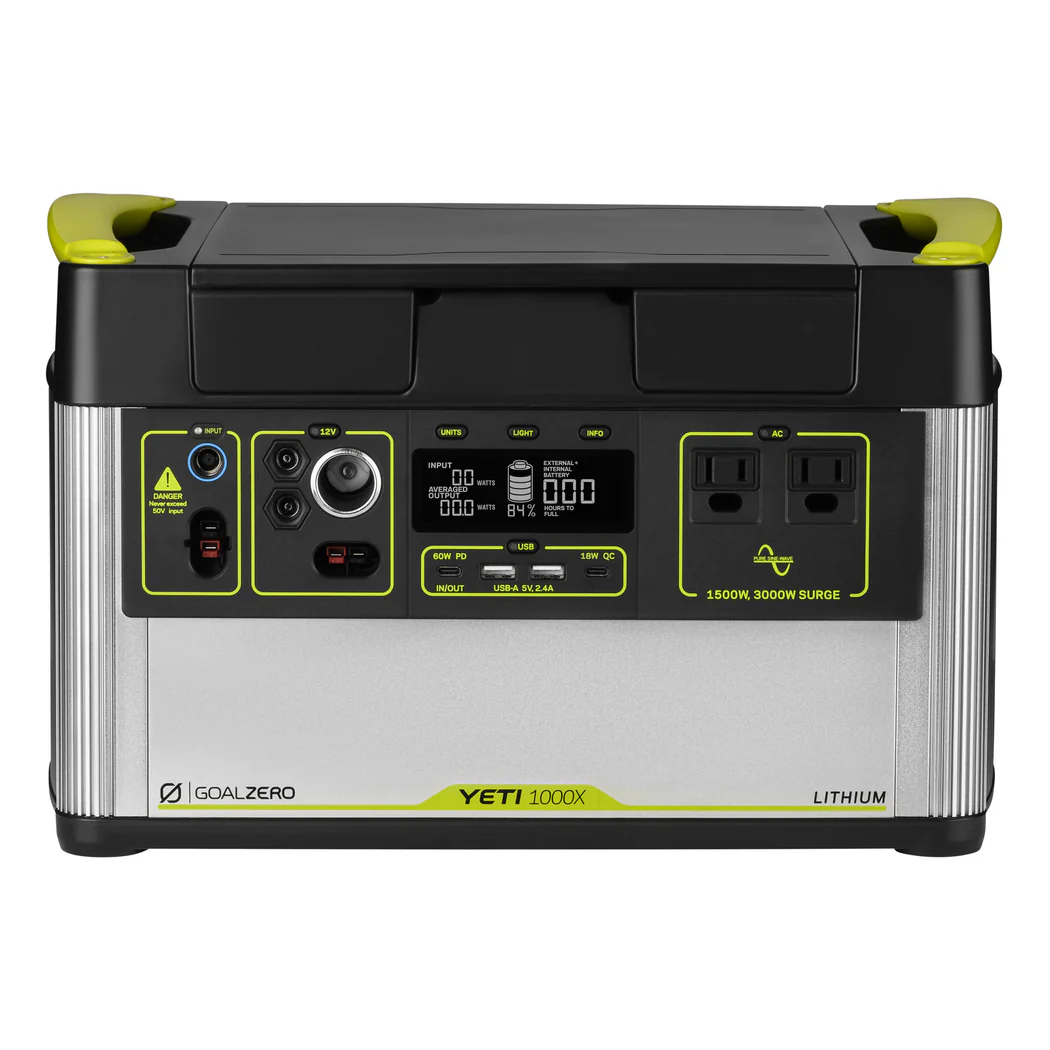
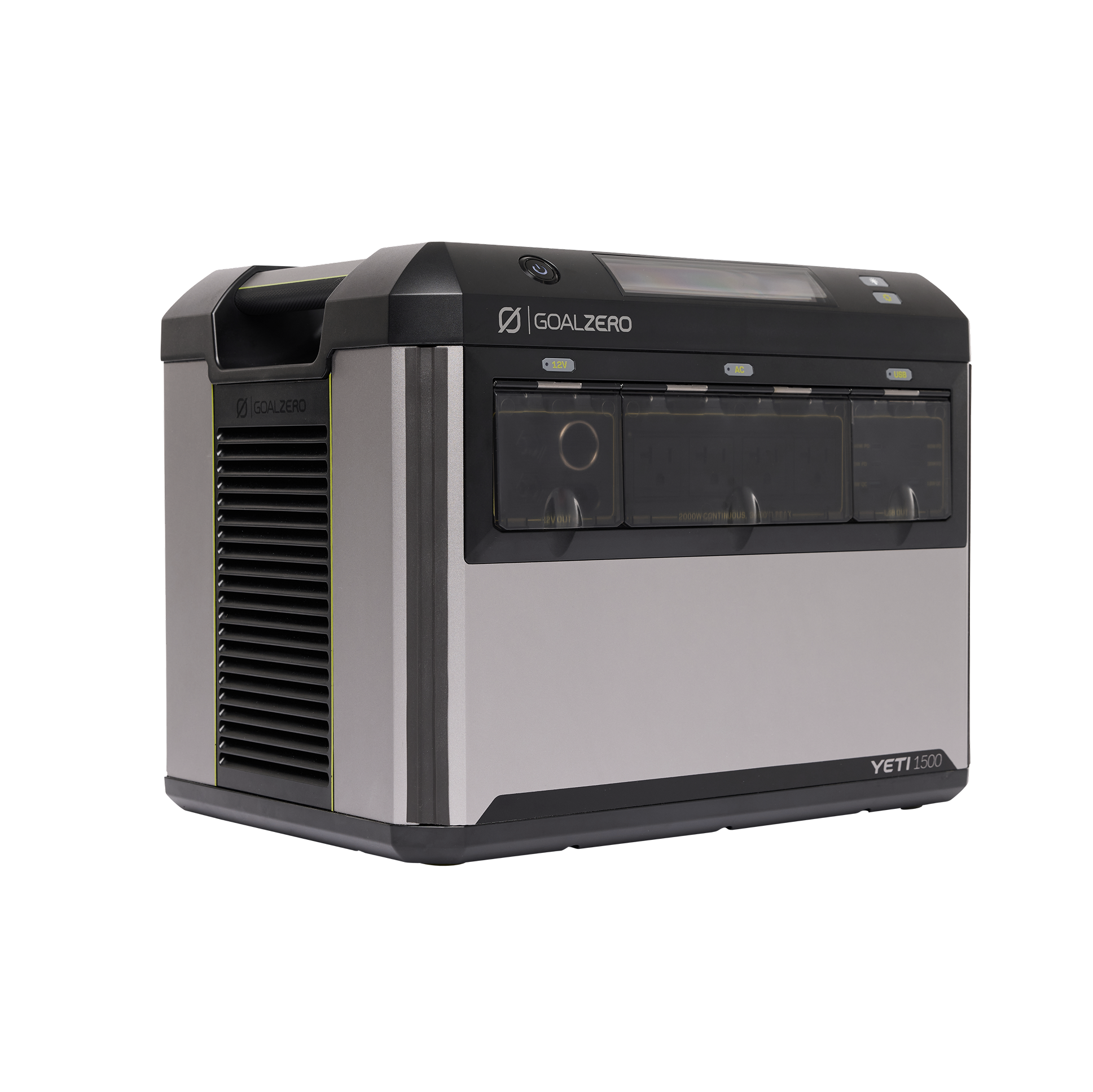
Goal Zero Yeti 1000X vs Goal Zero Yeti 1500 (6th Gen): the 1500 holds 1,505Wh to the 1000X's 983Wh, is rated for at least 4,000 cycles against 500, and is the only one of the two listing a UPS mode. Take the 1500 unless you are the one carrying it, where the 1000X's 31.7 lbs against 52.8 decides it.
Full profiles: Goal Zero Yeti 1000X → · Goal Zero Yeti 1500 (6th Gen) →

Written by Ian SchneiderUpdated
Solar & Off-Grid Tester, Station Arena Test Desk
Spec deltas
The cheaper Yeti is the expensive one. Goal Zero asks $1,000 for the 1000X and $1,500 for the 6th-gen 1500, and over their rated lives those prices buy 492 kWh and 6,021 kWh of stored energy. Twelve times the energy for half again the money. The gap is chemistry rather than tuning: the 1000X's pack is lithium NMC rated to at least 500 cyclesA1, while the 1500's sheet claims at least 4,000, and our research on it explicitly separates the 6th-gen unit from the older 1500X and that unit's chemistryB0.
The $500 gap buys more than cycles. The 1500 runs a 2,000W inverter against 1,500W, carries up to five years of warranty against up to two, and feeds a laptop at 140W over USB-C where the 1000X stops at 60W. It also lists a UPS mode the 1000X's spec sheet never mentions, so it can sit between the wall and a router and take over when the grid drops, rated no worse than 15ms.
The 1000X wins one axis outright and it is a real one: it is the lighter box by enough that you notice on stairs, and used occasionally its rated life is years out rather than months. Against that, the 1500's long-term record barely exists yet. It shipped around March 2026, and a small pool of REI reviewers report hard failures alongside an otherwise positive professional consensusB0B10B11. Take the 1500 anyway. Just take it knowing both of those things.
What the Numbers Reveal
Each conclusion stated first — the numbers behind it on one line, the full analysis below.
rated cycles
The warranty says the same thing from the other end, up to two years against up to five, and at weekend use the 1000X reaches its rated cycle count in 4.8 years where the 1500 is 38.5 years out. Buy the 1000X, use it the way people use these, and replacing it puts $2,000 of Yeti behind you against the $1,500 the 1500 asked once.
Yeti 1000X: $1,000 for 983Wh, rated to at least 500 cyclesYeti 1500 (6th Gen): $1,500 for 1,505Wh, rated to at least 4,000 cyclesRated-life energy: 492 kWh for the 1000X against 6,021 kWh for the 1500
Why it mattersIf this box will be working most weeks, the $500 you save today is a deposit on its replacement.
Margin that thin only gets thinner. A pack near the end of its rated life holds about 80% of what it started with, and daily use is precisely the fastest route to 500 cycles, so the buyer most likely to wear the 1000X down is the same buyer whose load already sits at the edge of it. The 1500 finishes that day with 369Wh in hand and has at least 4,000 cycles to keep doing it.
The Remote Workday load needs 910Wh; the 1000X's usable figure is 836Wh after the flat 15% conversion allowance, a 74Wh shortfallThe 1000X's nameplate capacity is 983Wh, which clears 910Wh on paperA pack at the end of its rated cycle life sits near 80% of its original capacity
Why it mattersAnyone running a full workday off one of these every day should skip the 1000X; the margin is not there new and it will not appear later.
Typical price
And the capacity you bolt on goes to work beside cells rated to at least 500 cycles, so expansion grows the size of the unit without extending its life. Past 1,505Wh the port is genuinely the 1000X's advantage. Short of that you have bought hardware, cables and adapters to reach a number the 1500 shipped with.
The 1000X expands through Goal Zero's Yeti Link system, which needs additional cables and adaptersA3The 1000X starts at 983Wh; the 1500 is sealed at 1,505WhThe 1000X's cells are rated to at least 500 cycles against the 1500's 4,000
Why it mattersIf you expect your needs to climb, that is an argument for a bigger station, not for the 1000X's expansion port.
solar input
The 1500's larger solar input scales with its larger tank, so refilling it costs about the same slice of a sunny day as the smaller unit, and a reviewer put a full wall charge at just over an hourB2. Pair that with a UPS mode and the router never registers the cut at all. On the 1000X an outage is an errand: notice it, get up, plug things in, and start rationing.
The 8-Hour Blackout load needs 1,645Wh: the 1000X covers 51% of it, the 1500 covers 78%Solar input is 600W into 983Wh on the 1000X and 900W into 1,505Wh on the 1500Only the 1500 lists a UPS mode, rated no worse than 15msA hands-on reviewer recorded a full wall charge from empty in just over an hourB2
Why it mattersBlackout buyers should shop the UPS line and the solar input, not the capacity gap between these two.
The specific dimensions that decide these two units — everything else is a tie.
Lifetime Value
Selected because: The two prices sit $500 apart and the rated-life energy behind them is 492 kWh against 6,021 kWh, which settles most of this page.
cost / lifetime kWh
Goal Zero's own warranty is the tell. Up to five covered years on the 1500 against up to two on the 1000X works out to $300 per covered year against $500, so the cheap unit carries the higher annual cost before it has been cycled once.
The 1000X is not the value play per watt-hour either: $1.02 against the 1500's $1.00. Reviewers have been blunt about that price, pointing out that LFP rivals deliver more capacity for less money and last far longer, with some also flagging middling specs and too few portsA4. You pay a premium for the smaller, shorter-lived pack, which is a strange thing to be able to say about two units on the same brand's shelf.
What the Specs Don't Tell You
Selected because: Four cards fire on this pair and three of them describe the 1500, including the only UPS mode on the page.
rated cycles
One side answers the blackout question with silence. The 1500 lists a UPS mode; the 1000X's spec sheet lists none, so the same router either keeps running through a cut or comes back whenever you get to it, depending entirely on which box you bought.
Four cards fire here and three of them are the 1500's: the UPS mode, the warranty term, and the cycle rating. The fourth belongs to the 1000X, and it is the one card on this page that needs reading rather than counting.
Your Life, Your Pick
Selected because: Two of the six scenarios go to the 1500, three are beyond both units, and only the CPAP night is a clean pass for either.
Three of the six rows come back with neither unit covering the load, and that is the more useful finding. Van life asks for 4,685Wh a day and the bigger of these two covers 27% of it, which is not a close call between two products; it is a different shopping trip. The full weekend camping list and the whole eight-hour blackout list land the same way, partial cover on both units, so the honest framing is which essentials you keep rather than which unit passes.
The remote workday is the row to read closely, because 74Wh is the entire story in it. Worth not worrying about, meanwhile: nothing in these six scenarios peaks above 400W, so both inverters start everything they are asked to start and surge headroom decides nothing here.
Portability & Form Factor
Selected because: 31.7 lbs against 52.8 is the one measurement the 1000X wins, and for some buyers it outweighs everything above it.
weight
One of these you carry to the campsite. The other you carry to the car, set down, and reconsider. The gap is twenty-one pounds, 31.7 lbs against 52.8, and it is the only axis where the cheaper Yeti wins outright. Reviewers rate the 1000X's build as premium at that weight and report it performing reliably, including a mini fridge run for 12 hours and sessions in both cold and hot conditionsA2.
The 1500 answers with an aluminium enclosure that a reviewer hauled over rocky roads and a seemingly endless run of speed bumps without trouble, though the same review thought it looked dated beside its competitorsB6B7. One pros-and-cons roundup describes it at nearly 60 pounds and at a price no version of it sells for, and since neither figure matches the unit as sold we have set that entry asideB8. Weight is the one thing the 1000X wins, and the buyer it wins for is specific: the person doing the lifting more often than the cycling.
Growth Path
Selected because: The 1000X can expand and the 1500 cannot, which sounds decisive until you notice the 1000X starts at 983Wh and the 1500 is fixed at 1,505Wh.
solar input
The 1000X's expansion port is the single card it holds, and it is weaker than it looks. It starts at 983Wh, below the 1500's fixed 1,505Wh, so the first battery you add mostly buys back capacity the 1500 includes in the box, and chaining capacity through Yeti Link takes extra cables and adapters to doA3.
The 1500's sealed ceiling is the honest constraint you take in exchange. Size it for the loads you have, because there is no adding to it later, and its 6mm port ecosystem is proprietary and will not accept older Yeti Tank expansion batteriesB9. That is a genuine limit. It is just a smaller one than a port bolted to a pack that wears out first.
Strengths & trade-offs
Goal Zero Yeti 1000X
Strengths
- +Costs $500 less
- +Lighter by 21.1 lb
Trade-offs
- –Shorter-lived battery — rated for 500 charge cycles vs the Yeti 1500 (6th Gen)'s 4,000, so it wears out sooner.
Goal Zero Yeti 1500 (6th Gen)
Strengths
- +Larger battery capacity
- +Higher AC output
- +Longer warranty
- +Faster solar charging
- +Rated for 4,000 charge cycles — much longer battery lifespan
Trade-offs
- –Substantially more expensive (+$500) than the Yeti 1000X.
- –Significantly heavier (+21.1 lbs), making it harder to move.
Will It Power Your Gear?
Scenario math and per-appliance runtimes, modeled from the spec record.
Scenario verdicts
We ran the math on six real-world scenarios. Here's which unit survives your actual life.
SCN-01 · 2 nights · needs 2,100Wh
Weekend Camping
Two nights off-grid with essential comfort
Neither unit
Neither unit covers this scenario's 2,100Wh: the Yeti 1000X comes up 1,264Wh short (about 40% covered), the Yeti 1500 (6th Gen) 821Wh (61%). Treat this as partial cover — enough for the essentials in it, not the whole list.
Battery budget usedlower = more headroom
LOAD Phone Charger 15W×6h · LED Lights 40W×8h · Box Fan 75W×14h · CPAP Machine 40W×16h
SCN-02 · 8 hours · needs 1,645Wh
8-Hour Blackout
Keep the essentials running through a night without power
Neither unit
Neither unit covers the whole 1,645Wh list, the 1000X getting 51% of the way and the 1500 78%, so this is a scenario you plan around rather than one either box passes. What separates them is the moment of the cut and the hours after it: only the 1500 can sit inline and hold the load when the grid goes, and its larger solar input claws back what the outage spent. Trim the list to the fridge and the phones and both work. Keep the whole list and neither does.
Battery budget usedlower = more headroom
LOAD Fridge 150W×8h · Router + Modem 20W×8h · LED Lights (4 bulbs) 40W×6h · Phone Charger 15W×3h
SCN-03 · 8 hours · needs 320Wh
CPAP Overnight
Sleep therapy without interruption — the #1 medical use case
Either unit
Both clear this one without trying. About 40W for eight hours is 320Wh, which is 38% of what the 1000X can deliver and 25% of the 1500's, so capacity decides nothing and the tiebreaks are what the person two feet away actually cares about in the small hours. Neither unit publishes a noise figure, so the fan is an unknown on both sides. Only the 1500 lists a UPS mode, which is what you want if the machine runs through the station and the grid fails mid-sleep.
Battery budget usedlower = more headroom
LOAD CPAP Machine 40W×8h
SCN-04 · 8 hours · needs 910Wh
Remote Workday
Full work day off-grid without power anxiety
Yeti 1500 (6th Gen)
Seventy-four watt-hours is the whole story of this row. The 1000X's nameplate 983Wh clears the 910Wh a workday needs, but every unit here gets the same flat 15% conversion allowance, and against that the 1000X lands 74Wh short, about 92% of the day. The 1500 finishes with 369Wh spare. For an afternoon it makes no difference. For a five-day week the margin is the product.
Battery budget usedlower = more headroom
LOAD Laptop 60W×8h · External Monitor 30W×8h · Router + Modem 20W×8h · Phone Charger 15W×2h
SCN-05 · 4 hours · needs 670Wh
Tailgate Party
Game day power for the crew
Yeti 1500 (6th Gen)
The 1500 takes this on reserve, using 52% of its usable capacity against the 1000X's 80% for the same 670Wh afternoon. Both handle it easily, and the load peaks at 400W, which neither inverter notices. So the spec you will actually feel is not on this row at all. The 1500 wins the numbers; the 1000X wins the walk from the car.
Battery budget usedlower = more headroom
LOAD Blender 400W×0.5h · LED TV (55") 80W×4h · Bluetooth Speaker 15W×4h · Phone Charger (×3) 45W×2h
SCN-06 · 24 hours · needs 4,685Wh
Van Life Daily
A full day of mobile living — the ultimate endurance test
Neither unit
Neither unit covers this scenario's 4,685Wh: the Yeti 1000X comes up 3,849Wh short (about 18% covered), the Yeti 1500 (6th Gen) 3,406Wh (27%). This is well outside what either unit is for; the right answer here is a larger station, not a choice between these two.
Battery budget usedlower = more headroom
LOAD Mini-Fridge 150W×24h · Laptop 60W×4h · Phone Charger 15W×3h · LED Lights 40W×5h · Fan 75W×8h
The Load Test
RUNTIME = (Wh × 0.85) ÷ LOAD
None of the scenarios above exactly yours? Build it. Toggle what you'd plug in; both units are tested against the combined draw.
Essentials
Comfort & Convenience
High-Draw Appliances
Test duration
8h
Continuous draw
205W
Projected runtime
For this load: Yeti 1500 (6th Gen) runs 6.2h vs 4.1h.
Sold on Amazon
Planning for more than this? Describe your whole setup and get it sized →
Modeled from the spec record — same math as the tables below. Methodology
Runtime by appliance
Real-world runtime estimates for common appliances, modeled at 85% inverter efficiency.¹
Essentials
The basics you need runningscale 0–85.3hComfort & Convenience
Makes off-grid life actually enjoyablescale 0–17.1hHigh-Draw Appliances
These reveal the real limitsscale 0–1.3h¹ Runtime = (capacity × 0.85) ÷ appliance watts. Within each group, all bars share one time scale (the group's longest runtime), so lengths are comparable across appliances; identical runtimes collapse into a single blue/orange bar. Actual runtime varies with battery age, temperature, and simultaneous loads — see methodology.
Conclusion
September 13, 2026
Verdict: the Yeti 1500 (6th Gen), on Power Score margin
Take the 6th-gen Yeti 1500. It holds 1,505Wh to the 1000X's 983Wh, is rated for at least 4,000 cycles against at least 500, carries up to five years of warranty against up to two, and is the only one of the pair whose spec sheet lists a UPS mode, rated no worse than 15ms. The $500 you would save on the 1000X buys a pack that reaches its rated cycle count in 1.4 years of daily use, and it does not even buy a lower price per watt-hour: $1.02 against $1.00. The 1000X earns its keep in exactly one place. It weighs 31.7 lbs against 52.8, so if you carry this thing more often than you cycle it, the lighter box is the right answer and the cycle rating never gets to matter.
Editor-assigned confidence, based on cited owner research and spec analysis.
List prices as of September 13, 2026. The links below open Goal Zero's current price.
Sold on Amazon · today’s price is on the listing
or check the Yeti 1000X price$999.95 list
Written by Ian Schneider, Solar & Off-Grid Tester · Station Arena Test Desk · Updated September 13, 2026
Black Friday · 38 days out
Price to beat:Yeti 1000X $1,000
We have never seen it discounted, so any real cut would be a first.
Measured Data
Benchmark scores and the full spec record, side by side.
Benchmark scores
Not rated for both units (minimum threshold unmet): UPS, RV Living, Home Backup, CPAP, Food Truck, Camping.
Full specifications
ᵈ Derived: price ÷ rated capacity. See the data behind our comparisons →
Comparison ToolAdd more power stations, side by sideOpen Tool →How these numbers are produced
Numeric verification
Every figure on this page traces to our spec database or arithmetic on it — no estimated numbers.
Owner claims
Statements about owner experience are cited to published reviews — see Sources & Research Notes below.
Runtime model
Runtime = (rated capacity × 0.85 inverter efficiency) ÷ device wattage. Solar recharge estimates assume panels deliver 70% of rated output. Cold weather, battery age, and stacked loads reduce real-world results.
Power Score
Computed from 14 published spec dimensions, weighted per use-case bench. Higher is better; a unit must meet a bench's minimum threshold to be rated.
See the full weight table and data sourcing on our methodology page →Class ranking (the star rating)
Each unit's star score is a category ranking, not customer reviews — no buyer opinions feed it. We score every station on size-independent quality (value, output, portability, endurance, ports, warranty, and more), then percentile-rank it against the other units in its capacity class, so a class-leading compact unit and a class-leading whole-home unit can both earn 5★. Here, Yeti 1000X rates 3.5/5 (11th percentile of 20 Compact-class units), and Yeti 1500 (6th Gen) rates 3.4/5 (4th percentile of 27 Everyday-class units).
How the class ranking is computed →Test Notes & Caveats
Hidden gotchas and advantages we spotted that you won't find on the product page.
The 1500's Ceiling Is What You Buy
Sealed at 1,505Wh with no expansion port, which is a real constraint and worth saying out loud: size it for the loads you have, not the ones you might have. The 1000X can grow, but it grows from 983Wh, so the first battery you add is mostly catching up to where the 1500 starts. Past 1,505Wh the port finally earns its keep. Short of that it is a feature you shop for and never use.
Only One of These Can Sit Between the Wall and Your Gear
Plug a router, a desktop or a CPAP into the 1500 and it hands the load to battery when the grid drops, rated at no worse than 15ms. Read that as a published ceiling rather than a measured result: comfortable for network gear and most electronics, with the fussiest desktop power supplies sitting close to the line. The 1000X's spec sheet does not list the mode at all, so the same gear goes dark and waits for you to notice.
Warranty: 5 Years vs 2
The Yeti 1500 (6th Gen) is covered for 5 years against the Yeti 1000X's 2 years. An underrated factor if you're keeping this unit for years.
Count Lifetime Energy, Not Cycles
A cycle is not the same size on both units: 1,505Wh on the 1500 against 983Wh on the 1000X. Multiply each by its rating and the rated lives hold roughly 6,021 kWh and 492 kWh of energy respectively, which is the comparison that actually means something. And the end of rated life is not death. A pack there sits near 80% of its original capacity and keeps working, and both ratings are minimums rather than expiry dates.
Full record above — the Test Desk pick is the Yeti 1500 (6th Gen).
Check Yeti 1500 (6th Gen) price →or check the Yeti 1000X priceOwnership Analysis
What happens after you buy — true cost of ownership, brand trust, and growth potential.
Lifetime value
Service lifeyears at one full cycle per day
Lifetime energy delivered
Cost per delivered kWh
│ warranty ends · Reaching the cycle rating means ~80% capacity remains — degraded, not dead.
Analyst note
The Yeti 1000X is cheaper to buy, but the Yeti 1500 (6th Gen) is cheaper to own. At $0.25/kWh over its lifetime vs $2.03/kWh, the Yeti 1500 (6th Gen)'s higher cycle life and capacity make each dollar go further over the years.
Delivers each lifetime kWh for $1.78 less — check the Yeti 1500 (6th Gen) price →
Growth path
Yeti 1000X
EXPANDABLESupports Goal Zero expansion batteries, so you can add capacity later without replacing the base unit — useful if your needs may climb past 983Wh.
Accepts up to 600W of solar. Suitable for a 1-2 panel setup.
Adequate ports for most setups, but heavy users may want a power strip.
Expansion batteries are Goal Zero-specific. You're investing in the Goal Zero ecosystem.
Yeti 1500 (6th Gen)
FIXED CAPACITYFixed at 1,505Wh, with no expansion — so size it for your needs up front rather than planning to add capacity later.
Accepts up to 900W of solar. Suitable for a 1-2 panel setup.
Generous port selection supports complex multi-device setups.
Realistic full solar rechargeat 70% of rated panel output — see methodology
Analyst note
Don't read the Yeti 1000X's expandability as a straight win here: it starts at 983Wh, below the Yeti 1500 (6th Gen)'s 1,505Wh, so a first expansion battery largely buys back capacity the Yeti 1500 (6th Gen) already includes. It only pulls ahead if you'd grow past 1,505Wh — short of that, the Yeti 1500 (6th Gen)'s larger fixed capacity is the simpler value.
What Owners Report
Patterns from published owner reports and long-term reviews — every claim cited to its source below.
Goal Zero Yeti 1000X
The 1000X's field record is reviewer-led rather than long-term-owner-led, and it is remarkably consistentA0. The praise is always build quality: premium feel at 31.68 lbs, reliable in use, with one test running a mini fridge for 12 hours and the unit working in both cold and hot conditionsA2. The criticism is always the same two things. Its NMC cells are rated for 500 cycles to 80% in a market where LFP rivals run past 3,000A1, and at about $1.02 per Wh reviewers call it expensive for what you get, some also noting middling specs and too few portsA4.
Its growth path draws mixed notes rather than negative ones. Yeti Link genuinely chains units for more capacity, but reviewers are clear that it needs additional cables and adapters to get thereA3.
“Excellent premium build at about 31.68 lbs; performs reliably — ran a mini fridge for 12 hours and worked in both cold and hot conditions.”
Sources
thepowerpick.com · batteryskills.com · offgridbenchmark.com · pcworld.com · bestgeneratorsolar.com · appleinsider.com
Goal Zero Yeti 1500 (6th Gen)
Long-term data on the 6th-gen 1500 barely exists. It launched around March 2026, so what is on record is professional hands-on testing plus a small REI review pool rather than years of ownershipB0. What those reviews found is encouraging: a full wall charge from empty in just over an hourB2, a CPAP run overnight that still showed more than 60% in the morningB4, and a mains-to-battery handoff that kept a modem and router alive through a winter stormB5. Solar is the one place reality lags the claim. Goal Zero quotes 4.5 hours to full and a reviewer working with cloud movement and imperfect panel angles called 6 to 8 hours the realistic numberB3.
The complaints deserve equal weight. The internal fans become audible when the inverter is pushed near its 2,000W limit, noticeable in a quiet room rather than loudB1. The 6mm port ecosystem is proprietary and will not take older Yeti Tank batteriesB9. And a minority of REI buyers report real failures: one unit stopped accepting charge on 120VAC, solar and 12V alike, with unsatisfying support afterwards, and another hit connectivity and charging problems following a firmware updateB10B11. That is one review pool against an otherwise positive professional consensusB0, but on a unit this new it is the risk you are accepting.
“When pushing the inverter near its 2,000W limit, the internal cooling fans become audible — not loud, but noticeable in a quiet room.”
Sources
exploreandrenovate.com · wattsourcer.com
Sources & Research Notes
Every owner claim in this report is traceable to a published source. The bracketed references above resolve here.
Recurring owner themes
- Premium build and reliable performance, but held back by 500-cycle NMC chemistry, high price per Wh, and expansion needing extra hardware. [Yeti 1000X · 3 entries]
- Real-world charging speed, CPAP endurance, and UPS backup performance consistently match or beat Goal Zero's marketing claims in hands-on tests, though solar recharge time runs slower than advertised once conditions aren't ideal. [Yeti 1500 (6th Gen) · 4 entries]
- Reviewers flag the unit's price and near-60-lb weight as barriers, and its proprietary 6mm port ecosystem plus incompatibility with older Yeti Tank batteries as an ecosystem lock-in concern. [Yeti 1500 (6th Gen) · 2 entries]
- A minority of REI buyers report serious reliability failures (total charging failure across all input types) paired with unsatisfying customer service, plus firmware-update-triggered connectivity problems — a contrast to the otherwise positive professional-review consensus. [Yeti 1500 (6th Gen) · 2 entries]
- A1
“Uses lithium NMC cells, not LiFePO4, rated for only 500 cycles to 80% — a disadvantage in a LiFePO4 world where rivals last 3,000+ cycles.”
thepowerpick.com / batteryskills.com — Yeti 1000X review · 2026 · [negative]
- A2
“Excellent premium build at about 31.68 lbs; performs reliably — ran a mini fridge for 12 hours and worked in both cold and hot conditions.”
thepowerpick.com / offgridbenchmark.com — Yeti 1000X review · 2026 · [positive]
- A3
“Expandable via the Yeti Link system to chain multiple units for more capacity, though it requires additional cables and adapters.”
pcworld.com / bestgeneratorsolar.com — Yeti 1000X review · 2026 · [mixed]
- A4
“At about $1.02 per Wh it's pricey — reviewers note LFP rivals offer more capacity for less, charge faster, and last far longer; some also flag middling specs and too few ports.”
appleinsider.com / thepowerpick.com — Yeti 1000X review · 2026 · [negative]
- B1
“When pushing the inverter near its 2,000W limit, the internal cooling fans become audible — not loud, but noticeable in a quiet room.”
exploreandrenovate.com — "Goal Zero Yeti 1500 Worth Buying? Honest Pros & Cons Analysis" · 2026 · [mixed]
- B2
“A full charge from 0 to 100% completes in just over an hour via wall power.”
Popular Science — "Goal Zero Yeti 1500 6G review: A rugged portable power station that isn't afraid to get dirty" · 2026 · [positive]
- B3
“Goal Zero claims a 4.5-hour full recharge from solar, but in more typical conditions with some cloud movement and sub-optimal angles, 6-8 hours is a more realistic expectation.”
exploreandrenovate.com — "Goal Zero Yeti 1500 Worth Buying? Honest Pros & Cons Analysis" · 2026 · [mixed]
- B4
“I ran a CPAP machine overnight, which left me with more than 60% capacity in the morning.”
Popular Science — "Goal Zero Yeti 1500 6G review: A rugged portable power station that isn't afraid to get dirty" · 2026 · [positive]
- B5
“The transition from mains to power bank worked seamlessly as you'd hope — it kept the modem and router running through a winter storm.”
Popular Science — "Goal Zero Yeti 1500 6G review: A rugged portable power station that isn't afraid to get dirty" · 2026 · [positive]
- B6
“The aluminum enclosure gives a premium, tool-like feel, and the unit survived rocky roads and over the seemingly endless number of speed bumps without issue.”
Popular Science — "Goal Zero Yeti 1500 6G review: A rugged portable power station that isn't afraid to get dirty" · 2026 · [positive]
- B7
“The design isn't as modern or appealing as other competitors.”
Popular Science — "Goal Zero Yeti 1500 6G review: A rugged portable power station that isn't afraid to get dirty" · 2026 · [negative]
- B8
“At over $2,000, it's a significant investment...at nearly 60 pounds, it's portable but not 'light' — more 'luggable' than carryable.”
exploreandrenovate.com — "Goal Zero Yeti 1500 Worth Buying? Honest Pros & Cons Analysis" · 2026 · [mixed]
- B9
“The 6mm port ecosystem is proprietary, limiting accessory options, and the unit is not compatible with older Yeti Tank expansion batteries.”
wattsourcer.com — "Goal Zero Yeti 1500 Review (2026)" · 2026 · [negative]
- B10
“The unit stopped accepting charges via 120VAC, solar, and 12V inputs, resulting in complete system failure, and the owner reported less than satisfactory customer service from Goal Zero.”
REI customer reviews — Goal Zero Yeti 1500 Portable Power Station product page (review aggregate) · unknown · [negative]
- B11
“Experienced connectivity and charging issues after a firmware update.”
REI customer reviews — Goal Zero Yeti 1500 Portable Power Station product page (review aggregate) · unknown · [negative]
Research compiled September 13, 2026.
Who Should Buy Which
Buy the Yeti 1000X if you…
- →You carry it more than you cycle it. Trailhead, boat, truck bed, up to a second-floor apartment: 31.7 lbs is a one-person, one-trip lift, and used a few weekends a month the 500-cycle rating is years out rather than months.
- →You already own Goal Zero expansion hardware or Yeti Link cabling, since the 6th-gen 1500 will not accept the older Tank batteries and cannot be expanded at allB9.
- →Your loads are small and occasional. A CPAP night is 320Wh, which is 38% of what the 1000X can actually deliver, and phones, lights and a laptop never get near the rest of it.
Buy the Yeti 1500 (6th Gen) if you…
- →Something on the end of that extension cord must not notice the grid going away: a router, a desktop, a CPAP. Only the 1500 lists a UPS mode, and that line is the whole reason to pay the difference if this is emergency gear.
- →You cycle it hard, daily or most days. This is the only one of the two rated for that kind of life, and the warranty behind it runs up to five years.
- →You work off it. The remote workday asks for 910Wh and the 1500 finishes with 369Wh in hand, which is the difference between a unit you plan around and one you just use.
- →You refill from the sun and want the bigger input doing it, because an outage sets its own schedule and you may be recharging every day of it.
If neither fits
Full-time van life, or anything with a 4,685Wh daily appetite: the bigger of these two covers 27% of that day, so the answer is a substantially larger station or a hardwired system with its own charging, not whichever of these two you prefer. Same answer if your camping list is the full 2,100Wh version rather than the essentials inside it, because both units cover part of it and you would be rationing by Saturday afternoon.
The Bottom Line
Take the 6th-gen Yeti 1500. The same brand sells you two boxes $500 apart, and over its rated life the cheaper one moves a kilowatt-hour for $2.03 against 25 cents, comes with less than half the warranty, and has no answer at all for the moment the grid drops. No feature on the 1000X closes that, because the gap is not a feature. It is the cells.
The exception is honest and narrow. If the lifting matters more to you than the cycling, the 1000X is the lighter box and that is a real thing to want. Everyone else is choosing between a unit they will replace and a unit they will forget they bought. Buy the one you will forget.
Frequently Asked Questions
Answers drawn from the spec record and cited owner research.
Is the Goal Zero Yeti 1500 (6th Gen) worth $500 more than the Yeti 1000X?
Yes, unless weight decides it for you. The 1500 is rated for at least 4,000 cycles against the 1000X's 500, holds 1,505Wh against 983Wh, and carries up to five years of warranty against up to two. The only buyer who should take the 1000X instead is the one lifting it regularly, at 31.7 lbs against 52.8.
Can the Yeti 1000X run a CPAP all night?
Yes, comfortably. A CPAP draws roughly 40W, so an eight-hour night is about 320Wh, which is 38% of the 836Wh the 1000X can actually deliver after the flat 15% conversion allowance. The 1500 uses 25% of its own usable capacity for the same night, so capacity is not what separates them for this job.
Does the Goal Zero Yeti 1000X have a UPS mode?
Its spec sheet does not list one, so gear plugged into it goes dark when the grid does and waits for you to intervene. The 6th-gen 1500 does list the mode, rated no worse than 15ms, which makes it the pick when a router, a desktop or a medical device has to stay up through a cut. Treat that figure as a published ceiling rather than a measured switchover, and note that the fussiest desktop power supplies sit close to that line.
Can you add batteries to the Yeti 1500 (6th Gen)?
No. It is sealed at 1,505Wh and will not accept the older Yeti Tank expansion batteries either. The 1000X does expand, through Yeti Link and with extra cables and adapters, but it starts at 983Wh, so the first battery you add mostly buys back capacity the 1500 already includes. The port only pulls ahead if you would grow past 1,505Wh.
How long will the Yeti 1000X battery actually last?
Its pack is rated for at least 500 cycles, which is about 1.4 years if you cycle it every day. Hitting that number does not kill it: the pack settles near 80% of its original capacity and keeps working, and the rating is a minimum rather than an expiry date. The 6th-gen 1500's 4,000-cycle rating puts the same milestone roughly 11 years out at daily use.
Where to buy
Goal Zero Yeti 1000X
$999.95
$999.95 · direct from Goal Zero
Last checked 16 days ago. Prices move — check before you buy.
Goal Zero Yeti 1500 (6th Gen)Pick
Sold on Amazon · today’s price is on the listing
Prices may vary by retailer and are subject to change.