Head-to-head test
EcoFlow RIVER 3 MAX PLUS WIRELESS vs BLUETTI Elite 10 Mini
The RIVER 3 MAX PLUS WIRELESS costs five times as much and still wins on cost per kilowatt-hour. The Elite 10 Mini is a phone-and-laptop charger, not a small power station: its 200W outlet won't even start a blender.
Full profiles: EcoFlow RIVER 3 MAX PLUS WIRELESS → · BLUETTI Elite 10 Mini →

Written by Wenny ZhengUpdated
Portable Power Tester, Station Arena Test Desk
Spec deltas
The RIVER 3 MAX PLUS WIRELESS is $599 (last listed price). The Elite 10 Mini is $119, about a fifth of the price. Check what each dollar actually buys, though, and the cheaper unit is the more expensive one to run: $0.31 per lifetime kilowatt-hour against the RIVER 3's $0.17.
Six real-world scenarios settle most of the rest. The RIVER 3 wins CPAP Overnight, Remote Workday, and Tailgate Party outright; the Elite 10 Mini wins none of them. Tailgate Party is the sharpest example: its 200W outlet can't start the 400W blender in that test load, full stop, before battery size is even relevant.
None of that makes the Elite 10 Mini a bad buy. It's a genuinely good phone-and-laptop charger at 3.97 lbs, for someone who never wanted a power station in the first place. It just isn't a smaller, cheaper version of the RIVER 3. They're not competing for the same job.
What the Numbers Reveal
Each conclusion stated first — the numbers behind it on one line, the full analysis below.
continuous output
That's a different failure mode than running out of charge. The RIVER 3 MAX PLUS WIRELESS clears the 400W peak easily at 600W continuous and still finishes the four-hour event using just 66% of what it can deliver. This scenario was never close, on either axis.
Elite 10 Mini outputs 200W continuous, with a 300W surge ratingThe Tailgate Party test load's peak single-appliance draw is a 400W blenderRIVER 3 MAX PLUS WIRELESS outputs 600W continuous, with a 1,200W surge rating
Why it mattersCheck outlet wattage against your highest single-appliance draw before you check battery size. A bigger battery on the Elite 10 Mini would not fix this.
That's why the five-times-pricier unit ends up the cheaper one to actually run. It isn't paying more per cycle, it's delivering far more energy per cycle, for a price that doesn't scale at the same rate.
RIVER 3 MAX PLUS WIRELESS costs $599 (last listed price) against the Elite 10 Mini's $119RIVER 3 MAX PLUS WIRELESS costs $0.17 per lifetime kWh against the Elite 10 Mini's $0.31Both units are rated for 3,000 cycles
Why it mattersAnyone buying the Elite 10 Mini specifically to save money on running costs should know they're paying more per watt-hour for that choice, not less. The savings are real only in absolute dollars spent today.
The Elite 10 Mini isn't in a worse position on this scenario, it's not in the scenario at all. 836% of usable capacity isn't a tight fit, it's roughly eight days of energy packed into one day's demand.
Remote Workday needs 910Wh for a laptop, monitor, router, and phone charging over 8 hoursRIVER 3 MAX PLUS WIRELESS uses 90% of its usable capacity to cover that dayElite 10 Mini would need 836% of its usable capacity for the same day
Why it mattersSomeone doing this daily, not just once, should size up from the RIVER 3 if their workday ever runs long, but shouldn't shortlist the Elite 10 Mini for this use case at all.
Capacity
The Elite 10 Mini's real advantage was never efficiency, it's absolute size. You're not trading efficiency for portability by buying it, you're trading total capacity for something that fits in a bag at all.
RIVER 3 MAX PLUS WIRELESS packs 1,196Wh into 20.8 lbsElite 10 Mini packs 128Wh into 3.97 lbs
Why it mattersChoose the Elite 10 Mini because you need something pocketable, not because it seems like the leaner, smarter-engineered option. Gram for gram, it isn't.
The specific dimensions that decide these two units — everything else is a tie.
Your Life, Your Pick
Selected because: Six computed scenarios split 3 p1 / 3 neither / 0 p2, including a genuine wattage (not capacity) failure on Tailgate Party — the clearest evidence for the verdict.
Tailgate Party is the scenario that actually separates these two, and not for the reason you'd expect. The Elite 10 Mini's 200W outlet can't start the 400W blender in the test load, full stop, before its 128Wh battery is even part of the conversation. The RIVER 3 MAX PLUS WIRELESS, at 600W, starts it fine and finishes the four-hour event having used just 66% of what it can deliver.
Weekend Camping, the 8-Hour Blackout, and Van Life Daily all come back 'neither.' A full day of van life needs 4,685Wh, which is 461% of what the RIVER 3 can actually deliver, before the Elite 10 Mini even gets a turn. The other two are the same story at a smaller scale: real off-grid weekends and real blackouts need more stored energy than either box holds. At this size, the honest question isn't how long either one runs, it's what you're actually plugging in. CPAP Overnight and Remote Workday are where the RIVER 3 earns its keep, and Remote Workday is the tight one: an 8-hour laptop-and-monitor day eats 90% of what it can deliver.
Portability & Form Factor
Selected because: 20.8 lbs vs 3.97 lbs is the most physically real difference buyers will feel, and the Wh-per-lb math overturns the assumption that the small unit is the efficient one.
weight
20.8 lbs against 3.97 lbs looks like the RIVER 3 pays a portability tax for its extra capacity. It doesn't. Divide capacity by weight and the RIVER 3 delivers about 57Wh per pound; the Elite 10 Mini manages about 32Wh per pound. The bigger unit is the more weight-efficient one. The Elite 10 Mini's real selling point isn't efficiency, it's absolute size.
In practice, 20.8 lbs is a two-handed lift out of a trunk, not something you toss in a daypack. It's built to live in one spot for a trip, not ride in a jacket pocket. The Elite 10 Mini at 3.97 lbs is closer to a large water bottle than a power station, the kind of thing you genuinely forget you're carrying, which is the entire reason it exists at 128Wh instead of something bigger.
What the Specs Don't Tell You
Selected because: Four gotchas fire with real nuance, especially the warranty-per-dollar result favoring the cheaper unit despite its shorter absolute term.
Three of the four gotchas here point the same direction the specs already do. The RIVER 3's inverter has more headroom, a 2.0x surge ratio against the Elite 10 Mini's 1.5x, which is exactly why the blender problem above happens. Its 30dB fan is also quiet enough to sleep near, where the Elite 10 Mini's 45dB isn't. Sealed capacity on the Elite 10 Mini is the honest tradeoff for going this small: there's no expansion port to add later, so 128Wh is what you get, permanently.
Warranty is the one gotcha that doesn't follow the price. The RIVER 3's coverage runs two years longer in absolute terms, 5 years against 3, but because it costs about five times as much, the Elite 10 Mini actually returns more warranty coverage for every dollar spent. It's a small, honest point in the cheaper unit's favor, even on a page the RIVER 3 otherwise wins.
Lifetime Value
Selected because: cheaperToOwn=p1 despite a 5x sticker-price gap is the single most counterintuitive, decision-relevant number on the page.
$0.17 per lifetime kilowatt-hour for the RIVER 3 against $0.31 for the Elite 10 Mini: the $599 (last listed price) unit is the cheaper one to actually run, not the $119 one. Both are rated for the same 3,000 cycles, so the RIVER 3 isn't buying more charge cycles for its extra money, it's buying more capacity per cycle, and that capacity is what spreads the purchase price across far more total energy over the unit's life.
For a weekend-only user, that's 6 cents a day for the RIVER 3 against 1 cent a day for the Elite 10 Mini. The Elite 10 Mini is still cheaper in absolute terms because its total spend is so much lower; it's just more expensive per watt-hour it actually delivers. Buy the RIVER 3 for the cheaper energy. Buy the Elite 10 Mini because 128Wh is genuinely all you need and you don't want to spend $599 (last listed price) to get it.
Brand Trust
Selected because: Cross-brand pair with real divergence (EcoFlow recall caveat vs BLUETTI support inconsistency) that matters differently at $599 (last listed price) than at $119.
EcoFlow is the bigger financial bet at $599 (last listed price), and it carries a real caveat: an October 2025 recall on the DELTA Max 2000 for overheating risk, worth knowing even though the RIVER 3 is a different product line. Support quality is inconsistent, some claims move through fast, others involve long waits and refurbished replacements, so a retailer with its own strong return policy is the safer route on a $599 (last listed price) purchase.
BLUETTI's support is the less consistent of the two brands: email-based, with China-timezone delays and a wider spread between smooth and frustrating outcomes. That matters more on a $599 (last listed price) purchase than on the Elite 10 Mini's $119 one, where replacing it outright is a real option if support falls through. EcoFlow's larger, more active community is worth factoring in too: more people troubleshooting the same units means faster answers if something goes wrong.
Strengths & trade-offs
EcoFlow RIVER 3 MAX PLUS WIRELESS
Strengths
- +Larger battery capacity
- +Higher AC output
- +Longer warranty
- +Faster solar charging
Trade-offs
- –Significantly heavier (+16.8 lbs), making it harder to move.
BLUETTI Elite 10 Mini
Strengths
- +Lighter by 16.8 lb
Trade-offs
- –Sealed capacity — the RIVER 3 MAX PLUS WIRELESS can add batteries to grow past 128Wh; this one can't.
Will It Power Your Gear?
Scenario math and per-appliance runtimes, modeled from the spec record.
Scenario verdicts
We ran the math on seven real-world scenarios. Here's which unit survives your actual life.
SCN-01 · 2 nights · needs 2,100Wh
Weekend Camping
Two nights off-grid with essential comfort
Neither unit
Two nights of phone charging, LED lights, a box fan, and a CPAP need 2,100Wh total, 207% of what the RIVER 3 can actually deliver, and far beyond the Elite 10 Mini's reach entirely. This is a bigger-station trip for both units.
Battery budget usedlower = more headroom
LOAD Phone Charger 15W×6h · LED Lights 40W×8h · Box Fan 75W×14h · CPAP Machine 40W×16h
SCN-02 · 8 hours · needs 1,645Wh
8-Hour Blackout
Keep the essentials running through a night without power
Neither unit
A fridge, router, some lights, and phone charging for eight hours needs 1,645Wh, 162% of the RIVER 3's real capacity and well beyond the Elite 10 Mini's. Both units are undersized for a fridge-inclusive blackout. Plan on a bigger battery or a generator for this one.
Battery budget usedlower = more headroom
LOAD Fridge 150W×8h · Router + Modem 20W×8h · LED Lights (4 bulbs) 40W×6h · Phone Charger 15W×3h
SCN-03 · 8 hours · needs 320Wh
CPAP Overnight
Sleep therapy without interruption — the #1 medical use case
RIVER 3 MAX PLUS WIRELESS
An overnight CPAP at 40W for eight hours needs 320Wh, 31% of the RIVER 3's usable capacity and 294% of the Elite 10 Mini's. This is comfortably a RIVER 3 scenario. The Elite 10 Mini would need to be recharged mid-sleep to finish the night.
Battery budget usedlower = more headroom
LOAD CPAP Machine 40W×8h
SCN-04 · 8 hours · needs 910Wh
Remote Workday
Full work day off-grid without power anxiety
RIVER 3 MAX PLUS WIRELESS
A laptop, monitor, router, and phone charging for a full workday needs 910Wh. The RIVER 3 covers it but ends the day at 90% used, real margin, not huge margin. The Elite 10 Mini needs 836% of its usable capacity for the same day and isn't a candidate.
Battery budget usedlower = more headroom
LOAD Laptop 60W×8h · External Monitor 30W×8h · Router + Modem 20W×8h · Phone Charger 15W×2h
SCN-05 · 4 hours · needs 670Wh
Tailgate Party
Game day power for the crew
RIVER 3 MAX PLUS WIRELESS
This one isn't about capacity. The Elite 10 Mini's 200W outlet can't start the 400W blender in this load at all, regardless of battery size. The RIVER 3's 600W handles it and finishes the four-hour event at 66% used.
Battery budget usedlower = more headroom
LOAD Blender 400W×0.5h · LED TV (55") 80W×4h · Bluetooth Speaker 15W×4h · Phone Charger (×3) 45W×2h
SCN-06 · 24 hours · needs 4,685Wh
Van Life Daily
A full day of mobile living — the ultimate endurance test
Neither unit
A full 24 hours of mini-fridge, laptop, lights, phone charging, and a fan needs 4,685Wh, 461% of the RIVER 3's usable capacity and far beyond the Elite 10 Mini's. Full-time van life needs a proper house-battery setup, not a portable unit this size.
Battery budget usedlower = more headroom
LOAD Mini-Fridge 150W×24h · Laptop 60W×4h · Phone Charger 15W×3h · LED Lights 40W×5h · Fan 75W×8h
SCN-07 · an afternoon · needs 100Wh
Afternoon Off-Grid
Phones and a speaker at the park, beach, or campsite — the small-unit job description
Either unit
This row is here for the Elite 10 Mini's class of job: phones and a speaker, 100Wh across an afternoon. Both cover it — the Elite 10 Mini finishes at 92% used, and the RIVER 3 MAX PLUS WIRELESS barely notices it. For this job the RIVER 3 MAX PLUS WIRELESS's extra capacity is dead weight, not headroom; at 4 lbs the Elite 10 Mini is the one you'll be glad you brought.
Battery budget usedlower = more headroom
LOAD Phone Charger (×2) 30W×2h · Bluetooth Speaker 10W×4h
The Load Test
RUNTIME = (Wh × 0.85) ÷ LOAD
None of the scenarios above exactly yours? Build it. Toggle what you'd plug in; both units are tested against the combined draw.
Essentials
Comfort & Convenience
High-Draw Appliances
Test duration
8h
Continuous draw
205W
Projected runtime
Only the RIVER 3 MAX PLUS WIRELESS can start this 205W load.
Planning for more than this? Describe your whole setup and get it sized →
Modeled from the spec record — same math as the tables below. Methodology
Runtime by appliance
Real-world runtime estimates for common appliances, modeled at 85% inverter efficiency.¹
Essentials
The basics you need runningscale 0–67.8hComfort & Convenience
Makes off-grid life actually enjoyablescale 0–13.6hHigh-Draw Appliances
These reveal the real limits¹ Runtime = (capacity × 0.85) ÷ appliance watts. Within each group, all bars share one time scale (the group's longest runtime), so lengths are comparable across appliances; identical runtimes collapse into a single blue/orange bar. Actual runtime varies with battery age, temperature, and simultaneous loads — see methodology.
Conclusion
July 28, 2026
Verdict withdrawn: the RIVER 3 MAX PLUS WIRELESS is no longer sold
We picked the RIVER 3 MAX PLUS WIRELESS, but it's been discontinued (EcoFlow now points buyers to the DELTA 3 Classic). The Elite 10 Mini is still on sale, but that alone doesn't make it our pick. The comparison below is still accurate if you own either one.
Editor-assigned confidence, based on cited owner research and spec analysis.
Written by Wenny Zheng, Portable Power Tester · Station Arena Test Desk · Updated July 28, 2026
Black Friday · 38 days out
Price to beat:Elite 10 Mini $113
The lowest we have recorded. A Black Friday price above it is a sale this unit has already had.
Measured Data
Benchmark scores and the full spec record, side by side.
Benchmark scores
Not rated for both units (minimum threshold unmet): CPAP, Solar Generator, Tailgating, Camping.
Full specifications
ᵈ Derived: price ÷ rated capacity. See the data behind our comparisons →
Comparison ToolAdd more power stations, side by sideOpen Tool →How these numbers are produced
Numeric verification
Every figure on this page traces to our spec database or arithmetic on it — no estimated numbers.
Owner claims
Statements about owner experience are cited to published reviews — see Sources & Research Notes below.
Runtime model
Runtime = (rated capacity × 0.85 inverter efficiency) ÷ device wattage. Solar recharge estimates assume panels deliver 70% of rated output. Cold weather, battery age, and stacked loads reduce real-world results.
Power Score
Computed from 14 published spec dimensions, weighted per use-case bench. Higher is better; a unit must meet a bench's minimum threshold to be rated.
See the full weight table and data sourcing on our methodology page →Class ranking (the star rating)
Each unit's star score is a category ranking, not customer reviews — no buyer opinions feed it. We score every station on size-independent quality (value, output, portability, endurance, ports, warranty, and more), then percentile-rank it against the other units in its capacity class, so a class-leading compact unit and a class-leading whole-home unit can both earn 5★. Here, RIVER 3 MAX PLUS WIRELESS rates 3.6/5 (15th percentile of 27 Everyday-class units), and Elite 10 Mini rates 4.2/5 (52nd percentile of 24 Personal-class units).
How the class ranking is computed →Test Notes & Caveats
Hidden gotchas and advantages we spotted that you won't find on the product page.
Elite 10 Mini: 45dB Published
The Elite 10 Mini's fan hits 45dB under load, about like a running refrigerator, above the 45dB threshold most people find disruptive for sleep. The RIVER 3 MAX PLUS WIRELESS runs quieter at 30dB, the more relevant number if either is going near a bedroom or a tent.
Elite 10 Mini: Fixed Capacity
The Elite 10 Mini is sealed at 128Wh, and that is the ceiling. Normally the counterpoint would be that the RIVER 3 MAX PLUS WIRELESS can add expansion batteries, but that isn't a live option here: the RIVER 3 MAX PLUS WIRELESS is no longer sold, and EcoFlow points owners to the DELTA 3 Classic. For a new purchase the expansion question doesn't arise between these two, so the Elite 10 Mini's fixed 128Wh is simply what you get.
Elite 10 Mini: Power Lifting to 400W
The Elite 10 Mini has BLUETTI's Power Lifting mode, which runs a resistive appliance rated up to 400W from its 200W inverter. It does that by delivering less power than the appliance asks for, not more than the inverter has: the heater still works, it just heats more slowly. Two things follow. BLUETTI scopes the mode to purely resistive loads — a heater, a kettle, an incandescent lamp — so it does nothing for a fridge compressor, a pump or a power tool; for motor loads the figure to read is the Elite 10 Mini's separate 300W surge peak, not this one. And it is not a reason to size down, because running a load that big from 128Wh is a short session either way. Genuinely useful if a heater or a kettle is why you're buying; beside the point otherwise. The RIVER 3 MAX PLUS WIRELESS publishes no equivalent.
Surge Power: Inverter Quality Indicator
The RIVER 3 MAX PLUS WIRELESS surges to 2.0x its rated output, 1,200W against a 600W continuous rating. The Elite 10 Mini surges to 1.5x, 300W against 200W. That gap is exactly why the Elite 10 Mini can't start a 400W blender in the Tailgate Party scenario: a higher surge ratio means the inverter tolerates the momentary spike that motors and compressors draw on startup.
Warranty: 5 Years vs 3
The RIVER 3 MAX PLUS WIRELESS carries the longer warranty in absolute terms, 5 years against the Elite 10 Mini's 3. But because it also costs about five times as much, the Elite 10 Mini actually delivers more warranty coverage per dollar spent, the cheaper unit's one clear numbers-based win on this page.
Ownership Analysis
What happens after you buy — true cost of ownership, brand trust, and growth potential.
Lifetime value
Service lifeyears at one full cycle per day
Lifetime energy delivered
Cost per delivered kWh
│ warranty ends · Reaching the cycle rating means ~80% capacity remains — degraded, not dead.
Analyst note
The RIVER 3 MAX PLUS WIRELESS is no longer sold, so there is no price to work its cost per kWh from, and this comparison doesn't quote one. On what you can actually buy today, the Elite 10 Mini works out at $0.31/kWh over its rated life. If you already own the RIVER 3 MAX PLUS WIRELESS, the hardware comparison still holds: over its rated life the RIVER 3 MAX PLUS WIRELESS delivers about 3,588 kWh and the Elite 10 Mini about 384 kWh. One thing to know reading the table: both carry the same 3,000-cycle rating, so the lifetime rows are sticker price and capacity in disguise — the wear horizon is identical and decides nothing here.
Brand trust
EcoFlow
Ecosystem
The largest lineup in the category: DELTA Pro, DELTA 3, and RIVER 3 families, plus solar panels and smart home panels, so there's a clear upgrade path beyond this unit.
Support
US phone, email, and chat support. Outcomes split: some replacements are a fast prepaid-label swap, others involve long waits or a refurbished unit. Buying through Costco or Amazon adds a return safety net.
Community
The biggest community in the category: Reddit, multiple Facebook groups, and an official forum, which matters if you want a fast answer to an unusual problem.
App experience
Rated 4.6/5 iOS (~8,400 ratings) · 4.2/5 Android (~17,000 ratings)
Unique strength
Fastest charging in the category and the deepest expansion ecosystem, up to 180kWh with the DELTA Pro Ultra X line.
Worth knowing
An October 2025 recall on the DELTA Max 2000, overheating risk with 6 incidents, is worth knowing about even though it's a different product line than the RIVER 3.
BLUETTI
Ecosystem
A broad lineup from budget to flagship, including niche builds like sodium-ion cold-weather units, but the Elite 10 Mini sits alone at the bottom of that range with no expansion or accessory family attached.
Support
The less consistent support of the two brands: email-based, with China-timezone delays. Buying direct from BLUETTI's own site tends to produce smoother outcomes than third-party retailers.
Community
An active, growing Reddit community, second-largest in the category after EcoFlow.
App experience
Rated 4.5/5 iOS and Android — tied for best app experience in the category. V3.0 UI redesign was well-received.
Unique strength
The best capacity-to-price ratio in the category, and a fully LFP lineup rated 3,500 to 6,000-plus cycles on other models in the range.
Worth knowing
No spare-parts policy on some older or discontinued models, worth asking about before buying if you're planning to keep a unit for years.
Analyst note
EcoFlow is the safer ecosystem bet if you might expand into a bigger battery setup later. BLUETTI is the better bet on support-per-dollar if 128Wh is genuinely all you'll ever need from this category. Either way, buy from a retailer with a strong return policy of its own. Both brands have inconsistent support track records.
Growth path
RIVER 3 MAX PLUS WIRELESS
EXPANDABLESupports EcoFlow expansion batteries, so you can add capacity later without replacing the base unit — useful if your needs may climb past 1,196Wh.
Accepts up to 200W of solar. Limited to a single portable panel.
Adequate ports for most setups, but heavy users may want a power strip.
Expansion batteries are EcoFlow-specific. You're investing in the EcoFlow ecosystem.
Elite 10 Mini
FIXED CAPACITYFixed at 128Wh, with no expansion — so size it for your needs up front rather than planning to add capacity later.
Accepts up to 100W of solar. Limited to a single portable panel.
Limited ports. You'll likely need a power strip or splitter.
Realistic full solar rechargeat 70% of rated panel output — see methodology
Analyst note
Growth only counts if you can still buy in, and the RIVER 3 MAX PLUS WIRELESS is no longer sold (EcoFlow points owners to the DELTA 3 Classic). That leaves the Elite 10 Mini: it is sealed at 128Wh, so buy the size that covers you now. The RIVER 3 MAX PLUS WIRELESS's expandability still matters if you already own one, but it isn't a reason to pick it over the Elite 10 Mini.
What Owners Report
Patterns from published owner reports and long-term reviews — every claim cited to its source below.
EcoFlow RIVER 3 MAX PLUS WIRELESS
This exact 'Max Plus Wireless' configuration is recent enough that there's no real owner community to draw on yet: no Reddit threads, no long-term forum reports, mostly early blog coverage, and some of that covers sibling River 3 models rather than this specific unit. Treat what follows as early-adopter signal, not a mature field record.
Within that limited coverage, reviewers consistently flag the fan as quiet, describing it in the same breath as cheaper units whose fans kick on loudly and often by comparisonA2A3A7A8. The sub-10ms UPS switchover and a notably quick empty-to-full recharge both come up as genuinely useful for remote work and campsite power, not just spec-sheet numbersA1A5.
One naming note: 'Wireless' refers to a detachable power bank module you can pull off and carry separatelyA6, not a wireless charging pad built into the main unit's top surface. That's a mix-up flagged on the closely related base Plus model, where reviewers noted buyers might expect a charging pad that isn't thereA9.
“The RIVER 3 Max Plus (Wireless) can go from empty to full from mains in around 2.3 hours, which is very quick given its capacity.”
Sources
root-nation.com · backuppowerhub.com
BLUETTI Elite 10 Mini
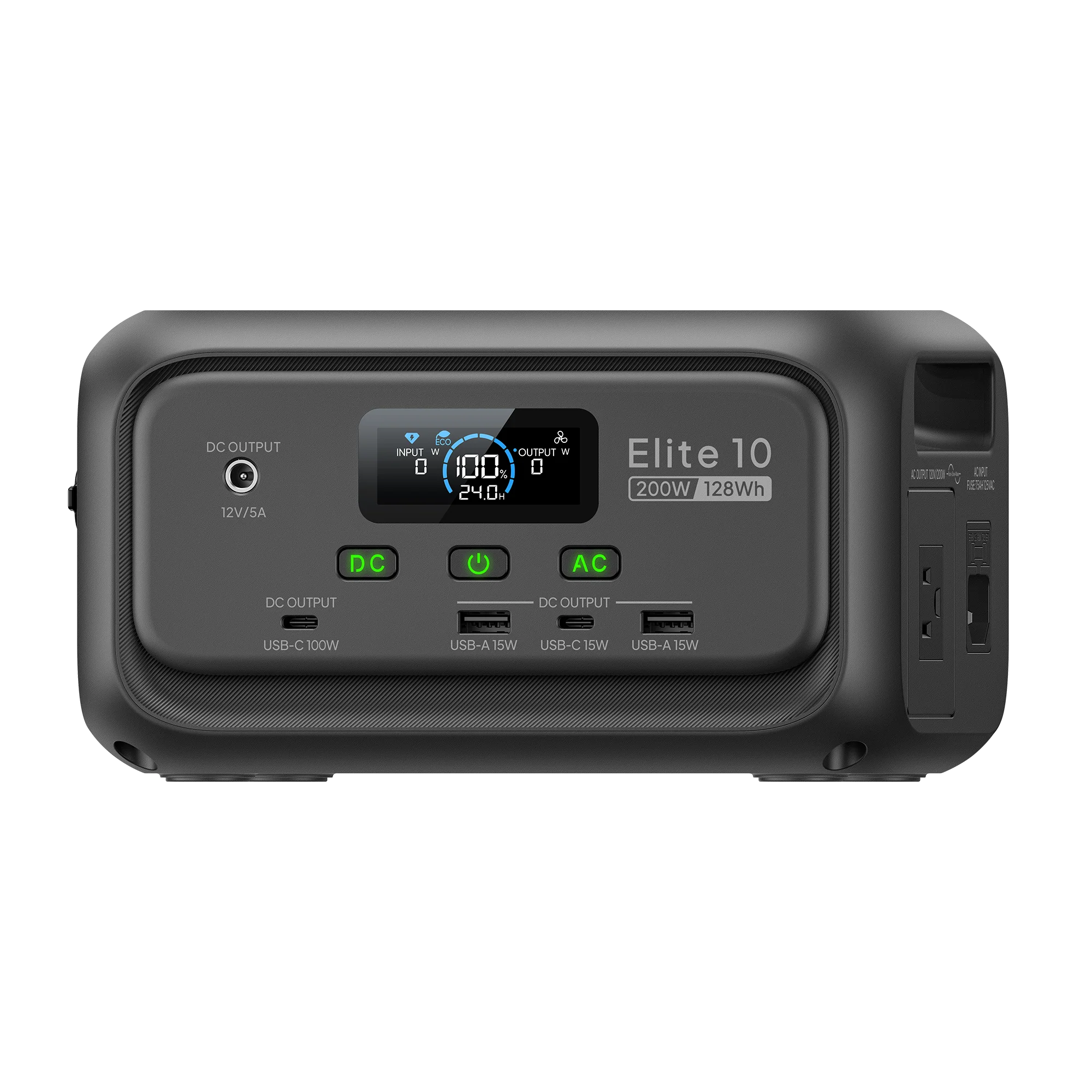
Coverage on the Elite 10 Mini is also review-site-level rather than a mature owner community, but it's consistent on the basics: a real AC outlet plus dual USB-C (one at the full 100W), fast recharging, and the same sub-10ms UPS switchover as the RIVER 3, built for phones, a laptop top-up, and small gear rather than appliancesB1B2.
Reviewers describe 128Wh as good for one or two laptop charges, roughly ten to twelve phone charges, or about half a day from a small LED lamp, not fridges, appliances, or power toolsB3. The dual USB-C setup is repeatedly the most-used feature called out, and the current $119 price, discounted from its original launch price, is treated as a genuine value for what it replaces: a drawer full of separate chargers and cablesB4.
“A 128Wh LiFePO4 mini power station with a 200W AC outlet plus dual USB-C (100W PD and 18W), two USB-A, and a 12V DC port.”
Sources
bluettipower.com · macrumors.com · backuppowerhub.com · geardiary.com · outdoortechlab.com · irishexaminer.com · 9to5toys.com · cleantechnica.com
Sources & Research Notes
Every owner claim in this report is traceable to a published source. The bracketed references above resolve here.
Recurring owner themes
- Reviewers consistently praise the low fan noise (~30dB) as suitable for bedroom/overnight use. [RIVER 3 MAX PLUS WIRELESS · 4 entries]
- The UPS/fast-recharge combination is repeatedly cited as a practical real-world benefit for remote work and campsite hookups. [RIVER 3 MAX PLUS WIRELESS · 2 entries]
- Palm-sized LFP mini unit with a real AC outlet, fast charging, sub-10ms UPS, and dual USB-C — for gadgets, not appliances. [Elite 10 Mini · 3 entries]
- A1
“The RIVER 3 Max Plus (Wireless) can go from empty to full from mains in around 2.3 hours, which is very quick given its capacity.”
Wandering Bird blog — 'REVIEW: Ecoflow River 3 Max Plus- vanlife essential or not?' · 2025-11 · [positive]
- A2
“The RIVER 3 Series is quiet. Very quiet. It's listed as only making 30dB.”
Wandering Bird blog — 'REVIEW: Ecoflow River 3 Max Plus- vanlife essential or not?' · 2025-11 · [positive]
- A3
“Some cheaper units have noisy fans that kick on frequently, which isn't ideal when you're trying to sleep.”
Wandering Bird blog — 'REVIEW: Ecoflow River 3 Max Plus- vanlife essential or not?' (comparative context, implies this unit avoids that problem) · 2025-11 · [positive]
- A5
“UPS (Uninterruptible Power Supply) switching on the RIVER 3 Plus/Max models is under 10 milliseconds... your devices won't suddenly power off.”
Wandering Bird blog — 'REVIEW: Ecoflow River 3 Max Plus- vanlife essential or not?' · 2025-11 · [positive]
- A6
“Use the mini power bank separately when you're out exploring, without taking the entire Ecoflow unit with you.”
Wandering Bird blog — 'REVIEW: Ecoflow River 3 Max Plus- vanlife essential or not?' · 2025-11 · [positive]
- A7
“The only noticeable difference during high-power use is the increased fan noise.”
Root-Nation.com — 'EcoFlow River 3 Max Review' (covers sibling River 3 Max, mentions Max Plus family) · 2025-05 · [mixed]
- A8
“The new model is not only quieter but also smaller and lighter than the River 2 Max, despite having the same 512-watt capacity.”
Root-Nation.com — 'EcoFlow River 3 Max Review' (sibling model discussion, referencing River 3 Max/Plus family including Max Plus) · 2025-05 · [positive]
- A9
“Given that EcoFlow markets the RIVER 3 Plus with 'wireless' in its feature set... some buyers may expect a Qi wireless charging pad on top. It doesn't have one.”
BackupPowerHub.com — 'EcoFlow RIVER 3 Plus Review' (base Plus model, not Max Plus Wireless — included for contrast/confusion risk noted by owners/reviewers) · 2026-03 · [negative]
- B1
“A 128Wh LiFePO4 mini power station with a 200W AC outlet plus dual USB-C (100W PD and 18W), two USB-A, and a 12V DC port.”
bluettipower.com / macrumors.com — Elite 10 Mini review · 2026 · [positive]
- B2
“Reaches a full charge in about 70 minutes — one of the fastest in the sub-200Wh segment — and supports UPS mode with an under-10ms switchover.”
backuppowerhub.com / geardiary.com — Elite 10 Mini review · 2026 · [positive]
- B3
“128Wh is enough to charge a laptop 1-2 times, a phone 10-12 times, or run a 10W LED lamp about 13 hours; not for appliances, fridges, or power tools.”
outdoortechlab.com / irishexaminer.com — Elite 10 Mini review · 2026 · [mixed]
- B4
“Launched at $119 (down from $199); owners highlight the dual USB-C setup as a most-used feature — a palm-sized companion for drives and short trips.”
9to5toys.com / cleantechnica.com — Elite 10 Mini review · 2026 · [positive]
Research compiled July 28, 2026.
Who Should Buy Which
Buy the RIVER 3 MAX PLUS WIRELESS if you…
- →Buy the RIVER 3 MAX PLUS WIRELESS if you actually plug things in: CPAP overnight, a full remote workday on a laptop and monitor, or a tailgate that includes a blender. It's the only one of the two that can start a 400W appliance at all, and it still finishes an 8-hour workday with a real, if narrow, 10% of capacity to spare.
- →It's also the pick if you're thinking past this one purchase. It has an expansion path if your needs grow, and despite costing about five times as much upfront, it works out to $0.17 per lifetime kilowatt-hour against the Elite 10 Mini's $0.31, so you're not even paying more for the energy itself.
Buy the Elite 10 Mini if you…
- →Buy the Elite 10 Mini if the job is genuinely small: charging a phone repeatedly, topping off a laptop, running a strand of lights, the kind of use reviewers describe as its actual sweet spotB3. At 3.97 lbs and $119, it's not a discount power station, it's a different category of object, closer to a large water bottle than a power bank.
- →It's the right call on price alone if 128Wh is honestly enough for what you do, sealed capacity and all. Just don't buy it expecting to grow into it later, and don't expect it to run anything with a motor or a compressor. Its 200W outlet is a hard ceiling, not a soft one.
If neither fits
Anyone planning a real multi-day camping trip, an overnight blackout with a fridge running, or full-time van life should skip both. Even the 8-Hour Blackout scenario needs 162% of what the RIVER 3 can actually deliver, and Van Life Daily needs more than four and a half times its capacity. Look at a genuinely larger station, ideally one with an expansion path, not either of these.
The Bottom Line
The RIVER 3 MAX PLUS WIRELESS wins on merit, not just size: it's the only one of these two that starts every appliance in this test, it clears an 8-hour remote workday with a real, if narrow, margin, and it comes out cheaper per kilowatt-hour than a unit a fifth of its price. That last part is the one worth remembering. The more expensive box is also the better value.
The Elite 10 Mini isn't a worse RIVER 3. It's a good phone-and-laptop charger for people who never needed a power station, at 3.97 lbs and $119. Buy based on what you're actually plugging in, not the price tag. A blender doesn't care which one was cheaper.
Frequently Asked Questions
Answers drawn from the spec record and cited owner research.
Can the BLUETTI Elite 10 Mini run a blender or a mini-fridge?
No, and not because of battery size. Its 200W outlet is rated below the roughly 400W a blender draws on startup, so it can't power one at all, regardless of charge level. A mini-fridge's compressor surge hits the same wall. The RIVER 3 MAX PLUS WIRELESS, at 600W continuous, handles both.
Is the EcoFlow RIVER 3 MAX PLUS WIRELESS worth five times the price of the Elite 10 Mini?
If you're running anything beyond phones and a laptop, yes. It's the only one of the two that wins any of the six real-world scenarios tested here, and it works out cheaper per kilowatt-hour over its life despite the higher sticker price ($0.17 against $0.31). If your actual use case is just phones and light gadgets, the Elite 10 Mini does that job at a fifth of the cost and none of the weight.
How much heavier is the RIVER 3 MAX PLUS WIRELESS than the Elite 10 Mini?
20.8 lbs against 3.97 lbs: the RIVER 3 is the two-handed-lift-out-of-the-trunk unit, and the Elite 10 Mini is close to carrying a large water bottle. Per watt-hour of capacity, though, the RIVER 3 is actually the lighter design, about 57Wh per pound against the Elite 10 Mini's 32Wh per pound. The Elite 10 Mini wins on absolute weight, not on efficiency.
Which one is better for running a CPAP machine overnight?
The RIVER 3 MAX PLUS WIRELESS, clearly. An 8-hour CPAP night needs 320Wh, just 31% of what it can deliver, leaving room for a bad night or a second device. The Elite 10 Mini would need 294% of its usable capacity for the same night, so it would need a recharge partway through. Fan noise matters too if you're sleeping close to the unit: the RIVER 3 runs at 30dB against the Elite 10 Mini's 45dB, and most people find anything above 45dB disruptive for sleep.
What does 'Wireless' mean in the RIVER 3 MAX PLUS WIRELESS name?
It refers to a detachable power bank module that charges wirelessly and can be pulled off to carry on its own, separate from the main unit. It's not a Qi charging pad built into the top of the station, a mix-up at least one reviewer flagged on the closely related base Plus model, where buyers expected a charging pad that isn't there.
Brand matchup
EcoFlow vs BLUETTI: measured across every matchup →Where to buy

EcoFlow RIVER 3 MAX PLUS WIRELESS
No longer sold
BLUETTI Elite 10 Mini
$119.00
$119.00 · direct from BLUETTI
Last checked 16 days ago. Prices move — check before you buy.
Prices may vary by retailer and are subject to change.