Head-to-head test
EcoFlow RIVER 2 vs BLUETTI Elite 30 V2
The Elite 30 V2 beats the RIVER 2 on capacity, output, surge, solar input, and UPS speed — but costs $30 more to get there, and the spec that actually changes how a night around this unit feels is noise: 30dB against 50dB, a gap the RIVER 2's own maker fixed in its very next model.
Full profiles: EcoFlow RIVER 2 → · BLUETTI Elite 30 V2 →

Written by Wenny ZhengUpdated
Portable Power Tester, Station Arena Test Desk
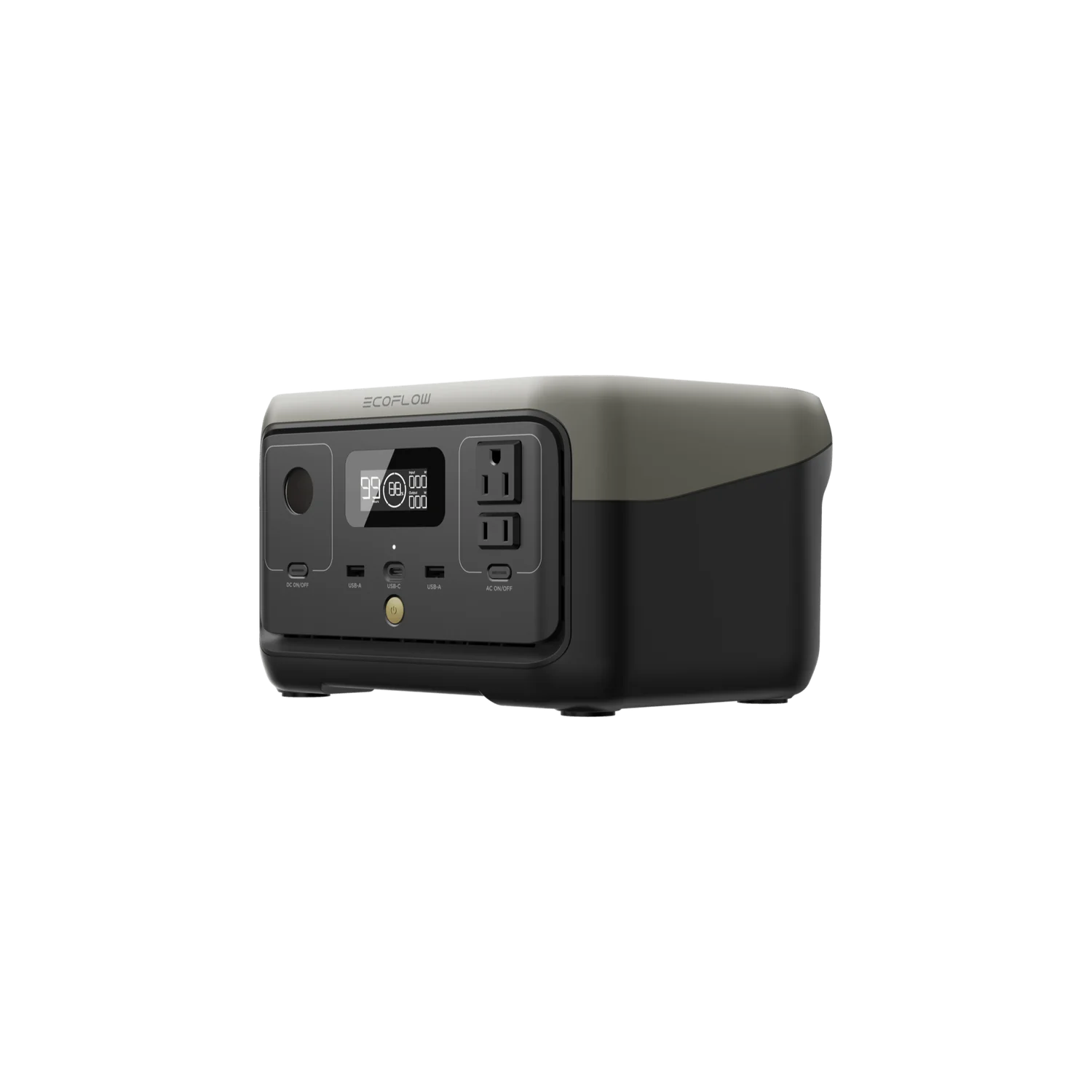
$209.00 · direct from EcoFlow
Last checked 20 days ago. Prices move — check before you buy.

$249.99 · direct from BLUETTI
Last checked 1 day ago. Prices move — check before you buy.
Spec deltas
The EcoFlow RIVER 2 costs $209. The BLUETTI Elite 30 V2 costs $239. That $30 gap lines up with the RIVER 2's pitch as the budget pick — it's the cheaper unit here.
Past price, the Elite 30 V2 wins the spec sheet outright: 288Wh against 256Wh, 600W continuous against 300W, a 1,500W surge against 600W, 200W of solar input against 110W, and a 10ms UPS switchover against 30ms. The RIVER 2 answers with exactly one number in its favor — 7.8 lbs against 10.3.
The gap that matters most day to day isn't on either spec sheet's headline row, though. It's noise: the RIVER 2 rates 50dBA under load, the Elite 30 V2 rates 30dBA. One of those is a unit you forget is running. The other is not.
What the Numbers Reveal
Each conclusion stated first — the numbers behind it on one line, the full analysis below.
It also isn't just a datasheet number. Owners of the RIVER 2 independently report it running noticeably louder under load than EcoFlow's own newer RIVER 3A1, while three separate Elite 30 V2 reviewers, testing independently over several months, landed on the same word for it: quiet, even while running AC loadsB4B5B6. Both sides of that spec are backed by field reports, not just a marketing sheet.
The RIVER 2 rates 50dBA of noise under loadThe Elite 30 V2 rates 30dBA of noise
Why it mattersAnyone running this near a shared tent, a sleeping space, or a quiet campsite with neighbors should treat noise as the deciding spec on this page — it's the one you can't turn off or route around.
A 20-30ms gap is invisible to a lamp but not to a router that reboots on a brownout or a sensitive appliance that resets its settings on a power blip — one reviewer specifically credited the Elite 30's fast switchover with keeping things stable through patchy cabin powerB10.
The RIVER 2 switches to battery power in 30msThe Elite 30 V2 switches over in 10ms
Why it mattersBuyers protecting always-on gear — a router, a modem, medical equipment — should weight UPS speed alongside noise; the RIVER 2's 30ms is real, not academic.
Typical price
That leaves the real question on this page: is a competitor that also beats it on capacity, output, surge, solar input, and switchover speed worth $30 more? For anyone who needs that headroom or can't tolerate the RIVER 2's noise, yes. For anyone strictly rationing dollars, the RIVER 2 is doing exactly what it was built to doA3.
The RIVER 2 costs $209, the price reviewers had in mind when they positioned it as the budget choice for strictly indoor use where every dollar countsA3The Elite 30 V2 costs $239 — $30 more than the RIVER 2
Why it mattersAnyone shopping on price alone should buy the RIVER 2 — it's the cheaper unit. Anyone weighing capability and noise alongside price should keep reading; that's the case for spending the extra $30.
continuous output
Every other spec that moved to get there — capacity, output, surge, solar input, switchover speed — moved in the Elite 30's favor. This isn't two equivalent units where one happens to be lighter; it's a genuinely smaller, less capable unit that also happens to weigh less.
The RIVER 2 weighs 7.8 lbs against the Elite 30 V2's 10.3 lbsThe RIVER 2 also holds less capacity (256Wh against 288Wh) and half the continuous output (300W against 600W)
Why it mattersOnly buyers actually counting ounces or dollars — backpackers, minimalist bikepackers, strict budgets — should let this gap outweigh everything else on this page; everyone who values capacity, output, and quiet more than saving $30 should take the Elite 30's extra 2.5 lbs without hesitation.
The specific dimensions that decide these two units — everything else is a tie.
What the Specs Don't Tell You
Selected because: Noise and UPS speed are the two firing gotchas that actually change how the unit feels to live with, not just how it reads on a spec sheet.
Noise is the gotcha that follows you home from this page: 50dB against 30dB isn't a spec-sheet footnote, it's the difference between forgetting the unit is on and hearing it across a tent. It's also the one gap with independent field confirmation on both sides — reviewers call the RIVER 2 the louder of the two relative to its own successorA1, and call the Elite 30 quiet under real AC loads, not just at idleB4B5B6.
UPS speed tells the same story in miniature: 10ms against 30ms, line-interactive against basic standby. Thirty milliseconds won't dim a lamp, but it's enough to reset a router or a sensitive device mid-outage — the exact moment a UPS-rated power station is supposed to earn its keep.
PowerScore Breakdown
Selected because: Double output, 2.5x surge, and more capacity is a clean sweep on capability worth stating plainly, even though the Elite 30 doesn't win on price.
overall power score
The Elite 30 doesn't win on one axis, it wins on all of them: more capacity, double the continuous output, 2.5x the surge, and nearly double the solar input. None of that came from a bigger battery — 288Wh against 256Wh is a modest gap — it came from a better-engineered inverter and charge controller doing more with a similar cell.
The RIVER 2 was a reasonable budget unit on the platform it shares with the RIVER 3A2, but that platform has since been outpaced on both sides — by EcoFlow's own newer model and, more directly here, by BLUETTI's.
Portability & Form Factor
Selected because: Weight and price are the RIVER 2's genuine advantages and deserve a fair accounting on their own terms.
weight
Give the RIVER 2 its due: 7.8 lbs is genuinely lighter, and for anyone carrying this any real distance, that's not nothing. It's one of two columns on the spec sheet where the RIVER 2 is simply the better number — the other being price, at $209 against the Elite 30's $239.
But it's a smaller, less capable unit that's also lighter and cheaper — every performance spec that shrank alongside the weight (capacity, output, surge, solar input, switchover speed) moved against the RIVER 2. Buy the weight and price advantage only if you actually need to carry it or need the lower number, not as a general tiebreaker against the Elite 30's capability lead.
Lifetime Value
Selected because: The RIVER 2's cost-per-lifetime-kWh is lower — the value-pick framing holds up on the lifetime math too.
cost / lifetime kWh
Run both units through their full 3,000-cycle life and the RIVER 2 costs $0.25 per kWh delivered against the Elite 30's $0.28 — a three-cent gap that stacks on top of the $30 the RIVER 2 already costs less up front.
For a unit whose own reviewers frame it as the pick for buyers where every dollar countsA3, that holds on both the sticker price and the lifetime math — the Elite 30 has to win this page on capability, not economics.
Strengths & trade-offs
EcoFlow RIVER 2
Strengths
- +Costs $30 less
- +Lighter by 2.5 lb
Trade-offs
- –No major technical downsides compared to rival.
BLUETTI Elite 30 V2
Strengths
- +Larger battery capacity
- +Higher AC output
- +Faster solar charging
Trade-offs
- –No major technical downsides compared to rival.
Will It Power Your Gear?
Scenario math and per-appliance runtimes, modeled from the spec record.
Scenario verdicts
We ran the math on seven real-world scenarios. Here's which unit survives your actual life.
SCN-01 · 2 nights · needs 2,100Wh
Weekend Camping
Two nights off-grid with essential comfort
Neither unit
Neither unit covers this scenario's 2,100Wh: the RIVER 2 comes up 1,882Wh short (about 10% covered), the Elite 30 V2 1,855Wh (12%). This is well outside what either unit is for; the right answer here is a larger station, not a choice between these two.
Battery budget usedlower = more headroom
LOAD Phone Charger 15W×6h · LED Lights 40W×8h · Box Fan 75W×14h · CPAP Machine 40W×16h
SCN-02 · 8 hours · needs 1,645Wh
8-Hour Blackout
Keep the essentials running through a night without power
Neither unit
Neither unit covers this scenario's 1,645Wh: the RIVER 2 comes up 1,427Wh short (about 13% covered), the Elite 30 V2 1,400Wh (15%). This is well outside what either unit is for; the right answer here is a larger station, not a choice between these two.
Battery budget usedlower = more headroom
LOAD Fridge 150W×8h · Router + Modem 20W×8h · LED Lights (4 bulbs) 40W×6h · Phone Charger 15W×3h
SCN-03 · 8 hours · needs 320Wh
CPAP Overnight
Sleep therapy without interruption — the #1 medical use case
Neither unit
Neither unit covers this scenario's 320Wh: the RIVER 2 comes up 102Wh short (about 68% covered), the Elite 30 V2 75Wh (76%). Either gets you most of the way, so this is a scenario you plan around rather than one you should rule them out for.
Battery budget usedlower = more headroom
LOAD CPAP Machine 40W×8h
SCN-04 · 8 hours · needs 910Wh
Remote Workday
Full work day off-grid without power anxiety
Neither unit
Neither unit covers this scenario's 910Wh: the RIVER 2 comes up 692Wh short (about 24% covered), the Elite 30 V2 665Wh (27%). This is well outside what either unit is for; the right answer here is a larger station, not a choice between these two.
Battery budget usedlower = more headroom
LOAD Laptop 60W×8h · External Monitor 30W×8h · Router + Modem 20W×8h · Phone Charger 15W×2h
SCN-05 · 4 hours · needs 670Wh
Tailgate Party
Game day power for the crew
Neither unit
The RIVER 2 can start the 400W peak but not hold it — 600W of surge gets it going, then the 300W continuous rating takes over, so capacity never gets a say. This is the wrong size of unit for the job rather than a close call. The Elite 30 V2 doesn't have the energy either — 245Wh usable against 670Wh, 425Wh short — so neither route works.
Battery budget usedlower = more headroom
LOAD Blender 400W×0.5h · LED TV (55") 80W×4h · Bluetooth Speaker 15W×4h · Phone Charger (×3) 45W×2h
SCN-06 · 24 hours · needs 4,685Wh
Van Life Daily
A full day of mobile living — the ultimate endurance test
Neither unit
Neither unit covers this scenario's 4,685Wh: the RIVER 2 comes up 4,467Wh short (about 5% covered), the Elite 30 V2 4,440Wh (5%). This is well outside what either unit is for; the right answer here is a larger station, not a choice between these two.
Battery budget usedlower = more headroom
LOAD Mini-Fridge 150W×24h · Laptop 60W×4h · Phone Charger 15W×3h · LED Lights 40W×5h · Fan 75W×8h
SCN-07 · an afternoon · needs 100Wh
Afternoon Off-Grid
Phones and a speaker at the park, beach, or campsite — the small-unit job description
Either unit
This is the job small stations are actually for, and both do it: the RIVER 2 finishes at 46% used, the Elite 30 V2 at 41%. At this size the decider is what rides in the bag — 7.8 lbs for the RIVER 2 against 10.3 for the Elite 30 V2 — and price, not the leftover watt-hours.
Battery budget usedlower = more headroom
LOAD Phone Charger (×2) 30W×2h · Bluetooth Speaker 10W×4h
The Load Test
RUNTIME = (Wh × 0.85) ÷ LOAD
None of the scenarios above exactly yours? Build it. Toggle what you'd plug in; both units are tested against the combined draw.
Essentials
Comfort & Convenience
High-Draw Appliances
Test duration
8h
Continuous draw
205W
Projected runtime
For this load: Elite 30 V2 runs 1.2h vs 1.1h.
$239 list · direct from BLUETTI
Modeled from the spec record — same math as the tables below. Methodology
Runtime by appliance
Real-world runtime estimates for common appliances, modeled at 85% inverter efficiency.¹
Essentials
The basics you need runningscale 0–16.3hComfort & Convenience
Makes off-grid life actually enjoyablescale 0–3.3hHigh-Draw Appliances
These reveal the real limits¹ Runtime = (capacity × 0.85) ÷ appliance watts. Within each group, all bars share one time scale (the group's longest runtime), so lengths are comparable across appliances; identical runtimes collapse into a single blue/orange bar. Actual runtime varies with battery age, temperature, and simultaneous loads — see methodology.
Conclusion
July 14, 2026
Verdict: the Elite 30 V2, on Power Score margin
The Elite 30 V2 holds more capacity (288Wh against 256Wh), doubles the RIVER 2's continuous output, carries 2.5x its surge rating, takes in nearly twice the solar, and switches over 3x faster in an outage — but it costs $30 more to get there ($239 against $209). The RIVER 2 answers with two uncontested wins of its own: it's the lighter unit (7.8 lbs against 10.3) and, at current pricing, the cheaper one. Neither tips the comparison by itself — weight matters mainly to a backpacker, and $30 is real money but not a deal-breaker on a sub-$250 purchase. What actually lives with you is the 20dB noise gap: 50dB under load is a running vacuum in the room; 30dB is barely there. That's the spec worth paying the premium for.
Editor-assigned confidence, based on cited owner research and spec analysis.
List prices as of July 14, 2026. The links below open EcoFlow's and BLUETTI's current prices.
$249.99 · direct from BLUETTI
Last checked 1 day ago. Prices move — check before you buy.
or check the RIVER 2 price$209.00 list
Written by Wenny Zheng, Portable Power Tester · Station Arena Test Desk · Updated July 14, 2026
Measured Data
Benchmark scores and the full spec record, side by side.
Benchmark scores
Not rated for both units (minimum threshold unmet): UPS, Solar Generator.
Full specifications
ᵈ Derived: price ÷ rated capacity. See the data behind our comparisons →
Comparison ToolAdd more power stations, side by sideOpen Tool →How these numbers are produced
Numeric verification
Every figure on this page traces to our spec database or arithmetic on it — no estimated numbers.
Owner claims
Statements about owner experience are cited to published reviews — see Sources & Research Notes below.
Runtime model
Runtime = (rated capacity × 0.85 inverter efficiency) ÷ device wattage. Solar recharge estimates assume panels deliver 70% of rated output. Cold weather, battery age, and stacked loads reduce real-world results.
Power Score
Computed from 14 published spec dimensions, weighted per use-case bench. Higher is better; a unit must meet a bench's minimum threshold to be rated.
See the full weight table and data sourcing on our methodology page →Class ranking (the star rating)
Each unit's star score is a category ranking, not customer reviews — no buyer opinions feed it. We score every station on size-independent quality (value, output, portability, endurance, ports, warranty, and more), then percentile-rank it against the other units in its capacity class, so a class-leading compact unit and a class-leading whole-home unit can both earn 5★. Here, RIVER 2 rates 3.9/5 (33rd percentile of 22 Personal-class units), and Elite 30 V2 rates 4.9/5 (95th percentile of 22 Personal-class units).
How the class ranking is computed →Test Notes & Caveats
Hidden gotchas and advantages we spotted that you won't find on the product page.
Elite 30 V2: Power Lifting to 1,500W
The Elite 30 V2 has BLUETTI's Power Lifting mode, which runs a resistive appliance rated up to 1,500W from its 600W inverter. It does that by delivering less power than the appliance asks for, not more than the inverter has: the heater still works, it just heats more slowly. Two things follow. BLUETTI scopes the mode to purely resistive loads — a heater, a kettle, an incandescent lamp — so it does nothing for a fridge compressor, a pump or a power tool, and this record publishes no surge figure at all, so read the mode as a resistive-load feature rather than as starting ability. And it is not a reason to size down, because running a load that big from 288Wh is a short session either way. Genuinely useful if a heater or a kettle is why you're buying; beside the point otherwise. The RIVER 2 publishes no equivalent.
Line-Interactive Beats Basic Standby by 20ms
10ms against 30ms won't register on a lamp, but it's the window where a sensitive router, modem, or medical device either rides through a brownout cleanly or resets. The Elite 30's faster switchover was specifically credited with keeping one reviewer's setup stable through patchy cabin power.
Warranty: No Difference
Both units carry the same 5-year warranty, so coverage isn't a tiebreaker here. The Elite 30 V2's figure is a maximum rather than a guarantee — it depends on buying direct from BLUETTI or registering the unit, since reseller purchases carry a shorter term.
RIVER 2: Noise Level Not Disclosed
The Elite 30 V2 publishes its noise level (30dB); the RIVER 2 doesn't publish one. That isn't evidence the RIVER 2 is louder — it means there's no figure to hold it to, and no way to compare the two on this without hearing them. If you're buying for a bedroom, a CPAP, or an apartment, treat the Elite 30 V2's 30dB as the only published number on the table — a spec-sheet figure, not a measurement — and look for hands-on reports of the RIVER 2 before deciding.
Full record above — the Test Desk pick is the Elite 30 V2.
Check Elite 30 V2 price →or check the RIVER 2 priceOwnership Analysis
What happens after you buy — true cost of ownership, brand trust, and growth potential.
Lifetime value
Service lifeyears at one full cycle per day
Lifetime energy delivered
Cost per delivered kWh
│ warranty ends · Reaching the cycle rating means ~80% capacity remains — degraded, not dead.
Analyst note
Both units have similar long-term ownership costs ($0.27/kWh vs $0.28/kWh). The price difference is what you see on the sticker — neither is a hidden bargain or rip-off. One thing to know reading the table: both carry the same 3,000-cycle rating, so the lifetime rows are sticker price and capacity in disguise — the wear horizon is identical and decides nothing here.
Brand trust
EcoFlow
Ecosystem
Largest in portable power — 12-15 models across DELTA Pro, DELTA 3, and RIVER 3 series, plus solar panels and smart home panels
Support
US-based phone/email/chat support (1-800-368-8604). Experiences are polarized — many report hassle-free prepaid-label replacements, but others report long waits and refurbished units sent for new claims. Pro tip: buying from Costco or Amazon gives you a stronger return safety net.
Community
Largest community in the space — Reddit r/Ecoflow_community (~31K members), multiple Facebook groups, and an official community forum
App experience
Rated 4.6/5 iOS (~8,400 ratings) · 4.2/5 Android (~17,000 ratings)
Unique strength
Fastest-charging technology (X-Stream), deepest product ecosystem, and most active innovation cadence. At the very top of the range, the DELTA Pro Ultra platform stacks batteries and inverters into whole-home backup — a flagship path, not a line-wide feature.
Worth knowing
Tested subscription paywalls for advanced app features in early 2025 before community backlash paused the plan. No parts or service offered out of warranty.
BLUETTI
Ecosystem
One of the broadest lineups — 15-20+ models from budget (AC2A) to flagship portable (Apex 300, 2764.8Wh). Includes specialized products: vehicle solar hubs, sodium-ion cold-weather units, and balcony storage systems.
Support
The most inconsistent support in the space. Heavily email-based with China timezone delays. Some users get smooth, efficient service; others report weeks of troubleshooting runarounds, being offered discounts on new units instead of repairs, and confusing third-party purchase claim processes. Buying direct from Bluetti's website tends to produce better support outcomes.
Community
Active and growing — Reddit r/bluetti has a dedicated community. Second-largest after EcoFlow in engagement.
App experience
Rated 4.5/5 iOS and Android — tied for best app experience in the category. V3.0 UI redesign was well-received.
Unique strength
Among the best capacity-to-price ratios available — several Elite and Apex units are the lowest $/Wh in the catalog. Widest product diversity including industry-firsts like sodium-ion cold-weather units and dual solar+alternator vehicle hubs. LFP across the rest of the range, though rated cycle life spans 2,500 (EB3A) to 6,000, and it varies WITHIN the Elite range rather than tracking it — the Elite 300 and Elite 200 V2 are rated 6,000 while the Elite 30 V2, Elite 10 Mini, Elite 320 and Elite 400 are rated 3,000+ and the Elite 100 V2 4,000+, so check the specific model. Dual-voltage (120V/240V) in flagships.
Worth knowing
Customer support inconsistency is the #1 risk factor. Older/discontinued units may become unrepairable — no spare parts policy for some models. Some reports of erratic communication from support agents.
Analyst note
EcoFlow positions itself as a mid-to-premium brand with stronger support infrastructure, while BLUETTI competes on value. The question is whether the EcoFlow ecosystem and support premium is worth it for your use case.
Growth path
RIVER 2
FIXED CAPACITYFixed at 256Wh, with no expansion — so size it for your needs up front rather than planning to add capacity later.
Accepts up to 110W of solar. Limited to a single portable panel.
Limited ports. You'll likely need a power strip or splitter.
Elite 30 V2
FIXED CAPACITYFixed at 288Wh, with no expansion — so size it for your needs up front rather than planning to add capacity later.
Accepts up to 200W of solar. Limited to a single portable panel.
Limited ports. You'll likely need a power strip or splitter.
Realistic full solar rechargeat 70% of rated panel output — see methodology
Analyst note
Neither expands, and that's no knock on either — each is a complete unit at a fixed size. Buy the capacity that covers your needs now (the Elite 30 V2 gives you the larger ceiling); you can't add to either later.
What Owners Report
Patterns from published owner reports and long-term reviews — every claim cited to its source below.
EcoFlow RIVER 2
The RIVER 2 shares its core platform with the newer RIVER 3 — 300W output, LiFePO4 chemistry, roughly 60-minute fast charging — and reviewers describe it as a popular, proven budget unit on that platformA2. The clearest recurring knock against it is noise: owner reports describe it as noticeably louder under load than the RIVER 3 that replaced itA1.
The honest framing from reviewers is that it's a reasonable choice for strictly indoor use where every dollar counts, but one that lacks the refinements EcoFlow later added — waterproofing, a faster UPS, quieter operationA3. At its current $209 price against the Elite 30's $239, that value framing holds up — the RIVER 2 is $30 cheaper, even before weighing what it gives up to get there.
“Shares the same core platform as the RIVER 3 — 300W output, LiFePO4 chemistry, and roughly 60-minute fast charging — and remains a popular, proven budget small-format unit.”
Sources
backuppowerhub.com · ecoflow.com · versus.com
BLUETTI Elite 30 V2
Owner testimony on the Elite 30 V2 clusters hardest around how quiet it runs. Three separate reviewers, testing independently over several months rather than a single demo session, all landed on the same conclusion: it stays quiet even under real AC loads, with the fan only becoming noticeable at higher wattagesB4B5B6.
The honest catch, volunteered by the same reviewers rather than hidden: real-world runtime under demanding loads came in a little short of expectations, which the reviewer chalked up to the unit's genuinely small 288Wh capacity rather than any defectB9. And like most units this size, it carries no official IP rating, so it's a tent-or-vehicle unit in a rainstorm, not one left exposedB14.
“The smartphone app works great allowing for customizing the settings and keeping track of the unit's status.”
Sources & Research Notes
Every owner claim in this report is traceable to a published source. The bracketed references above resolve here.
Recurring owner themes
- The RIVER 2 is the older, cheaper unit on the same core platform — reasonable for budget indoor use but louder and less refined than the RIVER 3. [RIVER 2 · 2 entries]
- Multiple independent reviewers, testing separately over several months, consistently describe the unit as very quiet even under load, with the fan only noticeably kicking in at higher wattages. [Elite 30 V2 · 3 entries]
- Impressions of the companion app are inconsistent between reviewers — one calls the UI rough/basic while another says it works great for monitoring and customization. [Elite 30 V2 · 2 entries]
- BLUETTI's advertised fast-charging claims (turbo to 80% in ~45 min, full charge in roughly 70 minutes to 2 hours) were verified as accurate in hands-on testing rather than just marketing numbers. [Elite 30 V2 · 2 entries]
- The three separate physical power buttons (main/DC/AC) create an extra step in normal use that at least one long-term user found unnecessary, though another reviewer described it neutrally as just how BLUETTI designs its units. [Elite 30 V2 · 2 entries]
- Reviewers who kept the unit for extended field use (months, not just an initial test) report continued satisfaction and no durability failures, despite the unit lacking a formal IP rating. [Elite 30 V2 · 2 entries]
- A1
“The RIVER 2's spec data doesn't include a specific dB rating, and owner reports suggest it's noticeably louder under load than the newer RIVER 3.”
backuppowerhub.com — EcoFlow RIVER 2 vs RIVER 3 · 2026 · [negative]
- A2
“Shares the same core platform as the RIVER 3 — 300W output, LiFePO4 chemistry, and roughly 60-minute fast charging — and remains a popular, proven budget small-format unit.”
ecoflow.com / versus.com — RIVER 2 vs RIVER 3 · 2026 · [positive]
- A3
“For strictly indoor use where every dollar counts, the RIVER 2 is still a reasonable choice — but it lacks the RIVER 3's refinements like waterproofing, faster UPS, and quieter operation.”
backuppowerhub.com — RIVER 2 vs RIVER 3 recommendation · 2026 · [mixed]
- B4
“It is nearly silent when charging and when powering things like iPhones and Macs. The fan inside will kick on under higher loads, but it's still not unreasonably loud. I can hear it, but it's a noise I could sleep through.”
MacRumors — 'Bluetti Elite 30 V2 Review: A Lightweight Portable Power Station for Camping and Backup Power' · 2025-12 · [positive]
- B5
“It doesn't make much noise, which is a good thing when you're relaxing or trying to sleep.”
AllOutdoor — 'AllOutdoor Review – BLUETTI Elite 30 V2 Power Station' · 2026-07 · [positive]
- B6
“The device ran quietly, under 30 dB, so it didn't interrupt the peaceful outdoors.”
TheGadgetFlow — 'Bluetti Elite 30 V2 review: more than a mini power station, coming up at CES 2026' · 2026-01 · [positive]
- B9
“The battery life in real-world use was a little less than I expected when doing demanding editing, but that's to be expected with its small 288Wh capacity.”
AllOutdoor — 'AllOutdoor Review – BLUETTI Elite 30 V2 Power Station' · 2026-07 · [negative]
- B10
“If the mains power goes down, it switches to battery power in less than 10 milliseconds, and that was reassuring in cabins where the electricity was a bit patchy.”
AllOutdoor — 'AllOutdoor Review – BLUETTI Elite 30 V2 Power Station' · 2026-07 · [positive]
- B14
“This station lacks an official IP rating for water or dust resistance, so it's best stored inside a tent or vehicle rather than left exposed during rainstorms.”
BackupPowerHub — 'BLUETTI Elite 30 V2 Review: Best Ultra-Portable Under $250 in 2026?' · 2026 · [mixed]
Research compiled July 14, 2026.
What Owners Actually Report
Drawn from 40 comments on independent review channels — not from retailer reviews, which skew to the first week of ownership. Each line is our summary of one commenter's claim, linked to the original. We record what they said, including where it contradicts the spec sheet.
EcoFlow RIVER 2
37 claims from 27 comments · 30 from owners · 11 with figures
- Runtime
- 10 · 38% negative
- Price & value
- 5 · 20% negative
- Solar input
- 3 · 3% negative
- App & firmware
- 3 · 39% negative
- Durability
- 2 · 100% negative
What owners complain about
Used as a DC UPS it averaged well over 10W to deliver 5W to a cable modem.
Idle drainmeasuredowner6 agreedsource →
Display reads 0W output until roughly 15W is drawn; a 2W night light shows nothing.
App & firmwaremeasuredowner2 agreedsource →
His River 2 and Glacier both died blinking and non-functional just after warranty expired.
Durabilityowner4 agreedsource →
What owners praise
RIVER 2 pulled 120W from a 100W third-party panel over four days in a van.
Solar inputmeasuredowner15 agreedsource →
Ran router, PoE switch, NAS, modem and a NUC through two outages, cameras up about 2 hours.
Runtimemeasuredowner4 agreedsource →
River 2 plus a 100W panel is exactly the emergency-only setup he wanted and works great.
Price & valueowner31 agreedsource →
BLUETTI Elite 30 V2
22 claims from 13 comments · 12 from owners · 2 with figures
- Solar input
- 1 · 0% negative
- Inverter & surge
- 3 · 0% negative
- Other
- 4 · 25% negative
- Price & value
- 2 · 0% negative
- Build quality
- 2 · 0% negative
What owners complain about
Burned itself out within roughly six months.
Durabilityownerafter 6 monthssource →
Charge limiter did not work.
App & firmwareownersource →
Mocks the 288Wh rating as marketing to one-up the River 3 Max Plus at 286Wh.
Other7 agreedsource →
What owners praise
Overpanelling with a 200W panel is fine; the MPPT simply caps at its 10A limit.
Solar inputmeasuredowner21 agreedsource →
Got a Bluetti Elite 30 V2 in the same condition for the same $200 CAD.
Price & valuemeasuredownersource →
In lifting mode it runs an electric kettle, a 1000W burner and an 800W shop vac while camping.
Inverter & surgeowner1 agreedsource →
Claims are weighted by how specific they are, whether the commenter owns the unit, and how many readers agreed. Comments that mention a product under a rival's review count for more, because the commenter had no reason to be there. This is what buyers report, not our test results — for measurements we ran ourselves, see the methodology.
Who Should Buy Which
Buy the RIVER 2 if you…
- →You're backpacking or bikepacking and 2.5 lbs is a real number to you — the RIVER 2 is the lighter unit, full stop.
- →You're working with a strict budget — at $209 against the Elite 30's $239, the RIVER 2 is $30 cheaper and still covers basic device charging and short-duration backup.
- →You already own EcoFlow accessories or solar gear and want to stay in that ecosystem rather than start a new one.
Buy the Elite 30 V2 if you…
- →You'll use this near a shared space, a tent, or anywhere the RIVER 2's 50dB rating under load would actually bother someone — the Elite 30's 30dB is the difference that matters most here.
- →You want more capacity, more output, and a faster switchover, and you're willing to pay $30 more to get them in a unit that also runs dramatically quieter.
If neither fits
If your real target is a weekend camping trip (around 2,100Wh) or an 8-hour blackout (around 1,645Wh), both of these units fall well short — they're built for device charging and short-duration backup, not multi-day power. Step up to a mid-size AC-class unit from either brand instead.
The Bottom Line
The RIVER 2 loses the non-price spec sheet to a unit that's also dramatically quieter under load — a 20dB gap that's the widest relative spread of anything separating these two. But it wins the price comparison and the lifetime-cost math outright, on top of being 2.5 lbs lighter.
For anyone who'd rather have the capacity, output, and quiet than save $30 up front, the Elite 30 V2 is still the pick. For anyone optimizing strictly for weight or price, buy the RIVER 2 instead — it's both the lighter and the cheaper unit.
Frequently Asked Questions
Answers drawn from the spec record and cited owner research.
Is the EcoFlow RIVER 2 actually the budget pick between these two?
Yes, at current pricing. The RIVER 2 costs $209 against the Elite 30 V2's $239 — $30 less — which matches how reviewers who called it the choice for buyers where every dollar counts framed it. The Elite 30 V2 is still the more capable unit on nearly every other spec, but it isn't the cheaper one.
How much louder is the RIVER 2 than the Elite 30 V2?
20dB — 50dBA under load against 30dBA. That's the widest relative gap of any spec between these two units, and it's backed by independent field reports on both sides: owners describe the RIVER 2 as noticeably louder than EcoFlow's own RIVER 3, while multiple Elite 30 V2 reviewers over several months consistently call it quiet even under AC loads.
Which one is better for backup power during an outage?
The Elite 30 V2, mainly on UPS switchover speed — 10ms against the RIVER 2's 30ms, the difference between line-interactive and basic standby protection. One reviewer specifically credited that fast switchover with keeping things stable through patchy cabin power.
Is the RIVER 2's lighter weight worth the tradeoff?
The weight edge is worth it on its own if you're actually carrying the unit any distance — and it's not the RIVER 2's only edge. At 7.8 lbs against 10.3, it's the lighter unit; at $209 against $239, it's the cheaper one too. What it still gives up is capability: less capacity, half the continuous output, and a much slower UPS switchover. Weight and price are real wins for the RIVER 2; capacity and switchover speed are real costs.
Which one should I actually buy?
The Elite 30 V2 if capacity, output, and quiet matter more to you than $30 — it holds more capacity, doubles the output, switches over three times faster in an outage, and runs a full 20dB quieter under load. The RIVER 2 if you're counting ounces or dollars — at 7.8 lbs and $209, it's both the lighter and the cheaper unit, just with less capability behind it.
Brand matchup
EcoFlow vs BLUETTI: measured across every matchup →Where to buy
EcoFlow RIVER 2
$209.00
$209.00 · direct from EcoFlow
Last checked 20 days ago. Prices move — check before you buy.
BLUETTI Elite 30 V2Pick
$249.99
$249.99 · direct from BLUETTI
Last checked 1 day ago. Prices move — check before you buy.
Prices may vary by retailer and are subject to change.