Head-to-head test
EcoFlow RIVER 2 Pro vs Jackery Explorer 500
Ten dollars more buys you 250Wh less battery and cells rated to wear out nearly four times sooner, which leaves the Explorer 500 with one argument: 13.3 pounds against 17.2.
Full profiles: EcoFlow RIVER 2 Pro → · Jackery Explorer 500 →

Written by Wenny ZhengUpdated
Portable Power Tester, Station Arena Test Desk
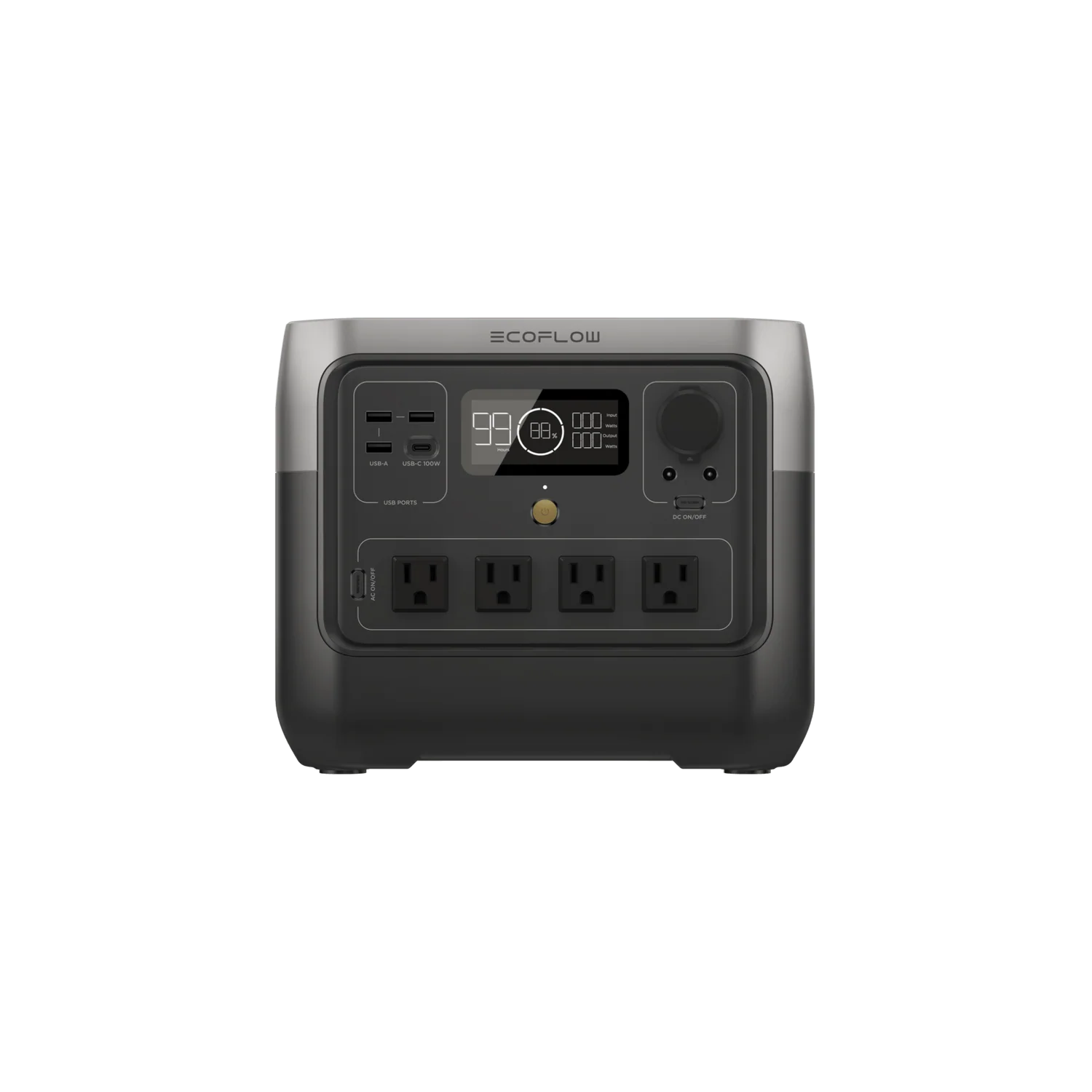
$389.00 · direct from EcoFlow
Last checked 1 day ago. Prices move — check before you buy.

$359.00 · direct from Jackery
Last checked 14 days ago. Prices move — check before you buy.
Spec deltas
The RIVER 2 Pro is the cheaper of these two at $349, and it's also the bigger one, the longer-lived one, and the faster one to refill. $349 buys 768Wh rated for 3,000 cycles. $359 buys 518Wh rated for 800. Normally the cheaper station is the compromise. This time it's the upgrade.
What the Explorer 500 wins is the part you feel in your hands: 13.3 pounds against 17.2, and a 37dB rating against 62dB. Both are genuine, and one of them is the reason anybody should still consider it. Neither is worth 250Wh, 2,200 cycles, three years of warranty and 120W of solar input.
Before either name matters, check whether you're in the right size class at all. Of the six load profiles this page models, four come back short for both units. 768Wh on the label is 653Wh once the inverter takes its 15%, and 518Wh is 440Wh. Weekend camping wants 2,100Wh. A day of van life wants 4,685Wh. If your list looks like those, close the tab and shop a shelf up, because these are day-bag stations and not house batteries.
What the Numbers Reveal
Each conclusion stated first — the numbers behind it on one line, the full analysis below.
rated cycles
Nearly six times the cost per unit of energy, and the expensive one also has the higher sticker. That happens because the Explorer 500 is the pre-refresh model still selling at post-refresh money: the extra $10 buys you the older chemistryB1B4, not a saving.
RIVER 2 Pro: $349 for 768Wh, rated 3,000 cyclesExplorer 500: $359 for 518Wh, rated 800 cyclesThe Explorer 500 runs traditional lithium-ion cells; Jackery's v2 refresh of the same unit moved to LiFePO4 with a far higher cycle ratingB1B4
Why it mattersAnyone who came here to spend less should notice there's nothing to save. On this page the cheaper sticker and the cheaper battery are the same unit.
solar input
At nameplate input the RIVER 2 Pro puts its whole 768Wh back in about 3.5 hours of sun (768 divided by 220), while the Explorer 500 needs about 5.2 hours for its 518Wh (518 divided by 100). The bigger battery refills faster in absolute hours and faster still as a share of itself, so the gap between these two widens on day two of a trip instead of closing.
RIVER 2 Pro accepts 220W of solar input; the Explorer 500 accepts 100WThe remote workday profile needs 910Wh, against 653Wh usable on the RIVER 2 Pro and 440Wh on the Explorer 500RIVER 2 Pro holds 768Wh; Explorer 500 holds 518Wh
Why it mattersIf the unit will live away from a wall outlet, choose on the 220W input rather than on the 250Wh of capacity.
The 62dB is a ceiling, not a bedside condition. A CPAP draws about 40W against an 800W continuous rating, roughly 5% of what the unit is built to deliver, and the noise figure describes it working hardA2. The Explorer 500's missing transfer switch has no such asterisk. If the station lives plugged into the wall as a backstop, it fails the exact job you bought it for, because a machine that reboots at 2 a.m. wakes you as reliably as a fan does.
Explorer 500 rated at 37dB; RIVER 2 Pro rated at 62dB, which EcoFlow's own documentation gives as the figure for charging or discharging at high wattageA2RIVER 2 Pro transfers to battery in 30ms; the Explorer 500 has no transfer spec at allA CPAP night is about 320Wh, which is 49% of the RIVER 2 Pro's 653Wh usable and 73% of the Explorer 500's 440Wh
Why it mattersCPAP buyers who want grid backup should take the RIVER 2 Pro; the person who runs purely off-battery on the road is the one reader here with a real reason to pay more for less.
The specific dimensions that decide these two units — everything else is a tie.
Your Life, Your Pick
Selected because: Four of the six load profiles come back short for both units, so the first question isn't which one, it's whether either is the right size.
Both of these are smaller than what most people picture when they picture a power station. The eight-hour blackout profile draws 1,645Wh; the RIVER 2 Pro covers about 40% of it and the Explorer 500 about 27%. That's a router, phones, some lights and a fridge for part of the window. It is not a household running normally for eight hours, and no arrangement of these two makes it one.
The tailgate is the interesting exception. That load wants 670Wh and the RIVER 2 Pro finishes 653Wh of it, missing by 17Wh, which is the rare shortfall you can fix on the day by leaving one appliance in the car. The Explorer 500 misses the same load by 230Wh, and that isn't a fix, it's a different unit's job. When a single extension cord decides the outcome, headroom stops being a spec and becomes the whole point.
Lifetime Value
Selected because: These two are ten dollars apart on the shelf and nearly six times apart per kilowatt-hour they will ever deliver.
cost / lifetime kWh
Fifteen cents a kilowatt-hour against eighty-seven. Read it once and everything after this is bookkeeping. The arithmetic is short enough to check: 3,000 cycles of 768Wh is 2,304 kWh over the RIVER 2 Pro's rated life, 800 cycles of 518Wh is 414 kWh over the Explorer 500's, and the prices are $349 and $359.
Cadence turns that ratio into a date. Used twice a week, the RIVER 2 Pro's rating runs 28.8 years and the Explorer 500's runs 7.7. Used daily, it's 8.2 years against 2.2, and 2.2 years is still inside the window where you'd describe the thing as new. The Explorer 500 doesn't drop dead at 800 cycles either; Jackery rates it at 80% of original capacity when it arrives thereB1. The difference is how soon you arrive.
What the Specs Don't Tell You
Selected because: They split cleanly on the things a capacity number hides: a 30ms transfer switch on one side, a 37dB rating on the other.
rated cycles
One of these can sit between the wall and your router. The RIVER 2 Pro transfers to battery in 30ms; the Explorer 500 has no transfer spec at all. For anyone buying a small station as a desk-side backstop for a PC, a modem or a medical device rather than as a camping battery, that single line settles it before capacity, weight or price get a vote.
The counter-catch belongs to my own pick, so here it is unprompted: EcoFlow's own documentation rates the RIVER 2 Pro at up to 62dB when it's charging or discharging hardA2, and one owner thought that bad enough to open the case and fit a quieter fan, cutting away internal plastic to make it sit rightA1. That's a real complaint about a real machine. It's also load-dependent in a way the bare number isn't, and almost nothing people ask a station this size to do is 800W.
Portability & Form Factor
Selected because: 13.3 pounds against 17.2 is the Explorer 500's last remaining argument, and for a few buyers it's enough.
weight
13.3 pounds is a one-hand carry from the car to the picnic table. 17.2 pounds is also a one-hand carry, just one you notice by the end of it. Neither of these is a two-person lift, which is the honest reason the weight gap decides less than it looks like it should: both units live in the class you pick up, and the difference between them is comfort rather than capability.
Where it does decide something is the long walk and the packed van. If you're hiking a station to a remote site or fitting one into space that's already spoken for, the Explorer 500's 13.3 pounds is worth ten dollars. If its usual journey is from a closet to a kitchen counter, you're paying that ten dollars for nothing.
Strengths & trade-offs
EcoFlow RIVER 2 Pro
Strengths
- +Costs $10 less
- +Larger battery capacity
- +Higher AC output
- +Longer warranty
- +Faster solar charging
- +Rated for 3,000 charge cycles — much longer battery lifespan
Trade-offs
- –Can receive complaints about fan noise under heavy load.
Jackery Explorer 500
Strengths
- +Lighter by 3.9 lb
Trade-offs
- –Lacks smartphone app control for remote monitoring.
- –Shorter-lived battery — rated for 800 charge cycles vs the RIVER 2 Pro's 3,000, so it wears out sooner.
Will It Power Your Gear?
Scenario math and per-appliance runtimes, modeled from the spec record.
Scenario verdicts
We ran the math on six real-world scenarios. Here's which unit survives your actual life.
SCN-01 · 2 nights · needs 2,100Wh
Weekend Camping
Two nights off-grid with essential comfort
Neither unit
2,100Wh is the ask, and the RIVER 2 Pro brings 653Wh of usable energy to it while the Explorer 500 brings 440Wh. Neither is close, and a three-to-one shortfall isn't something you plan around. If this is genuinely your weekend load, you're shopping the wrong shelf: you want a station whose usable capacity clears 2,100Wh, not the larger of two that cover under a third of it.
Battery budget usedlower = more headroom
LOAD Phone Charger 15W×6h · LED Lights 40W×8h · Box Fan 75W×14h · CPAP Machine 40W×16h
SCN-02 · 8 hours · needs 1,645Wh
8-Hour Blackout
Keep the essentials running through a night without power
Neither unit
Neither unit covers this scenario's 1,645Wh: the RIVER 2 Pro comes up 992Wh short (about 40% covered), the Explorer 500 1,205Wh (27%). Treat this as partial cover — enough for the essentials in it, not the whole list.
Battery budget usedlower = more headroom
LOAD Fridge 150W×8h · Router + Modem 20W×8h · LED Lights (4 bulbs) 40W×6h · Phone Charger 15W×3h
SCN-03 · 8 hours · needs 320Wh
CPAP Overnight
Sleep therapy without interruption — the #1 medical use case
Explorer 500
320Wh for the night, which is 49% of the RIVER 2 Pro's 653Wh usable and 73% of the Explorer 500's 440Wh. Capacity is settled; both clear it with room. The Explorer 500 takes this one as the smaller, quieter-rated box for a job that never asks either unit to work hard, and if the station's only role is sitting beside a bed on battery, that's the right pick. Know what it costs you, though. The Explorer 500 has no transfer switch, so it can't sit between the wall and the machine and catch an outage the way the RIVER 2 Pro's 30ms transfer can. A CPAP that reboots at 2 a.m. wakes you too.
Battery budget usedlower = more headroom
LOAD CPAP Machine 40W×8h
SCN-04 · 8 hours · needs 910Wh
Remote Workday
Full work day off-grid without power anxiety
Neither unit
Neither unit covers this scenario's 910Wh: the RIVER 2 Pro comes up 257Wh short (about 72% covered), the Explorer 500 470Wh (48%). Treat this as partial cover — enough for the essentials in it, not the whole list.
Battery budget usedlower = more headroom
LOAD Laptop 60W×8h · External Monitor 30W×8h · Router + Modem 20W×8h · Phone Charger 15W×2h
SCN-05 · 4 hours · needs 670Wh
Tailgate Party
Game day power for the crew
Neither unit
670Wh needed, and the RIVER 2 Pro lands 17Wh short with 653Wh usable. That's the rare miss you can fix on the day by leaving one appliance in the car. The Explorer 500 is 230Wh short with 440Wh usable, which isn't a fix, it's a different unit. And before capacity enters it at all, the 800W continuous rating against 500W decides which appliances are eligible in the first place.
Battery budget usedlower = more headroom
LOAD Blender 400W×0.5h · LED TV (55") 80W×4h · Bluetooth Speaker 15W×4h · Phone Charger (×3) 45W×2h
SCN-06 · 24 hours · needs 4,685Wh
Van Life Daily
A full day of mobile living — the ultimate endurance test
Neither unit
Neither unit covers this scenario's 4,685Wh: the RIVER 2 Pro comes up 4,032Wh short (about 14% covered), the Explorer 500 4,245Wh (9%). This is well outside what either unit is for; the right answer here is a larger station, not a choice between these two.
Battery budget usedlower = more headroom
LOAD Mini-Fridge 150W×24h · Laptop 60W×4h · Phone Charger 15W×3h · LED Lights 40W×5h · Fan 75W×8h
The Load Test
RUNTIME = (Wh × 0.85) ÷ LOAD
None of the scenarios above exactly yours? Build it. Toggle what you'd plug in; both units are tested against the combined draw.
Essentials
Comfort & Convenience
High-Draw Appliances
Test duration
8h
Continuous draw
205W
Projected runtime
For this load: RIVER 2 Pro runs 3.2h vs 2.1h.
$349 list · direct from EcoFlow
Modeled from the spec record — same math as the tables below. Methodology
Runtime by appliance
Real-world runtime estimates for common appliances, modeled at 85% inverter efficiency.¹
Essentials
The basics you need runningscale 0–43.5hComfort & Convenience
Makes off-grid life actually enjoyablescale 0–8.7hHigh-Draw Appliances
These reveal the real limits¹ Runtime = (capacity × 0.85) ÷ appliance watts. Within each group, all bars share one time scale (the group's longest runtime), so lengths are comparable across appliances; identical runtimes collapse into a single blue/orange bar. Actual runtime varies with battery age, temperature, and simultaneous loads — see methodology.
Conclusion
August 9, 2026
Verdict: the RIVER 2 Pro
Take the RIVER 2 Pro. At $349 against $359 it's the cheaper unit, and it's also the one holding 768Wh instead of 518Wh, rated for 3,000 cycles instead of 800, accepting 220W of solar instead of 100W, and covered for five years instead of two. The lifetime arithmetic turns that pile of advantages into one number: $349 across 3,000 cycles of 768Wh is $0.15 per kilowatt-hour delivered, while $359 across 800 cycles of 518Wh is $0.87. The Explorer 500 is the lighter box at 13.3 pounds and the quieter one on paper at 37dB, and if the unit's whole job is to sit beside a bed on battery and never work hard, those are real. Everywhere else you're paying a premium for the smaller, shorter-lived box.
Editor-assigned confidence, based on cited owner research and spec analysis.
List prices as of August 9, 2026. The links below open EcoFlow's and Jackery's current prices.
$389.00 · direct from EcoFlow
Last checked 1 day ago. Prices move — check before you buy.
or check the Explorer 500 price$359.00 list
Written by Wenny Zheng, Portable Power Tester · Station Arena Test Desk · Updated August 9, 2026
Measured Data
Benchmark scores and the full spec record, side by side.
Benchmark scores
Not rated for both units (minimum threshold unmet): CPAP, Solar Generator, Tailgating.
Full specifications
ᵈ Derived: price ÷ rated capacity. See the data behind our comparisons →
Comparison ToolAdd more power stations, side by sideOpen Tool →How these numbers are produced
Numeric verification
Every figure on this page traces to our spec database or arithmetic on it — no estimated numbers.
Owner claims
Statements about owner experience are cited to published reviews — see Sources & Research Notes below.
Runtime model
Runtime = (rated capacity × 0.85 inverter efficiency) ÷ device wattage. Solar recharge estimates assume panels deliver 70% of rated output. Cold weather, battery age, and stacked loads reduce real-world results.
Power Score
Computed from 14 published spec dimensions, weighted per use-case bench. Higher is better; a unit must meet a bench's minimum threshold to be rated.
See the full weight table and data sourcing on our methodology page →Class ranking (the star rating)
Each unit's star score is a category ranking, not customer reviews — no buyer opinions feed it. We score every station on size-independent quality (value, output, portability, endurance, ports, warranty, and more), then percentile-rank it against the other units in its capacity class, so a class-leading compact unit and a class-leading whole-home unit can both earn 5★. Here, RIVER 2 Pro rates 4.7/5 (84th percentile of 20 Compact-class units), and Explorer 500 rates 3.3/5 (1st percentile of 20 Compact-class units).
How the class ranking is computed →Test Notes & Caveats
Hidden gotchas and advantages we spotted that you won't find on the product page.
The RIVER 2 Pro's 62dB Is a Ceiling, Not a Constant
62dB is the RIVER 2 Pro's high-load figure, what it may reach charging or discharging hard, and that's a different claim from 62dB all the time. Against an 800W continuous rating, a laptop or a CPAP is a trickle and the fan behaves accordingly. Where it bites is fast charging: refill this in a hurry in a small room and you will hear it. The Explorer 500's 37dB rating carries no such asterisk, which is a fair reason to prefer it if the unit lives where you sleep.
Explorer 500: Solar Recharge Takes 5.2h+
At its 100W rated solar ceiling, refilling the full 518Wh takes about 5.2 hours of sun — as a floor, since the rated figure assumes ideal panel angle and clear sky, and real days deliver less. Not practical as the primary charge source for daily off-grid use; treat solar as a top-up and plan on a wall outlet or generator.
No App on the Explorer 500, Which Isn't Purely a Loss
The Explorer 500 has no app, so checking charge or draw means walking over to it, while the RIVER 2 Pro reports from your phone. Before you weigh that heavily, know what you'd be joining: Jackery's app carries a 2.3 to 3.3 out of 5 rating across the two stores, is split across more than one confusingly named app, and asks you to log in even offline. Missing software you'd have resented is a smaller loss than the spec table makes it look.
Only the RIVER 2 Pro Catches the Outage
The RIVER 2 Pro transfers to battery in 30ms. Plug a desktop, a modem or a medical device into it and the grid can drop without the device noticing. The Explorer 500 publishes no transfer spec at all, so anything running through it restarts when the power does. If you're buying a small station as an always-on backstop rather than a camping battery, this is where the comparison ends.
Five Years Against Two
Plain terms first: EcoFlow covers the RIVER 2 Pro for five years and Jackery covers the Explorer 500 for two, so three extra years come attached to the cheaper unit. It lines up with the cycle ratings rather than fighting them. The unit rated for 3,000 cycles is the one whose maker will stand behind it longest, and the one rated for 800 gets the shortest window.
Battery Lifespan in Real Years
The RIVER 2 Pro is rated for 3,000 cycles vs 800. In real life: at daily use, that's 8.2 vs 2.2 years. At weekend use (twice a week), it's 29 vs 8 years. One caution reading years across different sizes: a cycle is 768Wh on the RIVER 2 Pro and 518Wh on the Explorer 500, so count lifetime energy — roughly 2,304 kWh against 414 kWh over the rated life. After hitting the cycle limit, the battery doesn't die — it drops to ~80% of original capacity, which is still very usable.
Full record above — the Test Desk pick is the RIVER 2 Pro.
Check RIVER 2 Pro price →or check the Explorer 500 priceOwnership Analysis
What happens after you buy — true cost of ownership, brand trust, and growth potential.
Lifetime value
Service lifeyears at one full cycle per day
Lifetime energy delivered
Cost per delivered kWh
│ warranty ends · Reaching the cycle rating means ~80% capacity remains — degraded, not dead.
Analyst note
The RIVER 2 Pro wins on both sticker price and long-term value. At $0.15/kWh over its lifetime, it's meaningfully cheaper to own. Clear value winner.
Delivers each lifetime kWh for $0.72 less — check the RIVER 2 Pro price →
Brand trust
EcoFlow
Ecosystem
Largest in portable power — 12-15 models across DELTA Pro, DELTA 3, and RIVER 3 series, plus solar panels and smart home panels
Support
US phone, email and chat, and the experience is genuinely polarized: prepaid-label replacements with no argument for some owners, long waits and refurbished units for others. Buying through Costco or Amazon gives you a second route back that doesn't depend on which version you get.
Community
Largest community in the space — Reddit r/Ecoflow_community (~31K members), multiple Facebook groups, and an official community forum
App experience
Rated 4.6/5 iOS (~8,400 ratings) · 4.2/5 Android (~17,000 ratings)
Unique strength
Fastest-charging technology (X-Stream), deepest product ecosystem, and most active innovation cadence. At the very top of the range, the DELTA Pro Ultra platform stacks batteries and inverters into whole-home backup — a flagship path, not a line-wide feature.
Worth knowing
EcoFlow recalled the DELTA Max 2000 in October 2025 over an overheating and fire risk after six incidents, and tested paywalling advanced app features in early 2025 before community pushback paused it. Neither touches the RIVER 2 Pro directly, and both tell you something about how the company moves. There's also no parts or service outside warranty, which makes the five-year cover the whole of your safety net.
Jackery
Ecosystem
12-15+ models across Explorer (portable) and HomePower (home backup) series, plus SolarSaga panel ecosystem and innovative form factors
Support
US-based and widely criticized, with a pattern of slow scripted replies, strict receipt requirements on warranty claims, and refurbished replacements for units that failed outright. The two-year window is short enough that you want the retailer's return policy behind it, so buy from Costco or Amazon.
Community
Smallest community of the major brands — Reddit r/Jackery has ~2,000 members. YouTube presence is solid due to brand recognition.
App experience
Rated 2.3-3.3/5 iOS and Android — the weakest app experience of the major brands. Multiple confusing apps (Jackery app vs Jackery Home) and mandatory login even offline.
Unique strength
Highest brand recognition and widest retail distribution (Costco, Home Depot, Best Buy, Amazon). The "Toyota" of power stations — dependable, proven, wide availability. Innovative form factors like the Solar Gazebo and Solar Mars Bot.
Worth knowing
Jackery's real advantage is that you can buy one at Costco, Home Depot or Best Buy and walk it back to the same counter, which is a form of support. Its app is the weakest of the major brands at 2.3 to 3.3 out of 5, and a couple of older models still ship the shorter-lived chemistry, so check the cycle rating on the exact unit you're buying.
Analyst note
Neither support desk is a reason to buy. EcoFlow has the deeper ecosystem, the bigger community (roughly 31,000 on its main subreddit against roughly 2,000 on Jackery's) and the five-year warranty; Jackery has the shelf at Costco. If support weighs more with you than specs, the useful move with either brand is to buy from a retailer with a generous return policy rather than to choose on the manufacturer's phone number.
Growth path
RIVER 2 Pro
FIXED CAPACITYFixed at 768Wh, with no expansion — so size it for your needs up front rather than planning to add capacity later.
Accepts up to 220W of solar. Limited to a single portable panel.
Adequate ports for most setups, but heavy users may want a power strip.
Explorer 500
FIXED CAPACITYFixed at 518Wh, with no expansion — so size it for your needs up front rather than planning to add capacity later.
Accepts up to 100W of solar. Limited to a single portable panel.
Limited ports. You'll likely need a power strip or splitter.
Realistic full solar rechargeat 70% of rated panel output — see methodology
Analyst note
Neither expands, and that's no knock on either — each is a complete unit at a fixed size. Buy the capacity that covers your needs now (the RIVER 2 Pro gives you the larger ceiling); you can't add to either later.
What Owners Report
Patterns from published owner reports and long-term reviews — every claim cited to its source below.
EcoFlow RIVER 2 Pro
Field evidence on the RIVER 2 Pro specifically is thin. The ledger holds four model-verified entriesA1A2A3A4, and whoever compiled it flagged that most online discussion lumps the whole RIVER 2 line together rather than isolating the Pro, so the long-term ownership picture you'd want simply isn't there yet.
What exists points one direction, which is noise. EcoFlow's own product documentation concedes up to 62dB when the unit is charging or discharging at high wattageA2, and one owner went as far as replacing the fan outright, cutting away internal plastic to fit the new oneA1. Separately, owners are asking whether running it as a UPS shortens battery lifeA3, which tells you what people actually buy this unit for. A van-dwelling CPAP user also turns up in a RIVER 2 Pro thread running an AirSense 11 overnightA4, though on a DC-DC cable from a separate battery bank, so read that as context rather than proof the station does that job.
“Will using River 2 Pro as a UPS affect battery life ...”
Sources
ctrl-alt-rees.com
Jackery Explorer 500
The Explorer 500's ledger is review-desk material rather than long-term ownershipB1B2B3B4, and its four entries agree on one shape: a compact, affordable, dependable entry unit built on chemistry that has since been superseded. It's 518Wh and 500W on traditional lithium-ion cells, with Jackery quoting 80% capacity retention after 800 cyclesB1, and it weighs about 13 pounds, which every write-up mentions approvinglyB2.
The entry that should change a purchase is the last one: there's a v2 of this unit on LiFePO4, rated for far more cycles than the model on this pageB4. Reviewers still frame the original as the cheapest way into Jackery's ecosystem for weekend useB3, and that framing was fair when it was the current model. Check which version is in the box before you click buy.
“518Wh capacity with a 500W output, on traditional lithium-ion cells — Jackery rates 80% capacity retention after 800 cycles.”
Sources
backuppowerhub.com · jackery.com · greencitizen.com · poweredportablesolar.com · batteryessence.com
Sources & Research Notes
Every owner claim in this report is traceable to a published source. The bracketed references above resolve here.
Recurring owner themes
- Fan noise at high wattage charging/discharging is a consistent owner and manufacturer-acknowledged complaint, severe enough that some owners physically mod the unit with quieter fans. [RIVER 2 Pro · 2 entries]
- Affordable, portable Jackery entry unit, but on older lithium-ion chemistry with limited cycle life vs newer LFP models. [Explorer 500 · 3 entries]
- A1
“I've since performed the same mod on my RIVER 2 PRO and it works great for that unit, too - although it did involve cutting away some of the internal plastic.”
ctrl-alt-rees.com blog — 'EcoFlow RIVER 2 Noisy Fan Fix!' · 2022-11-17 · [negative]
- A2
“When charging and discharging at high wattage, RIVER 2 Max and RIVER 2 Pro may make a noise up to 62db.”
EcoFlow official product page — RIVER 2 Series specs/FAQ footnotes · unknown · [negative]
- A3
“Will using River 2 Pro as a UPS affect battery life ...”
Facebook — EcoFlow Club group post title · unknown · [mixed]
- A4
“I'm very new to CPAP (1 week) and I live in a van. I have solar and a decent battery bank and I've got the ResMed DC-DC cable which powers my AirSense 11 AutoSet overnight no problem.”
Apnea Board forum — '[Equipment] EcoFlow River 2 Pro' thread · 2025-07 · [mixed]
- B1
“518Wh capacity with a 500W output, on traditional lithium-ion cells — Jackery rates 80% capacity retention after 800 cycles.”
backuppowerhub.com / jackery.com — Explorer 500 review · 2026 · [mixed]
- B2
“Weighs about 13 lbs — a compact, portable unit.”
greencitizen.com / poweredportablesolar.com — Explorer 500 review · 2026 · [positive]
- B3
“The 518Wh capacity at $449 is the most affordable entry into Jackery's reliable ecosystem — good for weekend warriors and occasional users.”
backuppowerhub.com — Explorer 500 review · 2026 · [positive]
- B4
“An older lithium-ion unit; the newer Explorer 500 v2 uses LiFePO4 rated for far more cycles, offering significantly better longevity.”
batteryessence.com / backuppowerhub.com — Explorer 500 v2 review · 2026 · [mixed]
Research compiled August 9, 2026.
What Owners Actually Report
Drawn from 85 comments on independent review channels — not from retailer reviews, which skew to the first week of ownership. Each line is our summary of one commenter's claim, linked to the original. We record what they said, including where it contradicts the spec sheet.
EcoFlow RIVER 2 Pro
32 claims from 21 comments · 27 from owners · 8 with figures
- Runtime
- 5 · 0% negative
- Size & weight
- 2 · 0% negative
- Solar input
- 2 · 0% negative
- Inverter & surge
- 3 · 23% negative
- App & firmware
- 3 · 0% negative
What owners complain about
Wildly fluctuating DC output on two separate units bought from different retailers.
Build qualityowner1 agreedsource →
Does tend to self-discharge, so he keeps it on the low 100W power setting.
Idle drainowner3 agreedsource →
Unit would not power on within a week of purchase despite a full charge.
Durabilityownersource →
What owners praise
Jackery Explorer 500
77 claims from 64 comments · 66 from owners · 28 with figures
- Charging
- 12 · 42% negative
- Durability
- 13 · 62% negative
- Runtime
- 10 · 1% negative
- Solar input
- 10 · 90% negative
- Other
- 11 · 44% negative
What owners complain about
Caps at 81W AC and 65W from a SolarSaga 100.
Chargingmeasuredowner4 agreedsource →
Max solar he has ever seen is about 65W, which he blames on the Jackery not the panel.
Solar inputmeasuredownerafter 24 months3 agreedsource →
Jackery 500 crapped out twice in three and a half years.
Durabilityownerafter 42 months3 agreedsource →
What owners praise
Ran a ResMed CPAP three nights on the AC outlet; 12V plug left 55% at night three instead of 3-4%.
Runtimemeasuredowner8 agreedsource →
Charged from 74% to 100% in a few hours off the SolarSaga 60.
Chargingmeasuredowner4 agreedsource →
Sticks with the budget-friendly Jackery 500 and solar in camp; it works as advertised.
Price & valueowner9 agreedsource →
Claims are weighted by how specific they are, whether the commenter owns the unit, and how many readers agreed. Comments that mention a product under a rival's review count for more, because the commenter had no reason to be there. This is what buyers report, not our test results — for measurements we ran ourselves, see the methodology.
Who Should Buy Which
Buy the RIVER 2 Pro if you…
- →The person who wants one box for a desk, a router, a CPAP and a weekend cooler, and wants it still working in a decade. At twice-weekly use the 3,000-cycle rating runs 28.8 years, and it's the cheaper unit at $349.
- →Anyone using it as a backstop for a PC, a modem or a medical device on grid power. The 30ms transfer is the whole reason to pick this side, and the Explorer 500 has no equivalent.
- →The off-grid weekender recharging from panels. 220W of input puts 768Wh back in roughly 3.5 hours of nameplate sun, and that's the spec that decides how day two goes.
Buy the Explorer 500 if you…
- →The person carrying it a real distance on foot, or fitting it into a van that's already full, where 13.3 pounds against 17.2 is a decision rather than a footnote.
- →The buyer who runs it purely off-battery beside a bed and never plugs it into a wall. 37dB against 62dB is the one spec the Explorer 500 clearly wins, and a station that never has to catch an outage doesn't need the transfer switch it doesn't have.
If neither fits
Skip both if your list looks like the profiles that came back short for both units: 1,645Wh for an eight-hour blackout, 2,100Wh for a weekend of camping, 4,685Wh for a day of van life. The RIVER 2 Pro's 653Wh of usable energy doesn't reach halfway into any of them, and the Explorer 500's 440Wh reaches less. Size the replacement properly rather than guessing: to have 1,645Wh usable after the same 15% inverter derate you want roughly 1,935Wh on the label (1,645 divided by 0.85), so that's the shelf, and neither of these is on it. Skip both too if what you specifically wanted was Jackery's build quality. There's a LiFePO4 v2 of the Explorer 500 rated for far more cycles than the unit priced hereB4, and buying the older chemistry at this price is the one genuinely avoidable mistake on this page.
The Bottom Line
Take the RIVER 2 Pro. It costs less, holds 250Wh more, is rated for nearly four times the cycles and accepts more than twice the solar input, and the lifetime arithmetic compresses all of that into fifteen cents a kilowatt-hour against eighty-seven. Nothing on the Explorer 500 closes a gap that size, because the only two things it wins cost you capacity, cycles, warranty and a transfer switch to collect.
The one reader who should ignore all of that is the person carrying the unit on their back and running it off-battery beside a bed, where the lighter box and the quieter rating are the entire job. Everyone else, check your load list first. If it clears 653Wh of real usable energy, neither of these finishes it, and the right move is a bigger station rather than the better small one.
Frequently Asked Questions
Answers drawn from the spec record and cited owner research.
Which is cheaper, the EcoFlow RIVER 2 Pro or the Jackery Explorer 500?
The RIVER 2 Pro, at $349 against the Explorer 500's $359. It also holds more, 768Wh against 518Wh. Per watt-hour of capacity that's $0.45 versus $0.69 ($349 divided by 768, and $359 divided by 518), so the cheaper unit is already the better buy before you get to how long either one lasts.
Can either of these get me through an 8-hour blackout?
Not the whole list. That profile draws 1,645Wh, and the RIVER 2 Pro has 653Wh of usable energy after inverter losses while the Explorer 500 has 440Wh. Both will cover essentials such as a router, phones, lights and a fridge for part of the window. For the full eight hours of normal life you'd need about two and a half times the RIVER 2 Pro's usable capacity (1,645 divided by 653).
Which one is quieter to sleep next to?
On paper the Explorer 500, rated 37dB against the RIVER 2 Pro's 62dB. Read the 62 carefully though: EcoFlow publishes it as the figure for charging or discharging at high wattage, and a CPAP pulls about 40W against an 800W continuous rating, so the gap you'd actually hear at that load is smaller than the gap on the sheet. If the unit will also be plugged into the wall as an outage backstop, the RIVER 2 Pro's 30ms transfer matters more than either dB number, because the Explorer 500 has no transfer at all.
Is the Explorer 500's 800-cycle rating actually a problem?
Your cadence sets that answer, not the number. Twice a week, 800 cycles is 7.7 years; every day, it's 2.2. Jackery rates the pack at 80% of original capacity when it gets there, so it shrinks rather than fails. The reason to care is the comparison: the RIVER 2 Pro is rated for 3,000 cycles at a lower price, and Jackery's own v2 refresh of this unit moved to LiFePO4 with a much higher rating.
Will either of these run a microwave or a space heater?
Check the appliance's own label against the continuous ratings, which are 800W for the RIVER 2 Pro and 500W for the Explorer 500. Those are the ceilings that decide whether a device runs at all. The surge ratings, 1,600W and 1,000W, only cover the instant a motor or compressor spins up, and they don't extend what either unit can hold. Most microwaves and nearly all space heaters sit above both continuous ratings.
Brand matchup
EcoFlow vs Jackery: measured across every matchup →Where to buy
EcoFlow RIVER 2 ProPick
$389.00
$389.00 · direct from EcoFlow
Last checked 1 day ago. Prices move — check before you buy.
Jackery Explorer 500
$359.00
$359.00 · direct from Jackery
Last checked 14 days ago. Prices move — check before you buy.
Prices may vary by retailer and are subject to change.