Head-to-head test
EcoFlow RIVER 2 Pro vs Anker 535 PowerHouse
The $49 you'd save on the Anker buys 256 fewer watt-hours in a box that weighs the same, which makes the 535 the cheaper purchase and the pricier battery.
Full profiles: EcoFlow RIVER 2 Pro → · Anker 535 PowerHouse →

Written by Wenny ZhengUpdated
Portable Power Tester, Station Arena Test Desk
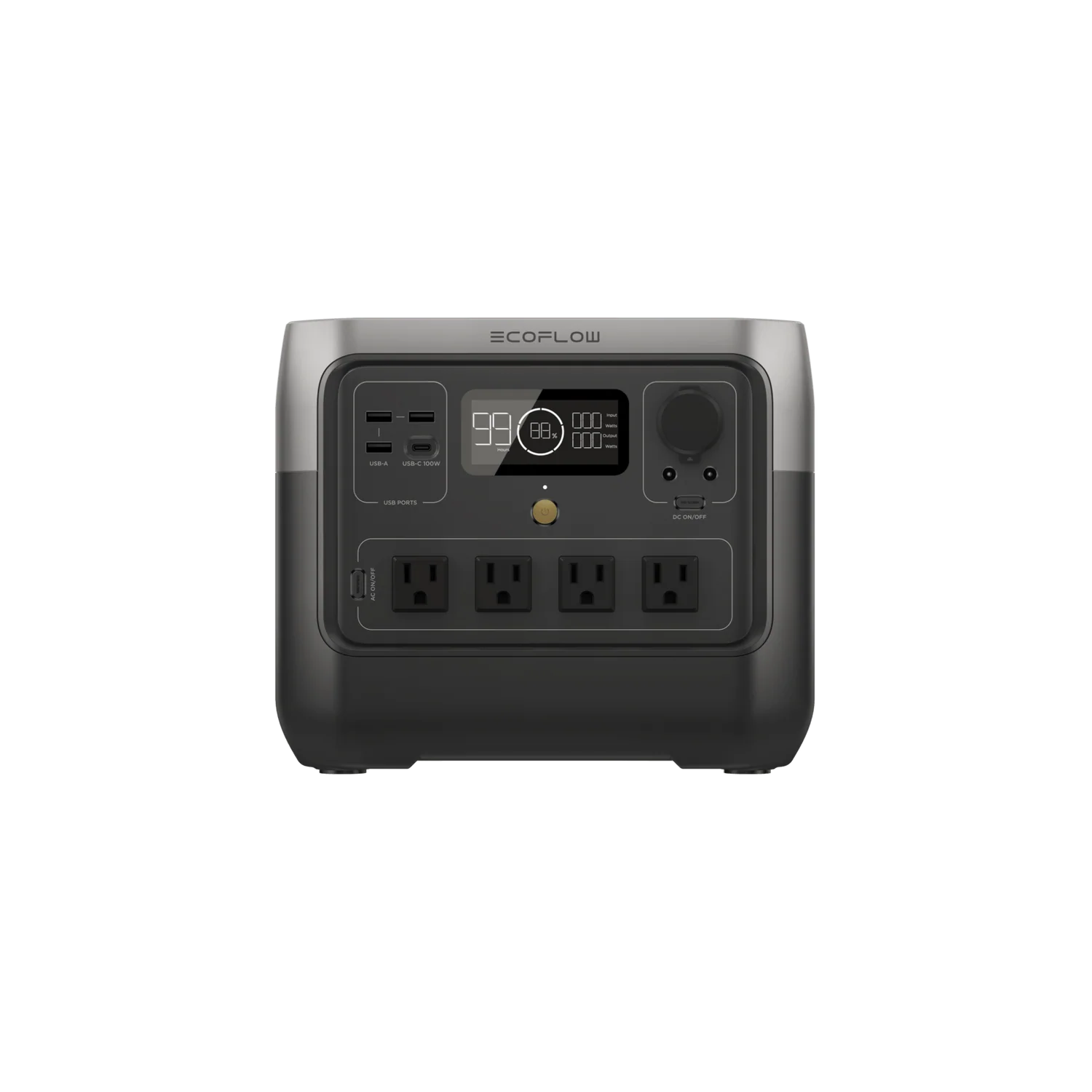
$389.00 · direct from EcoFlow
Last checked 1 day ago. Prices move — check before you buy.
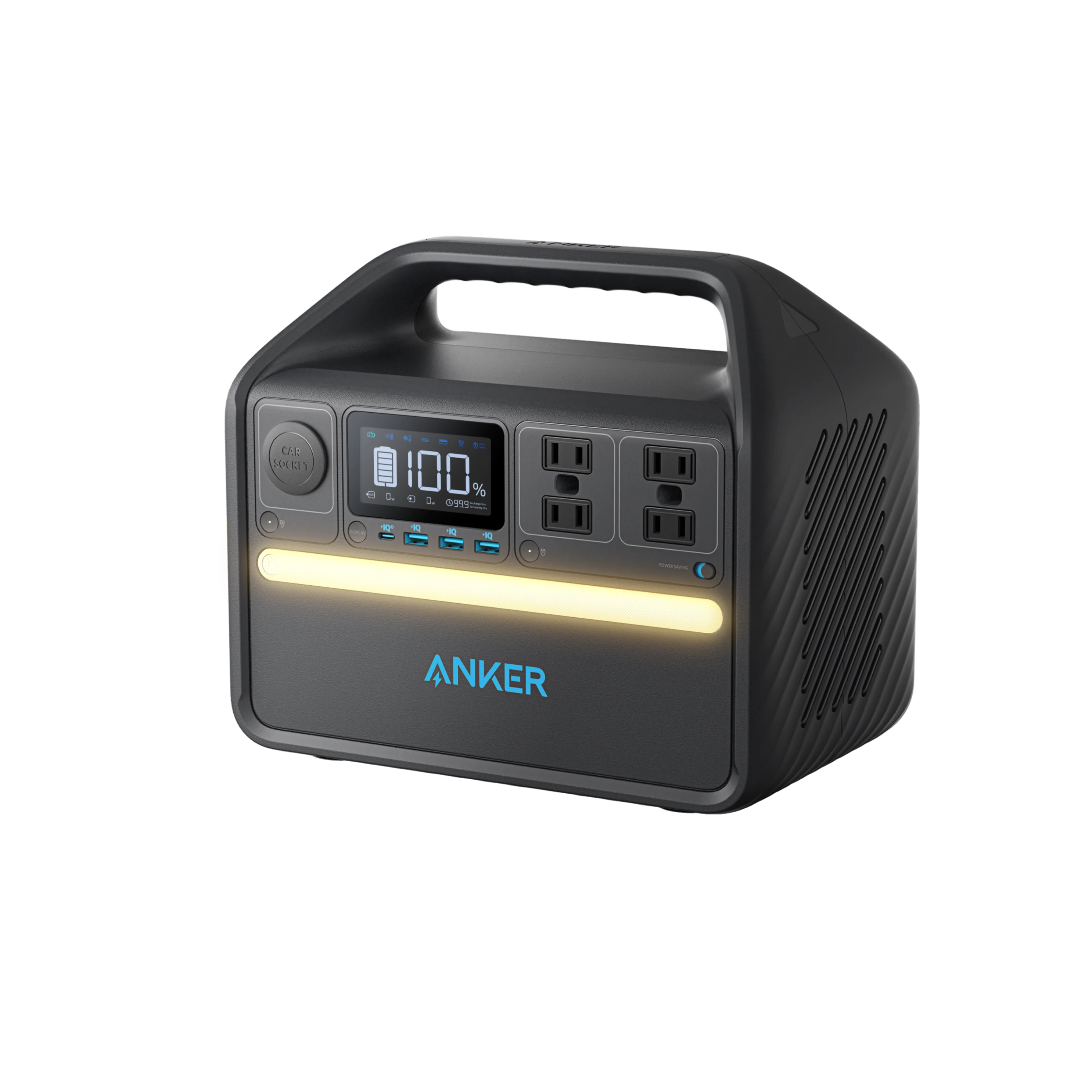
$299.99 · direct from Anker
Last checked 1 day ago. Prices move — check before you buy.
Spec deltas
Take the RIVER 2 Pro. The Anker saves you $49 at the register, $300 against $349, and gives up 256Wh to do it. Split the money by the energy and those extra watt-hours run 19 cents apiece ($49 over 256Wh), while the 535's own 512Wh work out to 59 cents each at its $300 price. You're being asked to pay more per unit of battery for the privilege of buying less battery.
The 535 is not a bad box. A reviewer measured it holding 89% round-trip efficiency and staying cool while delivering its full 500WB3, both units are rated for 3,000 cycles, and both carry five years of warranty. It's also half a pound lighter, 16.7 lb against 17.2 lb, which is a difference you need a scale to detect.
The RIVER's real flaw is noise. EcoFlow's own documentation allows up to 62dB when the unit is charging or discharging at high wattageA2, and one owner went as far as cutting away internal plastic to fit a quieter fanA1. Anker publishes no noise figure for the 535 at all, which is not the same thing as being quiet. That's the honest catch, and it's a recharge-hour problem rather than a 3 a.m. one.
What the Numbers Reveal
Each conclusion stated first — the numbers behind it on one line, the full analysis below.
weight
Extra capacity normally arrives as extra weight, and at this size it doesn't. Half a pound separates these two, so the usual reason to accept a smaller battery has been removed from the table. You aren't trading portability for watt-hours. You're just declining watt-hours.
RIVER 2 Pro is $349; 535 PowerHouse is $300768Wh against 512Wh, a 256Wh difference17.2 lb against 16.7 lb, half a pound apart
Why it mattersIf you were leaning Anker to save $49, you're paying a premium per watt-hour and getting nothing back in your arms for it.
Two nights costs 640Wh, and only one of them clears it. The RIVER's 653Wh covers a second night with 13Wh left over. The 535's 435Wh doesn't reach it. Outages that run into a second evening are the ordinary kind, and the second night is exactly where 256Wh stops being a spec and starts being a machine that either runs or doesn't.
A CPAP draws about 40W, so an eight-hour night costs 320WhUsable energy after inverter losses is 653Wh (RIVER 2 Pro) and 435Wh (535 PowerHouse)Neither unit expands, so what you buy is the ceiling
Why it mattersAnyone buying this for a medical load should treat the second night as the deciding number, and should still plan a recharge, because 13Wh is not a margin.
solar input
Day one you're 256Wh apart. Day two you're 256Wh apart plus whatever the extra 100W of panel ceiling put back while you were out (220W against 120W). The unit with less energy to give is also the one that needs the longest good-sun window to get it back, which is the wrong pairing for anyone whose only charger is the sky.
Solar input ceilings are 220W (RIVER 2 Pro) and 120W (535 PowerHouse)A full solar refill on the 535 is computed at 6.1 hoursReal-world solar input on the 535 lands at 60 to 75W against its 120W ratingB4
Why it mattersSolar-first buyers should stop reading this as a fixed 50% capacity gap. It compounds every day you stay out.
That 62dB is specified at high wattage, and a CPAP at 40W is nothing like high wattage, so the figure describes the RIVER's recharge hour rather than your night. The fan is a genuine irritation, real enough that one owner cut into the case to fit a quieter oneA1. But choosing the 535 over it means trading a known annoyance for an unmeasured one.
EcoFlow publishes up to 62dB at high-wattage charge and dischargeA2The 535 PowerHouse publishes no noise figure at allA reviewer found the 535 stayed stable and cool while delivering its full 500WB3
Why it mattersDon't pick the Anker because it looks quieter on the spec table. Do run the RIVER's fast charges during the day if it's sleeping in your bedroom.
The specific dimensions that decide these two units — everything else is a tie.
Runtime: Will It Power Your Gear?
Selected because: 653Wh of usable energy against 435Wh after inverter losses is the whole reason the $49 gap exists.
continuous output
Rated capacity is the number on the box. Usable energy is what you get. Both units give up roughly 15% to the inverter, which leaves 653Wh and 435Wh, and every runtime estimate you see quoted anywhere should be read against those figures rather than against 768 and 512.
That 218Wh of difference (653 minus 435) sounds small in the abstract and turns decisive in specific places. It's the difference between landing within 3% of a 670Wh tailgate evening and reaching about 65% of one. It's the difference between covering two 320Wh CPAP nights and covering one.
Lifetime Value
Selected because: Both units are rated for 3,000 cycles, so lifetime cost falls out of capacity alone: 15 cents per kilowatt-hour against 20.
cost / lifetime kWh
Both are rated for 3,000 cycles, so lifetime energy is just capacity multiplied out: 2,304kWh from the RIVER, 1,536kWh from the 535. Divide each by its price and the RIVER works out to 15 cents per lifetime kilowatt-hour against the Anker's 20.
The sticker and the ownership cost point in opposite directions, which is the trap at this size. A smaller battery at a lower price is a bargain only if the missing watt-hours are ones you'd never have touched. Add up your load list before you assume they are.
What the Specs Don't Tell You
Selected because: Six flags fire on this pair, and two of them are about noise, on opposite sides of the table for opposite reasons.
Two of the six flags here are about noise, and they land on opposite units for opposite reasons. EcoFlow published a 62dB ceiling and got flagged for the numberA2. Anker published nothing and got flagged for the silence. Read those two cards together, or you'll walk away thinking the 535 is the quiet one.
One caution on the spec table while you're here: Anker doesn't publish a surge rating for the 535, and a blank in that row is missing data, not a unit that can't surge. It has an AC inverter, and a reviewer ran it at its full 500W without dramaB3. Judge the output gap on the continuous figures instead, 800W against 500W, because those are the ones both companies actually stated.
The flag worth acting on is the UPS row. The RIVER 2 Pro switches over in 30ms, quick enough to carry a desktop or a router through a flicker. The 535 has no switchover spec and isn't sold to do that job. If there's a machine in your house that shouldn't reboot, that one row settles this comparison before capacity gets a vote.
Your Life, Your Pick
Selected because: Five of the six standard scenarios come back 'neither,' which is the most useful thing this page can tell you before you spend anything.
Five of the six standard scenarios come back 'neither,' and the sixth is the CPAP night. That's the honest shape of this class: 653Wh and 435Wh are phones, a laptop, lights, a router and a medical device. They are not a house.
So the real difference between these two lives inside a narrow band, loads between 435Wh and 653Wh. Below it, both work and you should buy the cheaper one. Above it, neither works and you should be shopping a different size entirely. The $49 only earns its keep inside that band.
Portability & Form Factor
Selected because: Half a pound separates them, 17.2 lb against 16.7 lb, so weight can't be the reason to take the smaller battery.
weight
Half a pound is the entire portability case for the Anker, 16.7 lb against 17.2 lb. Both are a one-handed carry, both go into a trunk without ceremony, and neither is going to make you think about your back on the way to the campsite.
Which means weight can't break this tie, and energy has to. Energy isn't close. If the lighter number was your permission slip to buy the smaller battery, take it back.
Strengths & trade-offs
EcoFlow RIVER 2 Pro
Strengths
- +Larger battery capacity
- +Higher AC output
- +Faster solar charging
Trade-offs
- –Can receive complaints about fan noise under heavy load.
Anker 535 PowerHouse
Strengths
- +Costs $49 less
- +Lighter by 0.5 lb
Trade-offs
- –Lacks smartphone app control for remote monitoring.
Will It Power Your Gear?
Scenario math and per-appliance runtimes, modeled from the spec record.
Scenario verdicts
We ran the math on six real-world scenarios. Here's which unit survives your actual life.
SCN-01 · 2 nights · needs 2,100Wh
Weekend Camping
Two nights off-grid with essential comfort
Neither unit
Neither unit covers this scenario's 2,100Wh: the RIVER 2 Pro comes up 1,447Wh short (about 31% covered), the 535 PowerHouse 1,665Wh (21%). This is well outside what either unit is for; the right answer here is a larger station, not a choice between these two.
Battery budget usedlower = more headroom
LOAD Phone Charger 15W×6h · LED Lights 40W×8h · Box Fan 75W×14h · CPAP Machine 40W×16h
SCN-02 · 8 hours · needs 1,645Wh
8-Hour Blackout
Keep the essentials running through a night without power
Neither unit
Neither of these is a blackout unit. The list here runs 1,645Wh, and the RIVER covers about 40% of it while the 535 covers about 26%. That's real value for the parts that keep you connected and comfortable, and no value at all for the parts most people picture when they imagine an outage. If this scenario is why you're shopping, size up rather than choosing between these two.
Battery budget usedlower = more headroom
LOAD Fridge 150W×8h · Router + Modem 20W×8h · LED Lights (4 bulbs) 40W×6h · Phone Charger 15W×3h
SCN-03 · 8 hours · needs 320Wh
CPAP Overnight
Sleep therapy without interruption — the #1 medical use case
Either unit
Both cover the night without strain. At about 40W for eight hours the machine takes 320Wh, which is 49% of the RIVER's usable energy and 74% of the Anker's once inverter losses are taken off, so for one night capacity decides nothing. The morning is where they differ: one wakes up around half full, the other around a quarter. Push it to a second night and only the RIVER's 653Wh of usable energy covers the 640Wh it takes.
Battery budget usedlower = more headroom
LOAD CPAP Machine 40W×8h
SCN-04 · 8 hours · needs 910Wh
Remote Workday
Full work day off-grid without power anxiety
Neither unit
Neither unit covers this scenario's 910Wh: the RIVER 2 Pro comes up 257Wh short (about 72% covered), the 535 PowerHouse 475Wh (48%). Treat this as partial cover — enough for the essentials in it, not the whole list.
Battery budget usedlower = more headroom
LOAD Laptop 60W×8h · External Monitor 30W×8h · Router + Modem 20W×8h · Phone Charger 15W×2h
SCN-05 · 4 hours · needs 670Wh
Tailgate Party
Game day power for the crew
Neither unit
Neither one quite finishes a tailgate. The list runs 670Wh and the RIVER's 653Wh of usable energy lands within 3% of it, which in practice means the last warming tray comes off the plan and your evening is fine. The 535's 435Wh reaches about 65% of the list, which isn't trimming. That's planning around it.
Battery budget usedlower = more headroom
LOAD Blender 400W×0.5h · LED TV (55") 80W×4h · Bluetooth Speaker 15W×4h · Phone Charger (×3) 45W×2h
SCN-06 · 24 hours · needs 4,685Wh
Van Life Daily
A full day of mobile living — the ultimate endurance test
Neither unit
Neither unit covers this scenario's 4,685Wh: the RIVER 2 Pro comes up 4,032Wh short (about 14% covered), the 535 PowerHouse 4,250Wh (9%). This is well outside what either unit is for; the right answer here is a larger station, not a choice between these two.
Battery budget usedlower = more headroom
LOAD Mini-Fridge 150W×24h · Laptop 60W×4h · Phone Charger 15W×3h · LED Lights 40W×5h · Fan 75W×8h
The Load Test
RUNTIME = (Wh × 0.85) ÷ LOAD
None of the scenarios above exactly yours? Build it. Toggle what you'd plug in; both units are tested against the combined draw.
Essentials
Comfort & Convenience
High-Draw Appliances
Test duration
8h
Continuous draw
205W
Projected runtime
For this load: RIVER 2 Pro runs 3.2h vs 2.1h.
$349 list · direct from EcoFlow
Modeled from the spec record — same math as the tables below. Methodology
Runtime by appliance
Real-world runtime estimates for common appliances, modeled at 85% inverter efficiency.¹
Essentials
The basics you need runningscale 0–43.5hComfort & Convenience
Makes off-grid life actually enjoyablescale 0–8.7hHigh-Draw Appliances
These reveal the real limits¹ Runtime = (capacity × 0.85) ÷ appliance watts. Within each group, all bars share one time scale (the group's longest runtime), so lengths are comparable across appliances; identical runtimes collapse into a single blue/orange bar. Actual runtime varies with battery age, temperature, and simultaneous loads — see methodology.
Conclusion
August 9, 2026
Verdict: the RIVER 2 Pro, on Power Score margin
Buy the RIVER 2 Pro unless your entire load list fits under 435Wh and the $49 genuinely matters to you. It gives you 653Wh of usable energy after inverter losses against the 535's 435Wh, 300W more continuous output at 800W against 500W, nearly double the solar ceiling at 220W against 120W, 100W of USB-C against 60W, and a 30ms switchover the Anker has no equivalent for. It does all of that at a lower cost per watt-hour and a lower cost per lifetime kilowatt-hour, 15 cents against 20. Warranty and cycle ratings are identical on both, five years and 3,000 cycles, so longevity settles nothing. The 535 wins one column on paper, weight, by half a pound, and one column at checkout.
Editor-assigned confidence, based on cited owner research and spec analysis.
List prices as of August 9, 2026. The links below open EcoFlow's and Anker's current prices.
$389.00 · direct from EcoFlow
Last checked 1 day ago. Prices move — check before you buy.
or check the 535 PowerHouse price$299.99 list
Written by Wenny Zheng, Portable Power Tester · Station Arena Test Desk · Updated August 9, 2026
Measured Data
Benchmark scores and the full spec record, side by side.
Benchmark scores
Not rated for both units (minimum threshold unmet): CPAP, Solar Generator.
Full specifications
ᵈ Derived: price ÷ rated capacity. See the data behind our comparisons →
Comparison ToolAdd more power stations, side by sideOpen Tool →How these numbers are produced
Numeric verification
Every figure on this page traces to our spec database or arithmetic on it — no estimated numbers.
Owner claims
Statements about owner experience are cited to published reviews — see Sources & Research Notes below.
Runtime model
Runtime = (rated capacity × 0.85 inverter efficiency) ÷ device wattage. Solar recharge estimates assume panels deliver 70% of rated output. Cold weather, battery age, and stacked loads reduce real-world results.
Power Score
Computed from 14 published spec dimensions, weighted per use-case bench. Higher is better; a unit must meet a bench's minimum threshold to be rated.
See the full weight table and data sourcing on our methodology page →Class ranking (the star rating)
Each unit's star score is a category ranking, not customer reviews — no buyer opinions feed it. We score every station on size-independent quality (value, output, portability, endurance, ports, warranty, and more), then percentile-rank it against the other units in its capacity class, so a class-leading compact unit and a class-leading whole-home unit can both earn 5★. Here, RIVER 2 Pro rates 4.7/5 (84th percentile of 20 Compact-class units), and 535 PowerHouse rates 3.7/5 (21st percentile of 20 Compact-class units).
How the class ranking is computed →Test Notes & Caveats
Hidden gotchas and advantages we spotted that you won't find on the product page.
The Fan Is the Real Trade-off
62dB is EcoFlow's own ceiling, and it applies when the unit is charging or discharging hard, not when it's trickling 40W into a CPAP. That makes it a recharge-hour annoyance rather than an all-night one. It's still the one place this comparison goes against the winner, so if the unit lives in a bedroom, do the fast charges during the day.
The Small Battery Is Also the Slow One to Refill
A full solar refill on the 535 runs about 6.1 hours against its 120W input ceiling. The RIVER 2 Pro accepts 220W. On a single overnight that difference is a footnote. On day three of a trip where the sun is your only charger, it's the reason the smaller battery keeps getting smaller.
No App Here, and Anker's App Score Isn't This Unit's Score
The 535 PowerHouse doesn't do app control. Anker's SOLIX app rates well, but this unit doesn't connect to it, so read any app rating in the brand column as a fact about Anker's newer stations rather than about the box you'd be buying. Whether the gap matters comes down to whether you'd ever have opened the app, and plenty of people wouldn't.
Only the RIVER 2 Pro Lists a UPS Mode
The RIVER 2 Pro can sit between the wall and your gear and hand it to battery when the grid drops — rated ≤30ms — a transfer this long is one many desktops will NOT ride through, so plan on reboots for sensitive gear. Worth it for a router, a desktop PC, or a CPAP. The 535 PowerHouse's spec sheet lists no UPS mode, so anything plugged into it rides an outage only as far as your reaction time.
Identical Terms, Different Divisor
These warranties match exactly: five years on both, over cells rated for 3,000 cycles on both. Nothing here separates them. The only figure that moves is the price spread across the term, $70 a year for the RIVER 2 Pro against $60 for the 535, which is the sticker gap wearing a different hat.
No Noise Figure Means No Noise Promise
Anker doesn't publish a decibel rating for the 535, so there's nothing to hold it to and nothing to compare. An empty cell can read like a win next to a competitor's honest 62dB, and it isn't one. If quiet is the thing you're buying for, the unit that told you its number is the one you can plan around.
Full record above — the Test Desk pick is the RIVER 2 Pro.
Check RIVER 2 Pro price →or check the 535 PowerHouse priceOwnership Analysis
What happens after you buy — true cost of ownership, brand trust, and growth potential.
Lifetime value
Service lifeyears at one full cycle per day
Lifetime energy delivered
Cost per delivered kWh
│ warranty ends · Reaching the cycle rating means ~80% capacity remains — degraded, not dead.
Analyst note
The 535 PowerHouse is cheaper to buy, but the RIVER 2 Pro is cheaper to own. At $0.15/kWh over its lifetime vs $0.2/kWh, the RIVER 2 Pro's higher cycle life and capacity make each dollar go further over the years. One thing to know reading the table: both carry the same 3,000-cycle rating, so the lifetime rows are sticker price and capacity in disguise — the wear horizon is identical and decides nothing here.
Brand trust
EcoFlow
Ecosystem
Largest in portable power — 12-15 models across DELTA Pro, DELTA 3, and RIVER 3 series, plus solar panels and smart home panels
Support
US phone, email and chat, and the outcomes are polarized: some claims close with a prepaid label and no argument, others drag and come back as a refurbished unit against a new claim. Buying through Costco or Amazon gives you a second return path that doesn't depend on which experience you draw.
Community
Largest community in the space — Reddit r/Ecoflow_community (~31K members), multiple Facebook groups, and an official community forum
App experience
Rated 4.6/5 iOS (~8,400 ratings) · 4.2/5 Android (~17,000 ratings)
Unique strength
The deepest catalog in portable power and the fastest charging technology in it. On a 768Wh unit what you actually cash in is the charge speed and the app support, not the size of the ecosystem behind them.
Worth knowing
EcoFlow recalled the DELTA Max 2000 in October 2025 over an overheating risk, and tested a subscription paywall on advanced app features in early 2025 before backing off. Both are worth knowing about the company. Neither is about this unit, which is a different product line and a fraction of the size.
Anker
Ecosystem
7-8 SOLIX portable power stations across C-series (compact) and F-series (flagship), plus the X1 home energy system
Support
Anker's consumer-electronics reputation for no-questions replacements is real, and SOLIX support is drifting away from it: AI-driven first-line responses, and awkward return logistics once a unit is heavy enough to need hazmat shipping. At 16.7 lb, the shipping half of that problem mostly disappears.
Community
Moderate — active Reddit (r/Anker, r/AnkerSOLIXCommunity) and growing. Benefits from Anker's massive consumer electronics brand awareness.
App experience
Rated 4.5/5 iOS (~1,100 ratings) · 4.3/5 Android
Unique strength
Parent-brand trust and long-cycle cells. Anker's strongest value per watt-hour shows up in its larger stations, not here, where the 535 asks more per watt-hour than the EcoFlow sitting across from it.
Worth knowing
Any app rating in this column belongs to Anker's SOLIX app, and the 535 PowerHouse doesn't connect to it. Treat that score as brand context rather than a feature of this unit. Firmware updates on other SOLIX models have also removed features without notice.
Analyst note
Neither brand column should decide this one. EcoFlow is the bigger ecosystem with the noisier public record; Anker is the calmer name with support quality trending the wrong way. At this size you're buying a single sealed box from either company, not an ecosystem, and the spec table separates these two far more cleanly than the companies behind them do.
Growth path
RIVER 2 Pro
FIXED CAPACITYFixed at 768Wh, with no expansion — so size it for your needs up front rather than planning to add capacity later.
Accepts up to 220W of solar. Limited to a single portable panel.
Adequate ports for most setups, but heavy users may want a power strip.
535 PowerHouse
FIXED CAPACITYFixed at 512Wh, with no expansion — so size it for your needs up front rather than planning to add capacity later.
Accepts up to 120W of solar. Limited to a single portable panel.
Adequate ports for most setups, but heavy users may want a power strip.
Realistic full solar rechargeat 70% of rated panel output — see methodology
Analyst note
Neither expands, and that's no knock on either — each is a complete unit at a fixed size. Buy the capacity that covers your needs now (the RIVER 2 Pro gives you the larger ceiling); you can't add to either later.
What Owners Report
Patterns from published owner reports and long-term reviews — every claim cited to its source below.
EcoFlow RIVER 2 Pro
Field data on the RIVER 2 Pro specifically is thin. Online discussion tends to blur the RIVER 2, RIVER 2 Max and RIVER 2 Pro together, and only four entries could be tied confidently to this exact modelA1A2A3A4. Read what follows as directional rather than settled.
The fan is the one thing that comes through clearly. EcoFlow's own documentation allows up to 62dB when the unit is charging or discharging at high wattageA2, and one owner performed a fan swap on their RIVER 2 Pro that required cutting away internal plastic to make the replacement fitA1. That's a person who cared enough to open the case. Separately, one owner asked whether living plugged in as a UPS shortens battery lifeA3, which is a fair question EcoFlow hasn't answered publicly; the 3,000-cycle rating gives you a generous wear budget, but standby duty isn't the same thing as cycling. In the one CPAP thread tied to this unit, the owner runs an AirSense over a DC-DC cable rather than through the inverterA4, which is the right instinct on any battery this size, since skipping the inverter skips the 15% you'd otherwise lose to it.
“Will using River 2 Pro as a UPS affect battery life ...”
Sources
ctrl-alt-rees.com
Anker 535 PowerHouse
The 535 PowerHouse reads well in review testing and thin in long-term ownership. Measured round-trip efficiency came in at 89%, with the unit staying stable and cool while delivering its full 500WB3, and the package is consistently described as compact for 512Wh, with four AC outlets, three USB-A, a USB-C and a car socketB2.
Solar is the caveat everyone lands on. The 120W input ceiling reportedly delivers 60 to 75W in practice, which makes panel charging slowB4; AC is the fast path here, roughly 2.5 hours to 80%B4. The cells are LiFePO4 rated past 3,000 cycles with a five-year warranty behind themB1, so nothing about this unit is fragile. It's just small, and slow to refill from the sun.
“512Wh capacity with 500W output on LiFePO4 cells rated for 3,000+ cycles and a 10-year lifespan, backed by a 5-year warranty.”
Sources
ankersolix.com · trustedreviews.com · macrumors.com · batteryessence.com
Sources & Research Notes
Every owner claim in this report is traceable to a published source. The bracketed references above resolve here.
Recurring owner themes
- Fan noise at high wattage charging/discharging is a consistent owner and manufacturer-acknowledged complaint, severe enough that some owners physically mod the unit with quieter fans. [RIVER 2 Pro · 2 entries]
- Durable LFP (3,000+ cycles, 5-yr warranty), efficient, and compact for weekend camping; slow solar input is the caveat. [535 PowerHouse · 2 entries]
- A1
“I've since performed the same mod on my RIVER 2 PRO and it works great for that unit, too - although it did involve cutting away some of the internal plastic.”
ctrl-alt-rees.com blog — 'EcoFlow RIVER 2 Noisy Fan Fix!' · 2022-11-17 · [negative]
- A2
“When charging and discharging at high wattage, RIVER 2 Max and RIVER 2 Pro may make a noise up to 62db.”
EcoFlow official product page — RIVER 2 Series specs/FAQ footnotes · unknown · [negative]
- A3
“Will using River 2 Pro as a UPS affect battery life ...”
Facebook — EcoFlow Club group post title · unknown · [mixed]
- A4
“I'm very new to CPAP (1 week) and I live in a van. I have solar and a decent battery bank and I've got the ResMed DC-DC cable which powers my AirSense 11 AutoSet overnight no problem.”
Apnea Board forum — '[Equipment] EcoFlow River 2 Pro' thread · 2025-07 · [mixed]
- B1
“512Wh capacity with 500W output on LiFePO4 cells rated for 3,000+ cycles and a 10-year lifespan, backed by a 5-year warranty.”
ankersolix.com / trustedreviews.com — 535 PowerHouse review · 2026 · [positive]
- B2
“Weighs 16.5 lbs and is compact for a 512Wh unit, with 4 AC ports, 3 USB-A, a USB-C, and a car outlet.”
macrumors.com / batteryessence.com — 535 PowerHouse review · 2026 · [positive]
- B3
“Demonstrated 89% round-trip efficiency and stayed stable and cool while delivering its full 500W AC output.”
batteryessence.com — 535 PowerHouse review · 2026 · [positive]
- B4
“AC charging to 80% takes about 2.5 hours; solar input caps at 120W (realistically 60-75W), so panel charging is slow.”
batteryessence.com — 535 PowerHouse review · 2026 · [mixed]
Research compiled August 9, 2026.
Who Should Buy Which
Buy the RIVER 2 Pro if you…
- →You want the box that gets furthest into a real day's list. Two CPAP nights fit inside its 653Wh of usable energy. A 910Wh remote workday fits inside neither unit, but the RIVER covers about 72% of it against the 535's 48%.
- →You charge from panels. A 220W input ceiling against 120W is the spec that stops the battery ratcheting down over a multi-day trip.
- →You have a desktop, a router or a pump that shouldn't reboot. A 30ms switchover exists on one side of this comparison only.
- →You want the AC headroom and the fast USB-C. 800W continuous runs things 500W won't, 100W of USB-C charges a laptop at full speed where the 535 stops at 60W, and the RIVER publishes a 1,600W surge figure while Anker publishes no surge number for the 535 at all.
Buy the 535 PowerHouse if you…
- →Your list is phones, a laptop, lights and a router, it adds up to well under 435Wh, and you'd genuinely rather have the $49.
- →You charge from the wall and never from the sun, which turns the 535's weakest spec into something you'll never meet.
- →You want a box with no app, no account and no firmware relationship. The 535 doesn't do app control, and for a certain buyer that's the feature.
If neither fits
Anyone shopping for a blackout or for van life. A single eight-hour outage on our load list is 1,645Wh and a day of van living is 4,685Wh, against 653Wh and 435Wh of usable energy on this page. These are day-trip and bedside units. If you're buying because the grid goes down where you live, shop the class that starts where these two run out, and don't let a $49 decision distract you from a sizing error that costs many times that.
The Bottom Line
Take the RIVER 2 Pro. Every axis that costs money runs the same direction here: more usable energy, more continuous output, more solar input, faster USB-C, a switchover the other one doesn't have, a lower cost per watt-hour and a lower cost per lifetime kilowatt-hour. The 535 answers with $49 and half a pound, and the half a pound isn't real.
The fan is the honest catch and it's a real one. EcoFlow's own documentation concedes the unit gets loud under hard charge and dischargeA2, and one owner cut into the case to fit a quieter oneA1. It's still a recharge-hour problem rather than a bedtime one, and the 535 never published the number that would let it claim the win. Buy the RIVER, run your fast charges while you're awake, and stop relitigating the $49.
Frequently Asked Questions
Answers drawn from the spec record and cited owner research.
Is the EcoFlow RIVER 2 Pro worth $49 more than the Anker 535 PowerHouse?
Yes, on the arithmetic. That $49 buys 256Wh (768 against 512), which comes to 19 cents per watt-hour, while the 535's own capacity costs 59 cents per watt-hour at its $300 price. You also get 800W of output instead of 500W, a 220W solar ceiling instead of 120W, and a 30ms switchover the Anker doesn't offer, for half a pound more to carry.
Can the Anker 535 or the RIVER 2 Pro run a CPAP all night?
Both can, comfortably. A CPAP at about 40W over eight hours needs 320Wh, which is 49% of the RIVER's 653Wh of usable energy and 74% of the 535's 435Wh. The split shows up on night two: 640Wh for two nights fits inside the RIVER's usable energy with 13Wh to spare, and doesn't fit inside the Anker's at all.
Will either one get me through an 8-hour blackout?
Not a full one. An eight-hour outage covering a normal essentials list runs 1,645Wh; the RIVER 2 Pro covers about 40% of that and the 535 about 26%. Either will keep phones, a router, lights and a medical device going for a long stretch. Neither carries the whole list, and if that's your reason for buying, you want a substantially larger unit.
Which one is better for solar charging?
The RIVER 2 Pro, by a wide margin. It accepts 220W of solar input against the 535's 120W, and a full solar refill on the Anker is computed at about 6.1 hours, with real-world input reported closer to 60 to 75W than to its 120W rating. If panels are your main charging source, this alone settles it.
Is the EcoFlow RIVER 2 Pro loud?
It can be. EcoFlow's own documentation allows up to 62dB when the unit is charging or discharging at high wattage, and at least one owner replaced the fan to quiet it down. The qualifier matters: a 40W CPAP or a laptop won't provoke it, but a fast recharge will. Anker publishes no noise figure for the 535 at all, so there's no basis for calling that one the quieter unit.
Where to buy
EcoFlow RIVER 2 ProPick
$389.00
$389.00 · direct from EcoFlow
Last checked 1 day ago. Prices move — check before you buy.
Anker 535 PowerHouse
$299.99
$299.99 · direct from Anker
Last checked 1 day ago. Prices move — check before you buy.
Prices may vary by retailer and are subject to change.